The hard Left believes its mission is so critical, so morally superior, that all means can be justified to achieve its noble ends. And so almost every institution that the Left has in its line of vision is now petrifying.
Tuesday, September 29, 2020 to Friday, October 9, 2020
Hoover Institution
The Hoover Institution is co-hosting The Rise of Digital Authoritarianism: China, AI, & Human Rights on September 29, October 1, October 6, and October 9, 2020 from 9:00 a.m. - 11:00 a.m. PDT.
Unseasonably warm weather has returned to the San Francisco Bay Area, bringing with it the threat of more wildfires, and the adjacent counties continue to be all over the map (pun intended) when it comes to returning to a pre-pandemic social order.
We just finished the second week of Economics 1, Stanford’s introductory economics course, and the namesake of this blog and my twitter account. So far it has been fun, and for the same reasons that I mentioned years ago when I started teaching the course: (1) “I love to teach.” (2) “I love to do economic research” and teaching is “a natural extension of research.” (3) “I love economic policy—the application of economics to government as well as to decision-making in business.”
The first general election debate on September 29 represents a significant opportunity for President Donald Trump to change the dynamic of a race where he trails in national polling, as well as in recent polls from some of the battleground states he would need to win to be reelected.
Where do our deepest personal values come from? Can we choose those values? Philosopher and author Agnes Callard of the University of Chicago talks about her book, Aspiration, with EconTalk host Russ Roberts. Callard explores the challenge of aspiration--who we are versus who we would like to become. How does aspiration work? How can we transform ourselves when we cannot know how it will feel to be transformed? Callard discusses these questions and more in this provocative episode.
An associate professor of medicine at Stanford University, Dr. Eran Bendavid, joins Paul E. Peterson to discuss the risks and benefits of restrictive Covid-19 shutdown policies in different countries, and the related effects on the spread of the disease.
If information is power, then the corruption of information is the erosion, if not the outright usurpation, of power. This is especially true in the information age, where developments in the technological structure and global interconnectedness of information and telecommunications infrastructure have enabled states to engage in malicious influence campaigns at an unprecedented scope, scale, depth, and speed.
Over at The Money Illusion, fellow EconLog blogger Scott Sumner lays out 21 characteristics of a banana republic. He points out that it’s not a complete list. I agree.
Universities have been at the forefront of diversity for the past 40 years. Yet, after the unfortunate death of George Floyd, they have rushed to declare that their campuses are replete with systemic, institutional racism.
interview with H. R. McMastervia The Untold Story with Martha MacCallum
Thursday, September 24, 2020
Hoover Institution fellow H.R. McMaster talks about where he believes the United States' biggest threats are around the world, the important shifts in foreign policy made under President Trump, and his opinion on Robert O'Brien's performance as the current National Security Advisor.
Hoover Institution fellow Michael McConnell discusses Supreme Court nominee Amy Coney Barrett and notes that judges ought to read the Constitution modestly, with humility, not reading their own preferences into it.
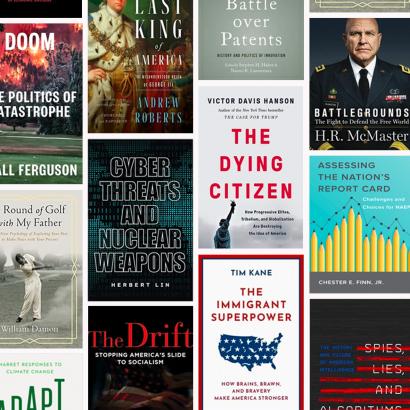
Hoover Institution fellow John Yoo discusses the coming SCOTUS confirmation hearings, and Hoover Institution fellow H.R. McMaster talks about his new book, Battlegrounds: The Fight to Defend the Free World.
President Donald Trump is expected to name Amy Coney Barrett, a former law professor at Notre Dame, as his nominee for the Supreme Court Saturday to replace Justice Ruth Bader Ginsberg.
A former US ambassador to Russia has warned that the lack of communication between Washington and Beijing could lead to misunderstanding and increase the risk of military conflict.
Donald Trump’s suggestion that he might not cede power if he loses the presidential election to Joe Biden is “a gift to our adversaries”, the former national security adviser HR McMaster said on Sunday, though he added that “even talking about” the US military removing the president if necessary was “irresponsible”.
Protecting people with preexisting medical conditions is an issue that has followed President Donald Trump his entire first term. Now, Trump has signed an executive order that he says locks in coverage regardless of anyone’s health history.
Joe Biden's tax plan would result in millions fewer employed and a drastic reduction in economic output, according to a new report by President Trump's former chief economist.
Former U.S. national security advisor H.R. McMaster joins Washington Post national security reporter Ellen Nakashima on Tuesday, Sept. 29 at 11:00 a.m. ET to discuss his forthcoming book, “Battlegrounds: The Fight to Defend the Free World,” how the global pandemic affects the most pressing foreign policy challenges and America’s standing in the world today.