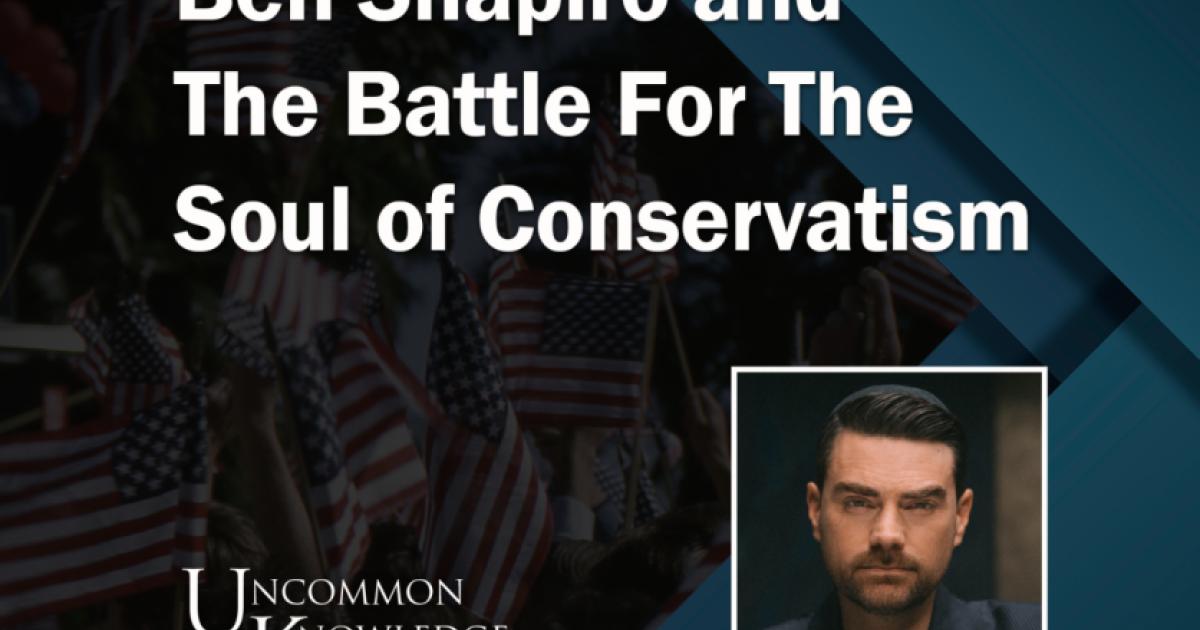
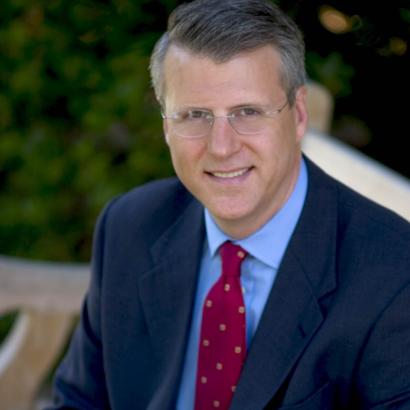
- What does it mean to be a conservative today? Ben Shapiro on Uncommon Knowledge. Now, welcome to Uncommon Knowledge. I'm Peter Robinson. Recording today in Palm Beach, a native of Burbank, California. Ben Shapiro graduated from UCLA, then earned his law degree from Harvard. He tried practicing law at a big fern, spending some months at Goodwin Proctor in Los Angeles, then set up his own legal outfit, Benjamin Shapiro, legal Consulting. And then after graduating from Harvard Law School, left the practice of law altogether to launch himself into media. First, Mr. Shapiro spent several years at Breitbart News, and then in 2015, he co-founded The Daily Wire. Now one of the most popular platforms in all of conservative media. Today, Mr. Shapiro continues to host his podcast, the Ben Shapiro Show, five days a week to speak on college campuses, to write books, the most recent of which is Lions and Scavengers, the True Story of America and her critics. And as I have just learned, he has offered a screenplay. In addition to this, he is the father of a growing family. Ben, welcome and thanks for driving over from Boca Raton.
- I appreciate it. Thank you.
- Okay. Hurdle question here. You have a JD from Harvard Law. I mean, that was the Golden Road. You went to a big firm. You could be managing partner if you'd stayed there
- Right now. Now, oh man, so many billable hours that I had to forego. What a life of document review.
- So, so why did you make the change? Why, and, and how and why did you make it so quickly? It's not as if you kind of got jaded over a period of five years. You decided early you.
- Right. So, so to be fair, I, I sort of think of my, my legal career as a, a side road from what I was doing even before then, right? So I was syndicated columnist on politics when I was 17. My first book came out when I was 20. By the time I finished Harvard Law, I already had two published books. So I was already in the political sphere. It was what I loved. It was the thing that I wanted to do. Harvard Law School was you get into Harvard Law School, you go to Harvard Law School. My mom had done business consulting and basically doing legal work without being a lawyer for years, right? And she said, listen, I'm getting paid half what the lawyers are getting paid. So if you, if you really want to be paid, well, then you probably should have a lot of grades. It's a good fallback. It's a, it's a good thing to have. And, you know, I did great on my LSATs and had good grades and, and decent resume. And I was really young. I was 20 when I graduated from UCLA. And so you get into Harvard Law, you go, and so when I finished Harvard Law, I thought I was gonna work in real estate law and really get to know that side of the business. I despised it. I quit within 10 months and I took up a job at Talk Radio Network, which was the syndicator for Michael Savage and Laura Ingram at the time,
- Right?
- For a cut of about two thirds pay. And my, the deal that I made with the company was I will do four hours of law a day for you, and I will for four hours do the actual business of radio. So I'd get up at like four 30 in the morning. I would cut audio on the programs, I would help write monologues, I would scan the news for some of the hosts that, that kind of stuff. So it was great preparation, learned the industry. And then, you know, meanwhile, I had been friends with Andrew Breitbart since the time I was 16, 17 years old. And so I started working with, with Andrew over at Breitbart. There was a, a period where I was working simultaneously with David Ho's Freedom Sensor. Right? We had a website called Truth Revolt.
- Right?
- And then we ended up leaving Truth ret. When I say we, my business partner and I, Jeremy Boring, he was at Truth Revolt also. We ended up leaving and that's when we launched Daily Wire in 2015.
- Got it. So what did your mom say, by the way? What, what, what I, she's, I mean, I feel like your father at this, your mother and I must be in sync here. What, what, what are you doing? You have a Harvard law degree?
- No.
- Or was she totally supportive?
- She, she was totally supportive of that. I mean, my parents always had great faith that I would figure it out. I mean, I've, I've always been a person with a very high RPM. And so the, the engine is constantly going,
- Okay, in the years after you joined Bright Part News in 2012, which is the same year that Andrew died unexpectedly of heart failure, you began speaking on college campuses, which could be fun, but it could also be rough. Here's an example of each, the fun and the rough. The second is from a studio, but it serves as a fair example of the kind of thing you were doing early.
- The, the very language of, of forcing women into motherhood suggests that in a vast, vast, vast majority of cases in which women get pregnant, they had no part in the actual pregnancy making act, which is not true. I've, I've done nothing. I, when, when you get, if you or any of your friends get pregnant, that is generally not having anything to do with, with me, per se. So I'm confused as to why I would want you to force it. Anything der the award at 65? Yes. Why are we mainstreaming delusion? It's not delusion. Why, why would you call it delusion? Because Bruce Caitlyn Jenner, I'll call it him, Caitlyn Jenner, because that's her, it's her. You're not being polite to the pronoun because disrespectful. Okay. Forget about the disrespect. Facts don't care about your feelings. It turns out that every chromosome, every cell in Kaitlyn Jenner's body is male, with the exception of some of his sperm cells.
- You, - It turns out that he, we have a doctor, his nail, wait, I need to, it turns out that he still has all of his male appendages. How he feels on the inside is t to the question of his biological
- Side. I'm not, I don't agree with that. I'm not on that train. Go Chromosomes don't necessarily mean you're male or female. Gender with gender, of course. Gender identity, go ahead now. So especially, but, but even so you have a thing like Klinefelter's syndrome. So you don't know what you're talking about. You're not educated on genetics to discuss the genetics or No, well, no, no. Or your genetics. I I Zoe I'd stay away from the genetics and back to
- The brain scans.
- You cut that out now, or you'll go home in an ambulance.
- Yeah, that seems mildly inappropriate for a political discussion.
- Alright, so why did you do that stuff? Why, what? I mean you saw an opening there. This, this is, this is before Charlie Kirk became, Charlie Kirk became famous for doing something similar, which is going into college campuses or situations like that and taking all comers. You did it first, and as I say, it was rough. Why, why, what did you see there?
- I mean, what was the opening for, for me, the, the question is, where can you get people to watch people say true things? For, for me, the, the guiding star has always been and lo star of what I, what I've always wanted to be about is saying true things. And very often, you know, the best way to expose the truth is in conflict with something that is inherently untrue. And so a lot of these sort of tets and back and forth, the, the sort of bend destroys videos. And a lot of those that have become very popular, though they're videos like that, that's not a destruction. That's me just saying something that is obviously clearly true to anyone with functioning prefrontal cortex. And, and sometimes when you are in a situation with somebody asking you a question, that's a good way of having the conversation and exposing sort of both sides of, of the argument. So I've, I've always enjoyed that part of it. I I, I like that part.
- So in the years since you, in, in the years since then, I want to ask a kind of general question about college campuses in the atmosphere and college campuses today, because I want to, I mean, there's a certain sense in which this whole show is for my kids actually who are, who just graduated from college and what, what does it mean to be a conservative? We've got college campuses in some ways continuing to move to the left since you started, on the other hand, we now have in the Trump administration a kind of a pretty severe pushback. Is that permanent? Is there an ideological adjustment taking place? We also have the forming of civics schools, which are fundamentally pro, they're at least well open to giving founding principle, American founding Principles affairs shake. And we see those, university of Texas we see at the Hamilton Center here at the University of Florida, on and on and on. So how do you size up the change in, and of course we had Charlie Kirk assassinated in public at a college event. When Donald Trump, let's put it this way. When Donald Trump leaves office, what changes in the atmosphere? College campuses will have proven permanent and what will simply snap right back to left?
- I think the vast majority of it will snap right back to the left.
- You do?
- Yes. I, I'd be very, very surprised if the Ivy Leagues continue to sort of maintain their temporary truce with the Trump administration's policies. I think they'll go right back to what they were doing before because the staff and administrators at these places are very much invested in the system that existed prior to, to President Trump. I think what will not go back is the generalized American perception of the veracity of these universities. I think that you're gonna see a lot of people who have been awakened to what these universities actually are over the course of the last 10 or 15 years. And those people are increasingly sending their kids to University of Florida rather than to the Ivy League. So a lot of people in my local Jewish community who have kids who are college age, a lot of them who normally would've said to their kids 20 years ago, yeah, for sure you have a hugely, you know, a huge opportunity to go to Harvard. You're not doing that anymore. Now you're going to, in my community, you should be university or you're going to University of Florida. A lot of people going local, a lot of people gonna southern schools because the southern schools are less apt to be as wildly to the left. And, and I think that the same sort of brain drain that you're seeing from north to south in the country, which is a technological brain drain and, and an actual brain, brain drain, I think you're, you're likely to see that happen with university students as well. People, people moving their education south or maybe offline entirely. Meaning i I think that you're, you're going to see a complete collapse in the system of higher education as a result of access to information. The, the real truth, and I felt this for a very long time about higher education, is that an enormous amount of higher education is just a credentialing system, which is a substitute for an IQ test. That is all that it is. And people will spend a hundred thousand dollars, two, a hundred thousand dollars to prove to an employer that they could sit in a room for a sustained period of time. And also that they did well in their SATs. And so if you went to Harvard, then your employer immediately assumes that you are a higher caliber employee than if you went to state college number one. That's breaking down number two. I don't think that employers have to act that way anymore. I, I think this is something that Peter deal obviously has been pushing for years. But yeah, I think more and more you're gonna see people say, what if I just went straight into the workforce at 18 or 19 years old? What if I decided that I was going to, you know, go to University of Austin? Or what if I went to an online university just to get the degree? Is the group worth anything? I think we're about to watch a massive change in the way that people address higher education. Totally.
- Alright, daily wire back, back to tracking your career in 2015, you founded the Daily Wire. What did you intend to do with the Daily Wire? I mean, it's huge now. What were you thinking then?
- I mean, basically this is a decade ago. Basic what basically what it became, I I will say that if you look back at our original business plan, I would say that there were a couple of things that we did not anticipate. One was the massive growth of my personal kind of podcast and brand. So our original business plan was much more about advertising revenue on an aggregation based news website. 'cause that was how people made money on the internet back in 2015. Right. And the other was
- You had something in mind like the Drudge report in the old
- Yeah, I mean everyone was doing the Drudge Report. Right, right, right. Breitbart was a version of the Breitbart was, I mean the Drudge Report is links. And so Breitbart was serving the Drudge Report. Basically. I think it was fair to say that in those days, to a certain extent, Matt Drudge was the editor of Breitbart because you were hunting for the Drudge Link in order to get traffic to your website that you would then monetize through advertising revenue. The, the, the idea of doing that, we had done some of that with Truth Revolt over at the David Hors Freedom Center. The, the, you know, thing that, that we did not anticipate again, was sort of the growth of personal brand. But I thought that we could add a bunch of brands, put together a really solid conservative outlet that would serve consumers who would then subscribe. So the subscription revenue is the other sort of
- Basis. So this is interesting. You set out to, to build a company, not to build a personal brand.
- Correct.
- You didn't set out to become a star?
- No, I I don't, I don't care about that at all.
- Okay.
- I legitimately do not care about that one iota. It makes no difference to me.
- Okay. So, but you wanted to build a business, you had profits in mind. This will get us into what's happening in the conservative, online conservative world, but profits are difficult things to handle for media companies. In as much as you want to tell the truth. You want to present your point of view. You strike me as someone who would not put up with a moment of audience capture. That is to stay starting to service your audience, starting to tell them what they wanted to hear to keep the audience or to find a profitable niche. So how do you, how do you get, how do you project that? How do you maintain a healthy interest in profits and at the same time real authenticity?
- Right. So I think that you have to have an Overton window. So obviously sometimes you miss the Overton window. I mean, some of the great regrets of of my career involved the hiring of people who began in the Overton window and then ended well outside of it. Obviously Candace Owens would, would be the, the chief
- Your, your creation. We have to,
- I mean, I think that, that, that would be a little unfair to Candace. I mean, I think that, that Candace had worked at
- Fair to her.
- Yes. I mean truly, I mean, Canice a Canice is an incredibly talented person on camera. She had already worked at TPSA, she had already worked at PR University. So she had already she
- Herself women in this world
- Before you. Yeah. She had already, she'd already been growing in profile by the time that we hired her. It wasn't as though we hired her directly off the street. And she had told me when she came in that she had actually been going to Hoover Institute and talking with Shelby Steele and Thomas Sowell. I dunno whether that was true or not, but that's what she told me. And, and so, you know, at the time she was sort of within mainstream conservative bounds when, when we hired her and you know, obviously you can't predict the directions that everybody goes. But one, one of the things that's fascinating that's happened inside the conservative movement is that we began as a conservative outlet. We had a couple of other hosts, Matt Walsh entered pretty early on. Michael Moles was pretty close to the beginning. We, we had some, some other hosts. Andrew Klavin was, was one of our early hosts. You know, these are all people who were, were kinda the earliest Daily Wire personalities. And those people who were all within sort, we, we just disagreed with each other on a lot of
- Things. Right.
- But this was all sort of inside the conservative tent.
- Okay. So let me ask you about, you mentioned Drew Clavin, Michael Knowles and Matt Walsh. And of the four of you, you and Drew, I'm speaking now as, as one of your customers here. Yes. One of your listeners. You and Drew are the only consistently, what I would term Reagan or William F. Buckley Jr. Conservatives. Right. I think that's fair. So Michael, Michael who is in all kinds of ways irresistible, but he, eh, he's a little, he's a little more willing to put up with the idea of big government Yes. Than, than I would be. And well, well come to
- He's Michael's more integralist
- Integralist
- And his, and his vision. He's, there's, there's some Adrian Ver mules Michael for sure.
- Yes, yes, yes. Well, okay. Right. I'm, I'm, I, I, yes. We'll, we'll, we'll, we'll, we'll, we'll apply big words to Michael. He'll like that a lot, I'm sure. Oh yeah. He'll love it. He'll love that.
- We'll say Dante and everything.
- Okay. So, so, but all four of you, we remain within the Ben Shapiro daily Wire Overton window.
- Yes.
- Alright.
- That, so the Overton window, as you can see, is actually fairly broad. I mean, we disagree on a Yes, a wide variety of topics, including on foreign policy, despite our critics, which suggesting that we, you know, Brooke, no ascent on Israel or war with Iran. I mean, that's obviously not true.
- Matt has been very skeptical of the current war from the very, from the get
- Go. Correct. Yes, he has. And I think that his questions, I disagree with him on the answers to the questions, but I don't think the questions that he is asking are fundamentally illegitimate.
- Got it. Alright. Okay. So this brings us to Israel and antisemitism right and left. A few statistics item. According to a Pew poll in 2022, just 35% of Republicans under the age of 50 held an unfavorable view of Israel. Two thirds roughly favorable, then came October 7th, to which Israel responded by invading Gaza. By 2025, that percentage of Republicans under 50 who held an unfavorable view of Israel, had risen from 35 to 50%. That's a staggering move in just a couple of years. Here's a second poll, university of Maryland poll last year found that among Republicans over 35, more than half considered Israel's actions in Ga Gaza to have been justified. But among Republicans under 35, just 22%, or almost one in five approved of Israel's actions in Gaza, this is rapidly diminishing support for Israel among conservatives. What is going on?
- So I think there are two things that are going on. The age gap is a reflection of, i, i I would say it's, it's highly correlative with social media use. So if you're under the age of 35, you live on social media and many of the things that you're seeing on social media, which I think Norm America never experiences you're experiencing on a day-to-day basis. And the algorithms are incredibly skewed toward anti-Israel content on TikTok, on XA lot of the big creators on YouTube are incredibly anti-Israel. And so if you're a young person, you are seeing a constant sort of stream of that material. So I think that's part of
- It. So, so can you back that up one? Sure. Why are the algorithms so so skewed against
- Israel? I mean, so to, to, to get technical, first of all, I think that there actually is some foreign interference with jogging the algorithms from abroad. There's pretty good evidence of this. National Contagion Research Institute has done some good work exploring kind of how foreign actors, particularly China, have, have really fostered a lot of anti-Israel and borderline antisemitic material on places like TikTok, which of course is run by tribes, by the tribes. And, and so that, that's had a major impact on how young people think. I think there's a second thing that has happened, which is the young, i, I won't call 'em conservatives 'cause I don't think that they're particularly conservative young anti-left people. I think that the, the young anti-left is in large part driven by a perceived sense that the institutions have failed them and the institutions meaning like all institutions. And thus they have been lied to by everyone. They've been lied to by their church. They've been lied to by their parents. They've been lied to by the quote unquote news media. And so they take an anti-establishment view on nearly every topic. And that also tends to cross over pretty strongly with conspiratorial thinking. Because it turns out that if you think the institutions are rigged against you, that is a very thin line to the institutions are purposefully rigged against me by people who seek ize. I think that the, the big danger that I see inside the conservative movement inside the Republican party or the broader anti-left movement is a grievance politics that has infused the right. I I think that, you know, Jews and people who folks
- Has it infused the right equally among men and women. I myself notice it among young men.
- I, I think that, I think that especially, I should say I think it is more among young men. I think it is growing among young women. I think the Candace Owens's audience is a good example of this. I, I, you know, I think there are aspects to we weird crossovers between some of the Maha movement and, and some of this that that's very popular with, with young women. But I think it is more with young men than, than young
- Women. Okay, so could, so I could, this is, this is me. I think you used the word Normy America. I think that means I'm a normie.
- Yes. You would be in the, the realm of
- Norm. I'm going to choose to take that as a compliment.
- Yeah. I mean I, I I would,
- Okay. Alright. Thank
- You. Because, because when I say normy, I just mean you don't believe evidence less propositions about wide ranging conspiracy theories to harm you.
- Alright. So my,
- Those same holes, by the way show extraordinary adherence to conspiracy theorizing among young men who are Republican and who voted Republican.
- Okay.
- And so the thing that I've been telling all my Jewish friends who are of course very worried about antisemitism is antisemitism is a symptom of a much broader malady. The antisemitism is not the thing that's causing everything else. The antisemitism is a symptom of something much worse that that is happening. And that I think is truly threatening to the country. And that is that the, the left has basically made the case that all the institutions have been rigged for centuries and are currently rigged against minorities, sexual minorities, and, and all the rest. And therefore the only solution is to tear down those institutions. And the right, I think in reaction to that said, young white Christian men particularly have been victimized by the system. And there's always a grain of truth to these things. I mean, obviously there was historic discrimination for the left. That's true. And for the right it there it's true that there was a lot of policy that was in fact rigged against young white Christian men.
- DI
- Right DI being the prime example. And that has now been abstracted into a theory whereby the fundamental institutions of the West are themselves corrupted in the same way that the left believes that. So the left will say meritocracy is a lie and it's a sham perpetuated by a by an elite in order to harm you. There's no such thing as meritocracy. It's all just a, a gigantic corrupt lie that has been pushed in order that the elite can stay the elite. You'll see the same exact thing said by Tucker Carlson.
- Right,
- Right. And, and, and I don't think that's a coincidence. The, the, the, the purported victims are different, but the general approach to the world is the same. And so the conspiracy theorizing what I've said before is that I think that, that, people have asked me before, what conspiracy theories do you believe in? I said, I don't believe in conspiracy theories. I believe in conspiracies. Because if there's a conspiracy with evidence, it's no longer a theory. And if it's a conspiracy without evidence and it's conspiracy theory, and you shouldn't believe it 'cause it has no evidence. Right. But, but the, but the, the, the move from the moon landing was fake and you relied about it to, and the Jews run the banking system is usually about 0.5 seconds. Right,
- Right. Okay. So can I just ask on this willingness to embrace conspiracy theories here, nobody wants to talk about COVID. It was such an unpleasant experience. We all wanna shove it down the memory hole, and I understand that. But I noticed that among students, students are not college students. I work as you know, at the Hoover Institution. So I'm on the, I'm on the Stanford campus all the time. And I could see the reaction among students, oddly enough, they were fairly docile. There was no young, there was no, there were no kids. There was no youth youth protest against the shutdown. However, there's this lingering sourness about it. I find a, this the kids know that the whole country knew very quickly that they were at almost no risk. That young and nevertheless, universities shut down and they shut down to protect the faculty, to protect older members of the faculty. A so they know they were lied to. B the universities continued to charge full tuition. So these pe they, they,
- Yes,
- The universities lie to them and mall their parents at an age when kids go to university, sort of willing to fall in love, willing to fall in love with, with a college experience. So I feel as though that's a kind of a planted, bitter experience that may have affected it all. That's part of
- It. A hundred percent. Hundred percent. So I, I think there were, I think there were three things that happened ah, right in a row,
- Right.
- Historically that really shifted the mindset and it matches up with the timeline. And this leaves aside social media, which of course is the exacerbating factor in all of this. But there were three things, right? Because there are three grains of truth to the anti-establishment
- Movement, right?
- Right. Grain of truth. Number one, Russiagate was nonsense. The, the idea that Donald Trump was elected because Russia intervened in the 2016 election and they were manipulating him from the outside. And Vladimir Putin was blackmailing him. It was trash and it was pushed by the establishment media for full on four years. So that's, that's line number one. Line number two was the lie that you're talking about, which is COVID is going to kill you if you go outside, it will kill your parents as well. You must end your life as we know it. And you must also get a shot that you really don't have to take. Because as a young person, your chances of surviving COVID are basically 100% correct. And so the, the the notion that you must take this shot, and if you do not take the shot that you have fundamentally vitiated the, the ties that bind us all together. That was, that was a lie. And then the third one, which was part of the second one, was the, and the clear exposure of la the thing that made it so clear were, are the B lm riots of 2020. The idea that you could go out and riot in the streets, and that was okay. No one was gonna say booty, you rioting in the streets about BLM spitting on each other and being in close proximity with one another that the virus was not only going to kill you if you went outside, but it was so woke that if you went outside for the right reason, you'd be totally fine. Everything would be fine. Right. So the, those lies stacked up led to this vast anti-institutional burgeoning that I think has exploded the course of the last five years. And everything in politics gets de pixelated. This is my after, after 20, 25
- Years. Explain that, explain that. Right?
- Sure. So ev every proposition when originally proposed is nuanced and interesting. And there, there are kinda ins and outs to it that you really have to get to know to by, by the time it is popularized, it becomes a bumper sticker.
- Right? - And so that is true of virtually everything. So an anti-institutional movement that says, listen, sometimes the institutions lie to you, sometimes they tell you the truth. In the cases where they're lying to you, we should be able to induce evidence that they were lying to you. And then we should not trust the people who lied to you. But that's not the entire institution. That's people within the institution who lied to you and you shouldn't just blow up all the institutions. Right? That is a nuanced point of view that gets de pixel pixelated into they lied to you unspecified. They
- Right, - They lied to you, they are all lying to you. Nothing they say can be trusted. Trust me, I'm selling you testosterone and gold. And also the idea that the Jews are behind the global markets and manipulating world events on behalf of a tiny state in the Middle East. Right. That, that is, that is the de pixelated version. Because once you believe that they are lying to you, then you're susceptible to, to literally anything. The other day I saw a video of, of Joe Rogan talking with Michael Shellenberger about the Epstein case. And Shellenberger started as a sort of theoretician of the idea that the Epstein case was all about the, you know, a, a foreign intelligence service manipulating politics globally based on child sex trafficking to prominent people. He started with that theory, and then he actually looked at the evidence. And what he came up with was, is, which is the evidence, is that Jeffrey Epstein was a perverted sex maniac,
- One sick man,
- Right? He was sick. And there are people who probably went to parties at his island with probably prostitutes. That's probably the best evidence that we have of, of other people being involved in, in sexual crimes. But that he was basically manipulating rich people to give him money and then using that money to prey on young women,
- Right?
- Right. And and to underage women and girls. And that's the actual, so Shellenberger goes on Rogan and he says this, he says, the president is not being blackmailed into doing his policy. And Rogan says, no, I think the president's being blackmailed by material in the Epstein files. And Schomberg says, but I don't have any evidence that that's true. And Joe says, just because there's no evidence doesn't mean they won't eventually uncover the evidence. Well, once you're in that logical frame, he, yes, once you're in that logical frame, you can literally be sold anything because there's no way to police that. How do, how do I, how do I even respond to that? You can, you can say that the moon is made of cheese. And if I say, well, I know that there, there's no evidence, there's literally no evidence. The moon is made of cheese. In fact, there's count evidence the moon is not made.
- Just you wait, the evidence. Yep. They'll,
- They'll come up with it someday. But how do you know, have you been to the moon? Right? Do you trust the people who actually went to the moon? Did they go to the moon? Was that all a big, like once you're in this world, anything can be sold to you? And you see this happen throughout politics. I think that another great DP pixelation that has led to radicalization is the d pixelation around quote unquote cancel culture. Right? So cancel culture was a, a term that was propagated by the right, looking at the idea that people would say things that were well within the Overton window, and then they would have their careers ended. So you would say a boy is not a girl and then you would get canceled. Right? You would be un personed de platformed in all of that. And we were all like, God, that's terrible. That's bad. It's not government action. So it's not technically censorship, but it is cancel culture, right? It's bad. That got dep pixelated into criticism is equivalent to cancellation. And so now if you're on the right and you criticize someone else for saying something that you think is immoral, that is now a form of cancellation. This has led to the bizarre proposition that it is better to be a Nazi than to criticize a Nazi. So follow the logic here. The idea here on the right has become that if you say something and lots of people object, it must be because you're over the target taking flack or you're only taking flack if you're over the target,
- Right?
- Also, people who criticize you are censors. They're a form of censor. So if you are a Nazi and people criticize you for being a Nazi, you being a Nazi and taking a lot of flack means you're probably saying something true. And if people criticize you for being a Nazi, they are censors. Now they're the true Nazis because they're trying to censor you by criticizing you. And so this leads inexorably to the sort of endpoint, which is, it is better to be a psychotic Nazi than to be the person criticizing the psychotic Nazi, which makes you a censor. Which may make you a n like the, these sort of fixations of these concepts cancel culture being equated to just mere criticism. The, the idea that that institutions have failed us will fail us in the future are not perfect. All institutions are flawed. Another big one that comes up a lot is everything went wrong in American history. And you see, you see Tucker Carlson push this one a lot. Like the, the nothing has gone right since 1945. It's been all downhill since the dropping of the abo. Like that's, that's a real pixelation. I feel like a lot of things have gone very right. Some things have gone wrong for sure, but I feel like some things went right, some things went wrong. That's how history works. But as soon as you dep pixelate politics, and most people sort of have a passing acquaintance with politics, right? Like people like you, people like me, we spend all day in this stuff and in the history and in the politics. And so we're like, wait a second, that that doesn't make any sense. If I, if you, if you zoom in from like one x to two x and you look at it even a little bit, then you're gonna know that what you're saying is not true. But for people it's about sort of the gestalt to the feel. And that's particularly true for young people where the the feels are are very important.
- Got it. Can, can I go back to, to this question of the Overton window? Israel, here's something that Matt, Matt Walsh put up. Let's see. This is from a recent tweet or X or whatever they're called these days. This is Matt quote, countries that cannot function without US foreign aid should simply not exist, take away all foreign aid permanently and let the chips fall where they may. And Matt was then asked whether this included Israel. We've been giving Israel some 4 billion a year in military support since the Obama years and lots of money since the camp David Accord. Matt replied, yes. I said all countries, didn't I? Alright, that's where, okay, so where did that fall in the Overton window?
- Wrong but not outside the Overton window because the o okay, so like I I I fully disagree with the original proposition,
- Right?
- Right. So the, the what would fall outside the Overton window is Israel is an evil state, a uniquely evil state on planet earth perpetuating a genocide. 'cause that's, that's actually false.
- Got it.
- His statement is an opinion. I think the opinion is wrong. I think the, the fundamental underlying premise in my opinion is just totally mistaken at best. You know, I
- Mean, forget about Israel NATO for 40 Yeah, exactly. Four decades. The
- Russians would've carved up this pro, the pro, yes. The proposition that we should, that any country that quote unquote cannot survive without outside help. Basically what that means is that all of planet earth is now run by China and the United States. That's it. 'cause every other nation, including Russia, by the way, is propped up by foreign help. Right? China is propping up Russia, China is propping up Iran. Like this is a great way to basically end up with, you know, two empires, one empire like that, that it's, again, I think it's wrong, but this is the thing about what Matt is doing versus say what many of these other people are doing. Matt is making a first proposition argument and then he's applying it equally. Right? So Matt believes the same thing about Israel, that he believes about France, which is the same thing he believes about Saudi Arabia or Egypt, which also receives American foreign aid.
- Exactly.
- Right. And so, like, again, I can argue with the fundamental principle, and I think you can have an interesting conversation about why he thinks that, again, I think it's wrong, he can defend that. But that that's a different thing than what many other people are doing. Which again, you, you fall outside the opportune window when you're saying things that are not merely wrong as a sort of matter of opinion, but wrong as a matter of actual fact and actual evidence.
- So, so the other, I don't have this one here, but this is just the other, I read it in my hotel room that Matt put up a, a since the war started, there was a tweet that said something like, we're told that this will be good for Israel. This is a pretty close paraphrase, I think, I think this is correct me, but I think I'm being fair to Matt, which I certainly want to do. We're told that this will be good for Israel and I'm sure that it will be, but it has yet to be explained why this is good for America, which is strikes me again, that's a perfectly legitimate question. And I think it, we could, I don't know whether we agree about this, but I would say aside from perhaps Marco Rub that Rubio, the administration has done a good job ex telling us what we're blowing up, but not why,
- I mean, I agree. That's
- So, so how would, how would you, how would you answer that? How would you answer that
- Question mean? I the other night we literally had this conversation.
- Oh, you did? Okay. So, so how did you answer
- It? I mean, so, so what I said is that Iran has been fundamentally opposed to the United States for 47 years. They have pursued the death of American soldier sailors and airmen for the exact same period of time. They've murdered at least a thousand Americans, at least in, in, in a wide variety of contexts. They've spread their terror tentacles all over the west, including into the United States, that, that Iran is the single most destabilizing force in the Middle East. That the United States has a heavy interest in the low price of key resources like oil. That, that we, we do have key allies in the region, not just Israel, but also Saudi Arabia, UAE Qatar, for what that's worth. You know, the, the, that the, the United States as the global hedgemon, which is what we are, has an interest in keeping ceilings free, has an interest in not spreading and not spreading terror tentacles and has an interest in breaking the access between China, Iran, and Russia. Because Iran is the purveyor and the provider of some 13% of, of China's oil and 60% of Iranian oil goes to China. And so that is a, and and, and they're providing shahe drones to the Russians in pursuit of their land attempts in, in Europe. So for the United States, there are a lot of solid American interests involved.
- So, so how did the conversation end? Did Matt say, Ben I submit
- No, well, what Matt actually said is that it's outcome dependent for him. The war, which is, which is which is a, which is a fair, which, which is fair,
- Fair
- Enough. Right. Right. I mean, like he said, listen, I said to him, man, if, and we could have this conversation, but we probably will, if the United States were to destabilize the Iranian regime and it were to fall and it were to fall to a secularist government, would the war have been a mistake? And he says, no, then I, then I would freely admit that the war was, was a worthwhile war. I said, well what, what if it turns out that the outcome of the war is a significantly more fragile Iranian regime that is incapable of spreading terrorism, rebuilding nuclear weapons, and that Israel is basically policing it to make sure that it can't, it can't develop its terror capacities any longer. And he said, then I would probably admit that it was still a
- Huge improvement,
- Still a huge improvement. He said, so under what circumstances would be bad? He said, it would be bad if somebody wars took over, which is what Trump has said, right? Or if the regime is somehow put in a stronger position and we paid money and spent time and blood for that. I said, well, if that's the case, I'll agree with you. Meaning that if, if the, I mean this seems to me like a pretty straightforward is financial
- Pro proposition war win
- Exactly. Correct. Wars that you lose tend to be bad wars that you win tend to be in hindsight. Good.
- Alright, so one last large question about this question of support for American support for Israel. It wasn't all that long ago when support for Israel was solid and completely bipartisan. It was long ago enough so that it's in the memory of my youth and just over the memory horizon for most of the population, I suppose. But on the same day of in September, 1984, for instance, both President Reagan and his democratic challenger, Walter Mondale spoke before the Jewish organization bene breath Ronald, I happen to write Ronald Reagan speech. So this one I remember Reagan quote, I pledge unwavering support for the state of Israel with which we will stand, quote forever United Walter Mondale support for Israel is quote, non-negotiable and rooted in quote, moral obligation. Both parties,
- Right?
- We're with you, those days are gone. Yes. Can they, will, will, are they ever coming back?
- I think unlikely. You do. I think unlikely because I think that again, the grievance politics that undergirds our politics is too strong. So I think that the, the anti-Israel sentiment and the anti-Semitism that we're seeing are an outgrowth of the same sort of politics that I've been talking about growing inside the Republican party and has taken completely over the Democratic party. Once you believe that conspiratorial forces run your life, that your personal shortcomings are the fault of the systems, you tend to start looking at who is disproportionately successful and thinking that they're manipulating the system. Right? This a Carl Popper point that, that basically it is very easy. It's easy. Yes, it is envy that, that if you look at Jews in America, they're disproportionately highly educated. They're disproportionately high income, they have generally pretty solid family structures. And so you look and, and, and they're disproportionately in a lot of major industries, including things like banking and like Hollywood and like the legal industry. And that's true. All of that is true in tech. Like all, all of that is true. And so the idea becomes, is that happening? Because Jews have a very, and have for generations placed extraordinary, extraordinary effort in educating their kids in, in placing high, high value on effort itself. And this sort of Amy Truit tiger mom thing doesn't just apply to a lot of Asian cultures, it applies to Jews like a lot. And maybe if you do that for generation after generation after generation, you end up with, with population that that actually is disproportionately successful and it and doesn't just apply to Jews, right? You see it with Indian Americans, you see it with Nigerian Americans, right? You see it with a, with a whole, a wide variety of groups that, and it,
- This is the Tom Sowell point.
- Yes. This is the Tom Sowell point. Yeah. It tends to be more clear with Jews because Jews have again been very visible across Europe for large portions of this. And so there's a long history of this being an issue, but sort of the middle, the middlemen minority, which is Tom SOL's
- Point, right?
- You know, like that, that's been true for Jews for a very long time. But now apply that matrix internationally. So if you're, if you're on the left, what you tend to believe is that success equals exploitation. These are the same thing. The successful are successful because they exploited. So the left looks to the Middle East. There's only one successful state in the Middle East. It is a tiny state with a very small population, and it is militarily dominant from this position over population of 400 million in the sense that, that you're, you're talking about again, the country of Israel is 10 million people, 2 million of those people are Arabs. Another 2 million of those people are higher ine, which means they really don't partake in any of the systems and and survive largely on welfare. That means you have 6 million citizens in Israel who are basically bolstering a military that is overseeing the safety of the entire Middle East that is generating a GDP per capita that exceeds, I believe every country in Europe at this point. And that
- That has a tech sector,
- That has a
- Tech sector, that has a tech sector which makes a dominant tech sector. The Europeans do not
- A dominant tech sector, right? Like more unicorn companies per capita than any country on earth. And that country is hated for its success because of that. And I think on the right, it's the same sort of thing. If you believe in grievance politics and that the United States has been brainwashed into, into its own senescence that the United States is, is basically complicit in its, its in its own decline. And that there's a group of secret people who are doing that. You start to look at, well, who's had a pretty good 80 years. Well, I mean the, the truth is the Jews in America have had an amazing 80 years and the truth is that the state of Israel has had a pretty stellar 80 years since its foundation. And so you can see why that starts to, to crossover,
- Right? This past December, you were the first speaker at the very first turning point USA conference since Charlie Kirk was killed Ben Shapiro at Turning Point USA.
- Why does that matter? Well, because today the conservative movement is in serious danger. It is in danger, not just from a left, that all too frequently excuses everything up to and including murder. The conservative movement is also in danger from charlatans who claim to speak in the name of principle, but actually traffic in COism and dishonesty who offer nothing but bile and despair, who seek to undermine fundamental principles of conservatism by championing innervation and grievance. These people are frauds and they are grifters and they do not deserve your time.
- First big meeting since Charlie Kirk was killed with seem to call for unity. And you offered that why?
- Well, in order to understand what I was doing there, I think you have to understand the lead up to what happened in TPSA. So in the immediate aftermath of Charlie's murder, Candace Owens began propagating theories about T-P-U-S-A being involved in a coverup of Charlie's murder, some deep, dark nefarious scheme in order to topple Charlie, who she says was, was beginning going to kind move into her camp, the anti-Israel camp, she says, but for other reasons as well, and that this may have included
- People, by the way, we should, we should note excuse. I mean to me, I listen to this, it's just crazy. Why would anybody listen to that? But she has a big audience.
- She has a huge audience. And, and the answer is because there is a market for conspiracy. I mean, that's what I'm railing against right there. I mean, I named her in the speech.
- Yes,
- I named her and Tucker Carlson.
- Yes you did.
- And I said that they are conspiracists because they are,
- Hold on. And you also named Megan Kelly. And here's,
- I said, Megan Kelly's a coward because me, Kelly is a coward.
- Alright? And here's what Meg Kelly said when she appeared after you at the very same conference, I'm certainly not going to condemn the people that Ben Shapiro demands I condemn in order to be in his imaginary club. And here's what Tucker said later, that same, at the same conference to hear calls for like de platforming and denouncing people at a Charlie Kirk event. I'm like, what? I mean this kind of was the whole point of Charlie Kirk's public life close quote. How do you respond? These are not arguments.
- They are not even remotely arguments, they're not remotely arguments, which is sort of the point. And of late, the, the attack on me has been to say that the reason I attacked Tucker and Megan and Steve Bannon among others, that the reason that I, that I name checked these people and Candace, was because of Israel or the Jews. One thing that you may notice, if you go back and you watch that entire TUSA speech, at no point anywhere in the speech do I mention Israel or the Jews, at no point, the only people who have mentioned it in this context are the people who are lashing back.
- So what are you doing here? You're attempting to, you're attempting to define an Overton window for the conservative note.
- Correct. And the the, and the prior night I did too. I gave a speech and heritage foundation criticizing Tucker Carlson, in which I said, the, the, any movement, any movement worth its salt must have ideological borders, right? Period. And the, it's not about de platforming like this is again, when I talk about the dep pixelation of cancel culture, you know when, when Megan says we're not gonna de platform people, I'm not gonna condemn the people. No one said that you can't have on who you want to have. All I said is they don't deserve your time. That is a personal decision you get to make, it's a decision I get to make
- When - Tucker says, when I hear calls for de platforming, anyone can have anyone on any stage at any time. This is America. If you decide to waste your time listening to the conspiratorial ravings of an incipient madman like Tucker Carlson, you can do that. This is America. But you are also wasting your time and you are making your brain dumber. You are becoming a stupider person.
- And do you feel you're getting traction or
- I I mean, I don't frankly care. I mean in in the sense that I'm saying a i I I'm saying a true thing and saying the true thing, whether it gets traction or not is worth, is worth something.
- Alright, one more question,
- But yes, I do think that it's getting traction.
- It is getting traction.
- It is, it is absolutely getting traction. There is a, there is a reason why that speech basically blew up the convention. And then by, by the way I should mention, okay, the entire speech was in defense of Erica Kirk who spoke before me. I was not the first speaker. Erica was the first speaker.
- I'm sorry.
- Okay. And so I, Erica spoke, I gave that speech, and now I'll just say it because I may as well. I came off the stage and Erica gave me an enormous hug because no one in this camp will defend her against basic lies. Candace has been lying about Erica, she's been saying awful things about Erica and let me explain. I didn't know Erica. I'd never met Erica. Okay. I,
- Before that night,
- Before that night, I had never met Erica Kirk in person. Actually, that's not true. I met Erica shortly after Charlie was shot when I, when I co-hosted his show with a couple of the other daily wire host Knowles and, and Walsh. Other than that, I had never had any dealings with Erica Kirk. I didn't meet her until after Charlie had been murdered. Okay? So this is not about a longstanding, right? This is because it's wrong. You don't do this to people. And people who are willing to sell out their supposed friends in order to get a few clicks are cowards. That was my criticism of me. Kelly remains my criticism of Megan Kelly today. Megan has still not condemned Candace Owens for what she's doing. And Kelly and and Candace put out a multi-part series called The Bride of Charlie that was about Erica Kirk and her perverse mission to, I don't know, take over T-P-U-S-A by being complicit in the murder of her husband. That's cowardice. I I don't know another word for it.
- Sort of one more sort of a final question about what it means to be conservative today. In the old days, my days coming up under Ronald Reagan and Bill Buckley, you could name very briefly what it meant to be a conservative low taxes, the smallest government you possibly could get if you had the political muscle on the hill. You pushed back against regulations as best you could and you kept the budget as small as you could while rebuilding our defenses. And the rhetorical point that you made over and over again, I did, I mean I was writing the speeches, was that the United States has its faults but is fundamentally good and our opponents have their virtues, but communism is fundamentally wicked. Some of that was it. That was it. Now
- Sounds good to me.
- Yeah, no, I I I think that would sound good to you. But so, so the question, when Donald Trump, what does it mean to be conservative now? How much of the maga, how much, well, let's put it this way, what was it that you called Michael? Michael Knowles. An Integralist. Integralist, yes. How much of that has made its way into what it means to be a conservative and how much of that we, earlier you said the moment Trump has gone, you expect college campuses to snap right back to the left. Will the conservative movement, such as it is snap right back to the simple principles of Reagan or Lama? No. No. Okay. So what's permanent? It
- Will fragment
- What's per it will fragment.
- Yes.
- Alright.
- Because there, there are a lot of live strains inside the MAGA coalition. So I think this is a fundamental distinction between what used to be called the conservative movement and the Republican Party, which are not the same thing.
- No. Correct.
- The Republican party is always a vehicle for victory. President Trump is not ideological in any way that that I can tell, I agree with an enormous number of his policy prescriptions and I think that he has conservative tendencies in certain areas, but I think he'd be hard pressed to call him, say a philosophical conservative. And, and I think that one of the things that we tend to do in politics is all the things that you mentioned when you describe being a conservative, they rest on a bedrock of foundational philosophy that we all take for granted when we talk about this sort of stuff. So when we talk about government should be as small as it can, the question that a lot of conservatives, it's, it's sort of worn away. The muscle just hasn't been used, is why. So I can explain why government ought to be as small as it as it should be on the federal level.
- Right?
- Right. Because I think that as you get more local, you can have a, a more, a more restrictive government because it's you and your friends. And so the idea that like your HOA is more restrictive than your city law, which is more restrictive than your state law, which is more restrictive than what federal law ought to be. Right. Sort of subsidiarity in terms of government, right. Or what we used to call just localism and federalism. Right. That these were fundamental principles that you understood. And so the idea that the federal government should not intervene in these areas because the co the country is diverse, the country cannot hold as a diverse place with many polies within it in sort of Montesquieu fashion unless you have a weaker centralized government. Like these are things that I have read and have spent time engaging with. But how many people have spent time engaging with that? The answer is very, very few. And so when you say to people, government should be as small as it, as it can, most people's now reaction is why, like, explain it to me. And most politicians even have no capacity to explain that. They, they don't understand that. Right. In the same way that, and this has happened to I think almost every major thing that used to unite the right, is that there's been a fundamental withering of the ability to explain philosophy undergirding these policy preferences. So
- To what extent does that, does that re So, so again, in the old days, I'm going back to the Normy days. My my own youth national review was the dominant publication in the conservative movement. And then coming up right behind it would be commentary, the public interest. There were a few quite small, but, and people who took politics seriously read.
- Yes.
- Now the Daily Wire, God bless you for all your accomplishments. I love listening to you. I'm even willing to put up with Michael Knowles because the, he's just the, there's a certainly Irre. He's Musicing, yes. He, he, Michael's amusingly
- Ironic. Yes.
- Mike Michael's irresistible. And, and mostly right. But I listen to you guys, what, how can we, how can we reassert this muscle of understanding of a, of achieving a grounding and political philosophy without reading,
- I mean, without study. So I don't think that it's fully possible to do that without, don't, without reading, without, with that study.
- Okay.
- I think it's my job to try to popularize
- That as much.
- So, yes, I mean, I, I, you know, I've been recommending that everybody read the Federalist Papers for, for years. When people ask me that, the books that people ought to read, the, the, the first two that I mention after the Bible are the Federalist Papers and, and democracy in America. You read those too, and that'll give you a pretty good primer in what America really is all about.
- Got it. Got it. Alright, a few last questions about, Ben, you grew up in the San Fernando Valley. You attended UCLA, you started your business career, you started the Daily Wire all in Los Angeles. And yet in 2020 I'm still in California. So all of this brings tears to my eyes. But in 2020, you left California for Florida. Do you miss home?
- No. Oh no. Not one iota. Really. Sure. Truly not at all. Like, I miss, I miss the weather sometimes that, that's about it.
- Alright.
- I mean, it, it had really degraded by the time we left.
- And do, do I miss
- What it used to be? Sure,
- Yeah. Yes, yes, yes.
- But I don't miss what it is now.
- So do you, to what extent sitting in California, you can look to me, I'm wondering though whether this is just a pompous thought, too pompous. I was in Tallahassee the other day and I spent it a couple hours with Ron DeSantis. And man, what he has done with the state of Florida and the model that that represents spending has increased by 40% during his seven years as governor. So there's no sense in which he's been starving state government, but in spite of being a no income tax, state revenues have increased by 50% school choice. More than half of students in Florida are now attending schools that their parents have chosen rather than simply going to the default school because they happen to be in that district. On and on it goes, what's happening in Texas? What seems to be happening, at least to some extent in Tennessee, when does federalism start working? When do New York and Illinois and California, which I'm going to accuse you of continuing to love, even though you say you don't miss it at all, when do they get the message? When does the correction begin?
- So I think that what you have right now is a tipping point where the correction is now impossible. Impossible, at least for the foreseeable future, because you basically have everybody who theoretically could have been the basis for a fix leaving when the, when the, I mean that's like saying when will East Germany fix itself if they had left an open border between East and West Germany? And the answer was, it won't because everybody who wanted to fix it left and went to West
- Germany. They built a wall for a reason.
- Exactly. You gotta keep people in, or all the people who, and now you're seeing them pay the price because the, the only that could happen that would prompt it is almost full scale collapse of, of some of these states in terms of their financing and fiscal capacity. And I think that will come, I think that you will see bankruptcy of many of these states. I mean, California's running a massive deficit in terms of its systemic debt. I mean, it's, it's, it's lying about it. I mean, when they talk about, you know, we're running Sur budget sur the amount of money, unfunded liabilities that they owed to things like CalPERS and Cal Stars. Insane, insane,
- Staggering. I
- Mean, you're talking about hundreds of billions
- Of dollars. Yeah, hundreds.
- And, and, and so, and, and
- The, and at the same time, Ron DeSantis during his seven years so far as he's in his last year now during his seven years as governor, he's cut Florida's debt in half.
- Yes. Because there's no substitute for governance. And listen, California remains the most beautiful state in the country.
- See, I got you to say something nice.
- I mean, God did a good job with California. The people did a terrible job with California. It turns out.
- Fair enough. You've built a daily wire into a big company. You've written 10 books, you've got your own brand, your own podcast. There are tens of millions of people who think of themselves as Ben Shapiro conservatives. What do you wanna do next?
- I mean, the, the, to me, all of these things that you're talking about are just vehicles for the ideas. That's all I care about is the propagation of the ideas. One of the great disappointments in my life has been finding out that people follow people not ideas. I wish that, that were not the case. I really wish, wish, wish that, that were not the case. I think it's been the story of humanity now that I, you know, reread my Bible on a constant basis. I mean, in the Orthodox community, you just do it as a matter of road. Every, every Saturday you read a portion of the Bible. And what you realize is that, that the big problem with the children of Israel in the desert is that they're following Moses. They're not following God. Right. That's why Moses can't take them into the promised land because at the end it's like, well, if he, if he takes them in, they're just gonna keep following the people as opposed to following the divine. You know, to me, when it comes to the ideas, that's the stuff I care about. But people are vehicles for ideas and people tend to identify with and follow people, not the ideas. And that's a tragedy. I wish it weren't the case, but that means that you have to find,
- But it's human nature.
- It is human nature. And you have to deal with human nature as it lies, not as you wish it were. And, and so we have to find more people, more good people to speak truth into the vacuum of truth that currently exists, to stand up to the crazies and fight the crazies. And, and so everything that we're doing to build the company is really in the end about that. Now, I think that it crosses over with profit. I think there are a lot of people who are hungry for this. I think there is a hunger for normalcy in the country. I mentioned kinda normy America. I think that what most a Americans mostly actually want at this point is just to be left alone. The last decade and a half have been, I would say not decade and a half. It's not the Trump era since Barack Obama in 2008 and maybe even a little bit before that into the late Bush administration, were just exhausted. It's been two decades of nonstop crazy. And it would be amazing to just be like, wow, I can go to sleep at night. You know, Rick Perry and his unsuccessful presidential run, he, he uttered the line that I thought was the, the one that, that mattered. And I wish that he had won because of it, which is he wanted a Washington DC so small that you don't go to bed every night thinking about it. That you never think about it. That you don't really even care who's president because does it matter to your life who the president is? That would be, that would be wonderful. That's the kind of thing that the founders actually thought was, was how it should work. You should, you should care much more about your local community and the things that you do with your family and your friends. Like that would be a better world. The only way to get there is for us to win. The only way for us to win is to win on about the business level and also an ideological level there. They're kind of the same.
- Alright, last question from your remarks at a City Journal event this past February. This is quoting you, we now live in a time in which solving problems solving, I'm thinking of Ron DeSantis in Florida again. We now live in a, in a time in which solving problems has become passe, we must encourage conservatives to embrace what it means to dream the American dream, to solve the problems of life using the liberty and virtue and determination granted to us by our creator in the freest and most prosperous, prosperous governmental system ever crafted by human minds. I'd never come across this formulation before that it is distinctively American to solve problems. Explain that.
- So the, the basic idea of America was always, if you've got a problem in your life, it is solvable by you predominantly. You come here, there are no guarantees. You cross an ocean, nothing is here. You've gotta solve a bunch of problems and you gotta fix things. And the sort of American spirit is that thing. It's like, here's a problem, we're gonna fix it. We're gonna solve it. It's why Americans have been innovators historically. It's why Americans have been pioneers historically. You have a problem. It is your job, not that somebody else's job. It is your job to figure out how to solve it. And as a country, the idea was if we give you the freedom to solve these problems, you will innovate. There'll be a group of people who innovate and figure it out. And that's the American dream is if I solve my own problems, then that solves problems for my kids and their kids as well. And I think that when I say it's, it's become passe. I mean this on both a personal level and a political level. On a personal level, the reason that you fall into grievance politics and conspiratorial politics is because you don't want to solve your problems because you say they're not my problems, they're society's problems. And I can't solve those problems unless society is exploded. It's almost a Marxist vision of history where the individual doesn't exist and you're just a product of your environment.
- Right?
- And it's infused the right as well. And, and so this idea that it's better to complain or bitch about the problems, then it, like, that's the thing. We love the people who complain about the problem. And so people will watch some of the worst actors in public life who are correctly diagnosing a problem. And then it turns out they have no actual solution for the problem. And all the solutions for the problems are things that they hate. And so that, that's easy. And you watch it on the left too. Bernie Sanders saying, you know, it's terrible that poor people. And it's like, well, yes, yes, I agree, but your, your solution to that problem is to make more poor people. Right? That is, that is not a solution. And in fact, if I mention, you know, that you're just labeling problems now you have no solutions to those problems. Ah, don't do that. Don't do that. He's at least, he's at least he's naming the problem. It's like, there, there's no, at least there if you don't have a solution, if you're asking questions and you're not interested in the answers, then as I've said before, you're not really asking questions. You're fomenting a proposition. And and when it comes to sort of politically, it's the same sort of thing, right? Whatever applies personally here, applies politically. We as a country, we have to decide that it is possible for our problems to be solved. Again, because there, there are a lot of problems that are both in our lives that we can solve and problems that we can solve on a governmental level. We may not wanna solve those problems because the solutions are too hard for us to take. I mean, if you don't wanna solve the national debt problem, we can continue to kick the can down the road on social entitlement program. And we can, we can do that. But pretending it's an insoluble problem is untrue. It is absolutely solvable. It's just nobody wants to actually determine what the solutions are because it's politically ugly and it's the third rail and all that. But we can solve those problems. And when I hear young men particularly say, you know, I live in a country where I can't buy a house and I can't get married and I can't have kids. And I think to myself that is just, I'm sorry, I got married, I had kids, I have a house. I was able to do all those things even though when I was growing up, we did not grow up rich. I grew up in a small two bedroom house in Burbank, California. It was maybe 1100 square feet. It was me and three sisters in one bedroom, my parents in the other one bathroom, six people until I was 11 years old. And guess what, it was a great life because we were in America, the greatest country in the history of the world. And I had a great set of parents and I had a great family. And we all had the prospect of one day we would get a bigger house. And when I was 11, we moved into a slightly bigger house. It was like 2,400 square feet and it was a mansion. It was great. And then I was able to rise from there and get myself a bigger house and my parents were able to get a bigger house. Like all that can happen for you if you make good decisions and pretending that the path has been for foreclosed to you, that that, that there's no way for you to get from point A to point B or alternatively that you deserve to be a point B without ever having to do any of the steps that get you to point B. That that is an inherent problem. And, and that is an insoluble problem.
- Ben Shapiro, thank you.
- Thanks so much
- For uncommon Knowledge, the Hoover Institution and Fox Nation. I'm Peter Robinson.