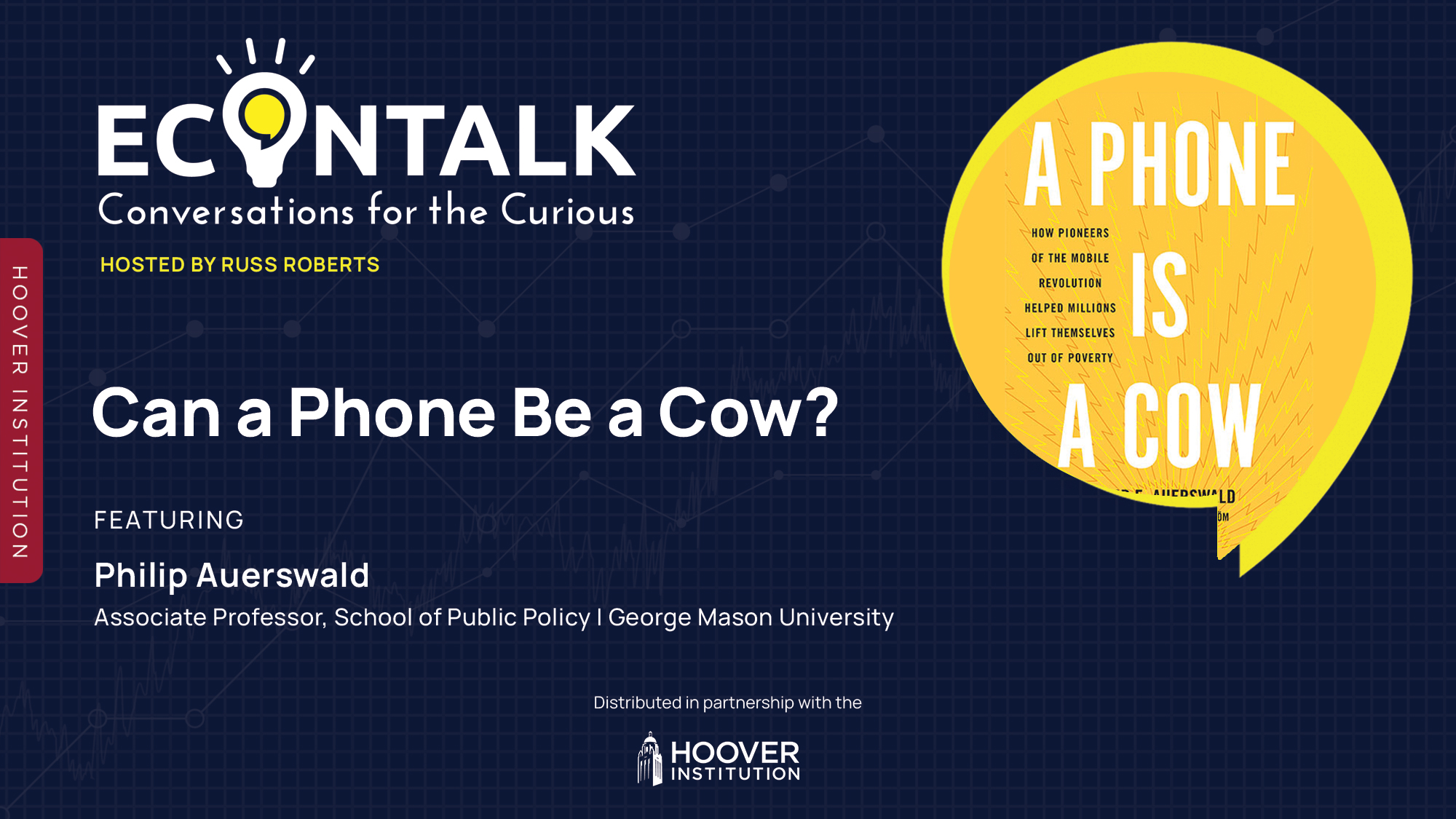
- Today is May 26th, 2026. And before introducing today's guest, I wanna let listeners know that we'll be doing an EconTalk book club around the ID by Homer, the first episode with the Ioni of Shalem College, who has been teaching the ID for over a decade, will Air July 6th. It will provide some useful context on the book to help you get started, and I hope inspire you to read it. Additional episodes, I dunno how many will air in the weeks to follow at least one, maybe two. And we'll be using the FALs translation, but there are many others to choose from. And now for today's guest, economist and author Philip Oswald of George Mason University. Philip was last here in September of 2017, talking about populism. Our topic for today is his latest book with the delightful title. A Phone is a Cow. How Pioneers of The Mogul Revolution Help Millions Lift Themselves out of Poverty. Philip, welcome back to EconTalk. Thanks so much for having me. It's a pleasure. So let's start with the title of the book. What does that mean? The phone is a Cow. So Phone is a Cow comes from the story of Iqbal Kadir, who is a central figure in the book. And Iqbal is the founder of Grummy phone, which is today the dominant provider of mobile telephony services in Bangladesh. And Iqbal faced the challenge of creating a mobile phone company in Bangladesh at a time when per capita income and Bangladesh was about $400 a year, which was the same price as a mobile digital handset at the time. So it was a, a daunting undertaking. Iqbal is featured along with Strive Mawa because they were really the first two people to see mobile phones as a, a potential device for really everybody including the rural poor in places like Bangladesh and Zimbabwe. So, so Iqbal, you know, was trying to understand essentially the business model to make mobile telephony work at the rural level. And he drew in inspiration, in fact, partnership with Grene Bank. And so Grene Bank is famously known for micro LL loans to women in villages to essentially use those loans for productive assets, including, say, a cow. So the loan would really pay for itself through the productive use of, of, of the asset. And, and Iqbal's really central insight in terms of making mobile phones viable in a place like Bangladesh in the mid 1990s, was that a phone could be a cow. A phone was a, a productive item, a productive asset, and not as it really was seen in, in, in the West at the time, as, as a, as a consumption good, a luxury good. So that's where a phone as a cow comes from. And what I, one of the things I love about this book, we hear his story, which is to call the rollercoaster, doesn't do justice to it. He, he and the other entrepreneur you mentioned, strive, overcome, unbelievable business hurdles, technical hurdles, regulatory hurdles. But the fundamental hurdle is what you just mentioned. You have a desperately poor country, and you have an item that is a year's worth of income, if not more for many, many of the people who are going to be the customers. So it's a fool's errand on the surface. What's beautiful about it, of course, is that since that gleam in his eye, the price of a cell phone has fallen dramatically, and per capita income in Bangladesh has gone through the roof for Bangladesh increased dramatically. Let's just say it that way. Yes. Yeah. And, And the reach of that product is absurd to the point where now Bangladesh, you know, it's per capita income is driven, grown dramatically. It's still, it's not a rich country, but there are more cell phones than there are people in Bangladesh. Yeah, yeah. No, I mean, exactly. And, and I, I I, I think one of the things I, I really loved about delving into Iqbal's story. I mean, he and I have known each other for 20 years. So it was really an opportunity for, for me to, to work with him and really understand the details, the particulars of how that came about and situated, you know, in, in this kind of full context. But one of the details that, you know, that surfaced was that, that he and his brother had a previous business idea, which was to develop a, a, a Bengali character set for the Macintosh, the earliest Macintosh. And at that time, Macintosh computer cost about $4,000, and the per capita income in Bangladesh was $200. So it was, you know, basically roughly 20 to one. And so, so, so, so really the, the, the obstacle was seeming completely insurmountable. Now, I I I, I think perhaps at the time they started Gring phone, now that I think about it, it may have been more like $300. The handset was $400. So it was a, it was a little bit more than, you know, one-to-one. But, but what Iqbal was looking at was not the absolute number, the one-to-one, but it was the change that it had gone from 20 to one, to one to one. And the, that, that trend on the cost side, there was every reason to believe that the cost due to Moore's law, which which Ibal was very well aware, would continue to drop, you know, exponentially and that income would grow. And so, so he foresaw exactly the f phenomenon that you described, and that was really what the vision for Grum and phone was based on. But besides the profitability, which ultimately came, there was an idea that this was gonna make the world a better place by allowing people to have the freedom to pursue some things they might not otherwise be able to do, because they were able to communicate. And one of the themes of this book is the power of communication and connection between people also the power of connecting different products together in, in innovative ways. But how did the phone help make the people of Bangladesh more productive? In other words, it's true that once he had the idea, eventually Bangladesh got much wealthier and the cost of the cell phone fell, which made it a more viable business proposition. But the beautiful part of the story is that part of that transition was helped by the phone because the phone allowed people to do more than just chat with their relatives in far away places. How is the phone in a, in a poor country, more than just a consumer luxury? Yeah. I think one of the difficulties of situating this book, particularly in contemporary US discussions about the mobile phone, is that we see not only do we see the mobile phone not only as a consumer device, but as a pernicious consumer device to some extent a time sanc a a distraction engine. And, and the idea that that the mobile phone could be a productivity enhancer seems anachronistic or, you know, if, if not just completely made up, right? That's just not our lived experience. But there's something that you and I, and I think probably everybody else knows, which is the United States is not Bangladesh, the lived experience of a consumer in really what is on average, the top 5% of the global income distribution is not the same as it is for the other 95%, and certainly not for the, the bottom quartile. And so what does a mobile phone mean? What did a mobile phone mean in Bangladesh? Actually, Iqbal's brother started the dominant provider of mobile financial services in Bangladesh. So they're, they're, they're a, a, a, a a, you know, a brother pair that have brought not just communications, but banking. So what's the point there? The point is that the phone is not just being able to talk to people. It's not just being able to make deals and to understand what prices and understand market conditions and save yourself a, a, a day's travel as, as occurred with Iqbal in the 1970s. One of the reasons that he saw that, you know, his favorite phrase connectivity is productivity. And, and he, he recalled, you know, an episode where, you know, he walked half a day to buy some needed medications for one of his siblings only to find that the pharmacy was closed and then walked home. Now he's a kid. What's his time worth? Not much, but it's a day of time that you would save, literally a day walking back and forth that you would save just by a phone call. And, and, and that, that, that experience was, was reinforced over and over again. That connectivity is productivity. So just simply the fact of telecommunication service is, is can be a just an incredible time saver. And saving time is saving money, saving time is increased productivity. And, and and beyond that, when we, and that's the sort of what we, we, you know, I get to in later chapters of the book, I only get to mobile financial services, but the phone has been the delivery mechanism for an array of essential services that simply were not accessible, that did not exist to the rural poor before mobile phones, just as telecommunication services did not exist, fa landlines never came close to reaching the majority of the world's population. And so, so it, it's, it is because we have this abundance of services, abundance of options, abundance of infrastructure, this, this, this accumulation of a century of depth of investment in our environment, that, that, that the mobile phone seems superfluous, but it is anything but superfluous to the majority of people on this planet. Now, the book's about, in some sense, it's nominally about the mobile phone, but it's also really about the role of entrepreneurship in, in our lives and, and in growth. So part of the book traces the rather unknown story, or not well-known story of how the mobile phone came to be. And you asked the question, who was responsible for the mobile revolution? And that's not an easy question to answer, but talk about why that is, and to the extent it is answerable, who, who is responsible for it. Well, that is not an easy question to answer, and that is really, that's, that's really the question I sought to answer in this book. So, who is responsible? Entrepreneurs are responsible, inventors are responsible, farsighted, government bureaucrats, allocating budgets to unlikely projects are responsible consumers who are willing to try something, adapt to something, are responsible. And, and, and really the list goes on. My, my my, my good friend and, and somebody who has been an inspiration in my work for 30 years now, Sid Winter wrote an article two decades ago in which he really explored this, this, this, this question of who is responsible for a radical technological discontinuity? And he used the mobile phones as his example. I didn't even know that when I started the book. And I came across it. And, and so I, I, I quote him and cite him at length in the book on exactly this case. But, but so we've talked about iqbal, and really that's kind of like later in the story, the market pioneers who did what you, you know, you might say, oh, last mile delivery, but it's not just last mile. It's to the majority of people worldwide. It's not a trivial thing to bring a frontier technology to most people. And that has not been done for many technologies. So, so that's where we began. We began with those, what you might say, last mile pioneers, but then you sort of, you know, trace it back then there had to be the initial mobile phone companies in the US and, and those faced a lot of o obstacles. There had to be the inventors. So you have the, you know, Marty Cooper, I tell the story of story of Marty Cooper at Motorola, which was hardly an upstart, but it really was the challenger to ma be at the time and not the obvious candidate for having developed the first mobile handset. And Marty Cooper's story is tremendous. Marty is still alive. The guy who made the first call on a mobile handset, actually, I, I iqbal and I did an event with him on the day of the anniversary, 50th anniversary of the first call placed on a mobile handset. So, so there's Marty Cooper's story and the whole story of how Mo Motorola developed the first mobile handset. And then you go back again to at and t Bell Labs and, and you know, the, this, this notion that that Bell Labs was possibly the greatest, this single institution responsible for invention in human history. It, it, it, it's, it's, it's, it's a, it's a claim that one can credibly make. And, and, and mobile telephony is just one technology that, that really originated in mult across multiple dimensions, not just the transistor, but the, the network and, and extension. And then of course, we go back to, where did the name Bell come from? Alexander Bell. Alexander Graham Bell. So that's actually where the book begins, is at the Centennial Exposition in Philadelphia, 1876 America's First World's Fair, where Alexander Graham Bell debuted the, the mobile, the, the, the, the telephone. So, you know, I was thinking when we were talking, what an interesting idea that the mobile phone would be transformative. Well, the landline phone could have been equally transformative, but you'd have to be able to take it with you. So the, the, the shortcoming of the landline phone is that it's landline, it's in your house, and it stays there. So if you're not in your house, it doesn't help you be more productive or happy or anything else. And I, it just struck me when you, you know, you made that list one name, you left off, two names you left off, which I want to mention are Claude Shannon and, and Steve Jobs. So Steve Jobs had this idea that, as you say, it's, we're not as happy about it maybe as we once were, that, that we have a computer in our pocket at all times. But what an extraordinary visionary. And if it was just a phone, if it was all it was, was a way to talk to other people, it'd be nice and it'd be good. But the productivity to turn it into a bank, as you point out, it's more than a cow. It's a bank, and many, many, many other things that make people more productive took a different kind of vision that, that he brought Claude Shannon laid the intellectual foundations for much of the digital revolution. And although anthropic, as far as I understand, it does not say that Claude is named after Claude Shannon. He presumably is the namesake of their LLM. So here's a question I wanna ask. Having introduced with that, when I was a little boy in the, say late 1950s, early 1960s, I love books about explorers. They're very popular for adults to give books to children about exploration basket of Gamma Balboa, Drake, Scott, Columbus, you name It, what could be better, right? Yeah, Yeah. Ocean voyages and, and dangerous missions and so On. Yeah. And we learned that later sometimes they were, they had a dark side that we know much about. Yeah, We were told all that when we were seven years old, maybe for the best, maybe not, not back then. No, I'm not saying anything about that. But here's the question. They were figures of romance. Why is it that the intellectual explorers of the 20th century are so obscure? Why is Claude Shannon only a household name to people in the most more arcane parts of the, the, the digital intellectual scape, DH ring, a name you mentioned, who envisioned Cell Phone service Known to absolutely nobody, almost no one. Somebody named Jet, JETT, you mentioned Jet. Yeah. Is People honored and celebrated and used to inspire young people the way physical explorers were. In many ways, there is as if not more transformative or daily lives. Any thoughts on that? Well, there's so much in that question, Russ. I don't even know where to get started. I mean, you picked out obviously two very significant names that, that, that I did not reference. And just to the, to the point of how many contributors there really were to the mobile revolution, but referenced, you, You referenced them in the book. You just, you didn't Just No, no. You didn't mention In that little, that just now. Yeah, No, of course. I mean, there, there's a lot about Claude Shannon, something about, about Steve Jobs. Let me, so I wanna start by directly answering your question, which is that, I don't know, I think, you know, one of the, one of the phrases I developed kind of for the marketing material in this book, I think it's in the, you know, in the introduction someplace, is, you know, we, we too often confuse high net worth with net impact. Yeah. And, you know, we're in a, a culture where we do celebrate entrepreneurs and these entrepreneurs, you know, these days, at least as from my vantage point, from how I see things now, you know, have, have a little bit of a complicated public persona. You know, when we think about an Elon Musk or a Mark Zuckerberg or so forth and so on. So a decade ago it was a little simpler. Yeah. I remember 15 years ago when, you know, a Silicon Valley seemed pretty nice place. Yeah. Like everyone was excited about. But but these, these sort of tech titans, as we're thinking about them, you know, there's a, there's a tendency, and it is a very flawed and mistaken tendency, a deeply flawed and mistaken tendency to identify entrepreneurship with those few people, these, these, these few very wealthy Silicon Valley situated success stories. Yep. That is not entrepreneurship. That, that it has never been entrepreneurship. It will never be entrepreneurship. It is a very small fraction of what the entrepreneurial process is. Str Maua and Nick Bir also are not representative. Other words, we know most entrepreneurship is a single proprietor. It's, it's anybody who takes initiative to build something, create something in the world. So it's a huge phenomenon. It's a global phenomenon. A I think it's a very significant phenomenon. But why do we not celebrate these stories? Now, you went beyond entrepreneurship. You didn't, we were, you talked about EK Jet, who was a government bureaucrat, but who wrote a, an article for the Saturday Evening Post that was really about the future of mobile telephony. And he wrote it in July, 1945. And so it was this, it was the, it was the same month that Eva Bush wrote, as we may think, talking basically about the internet. So these two visionaries saw the mobile phone and the internet at the same time. Now, people do not people veneer Bush is known more than EK Jet. But, but so, so, so it wasn't just entrepreneurs you talked about, and then Claude Shannon, I mean, if anybody deserves to be a household name in the United States and anywhere else, it's Claude Shannon. What an incredible figure. What a remarkable individual. And, and, and to be able to contribute to, you know, adding to that le I mean, of course people do write about Claude Shannon. He has remembered. But, so I don't know the answer to that. I don't know the answer to that. I, but that's certainly one of the reasons I wrote this book. Now, if I could just go on one more moment Sure. About Steve Jobs. So, you know, one of the aspects of this story, when we think about, you know, there's a lot of the book about, you know, first third focuses on Iqbal Cartier's story. And, and so, so why, why, why so much about Iqbal and then, and then Strive and I, I, I think, you know, they, they, they do merit that, so Iqbal started working on what was GoPhone and then became Grame phone in 1993. And we already talked about, you know, where Bangladesh was at that time. I Iqbal exited Grummy phone. He, he, he, he sold his position in Gruin phone at the same time that Apple was beginning to think about the iPhone. So that gives you a sense of how early Iqbal was. It was certainly not the iPhone that influenced Grene phone. It was Gruen phone was in a previous generation. Nonetheless, I'm not saying that, that Steve Jobs doesn't merit his, his reputation as, as really one of the great consumer tech visionaries, you know, of the last century. And then Shannon, we could just go on, that could be an entire different podcast around Shannon. But, but Shannon is, is a foundational figure in not just mobile telephony, but computing and communication is generally speaking, and somebody to which we owe, you know, whether we want to blame him or thank him. But a lot of what the world we exist in would, would, would, was, was at least significantly advanced or would not exist without Claude Shannon. Yeah. We're all living in Claude's world. I think that's the Yeah. What it comes down to. And of course, my other thought, I, I asked the question, I didn't think about an answer. I guess the other po part of it is that what Claude Shannon understood about the world is harder to convey to a 7-year-old than Balboa. So that, that could be, that's definitely part of it. But I think you're right. I think a lot of it's the money, the, the glamor for the great explorers, the glamor of risk and discovery for, at least for European eyes, but for the internet, the glamor is the money. And that's a shame. But that's a, that's another, that's, as you say, that's another story. Let's talk a little bit about Adam Smith, who, who plays a role in this book. Yes. A person about who, about whom you've done some thinking. Yeah, a little bit. You have some Yeah, A little bit. A little bit. I, I don't, you know, I don't pretend I'm an expert on Adam Smith, but I do, I do find him fascinating. Yeah. But Iqbal Kadir, this person who really laid the groundwork for Bangladesh's access to, to the mobile phone was very influenced by Smith. Talk about in what way and, and what role Smith played, say, relative to the academic side of development economics in some sense, you know, we say Adam Smith was the first economist. You could say he was one of the, you could argue he was the first psychologist, I like to say he was the first social scientist. He sat in his arm chair and he tried to figure out how the world worked, right? Yeah, yeah, yeah. But academics, they do that. But they also worry about getting papers published and their, their cv. But Smith was just trying to figure stuff out. And why is that still useful today? And and how does that, at least in your mind, are iqbal's contrast with the academic literature? S So there are a lot of different types of entrepreneurs, and I'm not at all going to make the claim that, that Iqbal, who as I indicate, and as I describe in the book, I know, well, you know, is, is typical. I I don't necessarily think he's atypical either in the specific regard that I'm about to mention, which is that above all, he's an economic theorist. He is somebody who, from the very beginning, was interested in ideas, interested in history, and focused on the practical application of what he learned from studying Smith and Hayek and, and, and, and works of history that he engaged with very deeply, you know, in his twenties and thirties. And that, that, that, that, that, that didn't just inform, but really formed his notion for Gramine phone. So Gramine phone is, is, is an, is a expression of an understanding derived from theory and a successful one. And among the, the theorists who was most influential in this was Adam Smith. So now let's sort of, you know, contextualize Adam Smith. I certainly do not claim to be an expert on Adam Smith, but, and any of us who's in the field of economics, you know, we are, we're all, we're all fans or influenced one way or the other. My, my favorite book about Smith is actually Albert Hirschman's, the Passions and the Interests, which is barely about Smith at all, but is about the, you know, couple of centuries of economic thinking that led up to Smith. And for anybody who has not read that book, I would say that is one of my top five favorite books in, in economics and just, just has, is full of really great insights that I believe are actually direct, directly relevant to a phone as a cow. And so, one of the beautiful things about, I think the way that Iqbal was influenced by Smith is it makes us rethink history as we understand it. So just quick digression, this year we're celebrating the 250th anniversary of the founding of the United States of America, or at least the Declaration of Independence. And so one of the Hallmark events that leading up to the Declaration of Independence was the Boston Tea Party. And that was a reaction to taxation without representation, right? So the crown imposed taxes on the colonies, and we did not have a role in that. What is not a question that's not asked often is why were those taxes imposed to begin with? And the reason is the taxes were imposed to finance Britain's colonization of Bengal, which was in some ways the economic center of Asia and a, a, a crossroads of the world. Bengal, the, the textile revolution began in Bengal and actually then migrated to the uk. And so Bengal was a place of, of, of tremendous importance and significance. And was was Britain's first colon expansionary colony. The colony of subjugation, the, the, the, the United States was a colony of colonization. Bengal was a colony of subjugation. And that required tremendous expenditures to maintain. And that's the reason we had the American Revolution, was because we were taxed to finance Bengal. So there's, there's a complete, we, we only think about Bangladesh, you know, concert for Bangladesh and def famine and the revolution and the miserable history of Bangladesh in the 1970s. Most people in the United States have not gotten past that idea. That's still where we think about it. Bangladesh, desperately poor place, you know, Mohamed, Eunice, Grammy, and Bank, all the rest of it. Right? Well, that's a lot more to the story of Bangladesh. And to Bengal and Smith saw that Smith wrote about Bengal as, as this sort of crown jewel. And, and he also wrote about Bengal as a place whose, whose, whose wealth was derived from its communications network. Going back to, you know, the, what we were discussing about earlier, but where in the case of Bengal, the communications network consisted of rivers and channels and, and waterways that connected the country as a delta country. It's the delta of the Anes River that, that connected the country in an exceptional manner, and that allowed commerce to flow from the, the, the coast to the interior. And so, so Smith wrote very eloquently both about Bengal's wealth and also about its subjugation. So to see, to see, to discover as, as a young Bengali at, at, at, at Wharton in, in the, the readings of, of, of the writings of Adam Smith to see. But Bengali reflected and celebrated, was tremendously empowering for Iqbal. And, and from, you know, then forward, I think he, he really reinforced his notion that, that the misery that he knew of his country was not the totality of the story. That there was a before and there would be an after. And he was committed to being part of that after. Yeah. It's very beautiful. The, the, the other part you talk about, which I find very inspiring, is the, the power of human agency. The ability of people to imagine a future for themselves or for others through products they might bring to the world and make it happen. And of course, it doesn't always happen when it does happen, it's not always successful. But this idea that we have some control over our destiny, which is a very American idea, but it's also very smithy an idea. And, and it's, it's a unappreciated idea for its novelty because through most of human history, people thought of themselves as pawns. And of course, in the Marxist viewpoint, you're a, you're a pawn of your class, you're, you're, you're oppressed often. Most of the world is. And, and that viewpoint, the idea that you have a choice and the ability to make something that isn't there before of yourself, or to do something for other people that's not charity, but will actually benefit them and you through their purchase of your product. I never really appreciated as a, as a smithian idea that this idea of self-interest in, in its sense of destiny and, and molding your future. Yeah. Well, I mean, Russ, I won't exaggerate things or maybe seemed to pander excessively by saying that I wrote this book just with the intent of appearing on EconTalk. It's a lot of effort. More than five years, just for this hour, which by the way, I do enjoy and appreciate. But I, this is one aspect of the book that I really thought you singularly would appreciate, because we don't have that many philosophers in economics. And I'm not saying we should. I mean, it's become a very technical discipline. And what constitutes a big idea in economics from the standpoint of the history of economic thought is not a very big idea. And so, so, so, you know, but this is a big idea. Predestination and agency juxtapose is a big idea. It's a bigger idea than me. It's a bigger idea than you. It's, it is among the biggest ideas that exists. We have right choice, you know, free will or, or, or destiny God's will or, or our, or our own agency. And so, so there's kinda like, that's the third level, right? You talked about the first level is the mobile phone and, and Iqbal and Claude Shannon and this detailed history, which I just loved getting into. And to me that's, that was the sort of the fun of the book, right? And then there's this next level of like, you know, the history of technology. How do we think about, you know, technol economic development, theories of economic development. And, and, and so there's the kind of like a theory level, but that it occupies. And then there's this philosophical level. So the closest I get to that is, is talking about Tolstoy's second epilogue to war and peace. And, and actually Tolstoy has a, I'm, this is one thing I, I bookmarked. So it is a long passage, but at the end of it, Tolstoy writes reason, gives expression to the laws of inevitability. Consciousness gives expression to the essence of freedom. And so he juxtaposes this notion of inevitability, which could be technological inevitability. How much does it matter that we had I bdi or strive mawa, right? Once you had the building blocks of a mobile phone, once you had the value that a mobile phone creates, it was gonna get to Bangladesh. Does it really matter that one or another person did it? Do we have any choice at all in our technological future? Once something is created in a planet of 8 billion people, someone's gonna figure it out. And if someone decides not to do something, somebody else will do it. Nuclear weapons, whatever it happens to be, these things are all inevitable in some sense, in some way of thinking. Our reason tells us that our minds tell us that we really have no way of controlling these forces that are beyond us. And the, the, the, the political philosophy of inevitability is Marxism. And it's Marxism, not in a derogatory term. It's not a, it's not to say, oh mar it is bad Marxism. It's, it's thoughtful Marxism. It's, it's thinking about history as, as, as very specifically class struggle. But beyond that, simply an inevitable force in which human beings play no significant part. And then we have the opposite, the great man theory of history, right? And it could be the Steve Jobs, it could be the al it could be the anybody. It could be the Mother Teresa, these, these exceptional people who, without whom nothing that we see would've occurred. I just said that about Claude Shannon. Right? You said we're, we're all living in Claude's world. And so, so how is this resolved? And, and in my view, and I've held this view for a very long time, if there's a single idea that's motivated my intellectual interest for the last 30 plus years, it is the notion that they're both true. It's just not that hard a problem. I mean, it's made out to be a hard problem. You know, the whole struggle between socialism and capitalism, you know, is made out to be a very hard problem. You know, is everything inevitable or are we these, you know, these sort of, sort of capitalist free will people and Randy and, you know, creators? Is it one or the other? It's both. It's just both. And that's what I loved about Sid's piece, even though it's just a couple of pages. It's very simple. It's both, we, we have entrepreneurial initiative, we have free will, and we exist in a world in which a lot is predetermined. They simultaneously, they, they coexist in this sort of magical way. And, and at least that's the way I see it. I, I can't see it any other way. And that's really what I'm, I'm intending to say in this book. That's what, that, that's what the book is fundamentally about is, is to kind of explore this, this duality of, of truly exceptional people who have capacities that other people do not have, who have determination that other people do not have, who deserve to be celebrated in just the way you said earlier. We should be telling these stories. And at the same time, there's this, this, this combinatorial progression of, of, of, of, of change over which we have not that much control. And these things exist simultaneously. Yeah. I would just put a little footnote to that. It's not so much that we don't have control, it's that the sense in which individuals contribute to it is, is a little more easier to predict. The incentives are overwhelming and they will win out. Those mark market forces are gonna push us to certain outcomes. They will be enacted by individuals making choices. The speed at which they happen will depend on individuals Who they benefit, how they benefit people at certain points. Exactly. But, but the idea of how we should look at our fate Yeah. And how much of it is up to us? Obviously it depends on where you live and where you're born, who your parents were and so on. But the idea that Smith saw self-interest, which I think we think of usually as grasping. Yeah. Or as how I come down when I'm faced with a choice, say in a negotiation, whether to leave money on the table or not. Should I put myself first or so on? It, it, there's such a broader view of that self-interest that you capture that is about our desire to remake the world in our own image, to, to forge it, to craft it. And your view that that's really what growth is about. It's, it's not this inevitable 3% a year, most of the time it's sometimes two and A half. Exactly Right. But, but rather this extraordinary range of options and endowments that we have of products that already exist and asking how might we combine some with others to make something that isn't here yet. And some of those things might take a very, very long time to be imagined if an individual didn't come forward with it at a particular time. Yeah. I I, I appreciate your qualification and you phrased it better than I did just now. It's, it's a little bit of a subtle thing to articulate. And so, and I and I, I, I was just looking in the book, you know how it is with, with books, you, you know, you finish a book and then I'm well into my next book. And then you, I just, you get the book. I just read it today Mostly. It's a little Fresher. I actually a little er I read it yesterday. I read it yesterday, and I thought, this is pretty good. I like this book, you know. But that's one of the things I love about it. This is not my first experience with this, that when you discover a book, you get the physical book. And, and there's just something about the physical book. I'm old school, something about a physical book, even your own physical book. Yeah. That when you read it, it reads differently. Yeah. So I have to say full disclosure, I like the book. I, I mean, I feel like it's probably the best thing I've done, such as It is I may, but so, so, so I was, I was, I I did say that by way of, I I wanted to find the specific quote. Yeah, let's Find It. There's a nice Quote from Smith. Well, it, it, it, it it, the quote from Smith, there's a very specific quote. Yes. Here it is. I found it amazingly. Okay, because I was looking it Up on the Go Ahead. So, so, so the, the, the, the, this is about agency, the natural effort of every individual to better his own condition when suffered to exert itself with freedom and security is so powerful, a principle that it is alone and without any assistance, not only capable of carrying on the society to wealth and prosperity, but of surmounting a hundred impertinent obstructions with which the folly of human laws too often encumbers its operations, Magnificence. And, and Of course welcomeness book four. I mean, So I, I almost wanted to read it again. It's so beautiful. Yeah. It's pretty great. No, it's pretty great. And I, I, I think I've read that quote before, but reading it highlighted like that in the book. It really, it, it grabbed me in a way it had before. But I wanted, I wanna talk about another economist. You mentioned in the book, and I thought I understood this paper, but I learned something I hadn't thought enough about. And it's a simple thing, but you pointed out in a way that forces you to think about it. And it's, I think, again, a very extremely profound idea. So one of the more extraordinary achievements of human beings is to have illumination available at lower and lower cost. And by lower and lower cost, we don't mean say the monetary price. 'cause that's not the right way to think about. And it's in different currencies in different countries, and it changes over time, and there's inflation and, but the right way to think about it is how much does a hap a person have to work to, to be able to say, read at night or watch a play a musical at night, and Yeah. And that's fallen in unimaginably large ways. It's gotten incredibly cheaper for human beings to enjoy light. And I thought, yeah, that's cool. And the size of it, the, what's fun about the paper is he tries to measure it, and it's crude, doesn't matter. It, it's the enormous improvement in hu the human experience. Yeah. But your Insight, Which I thought was incredible, which I missed when I, when I think about that paper, is it's not just that the candle got brighter and cheaper, Right? It's that we sequence a set of radically different technologies, and one of them, you go and you kill a whale and you take the innards of the whale and use it to create illumination To, to, to light streets. Yeah. And that is really different than how my lights are working right now. Yeah. And, and it's, it's not just like, well, they, it got better and better. Yeah. That's not what happened at all. It radically changed over time as people thought of new things. I think that's really, well one of the part that I think about a lot is how hard it is to measure standard of living. And that's because the transformation's so dramatic. It's not just that, oh, the light's a little cheaper, so you have more purchasing power, Which is central to that paper. Right? So that part's in there. Yeah. Yeah. But The Idea that, and, and, and there's a quote, which is one sentence way, I'm not gonna get a verbatim, you'll help me if you know it by heart, that captures this insight. And it's, I think, an incredibly deep insight for business. It relates to Clayton Christensen and the Innovator Dilemma, which you've talked about recently on the program. It relates to development, development, economics. It's the quote from Henry Ford, which is, you know, people didn't know they wanted cars. They thought they wanted faster horses. Right? Right. Yeah. Right. And what They really wanted was to move more quickly, but the only thing way they could think about it was, I wonder if we could feed a horse something he could move his leg quicker. Right. And I could get across town quicker. The idea of a car is not just like, well, that's a, that's a faster horse. It's not, it's not a horse, but it is horse a better way to get across town. And that is the human experience. I, I just, I'm getting romantic about it because I think it's, it's incredibly profound. Yeah. I, I, I mean, and those, you know, I guess a few of of us economists who are specialized in the economics of technology and innovation, like you sort of, I I guess any, you know, any subfield probably talks their way into thinking like, this is the only, this is the only subfield that matters. Yeah, yeah. You know, and so, so with difference to all the other, you know, subfields and economics and, and, and then when you talk about the economics of production theory, which is really my technical area, that's like 12 people, you know, that, that care about production, that's a settled problem. You know, nobody is thinking about the production function. But to me, that's an interesting thing to think about. So the northouse paper, the northouse paper perfectly EnCap encapsulates what we were just discussing about free will versus inevitability. And you also referenced, you know, GDP growth. We could talk about a diffusion, technological diffusion, ssha diffusion curves. Right? And, and, you know, you look across any technology, there, there is, there's the s-shaped diffusion curve. You always, it's, it's, everything is so regular and smooth that that, that it's hard to imagine that there's any discontinuity, any insight, any, you know, moment of, of, you know, particular significance underlying it, you know? And, and, and, and, and so nor house's paper traces out this, this incredible decrease in the amount of human effort required to illuminate at night. And so, so on its surface, it, it, it, and it's a very powerful paper. I, and one of the things, I mean, it goes back to 1 million bc you know, you talk about the long view. It's, it's, it's a fire in terms of it's a wood fire Yeah. With fire. Yeah. Fire going back to fire. So, so in terms of the long view, in terms of work that's been recognized by the, the SCH shares Risk Bank and Nobel's Prize of Economics so-called, you know, it, it, it's, it's, it's kind of unique. But then, and I, I guess, you know, if I was trying to imagine what, what, what might have been new in this book about that paper maybe I, I, I, I would've guessed correctly, which is the discontinuities underlying that I can't really improve on the way you characterized it. I was pulling up the, you know, the table, but you remembered, you know, off the cuff a lot of the highlights. And, and I think that, you know, the, the jump from whale oil to electrification is a, is a terrific example. And, you know, and, and, and you, we can, we can attack the fossil fuels industry. And of course we're, we're very, you know, concerned about climate change and, and all that. But you know, the, this, the before that we were, we were burning fellow mammals, and that was worse. So, so, and burning down And burning down forests to stay warm At night and burning down forests Exactly. Much worse than to Illuminate, but just to stay alive in certain climates, Just to stay alive. So, so, so, so when we think about technological progress, what, what, what, you know, what seems like regress in some sense. You know, we, we, there's always these paradoxes of progress. We don't see kind of the way in which we have improved across multiple dimensions, not just efficiency dimensions, but also ethical dimensions as, you know, just referencing. So, so anyway, yes. That is a core point of the book, and it's reflected in that paper. And, and, and I guess the, the, the, the, you know, the big idea is that human progress is about new technologies coming into being and becoming widely used. And that's what this book is about. It's not just technologies coming into being, it's not just innovation. What shrimper talked about is innovation, a successful market demonstration. The, the, the landline was a successful innovation. It reached hundreds of millions of people, but it didn't come close to reaching the majority of people worldwide. The mobile phone did. And so, so it's, it's a combination of, of, of creating new technologies. What, what, what Schumpeter talked about carrying out new combinations, that was his phrase for entrepreneurship, carrying out new combinations. It's to bring those, those market innovations to people. And that's what Iqbal Kad did. That's what Strive Mawa did. That's really the focal point of this book. Although there's a lot of other elements to the mobile revolution. And I will maintain, you know, given my areas of interest and expertise, I will maintain that there is no comparably important question in economics, because this is the question of human progress. This is the question of human wellbeing over the period of millennia. Everything else about resource allocation, about policy, about macro, everything else is a footnote to this larger question of how new things come into being and how they reach mo Most people, I cannot see it differently than that. Yeah, it's beautifully said. And it's, I I wanna bring, I wanna bring Hayek in, and I, you know, when you said, but when you're talking about the diffusion of, of technology and innovation, that, or in this case, it would probably be invention that allowed, say a, a filament to be, to bring illumination relative to whale blubber. Right? Right. I, I've never thought about this before. I, I think, but when you, when you frame it earlier as, as we've been doing in, in terms of inevitability versus agency, if you think about the Nord house insight, that the price of illumination has fallen steadily over time. It's a emergent order, invisible hand argument. It, it looks like, if you look at it, that someone must have decreed that this should be God's will. God's will. Or it's a natural law, which is Yeah. Not a, it's a different way of saying that's similarly, it, it's similar in the sense that it, the, the key point here is the inevitability idea. Yeah. And, and your insight that it's both the inev, the predestination inevitability combined with individual agency. So they're both happen at the same time. What's driving the illumination is that people like to do things in the dark. So they want light, they want to eat meals in, in at night, right? They want to go to shows, they want to go to concerts, they wanna read, they don't wanna be afraid in the winter, starting at four 30 in the afternoon. Right. That fundamental human urge has allowed thousands of people over human history to better themselves by creating cheaper and better ways to banish darkness. And it's both, there isn't inevitability, which is the driven by the human desire for illumination, but you couldn't have that inevitability without the crazy insights of people to come up with crazy ways of achieving that, which couldn't be predicted until they happened. And to say, well, eventually I knew someone would've figured out a cheaper way to do it. Right? Right. It's easy to say, but it's not, it's not gravity, it's not inevitable. It requires, at the same time, incentives to be in place for people to profit from that innovation and that invention. And it's really a, a beautiful thing. You know, we, we talk about Moore's law and, you know, people would ask the question, what kind of a law is it? I mean, why should it be that we can always expand the capability of chips at, at a certain rate of computer chips? And it's, it's, you have the answer. And I've never heard a better one, which is this combination, it looks predestined. It's not, you could kill It. Yeah. You could kill it easily with the wrong legislation and the, the, the wrong set of regulatory rules. But if you keep the incentives there for improvement, people will develop ways to do it, even though you may not know how they will. And that's the Nord house story. And it's, it's, it's a, it's a Smith Tol story, story, if I may be a little bold. A a absolutely. And, and actually you went in a direction, and I, it was part of your question, I didn't, didn't answer, but it's, you know, ano another way of thinking about, you know, not just the, the, the core contribution such as it is of this book, but actually of the, my last three books, my, my only general audience books going back to 2012, the, there there's sort of a trilogy and underlying that is this, this, this idea inspired by Schumpeter that that entrepreneurship and innovation are the carrying out of new combinations. And this was 1911. And you know, Schumpeter, you know, before we had evolutionary biology, before we understood DNA, you know, before we really understood the fundamentally combinatorial nature of life itself, not to mention technology, he had that insight that there was something combinatorial about innovation. Now, the, the, the great Marty Weitzman had whose contribution span so many different fields, almost to Kenneth Aero, I would say, you know, very close, had a paper called Hybridizing Growth Theory, which in is my favorite paper in the, in the growth literature. And it also borrows from this notion of, of, of innovation being fundamentally commonatorial. My, my, my, my friend and mentor Stewart Kaufman, with with whom I wrote some early papers, you know, is, is known for his insight about the adjacent possible that Steven Johnson then picked up on. And, and the adjacent possible is, is is fundamentally commonatorial when you have, you know, a set of Lego pieces and you arrange them in a certain way, then given the configuration that you're holding in your hand, there are certain kind of imminent next steps based on the combinatorial nature of the thing you've created. That you add one piece, subtract one piece, you know, that there's a kind of an imminent next possibility in the combinatorial nature of technology that doesn't exist when we think just in terms of scalers. And so, so we lose something fundamental when, when, when we reduce just to the number line, that that technology isn't producible in that way. It is fundamentally combinatorial. And, and so, so this idea of the adjacent possible is, is a way of understanding the combination of this, this, this, this, this paradox of how do we have free will and inevitability and, and, and the way that, that the, the adjacent possible and the combinatorial nature of innovation does that, is that the search space for combinatorial innovation is hyper exponential. It is simply impossible to think about in multiple lifetimes of the universe exhaustively searching everything that God has given us as possibilities. So we must choose a path. And, and this whole notion of path dependency that, that Brian Arthur or somebody else who's been very influential in, in my work and my career, who I had the opportunity to meet in 1993 at the Santa Fe Institute Summer School, along with Steve Kaufman, that, that this idea of, of, of, of, of path dependency originates in this, this combinatorial nature of technology. And it is the way in which, you know, what I call combinatorial foresight, that, you know, free, free will operates in long-term economic growth. Someone has to choose something to try, someone has to try it, someone has to test it out. It's what Ricardo Hausman, Danny Roderick wrote about is, you know, economic growth is self-discovery. It's the same phenomenon. It's, it's somebody has to get out there and, and be that pioneer, be that vasco de gamma. And for all, every vasco gamma, we know there's a bunch of people we never heard of who were sitting at the bottom of the seat. Right? All those people had to do something. And so, so, so, so to me, when, when you see life and Shannon wrote about life and Combinator, somebody that was Schrodinger wrote about it, you know, it, it was very much imminent at the same time that the mobile phone was being created. These are the same set of ideas, is they're not different ideas. Yeah. They're the same set of people and ideas who understood the combinatorial nature of technology and who understood the importance of combinatorics in other areas of creation. But I wanna put a, an asterisk or a footnote on that. And again, I learned this from you in your book. It's true. You, you're right. That, you know, if you have 20 Lego pieces in a certain configuration, you add, you have two you can add onto it. It's really different than if you have two Lego pieces and two, to add onto it. Right? Once you have a larger and larger stock of, of that you're endowed with, the, the possibilities do become exponentially, which barely covers it larger. Yeah. But I like your other point, which comes from the Nord house insight, your emphasis of the Nord house insight, which is, it's true that there's an inevitability about how I'm gonna probably add these two pieces when I have 10 already, but I might wanna break up those 10, start from scratch. And with those 12 pieces, achieve the goal I wanted to achieve in a totally different way. And that's, so for a while you're trying to harvest whales more and more effectively. Yes, yes. Yeah. And Because of property rights, it gets complicated that, that, that has a certain asymptotic, if not negative impact after a while. But you do that for a while. 'cause that's the easiest game is to rearrange, not to rearrange, it's to add on, is to combine what the, the, the model you're given with some new stuff. But the genius who comes along and, and takes it to another level is the one who says, you know, I, I think I could rearrange all the pieces and create something that hasn't been there before. It's still just a rearrangement, it's still a combination. Right, right, right. But I'm going to bring a new way of achieving my goals with this new combination. And that's, that's the visionary. Well, yeah. That's right. That's right. And, and I think you probably remember, I, I, I, I believe it was 2005, so roughly 20 years ago, the, the, the final discovered paper by sch Schumpeter, by Joseph Schumpeter was published, if I recall correctly, it was called development. And it was one of the last papers that Schumpeter wrote, and it was on the question of novelty. And so here I've been citing Schumpeter, you know, in, you know, as essentially somebody saying that economically meaningful invention, which is to say innovation carried out by entrepreneurship is, is the carrying out of new combinations. This was Schumpeter's great vision and insight, and I've just been talking about that. But toward the end of his life, he was really struggling with this idea of novelty. That if that is true, then under what circumstances can we say something is, is truly new to the world. And the one, the one thing that is in that category, in, in my book, the one element of the mobile phone story that I believe is in that category is the transistor. The transistor was something that was just imagined and discovered the properties of semiconductors, the cop, the, the, the possibility of the transistor. And, and so going from the vacuum tube, from the to the transistor was, was one of these discontinuities. But the transistor itself was useless. You don't, can't do anything with a transistor. Yeah. Right. Yeah. You have to use it for something. And it was a decade before, first of all, they figured how to make them at any kind of scale. And second of all, what are you gonna use it for? Like, it's gonna be useful for everything we know that, but it's, but it's gotta be useful for something before it's useful for everything. Yeah. So, so, so, so the transistor was this incredible new Lego piece, right? Once you have this Lego piece, then it was like, then you get to the point of like, wait, whoa, whoa, whoa. Like the, everything we're thinking about computation is different. Everything we're thinking about ultimately of telephony is different. Everything we're thinking about, you know, a refrigerator is different. You know, everything becomes different once we have this, this, this thing that becomes the chip. Right? Becomes the chip. And so, you know, to me that's, that's, that's another kind of piece of this is that, that once we have enough Lego pieces, almost all of invention, I mean, sorry, almost all of innovation, almost all of entrepreneurship, the overwhelming majority is rearranging new pieces. And a lot of it is just bringing existing stuff to markets that don't have it anymore. You know, it, ital did not invent anything. He, he barely innovated anything, but he had to create a new way of thinking about something that existed in a new context, which was, which was its own innovation. And, and so, so, so, so I think it's this interaction of, of the true novelty, which is just fascinating how that can happen. And then this, this whole Lego piece combinatorial thing. But there's this last piece, and we'll close with this, which is, comes from a paper of William Baumel and Rent Seeking and how we should think about the wealth of nations and where is it productive to spend your time in Yeah. Creating new products that help people or in creating new regulations that hamper your competitors. Yeah. Yeah. And when you read the story of the rollercoaster of Vial and Strive, what's his last name? Mawa. Mawa. You were forced to realize that the romantic story of the business person who has a vision, which they both did, and then forces the world, molds the world to, to accept that vision or brings that vision into reality through a set of decisions in a maybe with a team of, of talented people say, is only part of the story, especially in poor countries with bad governance. Yeah. Because the temptations of rent seeking to hamper innovators is so depressing and so important for understanding why countries, certain countries stay poor. And it's really hard to remember how many setbacks there are because, you know, you step back as a observer of, say, of Apple, and you say, yeah, well, Steve Jobs came, came up with this idea of a phone. And you know, you had to figure out a way to have a screen to enter the day, the numbers, you know, we, we, it'd be like the, you'd punch a little, a little keyboard or what, et cetera, et cetera. There are all these decisions that get made. But as you say, Iqbal's not an innovator. He's not, excuse me, he's not a, he's not a tech, he's not a, he's not a technologist. He's not an engineer. A technologist, not an engineer. Yeah, exactly. Yeah. And yet what he overcomes through persistence and drive to bring help ultimately lead to, to people in Bangladesh, having more cell phones per than, than people. It is, is a part of the human experience and a part of the business world that is neglected because it's not romantic. And it's, it's depressing and it's frustrating. And it inevitably shows you the importance of persistence and drive as much as technology and, and vision of that kind to bring things into the world that didn't exist before, so that people can actually enjoy 'em and use them. Well, that I, I think that's the, I mean, you know, you, you know what you're doing. So I'm not surprised, but I think that's a great place to, to close. And so there are a couple of things, you know, I think of, of real significance in, in what you just raised. First of all, the Bamel paper, actually, I have his, I, I have, I have a collection of books that inspired me. And, and, and Baumel really was a, a very significant figure. This is Baals micro theory of entrepreneurship recommended everybody. But anyway, this, this specific paper of bamel, it resolves an a a kind of an issue that I think a lot of people, general public type people, you know, have with entrepreneurship, with elevating entrepreneurship. Right. And intuitively, they kind of know something wrong with that picture. Right? And, and, and Bamel, you know, it goes directly at that human trafficking is entrepreneurship. And I just, just, just read a great book about lobbying called The Wolves of K Street. Right? That's entrepreneurship. Sure. It creates absolutely nothing. It, it, it probably is net destructive, right? But there's a lot of effort and a lot of reward, a lot of financial incentive around that activity. Sure. And, and, and that is pure rent seeking. And it is entirely an artifact of the construction of the regulatory environment, the governance environment, the fact that that, that, that, that the state has the monopoly over the use of force, and that extends to a lot of other dimensions of economic and social life. And so there's a lot of ways that very creative, diligent, imaginative people can devote their ex, their, their efforts that are net destructive or at best, indifferent to human wellbeing. And it's not at all guaranteed. I mean, another big question in entrepreneurship, and I don't have a really firm view on this, I I don't think it's something that it's sensible to have a firm view on, is, are entrepreneurs created or made, I mean, sorry, made, you know, major taught, created or, or taught. Exactly. Created or it's a Born, born or created or born or created. Born or made Struggling With no, born or made. That's what Born made. Everybody knows what we're talking about, but okay. Are okay, are entrepreneurs born or made? I don't particularly care. I think they're at least partly made. There's some genetic aspect, it doesn't matter, but, but Bamel really kind of lands pretty hard on, there's a certain subset of people that have these capabilities in any society. It's not everybody. And so how the society is organized will determine whether they become, you know, involved in human trafficking, whether they go into lobbying or in some other ways, you know, rent seeking activities or whether they become creative entrepreneurs and, and, and so, so that's the one part of the institution story. The, you know, the how nations Vail story that I buy. I mostly don't buy that at all. I mostly find You're talking about, you're talking about the MLU and Robinson Robinson book. Yeah. You know, types. Yeah. Yeah. I mean, I, I, I, I, and, and for a lot of the reasons that we just talked about, right? I think it's, it's, it goes much, much too far in the institutional predestination direction and, and, and misses human agency almost entirely, at least as I read it. There's parts of the book that, that, that get into human agency, but I feel like it, it fails to resolve that. So, but there is a piece of, of, of, of, of predestination I think that, that, that baumel really hits on it. It's how entrepreneurs allocate, you know, their, their talent. And then, and then the second part of what you said, It's the rules of the game. You set up The rules of the game, Bad rules. You're gonna encourage people to do bad things and You're gonna encourage people to do bad things. Just a piece of predestination with human agency layered on top of it. So now, as for the second part of what you just said, having to do with the, the centrality of, of persistence, of, of grit, as you know, we often sort of talk about and entrepreneurial success as evidenced in particular in this book in the stories of Al Kir and Mawa, but also Nick Hughes and Sus Loe and, and Pesa, and Shivani Soroya, who's more recently the founder of Tala. A great story, you know, in every case, this determination. And I, I, I feel like that's really the, the, the, the kind of takeaway from this book that, that I, I, I, I feel sort of resolves this born or, or made a, a, a story about entrepreneurship. You know, we can all be inspired by, by stories who, of people who have exceptional determination, right? And, and, you know, strive massawa, you know, he, his, his initial idea, he left the country. He had the opportunity to study in England, and there was a revolution going on in to overthrow the white supremacist government in Rhodesia. And he, a cousin of his was in, was, was, was part of that. And he said, I'm gonna come back and, and fight in the revolution as he was doing with Mugabi and his allies. And the cousin said, you know, we're gonna win. Don't do that. You'll probably just get killed, stay in England and study something that will be useful after we win. And so, so Maua gets a degree in engineering. And so you think the story's gonna be, he comes back and starts a mobile phone company. But no, that's not the story. The story is that he comes back and gets a stor, gets a, a job in the government telecommunications monopoly. 'cause that's the only jobs that exist. And then you think he's gonna leave that and start a mobile phone company. But that's not the story. He wants to build a house and, and he gets a loan for the house, but the quotes he get for the gets for the construction are twice the amount of the loan. So, and in order to manage the project himself, he has to create a company. That's the only way he has to actually create a company in order to get around this, this, this, you know, extremely high construction bits. So that company becomes very successful. It's a construction business, has nothing to do with telecommunications. And then out of that, he creates eco net. So, and, and, and then he runs into one obstacle. He runs into another obstacle. He's abducted and threatened. There's all these stories. Ultimately, he first sues the government and loses, and then he appeals to the Supreme Court. He, he appeals to the Supreme Court on constitutional basis. So he not only sues the Mugabi government and loses, he actually makes a, a, a constitutional case that it is a, a, a right of the, of the people of Zimbabwe to have telecommunication services. And, and the heroes of this story actually is Supreme Court. It shows the importance of an independent judiciary. 'cause over and over the Supreme Court ultimately rules in his favor. That's why he's able to succeed. But it's just part of the story. It goes on and on. I mean, the amount of determination. And he enlists his evangelical colleagues. He gets ministers who are in Zimbabwe, you know, in conversion missions that, that actually sign up for eco net service, even though it doesn't exist yet to kind of subsidize. And these, these students showing up, thou 4,000 students show up in protest in favor of, of the strive mass iwa, because it's really part of this, the second stage of independence. It's the personal, the market independence. They've received independence from white supremacists, but now they have to kind of create that internal independence. So it, it, it, this, what are we gonna do? What are we going to do when we wake up in the morning in a reality where so much is predetermined, so much seems out of our control. And what these, what this book says to me, what these stories that I did not create, I didn't create the stories in this book. They were lived by other people. It's a nonfiction book. I discovered the stories and I did my best to tell them. So when I say that they're great stories, I didn't create them, right? I mean, I just, I just identified them and tried to relate them. And they are great stories and, and they're, they're great stories about how we actually make a difference. What we do makes a difference. It can make a difference. It will make a difference. What, what will be is not predetermined. We play a role small and large, and I truly believe that. And I think it is a deep misunderstanding of history, philosophy, religion, and certainly economics to believe otherwise. That's really the point of this book. But I would just add that we make a difference. But poor drive Mao could have made a much bigger difference if he lived in a country that didn't try to crush him, to enable Mugabi to honor, to enrich his cronies. So that, that's just it, it's a tragedy that a man of that talent had to devote so much of it to being allowed to do what he could do. You know, I just wanna, I, I just wanna add one thing to that. Yeah, please. It's an interesting thing because years, years ago, I mean, probably early two thousands I was with Iqbal and the, the engineers from Lenor that had helped Grammy and Phone come into being, and this was just after Iqbal, just as Iqbal was ex exiting Grammy and phone. So he still was part of the company. And I, I said this, I was like, you know, it's incredible that you were able to achieve what you did in the environment that you did. I mean, you know, and, and both of them, these, both the Telenor folks and Iqbal said, well, you know, actually in some ways it was easier. I don't think we ever could have done what we did with Gruin phone in the United States because everything was unregulated. The, the, the, the, the way that, you know, that str Mawa and Iqbal Kadir were first was that they didn't pay for the licenses within years, within just a few years, the, the, you know, licenses ban spectrum for a mobile telephony, even in, in, in poor countries, was going in the tens, hundreds of millions of dollars. Right? Mo Ibrahim became a billionaire by aggregating those licenses be that, that instantly become very valuable once the market test was passed. But in, in, in Bangladesh, it was just a question of, yes, there was a bidding process, but the licenses of the cells were given away because nobody thought that they were worth anything. So, so yeah, I mean, the, the, the, the, there was something about this, this, this, this absolute lack of appreciation of what the possibilities would be that allowed them to bring together the resources in a way that in a regulated environment would be very difficult. So, in some ways, entrepreneurs in a place like the United States have a harder time because, so there's incumbent power is, is, is so entrenched, or at least can be, and regulations are so well-defined. You know, the, all the building and other restrictions, you know, that we talk about that are very significant. You know, so, so it's not totally clear that it's harder in, in, in these environments that we live in. My guest today has been Philip Oswald. His book is, phone is a Cow. Philip, thanks for being part of EconTalk. It's been a real pleasure.