







- Law & Policy
- Politics, Institutions, and Public Opinion
- Judiciary
- Revitalizing American Institutions
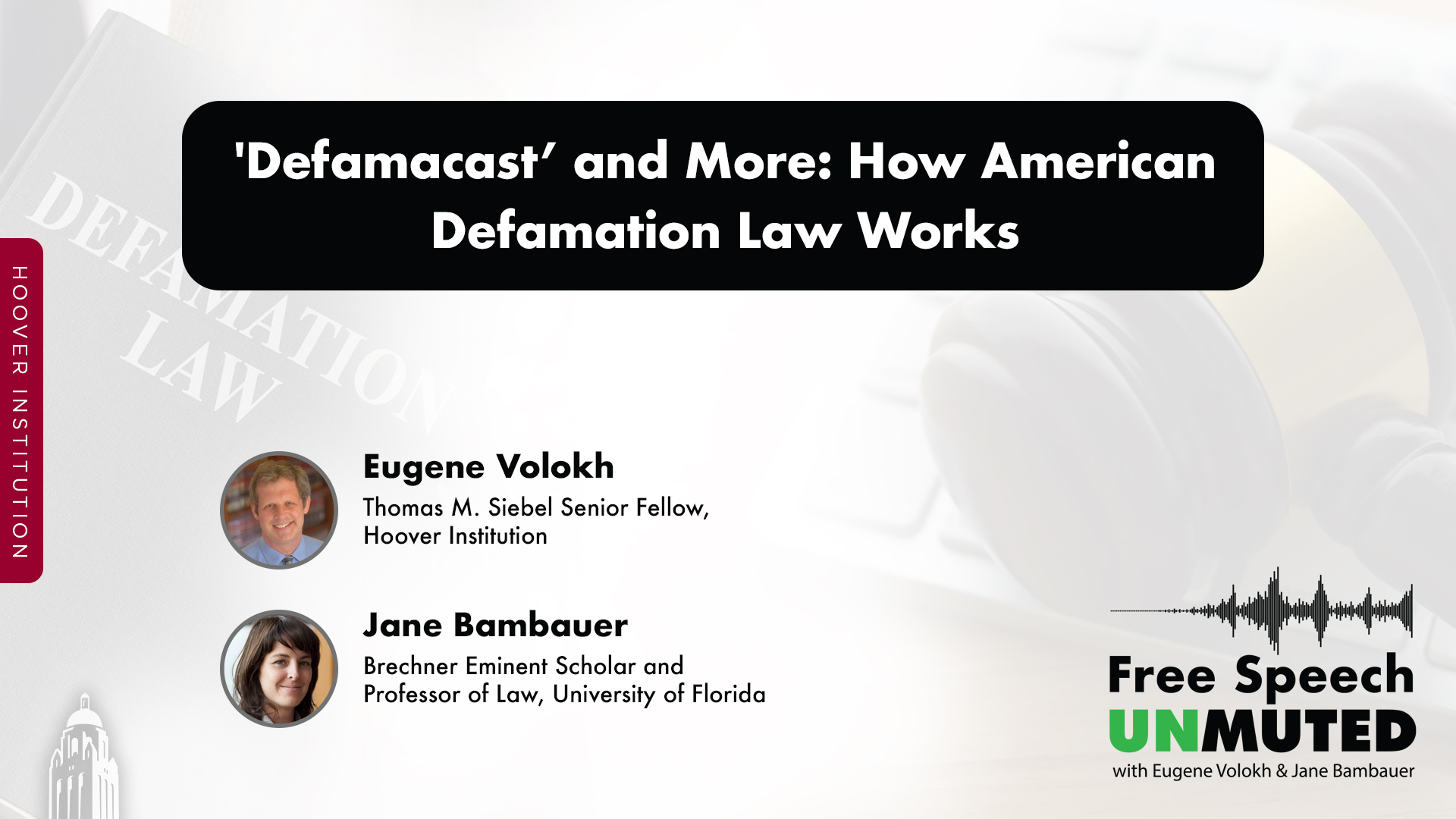
Can you be sued for repeating a rumor—even if you say you don’t believe it? Is calling someone a “racist” an allegation of fact or opinion? In this episode, Eugene Volokh and Jane Bambauer unpack the hidden rules of defamation law, from libel and slander to viral tweets and billion-dollar verdicts. It’s a deep dive into what you can freely say, what you can be sued for, and why the biggest legal battles often turn on the smallest details.
Recorded on April 27, 2026.
- Hello and welcome to Free Speech Unmuted. I'm Eugene Volokh, one of your co-hosts. I'm a senior fellow at the Hoover Institution at Stanford, and a emeritus professor of law at UCLA Law School. My co-host is Jane Bambauer, who's a professor at University of Florida Law School. And today we're going to be talking about defamation law. And the occasion for, for this episode is, it's been much, much in the news for quite a while, but especially recently with some of the lawsuits involving FBI Director Cash Patel, brought by FBI, director Cash Patel. But I, but we thought that this would be a good opportunity to just go through this interesting, important and complicated area of the law. So this is meant as a little, little guide to, to defamation law more generally. Now, one thing that I can promise you is almost none of this is going to be about the actual malice test for speech about public officials and public figures and New York Times v Sullivan. Of course, we're gonna have to talk about it 'cause that's one of the, the legal rules. But boy, it's gotten a lot of attention and I don't want this to be an episode just about that, so we'll mention it a little later on. But the important thing about libel law or defamation law more generally is that it's got a lot of elements far beyond just that in a lot of cases, actually turn on those other elements. Alright, so defamation. Defamation historically has been divided into two categories, libel and slander. Libel, generally written libel comes from in directly Latin term. And Latin derived languages means little book. And historically, by the way, libel has meant, has meant many things in legal cases, including, including just written filings in certain situations. So there could be a libel in admiralty that's just sort of a particular kind of written filing with certain legal effects. But here we're talking about libel in a sense of defamation. The oral analog is slander, which actually I didn't know until I looked it up this morning, comes from the same Latin root scandal. So you might think written in oral, an interesting distinction. How much should turn on it turns out these days not that much. A little bit here and there, but generally the rules are pretty similar, although in part because something does turn on it, the advent of radio and television raised, raised interesting questions about whether they should be classified as libel or slander. Different courts reach different results. The Georgia courts decided it's not quite libel because it's, the statements are usually orum oral, it's not quite slander because slander usually refers to kind of the ephemeral and statements that, that are made orally to just usually a small group of people. Whereas broadcasting can of course be recorded and broadcasting reaches very many people. So they decided to call it def Acast just made up, did not stick. But if you wanna be careful, defamation comes in three categories. Libel, slander, and def acast in Georgia, some cases. All right. Historically, when difference between libel and slander is a slander was generally just a tort, a civil cause of action. Libel could have was both a tort and a crime. It is still a crime in about 10 states. And a few other states have re many states have repealed their, their libel laws, a few of the states that repealed them, kind of working in criminal libel a little bit through the back door, through the criminal law of harassment and a few other, other areas. We're not gonna talk really about criminal libel, but it, it's still on the books as best I can tell. There are probably about 20 or 30 prosecutions throughout the whole country every year. It does happen. It rarely makes its way to publish decisions in appellate courts. I think a, a criminal liable law, if properly defined, is constitutional. I think the court has said that recently a fe, a federal appellate court has, has echoed that Some people say it shouldn't be, but I think if I have to describe what the law is, which is what this episode's gonna be about, then criminal libel is still, is still constitutional. Is it a thing? Well, a little bit of a thing, but that's, can I ask about the question? Yes, please.
- Yeah. Can I ask about the cases, the, you know, the 10 to 20 a year that do lead to criminal liability? Are these mostly, do, do these mostly involve fines or do people actually have jail or prison time and what, you know, and are they meaningfully different in your, in your opinion, from other types of defamation suits? Are they worse in some way?
- Yeah, so they, they, they do tend to involve fines. One state, for example, New Hampshire whose criminal li law was recently upheld by the First Circuit only allows for a fine. Others in principle allow for jail time. Occasionally there's been jail time. They're generally misdemeanors used for many misdemeanors. Courts tend to impose just a fine, especially in a first time offender. One complication to to that story is that most courts do allow injunctions against libel after a trial at which a statement has been found to be libelous. So they could say, well, we find the statement to be false and defamatory. We'll get to all the elements of, of, of libel law, and we're gonna order you not to repeat it. What happens if you do repeat it? Well, that at that point is a crime, it's criminal contempt, but it's really using criminal law to enforce libel law there too. Generally courts use fines, although occasionally I've seen cases where courts essentially say, you are not taking down the stuff that we ordered you to take down. You're repeating it, we're gonna throw you in jail. And, and at least in a few situations, that's what it took for the li bor to stop libel. So it's out there, it's not a big, big thing. We're not gonna talk further about it, I think, unless Jane, you wanna talk further about you an hour later. Well, just
- On that example, just so does that mean that in the second e gene Carol court decision, the one that ultimately awarded the big punitive damages, if I remember right, that was because he had already lost the first trial, the first trial on defamation, and had been ordered not to repeat, and then he repeated it. Is that, am I,
- I I have to say I do not recall the exact details of it. There's just so many of these cases.
- Well, the audience might, you know, the audience can, can follow that along
- And Right, right. Wonder if
- Maybe
- By the principle, you could imagine even like a politician who was ordered, you know, he has to follow the judges' orders. Generally judges are quite reluctant to enforce criminal contempt.
- Well, and then especially in this type of case, so yeah,
- Right. Yeah. And especially with a sitting precedent president, they may say, look, you know, he's got a job to do. We, we can't really interfere with it by throwing him in jail, at least, unless there's really a very, very strong reason. So LIB law historically has been state law, and as a result there's variation from state to state. Most of what we'll be talking about is pretty consistent from state to state. Occasionally we will say something like, well, the dominant rule or the majority rule is this, or some states at least conclude this. But when, but you should recognize that there is going to be variation from state to state. Of course there's also first Amendment law of libel. And by the way, if you broaden it beyond First Amendment into state constitutional rules, which historically throughout the 18 hundreds, for example, the First Amendment wasn't even understood as applying to states. So it was mostly state constitutional rules. They've been used to limit the defamation law since 1802 is the first case that, that I saw, which, which imposed limitations on state defamation law under the state constitution. So there are constitutional rules here, and the, the result, the, is that the current law of libel is a mix of federal constitutional rules. Some state constitutional rules and state law rules. We're probably not gonna distinguish them much just because there's so much else to talk about. But, but it's maybe helpful to understand that it's not all First Amendment law, but it is in part First Amendment law. This is a big deal. So you some may recall there was a $1.4 billion verdict against Alex Jones for, for false statements about, about particular, particular people involved in the essentially parents of of children shot at Sandy Hook. There was the $780 million settlement in the Dominion voting versus Fox News case over statements on Fox News, accusing dominion voting of, of the election related shenanigans, $35 million verdict in Gibson's Bakery, the Oberlin College, as some may recall. That was, that was a, a lawsuit brought over statements mostly by students alleging that ob that Gibson's bakery kind of discriminated based on race racial profile against, against some of its customers. Oberlin College got involved enough in it though, that it got on the hook for the $35 million. There's a $10 million verdict in Johnny Depp. V Amber heard over herd's allegations of, of spousal abuse. There's a $4 million verdict in Cardi bv, Tasha King over, as I understand it, claims of prostitution, drug addiction, sexually transmitted disease, and such different topics. Some of them are kind of, you might think of as political, some of them brought by people on the left, some of them brought by people on the right. And I, I'm not talking just about these ones, but lots of others as well. Some of them brought by very famous people, some of them brought by kind of ordinary business businesses or sometimes by, by just individuals. These are the big verdicts. But, but as we'll see there, there are lots of much smaller libel cases historically, for example, false employment references have been a fertile ground for, for libel claims. And I mean, you know, I'm gonna get millions of dollars from that, but, but that's, that's an important area of defamation. So what are the elements of libel law or let's, I will sometimes use libel law instead of defamation, but really most of what I say here is applicable to, to slander as ma as much as of as libel. It's just that the bulk of the cases out there are, are indeed libel cases. And that's, that's what most people focus on. So
- Before you go into the elements, could I say, could I add a little thing about the difference between slander and libel? Yes. So yeah, you mentioned that in the broadcast era there was the slippage because even though, even though it, the words weren't commit to a fixed, you know, fixed medium, they were reaching the wide audience, potentially people were recording it. And so it just kind of what, what the, the ephemeral assumption broke down. I think with the internet the reverse happened. That stuff that would've been slander where it's just between a few people suddenly got put onto blogs where again, only a few people was right. Were reading em, or, you know, social media posts where really only a, a group of friends see the sort of caddy comments. And so all of this stuff that w in a previous era would've been merely slander and would've had, you know, slightly different requirements for the plaintiff. Didn't make a lot of, you know, it didn't make a lot of sense to, to now apply libel, libel law to it. So, so I think, you know, that this may explain why it's, it's probably on balance good that, that you have more or less merged
- Probably, although you say doesn't make much sense. That's, that's rarely stop the law before, right? That, or to put it another way, generally speaking, rules are created because of a sense that they make sense, but they're often retained in part because it's the rule we don't wanna mess with it. True. Yeah. At least until it's really, really stops making sense, we'll often keep the old distinctions because they're out there. And also, one thing I should say on the internet, I can post something on our webpage and there are very few readers, but if it's accessible, if it's searchable by Google, and if somebody googles this person's name because it may be checking them out for a job or something like that, well then, yeah, then that, that could cause enduring
- In. Well, so yeah, so it has the risk of libel, but the kind of intent of slander,
- Right? There was a sense that like, people are just sort of casually chatting. We shouldn't be like, they're not really thinking things through, they don't have, but edit them, edit themselves. So we should cut them some more slack. Although, you know, when you are writing something, maybe you're not thinking through, but at least you have the opportunity to like, see it on, on the screen. In any event, hard to know. And certainly people have been calling and are calling for having the same rule for slander and libel. In some, some states it's a minority view, but some states do indeed apply the same rule and still unbalance the rules are generally similar. So what are the elements of defamation to, to have defamation? There has to be a, a factual assertion that is false, that is of and concerning a particular person that is published. Although that could be published to just one person, one third party other than the plaintiff that tends to injure the person's reputation sub sufficiently. That is without privilege. There are certain areas where the law recognizes that having defamation liability be especially dangerous or harmful, and it provides privileges that protect people against liability with a mental state, sometimes negligence, sometimes knowledge of recklessness and, and that produces damages or at least is very likely to, to have produce damages. So it sometimes it's proven damages, sometimes it's presumed damages. So those are the elements, let's walk through them because each one has its own, has its own interesting twists and ends up being pretty important in lots of contexts. So first, remember this is a, has to be a factual assertion. Simply insults don't qualify, opinions don't qualify. If I call someone ugly, that may be offensive, but that's not liable if I, if I call someone a fool, even if the person's job generally requires intelligence. That's understood that that's just kind of an evaluative judgment and opinion and not an assertion effect. Now of course you might gather already at that point, like how do, how do exactly do we draw the lines? So let me give an example of, of, of sort of the subtlety of some of this, and then we'll actually give an example involving, involved in involving cash Patel. So let's say that someone that Alan calls Betty a racist courts generally say that is a statement of opinion because, you know, racist means different things to different people. It's famously a matter of judgment. Sometimes it's hyperbolic or exaggerated, but in any event, it is, it's just a judgment call that is going to be understood by the reasonable a listener or reasonable reader as opinion. On the other hand, if Alan says, Betty fired this employee because the employee was black, well that is not just an allegation of racism, it's an allegation of, of specific action. And that is understood as a factual assertion. Now some, maybe it's protected for from liability for other reasons, but, but it is at least potentially an assertion of pact. So one thing that the law sometimes asks is, does the statement convey a message that the speaker is basing it on specific pact? So here are examples from restatement of torts, which is an important reference work on torts. It's not, it's not a statute, it's not created by, by a legislature. So it's not binding law, but it is generally understood as quite influential. So A writes to B about his neighbor's seat, I think he must be an alcoholic. A jury might find this was not just an expression of of opinion, but it implied that a new undisclosed facts that would justify this opinion. Note what's important, and that is neighbor, right? If somebody says about a neighbor, he must be an alcoholic. The implication is that the person has had lots of opportunities to see him. On the other hand, here's another example. A a writes to be about his neighbor. C he moved in six months ago, he works downtown. I've seen him during that time only twice in his backyard around five 30, seated in a deck chair with a portable radio listening to a news broadcast and with a drink in his hand, I think he must be an alcoholic. I think that's a incorrect inference. You know, the fact that that twice you've been in the early evening relaxing with a drink does not make you an alcoholic. I've been known to do that too, but, but that's the, that's a statement of opinion because it indicates the facts, the assu, the assumption in this hypothetical is that the facts are, as the neighbor says, they are in indicates of the, the facts and then draws an inference that the listener can agree or disagree with. But at least the listener understands that there are no kind of other facts that are, that are implied. Because after all, in the hypothetical, I a said, look, I've only seen him twice. Likewise, this is not from from the rest statement, but you could imagine that a writes to B about famous person C, that clearly the statement is
- Not
- Based on a's personal knowledge, it's based on stuff in the news. Oh, he must be an alcoholic. B will understand that that is an evaluative judgment based on what's been in the news and not a statement of kind of knowledge of specific facts. So just, so for example, if somebody says, you know, I saw Cash Patel in that photograph with a hockey team chugging a beer, he must be an alcoholic. Well, again, I don't think that's a correct inference. One can chug a beer or not be an alcoholic, but in context it's clearly a statement of opinion and therefore, generally speaking, not li not subject to liability. Other examples of things that are under assertions of fact is are hyperbole sort of exaggerated statements or statements that are understood to be figurative. There was a case, famous case in the early, well, not that famous, but in the early 1970s, Bressler v Greenbelt cooperative that, I'm sorry, Greenbelt Cooperative versus Bressler, that involved someone calling a developer saying that the developer engaged in blackmail. And the court said, well, in context, that's not an allegation. You committed the crime of blackmail. It's just an opinionated term for kind of excessively aggressive bargaining or something along those lines. So just last week there was a decision in a case Patel Phili, where Phili was on MSNBC's morning Joe, and he said, reportedly, K Patel has been visible at nightclubs far more than he has been on the seventh floor of the Hoover building. And the court says, you know, this is rhetorical hyperbole. He is not literally saying, yeah, you know, if you time, or I guess if you count the number of times he has been seen in nightclubs as opposed to the number of times he has been seen by his coworkers at the Hoover building, the first is greater than the second. No, no, that's not, that's not how a reasonable person would understand this. We understand this is a statement of opinion that he sort of spends too much time in nightclubs. That's a judgment call. Another classic example is parody. So something that in context would be understood as not a literal factual assertion, but a but again, an obvious joke, even if it's told as a factual story, as much parody is, another example is fiction. Where there is, there sometimes are movies that depict depict famous people as characters. And if it in context, it's clear that the, that this is fictional as opposed to, oh, this is based on, on actual facts that is also treated as not a factual assertion. So that's this factual assertion element. We could spend a whole episode just on that because they're all, there are all these fun cases as the wild, we're the wild. There
- Are, there are a ton of fun cases. I do wanna get your opinion on one sort of current controversy that, that i I consider hard. I wanna know if you consider it hard too. This is the Drake case. So in a very popular song by Kendrick Lamar, Lamar sings about Drake, well actually his whole album cover, it shows Drake's house with the sort of the, the, the like the type of map feature that is used to show where pedophiles live. And in his, and in one of his sort of rap battle songs, he, he says that Drake is a pedophile. He says a verified pedophile. He says he's placed on a neighborhood watch Lamar says, and then of course, even, even the, the hook of the whole song or you know, one of, one of the most popular lines is that he's trying to strike a chord and it's probably a minor, a minor. Now what makes this a little harder than I see what he did there, the normal rap battle though is that if it were just, if, if it just came outta nowhere, I think I would assume, eh, it's probably protected just hyperbole or you know, but the trouble is, there has been some reporting that Drake was hanging out with a 14-year-old girl and was having, you know, there were, there were some text messages where he was talking to her about boys and, you know, sort of getting, you know, sort of having, I don't know, more intimate con text conversations with her and, and maybe there's would be a reasonable inference that Kendrick Lamar knows more than any random person about Drake Drake's personal life and might have even more information than what is available in, in the public media. And so I find this genuinely hard and I'm wondering what you think.
- Well, you know, I I tend to think that the court got it right in concluding as a matter of law, by the way, saying it doesn't have to go to even to the jury because as a matter of law in context, this is a loose figurative or hyperbolic statement. It's imaginative expression that doesn't constitute actionable defamation. But, but you know, in a lot of these cases it is a judgment call and the the line may be firm, it's gotta be fact not opinion or fact not hyperbole, but it, when you apply, there's apply it there always so close to that line. There often are close cases, yes,
- Wherever you draw the line, there are gonna be close cases.
- Self defense is a classic example. It's gotta be reasonable self defense. There may be disagreements in, in some close cases. Okay? So then it's gotta be a false statement, at least as when it's speech on matters of public concern. And it's gotta be false in its substance and what the courts call the gist or the sting. So minor falsehoods don't count. If you say somebody's been convicted, was convicted of four counts of robbery, and it turns out he is only convicted of three counts of robbery, you know, it's an error. Obviously we would like people and especially news media to, to publish things that are, that are completely accurate. But, but the law recognizes that there are going to be mistakes. On the other hand, if, if, if someone is, for example, says, says that I, I happen to know from my personal knowledge, I happen to know that Cash Patel is an alcoholic. And then it comes out that, that the only evidence the person gives is, well, you know, I saw him chug that beer. Well, there, the gist or sting of the allegation of alcoholism is quite different from, oh, he has been known to drink a beer or even drink a beer in a way that some might think too enthusiastic. So, so the law does ask if the statement is, is false, but recognizes there's at least some tolerance for relatively minor errors. Now, an interesting question is what if the statement, so we were just talking about how a statement could be literally false, but still basically true because the jester sting is accurate. What if the statement is literally true but basically false? And you say, well, the law can't, can't punish that. We've gotta be like Mr. Spock and look at, look at just, just what literally is said. Although I'm not even sure Mr. Spock operated that way. So, so here's one of my favorite cases. It's a Memphis pub, a publishing company versus Nichols. It's from the late 1970s from the Tennessee Supreme Court. And there was a, an article in a newspaper, by the way, one of my favorite newspaper names, the Memphis Press, Simar woman heard by gunshot, Mrs. Ruth Nichol was treated at a hospital. I'm, I'm reading it literally, but I'm gonna omit a few words for a bullet wound in her arm after shooting at her home. A 40-year-old woman was held by police in connection with a shooting police said a shot was also fired at the suspect's husband officers said the incident took place af Thursday night after the suspect arrived at the Nichols home and found her husband there with Mrs. Nichols Witnesses said the suspect first fired a shot at her husband and then in Mrs. Nichols. So apparently every word there, every sentence was literally true. But I'm pretty sure that the implication that people drew from those sentences is that the woman caught Mrs. Nichols in a compromising sexual or at least romantic position with the woman's husband. And that's why she, she shot her. It turns out, however, that not only were Mrs. Nichols and the husband, that is to say the, the shooter's husband at the Nichols's home. But so were Mr. Nichols and two neighbors, all of whom were sitting in the living room talking when Mrs. Newton arrived, excuse me, when the shooter arrived there around three o'clock in the afternoon. So Mrs. Nichols says, you know, this conveys the implication that, that I was having an affair, and that implication is false. And the court said, yes, the case can go forward. Now, courts are reluctant to accept such falsehood by implication or sometimes falsehood or defamation by omission claims in part because, you know, people can infer all sorts of things from, from, from a statement. Often the speaker can't really expect everything that they will infer. Also, when it comes to omission, you know, every newspaper article, every written work in any situation has to omi much more than it includes. So, so courts are, are hesitant to allow that but such claims. But they sometimes do because sometimes the implication is so strong that we just, this is, this is what just naturally people assume and the literal falsehood isn't gonna save this, by the way, the plaintiff must prove the falsehood in public concern cases used to be the rule was defendant had to prove the truth, the speaker had to prove the truth. Now, the Supreme Court has said, well, in public concern cases, as a First Amendment matter, plaintiff must prove falsehood. But a few courts, at least ostensibly, and sometimes in fact in action apply, allow liability even for true statements if they're on a matter of private concern. And if as we'll get to shortly, they damage reputation. So here's my favorite case, Johnson v Johnson. So the, what happened was this, the, the ex-husband of the plaintiff went into a restaurant where she was sitting with her then boyfriend and called her a whore. And the court said in context that meant not necessarily a prostitute, but someone who was sexually promiscuous. And that in fact, based on the findings of the, of the lower court, that was probably true, but it wasn't a matter of private concern tended to damage reputation and therefore that could be a basis for, for defamation claim. Not an invasion of privacy claim, not an intentional infliction of emotional distress claim, but but of, but of a defamation claim. It's kind of exotic. Most states say it's gotta be false, but there are a few states that say, again, on purely private matters, even true statements could, could be actionable.
- So do, how, how does that case differ from how the case would be analyzed using public disclosure of private facts? Is it that there's no publicity? We mentioned that defamation requires only publication, right? Some of the other torts require a broader audience publicity. So it's
- An interesting question. Not all states recognize the that's true. The or private facts, privacy, tort tort. So, you know, probably the first, I'm sorry, another possibility might be that this, that the woman's past affairs were well known in the community. I mean, maybe that for example, there were the basis for the divorce, there were publicized as a result of that. It may be that she did not hide them. So as a result, it might not be a private statement, but it may be something that's still, still damaging, diminishes her reputation at least with other people who didn't know about it in, in the,
- Yeah.
- Okay, so here's another important question that arises under the falsehood. Let's say that Alan says to Betty, someone told me that Charlie was fired from his job for stealing from petty cash. And it is absolutely true. Someone did tell Alan that Charlie was, was thus fired, but in fact Charlie was not fired for stealing from PE from petty cash. Maybe he wasn't fired at all or maybe he was fired for something else. So the question is, does defamation law look to the literal statement? Someone told me Charlie was fired for stealing, or does one, does the law also consider kind of the embedded statement, which is Charlie was fired from stealing, fired for stealing. Excuse me. Yeah, and the general answer is that the law looks to both, this is a so-called republication rule. So sometimes rendered as tail bearers or as bad as tail tellers that someone who passes along falls and defamatory story is himself liable for that.
- And that in fact, you can't even say, somebody told me that Betty was fired, but I don't believe it. Right. Even that still bears the original sin for and exactly for anyone who hadn't the first rumor, you're now giving it to them.
- Right, exactly. And, and if you think about it, that's, that's gotta be in some measure, some version of that probably has to be, not necessarily has to be, but probably has to be the rule. Just because otherwise people could spread all sorts, in fact deliberately spread lies about people simply by saying, well, someone said the following, so long as someone did indeed tell them, tell them that. But there have to be lots of exceptions to this. So let, let me just give one that is, that is most clearly has to be present. It's the so-called fair report privilege, Which focuses on fair reports of government proceedings. Quintessential example is a, is a court case, although it also extends to the legislative and executive proceedings. So let's say you're writing, you're writing a, a story about a criminal trial and you need to say, this person, defendant was accused of this crime. You need to be able to quote the indictment or the testimony at trial. And the law has long recognized that people have a right to do that. So long as it's a fair report, so long as it's, you're not just deliberately choosing one, one sidedly what what to include and not include say, exculpatory evidence at the same time you, you talk about the inculpatory. So there, it's just recognized that there's a very strong reason to be able to report on what somebody is saying, even if you're not sure that the allegations are correct, even if you doubt the allegations, you need to be able to, you, the journalists, but also ordinary citizens need to be able to talk about such things. Another example is a so-called wire service privilege where newspapers can republish and, and I think others as well can republish originally was things like from Associated Press and such so-called wire services, but also from other reputable sources. That is a general matter generally speaking oversimplify here. But those states that recognize it and, and I think all states do accept it in some man manner or director and direct, you're not gonna be liable for passing along information from a reputable news source. There are other privileges that are more controversial, but one that I wanted to mention is 47 US C-section two 30, part of the so-called Communications Decency Act of 1996. And that says that internet service providers are not liable for things that are posted on their sites by users. But also it goes more broadly that it's not even just when they automatically accept it, but even for example, like a lot of courts have said things like retweeting for example is, is immune from liability. So long as you don't, don't kind of fake a, a tweet, but if the tweet turns out to be to be incorrect, you're generally speaking oversimplify it, but generally speaking, your immune from liability. So that's a limit on the republication. Again, you could have a whole whole episode just about that. Now what else? It's gotta be of and concerning the plaintiff, that means it's gotta be about the plaintiff either has to name the plaintiff or has to be pretty clear that you're talking about the plaintiff. Plaintiff could be an individual, could be a corporation. There's also a related tort called trade libel, which concerns essentially false and defamatory statements about products very close to libel of corporation, although the focus is more on supposed defects in the products as opposed to misconduct by the business. There's a torch slander of title which covers false statements that essentially cast out on someone's ownership of property. Note that this doesn't cover defamation of large groups, racial groups, religious groups, political groups, and it doesn't cover defamation of government entities. So if, if somebody says something even deliberately false about some school district or some town or the US government, that is not subject to defamation liability because it's not of and concerning a particular person including corporations, but not including government entities. Okay, so that's of and concerning. There's also the so-called publication requirement, which is, which just reminds us how natural it is for lawyers to use English words to mean something that's related but different. Yes. You think the publication and yeah, Jane, you alluded to that earlier because there's a similar publicity requirement in some of the privacy tots. It's actually quite different of the publication requirement. You think publication would mean no one gotta put it in a newspaper or at least on the web. And if I'm just chatting with someone that's not publishing well yes, it is. For libel law purposes, publication is conveying information, and again, I'll oversimplify here, but basically just to one person
- At least to one person
- Other than the plaintiff. Other than the plaintiff. Excuse me, Jane, you're quite right. At least to one person other than the plaintiff. So again, classic example of of, of defamation is a false and def and reputation damaging employer statement about an ex-employee. Yeah, we fired him because he was stealing. That could be said just to one person, just to the, to the prospective future employer could very well be defamatory. Another classic example is a letter to someone saying the person you're about to marry is a criminal or cheated on you or whatever else. It could be just to one person, that's enough. However, if Alan goes to Betty and says, Betty, you are a thief. And Betty says, no, I'm not a thief. She can't sue Alan for defamation for the statement to her because she knows she's not a thief. Because you're not gonna damage a person's reputation. You might hurt a person's feelings, but you're not gonna damage a person's reputation by talking just to them. Of course, you might ask, well, what if Alan says to Betty, you know, last night when you were drunk, you cheated on your, your, let's say, spouse on, on your husband. And Betty, Betty believes it because she was drunk. She doesn't, doesn't remember. You could imagine that actually causing a lot of the same harm that reputational damages caused to others. Maybe, maybe as a result she now says that to the husband and then the husband believes it. Or maybe she is very upset with herself, whatever else. It's an interesting question. I don't know of any cases on that. I wonder why not. You know, it's not, it might
- Be a good IIED case, even if it doesn't,
- Maybe maybe intentional infliction stress case.
- Yeah.
- But in any event, that's basically the publication requirement. Then there's another requirement is it has to be generally the sort of thing that tends to injure reputation that's separate from the damages requirement to, to quote one chord tends to injure one's reputation in the common estimation of mankind to throw continually. Sometimes they add obliquity of
- No, my gosh,
- Shame or disgrace upon him, or which tends to hold him up to scorn, ridicule, contempt, or which is calculate calculated to render him infamous, odious or ridiculous. What, what it basically means is it's gotta be not just, oh, you know, this person let's say saying that, that this person is, has, does drink alcohol. Turns out he doesn't, that by itself doesn't damage a person's reputation. Maybe it might in some situations, for example, if the person is a minister in a teetotaling religious group or even just known as a teetotaler, maybe that show that he's a liar. But if you just say, you know, I saw this person drinking it turns out you're mistaken. You, you, you go, I saw this person drinking alcoholic beverage. It turns out it was club soda. Well, you know, by itself it's generally not going to be defamatory, even if it's false. Likewise, if you say, you know, this person's article makes all these, makes like say some false assertions, turns out you're mistaken. You know, it's not good for someone to be known as someone who makes mistakes in articles, but by itself probably does not throw continually shame or disgrace on the other end. If you say he's a chronic liar, that's a different matter. That might be something that that is damaging. Okay, what else? You
- Say he made up this data even a single time, I think.
- Oh yes, absolutely. I was about to say them fighting words. No, that's a different category.
- It might also, yeah, not fighting. That's how you get if you, yeah, that's how you can do one-to-one directly to the plaintiff
- And stuff. Exactly. But even there, I don't, I I don't think just saying to someone you may update even if you know that he's gonna wanna punch you for it, because that is a very serious accusation about a scholar. I'm not sure it's fighting words, but, but if you say that about him, that that is almost certainly defam, at least potentially defamatory. This element is says another element is it's gotta be unprivileged. What does that mean? And privilege means different things in different contexts. So for example, there are evidentiary privilege is lawyer client privilege, which is to say that, that you can't force a lawyer to testify about client communi confidential client communication or clergy penitent privilege. You can't force a priest to testify about wo is said in the confessional. This is a different kind of privilege. This is a privilege in the sense of a defense de liability. And they fall into two categories, absolute and qualified. What does that mean? Well, let's look at some absolute privileges. Classic examples are witnesses in court, judges or lawyers in the process of litigation, lots of things are said in court, the damage a person's reputation and that the person might say are, are false. And the the law does not allow lawsuits brought based on it. It's absolute, you, you just can't sue because somebody said something that you say even that you can prove is false about, about you in, in a court proceeding, let's say, or connected enough to court proceedings. Now you could, if it's in a court filing and it's false in a civil case, you could get sanctions against the person maybe 'cause of the rules within, within the court proceeding. You could, if it's a, if it's said by a witness under oath it and it's a knowing falsehood that's perjury. It could be a criminal prosecution. But the legal system's view is if you allow defamation lawsuits based on that, then not quite every trial, but very many trials will lead to further trials about alleged alleged defamation in them and then further trials and turtles all the way down. And the law says that would unduly interfere with the administration of justice. So the
- Privilege, no question what if, what if you get that witness to also say the same clin statement out of court.
- So that's an interesting question. Generally speaking, the out of court statement would be potentially actionable. Now what if somebody quotes the in court statement, is that covered by the fair report privilege? Remember we talked about Yeah. Should be the publication rule be,
- Unless, unless they fall outside the privilege, which we're gonna talk about, I'm sure, but
- Right, so that's an interesting question. Some states say essentially you can't bootstrap your way to that kind of privilege by filing, let's say filing a lawsuit and then quoting it, saying, here's the lawsuit I just filed. Other states do allow that. Likewise, you could imagine, don't know of any cases that quite fit this category, but I think the logic of some of the cases suggests that if a witness says something in court and then repeats it out of court, even if he says, here's what I said in court, maybe that's the kind of thing that's, that, that would be outside of the fair report privilege. But, but certainly the in court statement is covered by the witness privilege and at least in at least quotes by others of that statement, outside court would be covered by the fair report privilege at least potentially covered. And that's an absolute privilege. As I said, that's something where you can't, you can't successfully sue over that. Even if you can show that it's a, that it's a knowing falsehood, then there's so-called qualified privileges. Classic example is what's sometimes called a common interest privilege. People are trying to decide whether to, to kick someone out of a club or out of a religious organization. And people say, you know, here's what I understand about this person. You ha there's the shared common interest. And that's an seen as an important interest to protect against excessive risk of di defamation liability. But it's qualified generally speaking that it means that you are going to be not held liable for innocent mistakes, even unreasonable mistakes in many states, but deliberate lies are not covered by this qualified privilege. Another example of this is most states recognize a qualified privilege for employment reference. I mentioned employment references are, are potentially libelous. Potentially defamatory, which is why a lot of employers refuse to get them. But the law says the law's position is, well, you know, we, we one don't wanna discourage them too much, so at least we'll provide some protection. For many employers, that's not enough. They don't wanna get sued, they don't want even the risk of liability. But there is, at least I oversimplify here, but in general, at least some protection for, for honest statements about, about an ex-employee generally speaking. Okay, so that's without privilege. We've got two more elements to go. One is with a culpable mental state, generally speaking, in most states, that means that you have to show that the defendant, the speaker, was at least negligent that reasonable mistakes are seen as, even if it's harmful to the plaintiff, it's just an unfortunate accident. Just like with physical injury, if I accidentally injure you and I was acting perfectly reasonably, it just, just so happens that, that I run into you, let's say with my car, but, but I was driving perfectly Well, maybe you darted out into traffic or maybe it wasn't even your fault, you got pushed out into traffic, I hit you. Well, if I acted reasonably, I'm not liable. Likewise, if I did reasonable investigation, I would, I would generally be found not to be negligent. So for example, there's this lawsuit by Cash Patel against that, against Atlantic where the author says, I've got all of these anonymous sources, which tell me that that Patel has been absent from work in various circumstances, apparently has been drinking a lot, and so on and so forth. If that's, if it's true that this person has all these anonymous sources, then even if the sources are wrong, it looks like that person probably the reporter, probably did reasonable investigation. Even in the absence of New York Times v Sullivan First Amendment protection, that reporter would probably be, be off the hook because the reporter was acting reasonably. And the in part because the law wants to encourage coverage even of things that reflect badly on people, whether government officials or otherwise, so long as there's reasonable investigation.
- Now, I saw in his complaint Cash Patel, you know, alleged that the, the, the Atlantic only gave him and his office two hours to respond. My under, I mean my understanding, it's, it's true that journalists often are trained to avoid getting, you know, avoid getting close to the negligence line by, among other things, always having, giving the option to of, to the subject of the story to res to respond. But it's not like that's a determinative fact, right? It like if you have 12 sources who are all high quality, even if they had never gone to Cash Patel, the the reporting still might be non negligent. Do you, do you agree with that?
- It certainly might be, it certainly might be, but of course negligence here is elsewhere is one of these totality of the circumstances, right? Yeah. It's questions, what's reasonable. Very often that's gonna end up going to the jury and the jury will usually consider whether you gave someone an opportunity to say, no, no, this is all a misunderstanding, or oh yeah, all those sources, here's they hate me because I fired them for, for, for being incompetent, let's say, or they're my political enemies. So,
- Or they're total prudes who don't like to drink. Huh? Just kidding,
- Prude. There you go. There you go. They're keto alert and they do any kind of drinking us. I dunno. But, but in any event, so yeah, there, there is no rule of liable law that says it is liable. It is defamation if you don't call the person for, for their side of the story, but it might be relevant to negligence. So in part because negligence is such a mushy standard in the nature of things, it's a mushy standard. It's a mushi standard with with with car accident lawsuits as well. The Supreme Court famously said, and I did say we have to talk about it, but at least we haven't just talked about it famously said in the New York Times v Sullivan case, that when it comes to lawsuits by public officials, an interesting question, by the way, wheres the line between public official and am mere low level public employee? Well, the director of the FBI, clearly a public official by public figures, people who are very famous or influential, they're general purpose public figures, even if they're not government officials or limited purpose public figures, which could be just an ordinary person who just got involved in some public debate and for lawsuits brought by them or for limited purpose public figures for lawsuits brought by them about the debate they got involved in. There's gotta be proof of knowing or reckless falsehood, not just negligence, false negligent falsehood and recklessness basically means knowing the statement was likely false and going along with it in any of it. This is a so-called actual malist, which is not actually about malice poorly named
- Yes, exactly,
- Exactly. Better to think about it as no knowing, publishing a statement, knowing it was false or knowing it was quite likely false. That's the recklessness part. And there I think it would be very difficult to prove, unless there's some extraordinarily strong evidence, very difficult to prove in that lawsuit over that Atlantic story that the reporter knew that the sources were lying to her and published in any anyway. Now, of course, if the reporter made up the sources, well that's pretty powerful evidence, but there's no reason, no reason to, to think that, that I, that I know of and simply carelessness or something that a jury might find to be carelessness. Famously New York Times v Sullivan says, that's not enough. It's controversial, but that's, but that's the current, that's the, that current rule. Then we turn to damages. For many torts, you've gotta show damages. If somebody, for example, hit me with, with their cars, I was crossing the street, but I was just, wasn't injured, fortunately it was just a low speed, I could have been injured, but I wasn't no damages. I mean, damages could be emotional distress, pain and suffering. But let's say I wasn't, there was no pain, there was no suffering, no damages, no tort, not necessarily so in libel law and in, and actually defamation law, although here the rules are sometimes in some states different, reliable for slander that the law has long recognized that among other things, reputational injury may be especially hard to, to, to I to, to prove. Because if people stop going to your business, for example, because they don't trust you anymore, they're usually not gonna send an email saying, oh, and I've stopped going to your business because I don't trust you anymore because of what somebody said. They just stopped showing up. So the law has generally recognized that at least in certain kinds of situations, and this varies by state, but fame, the famous examples are when there's an allegation of criminal misconduct of crime, when there's an allegation of something that reflects that, that suggests you're incompetent at your profession. Or sometimes there's a suggestion of very serious sexual misconduct, including perhaps cheating, let's say cheating on on one spouse. That in those kinds of situations, damages can be presumed. Now on for statements and matters of public concern, the court said that even when this is a private figure, so they can get proven damages on a showing of negligence. Presumed damages require knowing or reckless false. Likewise, punitive damages generally require knowing a reckless falsehood, even if they're about, about private figures. So there's this complicated law of damages. Some states also require just the showing of damages that don't allow presume damages. They require you to show you actually were injured. The theory is, look, if you, if you're not, the court shouldn't give you, give you an award of money just based on speculation. So, but so the interesting thing is, is while this is really important, in some cases it's not gonna be that important in ka Patel's cases because he's clearly a public official. He's gotta show knowing a reckless falsehood. I think it's pretty unlikely, at least as the Atlantic, he's gonna be able to show that. But if you can show that, then you get both, both proven compensatory damages it and if he lost some book deal as a result, or lost his job as the FBI director. But you could also get presumed imp punitive damages just because he had to, in the first instance, show knowing a reckless falsehood. But if he can't shown knowing reckless falsehood, he can't get any of those kinds of, those kinds of damages. So those are the elements. Let me close with two other important points. Stepping back one point is these are the formal legal rules, but plaintiffs have a pretty big advantage, at least certain kinds of plaintiffs beyond those formal legal rules, which is litigation is very expensive. Now it's expensive for plaintiffs, but it's also expensive for defendants. So especially if it's a well-heeled plaintiff suing a defendant who doesn't have a lot of money, maybe enough money to have to pay damages, but not enough to hire a lawyer and litigate the case for potentially years. The plaintiff can essentially pressure the defendant into settling even if the defendant settling, which is to say, baby, pay some money and take down the statement and publish an apology, and so on and so forth, or retraction. And sometimes even if the defendant does have money, the defendant might say, we don't wanna spend the money on that. Let's say if you're a struggling newspaper, you know, you could afford to litigate the case, but that might mean you have to, you can't hire some new reporters. Even if you win, you lose because you lose, lose all the attorney fees. At the same time, there are also protections for defendants beyond the formal legal rules. One is many states have so-called antis SLAPP laws, slap, S-L-A-P-P is an acronym that someone going for strategic lawsuit against public participation. Classic example was a real estate developer who threatened to sue critics in the neighborhood critics of a, a proposed development. And the goal was just to make them stop opposing it rather than, rather than to to get damages. Let's say that's the threat that, that made it work. So anti-slap lows go way beyond generally speaking that particular context. Most states have one or another version of them, some broader, some narrower, and they provide various protection for defendants that chiefly focus on two things. One is getting the case quickly disposed of including a quick appeal if necessary. And the second is having the plaintiffs have to pay the defendant's attorney fees. If the case is immediately disposed of, by the way, that's asymmetric. If the plaintiff prevails, the doesn't have to pay the plaintiff's fees, but if the defendant prevails at this initial antis SLAPP motion, well then the defendant, the plaintiff has to pay the fees. That could be quite a deterrent for plaintiffs and it could be an encouragement for defendants who have strong cases to, to litigate this. The antis SLAPP laws don't generally just preempt the defamation case. They only allow the case to be, excuse me, don't they don't just preempt defamation law generally. They don't just say there's no more defamation tort in our state. Rather, what they say is that the defendant can get the case dismissed if it's, if it's legally insufficient. But if the plaintiff can show some plausible merit, the plaintiff's case can, can go forward. So the plaintiff still can sue. But if the defendant Feels like this really is a very weak case in the plaintiff's part, the defendant will be emboldened by the presence of anti-SLAP law.
- You know, they have the incentive to, to, to show, you know, to, to show the weakness of the, on the merits of the plaintiff's claim. Right.
- And less disincentive to litigate. And of course there could be a lawyer who says, well, I know you can't pay me my hourly bills, but I I feel strongly about your case. I think you're, you're gonna win. So I'm gonna be able to get the plaintiff to pay my bills. Yeah. So that, that's really quite, quite important. Note, of course, not all states have them in, there's a disagreement among federal courts whether and to what degree these laws apply in federal court. So in some, in some places, if the case ends up being removed to federal court, for example, the parties or citizens of different states, then in that case the anti-SLAP law won't apply. Another important thing, which people often miss is libel insurance. Most newspapers and other publications like that, professional publications have libel insurance. Now that may not cover the, the entirety of a possible verdict, but it generally does cover reasonable attorney fees. Insurance policies don't just provide a duty to indemnify the defendant duty to pay for the verdict up until a up to a certain cap, but also a duty to defend, to hire a lawyer to do that. That is often the value of the insurance policy. So that's, that's pretty important. Now, as a practical matter, people still don't wanna be sued for liable. There's going to be a deductible that they have to pay. They may, they, they may wanna hire a lawyer that's, that's more expensive than the insurance policy will cover, so they'll have to pay some of the lawyers' fees. Plus also, of course, they might be afraid of losing their insurance, having it canceled if, if they make a claim under it or have having it cost more. But it's important to realize that most media defendants, especially if they, if the case is pretty clearly weak, so they're not gonna have to pay millions of dollars above their insurance limits, most of them are not that intimidated by the threat of a libel lawsuit because they've got insurance. Because they say, look, if this is a weak case, then the insurance will cover our attorney fees. At least that, that's the main concern people have. By the way, many, not all, but many homeowners insurance policies also cover libel, often confusingly under the rubric of bodily injury, even though it's not bodily injury, it's reputational injury, libel against slander, invasion of privacy as well. So if somebody threatens to sue you for, for defamation, dear listener, you might wanna check your homeowner's insurance policy if you have one, and, and see if it, if that's covered. I have seen cases, I've been involved in cases as a, as a friend of the court where yeah, it was an ordinary small time defendant, like just, just one of them was a college student who happened to be covered under his parents' homeowner's insurance policy, and he was defended by a lawyer who was hired by the insurance company. Now, there's an exception in many policies for business pursuits. So if you're running a blog, let's say, and you get even, I don't know, $50 a year in advertising revenue, that might lose you, your, your insurance, homeowner's insurance coverage,
- Get rid of the ads, not worth it.
- Totally not worth, just get rid of the ads. Totally. Exactly. Exactly. But for many people who just post things on social media, don't make any money from it, they, they may very well have coverage. And the last thing of course, is the streis a effect. The famous Streis a effect, Barbara Streisand, I mean, she's, she's, I'm told a gifted enough singer. I'm not so much care for music, but lots of people do that. She'll probably be, remember, remembered for more than just the Streisand effect. But right now, this stage in her career, many people know her. The Streisand effect, Barbara Streisand has a lovely house near the beach in a, a Los Angeles suburb, I wanna say Malad. And somebody posted a aerial photo of that house on their site, got virtually no attention except Streisand learned about it, got really upset. She had no legal basis to sue, but apparently there was a threat at least of a lawsuit. And then what happens is all this coverage, and then everybody went to the site to see her, to see her house. So the strongest end effect, or first to the danger of suing for basically invasion of privacy or defamation, it just further amplifies the original statement or allegation. So a lot of even people who even have perfectly legitimate libel claims, like somebody was outright lying about them in a way that potentially damages the reputation, might be reluctant to sue because that may just exacerbate the damage. And by the way, as a lawyer, I have often advised clients saying, look, you know, there's, at this point, you're a big business this point, there's a small website that is posting some allegations about you. Nobody's really noticing. Maybe a few people are, but not a lot. If you file a lawsuit against them, there's gonna be a news story. Big business sues small site. And of course the story will have to explain over what, and the fair report privilege will allow them to, to say, oh, over these particular allegations, and that will just amplify the allegations. And that's an unfortunate way of, of a feature of the way our syst our system works, but I think a necessary one, we have open courts, people are allowed to cover what is said in court. Generally. You can't seal alleged libels, you can't sue it as a John Doe in a libel case. I've actually intervened and filed briefs in cases supporting that proposition because I, I, I'm, I'm in favor of open courts, but one consequence is just as there's some libel lawsuits that should never have been filed and are just attempts to bully the defendant in submission, there's some perfectly good potential libel lawsuits that aren't filed because the plaintiff is afraid of amplifying the original statement. Or for that matter, of course, the plaintiff may just not want to, may not be able to afford a lawyer as well. You have to worry about defendants who can't afford lawyers, but plaintiffs often can't afford lawyers too. Okay. That was quite the sprint, long sprint through a long, however, even longer, more complicated body of law. Jane, what's your thinking?
- Well, just on the last point, I remember a kind of interesting study by Marat Mangan and, and Nuan Arbell finding that there's another downside to not suing, or that there are, there's a downside to suing the, the St strike and effect and other things, the cost, et cetera, if you've been defamed. But there's also a downside to not suing because then the audience does, you know, marginally, but significantly, you know, at least it looked statistically significantly assume that if you don't sue it, it's because there must be some truth to it. So, which makes sense from
- Right, you
- Know, from the inferences that people can draw if they know what your options are. Right. So, right.
- So that's right. And that's just a way of, of, of that. That's just think a special case of a broader pro proposition we should realize, which is that lawsuits are often filed or not filed as business decisions and not, or
- Yeah,
- Or personal decisions. Yeah,
- Personal brand
- Decisions. But yeah, personal brand decisions very well put. And not just as a purely legal decision, just as a lawsuit can further amplify the original allegation. A lawsuit could be a news hook that amplifies your denial If you just put out a press release saying all those statements about me are false. Maybe some people, some media outlets will cover that. If you file a lawsuit saying that, probably more media outlets will cover that, that will, again, repeat the allegations. But especially if the allegations were very widely spread, you may not worry about that so much is you might want to make sure that it repeats your denial of those allegations. Right. Yeah. And so, so these I think are, are, are important concerns. At the same time, of course, you could imagine at least some people in, say, some people not much caring that someone failed to, to sue among other things, because they may know that it's so hard to win a defamation lawsuit. I understand why people don't sue. So it's a, it's complicated and the calculus may end up being very different in different kinds of cases that, that I think people can reasonably decide to sue or reasonably decide not to sue in many kind of contexts.
- No. Yep. It's complex.
- Well, well, all right. All right. So I hope, dear listeners, that you have found this useful. It's a little, little less newsy than many of our, of our other episodes. We did tie this into the, to the Patel litigation, but this is stuff that happens all the time in all sorts of contexts. It's just really important, I think, and I think a lot of these kinds of rules like the fair report privilege and, and although concerning requirement and others are not paid enough attention to, especially once they're, the debates, are all focused on the big picture, first Amendment stuff like the actual malice, the misnamed, actual malice test. So I hope you found it useful and we look forward to your tuning in. Again, tuning in, remember the radios, tuning in on the radio, tuning in on YouTube or, or whatever podcast platform you use for, for our next episode. And by the way, a reminder, if you like this podcast, subscribe, they'll just make it easier for you to get access to our future episodes. Jane, thanks very much for joining us.
- Thank you, Eugene.
- This podcast is a production of the Hoover Institution, where we generate and promote ideas advancing freedom. For more information about our work, to hear more of our podcasts or view our video content, please visit hoover.org.
ABOUT THE SERIES
Hoover Institution Senior Fellow Eugene Volokh is the co-founder of The Volokh Conspiracy and one of the country’s foremost experts on the 1st Amendment and the legal issues surrounding free speech. Jane Bambauer is a distinguished professor of law and journalism at the University of Florida. On Free Speech Unmuted, Volokh and Bambauer unpack and analyze the current issues and controversies concerning the First Amendment, censorship, the press, social media, and the proverbial town square. They explain in plain English the often confusing legalese around these issues and explain how the courts and government agencies interpret the Constitution and new laws being written, passed, and decided will affect Americans' everyday lives.

