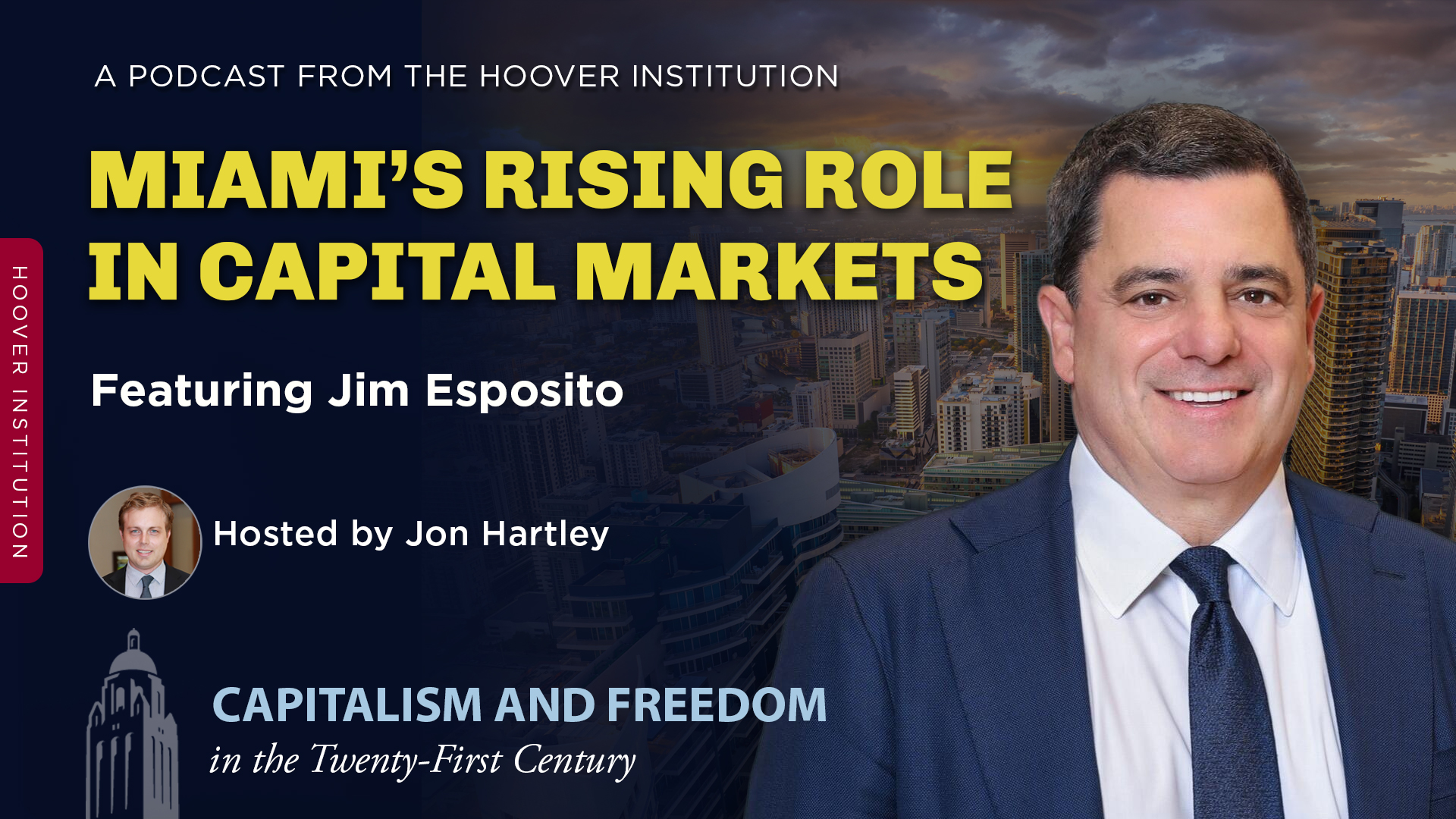
Jon Hartley and Jim Esposito discuss Jim’s beginnings, his career in senior roles at Goldman Sachs in New York and London, and moving to Miami to run one of the world’s largest broker-dealer and market makers, Citadel Securities. They also discuss the rising role Miami is playing in global capital markets (becoming “Wall Street South”) with Citadel’s moving its headquarters there, ongoing trends in the economy, and the rising role of AI in finance and business.
Recorded on February 27, 2026.
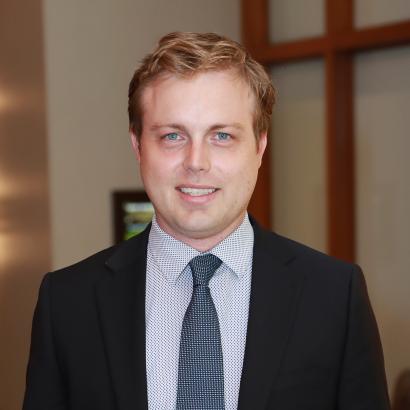
- Thank you everyone for being here and for coming to the third annual Miami Economic Forum hosted by the Economic Club Miami. This talk is also a live recording of the Capitalism and Freedom in the 21st Century podcast of the Hoover Institution, where we talk about economics, markets and public policy where I'm, I'm Jon Harltey, your host. I'm really excited to speak with Jim Esposito today. Jim is the president of Citi Citadel Securities, where he's responsible for driving the long-term growth of the firm's global client and partner relationships. He previously worked at Goldman Sachs for 29 years, where he was co-head of Global Banking and the Global Banking and Markets division. He was also the co-head of the Investment Banking and Global Markets Division divisions separately before they were merged to both the investment banking and broker dealer divisions. He served on the management committee. He co-chaired the partnership committee. He also earned his BA at Brown where he is a trustee and he also holds an MBA from from the Tug School of Dartmouth University, where he is also on the Board of Overseers. Welcome, Jim, really thrilled to have you here.
- Thanks John, for having me. I wish you would've said, but you look so young given all those accomplishments, so you missed that moment for me.
- Well, well you do. So I appreciate it.
- Never too late.
- I appreciate it and appreciate you being here. And you know, we're sitting here in Miami, some call it Wall Street South. I know our audience is very familiar with Ken Griffin, Citadel's founder. We had a chance to speak with Ken a few years ago here, but I suspect that folks may not be as familiar with Citadel Securities. I'm curious, you know, what's your, what is Citadel Securities role in financial markets?
- I think that's a great place to start, John. I do think there's sometimes a lack of understanding. You know, when people hear Citadel, the meta brandand, and I'd start from this place of reminding the group that Ken Griffin didn't just found one incredibly successful company. He actually found it too. I find people are very familiar with Citadel, the asset manager. That's the hedge fund side. The hedge fund is generally considered to be the most successful hedge fund ever launched, and that's based on the return performance of that fund. I have nothing to do with Citadel the hedge fund. So I am president of Citadel Securities. We like to think of ourselves as a next generation, really a technology driven market maker. We make markets to clients across global equities and fixed income. Many of you would see the big trading floors in New York that a bank like JP Morgan, Morgan Stanley, Goldman Sachs has, we're the equivalent of those big banks In global equities where we are particularly big, I would suggest we're actually bigger than those same banks that I just named. We trade more equity flow than anybody else around the globe. And when I sort of, you know, go through what we actually do in equities, I think this will inform the group's thinking for the talk we're about to have, we execute equity volumes through three distinct channels. The first is our on exchange market making business to put that business in context on any given day, we're about one third of the volume that gets executed on the New York Stock Exchange. So very, very big on exchange presence. The second place we have a large client presence is in the retail market around the globe, but particularly here in the US we account for about 35 to 40% of all retail flows across single shares and equity options. So if any of you have an account at Robinhood or Charles Schwab or many other retail brokers, we're basically the, the execution engine for those platforms. Dominant retail presence. And then the third place we meet clients is directly with the biggest institutions in the world. These would be names you recognize from BlackRock to Fidelity Capital Research, pimco, all of the large sovereign wealth funds, insurance companies, pension funds, and hedge funds. So you know where the 800 pound gorilla in markets. And we'll talk a little bit about how we accomplish all that. I'm sure
- It's, so I'm just curious like what, what makes Citadel Securities different or what sets it apart from say like JP Morgan or or Goldman Sachs, I know JP Morgan, Goldman Sachs, or I think bank holding companies. How is Citadel Securities different in, in this market making business?
- Yeah, in a couple ways. We are solely, I should say maniacally focused on market making. We don't have an asset and wealth management arm as I suggested. Ken has the separate hedge fund. We don't have an investment bank attached to us. We don't underwrite IPOs or debt issuances solely focused on market making. But importantly I would say versus the traditional big banks, we have two, what I like to think are competitive advantages. The first is we have achieved an operational scale and efficiency by leveraging technology that I think is really the envy of not just the banks but maybe any other company on the planet. And I say that because we account for about just shy of 25% of daily US equity flows. And we only have 1900 professionals in all of Citadel securities. If you were to look at the headcount, those big banks have against the same opportunity set. They have 10,000, 15,000, 20,000 employees doing middle and back office settlements. The banks talk about now leveraging tech technology generally incorporating AI to become more efficient. I would suggest we've already accomplished that. And so we were a company built and founded on the principles that technology is the best way forward. We've been at this now for well over 20 years and we've extracted that technology dividend in the way that maybe some of your own companies are only now starting to think about the second competitive advantage that we enjoy. We're very good at monetizing very basic trading flows. And the reason for that is we really sit at the intersection of where finance meets quantitative research and technology. And so when I look at the composition of our 1900 professionals, about 300 of our employees hold a PhD. And these PhDs are kids that come to us from literally the best schools around the globe. And these are kids that got a PhD in math, statistics, computer science and physics. We attract the best and I mean the very best in those STEM educational fields. Our CEO pun JAO was born in China, came to the US to get a PhD in statistics at Cal Berkeley. P is very much a talent magnet attracting, you know, some of the brightest PhD mines in our country. By the way, many of them actually sit here in Miami. We have a big quantitative research and capability here in Miami. It's that operational scale and efficiency combined with this quantitative researching capability that I think sets us apart.
- Well terrific. Well, I wanna get back to you and get into your origin story a little bit. So where did you grow up and how did you get interested in finance to begin with?
- You're gonna make me blush or cringe that I have to talk about myself. I'd rather talk about Citadel Securities, but I'll give you the high level basics and look you, you ran through, well my background, my educational background and my previous professional background. But I'd just say a couple of things maybe just to kind of, you know, understand what makes me tick. I did grow up in the state of New Jersey. I was a product of the public education system. I have two older brothers. And the reason I mention is when I think about my younger formative years, I grew up in a household, you know, particularly with my two older brothers where we competed in anything and everything. I grew up with a love for competition. A lot of that manifested itself in sports. I don't know if any of you are familiar with the sport of wrestling. I was a decent student in high school, but I wasn't even better. High school wrestler. Wrestling is the ultimate competitive sport. It's a one-on-one sport. You learn to compete, you definitely learn to lose, pick yourself up and go again and again and again. There's a really grinding element to the support of wrestling that I think rhymes with the success that I've had in my career. I think it's a really important part of who I am as a professional. Even though wrestling was a long, long time ago, I actually got recruited to wrestle at Brown University where I majored in political science and economics. So John, I know you're proud of me and that that was an important time in my life. When I fast forward that to thinking about Citadel. And here I will be specific to Ken Griffin. I've never met anyone and I literally mean anyone who has a love for competition, quite like Ken. Ken is the ultimate, I mean the ultimate competitor. I think it's easy to say Ken loves to win and he does win, but it's that love for competition. This notion that we come in every day with a mindset and a mentality that we wanna get a little bit better, a little bit better every day and then compound that success over a longer period of time. We play to win at Citadel Securities. We talk about that a lot When we enter a new business line, a new product. We'll only do it if we think we can win winning. For us it means being the best, being number one in that given product or that given area. Ken sets that winning mentality, that love of competition through the entirety of Citadel. It might not resonate with everyone. I think for the people that stay, that is a common thread. We share this spirit of competition and winning set by Ken. And so my early background aligns quite well, I think with the culture at Citadel.
- So fast forward here, I'm just curious for about, you know, 30 years in senior leadership sproles at Goldman Sachs and New York and London. I mean, why did you leave the world of large New York banks for a market making firm and now a life here in Miami?
- Yeah, I think that's actually an interesting question. So I left Goldman Sachs after just shy of a 30 year career. Goldman Sachs is a preeminent, maybe the preeminent global investment bank. I had a an amazing career there. I loved every single minute of it and I got to have a really diverse career there. So at some point in my career I co-ran the global capital markets business, which warehoused all the new issuance for equities and debt securities. I co-ran global investment banking and then I co-ran the global markets business where equity and fixed income trading resided. So I got to do pretty much everything on offer and I climbed that mountain and I thought it was an amazing time. And then I got to a place in my career where I realized if I were gonna stick around for the next five years, it was gonna be a little bit of, you know, shampoo, rinse, repeat. I wasn't that young, but I was young enough to know I could go out and do something different. I think I did something hard. I think my spouse thought I was crazy. But really at the, you know, kind of the top of my career there, I decided it wasn't obvious. I had one more rung to climb there. And while I didn't know exactly what I wanted to do, I think I had a checklist in my mind of things that I wanted to try. And in that checklist would've been things like I wanted to do something more entrepreneurial. I wanted to join a faster growing company on the margin. I wanted to be a private company, not a public company. 'cause I thought that could be an interesting challenge. And then I was hoping to kind of ride some of the trends of the things that I talked about earlier, technology, ai, and to see if I could find a place where I could lever the skills that I had built up over my 30 year career, but maybe deploy them into the faster growing side of the economy. So I, I had that in my head and that I decided I was gonna leave. It was emotional for me and for many at the firm. And so that's what I did. And I'll tell one quick story 'cause I think people always do enjoy Ken's stories. So the day my announcement came out from Goldman Sachs that I was leaving, I had decided I was just gonna sit in my, I was based in London at the time, was gonna sit in my office and just enjoy that moment, 30 years of hard work, of real, you know, sweat equity that I put into that, that place in that job. So my announcement comes out, it was a surprise to many, it crosses the tape. I'm in my office, my phone's blowing up, my email's blowing up, people are trying to come in and I was just, just sitting there kind of taking in the moment. I shut my ringer off on my mobile phone. I wasn't gonna answer any calls, but at some point early on, I looked down at my phone and I see this name scrolling across Ken Griffin. Ken Griffin, Ken Griffin. I was like, well boy, there's gonna be one carve out for my rule. I'm not gonna answer my phone. It's, it's gonna be for this. I knew Ken a little bit, but we didn't have a deep relationship. So I picked up the phone and Ken was incredibly upbeat and energetic. He said he had seen my announcement and it was amazing timing. And I said, why is it amazing timing? He said, I've been thinking about you, Jim, I think I have the perfect next opportunity for you. I was respectful. I said, Ken, that's amazing that you're thinking about me. That's exciting, but I need a little time. I promised my wife and kids, you know, I was gonna detox, certainly take more than a couple months off. Washed the Goldman Sachs out from under my fingernails. And I said to Ken, you'll be the first person I come to see. So just, you know, gimme some time, couple months I'll leave London, I'll come through Miami and I'll come see you, but you'll be the first. Ken said, yeah, that doesn't work for me. Said, what do you mean? He said, I told you I have something for you that's incredibly exciting. I have an amazing opportunity for you. I tried one more time. I said, no, no, Ken, I understand I'll, I'll, I'll, I'll get there. He literally said, Jim, I'm free next Tuesday afternoon in Miami. My assistant's gonna call you to follow up on your flight details. I'll see you next Tuesday. Click. I was an hour early for that meeting with Ken and that started an amazing discussion and ultimately an amazing journey that took me from London to here in Miami where I've been, you know, for just shy of two years, about 18 months now at Citadel Securities. And I'm not only glad I picked up that phone call, I'm super happy that Ken is Ken and doesn't take no for an answer
- That that's amazing. That that's a a great story. You gotta jump on opportunity while it's, while it's there. So, so you, okay, so you lived in New York, lived in London, Miami, worked in finance and all these places. How would you contrast these experiences? Exactly.
- So look, I think I had a great privilege to live and work in three of the most dynamic and important financial centers in the world. First New York, then London for almost 15 years. And now in Miami, I think all are amazing for different reasons, but let's, let's focus on Miami as a financial center and as a financial hub. It's early for me here, but in some ways Miami rhymes with some of my experiences in London. And at first blush, of course that comment doesn't make any sense, but what did well as a financial center, it really built interesting ties and bridges to the rest of the world. Now London did that well because the geography set up well, you know, in terms of the time zone. It linked back to the rest of the world maybe better than New York, perhaps New York benefits. It's so big and so important. It's almost like its own self-contained ecosystem. What I'm seeing and feeling in Miami, it's obviously particularly true at this time of year. Miami is a destination as an amazing place. And so whether it's FII with the, you know, Saudi Arabian delegation coming here, the natural ties back to everything. And everywhere in Latin America, Miami as a destination is incredible. This time of year every major bank hosts a financial services conference. Every hedge fund is coming through. And so sometimes people say, well, is Miami gonna be big enough? Do you have a natural ecosystem? I have no reason to be in New York at this time of year. Everybody comes through and I see everybody here. So my client game at this time of year is actually better than it would be in New York. And so I think it's important for, you know, local officials, policy makers, to continue to build those bridges back to the rest of the world. I think that's a way to accelerate Miami's growth as a financial hub and a financial center. I think it's doing it well. I'd be particularly focused on now can we build, you know, deeper bridges to Asia. I think there's opportunities there. So that's very much on my mind. Look, the, the obvious things that I'd, I'd say about Miami, and perhaps we can talk about this in some of our other experience that you mentioned to me in the green room, you know, Miami has, Florida has such a positive can-do attitude, the way that the local community, the way that, you know, public sector officials have embraced us as a company is like something we hadn't seen before. And so this public and private sector partnership and cooperation and collaboration is noteworthy here. It means a lot to us as an institution. There's a can-do positive attitude of solving problems together and wanting to really lift the entire society here to make the education programs better and better and better. And so we're a part of this vibrant community. It's working for our leadership group, it's working for our junior people. And so Miami is a very, very special place. And I'm glad that my career, you know, kind of followed that journey.
- So, so maybe Miami can call itself Wall Street South soon with Citadel Securities. We've got, you know, Carl Icahn, a lot of hedge funds that are here now, obviously, you know, founders fund a lot of VC firms that are here. It's going, I I feel it as well. I wanna talk about, I guess one famous story related to South Florida and Citadel Securities, and this was during COVID, the Citadel Securities famously built a trading floor in, in Palm Beach in about a week at the Palm Beach Four Seasons. And so you, by the numbers that you were giving earlier, I think, you know, you're handling, you built basically a, a setup and I presume some sort of a dining room or a conference hall that was handling like 20, 25% of the US equity trading flow or something like that in, in, in a week. I mean, what prompted that and how did it translate into your sort of ultimately moving your headquarters to here, south Florida, Miami from Chicago?
- Yeah, this might be the most Citadel securities esque story I could tell. And there's a lot in it in terms of what makes us tick and for our company, it's actually is our founding roots and our origin story here in the state of Florida. So obviously COVID was an incredibly difficult period. The vast majority of us in the room and pretty much every other company around the globe opted for a work from home strategy and that had varying degrees of success. But that was pretty much the only choice on the menu unless of course you're Ken Griffin. So Ken for a variety of reasons, but I would just highlight two. One is we do play a critical role in the capital markets. I referenced the amount of securities we trade every day. We were really nervous and worried about the safety and security and the functioning of the capital markets. We play a vital role and we take that responsibility incredibly seriously. The reliability and the durability of our technology stack to service clients. We think about that responsibility every single day. We account for just shy of 25% of equity volumes. But what Ken and Pong tasked the leadership group at Citadel Securities with was not just to be able to accommodate or normal flows. The homework assignment was what if nobody else can get up and running? We want Citadel Securities to build an ecosystem and a trading floor in a single hub that can accommodate a hundred percent of equity trading volumes. Let's assume no one else gets up and running. How are we gonna do that? Wow, working from home with that as your homework assignment didn't seem like that was gonna be a winning hand. And so through a lot of determination and a lot of local support, we rented the Four Seasons Hotel in Palm Beach and basically took over the entirety of that hotel. Not only did we live up to that challenge, we accomplished turning ourselves on and having the ability, we didn't need to do this to trade a hundred percent of us equity flows. And we did that in less than one week now to accomplish that. It wasn't just Citadel securities brilliance or leadership. We needed a heck of a lot of support from the local community infrastructure around the technology. We run broadband and wifi access a bunch of other things. Brave people who worked with us in the bubble that we created, I should highlight, we wanted to keep our own people and everyone else who was supporting us safe and secure. So we created this COVID bubble in the Four Seasons in Palm Beach. It worked incredibly well. And I say that was a part of our origin story that really was the entry point for Citadel in Florida. Our people got there, the sun is shining, it's an incredibly vibrant place. The beach is right there. What's not to like. These are people who were working in Chicago at the time, and so many, if not most of our people in that Florida COVID bubble fell in love with it. And again, going back to the partnership, public and private, it served us incredibly well. We then decided for a bunch of reasons, Miami is gonna be the destination and off, you know, we went running and, and here we are. Last thing I'll say about that experience, if any of you have been or happen to go to the Four Seasons in Palm Beach, you can send me a thank you note. I think to this day, the Four Seasons, Palm Beach has the best and fastest wifi service of any hotel around the globe. And that is a true story.
- That's amazing. So such a great and an amazing story. Just, you know, talking about that whole can-do attitude, I think really as, you know, reflective, embodied in terms of what, how Miamians and self Floridians think. I wanna sort of pivot a little bit to global markets here and, and the global economy. I mean, how, how would you characterize the currency of the economy and markets? I mean, we've got tariff uncertainties back a bit. We've got, you know, public debt as a factor of GP is high in the US and, and many advanced economies. AI seems to be disrupting one industry after another. I mean, are you constructive on markets right now or are you defensive?
- I think the foundation of the current global economy is incredibly strong. We might actually be in a Goldilocks scenario right now, we're seeing robust economic growth, reasonably low inflation. And you know, we're, we're, we're seeing an ability right now to lever technology, not just at a place like Citadel, but in the real economy that leaves us very constructive and very optimistic. Now against that strong foundation and backdrop, there's a lot of fragility, a lot of uncertainty, geopolitics obviously the, the, the divisiveness that we see in our own country makes the world both fragile and complicated. Now, John, you said it, I think ultimately now we're in a foot race between the growing stock of US debt and the amount of money that it costs, the growing money that it costs to service that debt versus what is an ever accelerating pace of change and productivity gains brought about by ai. I think the optimistic scenario is we can grow our way out of this. That AI is gonna lead to sufficient productivity gains. That stock of debt won't become a problem if somehow AI fails us and we don't achieve the productivity gains that might be priced in right now. At some point in the future we'll have a real existential moment. I'm not at all suggesting that's imminent. I'm not all suggesting we have to face that moment, but this footprint f race between productivity gains brought about by technology and what has been, you know, a lack of discipline in terms of cutting back government spending, that's where we are. Last point that I'd raise probably more just a a a personal view, but all of you have lived this alongside of me. I would just remind the group, you know, the last 15 years, it's certainly true in this country, but it's also true around the globe has really been an abnormal artificial period. And you think about the 2008 global financial crisis, the amount of both monetary and fiscal stimulus and accommodation that was pumped into markets. We got an extra big dose of that during the COVID period. We got another dose of that. You know, at the end of the Biden administration, I think we've probably lost a certain amount of discipline in financial markets. If you're an investor buying the dip has made, you know, all the sense in the world because there's always been a government backstop or put and there's been no penalty for making mistakes. There's been no penalties for being undisciplined generally. And I'm simplifying, I think every type of investor is stretched 1, 2, 3 categories out further on the risk spectrum than he or she maybe needs to be because we've lacked a discipline from this extraordinary abnormal artificial period so far. We've managed to take interest rates that were negative for a period of time, then they hovered around zero for a period of time up to a slightly more normal level. But I still worry about how do we wean markets off the sugar rush that was needed for a period of time, but potentially with the benefit of hindsight now was either too much or too long. I'm not sure we've completely walked to the final end of that tightrope. And I think markets are still grappling with that as well. So foundation incredibly strong, almost Goldilocks, but the picture around that foundation very, very complicated. Very, very fragile.
- So I wanna talk more about AI because you, you can't really pick up the newspaper on any given day, not here about AI in some way. Tons of capital expenditure on the part of hyperscalers. You've got, you know, questions about potential labor market effects, these, these incredible new tools that seem to be coming out every day, you know, whether it's cloud code or, or or, or many of these other, you know, agent AI applications. There's you questions about your hallucinations, the, the list goes on. Where do you think we're at in this AI journey right
- Now? Well, we're definitely in the very, very early innings, but to your point, most recently, you know, some of the large language model releases and you reference Claude, very significant game changing, transformational. And so when I say we're in early innings, but we're, we're about to ride a wave like one we've never seen before. And look, I, I think you pull on that string and you can get to, you know, some pretty heady, interesting societal debates. Some of them are playing out this week in the general press. You know, I mentioned something about our love for the state of Florida and Miami because I think, you know, local officials, policymakers have partnered with us in the private sector. Well on this AI debate, at a minimum, I think we need to start to have these types of discussions. And so I don't subscribe to a way of thinking or a view that none of us are gonna have jobs or the machines are gonna do everything for us. But if there were ever a period in history where we should be discussing upskilling and education and building a labor force fit for purpose in a world where we're heading into autonomous driving, I see many Waymo's, you know, cruising around Miami. I mean you'll be in touch, but trust me it's coming to a theater near you. The, the physical man physical manifestation of AI is gonna be robotics. You know, if you go to China, if you go out to Silicon Valley and get a proper demonstration about where robotics are heading, it's mind blowing. And so we have to set up our labor force, by the way, for the most entry level for, you know, more mundane tasks, menial labor jobs, but right up to the most important white collar jobs. It's gonna require bold imagination in a rethinking about how the labor force comes together equally on college campuses and what we're teaching our kids. This stuff's gonna matter. And so if I worry about anything, going back to the, you know, where our markets and where is the economy, I worry a lot about this, not because I don't think the problem can get solved, I worry because we're not even having a debate yet. And I think that's wrong. And so we're gonna have to think long and hard about that. So we have some wood to chop in that regard. Look, AI is gonna change everything we do as individuals and humans. We have to stay ahead of these trends as business leaders. And we'll talk about this, I'm sure you have to start thinking about where and how you can use these tools. Again, I said this, but ours as a company founded on these principles, first on technology generally then on many machine learning, large language model applications. But I think it's obvious to the audience, if there's any company in Florida that's leveraging ai, it's a place like Citadel. And we definitely are having wins and gains as a result.
- So, so I want, talk to me a little bit more about the AI labor market effects. I mean, is AI in your mind a positive or a negative for jobs sort of in society at large? And what about in, in, in finance? I mean we, you know, I think we've seen these sort of news reports from time to time that say, you know, that investment investment banks are cutting their analyst jobs by half because of ai. I mean, what, what would you tell young people today about how to maybe AI proof their and career prospects if they were thinking about entering a career in finance or another industry?
- There's a lot there. Look, I think there'll be more of let's, let's stick to financial services. I compared Citadel Securities to the big banks at Citadel Securities. We have really no strategic plan to cut heads because we're using AI in a more profound way. But I suggested earlier we had already achieved a lot of that technology dividends. So for us, AI is all about getting more efficient, more productive, running bigger and more robust financial models. You know, the speed by which we can do certain things that really fuel and power our, our strategies and our, you know, our, our client facing franchise. If we used to re-underwrite the big risk models that power Citadel Securities four times a year, 'cause that was about the amount of technology and computing power that could handle that. We're now capable of doing that 12 times a year and going from four to 12 leads to not only efficiency gains, more revenue and more profit falls to our bottom line as a result. So for the avoidance of doubt, AI has been very additive to our bottom line. But for us it's not at all a headcount issue. Now in the rest of financial services, it goes back to what I said earlier. I think there you'll see a more material reshuffling of what people do. There are many, many tasks at the big banks that Ken should and will get automated. I don't know if it'll be in the next 12 months or five years from now, but that will happen. I don't know if that means banks will have materially smaller headcounts. I think the jobs of the future will be more about people applying real thought reasoning, intuition and you know, coming up with big, bold ideas. And it goes back to the point I made about, you know, making sure colleges keep up with this, right? And so, you know, what's gonna equip you people against, you know, the potential job shrinkers that could come from ai. You know, I don't know if I have any great wisdom to impart, but I think educating well-rounded, thoughtful, articulate people is gonna be more important than ever before. And so I think it's gonna be things like that that people need to get focused on in a hurry. I do think these changes, as I said, are coming to a theater near you very, very soon. And if you run a small business, a big business, I think you have to be obsessed right now about what you're going to do with ai, what you're competitors are doing with it. And it should be a part of the leadership group of that company's time at Citadel Securities at Citadel, we don't have an AI department. In fact, I could be wrong, but I don't think anyone at our company has the title head of ai. The way we think about it is every one of us, everyone in the leadership group, every employee is tasked with thinking about what does he or she do on a daily basis? What are your operational workflows? Think about them, map them, break it down to the very, very granular level and then look at where you can disrupt yourself in that example by using ai. And that's how you start to get a productivity lift. That's how you start to incorporate ai. A tops down approach has been failing many large companies, if you think AI is off to the, you know, the side in a different department and you call them on some helpline on a one 800 number, you're missing it. I think you're really, really missing it. This is definitively a bottoms up, granular analysis of operational workflows. And when you start to do that work, I think you start to actually almost immediately get some real productivity gains.
- That's that's fantastic. And, and really, you know, we've got so many people here who I think are much like yourself coming from New York in finance or elsewhere. And so I think it's really a fantastic, you know, hearing I think from yourself in terms of how should people be leveraging AI in their businesses or, or day-to-day work. So I think one, it's really a, a, a real treat to, to have you here, Jim, and really wanna thank you for coming. This has been a real honor speaking with you and really wanna thank you for this fantastic conversation. Thank you. Thank you.