Working Papers
Bank to the Future: Payment Stablecoins are Digital National Banknotes
History Working Paper 202602
September 30, 2026
Recorded on October 23, 2017
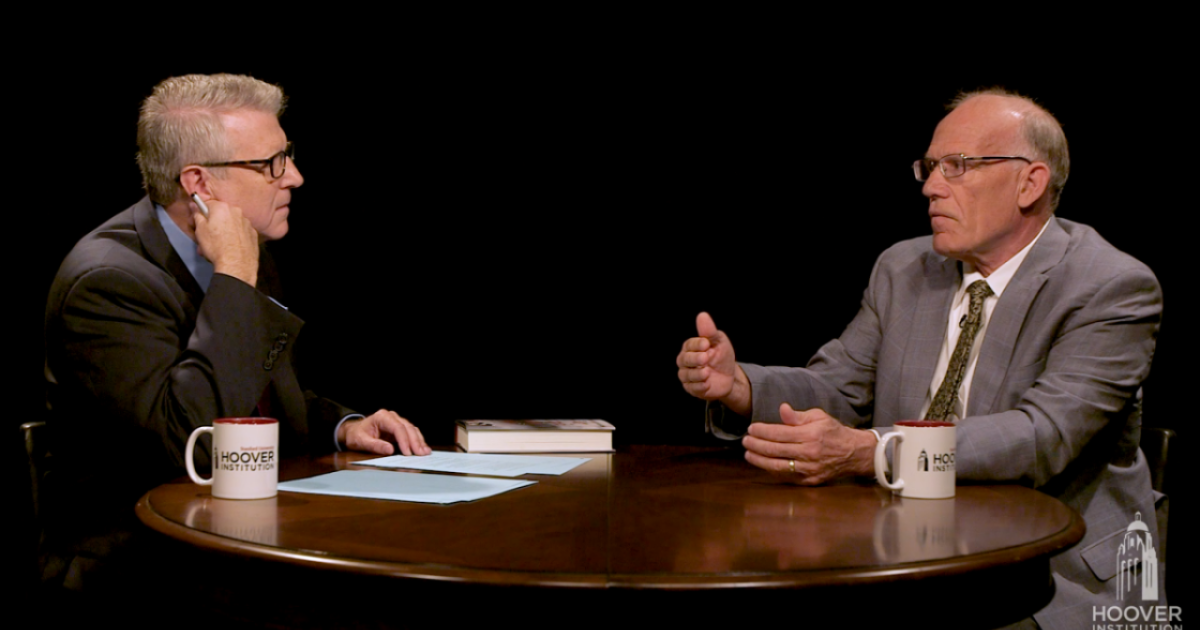
Could the Axis powers have won? What are the counterfactuals for World War II? Find out in part two of this episode as military historian, editor of Strategika, and Martin and Illie Anderson Senior Fellow Victor Davis Hanson joins Peter Robinson to discuss his latest book, The Second World Wars.
Victor Davis Hanson explains the counterfactuals of World War II, the “what-ifs” that easily could have changed the outcome of the war. If Hitler had not attacked Russia or the Japanese had not attacked Pearl Harbor, the USSR would have never turned on Germany and the United States would have never entered the war. Hanson argues that the leaders of the Axis powers overreached in their strategies, which ultimately caused their downfall. Hanson also explores the counterfactual surrounding the American commanders and the “what-ifs” that could have prevented American success in the war.
Victor Davis Hanson also reflects on his own family history and connections to World War II and how it shaped him as both a person and a scholar in his life today. He talks about his motivations to write his latest book, The Second World Wars, and how his family history and the current political climate inspired him to write it.
Watch both episodes to learn more about the history of World War II.
Didn’t see the first episode? Watch Part One here.
About the Guest:
Victor Davis Hanson is the Martin and Illie Anderson Senior Fellow in Residence in Classics and Military History at the Hoover Institution, Stanford University, a professor of classics emeritus at California State University, Fresno, a nationally syndicated columnist for Tribune Media Services, host of the Classicist podcast, and the editor of the military history journal Strategika. He is also the Wayne & Marcia Buske Distinguished Fellow in History, Hillsdale College, where he teaches each fall semester courses in military history and classical culture. Hanson is the author of hundreds of articles, book reviews, scholarly papers, and newspaper editorials on matters ranging from ancient Greek, agrarian and military history to foreign affairs, domestic politics, and contemporary culture. He has written or edited twenty-four books, the latest of which is The Second World Wars. Read more about the guest here.
Additional Resources:
Working Papers
History Working Paper 202602
September 30, 2026
Videos
Niall Ferguson draws on his book “The Pity of War” and personal family history to describe the horrors of trench warfare in WWI.
October 22, 2026
Articles
We remember the founders who survived the American Revolutionary War. We honor their courage and sacrifice in the struggle for liberty and independence. We celebrate their achievements in crafting a democratic, republican form of government. It is fitting that we do so.
October 20, 2026