Videos
Taiwan: Will China Make Its Move?
Elizabeth Economy and Bonnie Glaser discuss Beijing’s pressure on Taiwan and the risk of a crisis.
October 22, 2026
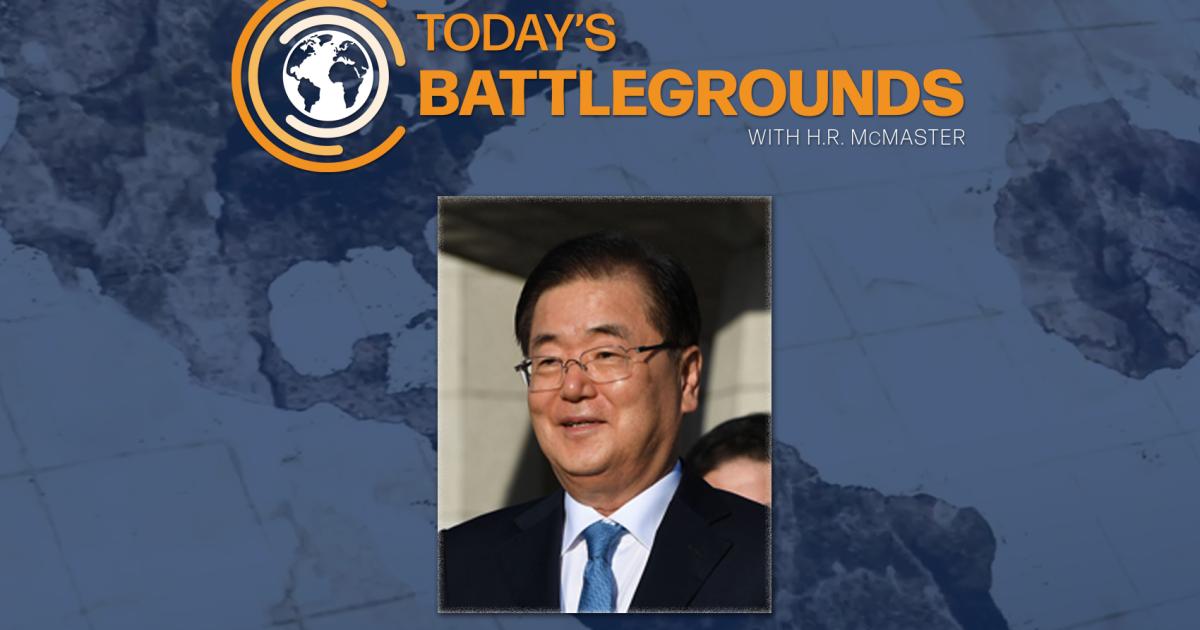
Join Chung Eui-yong, former Minister of Foreign Affairs of the Republic of Korea, and Hoover Senior Fellow, H.R. McMaster, as they discuss the future of the US–ROK alliance in the face of North Korea’s accelerating weapons programs, the implications of a growing Russia–North Korea partnership, and how Washington and Seoul can strengthen deterrence while preserving space for diplomacy on the Korean Peninsula.
Reflecting on his memories of the Korean War, Chung Eui-yong discusses the historical forces that have shaped South Korea's security outlook and offers his perspective on domestic political dynamics in South Korea today. Ahead of President Trump's upcoming visit to Beijing, Chung Eui-yong shares what he hopes will be on the agenda, including regional security and relations with China and North Korea. He discusses the importance of cooperation among the United States, South Korea, and Japan and the need for allies to work together on issues such as supply chain resilience, defense manufacturing capacity, and energy security, and his assessment of the current conflict in the Middle East and what it means for global stability.
- I first visited China 35 years ago, immediately after the establishment of diplomatic relations, and I found China very underdeveloped, agrarian society or communist society. Now, when you go to China, you will find if on, on all areas of China, very advanced capitalist country. So it's a huge transformation in the last three decades.
- This is today's battlegrounds. Our discussions with leaders from around the world consider how history produced the present, and how we can work together to overcome obstacles, to progress, seize opportunities, and build a better tomorrow.
- On this episode of Today's Battlegrounds, our focus is on the Republic of Korea. Our guest is Chung Eui-yong, former minister of Foreign Affairs of the Republic of Korea, minister Chung, joined South Korea's Ministry of Foreign Affairs in 1971. He later served in the National Assembly and contributed to deliberations of the US Korea free trade agreement. In 2017, president Moon Jay in appointed him director of the National Security Office, where he coordinated South Korea's national security strategy. He went on to serve as foreign minister from 2021 to 2022, helping steer South Korea's alliance management, North Korea policy and regional engagement. Korea's history stretches back millennia. A successive kingdom's cultivated a distinct language culture and bureaucratic tradition influenced by Confucian thought. Korean states have navigated the influence of imperial China while maintaining sovereignty and repelling repeated invasions, including Japanese invasions in the mgen war of the late 16th century, and Manchu incursions in the 17th century. In the late 19th century rivalry between Shing, China and Meiji, Japan turns a Korean peninsula into a strategic battleground. Japan formally annexed Korea in 1910, an imposed imperial rule until the end of World War II in 1945, when Soviet forces accepted Japan's surrender north of the 38th parallel, and US forces did so in the South, the modern US Republic of Korea, ROK alliance was forged during the Korean War when Soviet and Chinese backed North Korean forces invaded the south. In June, 1950, the United States led a United Nations coalition to defend the ROK. After three years of fighting the 1953 armistice left the peninsula divided along the 38th parallel, the mutual defense treaty institutionalized an ironclad commitment between the United States and South Korea. And in the decades that followed, South Korea transformed into a democratic and economic power in Northeast Asia. Yet the threat from the north endured as the Kim family regime imposed totalitarian control over its population and pursued nuclear weapons. The United States has pursued negotiations to curb North Korea's nuclear ambitions, such as the 1994, a agreed framework, the 2005 six party talks, and the 2018 2019 Trump Kim Summits. But the regime has continued to advance its programs and refine missile and nuclear capabilities while leveraging negotiations to gain time and concessions. Kim Jong-un has declared North Korea's nuclear arsenal permanent and non-negotiable. Meanwhile, the US ROK Alliance has also had to navigate internal strains, including the political turbulence surrounding the 2024 martial law crisis, which tested the resilience of South Korea's democratic institutions and an uncertain US tariff and trade policy. We welcome Minister Chung to discuss the future of the US ROK Alliance in the face of North Korea's accelerating weapons program, the implications of a growing Russia, North Korea partnership, and how Washington and Seoul can strengthen deterrence while preserving space for diplomacy on the Korean peninsula.
- Mr. Chung, we young, welcome to today's battlegrounds. It is such a pleasure to see you, and I know our audience is gonna deeply appreciate your insights. Welcome. Great. Great to see you again.
- Great to see you again too. Hey, yeah, I still have many fond memories of closely working with you.
- Oh, hey, there's some of my fondest memories of, of our time together.
- Yeah. Long conversations at the NCE at Fort McNair in Washington. Lot of debate, lot of phone calls over the years between the 27, 17 and 18 was most one of the most precarious period Yeah. The Korean Peninsula. But we did help. I think we have successfully managed and we made that the dangerous moment into a strategic turning point, which eventually led to the first historic summit between President Trump and Chairman Kim Jonh. And I really missed you after you left a job. And I still think that had you had you stayed on, you could have make made much more meaningful achievements. And I I I'm
- Very sorry for that. Well, it's very kind of you to say, and I benefited tremendously from, from your advice and, and you know, we're so close to San Francisco here. I have these fond memories of That's right. The trilateral meetings we had, we had three confidential trilateral meetings with, with Yahi san our, our, our Japanese counterpart. And, you know, part of what we're trying to do is keep the family together oriented on, on, on the biggest problems that we're facing. And of course, maybe we'll begin with just the context for the Korean peninsula and security in Northeast Asia and, and then, and then talk about the situation in, in South Korea and North Korea. But, but first, how about just maybe the China challenge that we're facing. You know, of course, South Korea is, is right there, you know, adjacent to adjacent to, to North Korea and, and China and, and during the Trump administration won, we were trying to affect a pretty big shift in policy from cooperation and engagement to transparent competition with China. So maybe fast forward to today, we, we've seen Xi Jinping double down on his, on his priorities of, of maintaining technological advantages, advantages and advanced manufacturing. For example, we've seen China successfully get a grip on some critical supply chains and, you know, and become kind of aggressive in, in the region vis-a-vis Taiwan, south China Sea. From your perspective, as you know, I I would say the, you know, the most distinguished diplomat from from, from South Korea. How do you see the, the, the, the threats, challenges and opportunities associated with, with the China Chinese Communist Party and its policies?
- Well, first of all, China has changed a lot. There has been big transformation. I first visited China 35 years ago, immediately after the establishment of diplomatic relations. And I found China very underdeveloped agrarian society or communist society. Now, when you go to China, you will find if on, on all areas of China, very advanced capitalist country. So it's a huge transformation in the last three decades. And now China, because of such success as most of other advanced economies face, they also face structural challenges like slow growth demographic pressures, and they also have activity constraints. And China is also vulnerable to external technological restrictions. So, and the China, it seems that they increasingly convinced that the sustained economic development and national security are inseparable. So they're now, their economies are designed to reduce such structural challenges also to, to improve their technological self-reliance. So, and they are now focused on innovation, innovation in the areas like ai, as you mentioned, advanced manufacturing technologies and all that. And China's current trajectory doesn't, doesn't indicate a simple inward turn. I think they are strength strengthening their domestic technological capabilities and supply chain resilience while also maintaining global competitiveness. They're trying to expand their global com competitiveness in global markets through self-reliance of technology and industrial upgrading. And this, the China's, China's economic development present a very complex strategic environment for countries like Korea. First of all, we, we, we compete in key sectors like semiconductor, ai, automobile, and other areas. Electronics, electronics. But we, we, China will continue to be our essential economic partner. As you said, China is our, our closest neighbor. It is our largest trading partner. So, so Korea needs to pursue a calibrated strategy. The, we have to compete with China incorporation with other France and Ally like the United States, but they also have to maintain a close economic engagement return. It's a very complex situation for us. Of
- Course, you know, China is working closely with Russia on a lot of issues. But, but now I think what's changed from a South Korean perspective, I'd love to hear your thoughts on, on the threat from North Korea, because when we were working together, as you mentioned, it was, it was a period of increasing threats because of the many missile tests. The six nuclear tests happened when we were working together. Yes, sir. So we're responding to all these sort of provocations and, and, and we're, we were testing the thesis that we could convince Kim Jong-un, he's safer without the weapons than he is with them through this maximum pressure campaign. As you mentioned, it resulted in the Singapore summit and then the failed Hanoi Summit. But at the time, I think North Korea was pretty isolated, even, even China was recognizing some of the sanctions and, and Russia. But now ch nor North Korea's not as isolated. I mean, it's, I think it's, it should be kind of astonishing that North Korean soldiers are fighting alongside Russians on European soil. They're getting something I'm sure in return from Russia in terms of assistance with their programs. China has a, a much better relationship. Xi Jing had to even talk to Kim Jong on when we were working together, and he got kind of the fear of missing out on the Singapore summit. That's when they began to establish a relationship. We just had the, the, the sixth Congress party Congress,
- No, not Congress,
- During which Kim Jon was very threatening toward South Korea. How, how do you see the threat from, from North Korea these days and, and, and the connection between North Korea and, you know, what I would call kind of the, the, this aggressive axis of, of China and, and Russia?
- Well, actually after Hanoi, the situation on the Korean peninsula has deteriorated. The situation has become much more serious. First of all, North Korea has advanced this nuclear and missile technologies much further, much further than we like to see. And as you said, after they reestablished close partnership with Russia, by participating in the world in Ukraine, as you mentioned, the sense of isolation of North Korea is con reduced. Now they get the political support from one of the prominent members of the United Nations security, that that is for North Korea. It's a huge political support, and it, it reduces our leverage on North Korea and also China. When we, we, we worked, we are working together, China also very cooperative in terms of bringing North Korea out to negotiation a table for Gene nuclearization. And China was telling us that they were, they were doing its best to pursue North Korea. And so now the situation is now pushing China further closer to North Korea.
- You, Mr. Chong, you, you, you mentioned a, a couple of dynamics here. You know, one is that, that you, the China is, you know, more supportive now of, of North Korea. China is pretty aggressive economically. And North Korea is really, you know, rattling the saber, you know, saying it in this, in this speech, Hey, the real, the real enemy is South Korea. You know, it seems like he's trying to, to isolate South Korea for maybe even support from the United States. Right? All this is happening against the backdrop of an impending visit by President Trump to Beijing, we think at the, at the end of March, beginning of April. And, and what do, what do you think should be on the agenda for that visit from South Korea's perspective? What, what is your hope associated with President Trump's visit to China?
- I think first of all, China would, would aim to prevent further economic decoupling through President Trump's visit to Beijing. That they would also try to ease tar pressures and also stabilize external economic environment for them. But for, for, for us, president Trump's visit to China, we hope we will provide another momentum in dividing peace process on the Korean peninsula. We hope it'll set the stole the clock of peace, so, so to speak, on the Korean peninsula back in motion, president Trump was the one who really initiated, helped to initiate the, the peace process in 2018. And
- It was, it was really you and President Moon. I remember very well, what I remember the meeting in the Oval Office, you know, and, and, and I knew would, would when you visited, this is in early 2018, and I knew President Trump's gonna say, she said, what do you, what do you think he's gonna say? And I said, I'm, I'm sure he is gonna say yes, that he wants to visit with him. But I remember he sat you next to him in the Oval Office, and, and, and when he said, yes, I could still see the surprise on your face. And then remember, he, he asked for you to make the announcement. I was kind of on the house with them a little bit then, and you and I went back to my office, Dr. Wrote out on a legal pad. I left you in my office to talk to President Moon. And then you made the, the announcement on in the US media, but what a what a what a what a eventful day that was. But, but so, so we had the two summits, you're, you're really gonna about to tell us, Hey, what's changed since then? Right. Since the, the failed Hanoi Summit,
- We, we think President Trump and Chairman Kim still maintain a good personal group, and that will be a good asset for us. Chairman Kim has never mentioned negatively on President Trump in public. And President Trump repeatedly says he has phoned good, friendly relationship with Chairman Kim. When he came to Kanju last October, he really, he sent repeatedly a messages to Kim Jong to camp to see him right. While he was in Korea. I don't know whether he will do the same this time, but we hope his visit to Beijing very close to Pia will provide another momentum. And as you said, we were really surprised when President Trump accepted the proposal from chairman came to see him at the White House. And I, I remember you are the only one who raised the hand and cautioned the President Trump against such kick a decision. But Trump made the decision to see him, and he asked me to announce it, as you said. So we were surprised, but we did it. And that was the beginning of a real, real process. And we still believe President Trump was the only American leader who could do it. And I, I hope, we hope he can do it again this time, but I, I'm not quite sure whether it'll be materialized this time, but opportunities are rare and we need the deter, we need his determination to cease even a narrow opening and turn it into a, a real pro this time.
- Yeah, I mean, of course Kim, Han's recent speech doesn't bode well, I don't think for it. He said, Hey, we have to, you know, I'll talk to President Trump, but he has to recognize North Korea as a nuclear power. And, and, and so I, I, we'll see how it goes, but I think one of the, I dunno if you'd agree with this, but I, I think one of the reasons why Kim Jon was moved to have the summit with President Trump was the pressure campaign, but also the relationship between the United States, Japan, and South Korea all being close together. I remember us with, with, with Mr. Yahi Yan and this, and you and I would meet together and we said, Hey, we, we, we vowed all that every provocation from the north would be seen as bringing us closer together. That wasn't always the case before. And there were some, there were some rocky parts of the relationship after, but it seems like President Lee in, in, in South Korea today, he's doing a fantastic job with the relationship with President Trump and, and with, with, with, with Prime Minister Takai in, in, in Japan.
- Could - You maybe describe the importance of this kind of, you know, trilateral relationship and, and, and how you see it today?
- President Lee recently made a trip to Japan in January. He visited nara, which is hometown of the new Prime Minister of Japan, aka Akai. And I think it was a very, a very symbolic significance. The problem of the trilateral cooperation among our three countries is the bilateral relations between Korea and Japan. Let me say that just a second. The approach monk between Japan and Korea is driven more by our security need less by historical reconciliation. And we do have, you know, additionally longstanding territorial dispute with Japan. And these problems, ha ha have not disappeared. And this historical and territorial disputes between Japan and Korea push our political leaders place limits on our political leaders to push reconciliation. So what the United States has been playing a role in bringing Japan and Korea closer, but it is not without resolving these grievances between the two countries. For, for, for South Korea, it'll be not easy to promote security co corporation in a way the United States would like to, for instance, we cannot comfortably conduct military cooperation, let alone, let alone military exercises as we had discussed before. But the trilateral cooperation, IIII fully agree it's very important. When President Lee met the Prime Minister, Akai Akai described South Korea as a, as an important neighbor, and saying, the South Korea is an important labor, labor is an obvious statement, but the relations between the two countries had been so tense that it was notable enough to be specially reported in the media. It was a big, big news that Japanese prime minister called South Korea an important neighbor, right, right. That, that well rep represents the current state of relations between South Korea and Japan. And present. Lee, of course, emphasize underscored the importance of the Trilateral corporation among the United States, Japan, and South Korea. But he also mentioned, you have to note that trilateral dialogue and cooperation among South Korea, Japan, and China is important. We do have both East Asian, you know, frame among these three countries since about 10 years ago. So we have not only a summit meeting, which, which which are supposed to be held annually, but not it, it summit has not been held annually. But all the other mini, all the relevant minister, including foreign ministers, finance ministers, are trade ministers. They came meet their regularly. So what what we, we hope is that we, although we believe we support the importance of the trilateral religions among Korea, Japan, and the United States, we hope we can manage it carefully so that it should not be perceived solely as a, as a framework that will circle China because we would continue to need Chinese support in resolving North Korea issue and otherwise it could produce unintended consequences or for pushing China further to North Korea. What we are dearly concerned about is the, about is returning to the old confrontational structure reminiscent to Cold War era on one side, South Korea, US Japan on one side, and Russia, China and North Korea on the other. And actually after Hanoi and after North Korea's participation in the Ukrainian war, that structure is coming back as you, you noticed p jining with Kim Jong and President Putin on the school last September, and they had another similar occasion in Ang just a month later to celebrate the University of the foundation of North Korean army. Right. So we were very concerned about that, that image. I, of course, in late October last year at the AP Summit in South Korea presence, presence of China and US and also Prime Minister of Japan and South Korea, they all had a separate bilateral meetings. And we presently p the Beijing all the January again after his visit to Nara. But still, that is one thing we want to avoid.
- Right. Well, and you know this better than anybody. I mean, I I wasn't gonna to ask you a question about this, but what I'd like to do for our viewers is ask you to talk about your youngest memories in, in, in, in, in Korea at, at the outset of the Korean War, you know, and so we're, we're talking about the importance of the, you know, the US Japan, South Korea trilateral relationship, I think, I think. But most important part of it is kind of to portray strength, right? So, so that you don't have an aggressive party, you know, like North Korea and June of 1950, think, hey, I can get away with this invasion or China when they entered the war at the, at the end of 1950. So a cold war could be bad, but a hot war's even worse as you know, better than anybody. So could you maybe explain to our viewers, you know, where you were in June, 1950 and what your memories are of the Korean War?
- Well, I was only four years old when the war broke out in June, 1950. My father escaped to the south immediately after the North Koreans occupied soul for the first time. And my mother was left behind. She was only in her twenties, mid twenties. She was left behind with young kids, including myself, my brothers. It was, I was too young to remember everything. But the period was punctuated with some of the vivid memories like we were playing on the streets among, among the, the rock bodies. Yeah. Covered and bodies Shaft. Yeah. Bodies barely covered by straw mats. And I also saw us p ws being first to march on the streets with their hands up. And I also remember my house was a two story building. And, and one night we, our community was bombed heavily and everything was leveled and was still burning. And late, many years later, when North Koreans threatened to make Seoul or seal fire, I could easily imagine what it would look like. And my family lost uncle, my, my mother, my father's young brother. My mother lost her, her young sister. I mean, they, they were not there, but they were taken by North Koreans. And my mother's wish before she passed away a couple of years ago, I was to bring her younger sister back to spend the rest of her life. She once succeeded to seeing her at one of the family reunion projects about 15 years ago prior to her passing away. But that kind of, you know, things. So we don't want to see another war take place on the Grand Peninsula that this all, so no more war, we have to prevent another war on the right.
- And obviously it's a lot cheaper to, to prevent a war than to have to fight one in, in South Korea is investing more in defense. He has been what of President Trump's big priorities and, and so was Japan. And, and hopefully that will be enough to convince, you know, North Korea and China, obviously they can't accomplish objectives through the use of, through the use of force. You know, what I wanted to talk with you about as well is just kind of the, the general situation in, in the world today, right? There's a, there's an ongoing war in, in the Middle East, and I just wonder what your perspective is on that you served as, as, as a, a diplomat for your government in Israel, you know, the region well, how do you see the, the conflict in the Middle East today and, and what, what do you think our viewers need to know about it from, from your perspective?
- First of all, I really do not understand what is going on in the Middle East. It is very different from what I learned in textbooks about international norm, you know, disrespectful sovereignty and all that is really a perplex thing because it is developing very differently from what I learned. Well, we support President Trump's peace through strength policy because that is also one of our security policies, principles, as you know, when we were in in government, we increased our defense budget from 2.2% of GDP to 2.7% of GDP in four years time. But operations like midnight hammer after reserve or Epic fury, we wonder if those initiatives had ultimately contributed to global peace and stability. Projection of strengths can serve as a deterrent. We agree, relying solely on military force risks ing tensions and provoking unintended consequences. So su sustainable peace and stability require not only credible defense capabilities, but also consistent diplomacy. Trust, building respect, respect for international norms and so forth. When strengthen strength is balanced into dialogue and inclusive engagement, enduring peace can be achieved, will be, we believe recently Prime Minister Mark Car of Canada made a very impressive and persuasive speech that I don't agree that the American LED Alliance of Democracies is in the midst of Russia, as they said. And I don't think US airlines have broken faith with America. We still believe in the American led heman, if I may I use the term, we still believe in parks, Americana. We still believe the US will lead a group of democracies to make this world better. And you, you can, you can do it. You have to, you have to the the resources and, and the, and the strengths. You know, I'm now leading an organization of political parties in Asia and I meet many political leaders in Asia. And they tell me that it seems that the rules of United States and China have divorced at multilateral forum. China now invokes causes and principles like multilateralism, free trade, rules based global order that us one's champion. And they, they, they argue that US seems to be acting like China one state. I don't agree with this observation of course, but, but the very fact that it is being perceived every way is very worrisome. And I think the US government and the people of of the United States should really listen to pay more attention to such observation. That's perception.
- Yeah. I think also it's better, I, we be, could do a much better job communicating, you know, what our objectives are and, and highlighting, you know, how, how this kind of axis is working together with, you know, for example, China underwriting the war, Russia's war against Ukraine, you know, by energy purchases and providing the hardware that Russia's using, you know, the support that China's been giving Iran, you know, with their missile programs and just now, I guess today two shifts of left Chinese ports underway to, to Iran with, you know, with solid jet fuel, which components are, you know, chemicals which probably won't make it to, to Iran, I think. And, and of course, you know, the support that Russia and China are both giving North Korea while North Korea transfers millions of artillery rounds and, and and and so forth. And Iran, of course providing she head drones for Russia. They're all working together in this axis. I think we should highlight that more and then recognize, you know, how the US and South Korea, others, as you mentioned, have to all work together on these issues on supply chain resilience and defense manufacturing capacity and energy security. And this should all be common agenda items. You know, I think, you know, I I'd like to ask you how South Korea sees these challenges, these geopolitical challenges, but also maybe in the context, could you maybe talk to our viewers? 'cause you've lived it South Korean politics, can you explain this a little bit to Americans? 'cause whenever we feel bad about how difficult our internal politics could be, I think sometimes South Korea has very similar polarization domestically and these swings between governments and you know, we had of course, you know, last year with President Yun and the constitutional crisis and then his recent conviction. And so I I how, how do you explain South Korean politics? How do you see it today? And, and do you see a emerging, a a political environment that might be a little bit less contentious? 'cause we hope for that in the United States as well. But, but how do you view politics in your own country as it relates to these foreign policy issues?
- Well, I hear that some foreigners say even call claim politicization of justice in South Korea. Yeah. And I think there is a, a bit exaggerated expression since 19 70, 19 87 when South Korea became a full democracy. We have developed a strong legal mechanisms to hold senior officials, political leaders accountable. And there were also huge expectations from the people for more transparency and anti-corruption enforcement. And during the last 10 years, we have impeached two presidents. They happened to be from the same conservative party, the first case involved with corruption and interference in state by a close competent of the president.
- President Park. President Park, yeah. President Park. Yeah. Right.
- And the second one was, as you know, unconstitutional, illegal pro
- Of the, of the, of the parliament. Yeah. The legislature,
- National law president, the former president, shook the nation by, by proclaiming emergency martial law. All of a sudden it was a total deserts view of 1980 martial law, which was announced by then military dictator duan. And it brought back the memories of very harsh crackdown on protestors. And people responded to the new proclamation of martial law immediately, people immediately gathered because whole thing was televised, televised live. And the people gathered at the National Assembly to block police and marsh troops to occupy the National assembly compound. Actually, most of the lawmakers from the opposition party had to climb over the fence to get to the chamber, including the, the leader of the opposition party who now is the president and the speaker of the parliament. And they succeeded in between this martial law bill. Immediately after the after proclamation of martial law prison, the, the martial law command issued the first degree, degree, which spent all the political activities and also put all the media under the control of the al command. And anyway, it was stopped by the parliament and stopped by the people and the justice was done. I also have to say that President Jung, he's been public prosecutor or that's, that is his entire career. And he, after he was elected president, he began to intimidate his political opponents with the method which he was most familiar with, with the criminal investigation. And he also suppressed the press, the media for spreading fake news. And he also, he lost, his party lost badly in the general reductions in 2024. And the opposition on over 190 seats, out of 300 seats, and pre president Yung supporters claim that the election was fabricated. And president won YI think, agreed to that. And he approval rate went down to 13% in late 2024, November, 2024. And he, he decided to declare martial law on December three. It also stopped by the people, and I think it well shows the democratic resilience of the, of, of, of the, of Korea, right.
- Most, you know, here in the United States, we've had similar sort of, you know, attacks on our institutions and the tendency among some politicians to use, you know, to use these institutions to score partisan political gains. And I think what, what we're, what we share in common is this belief that it's really important to, to, to, you know, protect our confidence, build confidence and our democratic principles, institutions, and, and processes. Hmm. And you know, I, I'll I'll tell you mi Mr. Chung, if what I'd like to ask you just in, in, in, as we wrap up here is what else you'd like to tell our viewers, you know, about how you see the world today and maybe, maybe a little bit as well about how you see, you know, South Korea, US relations and, and what you think are our common agenda should be here in the, in the future.
- Well, I, I wanna talk more about denuclearization of North Korea because in our perspective it is the most important issue. And without resolving nuclear issue of North Korea, we cannot build a lasting place on the Korean peninsula. We have been divided for now almost 80 years. Our liberation from Japanese colonial rule brought joy, but also national division. And the price we had to pay for the division was very severe. We went through the war, which was really devastating, killed millions people. 36 soldiers sacrificed their lives. We are very grateful for their sacrifice, but we don't want to repeat. And Korea had to start from nothing. In 1953, we faced three existential challenges, building democracy, building both an economy and maintaining peace. And I think in a way we, all these three challenges with the help of the United States. United States is the only ally who came to support us with economic and military support. Without the support of the United States, we could not have achieved all these things. And we really do all America for what we are today. But, but we lost very valuable opportunity to reserve this issue in Hanoi. But Hanoi failure is, is not the end of the process. It's just a part of process. We believe we, we, we, we think, as I said before, we still have a chance to resolve this issue. Denuclearization is not a short term event, but a long term process. We believe so. But, so while we maintain the goal of ization, we need, we need to set more realistic interim steps, steps considering the changing geopolitical situation. We now believe t in nuclearization should be defined as a risk deduction journey, a process of managing and gradually reducing risks. A practical, practically viable approach is a phase from freeze to reduction and to final dismantlement freeze can be a forced entry point of this process, freeze, freeze additional nuclear activities, including nuclear tests. And, and I think that has been partly achieved. And North Korea had offered to dismantle young bi, maybe you can start with dismantling young BI facilities.
- And for our viewers, this is the, the largest and the first reactor that they, that they constructed.
- And that's the core of the North Korean nuclear development program. Dr. Dr. Hecker said it is Los alums of North Korea.
- This is our colleague here at Stanford. Sig Hecker.
- Yeah. Without young be there will be no, no more real, those Korean North Korea's nuclear program and reduction. Yes. We need to first start with verification of frozen assets like and, and others. And then we proceed to reduce bill additional nuclear capabilities and well, and then actually in return, we need to provide some flexible reciproc measures, easing sanctions, and also replacing amnesty agreement with the peace treaty, or at least non-racial declaration between the US and, and North Korea. And as, as at the last stage, we can work for complete dismantlement, which is means completes as we call it, you know, right at, at that time we hope the US can normalize its relations with the United States. We, the nuclearization of the Korean Peninsula, we can then establish enduring peace on the Korean peninsula. And Koreans I think deserve death. We, we've been suffering too much for the last 18 years.
- Well, I don't think Kim Jong-Un's could have watched this program, but if he does, I hope he listens to you
- And, and agrees. I don't know whether he will listen to me anymore, but I hope he will listen to that. And I hope he will come back to the negotiation table. 'cause he cannot survive with the nuclear weapons program. There is no way for North Korea to, to make progress with nuclear weapons. That's right. That's right. That's not a good choice for him and for his people.
- Ab absolutely. Well, minister Chung w Young, I can't thank you enough for helping us learn so much about today's battlegrounds. It's a pleasure to have you here at Stanford University and at the Hoover Institution. And I can't thank you enough for, you know, for the privilege of, of working with you on such important issues years ago. And for your continued service as, as minister ambassador, expert on trade. I can't think of anybody better to help our viewers learn about our world from the, the perspective of South Korea. So thank you.
- Well, it's been a pleasure and, and a privilege for me to work video you 8, 7 8, 9 years ago. And as I said at the outset, had you stayed on, I believe we would've much better outcome. I was purely a disappointed when the Hanoi Summit broke down. 'cause I had really close, closely coordinated with then my counterpart, John Bolton. But if I may say this, I was really disappointed with John Barton. I think he came to the government with only one agenda to veil any negotiations with North Korea. And it is different, very different from what we had really discussed during so many meetings and phone calls. I, I kept the record and I had more than 60 phone calls with him within, in the period of eight months leading on to Hanoi. And all this apples of coordination were in vain. And it's a huge discipline. I've even felt a sense of, he admitted in his memoir that he was so glad that he succeeded in derailing the negotiations persuaded President Trump to walk out. And that was dear discipline, because I believe we are so close to something positive in Hanoi.
- Well, I really appreciate that perspective. I mean, it's one of those, you know, it could be a turning point in history, you know, who knows? But I, and I don't think of it, I think of it, me, me being there, because I don't think by that time President Trump was listening to me very much Anyway. But, but a a, it was, it, it was a real p privilege to, to, to be with you again and, and, and to, to meet your wife and, and to, to have some time together with you. So thank you so much.
- Thank you very much,
- Dan.
- Thank you.
- Nice to Thanks Miss.
- Thank you. Battlegrounds is a production of the Hoover Institution, where we generate and promote ideas advancing freedom. For more information about our work, to hear more of our podcasts or view our video content, please visit hoover.org. I.
Videos
Elizabeth Economy and Bonnie Glaser discuss Beijing’s pressure on Taiwan and the risk of a crisis.
October 22, 2026
Articles
In the span of a few years, China and the United States have each assembled something future historians might recognize as a new kind of empire. Their dominions extend not merely over territory, trade routes, and airspace but over knowledge itself.
October 20, 2026
series_item_video