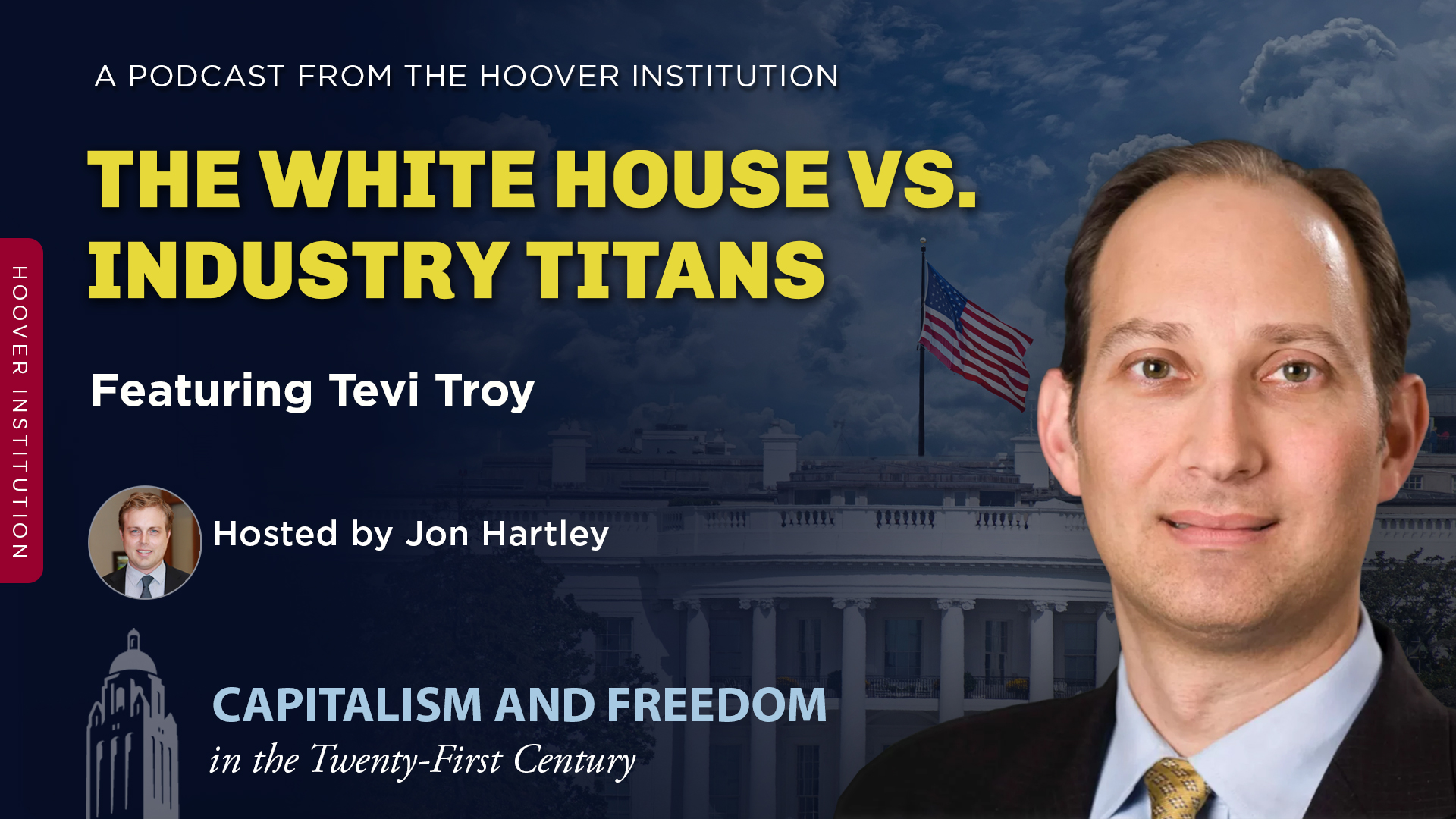
- This is The Capitalism and Freedom in the 21st Century Podcast, an official podcast of the Hoover Institution Economic Policy Working group where we talk about economics, markets, and public policy. I'm John Harley, your host. Thanks so much for joining us today. My guest is Te Troy, who is a presidential historian. He has a PhD in American history from University of Texas at Austin. He's a former White House deputy on the Domestic Policy Council and former Deputy Secretary of Health and Human Services during the George W. Bush administration. And he's currently a senior F fellow at the Reagan Institute and a senior scholar at UV University's Strau Center. He's also the recent author of The Power and the Money Epic Clashes Between Commanders and Chief and Titans of Industry. Welcome to, thanks much for joining us. Really excited to have you on.
- John, I'm thrilled to be here. I really do enjoy listening to your podcast. You have these great economists on and you go in depth about their careers and their thoughts and how they advance the ball in their areas of expertise. And it's just you, you do a really great service with this podcast. So thank you for having me on.
- Well, thanks so much for having me. I'm really excited to talk to you about you and your career. So, you know, first want to get into your own personal history you grew up in, in Queens. Tell us how you got interested in presidential history, intellectual conservatism and, and also how you stumbled on sort of this interesting dynamic between titans of business and presidents over time. H how, how did you get interested in all this?
- Sure. Well, as you said, I did grow up in Queens in the 1970s. It was kind of a rough time, high crime, graffiti inflation unsureness about America's place in the world. And I was from a family that was very patriotic. We were descended from European Jews who had escaped from Europe. And if my ancestors had not left Europe, they probably would've died in all the various tumbles of the 20th century, whether it was in Soviet Russia or Nazi Germany. And so we were very grateful and appreciative of this country. I still remember my mother would take me into the voting booth with her to show me how to vote. And it was a real point of pride back when you actually voted on election day, which I, I still think was a, a good thing and brought a measure of national unity. This is the day when we all vote. I think that was an important thing. My dad was a history teacher, so I had a love of history from him. And when I graduated college, I went to Cornell. I wanted to see if there's a way to try to make things better, to give something back to this great country that I love so much and I was so grateful for, and I gravitated to Washington. My first job in Washington was working at the American Enterprise Institute of Think Tank. Your listeners Will. Noel and I had the privilege of working for Ben Wattenberg. Ben was a former Lyndon Johnson speech writer who was really immersed in data and demographics and the statistics. And so I learned how to use statistics and numbers to marshal an argument from Ben was also a neo-conservative, so he had grown up a democrat, was a proud Democrat and then he didn't like where the Democratic party was going and he was trying to reform the party from within, but the party was moving so far left. And he said he was staying always where he was. But he became known in the eighties as Ronald Reagan's favorite Democrat. And I also looked around the American Enterprise Institute and I saw these titans, not just Wattenberg, but Judge Bork and Jean Kirk, Patrick and Hering Crystal was there. And I was just amazed at how impressive these people were. But also the influence they had, they were able to shape the debate. They were able to go out there and define what American policy was through their conversations with senators and congressmen and cabinet members. And I wanted to do that. I thought that was really cool what they did. So in the days before LinkedIn and before the internet, I tried to isolate what they had done to become what they were. I was a 22-year-old. I I, you know, you either have the natural smarts or you don't, but I didn't have the external things, the, the attributes that you acquire. And I tried to figure out what they had acquired along the way. And what I found, for the most part from these people, the senior levels of think tanks were that they had three things. Number one is they usually had some kind of advanced degree. Number two is they had some kind of book or article that helped make their name. And number three is they usually had some kind of senior government service. Obviously Judge Bork had been a judge and Jean Kirkpatrick had been ambassador to the United Nations. Ben had worked as an LBJ speech writer and I said, I'm gonna go try and do those things. My first step was to get a graduate degree. As you said earlier, I went to Austin, Texas to get a PhD in American Civilization. While I was there, I studied with Elsbeth Rosow. She was the wife of Walt Rostow, who was Kennedy's National Security Advisor and also Johnson's National Security Advisor. And I learned so much about the presidency from her, but also from talking to Walt Rostow who'd been the National Security Advisor, it was really my first encounter with people who'd been in the White House orbit. This was in, in the legendary Kennedy administration. So I went there, got my PhD, I wrote a dissertation that I hoped I could publish as a book. And I did, it was my first book. It was called Intellectuals in the American Presidency. And it looked at intellectuals who worked in the White House for various presidents. People like Arthur Schlesinger under Kennedy, Daniel Patrick Moynihan under, well, he worked under Johnson, but then he was the White House intellectual under Nixon. And then Marty Anderson, who was known to Hoover people 'cause he was both in the Nixon White House, but then he was the, the Domestic Policy Advisor under Ronald Reagan. So I wrote that book and then I had the opportunity to work in government myself. I started out on the hill working for the great Christopher Cox, a very smart California congressman with a lot of talent and a lot of ambition, and a real serious conservative. Then I worked for John Ashcroft, the senator from Missouri. He was thinking about running for president. That didn't work out, but it was a good experience working for him. And then I joined the Bush administration where I had a number of jobs starting at the Department of Labor. I was Deputy Assistant Secretary for Policy, which is the office that Pat Moynihan worked in when he was in the Johnson administration. Then I went over to the White House in a variety of jobs, including, as you said, the number two at the Domestic Policy Council. And eventually I became the Deputy Secretary at Health and Human Services. So that was my journey through government. And then I had done all those things that I set out to do, meaning had the PhD, wrote a book, a dissertation that became a book and was published and got some good reviews. And then I served in government and I said, I put these things together, now I wanna build that think tank life. And since then I've worked at a number of think tanks. I've worked at the Hudson Institute, Mercatus Institute. I started a think tank for a while called the American Health Policy Institute. I worked at the Bipartisan Policy Center and now I'm with the Ronald Reagan Institute, which is really a great fit because I'm so committed to the ideas of Ronald Reagan. And it's a terrific place with some great leadership people like Dave Trulio, who's at the head of the whole operation. And then Roger Zackheim who runs the institute. And I write, as you said, I, I write books and I write a lot of articles and I relish having some opportunity to try and shape the debate in a positive way, try and put ideas out there based on my experience and my knowledge of history.
- That's fascinating. I mean, your career's been amazing and we'll talk about some of your books just in, in, in a, a few minutes here. But I wanna first talk, talk to you and just help our, you know, listeners and viewers get a, a better sense of how some of these policy functions in the White House within the administration, how they work. You know, you, you worked on the Domestic Policy Council. I, I'm just curious, you recently wrote a national affairs article on the history of what are called Policy coordination councils. The Domestic Policy Council is one of them, the National Economic Councils, another, the National Security Councils, also a White House Policy Council as well. You wrote this article on how the White House makes policy. And it's interesting 'cause you know, the, all these policy councils, policy coordination councils were really built after the Second World War, you know, that they aren't in the Constitution. Unlike, you know, obviously that the cabinet secretaries are, are there, and I mean, to some degree, and I think we've seen over time some conflict between the, the policy coordination councils and, and the cabinet secretaries. But I'm just curious, like, could you explain how exactly they work in, in, in conjunction with the entire, you know, white House chain of command and, and how they actually get things done when, when it comes time to legislation or executive orders?
- Yeah, it's a great question and the full answer is in my probably 7,000 word piece in National affairs. So I will give a shorter version of that here. But first, lemme say a couple of things. You are correct that there's no constitutional basis for these councils. There's also no legislative basis for these councils. They are wholly the product of the president and the presidency. I I guess the, there's an exception of the National Security Council was, which the first one, but really the president establishes these and can de establish them. So I think that's the first thing to think about. The second thing is that I'm grateful to National Affairs and its editor Yuval Levin, who worked for me actually in the White House back in the George W. Bush days for having a magazine where you can explore these issues. It's obviously modeled after the public interest, which was Irving Crystal's great publication. Irving used to say that it only had 6,000 subscribers, but they were the right 6,000. And now with the internet and some savvy article writing Val's pieces can get, or, or pieces in Val's Magazine can get read by, read by many, many more people than just those 6,000. So National Affairs is a very important institution that allows us to explore questions of governance. Like the one I looked into about the policy council, 'cause nobody really has done this kind of deep dive into the policy councils. They did start with the National Security Council, which is part of Truman's effort to find a way to manage the Cold War. You've got the State Department trying to manage diplomatic relations and you've got the Defense Department is, is doing the military stuff. And then you've got the, the newly created CIA and there's all these different pieces moving around and the National Security Council is designed to coordinate all these different pieces so that they're at least moving to some degree in the same direction to the extent that's possible in the behemoth of a government that we have. It's modeled after a, a committee that the British had to help run World War ii. And the Americans saw that that was kind of a valuable way of letting Churchill understand what was going on in the various parts of his government. And so we brought that model in to the US to create the National Security Council. And then it takes a while, but we then create a similar coordinating council for domestic policy. It was originally called the Office of Policy Development. And it is really the ancestor of what becomes first the Domestic Policy Council. And then it's broken up into two things. The Domestic Policy Council and the National Economic Council. They're often political circumstances that come behind these creations. National Economic Council was part of Bill Clinton's effort to show that he was fulfilling his campaign promise of focusing like a laser on the economy. And he said, by creating this separate entity, this national council, it would show us a level of focus on the economy. And then sometimes there's external circumstances that lead to the creation of these things. The Homeland Security Council was founded in the aftermath of nine 11 when it was founded that, that the US doesn't, wasn't really paying attention sufficiently to threats, be they terror threats or natural disaster threats. And the National Security Council wasn't quite the right fit for some of these types of threats, specifically the National Disaster one's. I remember Steve Hadley, who's the National Security Advisor under Bush. His attitude was, I don't know anything about hurricanes. Why should I be following that kind of issue? So the, the, the way we have it is there, there's really basically four councils now, the National Security Council, Homeland Security Council, national Economy Council and Domestic Policy Council. The reason I wrote my article was in part because the Biden administration created something called a gender policy council. And I really see no reason for this council. Most of the issues are actually handled by the Domestic Policy Council. And creating extra councils just creates extra opportunities for strife. You talked about my books, one of my books is Fight House about Infighting in the White House, and you wanna create these institutions in the White House that can limit in fighting and coordinate and get better decision making. But if you have competing power centers, that actually leads to more fighting. So it's, it's almost counterintuitive. You've gotta have some of these, like you had to have a National Economic council and domestic policy council, even though sometimes there's tension between them. But if you have too many policy councils, you start to worry who's mi minding the store. And people really will get in each other's playpens and cause trouble with one another. So these councils, I, I described it when I was, when I was running the Domestic Policy Council, I described it as, you're kind of like a station manager in a train system. There are all these trains moving at various paces and these trains are policy questions. Now Colin Powell has said that the easy decisions, the 90 10 decisions get made at the local level by career officials. And then the harder the decisions are, the more they gravitate upwards. Some become done in the regional offices, some get done by political appointees, some get done by political appointees in Washington, the harder decisions gravitate to the White House. And then the hardest, hardest decisions, which Powell called the 49.5 to 50.5 decisions. Those decisions have to get made by the president in the Oval Office. So as this coordinator or a policy council, you're trying to decide which decisions can get made where, how quickly they have to be made, which trains make it into the station at what time. And then once that happens, there's a three level system of meetings at the White House that determine policy. There's the, the PCC, which is policy coordinating, then there's deputies where the deputies get together, decide things. Then there's principles. And after all those, if nothing is resolved, then it goes to the president for a decision that's called policy title. And a lot goes into that. You have to write a memo to the president, remember we mentioned you've all worked for me. I would have to approve all these memos before they moved forward. And I I would do this at eight or nine at night after I was through a full day of meetings from 7:00 AM to 7:00 PM at the White House. And I would always take Val's memos and put them at the bottom of the stack. 'cause I knew they wouldn't need any editing 'cause he was so good. So I, I knew when I got to Yu Evolve's memo, I was basically almost ready to go home 'cause his, his memo would be a, a joy to read and not something I had to take a red pen to. And so you have to have these memos that go to the president. You have to decide who's in the meeting with the president. A lot of people think they should be in the meeting with the president, but they shouldn't all be. On the other hand, if you have too few people, you might be squelching descent from somewhere. You may not be having the right people to raise different sides of the argument. You also, you don't wanna have a full down, full on knockout drag down fight in front of the president. You wanna have some sense of what the issues are, lay them out in the memo, make sure the people who are gonna have the argument will do so in a respectful way. And then the important thing, and this is something I learned from Carl Rowe, is you can have the biggest fights, you can have the biggest disagreements, but once the president makes the decision, you've gotta walk outta that room and lockstep with your adversaries, meaning the other aides with whom you disagreed with on that issue. You'll, you might be allies on a different issue, but you've gotta walk outta that room in lockstep behind the president's decision. And that really is in a nutshell, as I said, it's a 7,000 word piece. But in a nutshell, that's what the policy councils do. They try to tee up decisions for the president. So the presidents get, gets, the president makes decisions with full information in a timely manner and in ways that have all the appropriate voices heard so that they're not gonna be sniping to the press afterwards. I didn't get my say.
- That's fascinating. I I totally understand that the sort of, I guess the conflict that exists, you know, part between these coordination councils, you know, I think at some level the NEC, you know, it's displaced what the Council economic advisor's role that it played prior to the 1990s. This still play plays a significant role, but there's now sort of sort of competing tensions and the Council of Economic Advisors more analysis now. And, and NEC does there a bit more policy now, but I'm just curious about the relationship between the policy coordination councils and, and the cabinet secretaries. 'cause I know that Colin policy ly said that that for example, the, the policy coordination council directors are, are kind of like a chief of staff to the, the cabinet secretaries. But I understand that, that I, I think some policy council directors in some respects feel like the cabinet secretaries at some level report to them. So I'm just curious how this reporting structure sort, sort of works in a, like for example with the chain of command and defense. Like it's very clear that it goes, you know, from the president to the Secretary of Defense and then on on down on down the chain, you know, the various command center commanders and so forth. But I'm, I'm curious, you know, my understanding is, you know that there's been a lot of conflict between these people in the past, but you also worked as, you know, deputy secretary at HHS, which is an agency and has accountant secretary. So I'm, I'm just curious if you've seen also from the agency side, how, how sort of there's input from an agency and how that goes to the White House and that interaction there.
- Well first of all, I knew Colin Powell and he was very smart about the mechanics of government and how government works. And he was a very skilled bureaucratic player. But if he said that the policy councils were like chiefs of staff to the cabinet secretaries, he was wrong. And, and I'm not even sure he said that 'cause it doesn't sound like it because the point, the whole point is that the head of the National Security Council is supposed to coordinate between state and defense and CIA and all the agencies that have some kind of national security insight. And you can't be chief of staff to one agency and be head of the National Security Council. 'cause you ha have to weigh these competing tendencies, these competing interests and these competing personalities. And I think Powell is actually there at one of the perhaps worst managed periods of national security coordination, which was in the Bush years because you had a problem there. And again, I'm a big fan of George W. Bush. I think he did a good job coordinating on the domestic side, but that's where his strengths were. He was a former governor of Texas. He knew the domestic issues on the foreign policy side. He was less certain of himself when he came into office. That's why he picked Dick Cheney, who had a lot of foreign policy background to be his vice president. That's why he picked big dogs, people like Colin Powell and Don Rumsfeld who had more experience in foreign policy than he to be those key cabinet secretaries. But the problem was that when you pick all these big dogs, the big dogs often fight with one another. And he picked Condi Rice with whom he was very close to be the National Security Council. She again, was very talented person and obviously the head of Hoover where you were, but she was more junior to a lot of these people. And that put her in a tough position and she would tell the president, these people are fighting, what do I do? And he would say, you're the National Security Council coordinator, you have to work it out. Which was putting her in a tough spot. So there was a lot of infighting between those groups, especially between state and defense. The vice president's office was also involved. So it's a lot more than just the chief of staff to one agency. These council heads really have to coordinate and manage the tensions between agencies. And I think that's a better way of looking at it.
- That's fascinating. I, I heard this from General Mass that the story about Colin Powell and even in the, the Trump administration or the, the first Trump administration, for example, HR McMaster running National Security Council and, and, and Mass. And, and there, there's, this is just very interesting seeing how, you know, there's this new, you know, this new idea of policy coordination councils and and that's in sort of long run of history, something that's new and, and I guess, you know, something that can, can cause some tension. I wanna get into your books because I, I think there are, there are really fascinating and
- Before we do that, can, can we just, I just wanna briefly talk about the National Economic Council versus the CEA.
- Absolutely
- C because that is something that people get wrong all the time. And I just wanna lay out what the two council, the, the CEA is created by Congress, actually
- One act 1946.
- Yeah. And it, and it has a Senate confirmed head, the the head, the Chairman of the Council of Economic Advisors. And that is designed to provide full economic information from e economic experts for the president. And it's not even often that partisan in office. And I remember listening to your great interview with David Henderson where he talked about how Paul Krugman was in the White House, the Reagan White House, CEA. And so sometimes you'll have people on different sides of the aisle. But these are, well Krugman aside, these are usually skilled economists who are not too partisan. But the, the whole point of the CEA is to give the president better economic information, the point of the NEC, which is a different entity. And I know sometimes the CEA and NEC heads fight, but the NEC person is supposed to be a referee between competing interests within the economic policymaking realm, including CEA, but also including Treasury and including OMB and including Department of Commerce. And the head of the NEC isn't necessarily supposed to have his thumb on the scale. These advisors provide advice to the president and the NEC coordinator is supposed to create a forum in which they can have this done. Now it doesn't mean there always aren't, they aren't always like that. I mean, you know, now Larry Summers always would have his thumb on on the scale. But the idea is that the NEC is supposed to be the referee, just like the head of the DPC is supposed to be the head of the referee, the, the referee where they bring these ideas, these issues to the president. The president can ask the head of the DPC or the head of NEC, well what do you think? And that's fine, but they should be setting up a fair conversation for the president and the president's advisors to hear the competing questions and competing interests. And then the president can make an informed decision. And I, I can't believe I actually interrupted you when you were about to ask about my book, so I'm always happy to talk about my books, but I really wanted to get that out there.
- Well, that's fascinating just about that, the N-A-C-C-A and a long, long history there too. You know, many CEA chairs over time, Marty Feldstein, CEAI think during, during Reagan, Larry Summers and Paul Krugman and, and many others, John Cochran, Greg Manky, they were all there. It's, it's pretty, pretty impressive.
- Some, basically some of our, our best known economists have worked as a CEA.
- Absolutely. And so I, I just wanna pivot to some of your books here because some of them I think are, are really interesting in
- All of them actually.
- All of them. Very interesting. I think some in particular, just on of this topic of sort the relationship between business and, and business titans and the White House in your most recent book, but you've written a lot of amazing books on the American presidency, including intellectuals in the American presidency, shall we Wake the President Fight House, Jefferson Red, Ike watch, and Obama tweeted and most recently the power of the money epic clash between commanders and Chief and times of industry. I'm just curious, you know, what have you learned about the office of the presidency in writing all these books?
- Oh, that's a great question. I've, I've learned so much more about the presidency than I knew when I worked in the White House and I knew a lot 'cause I had already been a PhD and studied the presidency. So it really has helped inform my knowledge, understanding of the office, the history. I mean, well one person has joked me, you have a presidential story for every occasion. And, and I kind of do, I I like to throw presidential stories out there, but in each of my books I've written five books on the presidency, as you said, in each of my books, I'm trying to address the question of presidents and blank and the blank is something that has not yet been covered with respect to the presidency. But also, I'm not just trying to do trivia here. So I don't do presidents and their dogs, for example, although that's fine. If you wanna do that a good book, it'd be fine. But it's been done by the way. But I'm trying to do something that answers the question of where we are in 21st Century America. Something about the blank, applying it to the presidents that can inform us about this country at this time. That's why power in the Money, I think was really struck such a resonant note that it was really coming out at the right time when you had Elon Musk advising president on Doge. And you have these corporate titans who are more important than ever in what's going on in Washington, but government's more important in what they do and whether they can be successful in their businesses. I wrote Fight House at a time when there's a lot of tension within the Trump administration and infighting, and I showed that there had been infighting in many previous administrations. So with all my books, I'm trying to get to a larger question of where we are in 21st century America, even as I explore some new aspect of the presidency that hasn't really been delved into by previous historians.
- That's fascinating. And, and they're all really terrific. So I wanna focus a little bit more on just your most recent book, the Power and the Money. You know, the, this, you're cataloging a lot of, you know, relationships between business people and the presidency over the years. And it, it starts sort of in the late 18 hundreds, you know, at the rise of these, you know, big tycoons, you know, the Rockefellers, the Carnegies, the JP Morgans l let's start there. You know, there were a lot of examples of, I I think that JP Morgan, you know, was involved in the 1907 bailout, you and they, the US created the Federal Reserve almost in response to that, in the sense that they didn't wanna rely on private actors as a lender of last resort. But then you, you know, you also have Rockefeller and Standard Oil around that time, the rise of antitrust and, and trust busting under, under Teddy Roosevelt. I'm curious, you know, what, what was going on at at that time in terms of, you know, I guess how these titans were interacting with presidents, you know, were they donors, you know, what, what was exactly going on? And, and, and I guess what was the sentiment around folks like Teddy Roosevelt that obviously, you know, we're taking a very, you know, heavy handed approach with breaking up many of these, you know, very large firms have the, the standard oils of the world and, and you know, applying the, the, you know, the Sherman Act and, and all these antitrust laws that, that were being passed around that time.
- Yeah, it's a great question and it's really that period that got me interested in this topic. I was obviously seeing a lot of parallels between today and what was happening in the late 19th century. And what you have in the late 19th century is the rise of these new industries. Industries don't exist before railroads. Oil and government has no mechanism for trying to reign them in if reign them in, if they so desire they may not desire. But there, there's no mechanism if they do. And so you have, you have Rockefeller who comes from nowhere, builds this massive empire in a 10 year period from 1870 to 1880. He creates standard oil. It's interesting, the name Standard Oil is because he was trying, trying to create a standard for what oil should be. At the time, oil was combustible, unreliable. You didn't know what you were gonna get when you purchased it, but you knew if you got a standard oil shipment of oil, it was gonna be reliable. And so he was in many ways a regulator himself. It was a private sector form of regulation. You knew you were getting a reliable product if you were getting it from rock belt. It doesn't mean he was a, the nicest guy and you know, obviously had some sharp elbowed business practices. But what he was trying to do is create a standard for what oil should be. And he did, he builds this empire over a 10 year period and in the beginning of 1880, he has 90% of refining capacity in the US massive empire. Complete control over prices, over everything. And there are presidents who look at these trusts and start complaining, including Ulysses S Grant, but they have no power to do anything about it. And it's only in 1890 when the Sherman Antitrust Act passes that suddenly there's something that government can do. It has its first arrow in the quiver, if you will. But having a law and having it enforced are different things. You don't really have any presidents who are so interested in pursuing this until Teddy Roosevelt when he comes to power. And it's important to remember that Teddy Roosevelt was kind of an accidental president. He was made vice president because he was seen as such a pain in by forces in New York, including the standard oil people. They said, let's put him, make him vice president, get him outta the way. And then he, the thought is, you know, he's working for McKinley who's a vigorous young, powerful president, and McKinley is shot. And when McKinley dies, and they didn't even think McKinley was gonna die initially, but then he, he does die from his wounds. Then Roosevelt becomes president and I think it was Mark and that da that damn cowboys now in the White House. So Roosevelt's now in the White House and he is of a much more progressive bent than McKinley or the Republican party pen jars who, who put him forward and he wants to make changes and he sees the Sherman Antitrust Act and he creates the Bureau of Corporations and he has all these possibilities for reigning in companies. And he sees the value in making Rockefeller his villain, his target if you will. And Rockefeller at this point is already retired from the day-to-day management of the company. But that doesn't matter. Ro Roosevelt sees the value in using Rockefeller as a symbol of all that is evil in these new co corporations. And he starts the process by which standard oil is eventually broken up. He doesn't see the breakup as president himself 'cause that happens under his successor William Howard Taft. But it does happen in his lifetime and it really is an initiative that he started and Rockefeller for all these years, while he was amassing all his power, he never really paid attention to government. 'cause he didn't think government was that important. And for most of his career he was right. But this happens a lot of time with innovators. They are frozen in time at the time when they grew up in the business. And they see things at that moment and they'll always tell stories, well, I was growing up, I did this and that, but it's not always applicable when the government rules change. And what happened was over the course of his lifetime, the government rules changed. Government got more power, government got more tools, and suddenly government was a threat to his company. And he recognized it too late. This is actually a theme in the power of the money where I talk about multiple CEOs who thought that they didn't have to worry about government and then government came for them and they either had to adjust, change tack and become more involved. Or they, they suffered or sometimes they suffered and then they got more involved.
- It's fascinating and, and I, I guess just moving forward here in, in history to sort of the more, the early 20th to mid 20th century, the whole concept of, of government really changes in, in the us you know, from the sort of madisonian sort of concept to what really I think a lot of the progressives envision. So you have, you know, the 13th that sort of the 16th amendment, which introduces the income tax. You've got obviously 1929, the collapse in the stock market in the US you falling by almost 80, 90%. You've got the great, the Great Depression. You've got the, the enormous growth of government during the FDR era and, and also this sort of idea that began even earlier, which is sort of this reliance on, on experts. And this is sort of what leads to the rise of the administrative state. So one, I'm just curious like what's going on during this time where, you know, we, we sort of shift from having a government going including Supreme Court that in general, you know, was ruling, you know, making many sort of favorable pro business rulings to on this era of FDR and, and other progression of Woodrow Wilson as well as, you know, Teddy Roosevelt who's sort of a, you know, a pro to, to some of these others. But, but the whole concept of government changes and in many respects, you know, government experts are, are, are given lots of power in making regulation and and so forth. I'm just curious like how was business responding to that at the time? How were these business teams responding to that? Obviously many were not fans of FDR, but I'm just curious, you know, what was going on amongst the business leaders during this time? Obviously there was a lot happening. You there, you had the rise of the auto industry, you Henry Ford, you had the rise of of, you know, the banks obviously you know JP Morgan and I think you know, that that was broken up. You had Morgan Stanley, you had and, and, and JP Morgan, what it's known as today. But they were at 1.1 company. You know, you had you for example, glass Segal, which you know, was separating commercial banking from investment banking. There was a lot going on in that period. I'm just curious what the sort of stories that, that you included in your book or, or that you researched about when, when you were talking about this period.
- Well first of all, it's important to remember that business is always against regulation until they see it's inevitable. And then they wanna be part of the shaping of the regulation. And in in doing so what they do is create a barrier to entry for other smaller potential entrants. And as you know, complexity is a subsidy, the more complex you make the environment, the more expensive it is to get into an area and get into an industry. And so the big businesses can afford the lobbyists to shape the regulation. They can afford the lawyers to tell them how to deal with the regulation. They can afford the personnel costs that HR regulations impose. And so it's easier for them to have a regulated environment, even though you would say, oh, regulation costs the company billions of dollars a year. But yeah, they have the billions and a smaller entrant that's trying to get in. They say, I can't deal with all this paperwork. And they just give up and then they go work for the bigger corporation. 'cause they, they can't cope with all the regulatory imposition. So I think that is a recurring tension and recurring theme in American life that I see. And I also talk about how since you had that first incursion, if you will, the, the, the Sherman Antitrust Act, since then you've seen government get more and more involved. In fact, I have an amazing index in my book where I show what I call the end of the white space, the, when Rockefeller comes in, it's, he has a blank slate. He can operate without regulation other than the regulation he imposes on his own standard of o what oil should be. But over time, government has more and more regulations, more and more agencies, more and more legislation and business becomes more and more constrained. That doesn't mean they can't make a profit, they make huge profits, but they do so in many ways today at almost at the behest of government government's telling them how many people they can hire and at what wages and what what demographic characteristics the people they should hire can be and where they can sell their product. And are there tariffs on the products and what they can do with their environmental offshoots. And so many things are governed by government often to try and attain certain social goods. And businesses are in some ways the enabler, the participant with the government in doing this. So it's not just business thinks regulation, bad business wants get rid of regulation, it's business recognizes that government is there and they need to find strategies for not only dealing with the regulations that exist, but also shaping the regulations in ways that help them. And often that help either their, that don't help either their competitor or the new entrant into the labor market.
- But it's fascinating and, and you just, I I I guess fast forwarding a little bit more in this mid 20th century period, you know, we've got, you know, Detroit ends up becoming, you know, the, one of the largest cities in America has the highest per capita incomes out of any metropolitan area, or to believe that now sort of 75 years or so later. But, you know, you've got also, you know, the rise of, you know, business groups like the Chamber of Commerce and Business Roundtable. You've got the rise of unions and, and that sort of represented by these big conglomerates like a Ffl CIOI I'm just curious, I mean you also have, you know, mega donors also from, you know, representing are often being the heads of, you know, these various company fortunes. I'm, I'm just curious you what, what exactly are the sort of, you know, business versus labor dynamics at the height of, you know, union power looking alike? And, and obviously unions have changed enormously since, you know, the, the fraction of of workers of private sector workers that are affiliated with the union now are, I think less than 10% of the American workforce down from, in much higher numbers. It is the mid 20th century. But I'm just curious how how has that dynamic really shifted a lot and, and what, what were sort of the business titans saying or, or, or in terms of their interactions with the president, any particular stories that that were interesting at, at all? I know I, I I think Henry Ford's mentioned your book there, there's many others that, that are interested that are mentioning in your book as well. But I'm just curious what, what exactly you know, was going on sort of behind the scenes with the presidents over those years.
- Yeah, there's a lot going on there and I talk about multiple auto executives. I'd say there are three key automotive CEOs in my book. First there's Henry Ford and he grows up in this era where it's relatively light regulation When the New Deal comes around, he's very angry and bitter about it. He hates Franklin Roosevelt, although he does make some kind of accommodation with Roosevelt when World War II comes about and the US needs to build up its industrial armaments and he creates the largest armaments factory in the world at Willow Run. And Franklin Roosevelt, again, who has a terrible relation with the Ford, they really just like each other, Roosevelt even comes out to Willow Run and does a automotive vehicle tour of Willow Run. They have to do it in a car of Ford of course, because it's so vast and they drive around together. And Ford apparently is sitting in the middle seat of the back of this Ford squeezed between Franklin and Eleanor, both of whom he hates. And their son, his son Edsel, is sitting in the jump seat facing Ford and reported that Ford was giving him the stink eye the whole time 'cause he was so unhappy sitting between Franklin and Eleanor Roosevelt. But he helps the US even though he was not a fan of Roosevelt, even though Hitler actually mentions him in Amp, the only American to be mentioned in Amp. Even despite all these things, he really helps America build the armaments they need to fight World War ii. And then you have Lee Iacocca, who's the second of three auto CEOs I talk about in the book. And Iacocca enters the story as a republican anti-regulation kind of free market guy who works for Ford initially. And his first appearance in the book is in the Nixon White House when he comes to argue against Ralph Nader style regulations being imposed on the auto industry. And he actually is quite successful in getting the White House to push, push back against Department of Transportation's efforts to impose these regulations. But then over time the auto industry goes from on top of the world to being less successful in large part because you mentioned unions, the labor contracts that were negotiated by Walter Ruther, who's the head of the U-E-U-A-W end up becoming crippling to Detroit. They impose these huge long-term costs that the Detroit auto manufacturers thought they were getting good deals 'cause they limited the, the wage rises in the short term. But in the long term there were all these pen pension benefits and health benefits that ended up being crippling, crippling to making the price of American cars affordable. And at the same time, these regulations are being imposed by government and by the US government and it makes it more expensive to build cars. And so you see the rise of automakers, especially in Japan that are really eating America's lunch. And so Iacocca first, now he's head of Chrysler, he has to get a bailout from the US government, which he does under Jimmy Carter, but then he also wants all these tariffs and limits placed on Japanese cars coming into the us. So he goes from this really kinda free market Republican to a pro interventionist Democrat as the interests of his company changed. And this reminds me of something that Elaine Cha, who was one of my first bosses in Washington, I I worked for her when she was Secretary of Labor. She told me that you can never count on business to be in the foxhole with you. They're not ideologically committed to the same things that we were as George W. Bush Republicans, they're committed to the interest of their business and they will abandon you if whatever position you're taking is not in the interest of their business. I thought it was a really important lesson and there's something that stuck in my head as I wrote this book.
- It's fascinating. The, the whole concept of, you know, regulatory capture. This is an idea, you know, advance by the, you know, Chicago comms George Sigler in the 20th century. And I think it's an idea that that really, you know, has resonated a lot over time. And you know, at some level, you know, it's large companies have a big incentive to form these regulatory moats or to, you know, capture some sort of subsidies in some way. And, and obviously, you know what, what's pro business in this sense is not necessarily, you know, pro market or, or you know, pro American people or, or you know, favorable to, you know, using taxpayer dollars wisely that you know, it's promoting, you know, good outcomes for, you know, the, the, the broader, you know, broader population. I, I wanna fast forward a little bit further here and, and really talk about like the, the rise of, of tech. You know, obviously the tech lobby is, is now, you know, hugely powerful in in in many ways in, in both parties. And I'm just curious about what, who are the, you know, main figures that you talk about? I mean, obviously Elon Musk looms very large right now, or, or has loom very large in in the second Trump administration, but I'm just, I'm interested in, in what you have to say about the, the rise of the, the tech sector in general that's really grown enormously since the 1990s and the, their interactions with, with presidents, which seem to be, you know, increasingly more, more relevant and more important.
- Yeah, so high tech comes in two waves really. There's the nineties growth of high tech, mostly Apple and Microsoft and that era I talk about Bill Gates and Bill Gates was kind of like Rockefeller in that he creates this new industry, he doesn't think government's relevant to him. I ha he have this quote, great quote from him in the book where he says that the private sector is three times the fastest than government and the high tech sector is three times fast as the regular private sector, which means we're nine times faster than government. Okay, great. You're nine times faster than government, but government's also big and they grab you by the ankle, they're not letting go. And I think he failed to grasp that. And I think when the government under Bill Clinton goes after Microsoft in the nineties, that really hurt Microsoft. Obviously now it's a multi-trillion dollar company and they're doing fine, but at the time it really did set them back and allow a lot of these competitors to emerge. And Gates is chastened by what happens. And I speculate in the book and you know, there's some reason behind it, I don't just make it up that he leaves the CEO position of Microsoft in part because he's unable to make peace with the government and the new leadership that comes in after him is more accommodating to Washington and what Washington wants and Gates tries to transform himself from this kind of avaricious sharp elbowed, incredibly competitive person to being the kind of a ular philanthropist that we see him as today. But that's not what his perception was in the 1990s. And I have all these great book, great jokes, Microsoft jokes in the book, in my appendix I have an appendix about jokes told by and about CEOs. And one of the jokes in Microsoft world was, and this is based on Gates' sharp elbow and very competitive interest is, is Windows ain't done to Lotus don't run, which means that Windows is, the Microsoft software platform was designed in such a way that Lotus, the IBM spreadsheet program wouldn't run effectively on it. So they wanted to make the Windows platform a platform that you, you were, you would prefer to use Microsoft products on rather than other companies products. And so that was just one of many jokes about how Microsoft really was trying to keep out competitors and it ended up not working out well for Microsoft because the government came after them and, and took some real hits. The company took some real hits and we also know that Gates learns this lesson, not just 'cause he leaves the company and tries to remake his image, but when he meets a young Mark Zuckerberg and Zuckerberg is really at the cutting age of the second wave of high tech starting in the early two thousands. He tells this young Mark Zuckerberg get an office there now, and by there he means Washington, DC and Zuckerberg, as you well know, has built up a very powerful office in Washington headed by my former White House colleague Joel Kaplan. And it's one of the biggest lobbying shops in Washington and they're involved in everything and they see everything and they're spending a lot of money. And it's in large part because of that lesson that Bill Gates imparted to Zuckerberg, Zuckerberg saw Gates as a model. They both grew up in upper middle class households, they both started coding at an early age. They both went to Harvard and dropped out to, to build their businesses. And when Gates gives them a lesson like that, Zuckerberg absorbs it and takes it in.
- That's really interesting, really fascinating and just the, the whole enormous growth of, of the tech sector in its lobby, I feel like now you've got the crypto lobby is very powerful. There's many of these, you know, powerful groups. I also wanna talk a little bit about sort of the international components of some of these things. You, since 2016, there's obviously been sort of a shift in thinking about trade. Obviously, you know, both the rise of Bernie Sanders, democratic Socialists, sort of wing of the Democratic party, very much opposed to sort of the free trade, you know, Clinton Knight era. And and similarly, you know, president Trump obviously a big, big proponent of terrorists as as well. I'm curious what, in your research and all the work that you've done on this, where does trade factor into some of these things and, and any interesting sort of tidbits on sort of the international dynamics of, of some of these things The US has obviously become, you know, the, the, it has been the world's largest economy for for quite some time, even though it only has the world's third largest population. I'm just interested in what you've learned about maybe trade or, or, or some of these other sort of relationships around some of these particular policy issues over time. I mean, trade isn't exactly a, a new issue either in, in the sense that even in the Bush era there were some Bush 43 era, there were some tariffs in the Reagan era, there were some tariffs on on Japanese steel, but from a foreign policy standpoint, things, you know, trades mattered. You know, there, there wasn't very much trade with the Soviet Union and, and there was sort of thought as you had the first world, the free world, the the second world or the communist world, and then you had the third world, which you know, is African elsewhere where the, the whole phraseology of the third world comes from. But I'm just interested in sort of your long run sort of historical perspective. How did you know the thinking around formulation, certainly in the Soviet era, impact thinking on trade then and, and what were sort of the business people thinking then? Obviously, you know, selling to more markets, you know, helps, you know, business people in a lot of ways. But now the US is home to all these massive multinational companies that, you know, are selling to, to many, many, many, many countries. And that's part of why these companies are so big today. But I'm just interested in, in, in your reading of things, any sort of international or other policy tidbits that you learned.
- Yeah, it's, it's really interesting and first I, I may have to try your chosen profession of economists because they thought that it was just so obvious that free trade was correct and I, I am a free trader, but they stopped making the argument. They just assumed, well, you know, if, if you don't believe free trade's, right, you're ous. And they just stopped putting out additional research showing the benefits of free trade to the point where the American people forgot that there are benefits that it, that go to all when you have free trade, even though there are some people who might suffer overall everybody is better off. And so that argument stopped being made. Then you have the business people, and I talked about Lee Iacocca and you know, these, these people are happy to be free traders when it helps them get into foreign markets, but they don't wanna be free traders when it threatens their own businesses. So the business people really had no ideological commitment to free trade. And then you had the kind of globalist foreign policy types who thought, well if other company, if other countries are involved in trade with us, then they're gonna reform and become democratic capitalists. And you know, maybe we were, you know, too arrogant after winning the Cold War, but this thought that if you just get economic liberalization to China, then it will become a democratic free society. And that was just wrong. And I worked for Chris Cox in the 1990s. He was warning against that. He had a democratic partner with him at the time, a relatively junior member named Nancy Pelosi. Both of them were warning about the dangers of integration with China and, and maybe we should have listened a little more at that time. So I think you had failures in multiple places and it used to be when I was growing up that, or growing up in politics that the Republicans were mostly for free trade and they could get enough Democrats on board to pass free trade agreements. And now it's the Democrats are all against free trade unless they wanna criticize Trump and the Republicans are split, but many of them will go along with Trump and back. I think if perhaps there's a new leader, the Republican party in the post-Trump era who is a free trader, I think the Republican congressman would probably go back in that direction. But for the most part what you see is that the, whoever's the standard bearer of the Republican party gets to determine what the issues are and what the issue mix is and what the emphasis are. When I was working for George W. Bush, he would tell me and others in, in the Oval Office, I'm against nativism, isolationism and protectionism. That's not something you hear from the current Republican administration. George Bush was head of the Republican party not that long ago. I mean 15 years ago. He was 17 years ago, he was still head of the Republican party and these things change. So I think these battles have to keep being won. I remember Nathan Glaser, the great neoconservative, was presented with some Marxist arguments once, and he said that, your, your questions are so old. I've forgotten the answers, but you can't forget the answers. You have to keep working at it. You've gotta win this every generation over and over again. You can't just assume that people are gonna say, oh yeah, free markets and democratic capitalism are the way to go. You've gotta keep winning that fight and you gotta keep fighting that fight to win it.
- Absolutely. And and I was born on November 11th, 1989, actually won the Berlin Wall fell, and basically everyone born after doesn't have any memory of the USSR and, and the sort of pernicious effects of socialism that, that the people born prior to being, you know, remember. I'm just wondering, any final stories or thoughts from all your fantastic experiences in, in, in Washington and in your time working in the White House and in Congress and elsewhere, you know, all the research for these books? Any other stories or, or things about sort of, you know, business people and, and presence and, and Congress that, that you wanted to share?
- May maybe I'll share some life advice. 'cause people often ask me for advice, especially young, I know you have some younger listeners, which is the importance of reading. You've just got to read in order to know things. I mean, people today, they, they assume they can learn everything from TikTok videos. There's really a whole world out there. And just listening to your podcast, I get all these ideas about books to read. Economists maybe who had thought of it a a long time, and it's really reading the written word is the basis of our civilization. And our civilization for a long time has been moving in the right direction. I'm worried about some recent tendencies, but I'm kinda, like I mentioned Irving Crystal earlier. I believe in what Irving Crystal said, which he was short-term, pessimistic, long-term optimistic, and so long-term optimistic on America and democratic capitalism and our values are better values and they will win out in the end. But we're, we may have some hard days ahead in getting there.
- Well, it's really amazing just talking to Tevye about all your books and all your fantastic experience in in Washington. It's a real honor to you on and a real fascinating discussion, learning and all these bits of history between various titans and presence. It's really fascinating, the power of the money. A really great read. Thanks so much for coming on.
- Thanks for having me and thanks for doing your podcast.
- This is The Capital Moon Freedom the Train First Century podcast, an official podcast of the Hoover Institution Economic Policy Working group where we talk about economics, markets, and public policy. I'm John Hunter, your host. Thanks so much for joining us.