The Commons

Economic and Security Commons

Citizens across America and throughout the free world ask: What is happening to the old order and what will replace it? What comes next? At such a time we at Hoover should reflect deeply on the work that we have done and our willingness to challenge our assumptions going forward. We are scholars—but we are citizens too. This is a moment for us to respond as both. We are launching a Hoover Initiative to envision an Economic and Security Commons. ‘Economic and security commons’ is a phrase George Shultz liked. It expresses a vision of people and societies who share our commitment to freedom, coming together around common problems we face at this pivot of world history. We should envision what comes next through the rest of the 2020s.  Our initiative should encompass economics, security, and technology, cutting across the usual disciplinary divides to develop concrete ideas about how America and its partners might adapt to this new era. As we celebrate our country’s 250th birthday, work to map the global and political landscape will combine with teams focusing on nearly twenty specific topics to open up fresh conversations about ways to renew free societies and the American example.

Confronting and Competing with China

Confronting and Competing with China

In the past decade, China has become more aggressive in the Indo-Pacific region and has heightened its ambitions on the global stage, where it has attempted to reshape international institutions and thwart democratic norms. Hoover scholars are committed to research centered on how America can better understand Beijing’s worldview, and confront the challenges it poses now and in the decades to come.

Rebuilding American Institutions

Revitalizing American Institutions

From its founding, America has developed an array of institutions to preserve and advance our nation’s liberty and prosperity. Yet today, many citizens have lost confidence in those institutions, challenging their legitimacy and compromising their missions. In an objective, non-partisan spirit, the Center for Revitalizing American Institutions (RAI) will draw on the Hoover Institution’s scholarship, government experience, and convening power to study the reasons behind the crisis in trust facing American institutions, analyze how they are operating in practice, and consider policy recommendations to rebuild trust and increase their effectiveness.

Determining America's Role in the World

Determining America's Role in the World

Defending freedom at home depends on America strengthening alliances and partnerships with other democracies against threats to their sovereignty posed by forces of authoritarianism. The Hoover Institution has regional experts, as well as scholars in diplomacy, military, technology, economics, immigration, energy, and other policy perspectives that are integral to the nation’s security and prosperity.

Understanding the Effects of Technology on Economics and Governance

Understanding the Effects of Technology on Economics and Governance

Hoovers scholars address how America can grapple with risks and exploit strategic advantages presented by technology. Issues being studied include competing technologically with China; protecting American citizens and companies in cyberspace; and protecting freedom of speech while mitigating the spread of false information.

Addressing Challenges in Advanced Capitalist Societies

Answering Challenges to Advanced Economies

The Hoover Institution prioritizes research aimed at developing solutions that foster economic freedom. This focus area centers on generating ideas for sustainable fiscal and monetary policies, enhancing economic prosperity, and expanding equality of opportunity.

revitalizing history

Revitalizing History

The Hoover Institution was originally founded in 1919 as a repository of records about war and peacetime. Today, the Library & Archives holds among the world’s most important historical collections, supporting our fellowship’s efforts to inform policymakers and educate current and future generations about valuable lessons from the past.

Reforming K-12 Education

Reforming Education

The Hoover fellowship conducts extensive research in education policy. Specific issues of focus include expanding school choice, boosting American K–12 student achievement, ensuring school accountability, and increasing teacher effectiveness. Hoover’s education experts also engage the larger community of state and local policy makers, parents, and other stakeholders to develop solutions that are relevant, meaningful, and actionable. 

Empowering State and Local Governance

Empowering State and Local Governance

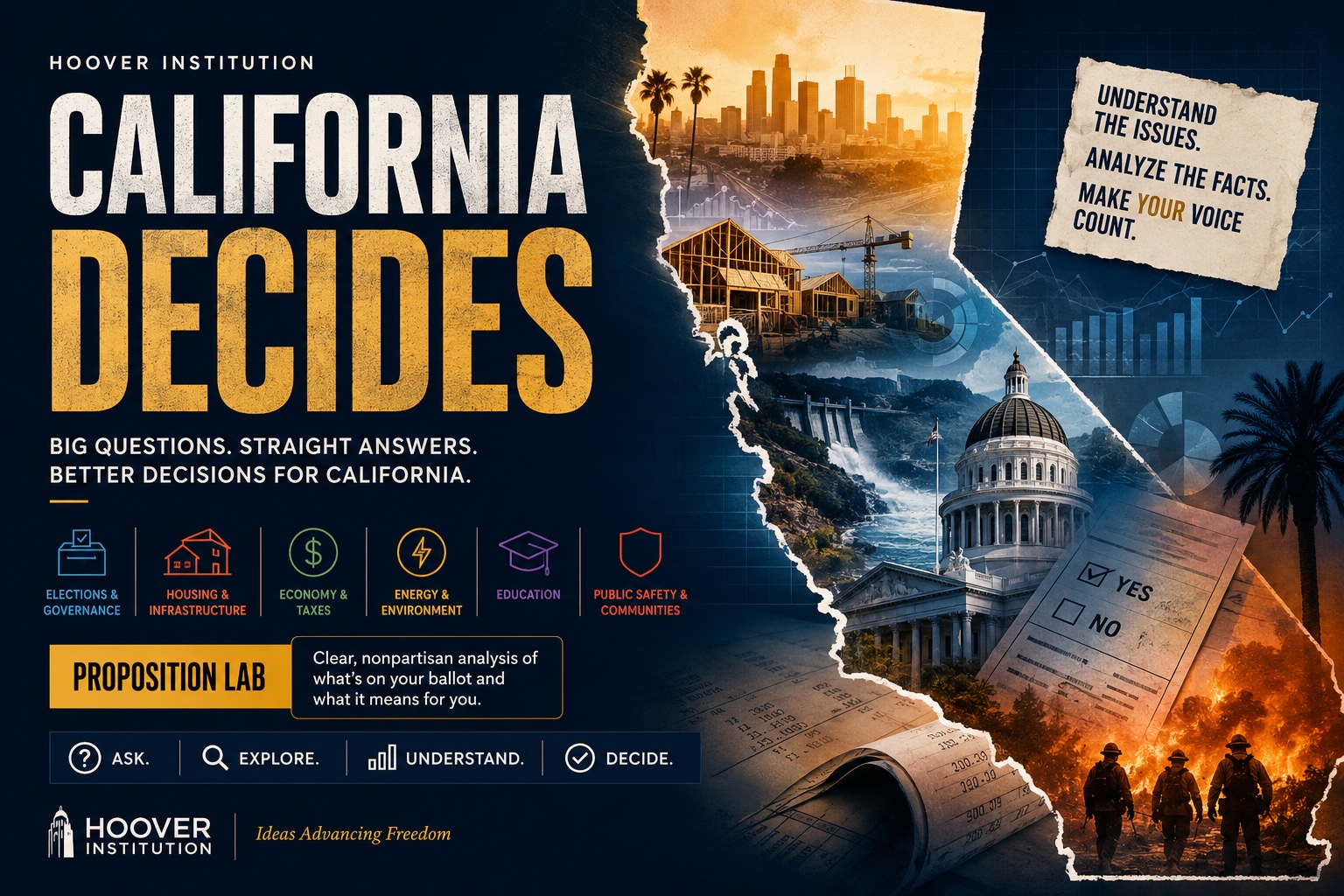
Significant policy making doesn’t just take place in the domain of the federal government. The Hoover Institution is committed to the idea that policy research should focus on solutions at the state and local level, where governments are best positioned to improve educational outcomes, stimulate economic growth, spur innovation, and respond to other needs of its citizens. To accomplish this goal of empowering states and localities across America, the Hoover Institution partners with a diverse range of state agencies and lawmakers. The aim of these collaborations is to produce data-driven policy recommendations on key issues such as economic development, public sector pensions, energy policy, tax and fiscal policy, and many others.

overlay image