

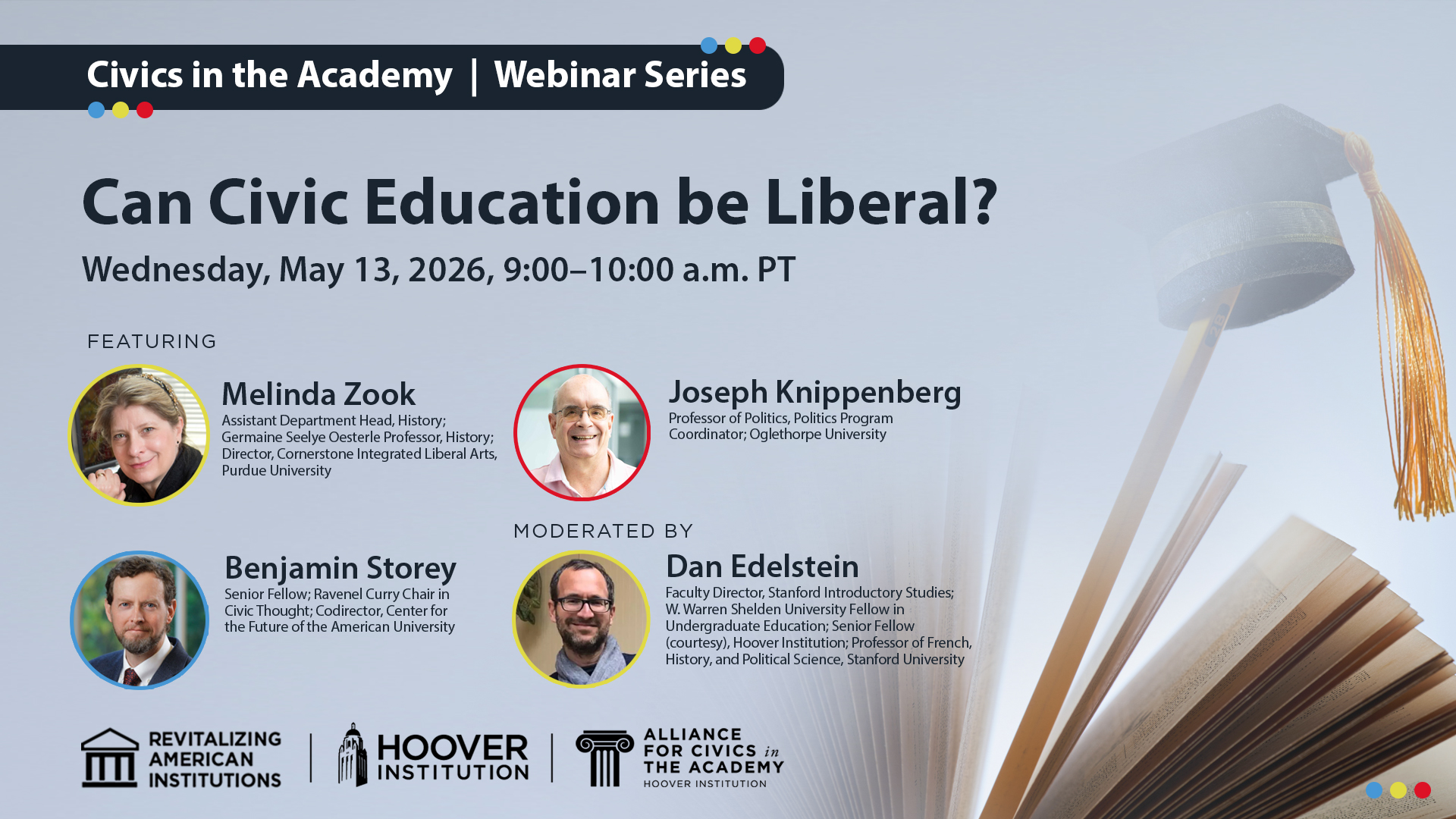
The Alliance for Civics in the Academy hosted "Can Civic Education be Liberal?" with Melinda Zook, Joseph Knippenberg, Benjamin Storey, and Dan Edelstein on Wednesday, May 13, 2026, from 9:00–10:00 a.m. PT.
Civic education and liberal education are often treated as complementary, but their aims can diverge in important ways. This webinar explores how efforts to prepare students for democratic citizenship intersect with, and at times strain against, the broader aims of liberal education, including open inquiry, intellectual autonomy, and critical skepticism. Panelists will consider how institutions can navigate these tensions while advancing a coherent vision of civic learning in higher education.
- Welcome to this year's Final Civics webinar. We are, we have a real knockout cast to see out the year in style. My name is Dan Edelstein. I'm the co-director of the Stanford Civics Initiative and the director of Stanford Civic Liberal and Global Education. Our first year requirement, which I guess also tips my hat as to how I would answer the question we will be discussing today. And I'm joined by three distinguished guests. I thought to combat the tyranny of Alphabetization, I would start with Melinda, with a Z. You always get, you always go last. It seems unfair against the, the spirit of civic equality. So, Melinda Zuck is the germane Sealy Osterley professor of history and the director of the wonderful Cornerstone Integrated Liberal Arts program at the College of Liberal Arts at Purdue University. She's a historian focusing on political thought, religion, woman in early modern Britain, and she teaches courses on English and medieval history, as well as on topics such as Shakespeare's Kings, the history of toleration and higher ed. She has published many books, articles, and essays on radical politics, martyrdom, political poetry, queenship, religion, woman writers, as well as teaching. She is also, as I mentioned, the primary art architect of the Cornerstone Integrated Liberal Arts Program, which is a truly wonderful model and a nationally recognized one for gen ed that allows STEM and business majors to integrate liberal arts coursework into their degree programs. This program, cornerstone now teaches more than 10,000 students every year through the transformative text sequence. And more recently, along with associate Dean Sherry Mateos in political science, she has launched the Cornerstone Institute on Civic thought. Also, joining us is Benjamin Story, who is a Ravenel Curry chair in civic thought, a senior fellow in social, cultural and constitutional studies at the American Enterprise Institute, or a EI, where he also co-directs the Center for the Future of the American University. He's also an SNF Agora Fellow at John Hopkins and a research fellow at the Kiita Institute at the University of Texas at Austin. Before he moved to a EI, he was the Jane Gauge Hip Professor of Politics and International Affairs at Furman University, where he taught for 17 years, his work has appeared in the New York Times, the Washington Post, wall Street Journal, Chronicle of Higher Education, among other outlets. He's the co-author with his wife, Jenna Silber story of why we are restless on the modern quest for contentment, which came out with Princeton Press in 2021. And they are currently working on a book titled, why Think How Liberal Education Should Prepare You for Life. And then wrapping up our lineup is Joe Berg, who is a professor of politics at Oglethorpe University in Atlanta, where he has taught since 1985. He's also a faculty affiliate of the Jack Miller Center, and he has served on the boards of the Association for Cortex and Courses as well as the American Academy for Liberal Education. His focus is on 17th and 18th century political thought and has published in a variety of edited volumes and scholarly journals. Currently, he is thinking and writing about liberal education and has joined many attempts to celebrate the semi quintal as he puts it, trying to atone for his bad attitude as a young man working in Washington DC during the bicentennial. So we, we look forward to some of those mea k buzz. So what a great group to talk about today's question. Can civic education also be liberal? And I guess vice versa, let us maybe just start by having each of you sort of put out a stake in the ground and then we can take it from there. So, Melinda, do you wanna kick us off?
- Oh, okay, sure. I'm happy to do so. So I'm new to all of this thinking a lot about civics, but I do think a lot about it because of course it is connected so much to liberal education, and of course it's part of liberal education. The skillset, the thinking that's involved are all very similar, however, okay, so it is also, it's part of it, but it's not without problems and fault lines. And I think the problem comes down to, there's a sort of foregone, foregone conclusion with civics. You really want to build an affinity between the students and the constitutional Republic of the United States. There's no doubt about that. You're trying to lead them in a certain direction. And I think that sometimes can be problematic in a classroom in which you're trying to be completely neutral and objective. Now, that doesn't mean it's impossible. And obviously even if we're teaching Shakespeare or TS Eliot, we want them to love the text, right? We want the same skill sets are involved, close reading, taking the text apart, playing with words and ideas. That's all true. But civics has a more pointed goalpost. And I think that, you know, I I, I think we can get around this, but I think it's worth talking about. So I'll just throw that out and then we can begin a discussion.
- Thank you, Melinda. That's a great point, Benjamin.
- Yeah, I agree with much of what Melinda had to say. The about this, the, I think in some ways the tension between civic education and liberal education can be somewhat reduced if we think a little more fundamentally about what it means to be a citizen. What does it mean to be a citizen? What it means to be a citizen is to have a share of sovereign responsibility for the political whole. What does it mean to be sovereign? What it means to be sovereign is at the end of the day, to have power over all the elements of our common political life. And so, if you think about what it means to be a citizen in this way, the citizen is not merely a part of an existing political community who owes it allegiance, the citizen is the superintendent of that community. And as such has to see beyond it. You can't govern something well, if you exist simply the, on the inside of it. So in this sense, it seems to me that a liberal education and a civic education have a great deal of overlap because the citizen really needs to know something about to not to put too final a point on it, everything, the citizen needs to be a certain kind of generalist. What kind of generalist? I think the citizen needs to be a disciplined generalist. A discipline generalist whose, whose specific discipline is the discipline of prudence. That is, is the discipline of taking responsibility for the whole over which the citizen possesses a share of sovereignty. So this is my way of describing why, what, what I think Socrates means when he describes himself as the one person in Athens to put his hand to the true political art in his time. That is this, this, this most signal of philosophers, this, this hero of liberal education under stood himself to be practicing a certain kind of high and reflective citizenship. And I think that's the kind of high and reflective citizenship. It's the business of university level civic education to cultivate the in the students who pass through our classrooms.
- Great. We've putting out some big position points here. This is excellent. Okay, Joe? The bar is high.
- Well, I would just say what they said and leave it at that. But I, I started thinking about this and the passage from Plato's Republic came to me, and this is from book five, where he says, unless the philosophers rule as kings or those now called kings in chiefs, genuinely and adequately philosophize and political power and philosophy coincide in the same place. While the many natures now making their way to either apart from the other are by necessity excluded. There is no rest from ills for, for the cities, nor I think for humankind. Now, let me rephrase that, to make it applicable to our topic here. Unless civil civic education and liberal education coincide in the same place, there is no restaurant yields for the cities. Nor I think for humankind civic education, liberal education are different. They have different aims. But I don't think that, certainly, I don't think that civic education can prosper unless it's situated in the context of a liberal education. And I could go on to explain that. Nor do I think that liberal education by itself without a civic component, can really accomplish its same. So they're different, but they're complimentary. And that I think they need one another. I'll leave it at that for now.
- Well, maybe sticking on the Plato theme for a moment. You know, Benjamin, I wonder what you would say to someone who might, you know, counter that, you know, is this really realistic and a democracy? Right? Mm. You know, and in the end, that's not really the political model that at least that Plato's Socrates promoted. And, you know, we have reasons to suspect that Socrates himself was rather skeptical about this working in a democracy. I mean, it's a high bar, right? If we expect the entire citizenry to, you know, not only be trained in prudence, but as you say, to sort of see beyond everything.
- Yeah. And that is, but at the end of the day, that is the high bar that we have set for ourselves. We are a country in which citizens are ultimately sovereign. And you know, the Greeks understood that this was a kind of stealing fire from the gods. They understood that there was something that you should be intimidated by in democracy. I think we are actually too little intimidated by the, the, the, the challenge of, of governing ourselves. And so in this sense, you know, I think it is really helpful. You know, I think one of the most common mistakes made in civic education programs is to begin with America. I love this country. I want us to understand this country, but I don't think we can get a proper perspective on this country if, unless we try to understand how human beings have undertaken this, this, this, this stupendous experiment in attempting to govern themselves in other times and places, unless we understand that this is an adventure, that, that often go very well, the, and that is just the adventure that we have embarked ourselves on. And so with respect to the democratic, and if you, if you want the more, the more ambitious elements of this, it seems to me that we should understand what we're doing with civic education in a similar way to that we understand what we're doing with everything else in the university. So for example, the university contains both math departments that, that employ people who study the highest levels of mathematics, do things that the rest of us couldn't begin to dream of doing. And it also staffs math requirements intended for all students passing through a particular university. I think we need to understand civic things in much the same way. There are people who dedicate their lives to the study of certain civic questions and penetrate them more deeply than the rest of us do, because they do that. And at the same time, it is the case that all of us should want to know as much as we can about the subject in front of us. So I agree with you, Dan, that it's a, it's a significant challenge, but I think it is in fact a challenge that we've set for ourself and something that we have lots of models the to, to, to, to direct, to orient civic education by, if we just look around the rest of the university.
- So all of us are academics and some degree administrators. And so I think we, we do also wanna think about how these sort of more philosophical pedagogical questions translate into academic programs. Melinda, you've done a lot of work in this area. Would you, how do you think about especially Benjamin's point that maybe the one way around the challenge you initially identified is to take this sort of longer historical view on civics and, and especially bringing it to all students, right. Which, which you've, you know,
- Well, that part I couldn't agree with more, of course, because I'm an early modern historian and I think, you know, maybe Benjamin has, has heard me talk on this. I, and I agree with you, Dan, who said once not too long ago, we wouldn't be here if it hadn't been for the demise of teaching western civilization, right? So of course I believe all of that. The problem is the, the pickle that we have gotten ourselves into now is there's very little room in the degree programs of our students for the kinds of courses they need to take, right? In liberal education in civics. I worry very much about creating whole new departments in, in this space. I not sure that that is completely the right road to go here. So it's, I think the, the, the answer in my res my belief is that general education is the place for civics and that that's where it should be taught and integrated. At least that way we would be able to reach all of the students. And, you know, this has been my mission at Purdue to reach all of the students, the engineers, the veterinary tech students, you name it. And civics is the kind of thing that every single human being right, needs to know. We're all citizens. So I worry that about over specialization of it and that students won't do it if they can't see a clear career path for them. Now, law school used to be an answer, it hasn't been for years. So I'm not quite sure which way you would tell them, okay, this civics major will lead to what, and our students are very practically are very, are very pragmatic minded.
- Well, Joe, you sit in a poli sci department. Yeah. And so, you know, what are your thoughts about sort of Benjamin's proposal of this sort of like turning some humanities departments more into like the math model where you have people doing advanced research, but you also have a service component. Do you think that's something that, you know, could, could exist within our current structures?
- When I first started teaching in the, in the Reagan administration, someone pointed out to me yesterday, I thought about the, the Intro to American politics course, which at our institution at that point served two different constituencies. One is to introduce students to the major. The other is as part of the gen ed requirement. I thought it served neither aim particularly well because it, its, its aim was divided. Now, I, I hesitate to, to place responsibility for civics on, on political scientists because I think in some ways political sciences that is evolved is either indifferent or hostile to citizenship. Now, I'm, that's a, a, a bold claim and I'm happy to vindicate it, but probably I don't wanna go down that path here. So I agree with Melinda that I think gen ed is a, a very important venue for some kind of civic education. But I also think that in terms of preparing students to be citizens, political science needs competition and some of these civic programs are providing competition and turns out that some of them actually do quite well in, in attracting and recruiting students. I think there was an op-ed in the Wall Street Journal today that talked about the successes of the program at the University of North Carolina Chapel Hill and certainly have lots of, you know, friends and acquaintances involved in, in these schools of civic thought at various places. And they, they are creating programs, they are recruiting students and you know, certainly the political scientists regard them as competition. And if competition is good for us, then perhaps it will bring political science back to a more civic role. But I don't think without that kind of competition, political science departments, especially at R one universities will take, will go down that path.
- And could I Yeah, jump in just for a second to re respond to, you know, I I I agree with a lot of what, what Joe was saying there wanted to Yeah. Respond a little bit to the, the sort of gen ed versus department distinction that, that, that Melinda was, was drawing a moment ago. I really, you know, first of all, I, I'm really happy if there's a place that has a new gen ed, the on civics, I support that. I think it's great the, but I also, I don't think this is an either or vm, I don't think that's the way we see it in other areas, the university. And I also think it is the case that the moment that we're facing in higher education right now is the biggest watershed moment we've had, I think since 1876. I think this is a moment where things, we, we work with universities all around the country, and I think I see things shifting, including departmental divisions, shifting the all over the place. That's a lot of what is going on right now. I think you can read about it in the Chronicle of Higher Education every day. And what I would encourage those who are interested in university level civic education, get in the game, make a case for the thing that you think is important. The, because I, I think it's important and deserves to have the kind of staying power that things like university history departments or English departments have. The, that is, it deserves to be the kind of thing that exists on every self-respecting university campus in the country.
- So I think probably most people on this call would agree with everything that we've been saying since you have to kind of care about civics in the academy to be tuning in anyway. But there does seem to be this, you know, kind of deeper institutional tension, which I don't think really necessarily reflects any philosophical dis disagreement. But between setting up independent centers, schools now even, who really take this on as, as a core part of their identity. And that's what we've seen at UNC, Florida, UT Austin and other schools versus sort of what Melinda's describing, which is how could we, you know, bake this in to the entire institution and try to reach all the students. I think, you know, it kind of comes down to the, the siloization challenge. So I'm just curious, what, what are your, all of your thoughts on like, for who are listening who do wanna maybe make the case, especially for the gen ed side, how do we push back against the enormous economic disincentives of taking away some of the student course space and putting it in gen ed instead of in specialization? So, so maybe Melinda, you could start saying how you've done it at Purdue.
- The first thing we have to do is elevate gen ed. If gen ed needs to be taken seriously, it needs to be something that tenure track and full-time faculty teach and take seriously. And one reason above all the students know that you have sort of disregarded this class by putting in an overworked adjunct with maybe three other positions at other area universities, or a very tired graduate student who's trying desperately to get the rest of their coursework done. So if we can elevate gen ed and, and begin to take it seriously and make it something that the faculty want to teach and like to teach because, you know, they don't wanna teach skills-based courses. They want to teach courses in civic thought or in on transformative texts, that means something. So that would be the first place. And then we've gotta work very hard with the rest of the university. And it, you know, with, with Cornerstone, that was a lot of work to bake it in to the 11 different colleges at Purdue University. So yeah, it takes a lot of work and it takes a lot of spreading of goodwill, lunches and coffees, but it was well worth it for the students above all. And it also, I mean, this is what liberal education and civics education can do. Ben was saying before the webinar started, we're at a pivotal moment in which we could have an absolute renaissance in the humanities and the social sciences. I believe that too, but we've gotta do a lot of convincing to make it happen. I've said enough.
- No, you've said it off
- When I, I, let me jump in here and add one thing and which is when we get our students coming to the universities, they're not prepared very well for the most part to read and to write. And they certainly don't have a, a very solid preparation in for, for either university success or civic success. So one of the things I've seen, and I I I think a lot of the, the civics programs are doing this is reaching back into K through 12 and attempting to improve the knowledge base of the teachers in, in those programs. And, you know, I live in Georgia, Ben may be familiar from this in South Carolina, in high schools in Georgia and across the south who's teaching civics, it's the coaches. What were they hired to do to coach not to teach civics? Now I, I like my football as well as the next guy. He does seem to me that without some effort at improving what's going on, especially in high school and even earlier, universities will not have much success in teaching civics, let alone other subjects. So I don't see political science departments at major universities working hard to promote civic education in K through 12. So it's gonna be left at the civics programs to do that, I think. And that's, that that's not a bad thing. I'll add one other thing. A lot of the focus on the civics programs has been at R one universities. And what I'm seeing is that a lot of the, the programs are under pressure to hire faculty who are respectable to their colleagues in other departments, which means they're hiring people who have distinguished publication records. They're not hiring people to teach, not hiring people for their teaching success. And I do think that's a bit of a risk if you're going to, you know, try to either compete with or attract undergraduate students.
- Mm. Couple a couple of quick thoughts here. First, entirely agree with Melinda on the importance of elevating general education. One of the things I think the, you know, I think the days of, you know, gen ed requirements that, that are just box checking exercises of, you know, courses that faculty say count for this skill or that that skill and so to so forth. I think the days of that are numbered. I don't think the public buys it anymore. I think universities are gonna need to change on this front end. Sorry, what? What's that, Dan?
- Oh no, we, we, you suddenly froze. We were afraid that somebody had stepped in 'cause you had, you had spoken truth to power and silence.
- Well, I was just saying that I think we're seeing new curricular core curricular movements, including the one at Stanford, which is obviously a leading candidate here. And I think that's a wonderful development on the siloing question. I, I think the answer to this is basically, if you don't wanna silo, don't make a silo. And the, and what I mean by that is, right, when I look at what I, I talk to my, my friends and colleagues working in civic thought programs around the country, people like Dan de Salvo at at UNC or Justin Dyer, the, at the University of Texas or Josh Dunn at the University of Tennessee. Those people are doing a lot of hard work of outreach to their departmental colleagues. They understand that sometimes people are a little bit upset when this new guy arrives in town and so on and so, and gets a lot of attention. The, and they've been working hard to build bridges, and I think that's really good for them. They, and I hope some of that attention could come from the, from the other side that people can work to, to integrate these new programs into their, into their universities. And I think this is a place where, you know, I know that people on campus are often worried about the, what seemed like zero sum games for, for getting students into classes, then getting enrollments and so on and so forth. I really do believe that this is a case in which a rising tide can lift all boats. A lot of people have been alienated from the humanities and social sciences. Then over the course of the years, these new civic thought programs do a lot to bring some alienated people back in the, and that can lend a lot of energy to other things that are going on around the university. And so I, in that sense, I don't see this as zero sum.
- Well, I hope that this prophecy of a renaissance comes true. I do want to also just flag that for anyone who's listening and who would like to try to do something at their own campus, there's a fabulous foundation that has really been pushing this effort to elevate liberal education, as Melinda had said, that's the Tegel Foundation. And they've actually named a grant proposal after Melinda's amazing program, the Cornerstone Learning for Living Initiative. They, you can find information on their, their website. The next deadline is in December. And many of us on the, on the cov worked closely with Tegel. They helped us get our own first year requirement off the ground. So it's great to have this connection. One thing that kind of looms large over these conversations lately is the, the rise of ai. And I think it's, it's sort of, I guess the jury's still out on how it's going to affect a lot of our efforts. On the one hand, it does seem to have sharpened the economic anxieties that many of our students are feeling, but maybe there's a way in which it could also kind of actually be a blessing in disguise for, for some of the, the efforts that we've been discussing. So I just thought I'd throw that question out too. And how does, how does all this land, you know, in 2026 differently than it might have even just two or three years ago?
- Well, actually, we were talking about this a little bit earlier, and I agree with Benjamin on this, that AI could lead to a revival of getting back to the humanities. The students this year, more than any other year, I were confused by the fact that STEM had always been a safe bet for them, and now suddenly it wasn't. So I can see the anxiety, I can feel it here at Purdue, right? Which started last year and then, you know, really with the Trump administration and then everything that's happened in the last year and a half. So, you know, here we are, the humanists just waiting for them to come to us and to supply the things that have been missing in their lives, which it would be along the lines of truth, beauty, purpose, meaning all those things that we believe in. So, you know, maybe it's not a horrible thing altogether. I've, I've had my moments of AI hating, but, you know, maybe there's a possibility that this could be something that good in our direction.
- I think Matthew Arnold just smiled, but yes, go ahead.
- You know, one thing a, a computer can't do is take responsibility. And I can say just as somebody who works at a DC think tank in which we hire a lot of young people, responsible agency is something that we look for the, as an employer that I'm sure a lot of employers look for and civic education rightly understood. And I also think liberal education, rightly understood, can both be understood as education's in responsible agency, in in agency with, with knowledge. The, that, that, that supports it. The, so in this sense, I do think that there's a, there's a possibility the in the, in the a AI revolution to, to push some of the, the imbalance the, that has existed in higher education for, for some time now. What, you know, Danielle Allen points out that we spend $50 on stem for every 5 cents that we spend on, on civic education, the, well, you know, you get what you pay for the, and that's, you know, that's some of where we are right now, I think, you know, with nothing against stem. I think the shifting back of some of that balance could be helpful for us. And I think students actually want to be responsible agents. And it would be useful for those of us in the, in the humanistic and, and social scientific fields to, to try to speak to that desire. The, because I think we actually do have something to offer.
- My, my university's motto is, make a life, make a, a living, make a difference. And AI is obviously com complicating the making a living challenge. Perhaps we'll end up with, you know, the, the, you know, the fabled Marxist utopia where everyone could be a hunter in the morning, a fisherman in the afternoon, a critical critic after dinner. And it seems to me that we can, I think, push them in the direction of, of asking, how are you, you're going to have some leisure, you may not have to work as much. What are you gonna do with your leisure? How are you gonna make your life meaningful? The other challenge, and this is, you know, completely on the other side, what if the are beings who were made to work? I mean, not forced to work, but working is part of who we are. And I think figuring out how we're going to work when machines can do a lot of work for us, I mean, it's been a challenge for a long time, but you know, that's a question that it behooves us to, to think about and not just let AI answer for us. Hmm.
- So I'm, in a minute I'm gonna shift to some of the questions we have from the audience. So if you haven't had a chance and you're listening and have a question, you can use the q and a function in the webinar. Maybe I'll just throw out one last thought. So Joe, your, your point about leisure calls to mind my, my favorite etymology, right? Which is that leisure and Greek is skole, which is where we also get school from. And of course, you know, for the Greeks and for the Romans as well, the whole point of a liberal education was actually to know how to spend your leisure. Well, it was not about work to some extent. It might have been about being a citizen too, but leisure was always at the heart of that. And I just wonder like there's this sort of other, there is kind of this challenge here, which is that it seems that in our cultural consciousness, we have completely lost sight. That a liberal education is not really designed to prepare you for your first job, but it is designed to prepare you for, for a life and to some extent for work, but also for leisure. And how do we, how do we change that dominant narrative that exists, you know, in society and that many of our students are bringing with them as they, as they enter into university?
- Well, I, I, I hesitate to answer that question when Benjamin story's part of the, the webinar, but I would certainly point to Tocqueville and talk about things like restlessness and how Tocqueville urges us to detain, to detain the mind in theory. And that, I think is a, a problem. I talk about sole and scholars and leisure all the time, and what I discover is, you know, my students think it's kind of a joke.
- Yeah.
- You know, one thing that I discovered a, a few years ago is that I wasn't educated as a, as a religious person. The, but I eventually found myself through a long and complicated series of transformations, inspired to start taking the Sabbath, start observing a day of leisure, a day of rest, the, in the course of the week. And I think one of the results of that, the, an unanticipated result is a, actually a, a deepened capacity for agency and for meaningful work, one has to step back, one has to reflect, one has to look, one has to think about the most fundamental things in order to really orient oneself, the toward meaningful action. And I think, Dan, as you were describing it, a university education can be an interval. The, as Michael OShot describes it, it can be a pause between the passions of adolescents and the responsibilities of adulthood in which we learn to reflect seriously on things, reflection that we ought to continue on in the rest of our lives, the rest of our lives. It could be much busier. That's why taking a Sabbath, whether it be Saturday or Sunday or Friday or whatever it is, but taking a Sabbath helps the, but that is really important for actually making our work meaningful and not just a reaction to whatever the next stimuli is. You know, popping at us out of our inboxes
- Can't help thinking of Seneca and shortness of life. That it's, in a way, maybe an education is about teaching us how to be masters of our own time. And Sabbath is a way to claim, reclaim some of time from all the demands that the, the world and others are constantly putting on us. Hmm. Melinda, do you have any
- Well, you know, I couldn't agree more. You know, I try to walk four miles a day just to think, You know, so I'm, I'm, I hear you on all of this. I worry about how to get it through to the students. Cornerstone is doing an experiment next fall with two learning communities called the Art of Attention. And they're basically phone out. You can't, can't use your electronics in the classroom. And you, all the students live together, take classes together. We're still trying to figure out how this is going to work. As you can imagine, parents aren't too crazy about students not being connected every second, their, their, their children being connected to them. So the, the, the nice thing about it is that the students will do it, we'll have 60 students doing it through Cornerstone and some art classes, and the faculty myself and, and as well will do it with them. So we can also tune out and turn off and, and calm down a little bit.
- Yes. I, I have heard people now introducing the idea of a, of a digital or technological Sabbath where at least you stand, you stay away from your electronic devices.
- It's
- Gonna
- Be tough.
- I know. Gosh. So maybe I'll go to some of our questions now. One of the first questions that came through, sort of about the changing nature of our student body and the extent to which we now have many more international students at American University. So just thoughts on how that might or might not change the way we approach civic education.
- Well, I'll just comment on this from my own experience as a student, I spent a year as a graduate student studying in France. And from my French classes, I did not want an education in globalism. I wanted an education in France. The, because I wanted to understand this distinctive place. And I think a lot of, you know, many of my students at Johns Hopkins this past semester have been international students. I don't think those students are offended by being introduced to, to American things. In fact, I think they want to be introduced to, to American things. And so we need to, we certainly need to have a, a broad and in some sense cosmopolitan vision. The, when we're thinking about things, there's lots of cultures in the world have done wonderful stuff then. But I don't think that we should be shy about taking seriously our own American traditions and helping, helping our students wherever they're from to understand those things and to understand the particular dramas of our national life.
- Yes.
- Alright. If anyone else wants to jump in on that, please feel free to, otherwise we'll move to another question. So here's an interesting one. You can lead 18 year olds to water, but can we make them drink? How do we see if it's swallowed rather than spit it out? Is there, is there a risk in especially in mandating classes that, that we actually turn them off from some of the topics or goals that we're trying to enliven them to? So Melinda, like with Cornerstone, does anyone ever go, oh, Shakespeare,
- Oh yeah, right. They, this is a truism about Cornerstone. The first week they look at the syllabus, they see there's five books and, and, and poetry and drama and, and they always say, I'm gonna hate this class. But by the third week they absolutely love it and it's their favorite class because no one else in their other classes is reaching them in the same way. These are very small classes. They're, it's like taking a small liberal arts college class and putting it in an R one where the students know each other, they know the faculty member. But you're right. And we always do a sort of icebreaker. The first thing you do, like a poem or a story is an icebreaker to show them that this is something that you can love and appreciate so far. So, you know, we've, we've done very well with this. And I think it's the faculty member that matters less, more so than the books, to be honest. A a good faculty member, a good professor can change your life.
- I would agree with Melinda on that. We have a, at Oglethorpe have a core that extends through all four years. And there is a lot of, among our first year students, but I will also tell you that the greatest friends and partisans of the core are, are alumni. And if there's ever any word that someone is going to alter or abolish the core, I can rally five or 600 alums within 24 hours. I mean, that's a bold claim, but it, it ha it's happened before when there was some muttering about changing the core and all of a sudden, you know, they were our wants and wants and future scholars were out there with their, you know, tortures and pitchforks ready to storm the administration building to in, in defense of great books. So I do think professorial enthusiasm, if, if you love learning and it shows your students will react. I do think a lot of faculty, unfortunately, and a a lot of students regard gen ed as a kind of obstacle to be gotten over rather than an opportunity to, you know, learn something and, and, and learn to love something.
- And it's not just a matter of you walking in and you love Shakespeare. You have to project love for them.
- Yes.
- And that makes the difference. Always go in with a smile, always, you know, talk to different ones that you're passing by. Don't be afraid of them. They're not your adversaries. They're your, your children, your grandchildren, your brothers, your sisters.
- I always tell my students that everything unpleasant about the university experience is extrinsic to the university experience in as much as it's all part, you know, how would I put this? It's what they don't like about it, which is having to show up at a particular time and having to produce written work on demand is all an artifact of the credentialing process. They need the, the credits, they need the degree in order to get something they want. Wouldn't it be wonderful if you would all just, you know, talk when we felt like talking and, and say things when we had things to say and not, and we didn't. And you know, we'd all love it a whole lot more. So it's not the subject itself, it's really the, the framework in which it's embedded that makes it in some ways seem like, seem unpleasant. So try to make it more pleasant.
- You know, this makes me think that we've sort of been dancing around another aspect of gen ed and civic ed, which is the format in which this material is taught. And, you know, when we were redesigning Sanford's first year core, the thing that seemed to me to stand out among other first year programs that have, that have, you know, withstood the test of time, and I was really thinking of Columbia and Chicago in this moment, is that most those core classes are delivered in a seminar format. They're not, you know, big lectures where you're just sort of sitting passively, you know, receiving the truths of all time and, and probably, you know, doing some shopping on your, on your laptop at the same time. And it does seem like maybe here as well, this is a chance for sort of the, the renaissance of the humanities, going back actually to the seminar model. I sometimes feel that you bring 17 students together in a seminar with a charismatic instructor. Frankly, you could be talking about anything. Yes. And there would be some of that transformative spirit going on. So I'm just, maybe I'll throw that out.
- Yeah. Just a, a quick comment on this, which is those of us who care about things like civic education and general education and liberal education often stay up at night pounding the desk the about the, the evil incursions of the German research model. But it's worth re remembering that the Germans gave us the seminar, the this is something that they developed. And I like you Dan, believe that seminar education is the, is the model that can actually do the most. To go back to our AI topic earlier, look, when you're really putting students front and center, when you're asking them to talk and give an account of themselves and give an account of what they're seeing and the books that you're reading together, this is wonderful training for their minds that will, and not just their minds, it's also for their hearts that they will take with them the, for their rest of their lives. And so I I, I'm a huge believer in seminar education. I also do have to though tip my hat to some of my friends who are, who are doing some of this kind of work where they have to do it in big lecture classes. There are huge state universities and they just have to do it. And so, you know, they're really developing the art of an excellent lecture. The, and an excellent lecture is a wonderful thing too. So the, you know, again, I, you know, I want a thousand flowers to bloom the, the seminar bloom, the seminar flower in particular. So, but so in this sense, the, I agree with the, the point you're making about this,
- And Melinda just, I just wanna sort of flag that this is something that is also central to Cornerstone, right?
- Well, absolutely. I will say that big is relative big. Yeah. Or small is relative. 'cause we have to do 30 students per class at Purdue. That's small.
- Yeah.
- That might be huge other places. But we've learned, we've learned to do it, let's put it that way, through a variety of active learning techniques,
- Right? And this is where the economic challenges come into play. As, as someone once put it with a, with a possible exception of the sex industry, education is the one field that has not made many gains in productivity over the last 2000 years. So we still have to pay people to be in the classroom. So maybe I'll go to another question. It kind of maybe gets to some of the topics we've been talking about, but it's really more specific about civic education and its purpose. So is the goal of civic education just to make students sort of care a bit more about, you know, Benjamin to your earlier point, just about, you know, taking on their, their, their responsibility in, in a constitutional system that, you know, makes the citizen sovereign, or is there also a way in which we are seeking to help shape their civic identity, which of course there's going to be slightly different, maybe even radically different from, from one student to the next?
- Well I think, you know, my, my friend Paul Carice has described part of the aim of what we're doing is the cultivation of a kind of reflective patriotism. A rational patriotism. And what I mean by the way that, that looks to me is that when we understand our American experiment in the light of the other civic experiments that have taken place from time to time, that naturally becomes an exercise in appreciating the, the experiment that we're in the midst of. I think, you know, as my, as my, my colleague Yoli in, I, I've, as I've heard him say a number of times, looking out over the American landscape, you know, it's just not that bad. And I think this is a thing that we often need to be reminded of. You know, that Melinda works at Purdue and Dan works at, at at Stanford, and Joe works at Oglethorpe and a u and a, a country that has such universities is in a certain sense, intrinsically the doing something significant, the right. And so in this sense, the yes, I think we want to shape our students civic identities, and yes, those civic identities are going to vary from student to student, but I don't think understanding and love are in opposition to one another. I think Plato thought that they went together, and I agree with Plato on this as, as on many other things.
- When I started my undergraduate career at Michigan State, I was in James Madison College, so a small residential unit, part of a larger university that was teaching oriented, not research oriented and so on. And the, the model that we adopted, and I got there within 10 years of the founding, was based on a textbook written by the Great Lake, great Martin Diamond, the Democratic Republic. And it does seem to me that one of the things about the small discussion oriented classroom is that it is the model for a kind of deliberative citizenship where everyone can contribute, where you learn to, you learn to speak persuasively, and you also learn to listen respectfully. And in, in some ways you can say, you know, the great model for democratic citizenship articulated by Aristotle in politics three chapter 11. You have to know what you know and know what you don't know and listen. And, and we bring these, you know, our various insights together and form a kind of coherent hope. Now, I don't think the college classroom can be entirely a model, but if people love that, then they'll be dissatisfied with, you know, the, the chanting and, and talking heads and shouting at one another, which, which comprises much of contemporary politics and even unfortunately, a lot of the discourse that we see on too many college campuses. So we get back to talking to one another about real questions. I have a, another friend who wrote a book celebrating this some years ago, and I recommended to everyone, and that is John Siri who teaches at Pomona College, and he wrote a book called America Goes To College, which I think does a very nice job of, you know, celebrating the virtues that could be cultivated in classrooms at places like Pomona.
- Well, maybe I'll go back to something that Melinda said at the start, and that does seem to be at the, at the core of this conversation, it's, and it is reflected in some of the questions, which is, you know, are we papering over the potential tension here? So let's say there's a student who goes through one of these new civic education courses and comes out at the end saying, you know what? Actually I think that probably Technocracy is the way to go. Hmm. You know, I've, I've looked at all these historical examples of democracies, it always gets messy, you know, eventually they fall apart. You know, I look at China and wow, you know, they're, they're getting things done, trains are running on time. They actually have trains. They have high speed trains at least. And so would it, would it be, I mean, it seems like a, if we were like deeply committed to a liberal education model, there would be a way in which that would be an okay outcome that, you know, you're making up your mind. We're not trying to, to encourage you to go in one way or another. However, it does seem like from a civic education model, we would, if, like we were turning out a lot of students who, who ended the class thinking, you know what, I'm on team technocracy or even autocracy now, we probably wouldn't feel that as a win. So,
- Mm. A quick couple of thoughts there. First of all, Dan, that's where many of them are before they come to college. In other words, as we, we've all seen the numbers that suggest that that investments in our democratic and Republican institutions has declined the all across the, the political spectrum, particularly the among the young. And look, at the end of the day, we're educators and insofar as we're educators, A, we can't simply cram opinions down anybody's throats, and b, we have to adhere to the search for knowledge above all. Now, if it were the case that a genuine understanding of our country, the pointed us toward the revolution regime change or something like that, the, then this would be a really tragic predicament. The, for us, I don't happen to think it does the, but, but you know, we're not gonna get around and we're not getting around right now. The possibility that people can come to different conclusions, the about this, if we think knowledge is, is on the side of some sort of reflective patriotism. The well we have to, we yeah, reflective patriotism that, that, that acknowledges the faults of the country as part of that, the, the very act of loving it. Well, we just have to make the case the, for what we can do. The, by helping students understand better the, the situation, the political situation in which we find ourselves,
- I think we can hope that they love liberty. That that transformative texts, the texts that you would read in a civics course, whether it's the Federalist papers or to Tocqueville, will lead them to a love of liberty. Because all these texts are about setting humanity free. So you can't impose certainly not, but your hope is that they will appre appreciate, understand, and be inspired.
- Joe, did you want to add anything on this?
- Well, I mean, I, I suppose that if someone came to a conclusion with which I disagreed, as long as they offered me their reasons, and I tell this to my students all the time, you don't have to agree with me. You just have to make a good argument. If they're committed to arguing, which is to say to to offering reasons, and they come to a conclusion that may be antithetical to the aims of civic education. In some ways they've actually adopted the core of a civic education already because they're offering reasons.
- Hmm. - And in, in that way, you know, the jokes on them, I suppose because we've gotten what we want, which is to say someone who isn't willing to engage in a respectful conversation and not to short circuit it by applying, you know, technological mind control or drugs or intimidation.
- So maybe I'll end with the last question that also is coming up through the, through the chat, which is that many of the civic centers that we've been discussing have been created, you know, through a political process. They are typically in, you know, so-called red states, Republican legislatures have been promoting this. And there is a reputation now that some of these efforts in civic education have acquired that this is, this is like a covert conservative or right wing efforts. How would, how would you address that concern and how would you counter it in people's minds?
- Couple of, a couple of data points to, to start with here. Yale, the Yale report that came out a a couple of weeks ago and acknowledged that the partisan s skew of university faculty and curricula, the, has become a major public trust issue for higher education. There is a second report out from the Harvard Radcliffe Institute just earlier this week. The, that makes the same point even more strongly. The eds and I'm aware of other conversations that are going on across elite, private, higher education that are tending in something at the same direction. I believe higher education is coming to acknowledge that it has a significant ideological skew problem and that that problem needs to be addressed. I think if you look at the, the, the new schools of civic thought in the light of this, you can see this as one way of, of addressing that problem. Now I think it is the case that these institutions should be internally pluralistic as far as I can tell. All of them are actually internally pluralistic the, on their, on their politics. But they are hiring in areas that are coded right on the academic political spectrum. That is every academic knows that some fields of study code, right? And some fields of study code left. Everybody knows that, you know, the, the study of gender history sounds more lefty than the study of military history. The, and which sounds more righty. That, and those are facts that are operative on university campuses right now. They are constantly in the background of hiring and, and curricular decisions. We're seeing a shift them in the direction of some more conservative coded areas, them over the past few years. And that is good for everyone at the university. That is, if you know, if you, if you that just assume you're sort of left-leaning liberal arts professor at whatever college it is. If conservatives came to love the university again as they did not very long ago, this would be good for everybody. They, there's lots of politics on campus. It's just taking a somewhat different shape in our moment.
- Last, so I think there was a question about the second report. You said it was the Radcliffe Institute that just
- Yeah, Harvard Radcliffe Institute. I think it was just published yesterday.
- Well, we are at time. So maybe I will thank all of our wonderful panelists for a really fascinating and timely discussion. Thank our attendees for joining us. Sorry I wasn't able to get to all of the questions. As I said at the top, this is the last of our civics webinars for this academic year. So tune in again in the fall and we will have another great lineup for you. So thank you very much.
- Thank you all.
- Thank you Dan. Thank you. Thank you Ben and Joe,
- This was wonderful conversation. You really appreciate it.
- Yes.
ABOUT THE SPEAKERS
As the Nehal and Jenny Fan Raj COLLEGE director, Dan Edelstein directs Stanford’s first-year general education requirement. He codirects the Stanford Civics Initiative and is the faculty codirector for the ePluribus Stanford initiative. He studied at the University of Geneva (BA) and the University of Pennsylvania (PhD). He is the author or editor of eleven books on European intellectual and political history, including most recently The Revolution to Come: A History of an Idea from Thucydides to Lenin (Princeton, 2025). He is currently working on a history of Western culture.
Benjamin Storey is a senior fellow in Social, Cultural, and Constitutional Studies at the American Enterprise Institute (AEI), and co-director of AEI’s Center for the Future of the American University. He is concurrently an SNF Agora Fellow at Johns Hopkins University and a research fellow at the Civitas Institute at the University of Texas at Austin. Prior to coming to AEI, Dr. Storey served as Jane Gage Hipp Professor of Politics and International Affairs at Furman University, where he taught for seventeen years. He was the recipient of Furman’s highest award for undergraduate teaching, and the founding director of Furman’s Tocqueville Program.
Dr. Storey has been a visiting fellow at the James Madison Program in American Ideals and Institutions at Princeton University, and the recipient of a “Enduring Questions” Grant from the National Endowment for the Humanities. He has taught at the University of Chicago, and for the Hertog Political Studies Program, the Tikvah Fund, and the William F. Buckley, Jr. Program at Yale. Dr. Storey is the coauthor, with his wife, Jenna Silber Storey, of Why We Are Restless: On the Modern Quest for Contentment (Princeton University Press, 2021). Together, the Storeys are working on a book titled, The Art of Choosing: How Liberal Education Should Prepare You for Life.
Joseph M. Knippenberg is Professor of Politics at Oglethorpe University in Brookhaven, GA, where he has taught courses on American government and political philosophy since 1985 and won numerous awards for teaching. He received his B.A. from Michigan State University and his M.A. and Ph.D. from the University of Toronto. Writing mostly about liberal political thought and liberal education, his articles and reviews have appeared in numerous edited volumes and professional journals (e.g., Perspectives on Political Science, the Journal of Politics, and the Journal of Religion, Culture, and Democracy), as well as on various websites (e.g., the Ford Forum, Minding the Campus, VoegelinView, and the James G. Martin Center for Academic Renewal). He has in the past served on the Georgia Advisory Committee for the U.S. Commission on Civil Rights and the board of the American Academy for Liberal Education, and currently serves on the Board of the Association for Core Texts and Courses).
Melinda S. Zook received her Ph.D. from Georgetown University. She is a specialist in the history of political thought, religion, and women in early modern Britain. Professor Zook teaches courses on English and medieval history, as well as on such topics as Shakespeare’s Kings, great books and the search for meaning and the history of toleration. She has published articles on radical politics, martyrdom, political poetry, women, religion, and teaching. Her book, Radical Whigs and Conspiratorial Politics in late Stuart England was published by Penn State Press in 1999 and in paperback in 2009. In 2013, she published Protestantism, Politics, and Women in Britain, 1660-1714 with Palgrave, awarded Best Book on Gender for 2013 by the Society for the Study of Early Modern Women. She is the co-editor of Revolutionary Currents: Nation Building in the Transatlantic World (2004) and Challenging Orthodoxies: The Social and Cultural World of Early Modern Women (2014); and Generations of Women Historians: Within and Beyond the Academy (2018). She is currently the Germaine Seelye Oesterle Professor of History and Director of Cornerstone: Integrated Liberal Arts for the College of Liberal Arts, Purdue University.