





- Economics
- International Affairs
- Regulation & Property Rights
- Comparative Politics
- Law & Policy
- Answering Challenges to Advanced Economies
- Determining America's Role in the World
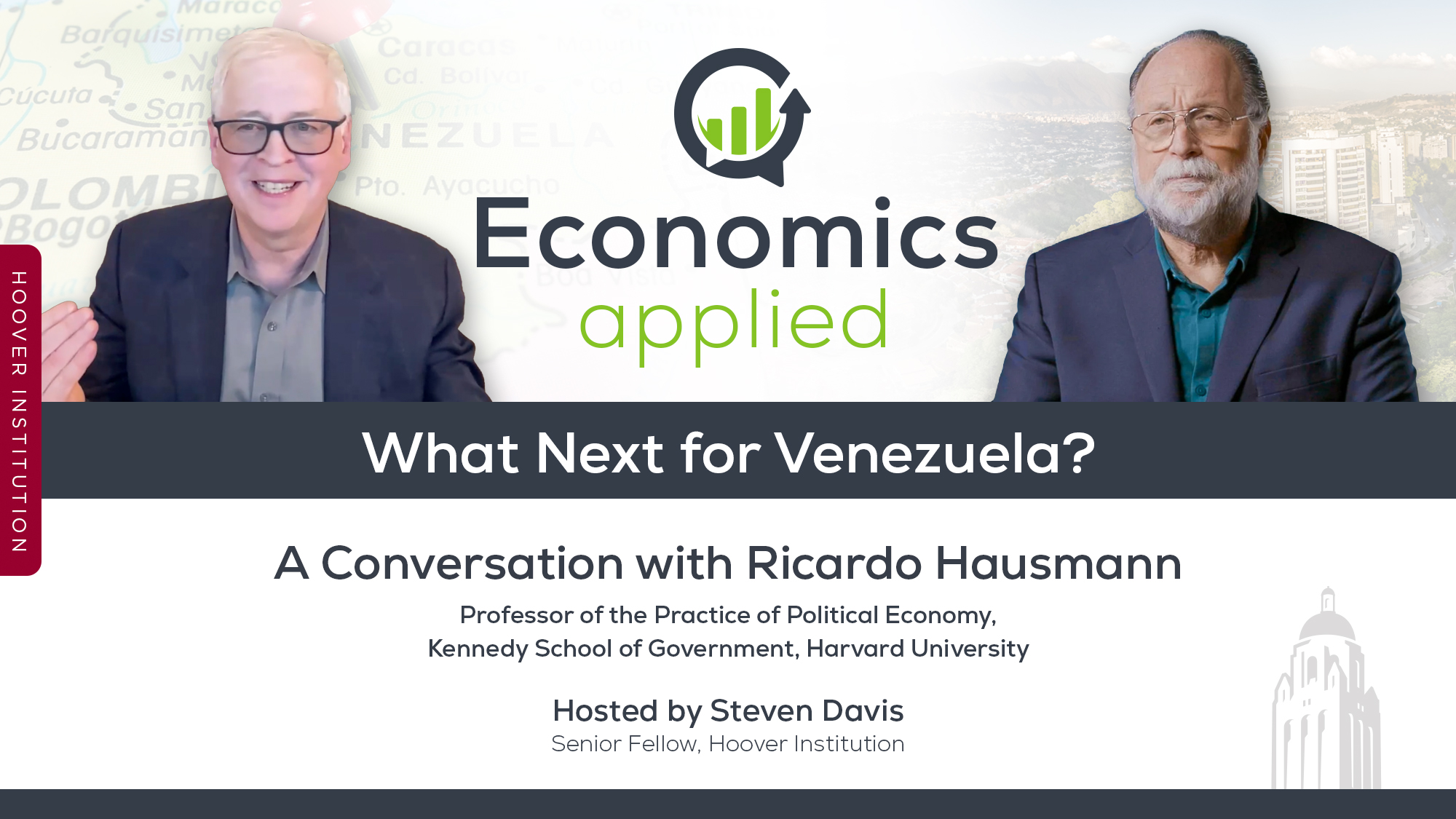
Venezuela descended into an economic, political, and human rights disaster in the 21st century. How can Venezuela find its way back to the rule of law, human rights, democracy, and prosperity? What role should the United States play? Steven Davis asks renowned economist Ricardo Hausmann.
Recorded on February 5, 2026.
- Last month, on January 3rd, 2026, US military forces entered Venezuela, captured Nicolas Maduro and his wife, and brought them to the United States to face criminal charges. The former vice president under Maduro Delcy Rodriguez, now serves as Venezuela's interim President. Maduro is gone, but the regime remains intact, at least for now. So what comes next for Venezuela? What should come next, and what role should the United States play? Welcome to Economics applied. I'm Steven Davis, senior fellow and Director of Research at the Hoover Institution. My guest today is Ricardo Houseman. He teaches at the Kennedy School of Government, where he also directs Harvard's Growth Lab from 1994 to 2000. He served as Chief Economist for the Inter-American Development Bank in 1992 and 93. He served in the Venezuelan government as Minister of state and head of the Presidential Office of Coordination and Planning, and as a member of the board of Venezuela's Central Bank. Welcome Ricardo. Thank you for making the time to chat with us.
- Thank you for inviting me.
- So you have been observing developments in Venezuela with a keen eye and great personal and professional interest for a very long time, I think it's fair to say. So let me first ask you to describe the present situation in Venezuela as you see it.
- Okay. So I don't know where to start because this is as weird as situation as I have ever seen anywhere, but Venezuela is the largest economic catastrophe ever to have, be felt humanity, at least on recording statistics outside of war and bigger than most wars. So GDP in Venezuela is about 75% below where it was in 2013 when Maduro got to power, right? The fall of 2070 5% means that to get back, we would need to quadruple our economy. Eh, that has never been seen. I mean, for example, 75% compares favorably, I would say, with a decline of 28% of us GDP, during the Great Depression.
- And this is worse than what happened in Iraq under Saddam Hussein. In terms of economics,
- It, it's worse than what happened in Germany during the first or the second World War, or in France during the first or the second World War, or, you know, it, it's just un unheard of. So there's this catastrophe in the background, and that catastrophe would have led normally in a democratic country for people to vote the government out and choose something different. But Maduro two times already in, in, in, in 19, in, in 19, in 2018 and 2024 stole elections. And so in, in 2015, the opposition won a two thirds majority in Congress, and the Supreme Court annul the powers of the, of the assembly. So e essentially we've been living in a dictatorship because the government had lost the way the, the support of the people, and they were not willing to leave. So in this context, there was a tit for tat dynamic where the more dictatorial the government would become, the more sanctions the US would put on them. Okay. Now incomes January 3rd, they take out Maduro. Maduro had been indicted for, for narco terrorism and drug trafficking and so on. A reward of $50 million had been put on his head. And so, so the US did an extraction operation, if you want, took out Malu and his wife, as you said, and you're left with a one thing you mentioned, which is the rest of the team, the vice president, which is not in the Venezuela. The vice president is not an elected position. It's an appointed position by the president. So an unelected president who stole an election appoints somebody, and now that somebody is, is the president in charge. Okay? Now it, the thing you didn't mention is that the US has essentially prohibited Venezuela to market its oil. So Venezuela is not allowed to market its oil, but it is allowed to le leave to give the oil to the US who would market the oil and would use the proceeds as the tech says, for the benefit of the Venezuelan people, every month the government is supposed to ask the US government for an allowance if you want. And that gives the US an enormous leverage over the con over the government in Venezuela. So if they want cash, they have to abide by some of the, of the demands that the, the US government imposes on them. Now, those demands are not public, or we are are not known. So you always infer that the government is doing something, maybe not because they, they're enthusiastic about doing it, but because they're being somewhat coerced into doing it. But the things that the US government has asked them to do are pushing the country in a good direction. And as a consequence of the government, you know, following orders, if you want, the cashflow constraints on the government and the country have been improving.
- Okay? So we don't know exactly what the demands of the United States are. We don't know how much resistance there is on the side of the Venezuelan regime to those demands. Presumably that's the, that's the current situation. The US has a lot of leverage as you, you indicated, by controlling any revenues that come from Venezuelan's petroleum exports. Okay. And, and other sources of leverage too. I I, I just wanna go back on your, your summary of how your very brief summary of how we got here and implicit in what you said, but I wanna make it explicit. Venezuela was an economic disaster under Maduro, but it was also a human rights disaster. The, there was tremendous political repression, persecution of his enemies. Millions of Venezuelans fled the country, partly because of economic deprivation, but also to escape the repressive apparatus. Have I got that right?
- You got it. Absolutely right. But there's a deep connection between the two observations.
- Okay.
- That it is because the regime disempowered the population took their rights away, took their freedoms away, that people started to leave, starting by the more capable. And it was this collapse in the, in the availability of human capital that also caused the, the, the collapse of the economy. It started with back still in, in the good time, quote unquote good times of Chavez. He, he tried to, to disrupt the meritocratic rules of the oil company, the national oil company, the national oil company, went on strike and he fired 20,000 of the 32,000 workers starting from the top. So he decimated the human capital of that, of that company. He took away their salaries and their pensions and all their rights. All these people left the country. They're producing oil in, in Alberta, they're producing oil in Colombia. They're producing a lot of oil in the Gulf, but they were no longer available to the Venezuelan oil company. So oil production collapsed when, yes, Chavez got to power in 1999, the country was producing 3.4 million barrels of oil. It's now producing less than a million. Okay? And that is essentially the consequence of this decimation of the human capital, because people were not allowed to, to live in the country. And that happened to many other people in the country. So,
- Exactly,
- Yes.
- So we should think of Venezuela, not only millions of people left, but it's among the most talented, skilled and highly educated who disproportionately left Venezuela first. Some under Chavez, and then more so under Maduro, as I understand it.
- That's right. And that it's significant that it started under Chavez, because under Chavez we had very high oil prices. The government was borrowing against those, that high oil income as if it was going out of fashion. And in spite of this artificial sugar high, if you want, people were leaving because there were no rights.
- Yes. Okay. So it's, it's a very sad story in the last quarter century, especially, and even more so in, you know, since 2013 when Maduro became president. Now, you, I've read, I've read some of what you've written about Venezuela's situation and prospects, and listened to you speak in other venues. So I have some sense of your views, but I, you have a very eloquent statement in a recent article in the Economist magazine of what you would like to see for Venezuela, your vision, so to speak. And it's closely tied to, in your view, how to promote economic prosperity as well as security in Venezuela. So I, I just wanna give you an opportunity to set forth your vision, what you would like to see, and, and also tell us why the human rights rule of law piece of that is so closely connected to the prospects for economic prosperity.
- Sure. Well, no, the announced US policy for Venezuela is that first they want stabilization stability, then they want recovery, and then they want, at the end a political transition. And that that's the way they want to order things. I have argued that the, what caused the collapse in Venezuela was the lack of rights that it was taking away people's rights, right? To property, right to information, right to right. Freedom of speech, public opinion, and, and then the effectiveness of the right to vote where you would vote for something and, and change would not, would, would not happen. So it's this complete absence of rights which caused the economic collapse. And I find it hard to believe that people are going to invest physical capital and move back their human capital to a country with no rights. So this idea that you put the political transition at the end and that you think you can achieve a lot of recovery before that, I put a huge question mark around it. Because, for example, me personally, I haven't been able to go back to my country in 13 years because Maduro didn't like an op-ed, I wrote, and, and just like me, there's hundreds and thousands of people who can't go back because they have no rights. It's, you know, there's exiles left and right. And what has happened to date is not enough for us to be able to go back. And, and I think that un until you make it for normal people, say like an academic like me, to be able to go back, it, people won't go back. If the people don't go back. There's not enough human capital to grow. But if, if we don't have rights, investors have even fewer rights, right? Because anything can happen to the investor. It's very easy to expropriate the cash flow or the properties or whatever. Many people who own property that is sort of profitable and so on, they're put in jail. And then once they are in jail, they, they negotiate with them that, you know, they can leave provided that they, they sell their property for a pen, for a pittance. So,
- Okay.
- So that, that ex, that risk of exp exploration of a predatory government is going to prevent a recovery from happening.
- Okay. So I wanna drill into this part of your argument in the broader discussion more fully. 'cause there's a lot of complexity here. First, I wanna make it clear to the audience, I share your aspirations for, you know, then what, for the sit for what the Venezuelans would, would like and should like to have, should have. But a few points, and I, you, you, this is meant to provoke you and get, get some further insight into your thinking and press you a bit. Lemme just start with an observation that you already made, which is Venezuela's economic performance under Maduro is, is disastrous, even by the standards of other autocratic regimes that have undermined human rights, property rights, and so on. So, the point I'm making here is there are degrees of badness when it comes to autocracy repression, and how much respect for rights you need in order to get an economy, not necessarily back to where Venezuela was a generation ago, but just significantly better than it is now. So this sequencing issue is really a, a, a tough one. And of course, you know, if, if you, if you were confident that you could go back and have your political rights, human rights not be persecuted, have the opportunity to speak your mind now, and investors were confident that at some point down the road there's going to be a successful transition to a stable Venezuelan run rule of law environment, then there would be a willingness to, to invest Now. So it's, it's not clear to me that we should, that the political transition part should come first rather than the slow accretion of rights. Maybe that's the, the slow accretion of rights, gradual buildup and confidence. Maybe that's the most effective, practical thing that can be done. And I wanted to, I wanted to get your thinking about this.
- What what is problematic about the slow accretion of rights is that you are forcing a government through coercion to do what the government does not want to do. So the best strategy for the US might be if you want a slower accretion of rights, so that they can achieve a transition without, as they call it, boots on the ground. Right? But the optimal strategy for the other side, they don't want to leave power. They want to stay in power. They know that they cannot win an election. So they know the following, that there are elections in the US in November. There's elections in the US in November of 2028, and maybe they can wait this out. So for example, probably because they were ordered to, they announced a big announcement that they're going to release political prisoners, then the days go by and no political prisoners are released, or 10 or 20 out of a thousand. So they're dragging their feet, right? And they, they free some political prisoners and they put other political prisoners in. So they're, they're trying to simulate as if, as, as if they're, they're giving your rights back. Obviously people say that. And they say there's no gradual accretion of anything. This gives me the fear that some crisis happens somewhere else in the us in the world, you know, they have to move the, the, the Gerald Ford aircraft carrier away, the pol the military pressure on the government dwindles. And as a consequence, they were barely, you know, obeying the, the instructions beforehand. Now they will just try to reassert power. So
- I, I take that point. I take that point, but let's play out the counterfactual.
- Yeah. 'cause
- The counterfactual runs into some of the same problems you described, which is the US insists on a rapid political transition to, I forget the woman who, whose party won the previous elections.
- Maria Corina Machado.
- I thank you very much, and I apologize for not remembering her name. So there is, you know, there she does have, and her political party does have considerable political support in Venezuela. So it's not like there's a lack of a, an obvious party and political figure around which you could imagine building a more democratic regime. But short, short of putting American boots on the ground, it's not how to, it's not at all clear how to bring that about. Because if you, the, the regime can hold out, as you pointed out rightly, you know, there's, there's real doubts about the durability of American attention to Venezuela. And so there are many ways that they can resist, including if the United States tries to impose a quick transition of political power.
- So I think it's, it's not that difficult. I, I mean, in first of all, the immense majority of the armed forces would obey the rules of a legitimate authority. So the, the idea that the armed forces are not under the control, if you want, of the will of the people is a suspect. I'll, I'll, I'll give you a reason why that is. So in, in every election in Venezuela, there's something called the planned Republica, where in all of them voting centers, you have military presence to assure that things go smoothly. And what happens in the voting centers is that every machine of voting gives a kind of like a ticket, a receipt of what happened. And EA copy is given to every party, every political party. On July 28th, 2024, the armed forces, eh, were deployed at the time of counting. They were given the order not to give the receipts to the political parties. They disobeyed the order, and that's why the opposition got 87% of those receipts.
- I see.
- And, and so the majority, by the way, in this, in the voting centers where the military bases are, the result of the election was the same as in the rest of the country. It was 70 30 across, across the, the, the country. So the armed forces, I think, would be respectful of the instructions given by a legitimate authority. They are not, they are, they're following the orders that they're following now, because there is a secret military police called the Deim, and they are a, a spying on all the military officers. They're coercing them. The, the, the government is more fearful of the army than they are of the enemies. That's one of the reasons why, why the American operation was a cakewalk, that the, the duo regime is afraid of arming the army because they don't know what they're going to do with the arms. So I think that what, what you need happen is to organize a free and fair election under the control, under the supervision of international observers when the voting gets counted, and the result is what it may, that creates an enormous problem for the regime not to recognize the outcome of the election. So then you'll have,
- But we've already, but that's already played out in, in a, in a different form as you just described.
- But, but without the coercive power of, say, the US or the
- International Party, that's, yeah. Then we're back. We're, again, we're back to the, the need for a coercive authority.
- Yeah.
- And at least in the present environment, the political will in the United States to provide that coercive authority isn't there? And it, it would be, you know, there would be a risk to American lives. And if, if that were to happen, it's, it's not, it's seems like a minor miracle that there was no loss of American lives in the, in the extraction of Maduro and his wife. But this would be a much larger operation. There would need to be,
- I don't think, I don't think it would be a much larger operation. The cove power is the fact that you control the cash flow. It's the fact that you leave them on a door open or, or an off ramp or off ramp for them to leave. But, you know, typically, you know, when you lose an election, you know, you leave power. It's not the end of the world. You just leave power when you lose an election. Right? I mean,
- But that's not, that's not the case here.
- Well,
- It hasn't, the secret, the secret police that you just described, they're not gonna just lose the election and go, go about their lives now, outside the, the, the corridors of power, the, that's not gonna happen. So these people either have to be eliminated or co-opted.
- Well, they can be eliminated or co-opted. But the important thing is that the way you get there, because right now the US doesn't mention democracy too often. Okay. And that sounds to people like me, like saying, I don't see a future where I can go back yet. Right? Yeah, agree.
- It's still agree with that, with no, I, I still uncertain. I, I, I share that view. It's, I don't think President Trump's Marks remarks have been particularly helpful,
- But, but you can imagine a situation where you have to give signals as to where you want to go, where you want the situation to go. So for example, they, the first signal is that they had to pass on Amnesty Law. So apparently the Amnesty Law has been passed. It hasn't been published in the official Gazette, so it hasn't been implemented. Let's see what happens. But the next thing that has to happen is that we need an electoral council to supervise the next elections, because the current electoral council is the one who stole the elections in 2024, so that they have no credibility whatsoever. So we need to agree on how it is that we're going to name a new electoral council. We need to open up the voting roles because they did not allow the 8 million Venezuelans abroad that by constitution have the right to vote. They did not allow us to register, and they did not allow the 3 million young people that had turned over 18 and were were entitled to vote. They did not allow them to register. So we need to open up the voting registries for, for people to, to be able to register. The government also made parties illegal. They took the legal representation away from parties. They have to legalize political parties. So there's a lot of things, if you want elections down the road, there are things you have to do now that will enable you to have elections down the road. So we can discuss when do you want the elections to happen? But in any date, you want those elections to happen in this reasonable future, if there are things you should be starting to do now, and they would constitute a signal, a confidence building signal that we're moving in that direction. Okay? Otherwise, it's all democracy is just cheap talk.
- Okay? So there's, there's a lot here that's well beyond my domain of expertise in terms of judging the military situation on the ground, how difficult it would be to push one coercive authority aside and install one that is more respectful of the wishes of the Venezuelan people. The, these are big problems. But let me, unless you want to talk more about those, I'm gonna set those aside now, and I, I, I do wanna get back to, and this is something you've studied over the course of your professional career, the points you began, you, you, you sketched this out earlier, but you know, what, what are the economic prospects for Venezuela under a scenario where it's just the old regime remains intact, maybe not quite as much economic mismanagement and mischief abroad as in the past. That's one scenario, not a, not a particularly happy one for Venezuelans or another scenario. The one you, you presumably prefer in which there is a restoration of political rights, property rights, rule of law, contract enforcement and so on. I want you to sketch out how those two differ in their implications for economic growth. And how do we know, how do we know? I mean,
- Okay, so, so let me sketch out what a recovery scenario would be, because if you, if the recovery scenario is sufficiently rosy, this can become a win-win. And you can buy off a lot of the people who, who are now, who bet on a regime that drove the, the economy to the ground and where there's no future for them, right? So, so it's not like, you know, if you are in the clique in power, that, that it's a rosy situation. You are uncomfortable, you know, the, the, the, it's an economy that, that, that has tanked dramatically. So the rosy scenario is you achieve the return of people's rights, people's individual rights, people's and corporations property rights. You improve the regulatory system, it's obvious that you should be able to generate a spectacular boom, a spectacular boom. Because going back to 2013 would imply a 300% growth. So we have some extent, you know, in these 13 years, 27 years of, of chaa rule, you know, people have gotten old and, and passed away and so on. But there's, the 8 million in the diaspora are engaged in activities, in technologies and business models that did not previously exist in Venezuela. They have learned they are everywhere in the planet. We would have the most cosmopolitan country, you can imagine, with deep connections everywhere from Australia to Canada, to Argentina, to u to, you know, Europe to the us, et cetera. It's super, super global connection to knowledge, to business opportunities, et cetera. So it, it would be, it, it's going from a situation where you have no human capital to a situation where you suddenly have a burst of human capital, of connections, of opportunities that were, were not there before. So I would say that 300% growth
- Over, but over what time span?
- Well, a
- I'm, I'm trying, I'm pinning you down here, but Yeah. So let's say over the next decade, what, what, under this ROY scenario, what kind of growth in GDP on an annual basis could Venezuela reasonably expect?
- Well, I wouldn't know to say expect, but that should strive to achieve. Okay. Because it's not that the check is in the mail, it's something you would have to achieve. There are many things you need to do to get there. First of all is that we have an economy of about $80 billion. It used to be an economy of $350 billion or $80 billion with two, with $160 billion in foreign debt that is defaulted on. So, you know, one of the things you need to solve is debt restructuring of all this debt. And, and it depends on how well you do it, to know how, how big is going to be the weight of the old debt that's going to prevent the, the birth of the new. So, so that, I leave that as a, as a constraint. But I would say that, you know, it will be a rate of growth that is related to the speed at which you can solve problems. And because the potential is just super high. So, you know, we used to be an electrical powerhouse and, you know, we had installed capacity of like 35 gigawatts, and now we're unable to produce 12 or 13. But, and that was hydropower green energy and so on, right? So there's a lot that can be recovered, a lot of oil that can be produced. We have probably some 12 million hectares, 25 million acres or so of good arable land. We are producing on less than 2 million acres. So, so it's just a deployment of known technologies, known business models on the existing situation that, that it could represent a
- Very okay.
- Very rapid growth. So, and, and, and, and, you know, the, the growth process has some speed limits. Sure. But it would be sort of like, it would be sort of like the fast 10% growth for a long time.
- So, okay, so finally, I got a number from you, but let me, let me tell you how I think about this. So as you've already explained, and I share this assessment, Venezuela's unusually blessed with natural resources, okay? Petroleum most obviously, but also hydro electro power or potentially hydroelectric power, arable land, minerals, minerals. So that's, that's 0.1. Second, perhaps more important for longer term growth is the human capital that resides in the diaspora community and under the right conditions would either grow back full-time to Venezuela, or would be willing to spend a lot of time there and make investments and so on. Okay. So in that sense, Venezuela is in a better position than a country that has never had a reasonably well-developed economy. Okay. Third, it does have some history. It's been suppressed for a long time for a generation, but it has a history of a functioning democracy and with, with, you know, a reasonable degree of rule of law. So these are all things that are in favor of Venezuela and, and under the right conditions. You mentioned speed limits to growth. Well, I was thinking about the same thing. And when we think about of lar of sizable countries that have had extended very rapid growth rates in the 20 or 20th first century, maybe 10% per year does seem to be something like an upper limit for what you might expect to sustain over 10, 10 years or more. But that does seem to me within, within the realm of plausibility for Venezuela under the right political conditions. And I, I think it's important to understand that, that there is, there is an economic element to the Venezuelan rosy scenario that ought to carry some weight, say, in US decision making. I'm trying to, you know, the, the, the fact of the matter is Venezuela's near and medium term future is likely to be highly influenced, if not mainly determined by decisions made by the US government. And I think that it's, it is, I'm trying to build a case, a narrow self-interested case from an American perspective for promoting this kind of vision that you described for Venezuela. I don't know if you think I've done a decent job, but I do think it's important to try to speak to the American audience on this point, as well as obviously the Venezuelan audience.
- Well, let, let me tell you what's in it for the us
- Yes.
- First, because a prosperous Venezuelan Venezuela is a country that would be importing a hell of a lot, right? So it's a more interesting market. It's a country that would be investing a hell of a lot. So it's a more interesting destination market. It's a country. It, when I finished my PhD in the us it didn't cross my mind to stay in the US as an assistant professor. This Venezuela was a magnet. Everybody wanted to be in Venezuela. It's an immigration country, not an out-migration country. So the whole migration issue would reverse course, right? And you would have a government that sees narco trafficking and so on and so on as not as a partner in crime, but as, as a problem to be suppressed. If you had, for example, a government in Venezuela in that wants to get rid of narco trafficking and a government in Colombia that wants to get rid of narco trafficking, well, we would get rid of narco trafficking quite easily. But the problem has been over the last 27 years that the Colombian narco traffickers have a, a safe space in Venezuela. And it's that that connection between Colombian narco trafficking and, and the Chavista regime and, and, and Maduro's leadership that had allowed them these escape routes so that they can produce the co the coca leaves in, in Colombia, they can process them and market them out of Venezuela. They can do the, the money laundering out of Venezuela. And so, so they would have a safe haven in Venezuela that, eh, you would do away with. If you have a government that understands that we were under a regime that was an narco trafficking regime that used tho that power in those resources to repress us, we don't want to see them again. And to have a government that has that as one of their major OB goals would be in, in the interest of the us
- Yes. So it's, it's well beyond petroleum. The United States has an obvious interest in, in a successful petroleum sector in Venezuela. But you're pointing out, and I agree with this, that there's, there's a much deeper, stronger US interest in a vibrant Venezuelan economy. And as we've already explained, that rests in considerable part, considerable part the prospects for that rest on the restoration of political rights, human rights, property rights, rule of law, and so on. So I think, so I think that's the argument.
- Yes,
- Yes. That, that, that argument I'm hoping will resonate in, you know, and who knows, perhaps I, I'm sure some versions of this argument are being made internally in dc whether they will, whether they will win out as the guiding force behind us policy remains to be seen.
- I mean, I think that Marco Rubio is super clear on these issues.
- Yeah.
- That, I mean, right now, you know, Latin America has always seen being seen under the prism of immigration and drug trafficking. And I would say the immigration problem would disappear and the drug trafficking problem would disappear because you'll have a government that sees drug trafficking as an existential threat.
- Yeah. Well, the, the Colombian Venezuelan drug trafficking problem might disappear, but sadly there are other sources of supply. I'm not sure it'll solve the entire US problem, but that's a different matter.
- Yeah.
- But I wanted to pick up one, one other thing you said, which is, which is striking when you think about it, and it begs a question. So as you pointed out, when you were a young man, you're still a young man, but when you were a younger man and you obtained your PhD in the United States in economics, you went back to Venezuela, it seemed like an obvious decision. It was such a vibrant, exciting, prosperous place with opportunities as you perceived it then for, you know, building a good life for yourself, that you went back and that, that raised the point. How did Venezuela get from there to a situation where a Chave Igo Chavez or, or Nicolas Maduro, even possible, some bad things happened in between? What's your explanation for that?
- That, that's a very, very good question. Venezuela started oil production in 1917 with Royal Shell and the standard oil of New Jersey. Now, Exxon came in, in the early 1920s. By 1929, Venezuela was the largest oil exporter in the world, and it remained so until 1965.
- Okay?
- And in 1965, we were displaced by Saudi Arabia, and the oil companies started to get less interested in Venezuela because they found all these cheap oil to extract in, in the Gulf. So, so Venezuela, between say, 1917 and 1977, that 60 year period was probably the fastest growing country in the world, the most prosperous country. It by, by 1960, for example, 7% of Venezuelans were born in Europe.
- Hmm. - So it was a country of immigration, not just of nearby people, but you know, Spaniards, Italians, Portuguese, and so on. My parents came in the forties. So, so it was a, it was a, a destination country. Then we got the oil boom of 19 73, 74, with the Yom Kippur war. And, and, and the increase in the price of oil represented an increase in national income of 45% in a single year.
- Wow.
- So something That's something, no. So then, then we started to, to think bigger, have bigger plans, too big 79, 80, they were a little bit too big. But then came the Iran Iraq war, and we got the second oil shock. So by 1981, we perceived that we were kind of like, okay, rich. And so on 1981, the demand for oil starts to decline. And if OPEC says, we won't let it fall, we will cut production. So all OPEC countries are starting to cut production to keep the price high. So 1981 was a peak of oil income. 82, they went down. 83, they went down even further, Venezuela Colla had a balance of payments crisis on February 18th, 1983. And it defaulted on its debt. It's the first country in the world to go from AAA rating to default. I in no time. Right. So, so we ended up with a debt crisis, macro imbalances in the 1980s,
- And things got worse in terms of later in 86, the world oil prices collapsed.
- Yeah. Well, the interesting thing is that 86 was just an additional headache in an already bad situation. But because in 86 the price went down, but the quantities had gone down earlier,
- Okay. In
- Venezuela. So, so, eh, 86, eh, you know, I think that a, that the collapse of oil prices in 1986 is what won the Cold War for the us It's, it's seldom connected, but you know, it really disrupted Russia, the Soviet Union. Yes. And so by the late eighties, all of Latin America was under this debt crisis. Debt crisis. There was in part, triggered by the folker shock in 81, 82. So, eh, eh, by the late eighties, 89, we got a new president, Carlos Andres Perez, under whom I served. It was the days of the Washington Consensus, the Brady Plan. So we did a, a major economic restructuring and opening and, and so on, and, eh, eh, which, which are the, which caused a revolt in Venezuela, and which is the excuse for Chavez to emerge as a political person to try to organize a military coup in 1992. But the 1990s were a mediocre economic performance. We tried a couple of times to stabilize. The last time was like in 1997. And in 1996 we did a major adjustment. 97 was a good year. And 1998 was the Russian crisis of, of their TK called. And that caused what was called in those days, the financial contagion, all emerging markets froze. So we had the double shock of having a very low oil price. The oil price actually had declined because of the Asian crisis in 97 and gotten worse with the Russian crisis. So the price of oil went down to something like eight or $9 a barrel at the time when financial markets were close to any emerging market. So that double whammy made 1998 be a horrible year in Venezuela in economic terms. And then that year was the year of the election that Chavez won. So Chavez won an election when the political parties had been selling adjustment and, and austerity and, you know, economic reforms that were supposed to deliver prosperity. And the shock of 1998 meant that,
- Okay, so the, as, let, let me see if I can summarize. Over from 81 through early 98, there were multiple shocks. 98 was a huge one. The storyline that the traditional political establishment had been telling about how Venezuela could get back on track was revealed to the electorate to be not credible. And so that kind of laid the groundwork for Chavez A was a, a left wing populist figure at the time. Is that a, is that a sensible way to characterize him?
- Yes. A very left wing populace, yes.
- Okay. And he took power and as his
- In, in a landslide.
- In a landslide. Okay. But then he used that and his position in power to erode many of the institutional restraints begin the process of eroding political rights, human rights, property rights. Have I got the basic story right.
- You got, you got the story right. It was very gradual. I mean, the first thing he did is he changed the constitution. Unconstitutionally changed the constitution, but so a new constitution that concentrated power in the presidency.
- Yeah.
- And then he used this popularity to ramp down a bunch of economic reforms. He was losing a lot of popularity until 2004 when the price of oil went back up.
- And,
- And between 2004 and 2014, there was the biggest oil shock in history. It was 10 years. It was, you know, called the commodity super cycle. It, it was 10 years of super high oil prices and super, you know, a lot of oil income coming in. The government didn't use the money to save for a rainy day. They use the high inflows to borrow against it. And because the government was so full of money, it allowed them to think that they don't need the market, they don't need society, they have all the resources they need so they can constrain society. So they started to appropriate everything that moved, they started to, to clamp down on the private sector, for example, they had foreign exchange coming out of their ears. They still impose exchange controls because with exchange controls, you have to ask permission to buy,
- Right.
- Raw materials, intermediate inputs, spare parts, machines. So they, you were constantly, you were constantly having to behave, otherwise you would not, you would not get what
- You need. So it's a, it's a
- Price controls.
- It's, it's a very, it's a complex story, but, and it's kind of a long, I don't know, 45 year history of ruin. I'm dating this back to the early eighties. Yeah. You know, so there's a lot of ruin in a co in a rich country. The Venezuelan history illustrates that it happened maybe in fits and starts and somewhat gradually in the latter part of the 20th century accelerated under, under Chavez. And then really, things really became a disaster under Maduro.
- Yeah.
- And
- So let me just give you a number.
- Okay.
- 2012, there were elections. Chavez was very sick with cancer, but he ran. Anyway, many people think that he ended up dying in December, but they did not announce his death until March. And nobody saw him between December and March. He had to be inaugurated on January 10th and never showed up to his inauguration. So anyway, but in, in 2012, the year of the election, the price of oil was a little bit over a hundred dollars a barrel. And the government spent as if the price of oil was at 200. So, so that was the fiction of the Chavez era. Okay. And obviously, when Malu got to power, he, maybe some people say that Chavez was very smart. He died at the right moment because when Malto came to power, suddenly the price of oil goes from a hundred to 30. And capital markets say, wow, if the price of oil is 30, you've borrowed way too much already. So capital markets closed themselves off, and the country that was used to live as if the price of oil was at 200 suddenly had to live as if the price of oil was 30 minus debt service. So say 15. And that collapsed. The, the, the economy was unable to absorb. And that's what led to this catastrophe. But it was pure, pure homegrown mismanagement. It was the mismanagement of a super, a good period in, in, in terms of external, external variables.
- Okay. So it's a sad illustration of how policy in some larger sense, it's beyond just economic policy to the, the way the regime operates can destroy what would otherwise be a very vibrant, prosperous economy.
- Absolutely.
- And I don't, I don't really want to end on such a down note, so I'll give you word. Maybe you have a more positive thing to say.
- Yeah. Look, the, the issue is an issue that many oil countries face. When I was born, Venezuela was producing 3 million barrels of oil, and we were 7 million people. Now we are a country of 32 million people producing 1 million barrels of oil. That means that whatever you do, you have to grow other parts of the economy. You have to diversify. And, and to do that, you have to create opportunities for people to try out things. And, and they were not going to try out things unless they feel secure in their basic rights. They, the, the situation has to be legible. And for that, you need the rule of law, the basic rights that people need to have in order to become agents of their own destiny.
- Okay. That's well said. We will leave it there on that more positive note than the one I gave. And thanks. So thanks so much, Ricardo. It's been a pleasure chatting with you, and appreciate your insights.
- Well, thank you for inviting me.
- Okay. Take care. Hope you can, hope you can go back to Venezuela sometime in the near future.
- I'd love to. I'd love to. All right. Thanks. Bye. Bye.
ABOUT THE SPEAKERS
Ricardo Hausmann is the Rafik Hariri Professor of the Practice of International Political Economy and director of the Growth Lab at the Kennedy School of Government, Harvard University. From 1994 to 2000, he served as chief economist for the Inter-American Development Bank. In 1992 and 1993, he served in the Venezuelan government as minister of state and head of the Presidential Office of Coordination and Planning and as a member of the Board of Venezuela’s Central Bank.
- Visit Ricardo Hausmann’s Website
Steven Davis is the Thomas W. and Susan B. Ford Senior Fellow and Director of Research at the Hoover Institution, and Senior Fellow at the Stanford Institute for Economic Policy Research (SIEPR). He is a research associate of the NBER, IZA research fellow, elected fellow of the Society of Labor Economists, and consultant to the Federal Reserve Bank of Atlanta. He co-founded the Economic Policy Uncertainty project, the U.S. Survey of Working Arrangements and Attitudes, the Global Survey of Working Arrangements, the Survey of Business Uncertainty, and the Stock Market Jumps project. He also co-organizes the Asian Monetary Policy Forum, held annually in Singapore. Before joining Hoover, Davis was on the faculty at the University of Chicago Booth School of Business, serving as both distinguished service professor and deputy dean of the faculty.
RELATED SOURCES
- “Peace and prosperity in Venezuela will come from democracy, not oil, writes Ricardo Hausmann, The Economist, 5 January 2026.
- Ricardo Hausmann on Project Syndicate.
ABOUT THE SERIES
Each episode of Economics, Applied, a video podcast series, features senior fellow Steven Davis in conversation with leaders and researchers about economic developments and their ramifications. The goal is to bring evidence and economic reasoning to the table, drawing lessons for individuals, organizations, and society. The podcast also aims to showcase the value of individual initiative, markets, the rule of law, and sound policy in fostering prosperity and security.
For more information, visit hoover.org/podcasts/economics-applied.

