







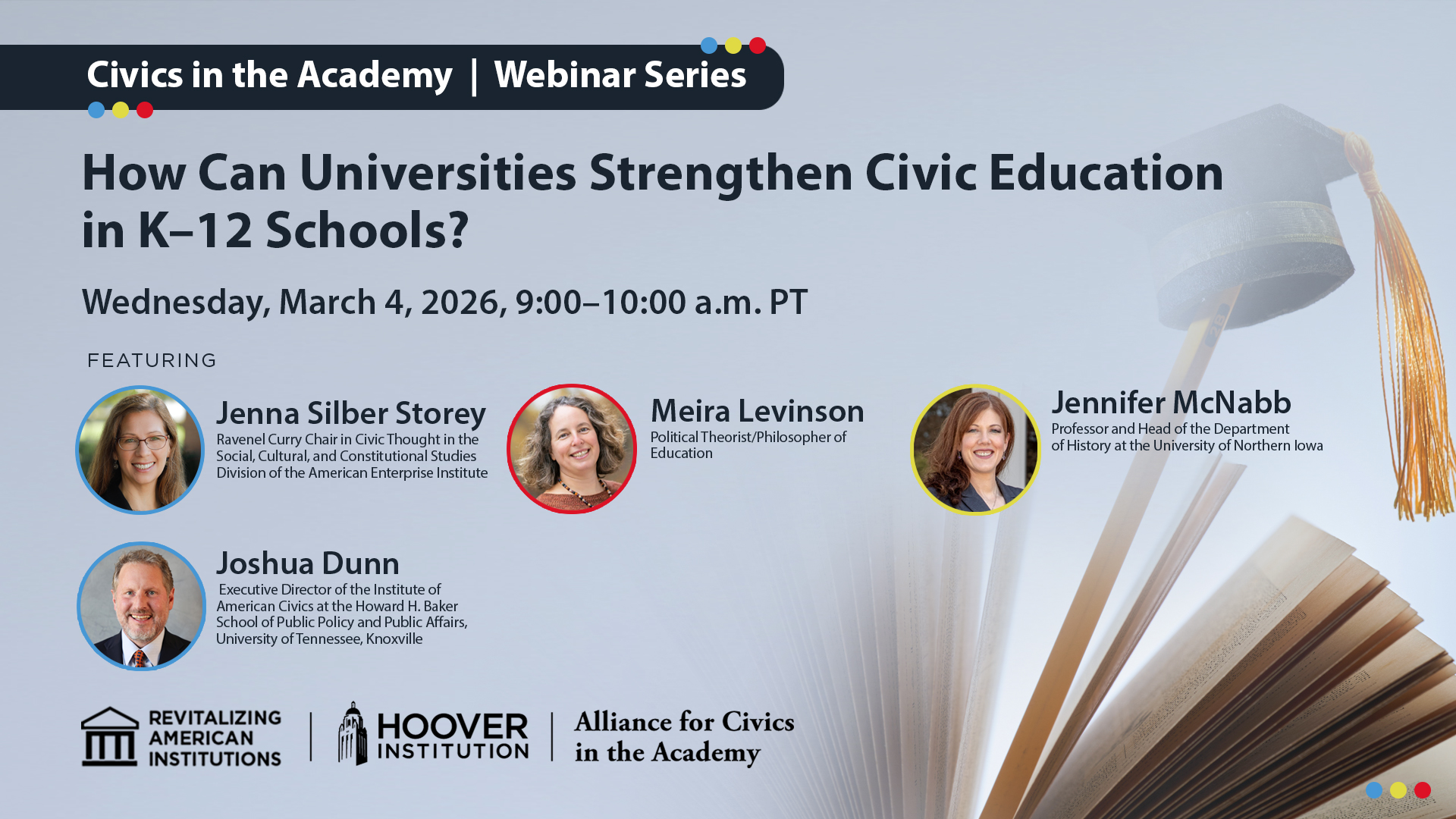
The Alliance for Civics in the Academy hosted "How Can Universities Strengthen Civic Education in K–12 Schools?" with Jennifer McNabb, Joshua Dunn, and Jenna Storey on March 4, 2026, from 9:00-10:00 a.m. PT.
Universities are increasingly reexamining their role as incubators of effective citizenship. An essential yet often overlooked part of this work is strengthening K–12 civic education. This webinar explores how efforts within higher education can support civic learning in K–12 schools, with particular emphasis on the academy’s role in training the next generation of educators.
- Hello, and welcome to the Alliance for Civics. In the Academy's webinar, there are obvious problems affecting American civic life. Today, our citizens are having trouble increasing, trouble talking to each other, getting out of their conversational silos. In Congress, we're seeing gridlock. It's hard to get things done together. Our political parties seem to be pulling in opposite directions. But what can universities do to help with these problems? That's the topic of our webinar today. Specifically, how can universities strengthen civic ed in K 12 schools? I'm Jenna Story. I'm the co-director of the American Enterprise Institute's Center for the future of the American University, and I'm a member of the executive committee of the Alliance for Civics in the academy. I'm gonna be moderating today's discussion, and I'm here with three distinguished guests who are gonna help us work through these questions. First, Mira Levinson, who's a political theorist and philosopher of education. She's now at the Stanford Graduate School for Education. Second, Joshua Dunn, professor and executive director of the Institute for American Civics at the University of Tennessee at Knoxville, specialist in Con Law and History. And finally, Jennifer McNabb, department head and professor of History at the University of Northern Iowa. Today we're gonna cover questions about what civics looks like in K 12, how the professors we have with us today have been involved in teacher training and in some cases in teaching in the K 12 space, and what do they think K 12 teachers most need from universities today? And finally, we're gonna talk through some thorny issues relating to teaching civics in the K 12 classroom, particularly how to deal with contested issues of the moment. We're gonna talk for about 30 minutes, and then we're gonna open it up to webinar audience members to ask questions of our panelists. So start thinking of those questions as soon as we start talking in just a moment. And please feel welcome to put your questions in the chat. All right, let's get started. I give, I give just a very brief introduction just named, essentially title and disciplinary background of you three. I wanna let our audience members get to know you a little better. So I'm gonna start by asking each of you to talk for just two, three minutes about two questions. Why do you care about K 12 Civics? What motivates you to do something in this space? And then just briefly what it is you have done. Let me say, I know that you have all done so much, we could talk, you know, an hour each to each of you about this, but just give the audience the highlights what you want the most to know about you as we start out this conversation. So let me begin with Mira.
- Great, thanks Jenna. It's a real honor to be here. So I would say the reason that I care about civic education is that every single child in this country is currently, has actually civic rights and responsibilities and will continue to have increasing civic rights and responsibilities as they grow into adulthood. And so therefore, it really, really, really matters that e every single child, you know, whether or not they are a full citizen, whether they're a legal resident, whether they are actually a long-term visitor, if they are documented or undocumented, because this is one thing that we know is true for every person here. Therefore, it really matters that young people learn about their civic rights and responsibilities and learn how to exercise those appropriately and effectively. So that's why civic education matters to me in a most fundamental way. As you mentioned, some of us, IIEI have taught, I was a civics teacher and a history teacher and an English and humanities teacher in the Boston and the Atlanta Public Schools for eight years. Back in the day, I also was an author of the C3 frameworks for College Career and Civic Life, the frameworks for state social Studies standards. I helped Boston develop and pilot its civics in action curriculum, which ended up becoming partially a model for actually the state of Massachusetts shifting its standards to have eighth grade civics in action in all of its across the commonwealth. And I do a lot of work with teachers these days, teachers, school leaders, superintendent school boards, et cetera, thinking about how we do address what you had already mentioned also, which is contested, sort of the contested areas of education, including civic education, how we decide what we teach kids, how we can teach controversial issues in ways that feel productive, et cetera. So those are some of the things that I do.
- Great, thank you. Let me go next to Josh Dunn.
- Thank you, Jenna. It's also a pleasure and honor to be with you and the rest of the panelists. So my experience with K through 12 civic education goes back in believe 2007 or so. I started doing professional development seminars with different organizations like the Bill of Rights Institute, teaching American history, those organizations. And for me, being with the teachers was an eye-opening and extremely rewarding experience. But by being with him, you recognized a few things and you quickly learned a few things, which is that often history civics government is neglected the professional development opportunities in K through 12 education. Quite often that teachers in in civics or history or, or or government, are given kind of generic professional development opportunities on pedagogy, but it's not necessarily related to, related to the content, unlike some of the other areas that be, became areas of increased focus after no child left behind, particularly math and, and, and, and English, science, math and ENG and English. So since then I've continued to do work in, in K through 12 education, both through some programs that I ran out in Colorado and then co coming here to Tennessee here at the Institute of American Civics. We started a civics academy three summers ago that initially drew 49 teachers from across Tennessee. Second year was 81, last year was 126. And now we're expanding it to, to three civics academies across each of the three grand divisions of Tennessee East Middle, and we and, and West Tennessee. And then we also do one day professional development programs for, for, for, for teachers. We also do things like try to to, to get civics into other parts of the curriculum as as well because we recognize time is limited in K through 12 education. And if we're gonna increase civic knowledge, we're probably gonna have to make common cause with with teachers and in, in some, in, in some, some other subjects. And I do think to build upon what Mary said, you the, this is absolutely essential for sustaining and maintaining our system of government. It depends on engaged and know knowledgeable citizens. And that has to start in K through 12 education.
- Thank you. Jennifer. Let me ask you why you care about K 12 Civics and what you've been doing in this space.
- Good morning everyone. So I teach at the University of Northern Iowa, which is in the top 1% of teaching producing institutions, public institutions in the country. One in every four students here at UNI is a teaching major. My particular major, I don't own it, but the major that I administer, the history teaching major is the largest secondary education program on campus. So very practically, I am drawn to questions about what our pre-service teachers are going to have to grapple with when they get classrooms of their own. So it's incumbent upon me as an educator really to think about the quality of what we're doing in our classrooms to empower these future teachers to turn their own classrooms into really productive civic education spaces. I've worked at two regional public institutions that were both the leading teacher producing institutions in their state. So I've long been involved in preparing professional development for pre-service and in-service teaching. Luckily my two institutions are very, they have been very outward facing. So there's a real attempt to connect pre-service student to practicing teachers. I think one of the things that I am most proud about, what I've been up to here at UNI is being co-project leader for a civic education initiative on campus that led to the development of our new civic Center for civic education. That Center for Civic education at UNI is designed really to provide student opportunities in the civic education space to provide opportunities for faculty research and development in the civic ed space. And then to create community outreach between our center and our region and then the state as as a whole.
- Great, thank you Jennifer. I'm gonna just pose to you first this follow up question. Ask the others to chime in as well. I think when people say civics to people of a certain age, my age anyhow, one's mind automatically goes to schoolhouse rock. And so often, even when I talk about teaching civics in the university to university students, people say, oh, well we should just, you know, revive schoolhouse rock and just put that on loop in the dorms or something. And I'm always, you know, from my perspective explaining that's not really how I would teach civics in university. I mean, that was very clever and, and obviously it sticks, sticks with people, right? But there's a lot more to it in the university. But today we're focusing on K 12. I'm thinking there's a lot more to civics in K 12 as well than just playing for the kids. Something like schoolhouse rock. So what does civics actually look like in the K 12 space? Where do we find it? Josh mentioned like, we have to make common cause with, with teachers who are not like, you know, labeled civics teachers, right in the curriculum. Where do you find it around the curriculum? And I imagine the three of you might characterize this somewhat differently. We'll leave this open. So Jennifer, if you could kick us off and then I'll ask others to, to see if they wanna add to this or if you wanna go on in the discussion.
- Well, I think it, it's maybe most instructive for me to offer a case study, which is to look at what civics is in Iowa. That might lead to some profitable discussions with the other panelists. K through eight civics is embedded across the curriculum. There are certain thematic approaches that the curriculum takes on rights and responsibilities on American history and government, but there are learning outcomes that are associated with particular grade levels rather than specific coursework that changes in the nine through 12 space where we see much more clearly defined coursework in American history, in world history, in civics and American government. So the goal, we have actually rolling out very soon new state standards in social studies and Iowa has an initiative that Iowa history must be embedded in the K 12 curriculum as well. Our new state standards talk about developing an understanding from students of the roles and responsibilities of citizenship and our democratic foundations of government. We look at that historically understanding historical context, being able to read and understand source material to understand its purpose, its intended audience, maybe its unintended audiences as well. So I think when we talk about civics in the K, the K 12 space, it has many different identities and I think Josh is right on in suggesting we're gonna lose something if we build silos or if we stay in the silos that that exist. So I think the goal is to create informed citizens and that is done through reinforcement of foundational ideas and issues. Oh, one one more point if I may. Our state legislature has, has passed an initiative that means starting in 20 26, 20 27, every Iowa high school student will have to pass the citizenship test to graduate from high school. So I think that really adds an, a sort of air of urgency to what we're doing on college campuses to help prepare teachers to prepare their students for this, this new task.
- So I think that what Jennifer has been describing in Iowa is true of many states, which is a, a real focus on knowledge acquisition and on understanding, which is crucial. I mean, it is foundational for good civic education and good citizenship. What's notable about what is not part of what Jennifer talked about is an emphasis on skill building the activities of citizenship beyond the activities of understanding, interpreting, sourcing, you know, et cetera, analyzing, which are crucial skills and there are skills of citizenship. I think that, and sort of dispositions and actions of that go beyond it. And so one of the things that I, I think really distinguishes unfortunately civic education from education in most other areas in both K 12 and in university actually, although especially in K 12, is that in English and science and math and so forth, we teach kids those subjects through having them do those things, right? So we teach reading through, having them read that doesn't mean that we just say go read kids, right? Like we teach phonics, we teach, you know, decoding we like, we do all sorts of, we teach very specific things, but we teach them in the service of their then doing the reading. We teach math through having them do math, right? And ideally not everywhere, but we teach science, at least in part through having them do science, through having them conduct experiments, observations, et cetera. We very rarely in K 12 teach civics through having them do citizenship. And that is something that I think is a real loss in education because in fact, I mean there's a good reason that we have kids do reading, do math, play baseball, you know, do like everything else that we want them to do. We may teach them about it and we teach them to do it. And like there are good developmental reasons, there are good reasons in the learning sciences, et cetera. And there are some states and districts in which there are more overt attempts to have kids actually do civics. So for example, in Massachusetts. Yeah. Yeah. So in Massachusetts,
- I was gonna ask Eric, I just might best, 'cause this is a really interesting point and I'm gonna ask Josh to respond a couple things in a minute, but I do wanna ask for examples like what do you, what concretely do you mean by doing civics? Because I think you've made a powerful kind of general point about this.
- Yeah, so there are a few different examples. So for example, in Massachusetts there was a both curricular revisions and state laws that were passed about six years ago. That means that now actually every eighth grader and every high schooler has to have the opportunity to do a self driven civic action project where they identify a problem, they can work in a group, they can do it as a whole class, they can do it individually, there's a lot of variation. But they identify a problem in at the local level, at the school level, at the state nation, global, that that's also totally open. They research the problem, try to understand its shape, why does it exist, who else has been working on it, what are different approaches that people have taken to addressing it, what are approaches that they might take to address it? They take some action and they reflect on what they've done. So that's an ex, that's one form of doing citizenship for a long time, say in the 1990s through the sort of early mid two thousands, 2010s, there was a big emphasis on service learning. That has disappeared in many districts and states. But that's another example of doing citizenship. There are schools in which say you may have mock elections or where you have robust student government or debate teams, or actually media production, right? Those are also ways of, I think doing citizenship. You can have class officers, you know, so there, there are lots of different ways in which you can do citizenship in the curriculum, the co-curriculum, the extra curriculum. What's unfortunate is when kids have almost none of those opportunities,
- Right? Yeah. Okay. This, that, that's a really good point. So Josh, I'm gonna throw a couple of things at you and you can choose which to take up. I mean, first the question that I had asked to sort of kick off this part of the discussion, which is just like, what does civics look like in, in K 12? And I think we're already hearing like what it, what it also needs to look like, right? So you can give me a state of the field, but also what, what you're trying to do or what you think should be done. And then just raising a couple issues that Jennifer and Mira brought up, we have maybe Iowa's requiring the citizenship test. I know Purdue University has required it. Is this a trend, is this a good trend? How would you, how would you deal with that in the classroom? And then also me's point about what about doing civics? What do you think about this topic? So Josh, a lot coming at you. Sure,
- Yeah. Yeah. So first of all, I, I think it's maybe two thirds of the states require a half year course or one semester course in, in civics often there'll then also be a US history course as well. That might might be a a a a full year. I think there are only three states that require a year or more of, of civics at the high school level. So it's, yeah, it, it, it, and if you talk to teachers, they, what they contin continually tell us, we always survey them and ask them, what, what do you need to be more effective? And what they always say is they need more class time. That's, that's what they need with their students. And they asking, is there anything that you all can do about that? Can you talk to the state legislators? Well we can't lobby the state legislature, but we'll, we'll, we'll let people know. But we also, going back to the point when I first spoke about how we know that there's just limited time during the day, and there are certain subjects that where the testing is much more, I mean, their schools are held accountable for it. So in Tennessee we also have the, the citizenship test where they, they select the school will select from a certain number of the, the questions on, on the test. But the students, they, I think they're unlimited attempts where they can take it and they just have to get a, a passing, a passing score in the end. And e everything that we know indicates that unless there are consequences, like real consequences, there's gonna be less attention and resources given to, to, to a, a sub subject area. I think there's also evidence that we just do need more basic class instruction. If you look at NA scores in, on American history and civics, they were stagnant for a long time and now they've had a precipitous decline just with the last round of testing that that, that, that we've seen. So just basic knowledge is, is we are, we aren't achieving what we need to in, in imparting that to students. We also see evidence that it's not prioritized by teachers though. And this is one of the interesting things. There was a RAND survey from 2020 that showed the overwhelming majority of teachers gave the highest priority or said it was one of their highest priorities to, to make their students or to, to breed tolerance in their students. That's a noble goal. We, that's, that's something that liberal democracy has, has to have, but barely half said that it was important to impart knowledge of basic American institutions, separation of powers, checks and balances, federalism. Now there's an irony to that, which is that we have evidence showing that increased knowledge about basic facts of American civic life is actually highly correlated and seems to be causally. Can I think you, you know, you tease it out some, but very highly correlated with greater levels of tolerance. People with higher levels of civic knowledge are less likely to impute false ideas to people that they disagree with. They're more willing to engage with people that they, they they disagree with. There's just a survey out of Florida state just from last fall that, that, that found us. So I do, I I think that there needs to be greater focus just on, on, on basic knowledge, but I also agree with mayor that there, there has citizenship is not just something that, you know, can I,
- Can I intervene there for just one sec? I'm just curious what you'd say. Sure. I mean, I'm gonna ask you to speculate here. Yeah. You've, you said there's a correlation, empirical correlation between
- Yeah.
- Knowledge of civics and tolerance, or maybe I'm not using the word, same word you use, but respect for tolerance of opinions that are different. So what, first of all, just clarify the connection for, for me or for others. And then,
- Yeah, so, so what they did is they surveyed at Florida State, they surveyed Yeah, theys, they surveyed a national sample, asked them questions about civic knowledge and then battery questions to try to, to measure their, their levels of tolerance. And what they found was that there was just a significantly greater tolerance among those who had higher levels of, of civic knowledge. So, and we, but we've had other research going back that kinda shows these connections too, again, about where people with high levels of civic knowledge, once again, were less likely to have false ideas about what other people believe and those things. So it, it's, yeah, there does just seem to be, it's closely connected in the data that we have.
- So, and if you're, if you're, if you, I'll give you the opportunity to speculate about why you think that is and then
- Yeah, well, yeah, I think there are a few things. I mean, if you actually understand how separation powers checks and balances work, you probably have to learn that. Well, the whole system is designed to make it so that you can't get exactly what you want. That there are lots of people in this big, vast democracy. And the, the, the idea behind the system is to try to, to, to create mechanisms where people can come together and constructively disagree and reach fruit fruitful compromises. I mean, if you just read Federalist 10, I don't know that how much it's assigned in high school classes, but if you read Federalist 10, you have to kind of understand, hey, factions are legitimate there, they're gonna be groups that are you, you have to accept the legitimacy of, or if you just understand basic First Amendment doctrine, free speech doctrine, you have to understand that you, there's no right to not be offended in, in, in the first amendment that your right to freedom of speech requires that you respect that, that the, the right that others have to, to speak their minds. So I think that again, that that kind of basic knowledge about the, the structure and what it's designed to do, and then the rights also those things reinforce a, a kind of political tolerance.
- Okay. That's, that's neat. Great. Yeah, I'm gonna, I'm gonna remind everyone, or let everyone know that we have eight or nine minutes until we turn to audience questions. So if you're in the audience, be thinking about those questions and putting them in the chat. And I'm gonna open up the last topic I said we were going to talk about, but also allow you to respond to anything else. You know, we can just continue the, the previous discussion as well. But I definitely wanna cover here a topic that came up in our, our conversations earlier when we were preparing this panel. And then I know you've all thought about and written about in, in some cases, which is how to teach contemporary like events, current events, or particularly contemporary sort of hot button issues in the K 12 space as a number of, you've made clear this is there are rights and responsibilities that K 12 teachers have that differ from those professors, right? So we might be talking differently about how to have these difficult conversations in the college classroom and in the K 12 space. But let's make first of all that kind of clear to the listeners and then how do you think, you know, given the constraints that exist or the, the reality of the landscape that exists for K 12 teachers, how do you think that they would best handle those contested issues? And if your part of your program is trying to help them do that, you know, how, how do you, how do you do that? So lemme just go back, let me ask Josh, I know I cut him off too before and diverted his comments. Let me ask him to, to say something first about this and then we'll open it up to others.
- Well, I would say one of the things that I, when, when we engage with teachers, we, we will, for our civics academies, we will have have content-based lectures on important principles, ideas, historical developments in, in American politics, in, in, in history to just deepen their knowledge. That's, that's the first thing that we do. But often what we will also do is we'll have panels of teachers, ones that we know have been quite successful in the classroom, they're recognized for their ability in the classroom where they will lead the discussion with other teachers about. So for instance, during the pre last presidential election, the, the summer before, we had a panel of teachers who they, they kinda, they just had a broad discussion about, well, how, you know, it's gonna come up in class and it's gonna be contentious election. How, how do you deal with these things? And very often that's the best way. They're the ones that are in the classroom with, with the, with with, with the students. And so I think that often just letting them talk to each other, giving them opportunities to trade war stories and discuss things that have worked, things that, things that haven't worked, how to take, maybe a student says something that's particularly contentious and maybe wouldn't be the best way to structure a class discussion around, but turn it into something that could be much, could be more productive. So that's that, that's, that's generally been been our approach. Just give them opportunities to, to think carefully about what they're doing in the classroom and to talk with their other profess professionals about, about the best ways to handle it.
- Sorry, I'm muting there. Yeah, Mira, you wanna jump in? We wanna, we wanna, I, I wanna make sure we cover like what are, what is the, the, you know, kind of legal situation for K 12 teachers or if it's complex, just give us a real, you know, brief sketch and, and then also what Josh was addressing, how we best help them deal with these things in the classroom.
- Sure, yeah. So it is important for K 12 teachers to know that they do not have academic freedom rights in the same way as at least traditionally higher education educators have understood themselves to have academic freedom. I mean, that also is potentially currently under threat, but teachers courts have decided that basically teachers' speeches for hire. And so if teachers say things that their principal, their superintendent, their school board, their state believes that they shouldn't say, then they are, they can legitimately be reassigned or fired or disciplined, you know, disciplined in various ways for their speech, which is hard in a time in which things are very contentious, right? Because not only are there questions about sort of what should be talked about in the classroom at all, what is age appropriate, grade appropriate, what is politically appropriate, what is perceived as being indoctrinate or not, et cetera. But also there are disagreements over, you know, if you over what you say is what you say perceived to be open and like, you know, creating an open classroom climate and permitting multiple views, is it seen as being indoctrinated or inappropriately sort of putting your thumb on the scale on one side or the other? There's contestations, so Diana Hess and Paula MacAvoy in their really wonderful book, the Political Classroom, talk about what gets treated as open versus settled in the classroom. And Diana has talks about the challenges of teaching in the tip when something is moving from being open to settled or settled to open, right? And the problem is, there's not only then controversy over the issue itself, whether, you know, that is abortion or gun rights or the right to self-defense and under various situations, whatever. But also there's contestation over whether this issue should be treated as contested. And so if you choose as a teacher to say, have an open debate about something that there are parents or school administrators or community members who think should not be treated as open for debate, then that teacher is getting herself into trouble. If she treats something as settled that she believes should clearly be settled and there are parents or community members or administrators who think that it should be treated as open for debate again, then he will be getting himself into trouble and potentially risks being fired. So one of the things that I just finished actually teaching a class to about a hundred k 12 educators about teaching controversial issues, this, and this was actually a, a course sponsored by the Civic Learning Institute. I saw in the questions that somebody was asking about educating for American democracy and that the Civic Learning Institute is a, comes out of Amer educating for American democracy and the Democratic Knowledge Project and other partners. And one, we talked about the importance of actually being clear educators being clear with themselves and with their students and with their administrators and so forth about why and how they are choosing say what to treat as open versus settled in the classroom. And the fact that that's difficult to be open about the challenges and the risks of treating controversial issues in the classroom and how essential it is. And then we talk about very specific techniques that they can use. Case study discussions, simulations, town halls, structured academic controversy, text on text, sort of silent conversations, primary source conversations. One, one of the advantages of something like structured academic controversy is that students are assigned roles without getting to choose them. And so then nobody gets confused about whether or not say a kid is seen as say, saying something offensive or, you know, anti-democratic or whatever, and they practice doing those things. But it is really important, as Josh said, to acknowledge that these conversations are both essential and challenging and that they really do that teachers understandably experience themselves as being at risk, particularly when they tread upon particularly controversial issues. And yet at the same time, going back to why I said I care about civic education, we aren't going to get better as a country in having hard conversations with one another where we fundamentally disagree about core values, principles, policies, ways of action if we avoid those conversations. So it is essential in elementary school, middle school, high school and college, that we have those conversations that we enable young people to learn and to practice and to develop the skills and dispositions and knowledge to have these conversations because that is the only way that we are going to get better at this as a country. But we really do need to honor the hard work that teachers are putting in in order to make this possible.
- Thank you
- Jennifer, I wanna jump
- In. Yeah, I I need to be mindful of time and there are so many rich, rich threats there to, to pick up on. So I, I just wanna confine my reactions I guess to what I've, I've heard to just a couple of points. I think one is the importance of modeling in the academy. We have to be having these conversations in our own classrooms. We have to acquaint all of our students, not just our pre our pre-teacher majors, but all of the students what reasoned civic discourse looks like. So modeling is, is super important. One of the things we've done here at UNI is build a curriculum that is interdisciplinary so that students see a lot of different perspectives in the civic education space. So we built a general education certificate and a minor both sharing the same titles, civic literacy, engagement, and the humanities. So in order to complete this coursework, students have to take courses in literature, not just political science. They take US history, they also take world history, they take a public speaking course. There are lots of rich ways for students to engage with being an informed citizen in fictional spaces, in historical spaces, in contemporary spaces. And they need to see all of those different viewpoints and understand the way that these courses talk to one another. So it's again, kind of circling back to Josh's idea about the importance of seeing civic education as transformational across the curriculum. No one department owns it, right? No one office on campus is responsible for civic education. It's, it's all of our jobs. And so by way of sort of pivoting to my second point, I, I'm a member of the governing council for the American Historical Association. And I think one of the things that my vantage point has, has taught me in that role is the desire of teachers for professional development. They want more tools, right? And so it's incumbent upon us in higher education to dialogue with practicing teachers and find out what they need. So I wanna just share a couple of quick resources. The first is what's known as American Lesson Plan, a really fantastic study authored by the American Historical Association. You can find it@historians.org. And it's a survey of 3000 educators across the country, middle school and high school US history teachers to talk about what US history looks like in the classroom from a variety of perspectives. So there's an executive summary for those of you who are interested, but the report really offers a deep dive into what's happening in US history courses across the country. The other thing that's happening, I, and I think it's really exciting for the a HA, the American Historical Association, is us trying to connect world history to the civics enterprise. There is a webinar actually next Monday, and you can find information about that@historians.org. And I wanna get the title correct, it's something about civics and I've, I've hit a button, here we go. The civic value of world history. And so that is a space that we're beginning to move into really intentionally to create a dialogue across us and world history. And that is something that's embedded in a lot of social studies frameworks. But again, I think the biggest danger, this is one of the questions, Jenna, you asked us panelists, what, what do we need to do that we're not doing? Or what kind of of flares are emerging? And I think it's being siloed. We're facing a lot of questions about what we do and how we do it in certain areas. Their legislators, their boards of regents or governors. They're, they really wanna know what's happening. And I think one potential default reaction is to kind of pull in and worry about your own patch. That's the wrong approach. We need to be really collaborative and working with colleagues across our campus and with this project of offering resources to continuing teachers. I think that's maybe a takeaway lesson.
- That's, that's great, Jennifer, thank you. Two quick comments, then I'm gonna turn to some audience questions, which I'll, I'll be asking of the panelists. So one, the resources you mentioned and those that Mira and Josh have shared with us either on the panel or prior to the panel. I'm pretty sure we are gonna list those on our webinar web, you know, YouTube page or our webinar page on the a CA website. So we will, I think, speaking on behalf of others, but I think we can find ways to get these out. I think we routinely do find ways to get these out and it might be a moment to just also say, for those of you who are interested in these topics, everyone listening to this webinar, make sure you visit the Alliance for Civics and Academy website, which has a lot of resources, including syllabi from very different approaches and perspectives on civics in, in the university space. And I'll just make a quick comment about your point about interdisciplinary conversation, because I also think that's really important. I, I have come to think in the university that it interdisciplinary conversation is maybe not the only step we need to take, but it an important key to talking across different kinds of lines of difference because disciplines are kind of success silos, particularly for professors or graduate students, right? And it's like you need to keep going here to get ahead and, and that of course is an important part of academic life. But when you're talking about questions that deal with citizenship or, or just even human questions, you're really not, you shouldn't be confined to that kind of success silo, right? You need to have the resources, have the opportunities to talk to people with a really open mind about what different perspectives can bring to these general questions. So often think about trying to cultivate expertise in generalism or expert generalists along with the kind of specialization that of course we have and need in the academy. Okay, so let, let me pose to you all, we'll get at least two and hopefully a few more questions in here. And we have roughly 13 minutes to address the questions before we turn to the final comments, lemme start with this one. I'm gonna read it and then I'll kind of re-articulate it. So how, how might we assure, ensure equitable and impactful access to civic learning and doing, right? So in other words, we have students, we all know this in the university space, I'm sure it's two and K 12 as well who are like really eager to engage in this civics, right? They walk in eager to engage in this, but we don't just want to serve those students. We want, as Meira said, I think at the beginning, like every child is going to be a full blown citizen someday. So how do we reach those who are not already inspired to do this? And is there any kind, I mean I'm thinking like is there any kind of like how do you work with the fact that some are really inspired, right? And treat that help them but also not let them override, you know, the, the interesting concerns of, of the younger kids, and I'll throw this other question which is tied to this in the chat out there about school participatory budgeting. I don't, I can imagine what that is, but I'm not really sure. So I'm just throwing that out if anyone wants to address that question as well. And that might be a way to involve a greater range of students. I'm gathering,
- I'm happy to jump in on this. So I, so I think this is one reason. So equitable access is one reason to have this in the curriculum as well as in the co-curriculum and extra curriculum, right? So to the extent that civics really got moved out of the curriculum in the past 40 years or so in, well in schools. So Josh mentions that and Checker Finn put a really, really good summary of their state by state analysis in the q and a. So encourage people look and you'll see what states require. But the fact that we currently have relatively few civics courses and formal civic learning opportunities for kids does mean that inevitably it's the kids who have the time, the support, the preexisting interests, the encouragement or whatever to get involved in say the co-curricular and extracurricular spaces. So we should put it in the curriculum because the curriculum is sort of the guaranteed stuff that all kids get exposed to. So that's one thing is to make sure that these things are in the curriculum in addition to being available in co-curricular and extracurricular spaces. A second thing is, as Josh had been talking about, and Jennifer had been talking about integrating civic knowledge, skills, habits, dispositions, opportunities into spaces that aren't just focused on civics. So you may not care about civics as a 10-year-old, you think, but you really care about bicycles. And if in your bicycle TR club you have a president and a secretary and a treasurer and you're voting for them, if your bicycle club is, is actually sort of kid driven and you have decide where are we going to go on our trip? Oh gee, we need to contact public safety to make sure that, you know, they have the cone set up or you know, have they cleared the ice? Like those are civic activities, right? And it's not, you're not being told you're doing this because you care about civics, you're doing this 'cause you care about bicycles or manga or whatever it is, right? But if we build in those, those civic dimensions to things that kids are already engaged in, that's another way that we ensure exposure. And then the third piece I think is also realizing that political scientists and social psychologists and political psychologists and so forth have found over a number of decades of research that really motivation tends to follow engagement. Like we think, oh you need to be motivated, right? In order to engage. So how do we get somebody motivated and then they'll go do the thing. Truthfully, what we see is actually just getting people to do something is what helps them build an identity as, oh, I'm a person who does this, right? So getting somebody to read helps them build an identity as a reader. Getting them to play baseball over time helps them build an identity as a baseball player. Getting them to do civics and to do citizenship can help them build an identity as a citizen. And so that's the other thing, I don't think that we need to worry quite as much about the motivation and interest gap if we are giving all young people consistent opportunities to get involved civically to experience themselves as people who are engaged in civics. Including like having hard conversations with one another. 'cause that's something again that we would all do better, right? So again, it doesn't have to be that they're always going out and volunteering with a campaign or working the polls, right? Like there are lots of, and lots of things that they can do and there's a lot of evidence to show that if we have young people doing those things, then the motivation, the identity and the motivation develop as a result of that rather than needing to exist be preexisting.
- Okay, let me see. Josh hasn't had a chance for a little while now, so lemme see if he has wants to get in here or, or wait.
- Yeah, so I'll, I'll I'll say a little bit about what we're doing to try to incorporate civics into other parts of the curriculum. We, we actually have teachers, English language or English teachers who are developing lessons plan lesson plans for us that we're gonna make available and that then other teachers can, can use kind of plug and plug and play. But we're also doing things to try to get into the performing arts. So we for instance, supported the production of Joseph Addison's Cato and then we brought a large number of students to, to be able to watch the play here, here on campus. We also supported a, a production of inherit the Wind hundredth anniversary of it here in Tennessee. And we had 12 to 1400 students come and watch these matinee performances of it. And then they got a history lesson, didn't tell you a whole lot about what actually happened in Tennessee during the, during the, during the scope. So I told you a lot about 1950s politics in America though. And, and then right now we're also supporting the, the writing and production of a script on the passage of the 19th Amendment. Turns out that Tennessee was the, the state that put the 19th Amendment over the top and there was one, one representative whose vote was decisive from EE East Tennessee and we're gonna make that freely available to, to schools so they don't have to pay a fee to be able to use it. And this is something that many schools struggle with. And then we're gonna provide ancillary materials about, oh well what does this teach you about? How is this connected to prohibition? Or obviously voting rights wasn't completely settled just by the 19th Amendment. You need to know something about the Voting Rights Act of 19 of 1965. So I, these are some of the ways we're trying to, trying to capture other students who might not be naturally interested, but they can see that there's a kind of drama to to to civic life in America.
- That's a, that's a neat point. And I happen to speak with some of the collaborators at UT Knoxville and from the English and theater departments that if I remember rightly, got together to help you all produce Joseph, add Addison's Cato play, you know, and they, they said to me, we were like totally surprised we wanted to do this for so long, we're totally surprised that this new institute for American Civics was interested in this. And of course the connection I think for you all is that that play was one of George Washington's favorite plays or maybe his favorite play, right? So it's kind of interesting to Jennifer's point, interesting way to have a really fruitful interdisciplinary collaboration that also helps K 12 'cause you, you're helping, you're inviting them to, to see the performance and engaging conversation about it. But even within the university you have professors you would not think might otherwise collaborate English theater and civics, American civics programs doing something like really interesting and as far as I could gather, like just really learning from each other as well as like showing that you can have these kinds of conversations to the,
- If anyone is interested in Addison's, Cato, Misty Anderson, the chair of the English department, the one who who created abbreviated script and she has full stage productions, it's easy to kind of, again, put on to re reach out to her. It is fantastic. I think there are actually some other universities now that are doing it. But it is something that I think that it would be easily, could easily be incorporated in a high school theater production as well.
- Okay. So I'm gonna let Jennifer get in on this, but I'm gonna pose one more question 'cause we just got off the talking about this when I forgot we have others. So let me ask Jennifer, you can respond to, to one or or or both. And this another question about kind of from a different angle. How do you see the role of a substantive American historical narrative in motivating civics learning? And I guess you could take that a number of different ways. Do we, is it helpful to give students historical narrative to kind of lead them up to the present moment, tell 'em about who we are and what we've been doing together as Americans and or is there any avoiding that? I don't know, maybe there is some implicit narrative no matter what you do and if so I suppose, you know what, what's the most fruitful or helpful narrative in that space? So Jennifer, I'll let you just take it away here.
- Yeah, two, two quick points that I think are related to Mira and and Josh's about what can happen on a college campus. First, taking inventory of the things you do. When we built our civic literacy curriculum, we didn't cut it out a whole cloth, we gathered a group of people together and said, what is it exactly you are doing in this space? What kind of contributions would you like to make to this curriculum? We did a little bit of new course creation, but what we realized more than anything else was that we had to be a lot more effective in articulating what we were doing, what the goals of the, the material that we were covering could be through a civic education lens. So I think that's super important and I think that doesn't happen quite enough on college campuses. We think people are gonna figure out why we tell students to take courses in a certain sequence. Do we ever tell them why no, we have to do that kind of stuff, right? So it's really important to do that work. One thing that I haven't heard come up in our conversation is the power of students to engage each other. When we created this new set of programming at UNI, you know, we did all the things that academics do. We made glossy flyers, we had info sessions and open house sessions and we would have a few of the true acolytes come out, the students who are really sort of naturally drawn to that work. Then we put ourselves in the library, which is this really interesting walking point on campus. Students cut through the library to get from one end of campus to another and we recruited students to stand at a table with us. They were the ones going out and reeling in their fellow students to explain why this curriculum was a value added thing for a student at this university. And they were remarkably successful. I just sort of stood there watching the magic happen, right? Watching students have these really great conversations student to student. So any college educators who are on the call like engage your students to help you do the work. Don't act as if you have to be the sort of translator. Sometimes the students are a much better translator than you are with regard to American history. I think this question might be drawing on what has emerged in recent decades as sort of this debate in history about whether we're needing to teach content or skills. Are we teaching historical thinking skills of interpretation, causation, periodization, there's a lot of Asian there. You know, are we teaching students how to think historically? Or are we going back to this or sort of remaining with this older model of pouring content into students? I think that's a really problematic dichotomy, right? We, we don't teach just content, we haven't done that in the past and we don't teach just skills. We can't help students think if we give them nothing to think with. We've gotta find a balance between creating a narrative that students can follow that is logical, that makes sense, that sees development, that sees continuities and changes over time, but that also imparts a way of thinking historically. So one of the things that I think is really important in civic education is understanding context. If you wanna understand contemporary issues, you have to understand that someone's had similar issues at some other point in the past. We have to understand where we came from to get to this current moment. And I think historical narratives can help in that regard. So I think it's finding a balance between content and skills and that's really hard when we're talking at the sort of nine through 12 level in particular and certainly K through eight about very little real estate for teachers to operate in, to balance both of those tasks is, is a real challenge.
- Yeah. Thank you Jennifer for that point. I, I see we just have a few minutes left and so I'm just gonna, first of all, thank, I'm gonna ask the panelists in just a minute to give us just a, a a few last words. What, what would they like the audience to take away most like the audience to take away from this discussion? Just a few sentences, but let me just say first thank you to the audience for, for coming to this webinar. Again, make sure to check out the a CA website and, and we'll have resources there and think about joining the a CA. If you're not already a member, you can post your own syllabi and be part of these a better, a more integrated part of these conversations. We also have, and, and I should say that links for all of this are in the chat, we also have a webinar coming up in just two weeks. We typically have these every month, but we've had so many, so much interest in so many topics. We have one coming up in two weeks called Building Civic Unity in a civically diverse Democracy. It's about, I'm sorry, in a, I think religiously diverse democracy. Lemme try that again. Building civic unity in a religiously diverse democracy. And we have Eva Patel from Interfaith America, Robert P. George from Princeton, and Father Francis Naau there to be the panelists for that discussion. So please join us same time in about two weeks. Okay. Just one or two minutes left here. Let me just go back to our panelists today. Thank you all for being part of this conversation and lemme just give you the last word here. I'll start with Mira.
- Yeah, I just wanna say thank you for hosting this and I, one of the thing that we didn't get a chance to talk about, but I do think is really important is historically in the United States, higher education has been treated as very, very different from K 12 education. And professors have had, as I mentioned, with the academic freedom reference, have had very different rights from K 12 teachers. This is, I think, changing in the United States. There's much greater interest in many places by state legislatures, governors, boards, you know, regions, et cetera in exercising control over and oversight over the curriculum and so forth. And so I think this is another reason actually for higher education and K 12 education to think carefully about what they might have to learn from one another and contribute to one another in this area.
- Great point. Thank you Josh.
- So since K through 12 education, I'll say that teachers are extremely hungry for good content and so go out, talk to them. There are gonna be opportunities and the more people we have doing this, the better. And then I'll repeat the other points, which is that we need to, we need to try to incorporate the in, in, in other areas of the curriculum, but there's also a desire for this in teachers in those other parts of the curriculum. That's something that we found that we were maybe a little bit surprised by, but it they, they also recognized this is a serious issue for America and they wanted to be part of this, the solution to this problem that we're all confronting.
- Great. Thank you Jennifer. Last words
- Break down your silos and the K 12 higher ed partnership is something that we can all work on together to be strengthened. I, I know from a higher ed perspective, we are equally hungry to provide the resources that we're hearing that our K 12 partners and I am gonna call them partners that our K 12 partners need.
- Okay, well thank you all once again for joining us, both the panelists and the people in the audience, and I hope we'll see you again in two weeks.
ABOUT THE SPEAKERS
Meira Levinson is a political theorist/philosopher of education who is working to start a global field of educational ethics that is philosophically rigorous, disciplinarily and experientially inclusive, and both relevant to and informed by educational policy and practice. In doing so, she draws upon scholarship from multiple disciplines as well as her eight years of experience teaching middle school humanities, civics, history, and English in the Atlanta and Boston Public Schools.
Meira has written or co-edited nine books, including Civic Contestation in Global Education and Educational Equity in a Global Context (both 2024, with Ellis Reid, Tatiana Geron, and Sara O’Brien), Instructional Moves for Powerful Teaching in Higher Education (2023, co-authored with Jeremy Murphy), Democratic Discord in Schools (2019, with Jacob Fay), winner of the 2020 AERA Moral Development and Education SIG Outstanding Book Award, and Dilemmas of Educational Ethics (2016, with Jacob Fay). Her book No Citizen Left Behind (2012) won awards in political science, philosophy, social studies, and education and has been translated into Chinese and Japanese. Meira shares educational ethics resources on JusticeinSchools.org, materials to support K-12 educators working in politically charged environments at Educational Values in Action, and resources for youth activists and teacher allies at YouthinFront.org. Each of these projects reflects Levinson's commitment to achieving productive cross-fertilization — without loss of rigor — among scholarship, policy, and practice.
Meira earned a B.A. in philosophy from Yale and a D.Phil. in politics from Nuffield College, Oxford University. Her work has been supported by fellowships from Guggenheim, the Edmond & Lily Safra Center for Ethics at Harvard, Harvard Radcliffe Institute, and the National Academy of Education. Prior to joining the Stanford faculty, Meira taught at the Harvard Graduate School of Education.
Jennifer McNabb is Professor and Head of the Department of History at the University of Northern Iowa, where she teaches courses on early modern European history and the history of England. She was Co-Chair of UNI's Civic Education Task Force, which created UNI's Center for Civic Education, and she was Co-PI for a National Endowment for the Humanities Connections Grant that developed UNI's first civic education curriculum: "Civic Literacy, Engagement and the Humanities." McNabb is also a Co-PI of a national grant that will establish the Iowa Civic Educators Institute, providing professional development opportunities for in-service and pre-service social studies and history teachers throughout the state. McNabb has received several awards for her teaching and has completed four courses for The Teaching Company’s The Great Courses on the Renaissance, witchcraft, sex, and marriage. She currently serves as a Councilor in the Professional Division of the American Historical Association and as president of the Midwest Conference on British Studies.
Joshua Dunn (PhD, University of Virginia) serves as Executive Director of the Institute of American Civics at the Howard H. Baker School of Public Policy and Public Affairs at the University of Tennessee, Knoxville. His research and teaching focus on constitutional law and history, education policy, federalism, and freedom of speech and religion. His books include Complex Justice: The Case of Missouri v. Jenkins (University of North Carolina Press), From Schoolhouse to Courthouse: The Judiciary’s Role in American Education (Brookings Institution Press) and Passing on the Right: Conservative Professors in the Progressive University (Oxford University Press).
Moderator
Jenna Silber Storey is the Ravenel Curry Chair in Civic Thought in the Social, Cultural, and Constitutional Studies Division of the American Enterprise Institute, and Co-Director of AEI’s Center for the Future of the American University. She is also an SNF Agora Fellow at Johns Hopkins University and a Research Fellow at the Civitas Institute at the University of Texas at Austin. She previously taught political philosophy at Furman University, where she was an Assistant Professor in the Department of Politics and International Affairs, and Executive Director of Furman’s Tocqueville Program. Her writing has appeared in outlets such as The New York Times, The Washington Post, The Wall Street Journal, The Boston Globe, The Chronicle of Higher Education, Inside Higher Ed, First Things, and The National Endowment for the Humanities flagship journal, Humanities. Dr. Storey is the co-author, with her husband Ben, of Why We Are Restless: On the Modern Quest for Contentment (Princeton University Press, 2021). They are currently working on a book titled The Art of Choosing: How Liberal Education Should Prepare You for Life.