


- California
- State & Local
- Empowering State and Local Governance
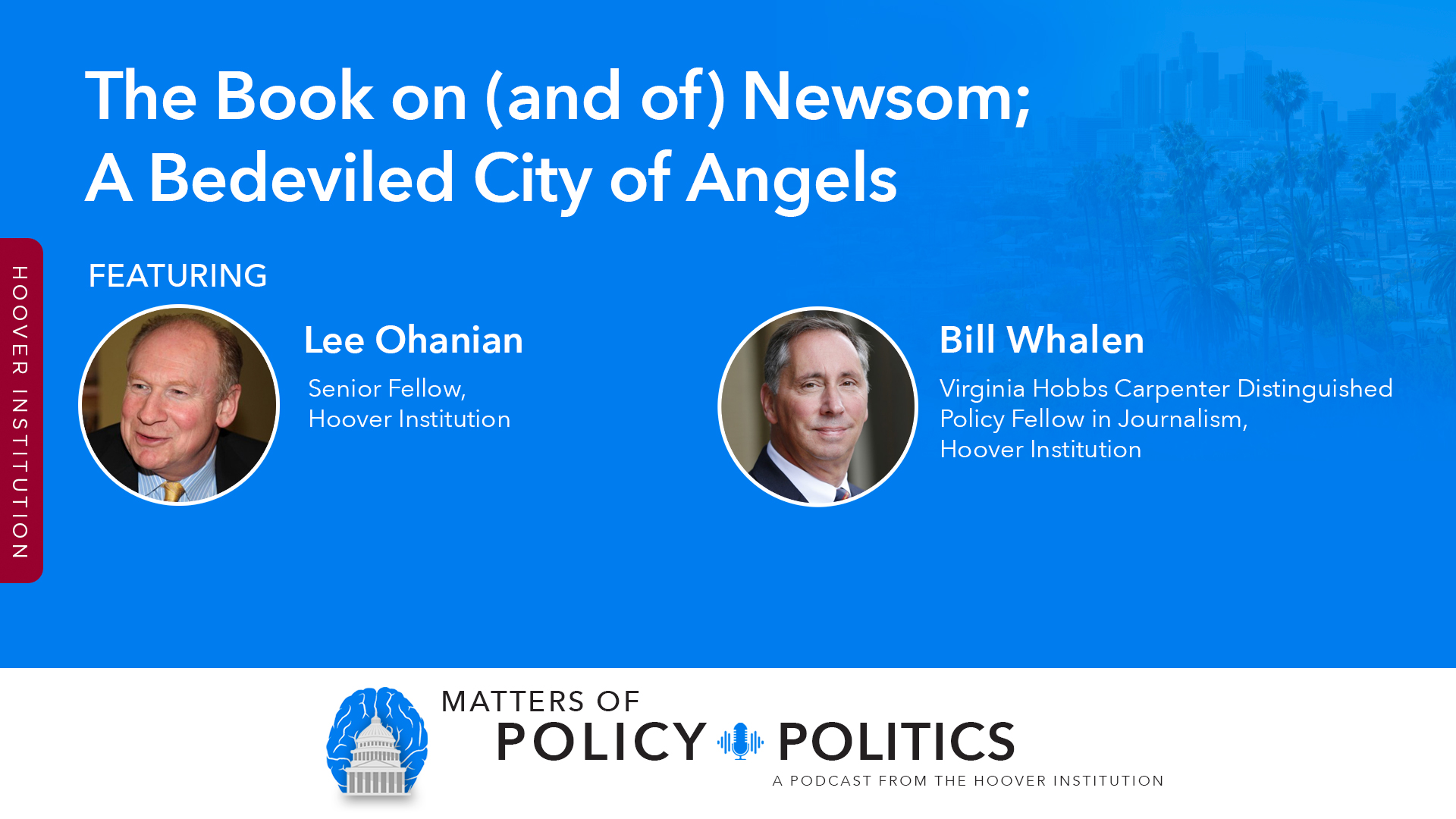
California Governor Gavin Newsom pads his frequent-flier miles: after two trips to Europe already this year, a nationwide tour promoting his new memoir (and presidential prospects). Meanwhile, political upheaval finds its way to disaster-prone Los Angeles with a plot twist in an already contentious mayoral race and calls for the chair of LA’s 2028 Summer Olympics to resign over his ties to the Jeffrey Epstein scandal.
Hoover senior fellow Lee Ohanian and distinguished policy fellow Bill Whalen, both contributors to Hoover’s California on Your Mind online journal, discuss the latest in the Golden State, including how Newsom’s autobiography squares with his governance record and the prospects of Los Angeles joining the ranks of cities ruled by “Democratic socialism”.
Recorded on February 19, 2026.
- After two visits to Europe in 2026, California Governor Gavin Newsom turns his attention to America and a book tour promoting his new memoir, young Man in a Hurry. But what about conditions in the Golden State? Meanwhile, there's little angelic about the City of Angels, Los Angeles Bears Race, experiencing a major plot twist and calls for the head of LA's Summer Olympics to resign after he is tied to the Jeffrey Epstein scandal. We'll discuss all of this and more on a California edition of matters of policy and politics.
- It's Thursday, February 19th, 2026, and you're listening to Matters of Policy and Politics, a podcast devoted to the discussion of policy research from the Hoover Institution and issues of geopolitical, national and local concern. I'm Jonathan Movroydis, and every month I have the privilege of moderating a discussion on politics and the economic situation of the Golden State with two Hoover fellows and experts on these issues. Bill Whalen and Lee Ohanian. Bill Whalen is the Virginia Hobbs Carpenter distinguished policy fellow in journalism and the regular host of the show. And Lee Ohanian is a Hoover Senior Fellow and Professor of Economics at the University of California Los Angeles, both right for Hoover's web channel, California on your mind. Good day, gentlemen. How are you doing?
- Very
- Well. Very well.
- Hey, fellows. Yeah, and just trying to dry out.
- So we have a traveling governor at California Governor Gavin Newsom shuttles between the Munich Security Conference in an early state bookstore pitching California's climate leadership abroad while facing refinery closures, rising oil imports and high speed rails, mounting costs at home. Question for Lee, what does this tell us about New Sonomas? And I generally wanna ask you about is there consistency between his oppositions to wealth taxes in California, but leaving the door open for something akin to the federal level?
- Yeah, Jonathan, you know, I think most people would look at the governor as being progressive. He, you know, he, he criticizes the president every chance he gets, which I think has been a winning political strategy for him, you know, in terms of, you know, his own economic record and the issue regarding wealth taxes, you know, he's, he states he, he's opposed to wealth taxes. I think it probably has been too little, too late because the idea should have been squashed last summer. What's happened is that we've had several billionaires who the tax would apply to have, have moved out of state or are in the process of establishing residence, residence in another state. For example, Peter Thiel, who co-founded PayPal, I believe, is looking to establish residence in, in Florida, and he left before the end of calendar year 2025. So I think Bernie Sanders is coming out to California. He perhaps he's already been here, and he of course is all in on wealth taxes. So I think that could be a conflicting issue for Newsom within the Democratic Party that just goes further and further left every day when you look at the governor's economic record, you know, and with, we particularly look at his second term in terms of job creation. The legislative analyst office, which is a nonpartisan advisory group that provides input to fiscal policy to Sacramento, wrote a, about a loss of over a hundred thousand private sector jobs between late 2022 and early to mid 2024. The California Center for Jobs has been recording additional private sector job losses, which, you know, so this is terrible. Electricity prices in the state are among the highest in the country. Gasoline prices, I believe are the highest, even higher than Hawaii. If you, you know, if you, if you can, if you can believe that homeless has, has gone up under Governor's watch, despite spending 24 plus billion dollars, housing remains, housing and structure remains very, very depressed. And that was the governor's, you know, signature, signature platform when he first ran for office in 2018. So it's not a good economic record that he's going to run on. And, you know, we'll see how he tries to, how he tries to play that.
- Yeah, he, he obviously, this is a, a challenge if he's gonna run for the presidency. Bernie Sanders did come to California. He did support the proposed 5% tax on billionaires that may or may not appear on the November ballot out here. Newsom went to the Munich security conferences. Jonathan mentioned who, who else was there? Alexandria Ocasio o Cortez, a OC, who is maybe the heir apparent to the Bernie wing of the party. She's all in on wealth taxes too. And the governor might end up doing some sort of modified hangout where he says, I oppose this at the state level, but the door is open for doing it at the federal level. Maybe that's how he tries to, to get out of it that way. But I think, you know, to his credit, he understands that if you put forward this billionaire tax, it's not like billionaires are all Scrooge McDuck and they sleep on beds of money and walk around with, you know, 5% of their wealth in their pocket and hand it over to you. It gets very complicated, Lee, in terms of how exactly to cough up the money. Do you have to sell off, you know, part of your company? Do you have to sell off your assets? Keep in mind if you sell off assets, stock shares, you get double taxed because you not only paying the 5% billionaires tax, but you're also paying tax on selling your capital gains, for example. So he could hit that way, but it's the complicated story of selling the California economy. It's very interesting. Newsom put out his set of talking points last night. I, I'm on the blast, the, the email blast list for him. So I always follow the stuff and, and buried in the middle of talking points. Lee, he claims that California, California to pay less, I think middle class California, he qualifies it now, but working class Californians pay less than, you know, people in red states do in taxes. So that's gonna be his mantra moving forward, especially as he now moves into selling his book and is gonna be going around the country to doing this. But, you know, it's, it's just, I think it's, overall it's a very difficult perception him to fight, especially when we get to the I of gasoline prices. I just could tell they anecdotally, when I have family and friends to come visit in California, one of the first things they take notice of as we drive down the street as they see the price of gasoline, and whereas they come from a state where there's a three or a two to the left of the price. In California, there is a four, or oftentimes a five I filled up the other day, it was five and a quarter a gallon, for example. So people's eyes see that and they buck out.
- Yeah, you know, bill, it's interesting, he, he's made this claim about California being a lower tax state than places like Texas or perhaps Florida. And I just don't know, I don't know how this calculation is being made because the tax foundation, which is the standard source for tax taxes across, across the country, it's been around I think for probably about a hundred years, has highly respected, it ranks California as 48th or third highest in taxes. The, the California Policy Center has estimated that in 2024, state and local tax revenue collected was over $800 billion, I believe about $828 billion. And if you divide that by the number of households in California, you come up with over $50,000 per household. So another way of thinking about that is that you could almost have a full-time government worker at your service every, every single day. So I just don't know where this tax, where this tax claim. I, I, I, it, I just, I just don't see it
- Here. Here's the exact claim, Lee. I'm looking at the email right now. Middle class family, he wrote middle class families in California played less, that's less than the very Trump, you know, all caps pay less than taxes than in states like Texas, Oklahoma, and Arkansas.
- Yeah. So Texas doesn't have a personal income tax, and I am pretty sure that that in Texas state and local tax revenue collection is not $54,000 per household. So, and I think there's, there, there's, there's think tank that he gets this from, and I don't know, I don't know how they do it. I think what they're doing is conflating tax policies, which are tax rates with economic outcomes. And I don't know what they mean by a middle class family in California or middle class family in Texas. But in any case, I don't think anyone's really gonna buy California being a low tax state bill. You know, when you talk about gas prices, we're looking at some refinery closures, some rent refinery closures, including a Valero refinery up in Benicia. And, you know, we've lost just an enormous amount of refining capacity over the years. And, you know, when people ask me about economic stories, I say, you know what? To understand this stuff, just put you in the, put yourself in the position of the, of the organization making the choice. And I say, why would someone want to continue to refine gasoline in California when California has, California's not a gasoline friendly state under the current administration. Valero paid, I believe, an $84 billion penalty a couple of years ago because of, because of emissions from that plant. You know, there's all sorts of regulatory and compliance problems within California. You know, you're just not making, you're just not making money if you're in the ga if you're in the gasoline refinery business. And you know, if we, if we, for example, I did a calculation based on the idea that if we lose 10% of our gasoline supply, and I think the Valero, the, that Valero plant is around nine or 10% of the state's total, then because gasoline is, is a very price insensitive product. You know that $4 50 cent average gasoline price in California could rise a dollar in the next few months to $5 and 50 cents. Currently it's about 50% higher than national library. So Bill, you said people come visit me and they look at a California gas price and they're used to seeing a two or a three as the first digit. I don't see how that's not going to continue to rise for California. And of course, energy prices are an incredible burden on, on lower income households within the state.
- Yeah, you probably saw the story, Lee, about California having to import oil from The Bahamas. Now you have a problem here. Valero shuts down, that's about 145,000 barrels of oil a day that they refined. So you have to find 145,000 barrels to refine elsewhere. And you look around the country and guess what? Other states do not do the California blend. So you know, who's gonna step up and fill a void here? I don't know. So now we get into market economics and supply and demand. Demand exists, supply goes down, price goes up. Very simple. And that's a headache for the governor because again, it's one of the first things that people notice when they get here and it eats away at your budget. You might remember a state lawmaker being re recalled a few years back because why he voted for an increase in the gasoline tax. So this is something that really irritates Californians, you know, for all the talk about electric vehicles and green energy, we are still a car society, I hate to tell you. And so, so it's something the governor's gonna have to deal with if and when it comes back from the book tour.
- Yeah, yeah. And we're very much a gasoline vehicle driven state, and there's no getting around that. And there's no getting around that five years from now. And I don't think there's any getting around that 10 years from now. And you know, previously we imported gasoline from New Brunswick, Canada and from South Korea, and you can just imagine that, you know, the lengths of those trips that are going to increase the price of gas. So maybe it's good that we find that we found a new supplier in The Bahamas, but we've dug ourselves in new corner because we have very low carbon content, gasoline that other states do not use. So it's real, you know, so we're very vulnerable, you know, we're risking our economy on the ability to purchase our special blend of gasoline from foreign countries. And if something happens to those countries, then we're really gonna be in trouble because we simply don't have the refining capacity.
- Yeah, I saw rather stagger number the other day in 1982, this is the last year Jerry Brown's first run as governor California imported about 6% of its oil needs in 2024, California imported about 64% of its oil needs.
- Yeah. So think about that. So almost two thirds of our gas is imported. And this becomes, I mean, what I'm gonna say is of course, very low probability, but this is a national security risk for California. We're just highly dependent on these foreign sources. They're all of course, friendly to us, but you just don't know what's gonna happen on the road. And the Sacramento has put us in a real bind here. This was, this was a mistake. And California, you know, we are all in on green energy. We're all in on climate change. But the way to deal with that is not by creating more carbon emissions by, by bringing gasoline from thousands of miles away. So this one's a real head scratcher bill, and it's one that, it's one that people feel very, very directly. And as you noted, they hold poli, you know, gas prices is something they hold politicians accountable for.
- It is, you know, you have to understand the California lifestyle in part to understand this, this problem. We are a very large state. For example, I have a niece and a couple of her sons are coming with her in a couple weeks. They're gonna hang out with me for a week here in California. I wanna drive them around the state. Well, I don't own an ev. And if I did, I'd have a problem. If I wanted to drive from the Bay Area down to Los Angeles, it's about 300, 350 miles, I'm not gonna get there. One fail swoop on one charger, my battery. I'm not gonna sit around at the charging station for a couple hours while my car's charging with those little munchkins. I need a gasoline car, plain and simple. I need an SUV to get around with them. So that's in part the state's design, but also Lee and Jonathan, we don't have a good public transportation system. We don't have a high speed rail system to move appeal around the state. And I think maybe we should talk a little bit about H-H-S-H-S-R for a moment. I, I have a piece in the, in the California post, the New York Post, new version out here this week. And what I pointed out was that there's a pattern to, to what Governor Newsom does. He goes overseas and then it comes back to California and perhaps makes up for lost time by doing a big splash event to show that he is on top of things and things are going well in California. And when he came back from the Munich Security Conference, he went down to the Central Valley to do an event Lee, on high speed rail. I think what they were doing was celebrating the open of a construction facility, but Newsom was hailing. This is progress. But I look at high speed rail Lee and I see the future problematic at best. They still don't have anybody on the train. They still haven't laid down tracks. There's many people riding the train now as we're riding the train. Five years ago, supposedly the so-called to train to nowhere, and the central valley's gonna open up later this decade, perhaps some point in the early 2030s, maybe the Los Angeles, San Francisco line in the late 2030s. To be perfectly morbid about this, Gavin Newsom was born in 1967. If he lives to be 85 years old, that would be, what, 2052? I'm not sure if we're gonna have a high speed rail line around by that either. So Lee, what, what is the future for high speed rail? Because one thing that stands out to me is the price keeps going up. They need about a hundred billion dollars. The last I looked, where's that money gonna come from?
- Yeah, bill, where is that money gonna come from? I, I don't know. I don't know where that money's gonna come from. The, you know, one of the, one of the major mistakes that was made with high-speed rail is that, and this is, this is really, you know, a kick in the pants to the voters who voted a $10 billion bond way back in 2008. You know, the idea was the state was going to, the state knew what it was doing, and that federal money would be coming and private investors would be flocking. And you know, there was an implicit suggestion that, you know, hey, if you, if you pony up $10 billion, we're good to go with the rest. And we are going to have these amazing space age trains that are gonna be going from LA to San Francisco in two hours and 40 minutes. What we have now is perhaps as much as $35 billion for Bakersfield and Merced that may not be open until 2035.
- Right. - And they'll, I mean, can you imagine going to voters back in 20, back in 2008 and say, Hey, how about we spend $35 billion on a trade from Bakersfield and Merced that'll be ready 27 years later. It's just, it's comical.
- I I think the original pitch, Lee, was to have the whole thing built by 2020, wasn't it?
- Yeah. The whole, well, yeah, certainly LA to SF was supposed to have been built by 2020.
- Yeah.
- And that was supposed to be in the neighborhood of 33 billion. So, I mean, it's comical to think anybody would've ever thought building braco me said for $35 billion was a good idea. That's just silly. Right. And the, the proposition that we funded that we collectively California's funded requires no operating subsidies. I don't think there's anyone, including the High Speel Rail Commission that believes Bakersfield and Merced can exist without subsidies in the absence of the rest of the system being built. So that's gonna be a legal problem. I think the, I think the state is just sidestepping that right now. And the way they're sidestepping it is by saying, well, you know what, we can also go from, you know, they can also, you know, we're also planning a route to Gilroy, you know, and again, it's just like these, these are not, these are not priority investments. The governor, in my opinion, the governor made just an enormous strategic mistake in 2019. He was giving his, his inaugural address. He had just been elected with over six, I believe over 60% of the vote. He was, he was never riding as high as he was during that Inno inauguration. And he said, we don't have the money. We've made a lot of mistakes on high speed rail. Yeah. And then he said, we've gotta freeze this until we have a stable revenue source. And until we can kind of figure out and resolve all the mistakes we've made, that's what he should have said. But Na said, he said, oh, we can go from Bakersfield to Merced. Right.
- So the latest, so the latest is he's now touting the Bakerfield to Merced. He's talking about jobs, you know, tied to the project. High speed rail is now advertising is a great way to get to Yosemite, nevermind the fact that I think the closest station will be about 70 miles from Yosemite. So that's quite a hike. I think we would agree. But you know, the funding is interesting leap. So, you know, you mentioned the original down payment on this, this was a bond passed in 2008, I believe. And it was, what about $10 billion bond? I believe so about a quarter of the project. But you know, Lee, they went with a bond and not a tax. And I suppose, because in part, taxes are harder to sell, but Lee, if they had gone with maybe a 1% increase in the sales tax, and again, I'm not saying it would've passed, but if they had tried that, they would have a dedicated fund of money each year right now to put into high speed rail instead of just getting basically a loan from the bank every few years in the form of a bond, or trying to hope that Washington showers money your way, which it did during the Biden years, but they got pulled back during the Trump years. So this is always a cautionary tale for California. Why are we doing the billionaires tax out here? The, the backers of the initiative say it's because of cuts in federal health programs. Well, again, that's tide goes in, tide goes out, money comes in during the Biden years, money goes out in the Trump years. The budget itself rests on all sorts of money we got from COVID and so forth. We end up being able to keep up with spending. So, you know, I look at high speed rail is yet another cautionary tale of California spending and California investment where you don't really have a financial plan at foot, but you still go ahead with a great idea nonetheless.
- Yeah. You know, and this, I mean, just another data point on why this should have been halted. The state just agreed to pay over a half a billion dollar change order pe change order penalty to a contractor.
- Yeah.
- And what's really, well, you know, what's ironic about that is that, you know, every annual report that comes up from a high speed rail says we're past the speed bumps. You know, we know what we're doing now. And then you come across, here it is in 2026 and, and you're paying, we're paying over over $500 million in change orders to a contractor. So no, they don't know what they're doing. I mean, certainly you can't sell it to anyone as we know what we're doing. So, you know, cap and trade money is gonna be used Newsom, I think extended cap and trade I think for 20 years. But that's not gonna be enough. We're looking at a total system cost of perhaps as high as $135 billion, which I believe is perhaps way too low because every time we've seen a cost estimate, it's been way too low. So this is just, so Bill, when you asked me what's going on high speed rail, I mean, no, I, California to San Francisco, I just don't see how that's ever gonna get done. Particularly in a budget where, you know, we've got, we've got ongoing budget deficits every single year now, and the governor's, I mean, there's another thing Newsom's gonna have to deal with in terms of presidential campaign. I believe Jerry Brown's last budget was 202 billion. And I believe the governor's proposed budget. We'll see what comes in June and July, but the governor's proposed budget is 348 billion.
- Right?
- So that comes in about a 72% increase, something not sustainable. That's, you know, and there's still no economics that, that can justify that. Particularly when you look at, when you look at California and you ask yourself, well just, you know, what, how much better is government? How much, you know, how much, how much infrastructure do we have since that time? Electricity prices, have they gone down gas prices? Have they gone down natural gas prices? Have they gone down water? Has that gotten better? So you've got this enormous spending spree, and I think most people are gonna look around and say, Nope, I just don't see it. So that's another issue. The government's gonna have to confront
- That budget continuously, as long as the AI boom continues in the market. 'cause that's what's fueling it right now. AI stocks go wild. Capital gains money pours into Sacramento. Lawmakers can turn that into spending projects if they so choose, which they do rather than say cut taxes or the money back to taxes payers. But this ties back into our talk about the billionaires tax. What if AI billionaires just start saying enough with California and start leaving the state and future AI billionaires do the same now and fair. Not all AI billionaires are in this camp. Justin Wong, for example, the CEO of Nvidia, he has no problem with the billionaire tax. He's willing to cough at 5%, but a lot of other people in the industries are not. And so again, this gets back to the idea of you're killing the goose that lays a golden egg and it's just gonna cause problems down the road, not just finding future gooses to lay gold eggs. But also, Lee, if you look at this initiative, it's divided percent goes into California healthcare programs, state health programs, that's ongoing spending. So what happens at the end of five years when you've stopped taking money away from the billionaires, you have to probably extend the tax another five years and another five years beyond that, as we saw with propositions 30 and 55 in the past couple decades when we, you know, raised the taxes on the upper end earners. So for, you know, for only four years at the first go to help with the, you know, temporary tax increase to help with the budget. But then they extended that for another 12 years. That comes up in 2030, I believe, Lee, it'll mark my words. It'll get extended at least another 12 years.
- Oh yeah, absolutely. I mean, when's the last, when's the last time a California tax on highly productive people got rescinded or just Dr you know, dried up and blew away?
- Well, I can tell you, I can tell you the last time he cut taxes, because I wrote the script for the governor when he did it about 1998.
- Okay. 28 years ago. Well, you know, another issue I think the Sacramento's maybe not fully comprehending is that ai, you know, you know, certainly the, the large language models requires just enormous amounts of electricity.
- Yes, yes. And
- We have a huge electrical grid problem. And I think really the only way around that, at least in California, is for small modular nuclear reactors to be associated with these data centers. So good luck in California trying to get that through. So what we're risking is losing AI data centers to states that have much more reliable electricity grids. I mean, Texas, you know, the governor loves to criticize Texas. A lot of data centers are opening in Texas, which
- Yeah.
- Has a lot of electricity. Yeah.
- You know, lead the future of AI in California could be that of like Apple, if you buy an Apple product, like you buy a laptop, you look on the box, what does it say designed in California? It doesn't say built in California, manufactured in California, designed in California, somewhere in tiny print. There's, you know, built in China, manufactured in China on it. But you know, apple doesn't build its products in California. Why the labor would be expensive or ridiculous. You couldn't get your laptop for $1,200, Lord, how Lord knows how much it would cost. But you look at other states right now that are building, and Virginia is really the one to look at Lee right now, where Glenn Youngin, the former governor, was very aggressive in bringing AI into the state. And now the state has a problem. It doesn't have enough energy for ai, it's gonna invest now more offshore and wind energy apparently, which is not reliable. And there's gonna be a reckoning for ai. But again, Betty getting back to California, you know, I just, I don't see where the revenue is gonna come if AI dries up all of a sudden
- Where, I mean, we're just walking on Tide Road. The idea that we could, I mean, just 72% increase in, in the, in, in the budget over a six year, over a seven, seven year period is, I mean, that's just fiscally responsible. Look at states that are growing such as Texas and Florida, and they haven't increased their budgets like that. You know, we're very proative in terms of our spending. And the LAO has warned Sacramento about the budgets that are in place. The LA o's predictions for future revenues are significantly less rosy than was coming out of, than the governor's finance office. Revenues are coming in faster than, than, than had been anticipated. But, you know, California's had this revenue rollercoaster issue for a long, long time. When, when stock prices are going up and when there are IPOs, cash flows into Sacramento, and when the stock market goes down and there's not IPOs, then we have a, then we have a revenue crash. And I just don't know what we're gonna do the next time that happens because we just don't really have much of a buffer anymore. And you know, bill, you know, you look at stuff like, you look at stuff like the cost of state government. There's a fellow named Ed Ring, he's a great economic al analyst at the California Policy Center. He, he calculated average state salaries, including non wage compensation,
- Right?
- The last time he did that was back in and was using 2019 data, and he found that the average state worker was making $143,000 in salary and benefits. Now, this is underestimated because pensions are not fully funded. Now if you just scale that 143,000 up by the rate of inflation that's, that's existed between 2019 and today using the CPI, that's about 26 20 7%, that means the average state worker is taking home a pay package, including benefits of $190,000. I mean, that is, you know, that is, that's extraordinarily high. So there's just a lot of stuff that Sacramento is really letting, really letting California's down on. And again, this is, if the governor chooses to run for president, and you know, I don't see any doubt that he, that he is, you know, this is, this is canon fodder for his opponents to come after him, including those, and including Democrats. They're gonna say, Hey, I ran a blue state. I, I was able to balance the budget. My cost didn't go off the, my cost didn't go crazy. I didn't, I didn't, I didn't have a, I didn't have a high speed rail that is still not anywhere close to being finished. And it's like, what does he say in response to that?
- Although Democratic rivals are probably tread lightly on the pension issue, Lee, because you're rattling the cage of unions, and you saw that out here in San Francisco last week, where the big story was the local school district public teachers went on strike for a week. They wanted more money. David Crane, who is a Stanford lecturer, he also runs an organization called Govern for California, which does great digging into state government. He was an advisor at Arnold Schwarzenegger. So he knows this stuff inside and out. David pointed out that if you look at the last 20 years of spending in San Francisco public schools, the revenue side has doubled. Meanwhile, Lee, the pension side, it's quintuple, it's gone up five times in terms of what they're now obligated in pensions. Similar story at the state level. I don't have the, the numbers in front of me here right now, but the pension debt grows there as well. Jerry Brown tried to go after pension reform. He did a little bit as a governor, didn't get very far though, and kind of stepped away from it, realizing that he would just get caught like a Winnie the Pooh with his head in the, in the, in the, in the bowl, stuck at the jar. But Newsom really hasn't addressed this. And again, this falls into a category of stuff. His accessor's gonna inherit what to do about the mountain of dead in California. You know, I did a, I had a conversation with our colleague Josh Row, who's written a lot about this. Josh is great on California stuff as well, and you just don't really have too many good solutions here other than negotiating, giving people a different deal when they come into state government, but otherwise, the state's on hook for rather lavish pensions. And again, there's just not gonna be the money to pay for it.
- Yeah, those were fiscal and respon irresponsible. And you know, there's a close political nexus between the Democratic party and unions. And I mean, again, you know, we just talked about perhaps $190,000 average compensation package for state workers. Retirement benefits are very, very significant. And those are just gonna be going up. I believe we, I don't know, we, we have an enormous amount unfunded pension, pension liabilities. So no, there really aren't any good solutions for this other than just, you know, other than, Hey, you know what, let's try to keep the Peter Thiels and the Elon Musk and Larry Pages and the Sergey Brins of Google. Let's try to keep them in California and have them continue to create amazing new businesses. Those people have left as far as I know. So yeah, we're really shooting ourselves in the foot here. This has been a, though, this has been a depressing pod podcast.
- It is depressing. Jonathan, maybe I, maybe I just need to curl up the good book. Do you, do you have any good books in mind, Jonathan?
- Yeah, it's called Young Man in a Hurry by California Governor Gavin Newsom. It's a, it's a new memoir and autobiography to be released, released next week. It's available on Amazon, Barnes Noble, wherever you buy, buy books if you, if you, if you care to, if you care to buy it. This is an, seems like an attempt to push back on the perception, the memoir. That is, that he comes from privilege and to introduce himself to voters nationwide as he looks at the national stage, possibly for the presidency. Early reviews coincide with fawning coverage in, in the likes of the New Yorker and Vogue Magazine, focusing on a political memoir rather than a policy blueprint. Does that risk handing opponents a ready-made opposition research in a presidential cycle? You might recall now, DHS secretary Christine Nome, and then governor of North Dakota sabotaging her own vice presidential prospects by publishing her memoir, which is memorable because she revealed that she had shot an untrainable dog. Bill, any thoughts on this?
- Yeah, I mean, the first rule in writing a memoir about yourself is don't have a nugget in there that's gonna blow up in your face. So whoever's advising then governor no, should have said Madame Governor, with all due respect, if you put it out there, you killed a dog, you got a problem. Remember Mitt Romney ran for president, he told the story about strapping the dog to the roof of the car, and you know how much grief he got for that, you know, and Nome never recovered from that. Here she was trying to run for vice president at the time. She was, you know, you know, she was lobbying for the job. This book is a way to sell herself as a really cool person. And it just backfired. All of a sudden she was in the middle pet out and a million people coming after her. So, Newsom in the question of memoir over policy, the book cuts off, by the way, when he becomes governor. So we don't get into the gubernatorial years. Maybe there'll be a follow up book after he leaves office to talk about policy, but right now he's doing the personal side of things. I don't think it's a bad strategy myself, because, you know, looks matter when it comes to Gavin Newsom, you read the little clip from, you read the little clip from Vogue, embarrassingly handsome is seasoned, you know, his hair season with silver Gavin Newsom looks like a million bucks. He's worth many millions of dollars. And therein lies the challenge. People look at him, they, what they know about him is he made a killing in the wine and hospitality business. So they think he just, you know, is just filthy rich and has always had it easy. He just looks, he reeks of California privilege. So the bush is the, the book is a pushback against that. The challenge is gonna be plaintiff's simple, if the book really kind of holds water, they have been very aggressive, you know, giving it to friendly outlets. It's already been, you know, reviewed in the likes of the New York Times, the Washington Post and so forth. And you mentioned New Yorker and Vogue. This, by the way, this ties in with them kind of raising the profile of the first partner, Jennifer Siebel Newsom, where you see flattering pieces written about her as well. So they really are kind of pushing with the cult of personality more than the policy here. And I suspect Lee, that's for a simple reason, for two simple reasons. Number one, there's this thing in presidential politics where we have to have pathos with attached to our candidate. This was a lesson I learned when I worked on George HW Bush's campaign in 1992. We ran against Bill Clinton and Al Gore and after their convention, they went around on media and talked about their difficult childhoods. And with Clinton, it was being raised by a very steely, you know, you know, a steel magnolia in the south. And for Gore was having a father he could never please. And then we were on the Bush campaign kind of laughing at this thinking voters don't wanna listen to this psychobabble. And we were wrong. Voters wanted to listen to the psychobabble. The world was changing, the Cold War was ending, and people wanted to feel the candidate's pain, as Bill Clinton famously said. Since then, candidates, both Republican and Democrat, have given us various tales of woe. George W. Bush, you know, talked about kicking the bottle. Remember the supposed line of Laura Bush, it's either me or the Jack Daniels, Barack Obama penned memoir, which talked about how difficult it was to be black and white and not really understanding his, his identity. Joe Biden talked about overcoming stuttering and dealing with the loss of his, his wife and a daughter. Interesting. The one person to break this trend was of course Donald Trump, who just went the other way, just kind of relished the fact of how wealthy he was, how attractive his wife was. Don't feel sorry for me, worship me. Look how great I am. But here's Newsom coming on, I gonna tell you this pattern in this case. What he wants you to, wants you to know is that he grew up in Marin County. His boyhood was complicated because his parents had divorced, his mother was doing multiple jobs, yet his father was tied into the world of the Getty. So he was what we, the phrase used in the movie, the departure. He was a double kid. He was, you know, living the good life in Pacific Heights in San Francisco, but also seeing his mother struggling in Marin County at the same time, dealing with his dyslexia, not knowing who he was and what was all about the question Lee is gonna be if people start liking Gavin Newsom. And here is, I think the problem which he has set for himself, the trap, he's almost set for himself. He has been so busy on social media the past what year now, flaming Donald Trump, making himself a very polarizing figure by doing so. I'm not sure how many people there are in between right now who have kind of an open mind about Gavin Newsom. In other words, I suspect they either like him very much or dislike him very much based on what he's been doing on the social media side. I'm just not sure how many Persuadables are sitting out there. Lee
- Great. Yes, I think, yes, he is very polarizing. You know, the last poll survey I saw about him was favorables. I think were in the thirties somewhere now. Trump's favorables, favorables are also, you know, low. I suspect JD Vance's favorables are low. So it's hard to know what to, what to make about that. You know, the challenge for any national candidate is that right now, nationally Democrats are about 27% of voters. Republicans are about 27% of voters and independents are 45% of voters. So Democratic candidate, you know, certainly you plug them in against, well if you, when you plug them in against Trump, you're pretty much guaranteed the entire Democratic vote. But you get, but there's that big group in the middle that you have to grab. And, and that group in 2000, in, in, in 2024 voted about policy issues. They voted, they voted about immigration, they voted about cost of living, they voted about economic opportunities. They voted about a president, president Biden, who was very old, who no longer seemed competent ums. So right now, sitting in 2026, now this is what, two and a half, at least two and a half years away from the election in 2028. I mean, when I look at the list of candidates, which are Newsome, perhaps Harris, perhaps a OC that Bill, you talked about her in Munich and she didn't know where Venezuela was located on, on the map. Those I think are the three leading candidates right now. I mean, if the Republicans run someone who I think is not, is not polarizing in terms of issues such as, such as abortion. I just don't see how the, I don't, I don't see how the Democrats win. Now, maybe another candidate comes up like Andy Becher, who is a Democrat, who's the governor of a red state in, in Kentucky, who's been reelected. So he can do both sides of the aisle. Very intelligent, very competent person. So I think it's, I would say right now it's Republicans to lose, you know, I saw a Wall Street Journal story earlier this week where if you fells watch much sports, you'll know who Stephen A. Smith is. He, he's an ESPI think ESPN sports analyst. And he says, you know what, I think this li I think this group of candidates is sufficiently weak that I think maybe I'll run. And, and he is actually, it's interesting, he's an African American fellow who, who was called out Newsom for policy failures. And he said, Hey, you're a good looking guy. You can give a great sound bite, but look what's happening in California.
- Exactly. So I've yet to read the book. I will confess that I've ordered it. I've gotta write a couple reviews on it. I think there are two things I'm gonna be looking at in particular when I read it. Number one is how he explains his brief college baseball career. I don't know if we talked about this on the podcast before, but Newsom went to Santa Clara, Santa Clara College, and he went there in part on a baseball, a partial baseball scholarship. The book, from what I've read so far, suggests that that's how we got into the college. But I believe it's far more complicated. I think Jerry Brown wrote a letter for him. His father had a newsom's father, William Newsom had a friend on the board of the university. They pulled strings to get him in. So it wasn't just baseball and he never played varsity baseball in college. Anyway, so I wanna see how fast and Lucy plays with that. And the other one is the Proposition eight debate in California, if you remember Newsom just, you know, days in office, I think like 40 days in office, starts handing out marriage licenses in San Francisco to same sex couples. That triggers Proposition eight in the so-called definition of marriage, saying that marriage is only between a man and a woman becomes a very contentious struggle on the ballot in 2008, I believe. And what Newsom's gonna do in the book is talk about kind of how heroic it was to be out there in the front of it. And he gets credit for starting it, but what he's gonna overlook probably is this, you talk to people who worked on the Prop eight campaign or worked against eight, I should say the no side of things. They were ahead in the polls. They were gonna beat Prop eight by about 10 points. And then the Prop eight campaign ran an ad featuring Gavin Newsom, and it was Gavin Newsom after the Supreme Court had said that the marriage licenses can go through. And he famous said, it's coming whether you like it or not. And he was in kind of full obnoxious mode when he did it. They ran that ad statewide and what had been a 10 point deficit for the campaign went to about a 10 to 15 point lead. It flipped because of that one ad. So it's kind of on him that that campaign, if you will. So, you know, this is gonna be part of parsing it. But you know, getting back to the idea of policy here, it's difficult for him to talk about California in terms of what he's done. Getting back to those talking points, what does he fall back on while he plays fast and loose with the taxes and then he quickly nestles himself in the fact we're the fourth largest economy, but he doesn't talk about things he has done while he's in office. Now, going back to my experience in 1992 with all of this, at one point the struggling Bush campaign decided to make it a referendum on Arkansas. And so we actually took reporters down to Arkansas, did a tour of the state and wanted to point out how it was 47th and this and 48th. And that the problem though was that voters already had kind of a preconceived notion about Arkansas and was not a very favorable one. But California Lee and Jonathan is a different animal. And the not so golden state of the Golden State is concerned nationally for people. It surprises them. I'm talking about homelessness and trash on the street and things like that. So again, Lee, he's cut to shore up some of these things before he leaves office and the clock is ticking every day that he goes over to Munich or goes to the World Economic Forum in Davos. That's one less state. He could be in California attending to state business.
- Well, I think it was back in I think perhaps 2021, maybe 2022, San Francisco Chronicle, which is, you know, progressive paper. Yeah. Ran an editorial saying, governor, you need to stay home and you need to do your day job. That was a long time ago. You know, there's just so many from an opposition research point of view, there's so many photo ops that are gonna look bad for the Governor Palisades Fire in which state of California is now being sued as well as City of Los Angeles. You know, there's a, there's a photo of the governor that I've seen many, many times. It shows him on Skid Row in la, which is just horrendous. It is. He's just
- Walking, he's walking by the guy. He's walking by the guy on the street, right?
- There's yeah, there's an, I believe an African American fellow who's laying on, who was literally laying on the street with his hand up. Yeah. And it looks like the governor is, you know, practically stepping over him, wearing, wearing a beautiful suit. Three, four, 5,000. He's,
- He's a, he's a middle, he's a middle aged man in a hurry.
- Yeah. And, you know, he's wearing this beautiful seat, beautiful shoes, and he is holding a latte and it's, it's hard to imagine if you could stage a photo that would be more polarizing in terms of the elites and the haves versus those that life is left behind.
- Well, I, I would start with homelessness. If I'm gonna, if I'm gonna do just a photo campaign in California or run an ad on California, the governor's office put out a, a release of January touting about homelessness being down in 2025. What they neglected was that overall under his watch, it's up about 14% statewide. So there lies the problem, there's the visual. The second thing I might get into is probably a social issue. And that's the question of, of transgender and, and, and schools and Newsom signing a bill in which schools don't have to report back to the parents if the kid decides to change his or her gender, if you will. That combined with Newsom just kind of not having an answer when it comes to transgender sports. I think it's just kind of something easy to hang around his neck. And then the third one coming his way might be the hot mess that is the Los Angeles Olympics. And maybe Jonathan, there should be our segue to talking about the hot mess that is Los Angeles in general right now.
- Yeah, yeah. It's a lot of turmoil in la former school, super superintendent and Deputy Deputy Mayor Austin Butner drops out of the mayoral race. Rick Caruso decides that he's not going to run. So that leaves among the leading contenders, progressive council member Anthia Raman, who's a former ally of current mayor Karen Bass. Meanwhile, mayor Bass has her own troubles. Her, she's called on the 2028 Olympics chief Casey Wasserman to step down for his Epstein ties. Apparently he was shown swapping emails with Ghislaine Maxwell. And there's also, there's also emails showing that past, personally directed the city's damage control in the days after federal prosecutors announced that the Palisades fire was sparked by a small fire that hadn't been fully extinguished a week earlier. Sali, just to start off, is there a you Peter Berro like figure who can restore confidence and discipline ahead of the 2028 Olympics given the mounting costs, costs and reliance on federal dollars, should LA press forward and go full speed ahead for the games?
- Yeah, well you also, a very unfortunate story about Casey Wasserman Newsom. The last I saw from Newsom was that he was gonna talk to Wasserman following the, the story that broke about Epstein. And I don't know if there's been anything after that. La mayor, Karen Basses has asked that he step down, which is, is really ironic given that she presided over the, just the total mess of the Palisades fire that she was in Ghana when it broke out. That she's now, you know, the city of LA is now being sued. The city, the city of LA is now suing the state of California. The, the judge in those cases, I believe has dismissed the argument of the attorneys for the city of LA and for the state of California of immunity. So California state and LA argued that they should be immune from these lawsuits. It now seems extremely obvious that LA was remarkably negligent in terms of the Palisades fire. So what this means legally is that discovery can now go forward, which means that all those text messages among firefighters and internal communications can now, you know, will now come out in court. And Bass has bass, you know, I, I believe LA Times was suing to have bass's text messages, which somehow, which disappeared when you look at LA in the Olympics. I mean, I just see a, a disaster. LA is, la is a governance mess. Karen Bass, in my opinion, e even just beyond the Palisades fire, he has not been an effective mayor to be mayor of la I mean, you gotta be, you gotta have enormous CEO experience. You have have enormous leadership experience. You're running a huge organization. And she had never done anything like that before. Now Rick Caruso, who's the democratic, who was their democratic opponent the first time around, you know, had that experience. So I think Caruso is a guy. If Wasserman does not do it, I think Caruso, I mean, he's, he is very smart, he very savvy. He gets things done. But I don't know if you know, that certainly wouldn't be Karen Bass's choice. It might be new, you know, it might be Newsom's choice. He likes, he likes Caruso, but, you know, in 84, so I'm gonna date myself here, but I was just outta college. I was living in LA it was my, you know, I think my first or second job you broth was just remarkable. The city ran beautifully. There was, there was less traffic because you broth figured out, let's stagger, let's stagger our business, start time. So we don't really clog up the freeways. It worked great. I think the city made money on that. But Bill, as you know, as we talked about before, this is what $7 billion we're looking at. And there's a seven,
- 7 billion in growing Lee. And it's about, they're gonna need about another 2 billion from Washington. So they're gonna have to find somebody who can work DC I've, Kevin McCarthy's name has been floated. Presumably somebody who could get Republicans to cough up money. Mr. Caruso managed to go scrub his social media because he's not been very polite toward Donald Trump the past year or so. There's just no obvious candidate. But I'd like to move back to the mayors race for a second because I, I find this fascinating, Lee and Jonathan, this regard. We have talked to the past about a Caruso bass race, and it would've been, you know, Caruso running from the center against bass and being kind of the common sense guy and just, you know, I'm gonna bring corporate sensibility to the job. Enough is, but now he's out and in is Didier Ramen. I, I guess we should also mention Spencer Pratt Lee's good friend from, from reality TV is also running for, for mayor. But Didier Ramen changes his race in a couple regards. First of all, she makes it a generational race because Karen Bass is, I think 72 years old. And I think Ms. Ramen is 44 years old. But now we have left versus even further left instead of left versus center because Dia Ramen is a democratic socialist. And so that means you're gonna have two people arguing over the left side of the spectrum. So Lee, the question is, if you're a Latino voter in Los Angeles, and I think Latinos are the majority of the electorate there, or the plurality, I should say. If you are a moderate, if you're say a tough on crime person who voted for, who voted for Hawkman in the last DA's race in Los Angeles, you can vote for when the choice is kind of that night and later that night. In terms of left versus far left,
- Yeah. You, you, you look at that race and you ask yourself who's gonna run this city? Yeah. Rothman, as you mentioned, the Democratic socialists of America. I think there are three or four on the city council who are members of DSA, something like that. So, I mean, just LA governance is just awful. Both at the city level and then also at the, at the county level. So we've got Spencer Pratt, who nobody's going to hear of outside of, you know, west of the 4 0 5, where he's very, very popular because a lot of very wealthy people, including very wealthy, very democratic people, you know, I mean, they live, they live in the Palisades, they live in Malibu, they live in Brentwood. It is just a mess there. So Bill, I just, I don't know, it's, I think I suspect Caruso. What did Caruso do? He kind of did a 48 to 72 hour kind of reconsideration of whether he was gonna run and then he decided not to. I don't know. It was up with that maybe. I mean, it's, it is an awful job right now.
- Well, but she did something with, Nita Rama did something similarly. She had endorsed bass in this race and then she crack the endorsement and decided why not me? I suspect her people went to her and said, you know, there's a void here. You can fill it, you can take her down. But you know, it's a far different race with her in and him out. For example, Lee, no one's gonna talk about the million dollar outhouse that sits top run you canyon. I mean only, only in Los Angeles. So you can build a million dollar, two toilet facility.
- No, no. Yeah, that's, yeah. You see stuff like that. There's a, so at a hiking trail in the Hollywood Hills, there is, well, they're probably gender neutral, but there are two bathrooms and it costs a million dollars. You know, you can buy, I
- Mean, 2, 2, 2 stalls, Lee, a million dollars.
- No, I know, I know. You know, I, I, you know, as you guys know, I've, I've railed about the $1 million per unit apartment buildings for the homeless in California, and now we're down to 1 million, you know, a couple of bathrooms. Well, I mean, not even, you know, not bathrooms, just toilet and toilet and a, and a basin. So it's like the, you know, where's the accountability, the fiscal responsibility that just simply is, I mean, it's silly. You know, another one of these things happened, bill was a, well, let me begin by saying that in l la now there's this issue called shade equity. So the idea being that, you know, the Palisades in Brentwood, Westwood, they're full of trees. You go out to East la not as many trees. So shade equity means that, you know, you go to a bus stop in, you build some shades. So there's a spot, I think it's in the San Fernando Valley, where they built some shade by putting in a few poles, and then there's a fabric you can stretch across these poles, that kind of a mesh fabric that basically blocks the sun. You know, I looked at that. So if you could picture that, and if you Google it, you can find it. But if you can picture like, you know, a few poles and then some fabric stretched across those poles to provide some shade that was three $50,000. I can buy a really nice house, single family home, and a lot of the country for $350,000. So there's just kind of a, just an awful sense of governance, which in la I mean, you know, where else could you imagine choosing to build a bike lane that's gonna be eight miles long and spend a billion, do a billion dollars, a billion dollars on an eight mile bike lane LA's doing that. There's just, there's just no rhyme or reason for how this is going. So yeah, Karen Bass, Rothman, Spencer Pratt, of course, has no political background, and nobody east of the 4 0 5 is gonna have heard of him. Right now. I think Bass has all the, all the support of the unions. And I, I think there might be 900,000 union members in California, and I think nearly all of them are in state and local government, but they're all behind bass. I guess that could, I guess that could change. But, you know, with all the union backing, I guess I see bass winning. I don't,
- Well, we'll see. I mean, let's, let's say it gets a runoff between ramen and bass. So the two, two type of vote, the top two vote getters, they move on to November. I could see Ramen kind of going easy on the Democratic socialist stuff and be a lot more friendly toward law enforcement, for example. But then it's the same with Zoran Mond in New York City. Once you're actually given the keys to the city, how do you govern? And one thing I'm looking at here is taxes. For example, there's a, a proposed half set sales tax for healthcare services on the June ballot. I mean, just, you gotta wonder where else would she or best go in taxes because that city of that county's appetite for taxes, Lee, just seems insatiable. If they're not getting you on your, on your income tax or your sales tax are going after your mentioned tax, it keep funding keep coming up. New ways to pick your pocket.
- Yeah, there's this, yes, there would be a one half percent increase in the sales tax that could bring taxes in some very poor communities up to about, I think, 11 or possibly 11.25% Among the highest in the country. And the LA County sales tax, I think it was, I think it just went up a year or two ago. So you just, I mean, you just can't keep doing this to people. There's, you gotta, you know, you, you, you, you gotta, if you're gonna govern, you gotta spend money efficiently and effectively, and you can't be writing checks. You can't be writing a million dollar checks for two bathroom stalls or $350,000 for shade equity. It just, it just, it just boggles the mind here. I mean, I don't know what else to say. I can't, you know, I've, I've spoken, I've spoken to developers about, about this stuff, and they just scratch their heads and they just say, this is insane. And every one of them says, I bet there's some, I bet, you know, there's people, there's people in in there who are benefiting. And of course, fraud is now the new, the new catch word across the country. And, you know, we'll see how much fraud is, is uncovered within California. But I know that, I know that some affordable housing projects have been, have been found to have enormous fraud. And some of the developers have been, have been, I think, I think have been indicted.
- Well, maybe she's elected. Mayor Ramen will choose Billy Eilish as her housing czar, Billy Eilish, the Grammy winner, who seems to think that we all live on stolen land as, so maybe we'll just get into returning stolen land to Los Angeles to the Natives.
- Well, thank you gentlemen, as always, this has been a very interesting hour of policy analysis. Thank you both for your time and see you next month.
- Okay. Take care,
- Guys.
- Always fun. Thanks. Thanks, fellas.
- You've been listening to matters of policy and politics and podcast to the Hoover Institution. Don't forget to subscribe this podcast wherever you might hear it. Also, get alerted to new episodes of the show and the latest articles of California on your mind from Bill and Lee by signing up for the Hoover Daily report at hoover.org/hdr. That's hoover.org/hdr. I'm Jonathan Voda sitting and for Bill Whalen, who will be back for another episode of Matters of Policy and Politics Next week. Thank you for listening.
- This podcast is a production of the Hoover Institution, where we generate and promote ideas advancing freedom. For more information about our work, to hear more of our podcasts or view our video content, please visit hoover.org.
ABOUT THE SPEAKERS
Lee E. Ohanian is a senior fellow (adjunct) at the Hoover Institution and a professor of economics and director of the Ettinger Family Program in Macroeconomic Research at the University of California, Los Angeles (UCLA).
His research focuses on economic crises, economic growth, and the impact of public policy on the economy. Ohanian is coeditor of Government Policies and Delayed Economic Recovery (Hoover Institution Press, 2012). He is a frequent media commentator and writes for Hoover’s web channel, California on Your Mind. He has won numerous teaching awards at UCLA and the University of Rochester.
Bill Whalen, the Virginia Hobbs Carpenter Distinguished Policy Fellow in Journalism and a Hoover Institution research fellow since 1999, writes and comments on campaigns, elections, and governance with an emphasis on California and America’s political landscapes.
Whalen writes on politics and current events for various national publications, as well as Hoover’s California On Your Mind web channel.
Whalen hosts Hoover’s Matters of Policy & Politics podcast and serves as the moderator of Hoover’s GoodFellows broadcast exploring history, economics, and geopolitical dynamics.
ABOUT THE SERIES
Matters of Policy & Politics, a podcast from the Hoover Institution, examines the direction of federal, state, and local leadership and elections, with an occasional examination of national security and geopolitical concerns, all featuring insightful analysis provided by Hoover Institution scholars and guests.
To join our newsletter and be the first to tune into the next episode, visit Matters of Policy & Politics.