

- Education
- K-12
- Higher Education
- US
- Reforming Education
- Revitalizing American Institutions
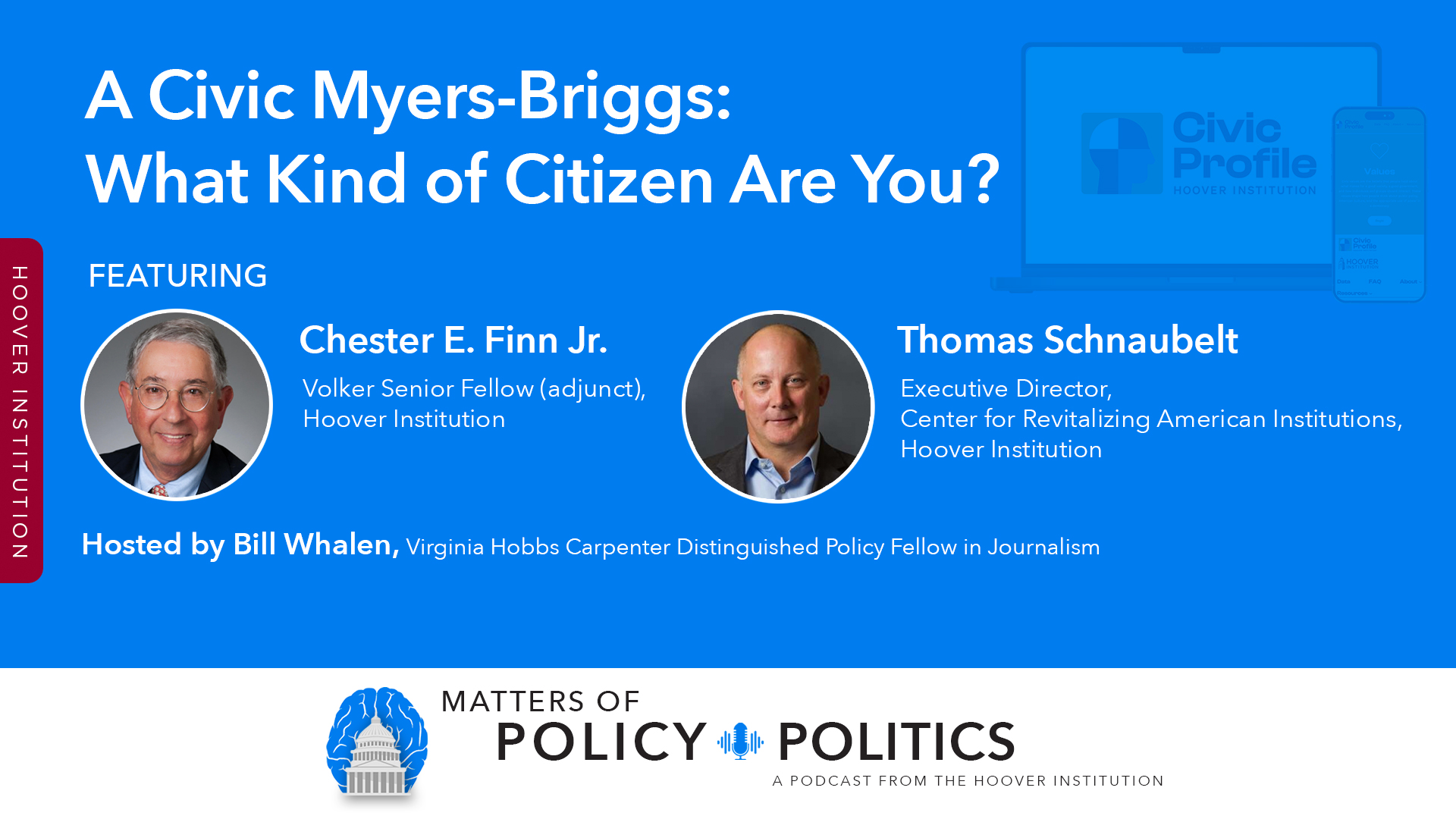
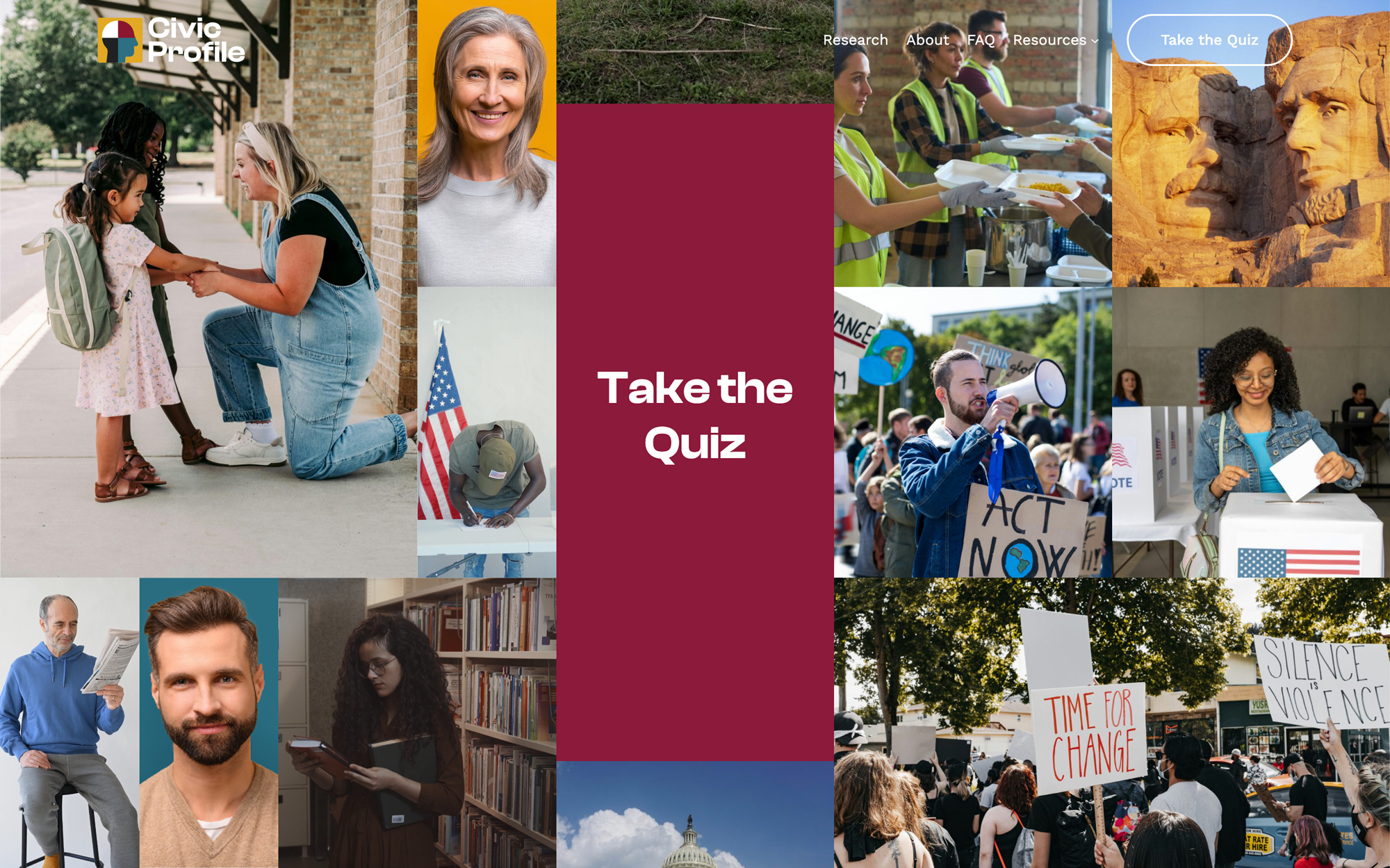
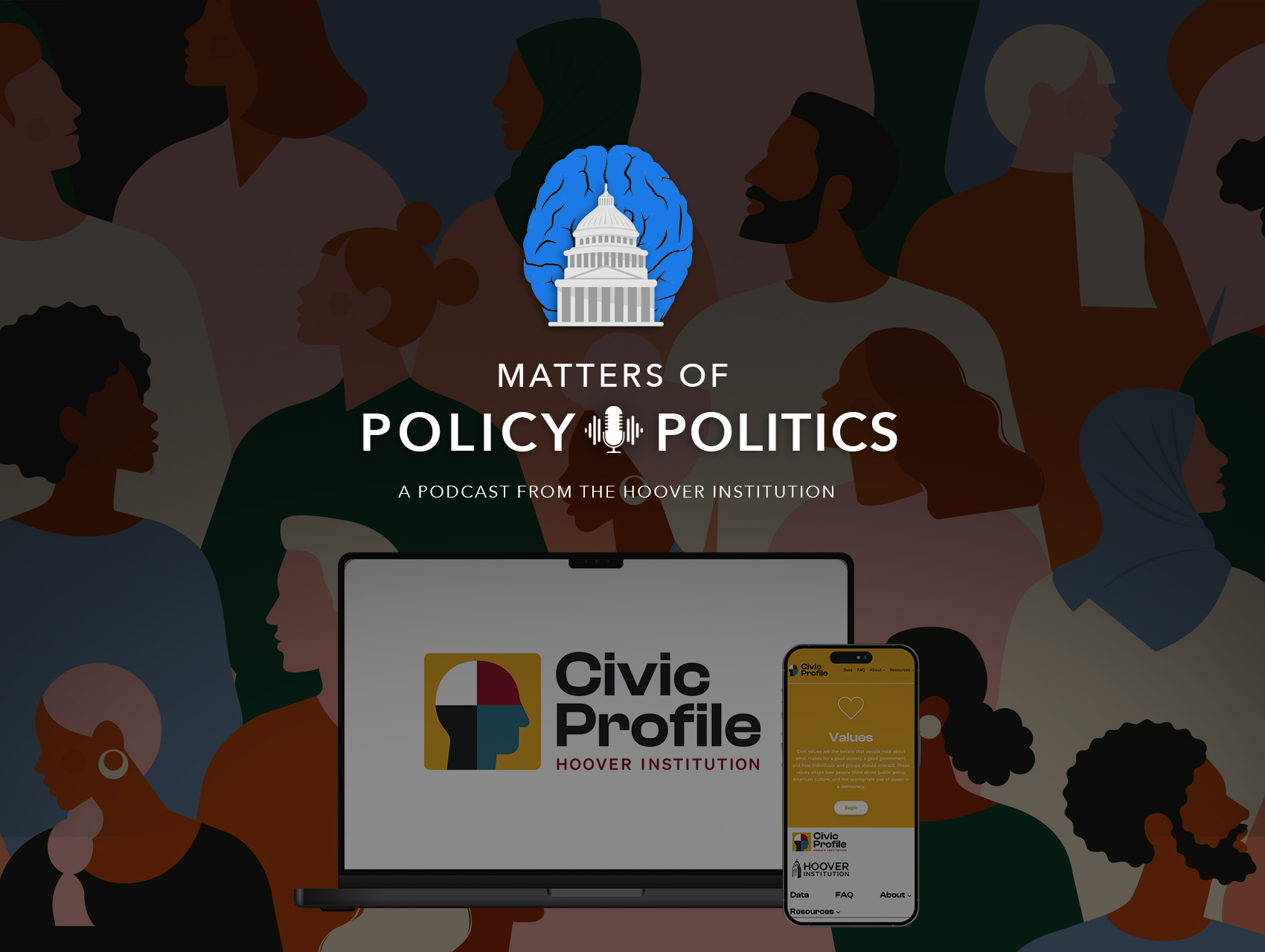
Assuming we already understand the parameters of “good citizenship” (obey the law; do no harm to others), how to decide what constitutes a “well-informed” citizen? Tom Schnaubelt, executive director of Hoover’s Revitalizing American Institutions (RAI) initiative, and Checker Finn, a Hoover senior fellow and chair of Hoover’s Working Group on Civics and American Citizenship, introduce Hoover’s pioneering “Civic Profile” which launches in early March – a three-part test that assesses civics-related values, knowledge, and engagement.
Also discussed: how to keep the civics “push” going past the coming American semi-quincentennial in early July (is a decades-long “civics renaissance” feasible?), plus other RAI endeavors currently underway at Hoover (national civics fellows, a networking Alliance for Civics in the Academy, “People, Politics and Places” fellowships that bring rural undergrad and grad students to the Stanford University campus, plus Hoover’s USA @ 250 lecture series on ideas, institutions, and civic traditions that have sustained America freedom dating back to the republic’s founding).
Recorded on February 25, 2026.
- America's 250th birthday approaches a time for celebration and reflection on whether we, the people are living up to the Jeffersonian ideal of a well-informed citizenry. Coming up next on matters of policy and politics, two scholars in the field of civics and education. We'll talk about a Hoover Institution innovation that allows you to learn what your civics personality is, plus other initiatives at Hoover's Center for revitalizing American Institutions has planned the lead up to the 4th of July. Stay tuned. It's Wednesday, February 25th, 2026, and you're listening to Matters of Policy and Politics. A podcast devoted to the discussion of Hoover Institution, policy, research, and issues of local, national and geopolitical concern. I'm Bill Whalen. I'm the Hoover Institution's, Virginia Hubs carpenter, distinguished policy fellow in journalism. I'm not the only Hoover fellow who's podcasting these days. I recommend you go to the following link, which is hoover.org/podcast, and there you'll find just a whole plethora of good stuff to listen to that includes the audio version of the Goodfellows Show that I have the great honor of moderating. So this podcast airs on the last Friday in February, meaning we are 18 weeks in a day from the 4th of July and the 250th anniversary of the adoption of the Declaration of Independence. It's a good time for Americans to examine the origins of the Republic, of course, but it's also a good time to examine what it means to be a good citizen, which is why we've provided who two Hoover Fellows on the show today. Checker Finn is the Voler Fi checker. Finn is the Volcker Senior fellow adjunct here at the Hoover Institution, as well as the distinguished Senior Fellow and President Emeritus of the Thomas b Fordham Institute. The name Checker Finn is synonymous with reforming primary and secondary schooling in America. That also includes the role that colleges and universities can and should play in civics and citizenship learning. Here at the Hoover Institution Checker also serves as the chair of Hoover's working group on good American citizenship within the Center for revitalizing American institutions. He previously led Hoover's task force on K through 12 education and now participates in the Hoover Success Initiative. Tom Schnabel is the executive director of Hoover's Center for Revitalizing American Institutions. Prior to that, he served as a lecturer and senior advisor on civic education at Stanford's Freeman Spogli Institute for International Studies, as well as the university's Associate Vice President for Education. Gentlemen, thanks for coming on the show today.
- It's a pleasure to be with you, bill.
- Yeah, thanks Bill. So, checker, you're a repeat customer this first time for Tom. Hopefully Tom enjoys it and checker either you enjoy it or else you're glutton for punishment. I'm not sure what, I appreciate both you being here. I wanna talk a lot about what Hoover is doing in the way of civics and education. But first I wanna find a little bit about the two of you and how you got into this field. I'm always especially curious about this when the field involves education. Do you, do you guys come from a line of academics or educators or what, what draw you to this concentration checker? Why don't you go first?
- Oh boy. I've been in this concentration for about a half a century now. The education part and the civics part has gotten more and more significant within it over the last, let's say, 10 years. I, I trained at the knee of the late Daniel Patrick Moynihan. And Lyndon Johnson had persuaded me that America was gonna end poverty by fixing its schools. And Moynihan was a professor of education and public policy at Harvard, and I needed a doctoral advisor. And that led to one thing after another with him. And then in the field of education ever since. Most recently, as you mentioned, bill on elementary secondary school reform, raising scores. Why don't kids know how to read, write, and do arithmetic? But at the, for institute in particular, we got into history and civics education by doing a review of state, state academic standards for those two subjects and discovering that they were pretty awful. That was about six years ago. And ever since then, I really had to be under my bonnet about history and civics education. I mean, once upon a time, I was a history major in college, and I've gotten more involved with a, with an a, a third party project called Educating for American Democracy, which is a new roadmap for history and civics education. I'm on the steering committee there and at Hoover, where I started, as you well know, in K 12 education, the on rushing semi quincentennial of the Declaration of Independence and the creation of the RAI center at Hoover has drawn me into a, a whole bunch of things having to do with civics and citizenship and American institutions. And one of them, the one we're gonna talk about mostly right now is our, our, our new civic civic profile, which is an amazingly, I think, innovative and, and potentially very important project and product. So I've been at this for a while. I'm still pretty pumped about it. And I just wanna emphasize right this minute that we're not supposed to just have a birthday party on the 4th of July, though that's a good thing. Complete with wrestling matches and auto races in Washington as I understand it, and a garden of heroes with statues. But besides all that, it ought to kick off a, a, a 13, 14, 15 year renaissance of civic and history education in American schools and universities. And I I I don't wanna just say that on, on July the fifth, we're gonna quit. This is meant to be the beginning of a renaissance.
- And Tom brought you, Tom brought you to education.
- Yeah. Bill, when you, when you said asked about our lineage, I'm like, wait, my lineage. I grew up on a farm that was also an airport. My whole family is a family of aviators. I was destined to become a pilot. I am a pilot, but studied physics as an undergraduate, and people are always like, how did you get from physics to what you do? And it really happened during grad school when I was teaching physics at the University of Michigan and really just decided that higher education needed to do a better job of really fulfilling its civic mission. And so that's been my career has been sort of focused on how do institutions of higher learning really instill, create and, and form civic identity among the students. A lot of that has been focused on experiential learning opportunities, trying to get campuses to engage deeply with their community and get faculty and students out doing work. That's a very experiential, before coming over to the Hoover Institution, I served as the executive director of the Haas Center for Public Service here. So there's always been this connection to public service, but what what drew me to the center for revitalizing American institutions, quite honestly, was that I, I just thought we weren't doing enough to kind of lift up the kind of institutional work that has to be done to protect our democracy. It's great to have people involved in public service and doing volunteer work, but we, I really wanted to focus more on how do we build or rebuild our institutions? How do we make them more trustworthy? How do we make them more efficacious? And that's, that's what we're doing here. And excited to talk to you about the things that checker has already foreshadowed that we've been doing that I think are, are exciting, especially because we're in this 250th year.
- Tom, can you elaborate a bit about what exactly RAAI does and how it fits into the Hoover mission? I've been at Hoover for over a quarter of a century now. When I came here at the end of the 20th century, Hoover was very hop top heavy in economics, very top heavy in foreign policy with an interest in education, certainly. But you didn't hear the word civics that often. So
- Yeah,
- Play that. And I think it's probably not a coincidence that it, that comes with the arrival of one Condoleezza Rice as our director.
- That's absolutely right. Yeah. I think Condoleezza Rice had a huge hand in sort of highlighting or, or thinking about like, we as a democracy have to pay attention to our institutions. And so there was a, this was before my coming here, but my understanding was there was a, a hoover wide conversation about what might we do to try to revitalize our institutions. And that led to the formation of this new center, the Center for Revitalizing American institutions. We call it RAI,
- Not only, but r ai,
- Not REI. Right? Right. The, the focus of RAI is, as I mentioned, it's, it's really about understanding how we got to this particular crisis and trust in American institutions. And then what are the, what doing some research around what are the policy recommendations that we can make? What are the ideas that we have that we can actually revitalize people's trust in? And the f the efficacy of those institutions. People often are like, wow, that's a huge job. How's that going? Sometimes they say that quite snarly, but what, what we're actually focused on are, we like to talk about it in sort of dimensions. The first dimension is actually the governing institution. So judicial, executive and legislative bodies at the state, federal, and local level. You know, a great example that we have is actually our faculty director, Brandis Kanes Roh, who is Ho Hoover senior fellow here, has a whole project. She's working with Dan Lapinski, a former congressman who's a distinguished visiting fellow here on what can we do to revitalize trust? How do we get congress actually, which is I think really at the very bottom end of what Gallup and Pew say, institutional trust, where, where people are with institutional trust. I think it's something like 7% of people think that they, that Congress is doing the right thing. So the, there's the governing bodies that we're focused on. There's also the second layer, the de toque vian, the sort of civil society, the non-government institutions like media, social media, churches, schools, higher education, elections, nonprofits, foundations. Those institutions also have seen precipitous declines in us. So we're looking at what can we do about that? And then the third layer, which is bring, which is the layer that brings us to civics, is really around democratic citizenship. And it's about individuals and how they form relationships with, and an understanding of different kinds of institutions. It's also in that layer that we're focused on polling. How do we know what Americans actually think about the institutions that we have? But that building and understand, building an understanding of American institutions was what led us to this idea that we have to do something around civics. You're right, Hoover hasn't been saying the word civics much. We don't have a deep bench. So we have people like Checker and like Josh Ober here who are, who are great civic educators. We, one of the things that, that Brandis asked us to do and that we did right away was do a whole ecosystem analysis of what's happening in American civic education. And, and it led us to some of the, the investments that we've made at RAI, you literally
- Led into my first question here, which is, you, you called it an ecosystem scan. I don't know if that's a fancy term for polling or not, or survey, but ecosystem scan. And you surveyed over 7,600 educators and students and you found gaps in the system, but you also found opportunities. So what are, what are the gaps? What are the opportunities?
- Yeah. Well, yeah, we, we did an ecosystem scan. It wasn't really a poll. It, it, it did involve some surveys.
- You can't
- See. We also did, yeah, we did some interviews and focus groups. We reviewed a lot of the reports that were out there. You could find some of those reports. By the way, on the working groups website that has this thing called the Citizenship Hub, we're compiling a lot of different resources there for educators in the, and the attentive public. But some of the gaps and checker, you can certainly weigh in here as well. Some of the gaps that we found that we thought, you know, we we should be attending to is, I mean, every single person bill that we talked to, which was like civic education leaders, said, we have to do something about this idea that we have to be engaging constructively across difference. Like that civic skill was something that everybody pointed out. But then what we started looking at was what exists out there? And it turns out there's actually kind of a cottage industry of bridging programs. So when you kind of dig a little deeper at that and you say, well, okay, what's really missing? One of the things that we saw was in higher education, particularly in more elite schools, there's, there's this almost disappearance of one of the most sort of primal d differences that we have in our country, which is the urban, the geopolitical divides around urban and rural. And so when, and what I mean by that is that there was virtually nothing focused on how do we bridge that gap within elite higher education. So one of the first things that we did was, like we said, let's form a new fellowship. We call it the people Politics and Places fellowship. That is about actually asking students to bridge that, bridge, that gap. Some of the other things that we found were one of the gaps was that while there's these conversations about civics are really robust within certain silos, like in K 12 education, in higher education, and even in civil society, although we don't pay much attention often to the, to what's happening in those third spaces, there's not a lot of cross pollination. There's not a lot of conversations that happen between them. And so here, again, we're looking at that and we're thinking, what does Hoover do? Well, Hoover convenes, well, Hoover can find really good people and exemplars. So that's what we've done. And we've created this thing called the National Civics Fellows, which includes exemplars from each of those realms as well as a researcher, as part of a team that intentionally is thinking about how do we crosspollinate, how do we make all the, you know, the, the whole more than the, just the sum of the parts,
- The, the civics part of this, let me just add, sits on top of a widely perceived sort of national crisis in civics education where kids don't know much, they don't retain much, the schools don't teach much. The states don't require much. The evidence from every possible test and survey of students and adults is the most Americans couldn't pass the citizenship test that immigrants have to take that the lowest scores of all on the national assessment of educational progress are not in reading and math and science. They turn out to be in civics and history. And so we've got a, a knowledge gap. And we, we've also got a, a, a gap in engagement. We've got cynicism, we've got a whole bunch of things that are kind of widely perceived to be national challenges the country's facing right now. And so, you know, Hoover can't cure all this, this is a big disease, but in so far as it can help call attention to it and come up with some remedies. I think the civic profile we're gonna talk about in a few minutes is a, is an example of that within the RAI venture at Hoover, but also with potential national applic potential national application.
- Yeah. Checker. I, let me, let me add a little bit to what you just said there. 'cause I probably should have led with the knowledge piece right there. There is a lot of, every poll that I've seen about this says that there's about, it's between a third and a half of adult Americans cannot name all three branches of the government. And I, I, I remember reading this that at one point in, in Reagan's thing, he was like, civics has to happen at home. It has to happen at the dinner table. But what we found is that there's actually a generational hollowing out of that civics. And so sometimes the parents aren't equipped to basically provide that. And so, and then you layer onto that, what another thing that we found is this kind of a lot of fear among educators to even wade into this because of that, that pol the polarization and the sorting, political sorting that we're experiencing. So there's a bunch of, there's a bunch of layers to this challenge bill that, that came out in our ecosystem thing. And like, like checker says, what we built in the civic profile is, is a, is we think a tool that can help reduce the, reduce the pressure, you know, on these things, but also keep the differences that we have alive and have them be presented in ways that people can actually talk about them.
- Alright, a question to the two of you. Are you good citizens? And you're both gonna say yes. So tell me why you're a good citizen checker. Why are you a good citizen?
- Well, let me say in anticipation of the civic profile, because we look at knowledge, we also look at engagement, and we also look at values,
- Right?
- In, in relation to people's views and, and, and, and preferences vis-a-vis government and their place in society. I en I engage in the obvious ways, like, like voting and participating in various organizations in the community where I live. And, and on a bigger scale too, on state and national stuff. The, I I do reasonably well though some days not as well as Tom on the knowledge part of our profile, which it means I can answer most of the questions on the citizenship quest test and get them reasonably accurate. And I, I, I mean the, the values part, we're not trying to judge people. We're trying to help people understand themselves. But I've acquired or developed, or e evolved a set of values over the years that most people would, would sort of call center, right? I believe quite a lot in individual freedom, but I also believe in a, in a, a competent, efficient government that deals with essential needs of a democratic society. Education being a primary example in my own case, but there's so many others, different national defense we could go on. So I think, I think I qualify, but let me underscore, the civic profile that we're talking about is not meant to pass judgment on my citizenship or yours or Tom's. It is meant to inform and then en encourage people to improve if they are so inclined. But we're not trying to give people grades on their citizenship. I wouldn't dare give Tom a grade on his citizenship, but
- Tom, Tom, conversely, what, what, what would be a bad citizen then? Is it, is it, yeah, setting aside issues like criminality and so forth, is it just as simple as being I literate and not giving a damn?
- I mean, that would be one way of thinking about it. I, I actually, I, I don't know, this is maybe a small semantical thing. I I don't, I don't really think we should think about it as being good or bad citizens. I think it might be better to kind of think about it as whether one has a healthy or an unhealthy civic identity. And I think that's a little bit broader where you're thinking about one part of a civic identity is what one knows about de you know, democratic practices, democratic knowledge. And, and so an unhealthy civic identity would be reflected in somebody not knowing their institutions, the not knowing their history, not knowing how institutions work or function. But other parts of it would be a little softer. You know, I, I I, I've written a little bit about civic identity formation, and the thought is that it's, there's parts of it that are these building blocks that are more skills oriented, and they're things that you could probably readily assess. Like you can actually assess whether somebody knows all three of the branches of government. But there's other parts of it that are softer or more values oriented that I like to think of as core commitments. And it would be the core commitment to the values, the practices and institutions of a liberal democracy. And by, I want to clarify, I'm not talking about liberal, like liberal or conservative. I'm talking about classical liberal, where it's attending to the rights of the individual. And that tension between the will of the, the majority, I think somebody with a healthy civic identity has also made some intentional choices about the, the issues that they care about and are acting on those things with integrity. I think they approach their, their life as a citizen with a, a certain civic mindset, which is meaning that they're locating themselves with others and thinking about that. So I think that that's, I don't, I definitely don't want to grade checker either, though. Both of us have been really watching our scores on the knowledge now checker. I just have to say both of us have now taken the, these, these tests and we actually helped write the question, if we're getting them wrong, there's something really wrong with us.
- Okay. Checker, let's break down the civic profile. So you mentioned there are three areas, three categories, you call them modules. So let's begin with the first one, the values module. What sort of questions are you asking when it comes to values?
- Yeah, we've got a, a, a a dozen areas that attempt to smoke out people's views on key issues, such as, for example, are you more inclined to preserve traditions or are you more in favor of change in society? Are you more inclined to prefer government to be centralized or decentralized? There's a variety of, of, and often you can be both. You can in be in favor of it being centralized for some functions and decentralized for others. We're not, not only in a few cases are we giving people sort of, sort of A or B, because in most cases you can be some A and some B. But we're, we've, we've done a huge series three now, I think national, national surveys with the help of u gov, right? Where all these questions have been piloted and we know where the country is, we know what a random sample of American adults are on all of these things. So we're gonna be able to display for people how their values on all these different categories compare with the population as a whole. And we're not gonna tell 'em they're good or bad, but they can see that, let's say 75% of the Americans are more tradition minded than they are. That's an interesting thing to know about yourself. You might or might not like it, you might want to do something about it. You might just want to be informed by it. You might be, and we will try to help people understand what that means for them. I mean, if they, if they are less tradition minded, they might be more change minded, more open to em, embracing changes in, in norms and laws and practices and in the society anyway. The values are a big chunk where they're, you answer them on a, what's called a Likert scale. A bunch of statements that I strongly agree with, I agree with, I disagree with, I strongly disagree with. And that's the way the, the algorithm lies behind the lies behind the profile will, will calculate where a person stands on a given collection of values. So that's the first,
- That's the first one, Tom. The second one is the knowledge module. So is that as simple as just asking questions about American history or are you doing something in addition to that?
- No, it's, it's pretty straightforward. It's, of the three, it is pretty what what we've done with the module section and is, is taken questions that are part of the citizenship test that, that the United States Citizenship and Immigration Services administers to people who are naturalizing. Now, there's some significant differences between that and, and what we've done because the naturalization test is actually given orally, not all of the questions really we're, we're, we were, we weren't able to sort of use all of the ques the battery of questions that they have. They have 128 questions, but we, we took the ones that we could actually create multiple choice questions of pretty, pretty readily. So that's the big difference between how it would be done, you know, if you were taking the citizenship test and doing it online, is that you get multiple choice op options. But that's what what we've done is emulate what would, what it would be like. 'cause in the real citizenship test, you would be given 10 questions orally. We've just taken at random for each person who does this 10 questions from the citizenship battery and said, okay, could you answer these? And that's why checker and I keep poking at each other, like, Hey, could you do this? Or how, you know, were you able to do it? The, but that's, that, that's the knowledge battery of questions. I, I do wanna mention that checker mentioned our, our work with YouGov on the values things. I think that was probably the one that took the most time. We, we both invented some batteries that were kind of, what we were working on with YouGov is to try to make sure that there were statistically relevant and reliable and valid, but on other ones, we actually used preexisting pre-validated questions that had already been out there. I think one of them, one of the pre-validated values questions is really around whether or not you are more focused on minority rights or majority rule. So that's, that's one of the, that's another one of the values. But the knowledge piece was, I, I have to say it was pretty straightforward. We're also trying to make sure that it's not a a, a blame and shame kind of thing. It's, it, you know, you get to the knowledge piece at the end and it's, I, I watched somebody take it and they had gone through the values and the engagement and they got to the knowledge section and they've said to me, oh, I could actually get this wrong. But the ones before you can't really get wrong because they're more about, it's like taking a Myers-Briggs, we've, we've kind of talked about this as a civics Myers-Briggs. There's nothing wrong with being either extroverted or introverted. There's nothing wrong with being a perceiver or a thinker, but it's good to know that. And that's very much the, the spirit with which we've kind of created the, the civic profile.
- Right. Now the third module is engagement, gentlemen, is that as simple as, do I vote, do I volunteer my time?
- But it goes beyond that. Do you po do you post opinions about things, social media? Do you, and how likely would you be to respond in various situations in various, in various ways, sort of self-knowledge about plausible responses to various challenges that might arise in your community. But we have a whole long list of, of, of organizations and activities that you might belong to or volunteer in. And it's, it's meant to smoke out the extent to which you participate, not just in government, but that is to say voting and going to, going to town council meetings, but also simple society, the extent to which you, you do things with your neighbors in your community, try to make it a better place in various ways. So it's a, there's, there's a lot of options here. And again, it's nonjudgmental. It's more like, well, you know, 63% of Americans say they volunteer at least once a month. How do you compare with that, with that figure, for instance, on the, on the feedback part? And it's, go ahead.
- Yeah. Part of, and part of what we did with this bill was to, to develop sort of these three archetypes based on the research data that we had. And so you'll go through this battery of questions and what, what it'll signal to us based on the research that we did, was that you're either somebody who's a community builder who, who likes to do this sort of direct action kind of things. I shouldn't say either. What we're doing is sort of saying, here's the, your overall sort of propensity towards these things and, and in relationship with the national data. So you, one, one of the archetypes is like a community builder, somebody who's very involved in their sort of local community, does the direct service, the volunteering. Another is what we call an institutional actor. And those are the people that are more like working within institutions. They're kind of the voter, the, I'm gonna get involved in a campaign, or I'm gonna become part of a city council or go to city council meetings. And then the third one is a change advocate. And those are the folks that are typically outside the system, but trying to sort of say, Hey, there's something wrong here. I wanna make sure that you're aware of that. And they're trying to build and sort of a, a, a campaign for the different issues that they care about. So those, those three archetypes that where they come from is both some of the literature that we reviewed, right? And the data that we, again, we did these surveys with YouGov that helped us kind of smoke out as to use checker's term, where, where do these things line up? Are there themes that we're seeing within the ways that people are, are engaging? The, the one last thing I'll say about this while we're ending, like here's the three parts. One of the things that we did with the civic profile at the very beginning, we looked at, there were probably a dozen instruments out there that were somewhat like this, like the, the, the, the political compass test. So there's a couple of other ones, but what we found was none of them brought all three of these things together. The knowledge, the values, and the behavior. So this sort of engagement, and that was the real contribution that we wanted. We wanted something that would kind of wrap all of this stuff up into a holistic civic profile for folks.
- Yeah, I would love to dig into the engagement data. For this reason, I have a real concern that we're becoming what I like to call a lurker nation. Hmm. Very cynical about politicians. They're very cynical about causes. So they don't get directly involved, they don't really leave their safe zone. They don't go out and, you know, volunteer for campaigns and do things. They sit at home and they lurk. They go on social media and they post, and I think we can agree this is a problem. So I'd be very curious as to how engagement breaks down if you're sort of actively involved out there changing or if you're just staying home and just taking pot shots of things.
- Well,
- One of the, oh, go ahead checker.
- A very short time, you'll be able to take this Pacific profile yourself and, and then you will get yourself compared to national data. And I don't think you're a lurker, but I think you're right. A lot of people are gonna turn out to be, they do a lot of posting, but they don't do much else.
- No, we are lurk, ease. We we're all very public things where people who lurk come after us. But, so question
- Jim. Well, bill, bill, bill, let me, let me mention too though that you said you're interested in that data. One of the beautiful things that we're trying to build on this platform is the opportunity for people like you or anybody to sort of go and take a look at the data that we've collected. We're actually publishing it online, right on the platform so that people can go and they can click, okay, show me this value. And then they can actually see how does that value differ by gender, by age group, by political ideology, by geo location, whether they're urban, rural, or suburban by their income status. So they, people can actually take a look and see what's happening with this value or this engagement piece. That's one of the contributions that we were, you know, checker has been really kind of pushing us to be, Hey, we want this to be something that's very much public facing, where the, where the information is gonna be made available so people can take a look and see how do I line up with the national data?
- Even as look at, even, even as this na these national data have enormous research potential for analysts to dig in. And, and as we continue to do this over time things will change and people be able to track changes. They'll also be able to make comparisons. I mean, there's research potential, there's individual potential in the civic profile. And, and there's the third category which we can get into, which we call the cohort where, for example, the teacher or professor of a course can use the civic profile with a group and and, and use it to trigger group responses, discussion, learning opportunities, things like that. So enough,
- Alright, so hopefully people listening to this want to take this test. So tell our listeners how where they can go take the test when they can take the test.
- We're gonna, we're gonna publicly launch the tool on March 9th. And where it will be is the url, civic profile.org. That's that, that's where they can go to check out, both do the profile and check out the data that I was just mentioning. I wanna say one other thing, checker and I both really committed to the idea that this could be a, and we've heard from some of the teachers that we talked to that this could be a very important tool in a classroom and, and, and especially around the civic values, the civic knowledge, just as a diagnostic tool for a teacher to sort of say, Hey, where do I need to go with this conversation and how, how, how can I use this data actually help foster conversations across difference maybe in somebody's orientation to change or tradition, that kind of thing. But there is another piece of this that we're really excited about. We're, we're working with the Hoover comms team and we wanna make this thing go out publicly. We want it to be out on social media so that not only can you do it in a classroom, you can post this to your family's GroupMe and have your whole family do it as a cohort. So I'm very like checker's interested in the classroom. I'm super interested in having my family take this and sort of look at like, what does that look like as a cohort and how do I compare to my brother and my sister and, and my grandma and like all that kind of thing. So I think there's another aspect of this that is hyper public that we're hoping we can, we can spark that conversation as part of the 250th across the nation
- Here. Here's a thought we're going through kind of a silly season. One of what will be many silly seasons leading up to the next presidential election and the current silly season involves SAT scores, specifically the governor of California who just wrote a memoir in which he talks about having a nine 60 on his SAT score. So it sparked this conversation about, about politicians and their intelligence and so forth. Why don't we make every individual who runs from the president of the United States take the civic profile?
- We probably make them take it, but we can certainly invite them to take, give and see who, see who accepts that opportunity. It won't be very many of 'em I suspect, but it might be very revealing just as people are asked to reveal their medical records, you know, asked to reveal their psychiatric records once upon a time as if memory serves. We had a vice presidential candidate fall from the ticket because of his psychiatric records. Tom Eagleton if memory serves. Yep. The no, that's a real, that's a, that's a really cool idea. I wanna underscore a to what to me is a very important element for the Hoover Institution here. To my knowledge, this is really the first public facing online tool that the general public could access that Hoover has ever produced. There could be a million people a year in in doing this. There could be, there could be a thousand. I think that this is a really interesting public service that Hoover is engaging in. We don't know how big the uptake will be. We're gonna do our best to, to, to maximize it, of course starting, starting next month, starting in March of 2026 and continuing. But I think this is a, a, a real sort of innovation from a, from an organizational standpoint for Hoover as well. That's all.
- Can we say one of a kind, don't only if it's kind or is there anything analogous to this?
- I'm not aware of anything analogous to this within the Hoover portfolio, as Tom's mentioned there, there are several other online instruments that are kind of analogous to this, right? That Myers-Briggs would be a, a famous example. The, that people can access and lots of people do
- 16 personality types, right?
- Yeah, yeah,
- Yeah.
- For Hoover, I'm not aware of, and for tanks in general, I'm not aware of anything quite like this.
- Okay. Let's talk about a few other REI undertakings, a couple of which you've already briefly referenced. Let's begin with the National Civics Fellows. This began last August, I believe, with the pilot cohort. I think there were only four fellows in it, but checker, tell us about who were bringing to this. Tell us a little bit about their backgrounds and their projects. This is a one year fellowship, I believe.
- Well, Tom's really the major Domo of this particular project, so I'm gonna throw this ball to him.
- Fair enough. Yeah, it is, it is a one year fellowship. But I will say that what we've done with our first fellows, because they're actually helping us kind of co-construct the fellowship and its future, is that we've asked them to actually serve for two years. But we have, as I mentioned, we have these four fellows. It's a small, they're visiting fellows, so they're non-residential. They're, they're off, you know, in, well I'll, I'll tell you exactly who they're one is Trive Thro Bite, who's in Minnesota. He's also with Ball State University. He is our higher education person who's focused on something called third Way Civics. I should mention each of these people were selected because they're exemplars within their own space and we're really hoping to amplify their work, but also wanting to get them together to kind of do this cross pollination and think about how they could make each other's work better. And that's been fascinating to watch. But TriNet, who is doing third way civics, which which is an amazing curriculum that's focused on higher ed. We have Steven Morris, who's with the Fresno, the, the Center for Civic Education in Fresno, works with the K 12 group. He does an amazing, he has amazing approach that's focused on both ethnic and civic identity. And he uses this idea of, of Sankofa throughout his work. And he, he also works with the California State Seal of Civic Education. So he is doing some cool work in the K 12 space. And then we have Sarah Shanks, who is the CEO and founder of something called Every museum, a civic museum where she has a group of civic museum curators and educators, about 300 of them who are interested in basically how do, how do we make museums more civically oriented and, and to do better civics. She's actually affiliated now with Monticello and is part of the, the effort that Checker mentioned he's a part of with this, with the educating for American democracy. She, she co-leads this, this community learning task force for the EAD project, educating for American democracy. So she's really our, our sort of civil society sector. And then we have Joe Khan, who's our researcher. He's from uc, Riverside. He's doing an interesting research project. And he's the one who actually needs a couple years for this project to unfold. But he, what he wants to do is build work with the Stanford Deliberative Democracy Lab, and he is gonna do a deliberation that's aimed at trying to understand what, what are the things about the approaches to civic education that we can agree on. We, we focus a lot on sort of what are the parts that we don't agree on. He's trying to do it so that we can agree on those things. I think the real interesting thing about what Joe is doing is this deliberative poll that he's creating. We're we're actually hoping that we can take the things that he develops for that and have it be implemented at the local school district, make it available to school districts across the country so they can have their own deliberations on the same topics that, that, that, and that's addressing one of the things that we found in our study, which is that, that, and I mentioned this, that teachers are, are self-censoring or sometimes they're being censored because, but they're, they're fearful of both the administrators or the parents in this, in this particular political climate.
- Alright, second category gentlemen, is the people politics and Places fellowship. I think you referenced that earlier. It's in its second year now, I believe. Explain to me as I understand this, is bringing kids from rural parts of America to Stanford and introducing them to a different part of America, if you will. And I think I saw a really fascinating number here. I think you, you claim that 20% of the American population is rural. I'm curious how you identify rural, by the way, but only 5% of the Stanford undergraduate population.
- You might, you might start fact that Tom was born on a farm in Wisconsin.
- Yeah, that's pretty darn, that's pretty frigging rural.
- Well, I was, it was, it was southern Wisconsin, so I was pretty close to Chicago. I I I didn't have like, I, I mean yes, it was a farm, but not, not as rural as some of the places like in Montana or Idaho. Anyway. Yeah. So the, this you, you, you're absolutely right Bill, that the places like Stanford, and I don't want to say Stanford is the only one that has that sort of differential between rural and, and urban, you know, in their student populations. By the way, you asked about where that definition came from. That definition that we use is, is really based on population density. It's from the US Federal Office of Rural Health Policy. There are a million different definitions. Some of are are, are basically algorithmic that are just population density. Others are cultural. We, yeah. So part of this was to sort of try to create a model here at Stanford that other institutions might pick up or emulate in the future. It's a small fellowship, but it, it's, it's, it's really about trying to have students study this geopolitical polarization and, and also simply study rural life. If one of the things that I discovered earlier in my career at Stanford was we had 582 students that were doing summer internships, 19 of those internships. This is when I was at the Haas Center for Public Service. 19 of those internships went to rural places of 582 of the 19 students that actually went to rural places. 18 of them were from rural places. So we only had one student that was either from an urban or a suburban area that went to a rural place that summer. So part of my interest is basically trying to deepen Stanford's engagement in, in understanding domestic rural life, period. And some of this has to do with when, when Trump got elected, the first time campus went apoplectic, they couldn't understand how did this happen. So many people were like, why did rural America, you know, elect this guy? And I was like, well, is that something more than just a rhetorical question? Do you really wanna, because I don't see any, anything on the surface that tells me that people here are, are working really hard to understand or engage with rural, rural life. And so that's partly what this, what this fellowship is about. It's not really about bringing more, although there is an active effort to sort of figure out how do we, how does Stanford attract more rural students to come here? That's a, that's a pretty sticky wicket though, because there is, and this is a little off the civics thing, but the, the, the challenge with that particular topic, bill, is that it, it really is about how institutions are rated and ranked. And they're often, places like Stanford are ranked by yield. We know that rural kids, if they're given the opportunity, they're given admissions to Stanford, they're much less likely to accept than if they were from some other area. And there are cultural reasons for that. So there is, there is a problem. There's like an institutional structural problem around that. I'm getting way off topic, so probably don't want to use this. But anyway, yeah. The fellowship is intended to, to deepen Stanford's engagement with domestic, rural life. And the students are studying it and then bringing it back to campus, which is really the, the goal in the fall for the students is to do a collaborative project where they're sort of showcasing here's the, here's the research, this is what I found out about domestic Yeah. Rural life.
- And it's in its second year, Tom.
- Yeah, this is the second year. And, and we've got students that go to places like Alaska, Wisconsin, and, and by the way, not to where I grew up in Wisconsin to a totally place. I'd never been there before until last summer. And, and we got students this year that are, that are currently exploring the idea of going to Montana. There's a couple places in in Montana that have, that have been of interest.
- Very good. And then I check the third initiative, the Alliance for Civics in the academy. And as I understand this, there are a lot of people involved in civics, but there really is not a network.
- This is for higher ed people involved in civics. And this is led by Josh Ober, distinguished senior fellow at, at at hoover, and a professor of almost everything you can think of at Stanford. And the, he's now got 50, a hundred, 150 campuses represented by individual faculty members who teach something like civics or something like it at their institution. And he is creating a network, oh, it's a loose network. This is not some sort of a, a formal club. This is an opportunity for them to exchange insights and ideas and curricula and problems and challenges at the higher ed level because it turns out that when you, when you look for them more, more colleges and universities than you might think have somebody teaching something that, that, that qualifies as civics, even though it, you'll never find it listed that way in the course catalog. And this network is almost a support group for people like this who frequently feel like they're isolated on their own campus and they don't have anybody to talk to about this thing that's important to them and that they do research on and that they're teaching their students as best they can. But wouldn't it be good to have some like-minded colleagues to kind of compare notes with? And he's got conferences, he's got webinars, he's got sort of newsletters. It's a, it's a rapidly growing, really nifty project. And I'm a, I'm a real fan.
- You mentioned earlier in the podcast, Ronald Reagan was looking at civics. So this would be 40, 45, the better part of 50 years ago now. So I'm assuming there are conservative academics who are very fired up about this. What about academics on the left? Are they as concerned?
- There's certainly a, a mix pe not everybody teaches civics the same way you could, some people see America as an kind of Reagan, Rosie, Rosie rosy glasses, everything's getting better all the time. Other people teaching history and civic c are more likely to emphasize fault, faults, inequalities, things we haven't got. Right. So they're not all, they're not all conservative by any means. But again, let me, let me throw this ball to Tom 'cause he's talks to this group more than I do.
- Well I I think first of all, it's pretty well documented that universities are themselves as institutions, some of the most conservative institutions, but they're filled with some of the most liberal people typically. Right? Like there's, and I will say that there seems to me at least, and I I, this is gonna fall into the category bill of, I I, I don't have any hard data, but I strongly suspect this thing. So I'm, I'm not gonna be able to cite something. But if, if, if I think about the sorts of initiatives that have taken shape and have gotten traction recently, things like Heterodox Academy 10 America Fire. I think there, the interest in those things has extended beyond sort of the traditional people. And I do think that more people who are maybe left of center are are taking, taking note that we have to do something differently that you can't that like that, that this idea of having, and, and this is what what's unfortunate about things like Heterodox Academy is this notion of viewpoint diversity has now actually become politically coded. And, and people think of it, oh, that's a conservative thing. And I, I've heard even people here at Stanford say, well, the, the notion of viewpoint diversity is a conservative notion. I think that's ridiculous. I think that that it's unhealthy. And I think from my perspective, I see more and more people in higher education wanting to figure out how do we engage constructively across difference. How do we bring back some of these ideas like they teach in citizenship in the 21st century here at Stanford, where we're studying things like Hobbes, Leviathan, like what do we do about the, the problem of citizenship? Do we need a sovereign? How do we, and this is where I'll just evoke again, Josh Ober, who is an architect of this thing that our, our notions of citizenship, we have to be exploring how do we make decisions at scale in a pluralistic society without a boss like that other than ourselves. Those kinds of questions are really central and I, I don't, I hope that we can avoid having that be a left or a right issue. It, it's really gotta be an all of us issue.
- Right. Hey, checker, could you take a moment and talk a little bit about civics at the K 12 level since we just talked about higher ed?
- Yeah, this is, and we've been talking a lot about Stanford as the, as the epicenter of a lot of what's going on in higher ed, as least as a convening point. K 12 intersects with Stanford, with Hoover really in, in, in two areas. The success project that Mackey Raymond directs in the education space and the RAI work in, in civics, both, at least three of the projects Som was talking about, but we've been talking about today, including above all the civic, the civic profile. And this is as, as I mentioned a little earlier when we were talking, this arises out of this widely documented phenomenon across the country that civics isn't being much taught, isn't being much learned, isn't being much assessed, isn't being much accountable for in the schools of the United States. And to the extent that any of these projects that we're working on can, can ameliorate that situation. We're we're we're doing our best to do it by giving social studies teachers in seventh grade or 11th grade, this tool that we're creating the civic profile, we are giving them something they didn't have before. They can use it with their whole class, they can use it with individual students. The Educating for American Democracy Project that intersects in several different ways with the work we're doing is meant to be a, a non-partisan or, or multi multi viewpoint, a framework for civics and history, education, renewal across the country. The push by a whole lot of other organizations to treat this 4th of July birthday as, as the beginning of a renaissance in the schools. The national assessment governing board has just announced that they're gonna redo their framework for assessing civics and gonna do it more often going forward. So that states will have more feedback. The data on national assessment civics has been national, but states haven't had any of it. So if you're the governor of, of Michigan or Alabama and you wanna know how your kids are doing in civics, you've not been able to get that from the federal government's big testing program, you'll be able to get it in the future. And so there's a lot of energy in trying to fix this problem, but there is huge evidence that it's a big problem. And once again, the Hoover contribution I think is real. I think it's important. Tangible, it's not gonna solve the whole problem.
- I'll tap into that too though. We've talked about higher ed and K 12 Bill, I, I want to bring up again the third spaces are really important. Those, those civic organizations. I, you know, we've made a little, a little bit about the fact that I've grown up on a farm. I think one of the places where my civic education, my civic identity was formed was in four H. Four H. Yeah. And, and I think we can't forget about the four H clubs, the Rotary Clubs, the civic clubs, the Boys and Girls Club. I mean, I don't know why they're all clubs, but you, you, you know, the idea though is that those third spaces, I think we've gotta highlight what you know and, and recognize that that's a big part of where we, where our nation's civic identity, collective civic identity is formed.
- Alright, let's wrap up with two questions. Tell me what else RAI has coming down the pike as we get closer to July 4th. Just a couple of cool things that we have planned. And then second, let's wrap up with kind of the bigger question of what happens after the July the fourth, which we talked about earlier. It would be a shame to put all this time, energy, and interest into the topic of civics. Only just to see a vanish on July the fifth and wait until 2076 and the 300th anniversary to reengage
- In the K 12 world. A lot of people are talking about the 13 year period of time between the 250th of this declaration and the 250 of the Constitution as a kind of a window in, in contemporary American history. That might be the focus of this educational renaissance that I mentioned happens to coincide with a number of years that a kid spends in school. So that somebody who's in kindergarten on this 4th of July might be graduating from high school when we celebrate the 250th of the Constitution. And what can we do during that period of time to keep this going and not just treat it as, as fireworks and hotdog on one day coming up. I don't know whether this can be sustained. It's gonna take a lot of folks. Education, as you know, is mostly a state and local function in America, not a federal function. So it's gonna take a lot of folks pitching in for this, this kind of continuation to occur. But I'll do my, I'll do my share. I think I think's gonna do it.
- I'll, I'll say a little bit, I'll, I'll blast out to the 30,000 foot or RAI level bill on this question. Just looking at the list of convenings that we have of scholars over the next three months, between now and and July, we've got a, a meeting where we're focused on understanding the confidence that people have in science scientists and scientific institutions. We have a confident a, a conference on the presidency and the executive, we have Ben Ginsburg gonna do a, a convening of people around elections. Andy Hall is gonna do something with artificial intelligence and politics. We've got HR McMaster hosting a conversation about understanding the civilian military. So you get the idea. There is a ton of stuff that we're doing and I would say that, and actually I should mention, if you want to watch a really fascinating conversation, go to our most recent webinar where we had Jane Kaminsky in conversation with Misha Oslan and Jonathan Op about the Declaration of Independence. Jean Kaminsky is the director of Monticello.
- Misha has a really great book on it coming out.
- Yep, yep. He, yeah. Actually, we're gonna be doing a book event on his book here at Hoover, sometime in, I think May 26th.
- Right.
- And then I, I, you asked about after the 4th of July, sometime in the fall, and this is part of Hoover's, USA at two 50, they've got a lecture series, RAI will be doing a lectures basically pulling together a panel on the architecture of liberty and freedom and American institutions and what, what we might need to look for for the next 250 years. So we've got, we're part of the Hoover's lineup on the USA at two 50 as well.
- Well, gentlemen, I enjoyed the conversation and I look forward to taking the quiz
- And we Sure, sure. You'll do well on it, bill.
- Yep. You're gonna have to post it and see what you got for you. You're gonna have to share it with checker and I, 'cause we've been poking each other the whole time.
- Meanwhile, just stop lurking.
- I'm have to go on, I'm gonna have to go on a couple times under pseudonyms just to make sure that There you go. Yeah. I, we gotta check if you can go backwards on the quiz and sort of retake it. That's
- Good point.
- Thank you, bill. Gentlemen, thank you for the call and congratulations, all the great work for you're doing with the Hoover Institution. It really is just, it's just remarkable. Thanks for Yeah,
- Thanks. To talk about all the best.
- You've been listening to matters of Policy and Politics, the podcast devoted to the discussion of policy research from the Hoover Institution, as well as issues of local, national, and geopolitical concern. If you enjoy this podcast, please don't forget to rate, review, and subscribe to our show. And if you wouldn't mind, spread the word, tell your friends about us. The Hoover Institution is Facebook, Instagram, and X vs. Our X handle is at Hoover ins. That's spelled H double O-V-E-R-I-N-S-T. I also recommend you go to our website, which is hoover.org, and sign up for the Hoover Daily report, which keeps you updated on what Checker Finn, Tom Schnabel, and their Hoover colleagues are up to. And that's delivered to your inbox. Weekdays, the Center for Revitalizing American Institutions, which we've been talking about, RAI for short. You can find it@hoover.org. What you do is you just scroll down to the bottom of the homepage and you'll find it along with five other initiatives that we call core institutional priorities. We'll be back next week with a new episode of Matters of Policy and Politics. We're gonna be talking about India for the Hoover Institution. This is Bill Whalen. Until next time, take care. Thanks for listening.
- This podcast is a production of the Hoover Institution, where we generate and promote ideas advancing freedom. For more information about our work, to hear more of our podcasts or view our video content, please visit hoover.org.
ABOUT THE SPEAKERS
Chester E. Finn Jr. is the Volker Senior Fellow (adjunct) at the Hoover Institution and President Emeritus of the Thomas B. Fordham Institute. At Hoover, he chairs the Working Group on Civics and American Citizenship within the Center for Revitalizing American Institutions. He previously led Hoover’s Task Force on K-12 Education and now participates in the Hoover Education Success Initiative, as much of his career has focused on reforming primary and secondary schooling in the US. That included serving as a member of the Maryland State Board of Education and Maryland's Commission on Innovation and Excellence in Education, as well as Assistant US Secretary of Education and chair of the National Assessment Governing Board.
Thomas Schnaubelt is the Executive Director of the Center for Revitalizing American Institutions at the Hoover Institution. Prior to his role at the Hoover Institution, Schnaubelt served as a Lecturer and Senior Advisor on Civic Education at the Deliberative Democracy Lab, within the Center for Democracy, Development, and the Rule of Law at the Freeman Spogli Institute for International Studies. Schnaubelt came to Stanford in 2009 and has served as the Associate Vice Provost for Education, the Executive Director of the Haas Center for Public Service, and a Resident Fellow in Branner Hall, where he and his wife oversaw the development and implementation of a living-learning community focused on public service and civic engagement. In 2015, Schnaubelt coordinated the launch of Cardinal Service, a university wide effort to elevate and expand public service as a distinctive feature of the Stanford experience, and he has launched and led several national initiatives focused on democratic engagement and social change education. Schnaubelt received a Ph.D. in Educational Leadership from the University of Mississippi, a Master of Arts in Education from the University of Michigan, and Bachelor of Science in Physics from the University of Wisconsin-Stevens Point.
Bill Whalen, the Virginia Hobbs Carpenter Distinguished Policy Fellow in Journalism and a Hoover Institution research fellow since 1999, writes and comments on campaigns, elections, and governance with an emphasis on California and America’s political landscapes.
Whalen writes on politics and current events for various national publications, as well as Hoover’s California On Your Mind web channel.
Whalen hosts Hoover’s Matters of Policy & Politics podcast and serves as the moderator of Hoover’s GoodFellows broadcast exploring history, economics, and geopolitical dynamics.
ABOUT THE SERIES
Matters of Policy & Politics, a podcast from the Hoover Institution, examines the direction of federal, state, and local leadership and elections, with an occasional examination of national security and geopolitical concerns, all featuring insightful analysis provided by Hoover Institution scholars and guests.
To join our newsletter and be the first to tune into the next episode, visit Matters of Policy & Politics.