














- History
- International Affairs
- Democracy
- Revitalizing American Institutions
- Revitalizing History
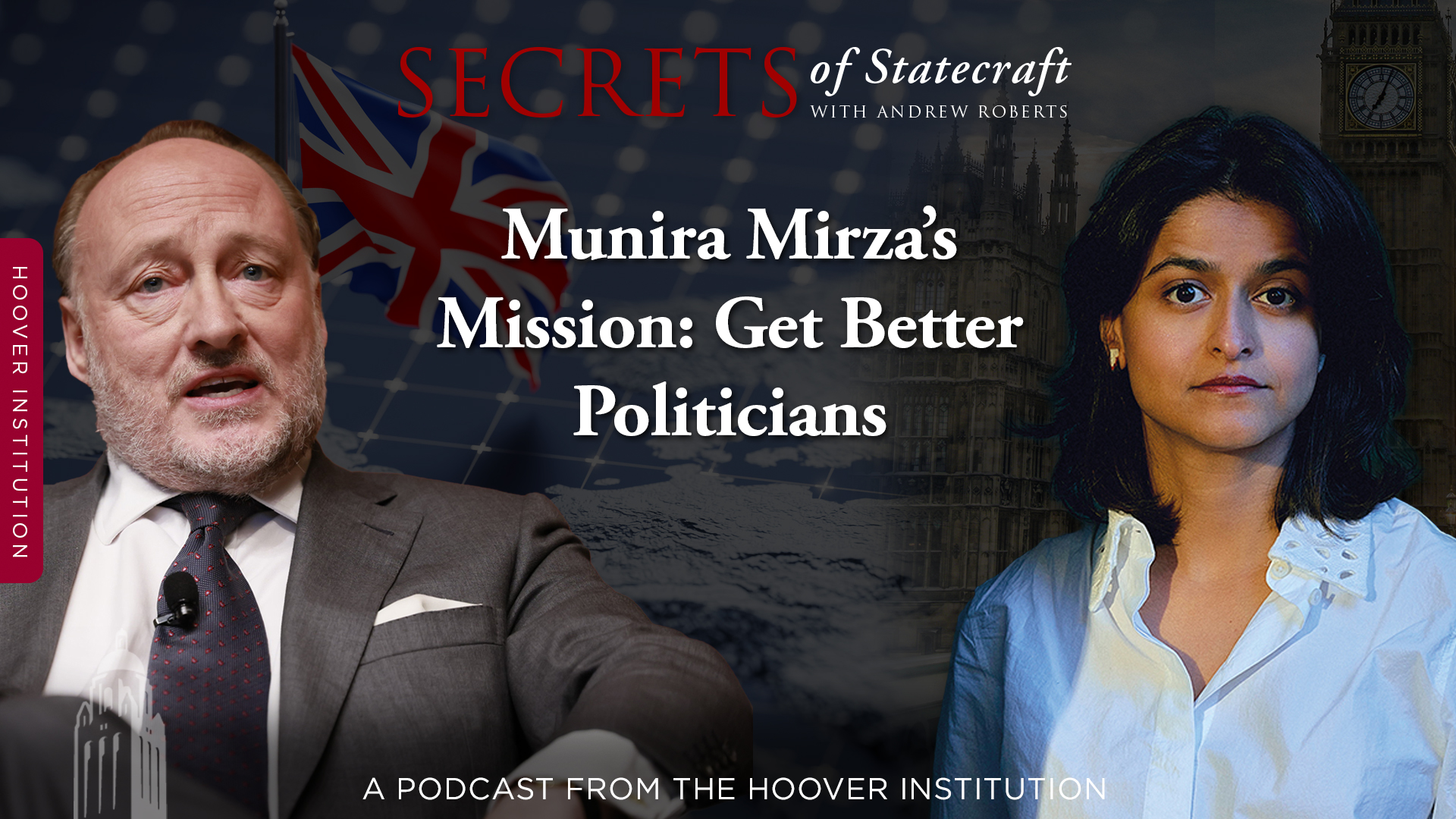
Munira Mirza is a former British political advisor who served as Director of the Number 10 Policy Unit under Prime Minister Boris Johnson from 2019 through 2022. She is currently the Director of Civic Future, a non-profit that tries to attract talented people to stand for public office. In this interview, she reflects on her time at the highest levels of British government and delivers a bracing diagnosis of why political leadership has deteriorated across liberal democracies. She explores how short-termism, media incentives, and declining elite formation have driven talented people away from public life. The conversation ranges from Brexit and COVID to meritocracy, civic duty, and what it would take to rebuild a serious governing class.
- Munira Mizra is the head of the former number 10 Downing Street Policy Unit and the Director of Civic Future, a charity which tries to attract talented people to stand for public office. Munira, you've worked at the very highest levels of British governments in the mayor of London's office, and then as head of the Prime Minister's policy units at number 10 Downing Street. And it was a particularly tumultuous time when you were there with Brexit and COVID and Ukraine and so on. And since leaving, you've written an awful lot about the, the poverty of political leadership in Britain. So can you tell me what, what did you learn from your time in government and and why do you think our political leaders are worse today than in the past?
- So I should caveat what I say about what's wrong with political leadership by just saying I also worked with some very brilliant people, very brilliant civil servants, some very, very good ministers who I think in the face of a lot of pressure and adversity made good decisions in far very heart. But overall, my impression was that the people who are running the country and the quality of decision making in the top is not as good as it should be considering how, how world leading Britain is in so many areas in business and finance and science tech. It's just extraordinary to me that more of our very smart, capable people don't go into public life. And when I was in number 10, I thought that the, the, the kinds of people who do very well in our political system are often the pushiest and the most ambitious. Our system sort of rewards people who are good on tv, who can speak in soundbites. It rewards a sort of short termism and thinking, so how, how can, how can we get out of this very bad news headline today rather than thinking more long term? And what would the consequences be for the country over a course of years rather than just, you know, over the next week? So I think some of that is just to do with, you know, politics generally. It was ever thus, but some of it is about the caliber and the quality of people and the seriousness of people. And I, I felt when I left government that the one thing that we could do to try and improve students, I mean, there are many things we need to do, but the one thing we could do, which would be very, very high impact, would be to try and get more very talented people inside, inside politics. Is
- That because politics is less of a sort of high status place than it was a few years ago? I remember, well, 40 years ago, people very much looked up to mps, they wanted to be mps. Whereas today, with the various aspects of the job, which I think have changed in the last 40 years, don't you agree not enough talented people are even considering going into public life in the first place.
- Yeah, and I, I don't think this is completely unique to the uk. I remember, I think a year or two before he passed away, Henry Kissinger wrote a, a really beautiful chapter at the end of his book on leadership, where he talks about a general decline in political leadership across the US and Europe across basically western liberal democracies, and points out that there's a, there's a kind of mediocrity in politics and that that tends to mean they're very good people, sort of turned off by it. He makes a point that, you know, the decline of deep thinking of intellectual life, the sort of the, the, the, the loss of century national beauty and service, the sort of noble and belief idea that the, the wealthy elites would, at least some of them would go on into public life. And, and he makes supply, I can't remember the exact words he used, but he talked about, you know, people are more likely to be globe making money in the financial services or working for an NGO rather than doing something as, as old fashioned, as working for their country. So I think it is a, a general problem in liberal democracies. But it's also, there are, we, we have a particular problem in the UK then, which is that if you look at the, the kinds of people who become ministers in the cabinet today, and this is not unique to particular political party. I'm making a Daniel point across, across the state. We get very few people who have led large businesses or who have been entrepreneurs or who have served in the Army. I mean, if you compare it to tabs of the past on the, you know, Baldwin, I, or even Pacha, there were still heavyweight individuals who were going into public life and they were bringing quite a quite considerable experience. They've had experience of making decisions under the pressure. I think the kinds of people who were left in the pool of mps, 'cause of course our system selects ministers from the, the pool about Ben Sheep, about Ben Trape. The kinds of people who are left are the sort of behind just some the, you know, sometimes not, you know, people, you know, dubious, dubious moral quality. Let's say you should look at the rates of, you know, alligators of sexual harassment in parliament. This, you know, it's pretty high for any workplace. So I think that that's, that's a real issue that, you know, the kinds of people who are now going into the system are probably on balance worse. It's very hard to que to evidence for it, but nobody says that it's getting better. And I think that's quite telling. Nobody says, oh, you know, the cabinet today is, you know, a hundred times better than it was in the past. It's just, it's never said,
- Well, the, the cabinets today, I don't think there's a single person who ever made money any money at all, all out of entrepreneurship or running a business themselves. Not one. I mean, it is extraordinary to think you've got a entire political class that, especially one that is telling business what to do, and they've never made a penny from from that themselves. What about the other thing I, I seem to remember Henry talking about Henry Kissinger talking about was the effect of social media and the way in which social media has altered, I think you've written about this in one of your articles for Engelberg about how social media has changed the political world in such a way that ordinary, normal, and talented people don't go to it. Tell us more about that.
- Yeah, I think so. He makes the point that the people don't read anymore. They don't read history, they don't read biography. It's very unusual in, in politics. It's not because time is always a constraint. It's very unusual to meet people in politics who are reading whole books as opposed to reading Twitter. And I think that that, that means that the quality of understanding of, of what's going on in society, how it compares to paths just has been diminished. So that's, that's one factor. It's also just the general 24 hour news cycle that you are, as I say, you're always thinking the short term history is a very good reminder of the, the deep structural trends that you have to be aware of. And it's also quite a good way of, I think, of, of finding perspective. So the thing that you are getting hysterical about inside government and that on a particular day, it's worth having a sense of perspective. Is this truly a great crisis? You know, the, the, you know, there'll be, you know, some, some new story about particular, you know, local situation. You know, I I I remember I have to say one of my worst moments was the, you might not remember this Andrew, but Geronimo the alpaca, which was a,
- No, I'm afraid I have somehow forgotten Geronimo the alpaca issue. What would tell me about the scandal regarding Geronimo? Now start from the beginning. No, no, my, my listeners are gonna want to know all about Geronimo the alpaca. I can assure you this
- Was in, it was in summer, or I think 2021. It was a very cute alpaca who had been tested for bog bind tuberculosis, which is quite a serious disease if you live in the countryside. And it can, you know, it can really affect cattle. And you know, farmers are, if they, if they find any of their herd or affected by this disease, they have to terminate. I think it's the right technical word,
- Terminate. I remember, I remember, I've forgotten he was called Geronimo, but now I remember the, the, the story. Yes,
- It was a very particularly cute, particularly cute animal. And obviously because it was in the middle of recess in parliament, nothing else was going on in the news. And the tabloid decided to make a big campaign. The family were very, very, we probably shouldn't joke about it, I'll probably get lots of hate mail talking
- About what save saved Germo. Was it, was that what the papers were trying to say?
- And sadly, I think Germo in the end did, did have to be termin. But you know, for several hours in government, you know, this was something that, you know, do we have to proceed with this? You know, should we change the, the rules around what happens to, to to animals if they're tested for this tested po positive. And anyway, this is all just to say that it was, how did history story
- Help you in this, in this area, Manira?
- Well, I think, you know, history, but also, you know, contemporary events. You have to look at the state of the country and remind yourself that these, these sort of, you know, media storms that exist. I mean, even, even I would say to some extent things like the 2020 was a a year of lots of many crises or, you know, large crises to do with COVID and to do with a lockdown. But also the, the Black Lives Matters marches that, that were going on through London and also the US and other parts of the, the world at this time, you have to look at, you know, how big public protests like that and the kinds of things that people are very exercised about looking back in time is Black Lives Matter and the kinds of things that they're complaining about. They're saying that the civil rights movement in the US in the 1960s, I I, I thought at the time that it wasn't, I thought that Marilyn, you know, there was, there were very, very different circumstances, but lots of people were trying to act like they did the same thing. And I think it
- Was cosplaying
- Under basically,
- Wasn't it?
- Exactly. That's what was happening. Yeah. And people trying to aggrandize for, for their, their campaign and their cause. And it's, it's useful to be able to take a step back and, and say, have the right perspective.
- What, there are two other areas of, for at least that I think of when I think about why talented people aren't going into public life. One of them obviously is the financial one. If you, if you go off and get a job in the city, instead you'll be paid a multiple, many, multiple times more. And the second one is the effect on family life as well. And your, your, you know, your wife and children. If you are a man going into politics, what about those? Is there anything can be done apart from obviously paying politicians more? We, we do underpay them terribly in my view, but is there anything sort of structural in that way that we can do to protect the families and to, and to show that it's a high status job rather than presently where we, we see mps as rather low status?
- Mm. So I think pay is important, but it's not as important as, or it's not, I think the only decisive factor, in fact in the past many mps who had been very successful in business have made enough money and could afford the pay cuts. And that's, that's also the case earlier, many people who've been successful who could afford to,
- Which
- Should not for the rest of their
- Life. Yeah. But when they're young, are they, they're not gonna do it in their twenties. No. That, that they, no. And it's, it's a big difference between making your money and coming in in your fifties than actually having the young talented person who could have made money if they wanted to, but instead dedicate themselves to public life from their twenties onwards.
- Yeah, lots of people will still continue, for example, to go into journalism, we have very times journalists or we're working in charity sectors, so I'm not saying it doesn't matter, but, but I think it, it's something that a lot of people will overcome, they feel motivated to, and to some extent it's the same with, with media intrusion and personal scrutiny. I think the thing that's really lacking, you, you, you've hit the nail on the head when you talked about low status, that the more mediocre and low quality your political class looks, the less good people want to be associated with it. It's like gresham's war. The bad money drives out the good will, you know, the the bad, the bad personalities rather out the good ones. And part of what I've been trying to do is to think how do we both increase the status of political life, public life by guessing, by, by proactively going out and finding intelligent people and saying, this should be a high status thing, that we want people who are serious, who reads, you think and want to bring them together. I don't think political parties have been very good at that.
- No, but you've set up an organization that does do that civic future. It, it tries to tackle this, this very problem. What, I mean, we can see what inspired you to start, it's your own time in, in go see quite how, how inadequate and ineffective so many politicians are. But, but what does civic future do to, to try to, to tackle this problem?
- So I set up civic future clarity in 2022. We we're effectively creating a talent pipeline. The people who want to go into public art or who are currently put off are going through the party politics, parts of political system. So we run fellowship programs, the people who are theories about getting involved in politics and who were very up for reading and debasing and meeting people who worked in public life meeting politicians, diplomats, business people and so on. And those programs are free because we want it to be trackable, but they're highly competitive. But we are not embarrassed at all to say that this is, this is about the elite. This is about, you know, people who are successful or could be successful in their lives. And the, the, the fellowship program that we began with, which we launched at the beginning, is the people in their twenties. So it's sort of early investment in talent. We don't expect those people to become positive and build eye or to become senior civil servants, but we want to build the foundations with them for understanding and how the world works and to get them into the good habits of reading and thinking of building their network so that at the point when they do want to progress or they do want to get to those high positions where they're making decisions, they've already done quite a lot of preparation and they're in a position where they can do it. I think this idea that a minister can just for a reshuffle on one one day wake up the next morning, become Secretary of State for a subject, having never given it a moment's thought before and suddenly become expert in it is, is crazy. And we do that all the time. We, we sort of expect, we expect talent to rise naturally. And don't think, how do you actually cultivate the next loop? I mean, really successful societies don't just leave it to chance. They, they think quite carefully what kinds of schools, what kinds of universities, what kind of institutions do we need to identify and select people? People are often surprised when I tell them that the conservative party to have its own college, up until the 1980s, it had a, a college in West Yorkshire called Swinton. And it would train activists and members and various ministers would speak there and give lectures and labor. The Labor Party also had a college in Oxford. It had Rusty and it had national educational schemes. And a lot of that has withered away. And I think with it, the ways in which people in the past would have come into contact with politicians would have had the chance to read and learn and think and understand the country that they're living in. And so what we've tried to do is recreate some of that kind of institution, I think, how do we bring people together? It's fun. You know, we have nice dinners and we, you know, we take people to Singapore for a week and we give them a chance to get to know each other. But really it's about trying to build a sense of camaraderie and purpose.
- It's a fantastic organization. It really is. It's one of the few things that really makes me feel optimistic about, about Britain today. In the old days it would've been Oxford and Cambridge and other universities that, that did exactly that, that everything that you've just made been mentioning really why, why aren't our universities doing essentially what civic future is trying to do already?
- Well, we still have the Oxford PGE course, which is sort of famous in Britain for, for being a kind of proving ground for the young politicians. And we have the Oxford Union
- Good thing or a bad thing in your view, Madeira. 'cause it's very controversial, isn't it, considering some of the people who've come out of it.
- Yeah. And interestingly, most of the graduates today go into public life, actually. They'll go into the private sector and you know, for the reasons that we've talked about, I think it's a very narrow route for a lot of people. So that's, it's, you know, specific way of, you know, thinking about the world of learning. But what about the scientists? What about the people who come through other routes? You have different ways of thinking. I think that the, that the route is, you know, too narrow a pill to draw from more generally. Universities have, because of their funding model, they're much more international. So they, there are courses in government, there are postgraduate courses, but actually most of the people who do those courses in Britain tend to be from abroad. I mean, if you look at some of the most prestigious schools of government in the uk like the, the bill of school in Osman, it's an excellent school, but the, you know, 90% of its cohort is international. So I, I think we're very good at educating the world's elites. We're just not very good at educating our own elites, business elites. And you know, going through that kind of university education, I think is expensive and not accessible to a lot of people. And I, when I set up some future, I spent quite a lot of time looking at other countries and I think other countries just have more independent pipelines that the talent, they're just, you know, you know, various organizations, nonprofit organizations that exist. But in Britain, I think now our universities don't really do it. The other, the other thing I would say about universities is that they perhaps are, they don't have that sense that, you know, we talked about with Henry Kissinger's point about noble abl. I don't think universities in this country really have a sense that they are responsible for council bathing the future elite in that way. I think university education has often, is often presented now as, you know, fulfilling your individual dreams, your individual career. The idea that you should be interested in the future of your country has not really been uppermost in, in the, the, the way which universities talk about what they offer. And I think that is partly maybe, maybe a sense of national embarrassment or embarrassment about service to the nation. And, and the idea that you might make a sacrifice in some way, the, the, your country generally. It's not really the language in which university speaks today. So I don't think the, the signaling from university is, is, is encouraging people to go into public life.
- You mentioned that. I I completely agree. I think it's that there's a sort of irresponsibility that have overtaken Don's in in the last sort of 30 or 40 years. Tragically the, you mentioned Singapore is one of the places that you take your civic future fellows and you're an admirer of Lee Yu and, and the extraordinary achievements that he wr in Singapore. Tell us, tell us more about that. Tell us more about why he's your hero.
- Well, so you could make a case that he is possibly the most effective political leader of 20th century. If you judge success by the journey that a leaders' country has made in their lifetime, in their, in, under their governance, despite all of youth memoirs is from third world to first it is really extraordinary story of how this, this tiny country, which on the, on the day of Independence in 1965 had no natural resources. No army didn't even have an, an independent water supply. It had been kicked out of the Malay Federation. So it wasn't a choice to become independent at that point. It really was on its own. The fact that it survive, not, not only survive, but actually thrived is I think part partly a legacy of, of British colonial pool, if I'm honest. The fact that we left certain institutions, it had a legal framework, but really largely down to him as a leader. He is regarded as Singapore as the heroic founder, the heroic figure. And in many ways he had a realistic understanding of the dangers that Singapore faced and had an intuition that the way to save the country and to to develop it was to invest in the talent of his people. He was completely hardheaded, I think partly formed by his experience of living under Japanese occupation during the war. So he had no, no kind of idealist naivety about, you know, human beings. He, he completely understood man's capacity in humanity and therefore he was quite ruthless and pragmatic. I mean, Singapore at that time was, you know, actually quite serious risk of communist takeover and didn't have, as I said, many natural resources or any kind of, you know, really eec economic strand. And I think what he, what he did is he realized that, you know, Singapore would have to pivot towards impact international investment. He would have to root out corruption. It's, you know, today it's the least corrupt country in the world, you know, at least according to certain metrics. And I think what singles him out them more than anything else is that he, his ability to communicate. I mean, we, we get our fellows to watch clips of him on YouTube even though, you know, he didn't in the end create a liberal democracy in the sense that, that we understand it. He was very, very keen to persuade people to agree with him. He wasn't actually, he didn't, he didn't have a, the sense that many, you know, that you should impose your view on people. He actually wanted to make an argument. And I think that that's, he speaks in a just a very kind of straightforward way, you know, his sentences are to the points. He's not afraid of people disagreeing with him. He will argue back, he's a very passionate speaker and think that that sense of clarity and hardheaded realism for Singapore is something that other world leaders recognize. I mean, ki Kissinger writes about him in in book that we talked about earlier and became a great friend of his and would often consult him about what needed to be US foreign policy in that region. We were around China and think one u became a sort of figure to lots of world leaders and would speak to them about his view. He'd just been around for a long time. That's the other thing I suppose about being a great leader. You're around for a long time. You just learn and become wiser.
- What other political leaders do you teach your fellows about? Who, who are the other ones that, that your fellows wind up admiring along with Lee and you? Anyone else in particular?
- Well, many, many of the people that you have written about, of course. So I mean we, we set different readings and biographies, but you know, there's, there's the real interest actually at the moment in those leaders who have a strong sense of the national interest. So daal is, I think becoming more and more popular as a figure. Not 'cause he was necessarily the, the easiest person to, to get on with the nicest
- Thing. It certainly wasn't that,
- It's maybe an understatement, but kind of chutzpah and belief, both self-belief but belief in France as a an idea. So that's, that's something that we've, we we've sn readings on, on some of our courses, you know, there from, from the biographies. Him and Churchill of course is just a fascinating heo. But, and the thing actually, the, the, what's interesting about Churchill is that it, it, he's a good example of someone who, oh, history had been different and he had not become Chinese to during the war, would he have been regarded as a great historical figure? I mean the chances are not, some people just rise to the occasion because the situation demands it. But you know, his career up until that point was not necessarily going to go down in the history books and the way that did. And so maybe a, he
- Was, he was always gonna be more than a footnote. I mean he did do, yes, he was at the founding of the welfare state and he got the first World War Navy, you know, ready for the first world war and so on. But you are right, quite right. He's not somebody that would be, you know, taught at civic future for example. I don't, I don't think you are right, I guess. Absolutely right.
- I feel, I feel bad for saying anything that possibly negative of that him, I know he's your
- Quite right, quite right,
- Right hero as
- Well. One of our shared heroes is AAN Ali, who's written about the threat of Islamism to, to the West, which I know concerns you as well. Do you think our politicians are doing enough to counter this, this threat, this danger today?
- I think, I think there is a gen a general ambivalence around this as an issue. I think some politicians, in, in fairness, I think David Cameron, when he gave his speech to the security conference, I think way back in the early 2010s did recognize that this was a problem. But on balance, what keeps happening is our political readers hear that they need to appeal to, or, or, or, or, or engage with more extreme views, ex extreme Muslim opinion in order to find, bind them in. And I, I think that that is a miss out. And you see this particularly at the local political level where local authorities often invite unelected community leaders with, with quite dodgy opinions come in and, and build political relationships with them to try and get out the votes. And they always see this in a very, as I said before, in a short term way, they think that that's going to be a way of shoring up their vote and their support. And what always happens is you end up supporting the more extreme elements and giving them more currency. So I think that there is a kinda lack of understanding about the level of threat that Islamism poses know Britain is becoming a more diverse society, the Muslim population is growing, there is a moderate Muslim population, but it's always being, it's being, there's a competition between the moderate and the more extreme form. And I think is Islamism is a poison. I think we have to try and, you know, be quite clear about the threat that it poses. And it's not, you know, it's not in favorable with democracies. I've seen in many other companies around the world that is often very hostile to genuine democracy.
- Are you worried about the Green Party being taken over by Islamists
- That's seen? Well I'm, we're run a charity, so I have to be careful not to wade too much into contemporary politics, but I think that on the left there's certainly a, again, naivety or possibly sympathy with a lot of the anti-Western views that is Islam. This have, and I mean obviously a lot of this has been triggered by October the seventh and about around the, the conflict in Gaza. But really that's just a, you know, one event and a very long history of the flirtation between parts of the left is Islam kinda extreme feeling. I think there's a, there's a line in one of your books, I think it's read war where you talk about Churchill's experience of fighting or, or you know, being on the border, the Afghan Pakistan border and seeing Islamist fundamentalism in, in its extreme form. And that that was what alerted him to the dangers of Nazis. I think that's fascinating that we are now, we are now seeing Islamism and it should be the memory of Nazism, that that alerts us to the dangers of extremist views. That these tendencies repeat in history that we should see them for what they are. But too often people come to it quite late and they think that what they're seeing is just the expression of a, a kind of normal religious identity or a normal feeling. Actually the politicization of religion in that way is something that we should be quite wary of.
- And we're seeing that also of course, aren't we in this horrific rise in antisemitism in this country?
- Yeah, yeah. Which is, you know, it's been unfortunately part of the Islamic world for a very long time, but has now mingled in with other, you know, political tendencies on the, the, the, the left as well. And it's become really a form of anti imperialism. 'cause with the different guys as well as the old tropes at antisemitism, which are very explicitly about Jews as a, a religious group, it's also about Jews and, you know, association with America and, and capitalism and so on. And so we're, I think we're in a very sad place that that that kind of way of thinking and an identifying an enemy has become a mainstream, sadly very mainstream I think in the Muslim world and in Muslim population.
- Now you me mentioned earlier in this conversation about how talented people tend to or tended to naturally get to the top in society, which obviously requires a meritocracy, the kind of meritocracy that Lee Qua new and Margaret Thatcher and others believed in. But have we still got one in this country? Is we, we see some statistics coming out of the ONS and so on about, about social mobility actually slowing down rather dangerous and worrying thing if, if a meritocracy is not, you know, the thing that we should all be working for and there are various forces in society that seem to be opposed to meritocracy. What's your feeling about, about this? 'cause if, if that is the case, then that's gonna be bad news for civic future and its fellows in the future.
- Well, I mean certainly as you say, qua, you was absolutely committed to meritocracy and resisted actually quite hard at the beginning, just after independence. He, he resisted the idea of quotas for the Malay population to go into the civil service and other high, high level positions because he said that, you know, everyone should be treated the same. There should be no favors and there should be no kind of social engineering. That's that view, sadly not always the case in, in the uk and, and, and I guess in the US until very recently, I think there are lots of institutions that maybe not explicitly but implicitly are trying to on the, on in the name of inclusion to try and widen or diversify the, the workforce or the people they weak to ethnicity or gender, whatever it is, rather than on the, the kind of talents that that people have. You see this in universities as well. There's clearly, I would say in, in the elite universities, kind of bizarre now to, to take into account things like ethnicity and gender in a way that I think might harm the merit principle. And we don't do that. So Peter, we're very clear. We, we select people, we, we don't, you know, we don't have targets or quotas. There is a separate thing which is do we have enough social mobility in this country? Are people actually coming through? I think there is a challenge there. It's not, you don't fix it by having targets, but you do have to fix it by having a dynamic economy and having really good jobs and having a reason to people to aspire to be educated and to do well. And that could be through university, but it's also through things like vocational training through apprenticeships. I mean a lot of the old industries that that could be, you know, great engines for social mobility haven't been expanding at the rate that they should be even in the last 20 years. I mean, we've done lots of things to harm the country's economy and to make it harder for really great businesses to employ people. You know, we've increased regulation, we've increased taxes, you know, industries like the defense industry, which should really be a strength of Britain, should be recruiting. Thousands of people just haven't been growing at the rate they should. So I think that's a different question. And often what happens around the audience around meritocracy is that they end up being about how can we get this very quick fix, you know, increasing the number of people who get into a university from a particular background. But really a a you know, broader analysis would be, let's, let's say how do we get more people to, to increase the possibilities that people have, the choices they can make and make it easier for 'em to get the training and the education they need regardless of where their, what, what their background is.
- And part of the, part of the problem has been seen with the Office of National Statistics, which said that public trust in government has now dropped below 40%. Are you worried that the whole of the values of liberal democracy are, are up for grabs? You know, civic futures obviously grounded in that, but don't you worry that liberal democracy is falling outta favor with people. We've had seven prime ministers in a decade might have another one before too long. We've, China's building its huge infrastructure, it's now competing in technology like AI and robotics and batteries and so on. A worrying number of people online are expressing their admiration for Putin and GI mean, how do we revive faith in our own system? How do we, how do we point out that liberal democracy is, is a better system considering we seem to be losing out?
- Remind people that China has indeed lifted many hundreds of millions of people outta poverty, but they also would've probably lifted more people outta poverty and been able to award greater freedoms to people. Have they not been a commun estate? And I think there is sometimes a kind of sort of implicit envy from some people, some commentators in, in Western countries that countries like China can just cut through democratic consent and get things done. There's this idea that, you know, the Chinese state is just more effective than a liberal democracy would be, which has to think about democratic consent. It has to, you know, bring people on board that has to manage elections and so on and, and, and the turbulence that comes with that. But I think we have to remind people that, you know, the great episodes of innovation that have happened in the world have largely come out of ese, which have been more democratic, which have been more innovative because they've allowed the circulation of ideas and therefore our science and technology based is still far in advance as the other country. So even though we're going through quite a difficult period at the moment, our societies tend to have a much better error correction mechanism and we do have the capacity to improve. So, you know, history is a good way of reminding people that in Britain in particular, you know, we've gone through decades in the past where we've had, you know, all systems have have been dying and new systems have emerged. And you look at the 1940s or the 1970s, you know, there was, there was are periods of, you know, stagnation or you know, people feeling exhausted and, and feeling detached or disaffected. And yet the political class, somehow or other, the elites have managed to renew and, and come up with a new system that's not possible in a, in a country like China in the same way. And actually, you know, they, I think that they are heading towards quite, you know, quite significant demographic decline. I mean the population will probably hal by the end of the century or get close to that, that's a, you know, there's, there's some major challenges there and our system can adjust. So I think reminding people of the great achievements that we've had and what what we have to preserve is part of it. And giving a sense of, you know, what, what, why western civilization, if that's not two grand a phrase, why has it been so uniquely successful in history? What, what has it, you know, why has it created this incredible economic social progress precisely because of this emphasis on cred, these, these all liberal values, which, you know, which have been really powerful.
- What book are you reading? What history book or or biography are you reading at the moment? Minera.
- So I just finished Howell Williams's biography of Charlemagne, which I really enjoyed and I enjoyed it part 'cause it's not an, it's not a period of history that I know very well and it's always, it's Charlemagne has fascinated me because I watched years ago Kenneth Parks civilization, and I dunno if you,
- Oh, I remember Kenneth Clark civilization, but I can't remember what he said about, about Charlemagne. What, what was the, the first, what was the story? So
- The first first episode is, is called The Skin of Our Teeth. And effectively he tells the story of how western civilization was on the verge of complete oblation in the dark ages. And then Charlemagne effectively comes along and renews Ian western civilization. He, I mean he was a, he's a paradox in some ways 'cause he was a barbarian, he was king of the France and he was a warrior, so certainly wasn't averse to massing lots of people m factions. He took over a lot territory, but he was also literate. He could read, he, Kevin write, he, he never got the hang of it, but he could read and he, he was very preoccupied with how do you hold together Europe? How do keep all these different peoples in in one in one kind of entity. And he created these libraries and employed copyists to, to to reproduce Latin go. And so to reconnect back to ancient civilizations by, and I think he's a fascinating figure because he actually cared about culture. He took seriously the idea that the, the territory that he looked after, it couldn't just be held together by war, by violence. It had to be, he had to use language and culture and art forms to try and bring people together in some, I think that's, you know, it's fascinating period. And I think he's sort of, he's underrated. I dunno why there hasn't been a major biopic film about him. Maybe there should be one. 'cause he was a really fascinating character.
- The key thing is we shouldn't allow Ridley Scott to make it otherwise he completely wreck it. You come away thinking Charlamagne was a pathetic little weed who nobody would ever want to follow. What about your He
- Did love his children. He was very devoted to all his children.
- Did he really? Oh well, there, there you go. Yeah. Well he's, that's,
- Yeah, he had many concubines
- Unusual for those days. Well, you can love your children have many concubines, I suppose. What is your, what's your chosen counterfactual? Your what if of history
- The Ottomans hadn't restricted the use of the printing press. Would we have seen a greater kind of flourishing of ideas and public intellectual life under, in the Ottoman Empire earlier? So they, they didn't bound the printing press in the, in the 15th century, but they did restrict its use that you couldn't print Arabic scripts. And there's a, there's a, there's an argument I guess that that was one of the reasons why the Ottoman Empire fell behind in terms of technology and did fell behind the, the, the western nations in terms of its economy.
- Yeah. And
- It's, you know, clearly the, the kind of the culture of Islam go through the same sort of reformation that Christianity did. But it, it can work both ways. You could also have seen more fundamentalism and more kind of adherence to scripts and, and, you know, the, the circulation more extreme ideas. It's not guaranteed, but
- No, I doubt it. I think, I think what happened to the Jewish and Christian faith were driven very much by the extension of knowledge. And if you had had that in the Islamic world, we know that one of the driving forces behind fanatical Islamism, not least because of what Oib Bin Laden actually said about the caliphate and the fall of the, of the caliphate, of the Ottoman Caliphate, is driven by this fury and hatred and resentment of the West for having had all these advantages which would've flown, I think from, from Islamic printing presses spreading the, spreading all the extraordinary achievements that they had had up until that point. Yeah, I think that's, do you know, I think that's probably the best what if of all of the ones that I've, I've been asking for the last however many years I've been doing this podcast is absolutely brilliant one. That's a great, oh my
- Goodness. That's a, that's a great honor.
- Thank you. No, it's a wonderful counterfactual. Not least because, because it obviously has this sort of, you know, optimistic drive and that's, and that's, that's very much part of what you are all about and what civic future's about. And so Manira Meza, thank you very much indeed for giving us some reasons for optimism. And anybody who like me admires what you do should go to www.civicfuture.org and learn more about it.
- You very much.
- Thank you, Manira. My next guest on Secrets of Statecraft is Dan Wong, author of Breakneck China's Quest to engineer the future and a fellow of the Hoover Institution. He's one of the most sighted experts on China's technological capabilities.
- This podcast is a production of the Hoover Institution, where we generate and promote ideas advancing freedom. For more information about our work, to hear more of our podcasts or view our video content, please visit hoover.org.
ABOUT THE SPEAKER
Munira Mirza is a British political advisor who served as Director of the Number 10 Policy Unit under Prime Minister Boris Johnson from 2019 through 2022. She is currently the Director of Civic Future, a non-profit that tries to attract talented people to stand for public office.

