







- Politics, Institutions, and Public Opinion
- Revitalizing American Institutions
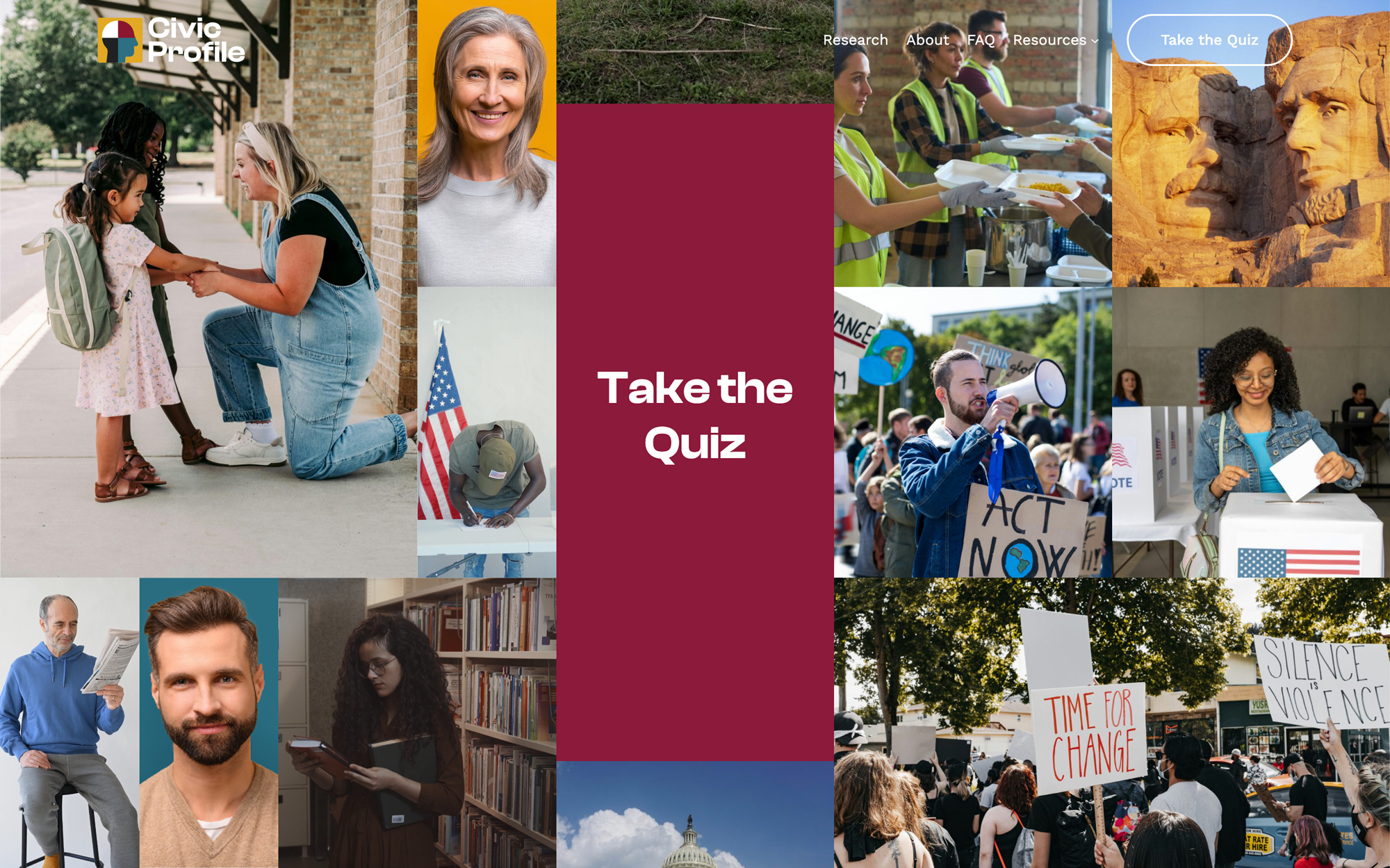
Civic Profile is a new interactive assessment tool that measures people’s civic values, knowledge, and level of engagement. Its architect, Hoover senior fellow Chester E. Finn Jr., spoke to Chris Herhalt about how the project came about and what it aims to achieve.
Chris Herhalt: I want to commend you on the release of Civic Profile. I’ve taken it for a spin already. It’s wonderful that it’s here for America’s 250th birthday. Where did the idea for this interactive tool come from?
Chester E. Finn Jr.: The idea originated loosely in the Hoover Institution’s very own Working Group on Civics and American Citizenship. We began to ask ourselves, how could we learn more about Americans’ views on a whole variety of civic issues, not just what did they know—what the citizenship test asks people—not just what do they believe, but also what do they do? Because civic participation, whether you’re a citizen or not, means you do things. It hinges on having values and views that we hope align with those of Thomas Jefferson and the Constitution. It hinges to some degree on participation in policy, in the community. And it also hinges on knowing something about how the government works and how our history works. That original impulse out of the working group evolved with the huge help of the team at Hoover’s Center for Revitalizing American Institutions (RAI).
I don’t believe Hoover has had anything quite like this public-facing tool, which potentially millions of people could participate in, but that’s only the beginning. There are also uses for educators, scholars, analysts, and researchers. And I think there’s a public purpose as well. In a tough time for the country, I think this tool itself could, at least in a modest way, help to open some dialogues that might not otherwise exist and get people to consider opinions they might not otherwise consider. And this would be a healthy thing for the country.
Chris Herhalt: I’m interested in how the tool tries to gauge everyone’s view of what participation means in our democracy. Why was it important to find information about how Americans view that and whether they do it in their daily lives?
Chester E. Finn Jr.: The Civic Profile has three parts, of which participation is one. The second part is what you know, and the third part is what you value. The participation part was a toughie to think through because you’re exactly right: participation in our polity can be passive or active. It can be law-abiding or disruptive. It can be protesting or voting. It can be helping your neighbor or attending the city council meeting. There are so many forms it can take.
We ended up sorting participation into three broad categories. One is essentially working within the system of government. It involves voting and writing your congressperson and going to the city council meeting and otherwise participating in the machinery of government, whether local, state, or national.
The second category could be called volunteerism. It involves what do you do for your neighbors, for your community. Whether it’s giving money or shoveling snow or volunteering at a food bank, there are myriad ways in which people participate by volunteering themselves or their resources, their time, their effort, their brains.
And the third category is activism. It’s people who don’t like working within the system, at least not all the time. Therefore, they want to march with signs, or they want to be the one who asks the really hard question at the public meeting, or the one who supports the renegade candidate for sheriff. There are so many ways in which you can work to change the system by working outside it and yet remaining a civic-minded person. It’s just that you’re working to change it in a different way.
So, we have these three categories, and we think they’re all valid. We ask questions that probe into all of them, and then we give people a kind of score. I hate the word “score” because we’re not judging people, but we do give people feedback on all of them.
Chris Herhalt: How are scholars and researchers going to be able to use the outputs of this?
Chester E. Finn Jr.: Scholars and researchers could use it today because the national sample that we’ve already tested this out on has produced an immense amount of data and information on all these metrics that I mentioned. The organization YouGov has done this surveying for us. They actually did it three times in the development process as we refined our questions and tried to understand this topic better. The most recent one also enables you to look at Republicans and Democrats compared to each other. You can look at liberals and conservatives, but also at different age groups, genders, and races.
When we’re giving people feedback on themselves, we show them how they compare to the country as a whole. You can also get feedback compared to your cohort—your classmates, your fellow members of a group, that kind of thing.
As for scholarship, we’re going to keep adding to the tools. We hope to refine it for other populations. But we are going to keep readministering it, I hope through YouGov, so that we’ll have new data over time. You can see changes over time in the American population. Researchers call this longitudinal data. There’s enormous long-term benefit to having this body of data around.
Chris Herhalt: My ten-year-old saw me doing it on my laptop, and she’s the product of two political junkies, so she’s maybe not representative of ten-year-olds, but she did it too and she loved it. You can definitely take it to middle school. It’ll get pickup for sure.
Chester E. Finn Jr.: Well, I want to compliment you on having a ten-year-old who can understand the questions the way they’re currently worded.
Chris Herhalt: Can you talk about how this kind of project can address and possibly counter political polarization?
Chester E. Finn Jr.: I think Civic Profile might actually help to do something about it—which is, to me, an amazing feat if we can pull it off.
Think about a high school civics classroom full of kids from all sorts of different backgrounds, who normally would simply parrot their parents’ ideas about politics. If you introduced a topic, they would just fight about it. After they all take the Civic Profile and get cohort data on their class, they can begin to look at it and see, first of all, where they stand vis-a-vis the rest of their classmates, and then begin to wonder, why do I think this and other people in my class think that? And they could begin to talk about it so that the kids who, let’s say, favor tradition and the kids who favor change, instead of just talking to others like themselves, might begin to discuss the difference between tradition and change and have a reasonable, thoughtful, attentive, polite conversation. And then, they might learn something in the process about how to listen to and talk with people who don’t agree with them.
This could also be done by the employees of the XYZ Corporation, who might be internally polarized in their lunchroom or on the shop floor. The employees of the Hoover Institution, I think, are going to take this, at least those who are willing. Any organization could do this, or any community. We think there’s the potential here for the results that people get, especially cohort results, to lead to really fruitful interactions that are perhaps less polarizing than the other interactions we have today.
Chris Herhalt: A lot of your previous work has touched on how haphazard and sometimes substandard civics instruction is in America. Was the introduction of something new and attractive for that field, especially at the high school level, a sort of motivation too?
Chester E. Finn Jr.: Yes, in part. The education problem, the curriculum problem, the [civics] instruction problem remains. We know from all sorts of data that kids are learning very little civics in high school; most colleges don’t teach it at all. I mean, hurrah for some of our colleagues at Hoover for trying to get college-level instructors together in the Alliance for Civics in the Academy to talk about how they do this. But still, we’ve got a huge problem of civics education, and that’s not going to be solved entirely by Civic Profile. Yet Civic Profile is a tool for teachers to use that might intrigue the students and might benefit them.
Just picture using it in a before-and-after way with your civics course. You’ve got a bunch of twelfth-graders taking your course for a semester or a year. You get them all to do the Civic Profile at the beginning of the course, and then again at the end of the course, and see if anything changed. This would be, I think, a very valuable instrument and body of information. But all by itself, it doesn’t solve the civic education problem. And I might add that our working group and RAI remain focused on the civics education problem, to which we’ve now made a small contribution.
Chris Herhalt: What is the value in broadening the intake and continuing this over time as a researcher?
Chester E. Finn Jr.: The simple answer is the more data, the better. But the longer answer is we know very little, for instance, about middle schoolers as future citizens. We could learn quite a lot from a body of data from a reasonable sample of middle schoolers. And we know next to nothing about immigrant populations and their civic values, and the non-English language version of Civic Profile could help with that. So, there’s lots to be learned from the additional populations that might be drawn into this.
Normally, we talk to other think-tank people and within our own little echo chamber. This is an opportunity to enlist a much bigger public in a really interesting Hoover venture that they too can learn from. You don’t just get results from your Civic Profile. You can, if you want to, learn how you might do things differently. It can be a learning experience for you, and perhaps for your ten-year-old.
This interview was edited for length and clarity.