





- History
- International Affairs
- Democracy
- Comparative Politics
- Politics, Institutions, and Public Opinion
- Confronting and Competing with China
- Determining America's Role in the World
- Revitalizing History
- Understanding the Effects of Technology on Economics and Governance
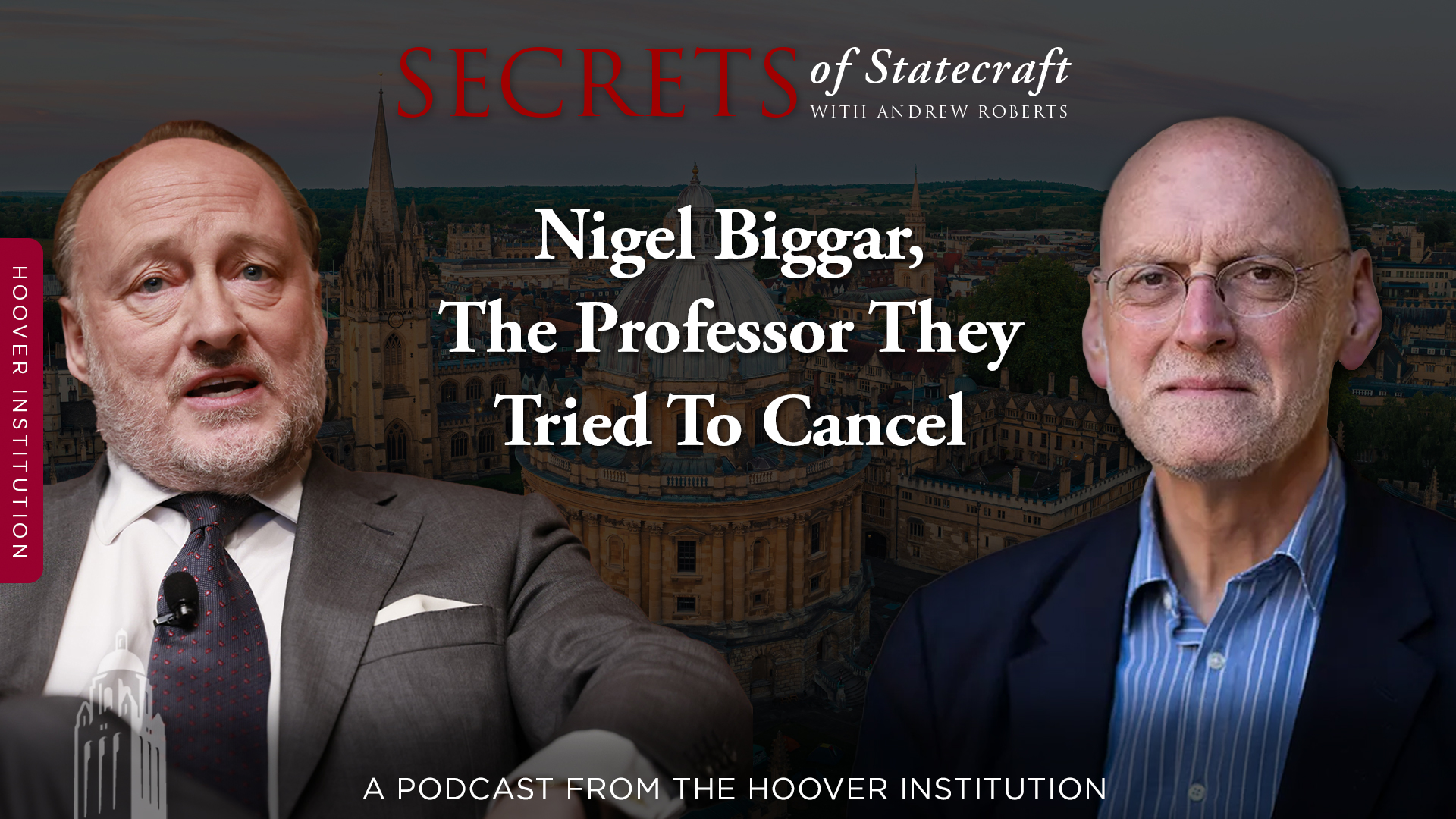
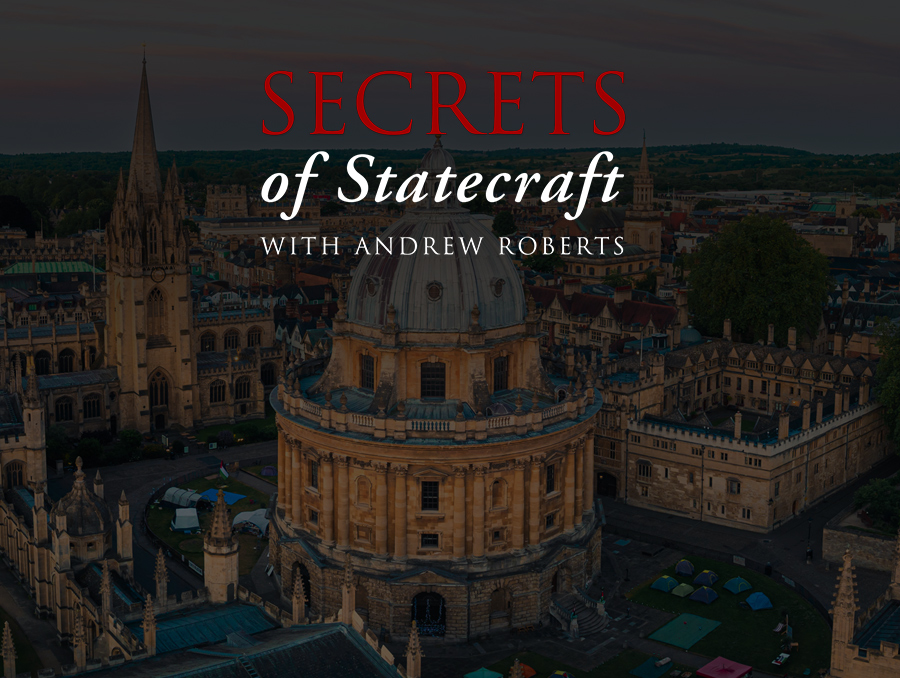
Andrew Roberts sits down with Oxford theologian and historian Nigel Biggar to explore the personal and intellectual firestorm surrounding his work on empire, colonialism, and reparations. Biggar recounts how his “Ethics and Empire” project triggered a coordinated campaign to shut it down, how a major publisher canceled his book at the last minute, and how it ultimately went on to become a bestseller. Along the way, he challenges what he calls the “tyranny of imaginary guilt” shaping modern debates about Britain’s past, questions the case for reparations, and reflects on the broader implications for academic freedom, free speech, and the politics of history in the West today.
- Lord Nigel Bigger was the Regis professor of Moral and Pastoral Theology at Oxford from 2007 to 2022. And is the author of three controversial bestsellers, colonialism, A Moral Reckoning, reparations, slavery, and The Tyranny of Imaginary Guilt And The New Dark Age. Nigel as Regis, professor of Moral and Pastoral Theology at Oxford, you set up a project in 2017 entitled Ethics and Empire, which was going to scrutinize the arguments against the historical facts of Empire. That became very controversial, didn't it? Tell us about that.
- So, Andrew, way back in 2014, during the referendum on Scottish independence here in the uk, I, being an Ang of a Scotland, a natural supporter of the United Kingdom, took an interest and I was examining arguments put forward by separatists Scottish separatists, because I thought maybe, maybe they were right, and maybe the UK had come to the end of, its, its sensible shelf life. But one argument I came across can be distilled into the equation. Britain equals empire equals evil. Therefore, Scotland needs to purify itself by leaving the UK and, and setting off into a bright new, shiny sin free future, probably European. And having read British and people history for now two decades, I knew that the, the equation empire equals evil is, is simplistic. But that was the moment I realized that colonial history, even 13 years ago, 14 years ago, was politically potent and being used for political purposes. And that's why the topic interested me enough to set up this research project Ethics, ethics and Empire in 2017, along with John Darwin, who was and is one of the most eminent historians of, of not just British empire, but empire Worldwide are based in Oxford. And the idea of the project actually was to, to look at how people throughout history from ancient China, through the medieval Arab world to the modern Europe, how how in the past did they view the empires of their time? Did they view empire the same? We way we tend to namely as a bad thing? And if not, why not? In other words, to get some kind of critical purchase on the way we see things by, by viewing a, a very different point of view and, and to consider why people might have seen things differently. That was, that, that was the plan. And we, we launched, we launched the project in July 17 with the first of five annual conferences. It was a great success. But then sh Shall I carry on?
- Please do. You must have, it's the hundred, it's the 170 academics who write to try and cancel you
- That I want to carry. I I'll get you, I'll get you quickly. So, no, don't,
- Don't, we are enjoying this, I promise. All right. Okay. Carry on.
- Alright. In, in November 17, I published an article in the London Times making what I thought to be the completely incontrovertible odine case that we, British Australians, Canadians, new Zealanders, we can find in our colonial history reasons for both pride and shame, shame and pride, both. And about a week later, I put up online a description of the Ethics and Empire project and unknown to be at the time that was, that, that was the fatal move because about a week later, a reader in post-colonial study at Cambridge University, Dr. Pri Powell, evidently read this online description. And that moved to, to tweet to her disciples and, and comrades around the UK and the world on December the 13th at 8:45 AM I know this 'cause I've got, I've got a screenshot of it, the Mortal words, OMG. Oh my God, this is serious. SHIT we need to block capital, shut this down. And that, that really
- Was a call arm. Sorry, is this the same, is this the same Priya Gopal who wrote White Lives Don't Matter in, in another tweet the same person? Yes. Okay. So one that I think we've got the, I I think we've got the, the sense of this person carry on.
- Okay. And that, that precipitated a week's worth of three online mass mass protests, one by a set of, of Oxford students, second by 58 Oxford colleagues, and the third by actually 195 academics worldwide, all protesting against this wicked project. And the last protest urged Oxford University to take the project out of my hands. And within four days of the first protest, my colleague John Darwin resigned from the project citing personal reasons.
- And so the result was this extraordinary book, colonialism, a Moral Reckoning of 2023, which they, which the essentially, the, the woke left also tried to close down, didn't it? Yes,
- Yes it did. Yes. So, so the second attempted cancellation took place in early 2021. One of the upsides of the 2017 ra, which brought me to Thank you, which brought me to into the pages of the, of the press in the UK every day for about a fortnight. One of the upsides was I got a contract from Bloomsbury Publishing to write a book on, at the time the, the title was going to be an Intelligent Person's Guide to Colonialism, since we all know there are plenty of unintelligent accounts. So I produced the Manscript to end of 2020. And in early 21, my commissioning editor Robin Bair Smith at Bloomsbury wrote to say that he was speechless with admiration for the books rigor and comprehensiveness. He said it was one of the most important books to come across his desk in years and predicted sales of up to 20,000 copies went into the copy editing process. They produced a cover. But in March, I got an email from the top of Bloomsbury announcing that they were postponing publication indefinitely because quote, public feeling is unfavorable. And I got a, you know, I, I can talk for England about this, but just cut a a longer story a bit shorter in April of 2021, effectively they returned my contract and I was left without a publisher. And I, I kept pressing them to tell me, you know, you know, there's lots of public feeling out there, feeling folks, it doesn't all think the same thing. Which bit worries you. I asked innocently and could not extract an answer from them, but they, they canceled the contract. Good news
- Is also publishers. Yeah. Publishers are not policemen. They shouldn't take a, they shouldn't give a toss for public feeling. They should be publishing what they believe to be, to be readable and Right. It's a, it's a monstrous to think that public feeling will silence a a Speaker of truth.
- Monstrous. No, I, I mean, and I, I, I was, I mean, I I'm a man of a certain age, so I, I don't really know what I feel, but my American wife tells me I was devastated. But I, you know, I was devastated personally because I'd written this book, which I thought was important and it looked as if it, as if it might not get published. But most of all, what depressed me, Andrew, was the thought that we in Britain had come to the place where a book that I thought was important, my publishing, my my commissioner editor, thought was important. He thought it was one of the best books to come across a desk in years. And it couldn't get published because someone in the, in the, in the publishing company had had taken fright that really depressed me. Really. And I, I, after it was clear that I couldn't persuade Bloomsbury to publish the book, I wrote them a, an email. I, I told them what I thought. I said, you know, I think, I understand you're a commercial enterprise, but you also have a civic duty to try and keep our public space liberal. You know, where I, where, where, where I, where ideas get a free expression. We have a marketplace of ideas and we, we test ideas that might be mistaken or wrong, but they weren't, they weren't moved by that. So, no, that really, really did depress me.
- And what did you do?
- Well, I eventually, I, I I, I hired a, a literary agent, Matthew Hamilton, and together we managed to get in touch with Harper Collins, William Collins in London. And they took on the book, and they published it in February 23. And I'm pleased to report that last time I looked at as, but a year ago it had sold over 70,000 copies, which is three times what Robin Bear Smith had predicted, which, which makes clear that whatever the reasons for Blooms were blooms, his cancellation, there weren't commercial.
- No, clearly they were entirely, entirely political, as was, I think quite a lot of the responses in, in reviews that were negative. The Guardian, needless to say, always was going to give that a negative book review. You, I'm very jealous of you, by the way, Nigel, because you had one review from Wired that said it was an immoral book. I've always wanted to have one of my books announced as as immoral. So, so anyway, it had a happy ending. You, you sold three times more copies than you were going to, and Blooms Bee were were widely lambasted in the press, I remember at the time and, and well done, well done Harper Collins.
- Yeah, I did.
- Bringing us onto your, your 2025 book reparations, which asks essentially where the historic wrongs can be righted and speaks about the concept of full guilt and so on. That was immensely controversial as well, wasn't it? Because you pointed out that the role of slave trading in the British economy was nothing like so enormous as it's been made out to be. And you, you take on the whole concept of reparations for slavery. Tell us about the, the, the, the research and the writing and needless to say, the backlash against that.
- Yeah, let, lemme start off with this notion of, of imaginary guilt. 'cause the subtitler is slavery and the tyranny of imaginary guilt. Th this, this phrase imaginary guilt I got from the Baghdad born Jewish historian dui, who in 1976 wrote a book called The Arab, the Anglo Arab Leverance. And in this book he's discussing whether or not it's true that the British had indeed promised Palestine to the Arabs in the course of the First World War. And therefore whether they had betrayed the Arabs by allowing Zionist immigration in the, in the 1920s and thirties. And Kuri was of the view that in fact the British had not promised Palestine to the Arabs. The British did in fact help to set up two Arab states, namely Iraq and Jordan. But Palestine was not promised to the Arabs. And I, I think Kari's argument is persuasive. But the reason he wrote that book was because the British foreign office, in his view, had come to believe that the British had promised Palestine to Arabs. And this imaginary guilt, the, the canker of imaginary guilt as he puts it, was, was infecting and distorting British foreign policy. So just going back up for a moment to colonialism, Andrew, the reason I wrote it was because I feared that, and a Britain, a Britain or British elites, largely ignorant of their own history and allergic perhaps to any approval of, of our, our colonial past, would become subject to imaginary guilt and therefore manipulable and exploitable by others who wanted to, to leverage our imaginary guilt. And even in, in, in colonialism, I begin to touch a bit on the issue of reparations. 'cause I anticipated that Caribbean countries certainly would come knocking on Britain's door asking for money to, to make up for our, our sins in the 18th century and later 17th century. So reparations really is a kind of sequel to colonialism, but focusing on, on the, on the claims that Britain owes reparations for roughly 150 years worth of slave trading and slavery from 1650 to 1830, I guess 180 years. And I'm on the firm view that, that no Britain does not owe reparations for historic slavery because what the advocates of reparations do is they, they try and focus attention simply on the 180 years of British involvement in slavery, the involvement list to be precise of some Britains many weren't involved at all in slave trading and slavery. They, they want us to forget about the contexts and they want to exaggerate the British involvement and to make it seem extraordinary so that, that more than any other people, we British, we owe reparations. But once you put the phenomenon of British involvement in slavery into con into, into its several contexts, one of which was slavery was a universal institution practiced in every continent by people of every skin color. The British involvement was not extraordinary at all. And we can discuss why that, why that was. Secondly, the British were among the first peoples in the history of the world to abolish the damn. And third, the British then used their superior imperial power after the Battle of Waterloo in 1815 to suppress slavery from Brazil to New Zealand for over a century under half. So those are the three contexts which, which make, which put the British involvement in slave trading and slavery into context. And in that, put a put in, in, into, into context the idea that the British should pay reparations when they were among the first peoples to repent of it and then spent money in treasure suppressing it worldwide for a century and a half is, is a nonsense. And, and in in particular the idea that the African Union, which is now about to present its bill for reparations, for slavery and colonial sins, the idea that they should be exploiting our imaginary guilt is, is obscene. Because the Africans, the Africans were involved in enslaving other Africans for centuries before Europeans arrived on the coast of West Africa. And for some time after the British abolished it. So I, I think the, the argument in favor of Britain paying reparations is, is nonsense. And, and on the issue of yes, the claim is made by advocates that British prosperity, the British industrial prosperity was built on the backs of slaves. Well, that's a thesis that the Marxist Trinidadian historian Eric Williams made in 1940. And, and people who follow Williams' Marxist, usually they follow that line. But there are plenty of economic historians who doubt that slave trading slavery made an enormous contribution to Britain's Indus industrial prosper parity, the winner of last year's Nobel Prize for economics, Joel Mocha, who's written on these things. He reckons that without involvement in slave trading and slavery, Britain's industrial revolution would've proceeded nevertheless albe at us at a marginally slower pace. And da and David tis the, the, the most eminent living historian of transatlantic slavery reckons that the contribution of slave trading and slavery to Britain's industrialization was small, quote unquote. And when describing the contribution of slave trading to the wider economy of Liverpool, which was the largest slaving port in Britain in about 1750 ELs even uses the word trivial. So really the, the, the, the weight of, of historical opinion is that yes, safe trading slavery made a contribution, but it was really small. It wasn't, it wasn't enormous.
- And yet the Church of England has completely swallowed this, this skills line, hasn't it? I mean it's, it's set aside a hundred million pounds to give in reparations. And it's rather strange about who the reparations are gonna be paid to, to the fact that nobody's met anyone who's met, anyone who's met anyone who's met anyone who was a slave of the British empire. So who you actually give the money to is a bit more complicated as well. Is it a part, is it a sort of, I've seen it re recalled a perversion and parody of the Christian idea of repentance. Is that what's happening in the Church of England?
- Well, I, I think it is. I, I mean, Christians were think of, think that repenting of wrongdoing is a good thing to do and most of us would too. So it's good to confess your, your sins, your wrongdoings. It's, it's good to repudiate them. And of course it's good to, to make up for your wrongdoing if you, if, if you can, that that's all moral common sense, I think. But it doesn't make good sense to exaggerate your sins, which is what's happened here, to take them out of context and doesn't make sense when people who know about these things point out in fact that the church's involvement in slave trading was nothing like what the, the authorities assume it to have been. So the argument has to do that with, with an eighth fund called the Queen Anne's Bounty, which was devoted to supporting poor clergy in their parishes. And the argument is that in the 1720s it invested in slave trading. The, I can't go into into the details because they're quite complicated, but Richard Dale, who wrote a book about the South Sea Company, which was an investment body in the 18th century, has demonstrated that the church misinterpreted the data and that in fact, the church made no profits at all from slavery in that, in that period. But nevertheless, the, the church commissioners who are the body responsible for this escapade, they have remained adamantly attached to the project. I I, I think partly of course, because it would be very embarrassing for them to roll back. I, i, as a churchman myself, I would hope that a Christian institution would do better than other institutions. But, but not so in this case. So they, they keep on digging. But also I think it's part of the woke mindset as I've experienced it, that it doesn't really care about the truth about the past. It cares about using the past for a political project. So the project here is the dogmatic project is that Britain is systemically racist and that our systemic racism derives from the sense of racial superiority that we gain through the colonial period. And therefore we have to repudiate our colonial history. We have to pay rep, we have to pay reparations for the slavery that epitomizes our colonial endeavors in order to free ourselves of systemic racism. That's the dogma. And so when you come, come along and say, well, actually the church wasn't involved in, in, it didn't make much money from slave trading at all. And when you suggest that in fact Britain is not systemically racist, and here's several pieces of social scientific evidence to suggest that it's not, and by the way, we did just have a Prime Minister who was ethnically Indian and, and Hindu by religion. We now have a leader of the Conservative party who is a, a black Nigerian first, first generation immigrant, which would suggest that we're probably not white supremacists in that in this country. But when you, when you present this evidence that they're not interested because they're on a crusade and, but, but that, well you can't
- Say T crusade either, can you?
- They're on a mission, yeah, on a progressive mission.
- Tell me, I mean, it's interesting, isn't it? How this post imperial guilt thing still has very serious real life consequences. The whole of the Chagos Islands issue, for example, Diego Garcia, the idea that Britain has to hand those over to Mauritius really comes from post imperial guilt. And the way in which it's, it's manipulated by, in this case, foreign judges to put pressure on, on Britain rather foreign office to to hand over these islands, even though they've been British for over 200 years. And, and no indigenous people live there. The assumption is by the decolonization Committee of the United Nations, that because they are British, they must be given away automatically. I mean, we are guilty of, of doing terrible things in the chagos silence, including chucking off the poor old chagossians back in 1967 done by the Labor party, needless to say. But isn't this a classic example of us having real life, modern consequences of this sort of false guilt that you write about?
- Yeah, no, it is, it is, it is just another example of the way in which the, the false imaginary guilt to which our elites are subject makes them vulnerable to all sorts of opportunistic exploitation of which there's a one. And, and the, the, the claims for reparations for colonial sins through the United Nations are only gonna grow louder. In fact, I I I think that there, there's a wider group of countries wanting to, to, to claim money from us because of what we were alleged to have done to them in, in the past. But it, but it wouldn't, it wouldn't gain traction if they didn't think that the people who rule us weren't susceptible to, to feeling guilty. And that's the, the main reason I've written these two books on colonialism reparations, is to try and, and immunize us against this guilt and therefore against opportunistic exploitation. But yes, it's not, it's not just that the United Nations thinks we should decolonize, it's also that Stan and Philip Sands, and Lord Herma, our Attorney General and other members of the Labor Party think we should decolonize too. That's the problem. And I think what, what needs to happen is that we have a government that is properly historically informed, that has a much more self-confident attitude toward our past. Yes, of of course, of course the British Empire lasting 400 years and stretching from Newfoundland and New Zealand, of course, some bad things, some very bad things were done by our ancestors. But name me a state in the history of the world, of that length of time and spread all over the world that wasn't guilty of, of similar things. And worse, I mean, states and empires are run by human beings, not gods or saints. But that said, that said, the British Empire, in my view, achieved some extraordinary humanitarian and liberal things and a balanced view of our past would acknowledge both and, and not be susceptible to this kind of manipulation. But our current government is, is very susceptible. And you're quite right. I think that the kind of the, the, the, the mo the mood music in the background of number 10 when discu discu discussing the Chagos Islands is we are guilty. We shouldn't have these things and we need to do with the un instruct us.
- It's not just Britain is, it's quite recently when Canada was criticizing China for its appalling treatment of the Uyghur Muslims. The, the Chinese immediately hit back with this attempting to use this false guilt with regard to what happened in the, what were called the Indian residential schools. Tell us about that.
- Yes. That's, that's a, that's a, a very fine example of the strange psychological space that our elites are in. So yes, four years ago, I think an indigenous group in British Columbia, Kalos, British Columbia claimed that, that they discovered the mass graves of Indian kids, native kids who'd attended residential schools there in the 19th century or up to the early post-war period. And of course, the, the, the phrase mass graves connotes atrocities. And this was, this was broadcast by the Toronto global male by the New York Times and Al Jazeera all over the world. And the, the Canadian government, I, I think, ordered that all government buildings would fly the Canadian flag and flags at half Mart. Since then, I think a third of a billion Canadian dollars have been spent by the federal government on indigenous communities. Over a hundred churches have been, have been vandalized, but to the ground by protesters because these residential schools were often run by religious bodies. And, and yes, the Chinese use this to say that Canadians have no moral standing to criticize, to wag their fingers at the Chinese for their abuses of, of human rights. But here's the thing, Andrew, four years after this claim of the discovery of mass graves in Kalos, and there were subsequent claims since nowhere in Canada has any grave been disur
- Nowhere. Yes, it's a, it was just a complete full, full story, wasn't it? Most extraordinary
- Thing. But, but the really, the, the, the, the extraordinary and dismaying thing is it's a story that has become a public orthodoxy in Canada. And there're even some Leftwing mps, at least one Le Leftwing mp federal MP, who wants to criminalize residential school denialism to make, make, make it a crime to deny something for which there's no evidence at all. That's, that's the crazy, a
- Crime, crime decision, a crime to deny a genocide that never, that never took place. Wow. Yeah. One of the reviewers of your, of your book, I, I'm very interested in the way in which people attack you, essentially just making stuff up. And there's a classic example in the Times literary supplement, which is a very well respected magazine, newspaper, a review of your book, reparations by Prat Anil and Prat Anil wrote this, the abolition of slavery in 1833, talking about British abolition of slavery, obviously was also a grudging concession by that time, Argentina, Chile, Columbia, France for a while, Haiti, Mexico, Peru, and the northern United States had already abolished slavery. Britain was rather late to the moral party. He writes, then Tim Congdon, the economist, wrote to the TLS, and I've got the letterer in front of me pointing out that far from all of those countries abolishing slavery before 1833, Argentina abolished us in 1853, Chile did that, abolished it in 1823. But Columbia in 1851, France in 1848, Mexico in 1837, Peru in 1854, and the Northern United States still had, according to the census of 1840 thousands of people still in bondage, mainly in New Jersey. And obviously they had to fight a civil war where 700,000 people died before it was abolished in 1865. I mean, how do you feel when someone will review a book of yours and write what is essentially complete crap?
- I feel extremely frustrated. So frustrated that I, I published a letter in the last edition of the TLS just quoting chapter in verse and demonstrating how, how systematically Anil misrepresented what I'd written because he claims that I claimed that Britain was the, the very first to abolish slave trading and slavery. I never claimed that I say Britain was among the first, but it was, it was the first leading major power to abolish both slave trading and slavery. That that's still true. And then Britain led the world, as I said, after 1815 in, in the suppressing slavery from Brazil across Africa, India, Australasia for 150 years in the 20, in 1820s and thirties, the Slave raid department was the largest department in the foreign office. And in about 1840, the Royal Navy devoted over 13% of its total manpower to intercepting the slave traffic between West Africa and Brazil. And it's, it stayed there for, for some, some decades. So yeah, Al God bless him, he, he like, like so many of, of my work critics and I've, I've engaged with them now for off and on about eight years. The basic problem is that, that they, they just can't do justice to people they don't agree with. Because I find myself constantly misrepresented, constantly converted into a stroll man that can be down. And I keep saying, well, I never said that. And Anil for example, he wants to say that, and he did, he did this, he reviewed my book on colonialism before he reviewed the one on reparations. He reviewed colonialism in the, in the Times. And then he said, oh, the only reason the British suppressed the transatlantic slave trade after abolishing it in the empire was be for commercial reasons. Namely sugar produced on this, on the slave plantations in, in, in Brazil in particular was cheaper because of course the slaves weren't, weren't paid cheaper than sugar produced in the West Indies by freed slaves who were paid wages. Therefore it was in the British interest to, to suppress slavery in Brazil. Now, I said, in, in, in a response to Anil's Times review, I said, well, yes, I, I've no doubt that some Britain supported the transatlantic, the suppression of transatlantic slavery for commercial reasons. But other people certainly supported it for humanitarian reasons. And you know what, there are plenty, plenty of people who supported it for both reasons, because most of us, most of the time have mixed motives. I mean, it's, it's normal. But then, but then, you know, so I say this in a, in a published response to annual in 2024, he comes back in, in the review of reparations this year and just repeats the same thing again. So it's, I mean, the, the, the lack of the lack of intellectual scruple on the part of the progressive left, I have found shocking. I I'm no longer shocked 'cause I, I just take it for granted. But it, it is really astonishing how, how lacking and scruple many of these folk are.
- And also, as you point out in your most recent book, the New Dark Age, which is published this year, how scared they are of of free speech, how inimicable they are to free speech, and how worried are you that back on in July, 2024, the Labor Party suspended the operation of the Higher Education Freedom of Speech Act of 2023.
- Yes. I I just to to be clear here, I mean, I, because of my being dragged into the cultural wars in my university, I realized we had a problem in 2019. I held a, a conference in Oxford under the title, academic Freedom Under Threat, what's To Be Done? And it was out of that, that a emerged that helped to inform and promote what became the Higher Education Freedom of Speech Acts 2023. And among other things, the, the this, it certainly stiffens the statutory responsibility of universities to, to maintain not just a defend free, free speech, but to promote it. And it also would, would establish a, a complaint system whereby students and professors can complain to the university regulator Offstead if they felt that their university was infringing their free speech. And that's necessary really to hold universities to, to account. The other thing, the, the, the Act would do and has done in fact is to put someone in the office of the regulator, a a new director for Freedom of Speech, whose sole job is to monitor what universities are and are not doing to defend and promote free speech on their campuses. So this, this was passed in 2023, and it was in the process of coming into operation when the conservative government fell and labor took over. And then the education secretary with no warning at all, and this wasn't in the manifesto, announced within a couple of weeks of the labor government coming into office that she was gonna suspend the operation of the act and perhaps even repeal it. The news since then has, has been actually quite good, be because of the last six years, the, those of us who are properly liberal, those of us who want a society where we can, every one of us can speak freely what we believe to be the truth, and we can test other people's claims to truth so that perhaps we could avoid being dominated by distorted and false orthodoxies. That's what I mean by liberal. In the last five, six years, we've organized the Free Speech Union, which our chair run by Toby Young has become extraordinarily successful. It's, it now has 40,000 subscribing members. When the labor government indicated it might actually try and repeal the Higher Education Freedom of Speech Act, we, we, we, we got into action. We got seven Nobel Prize winners to write a letter of protest to the Times newspaper, the FSU apply for, for judicial review. And I think we've actually persuaded the government to row back and the director for Freedom of Speech is still in office. We're told a complaint system will come into operation, but not, not just yet. So we're trying to lobby the government to, to get that done, but we're still hopeful that it will come into operation. So the new, since July 24 is, is much less bad than we feared when it first announced. And I, I'm hopeful that important parts of the act will survive and when this government falls as as it's bound to, unless it changes, its, its its course and it's not likely to do that. There's the prospect, of course, of of having bits out of the act that were taken out by the labor government. Put back in again
- What you, you subtitle the book Why Liberals Must Win The Culture Wars. How do you think, how do you think they're doing at the moment? Where are we in the, in the war against Woke?
- Some people say we, we've, we've reached part, we we've reached peak woke and passed it. That might be the case. I think, I think it probably is the case because as I say, five years ago in, in, in Britain when people like me came under fire, there was no one to, to, to look for for help at all. Whereas now we've got the Free Speech Union, we've got the Higher Education Free Speech Act. We discovered that in this country, unlike Canada, we have a pretty vigorous center and right of center press, which are very, very open to publishing articles about the suppression of, of free speech. And the, the last thing that universities or any other institutions want is publicity on these matters. So that's all good. And of course, on the transgender ideology front, we've had some signal victories. Nicholas Sturgeon in Scotland fell from Grace because she nailed her flank to the mast of, of an act that would've made gender, self, self-identification pretty automatic. But a lot of her long-term followers abandoned her over that. Then we had the Supreme Court ruling that told us what most of us already knew, but apparently our government needed to be told, in fact, biological sex is real. So I, I think on on that front, we've had significant rollback on the decolonizing front. There's a lot to be done yet. 'cause too many area institutions are still busily decolonizing and there are certainly groups that are active in promoting it. So we haven't won that battle yet on race. That's, that's the, the other topic, and I think of course the, the, the left are wedded to the notion that Britain is ally racist because if, if, if, if that weren't true, then many of them wouldn't have anything to do with their lives. But the, my my sense, yes, I mean we had the, the Government's commission on race and Ethnic disparities produced their report in 2021 shared by Tony Sewell, the Jamaican Britain, which was very sensible sort of saying and pointing out that in Britain today, disparate outcomes between different ethnic groups varies widely. And you know, you've got Chinese and Indian Britain's doing extremely well. West Africans pretty well. Caribbean Britain's not so well, but at the bottom of the heap of the poor whites. So, so, so, so Seals report said, can we please stop, stop talking as if what we have in our country is whites on top and and non-whites on the bottom. 'cause it's, it's just empirically untrue. So let, let's talk, let's start talking about black and ethnic minority people as a block. And, and you know, they, they, they said that yes, it's possible that in some cases racial prejudice does help to explain disparate outcomes. But let's not assume that, 'cause there are all sorts of other cultural reasons why that might be the case. Now, of course, that were, that that was instantly dismissed by, by columnists and the Guardian. I, I, I read The Guardian for about a week after the report came out, but I, I observe in 20 23, 2 books were published both by ethnic minority, Britains won by Raki Asan called Beyond Grievance, what the Left Gets Wrong about Ethnic Minorities. And Asan identified himself as a natural person of the left. But, but, but he argues that that actually a Britain's the, the reality in Britain is, is much more nuanced in terms of race than, than your typical anti-racist activist would, would tell us. And then the other book was by Todi, a a a recent immigrant from Nigeria who came to this country to do a, a master's degree in English, I think in one of the London universities. And when he came here, he discovered all his white peers were obsessed with racism. And there's, there's black to Mewa in London, London looking around himself and saying, where, where is it? I don't, I don't, I don't experience it. And Towa published a book in 2023 bearing the telling title, this is Not America, this Is Not America. I think, I think a lot of our trouble here is we've, we've imported radical black politics or rather activist groups in this country have imported radical black politics. And again, too many folk in our center left media and I include the BBC here, have swallowed that wholesale.
- Yes, well, we saw that at the time of Black Lives Matter in in 2020, didn't we? With a huge demonstration and the attack on Winston Churchill statue and and so on. Exactly.
- And, and, and, and you, you may have seen this, Andrew, there was a, a, a photograph of a BLM protest in England with, with a white English woman holding a placard saying, disarm the police. Anyone for anyone doesn't know it, listening, listening to this, the UK police as a rule unarmed, but this was important from America so, so, so dumbly without any kind of critical
- Filter at all. Nigel, what history book called Biography are you reading at the moment?
- Well, one I've, I've just finished is one by Tim Boveri, allies at War. And, and very you have something to say. Okay. I think that
- No, absolutely. I think in fact, yeah, he just won the Duff Cooper Prize two, two nights ago. It's a, it's a really excellent book. Did he, did I think, yeah. I think I might be even on the back cover having plugged it, it's all reviewed it or something. I I really, I really do rate it very highly. I'm glad you're enjoying that. Well,
- I'm, I'm, I'm, I'm, I'm so relieved because you know about these things and I'd be embarrassed if I liked it and you didn't. So
- What, what about your, what if your counterfactual
- Yeah, well the what if I, I've, I've thought about is what if, what if Admiral Arthur Philip never arrived in Sydney Cove in Australia in 1788. And what if the British had never colonized Australia?
- Well, do you know, funnily enough, the Treaty of Tilt and Napoleon and Czar Alexander the first decided that Australia was going to be called Terrace Napoleons and the French were gonna have it. Yes. The French were going to SLE it. We were, we were very fortunate that Admiral Philip did. And, and the whole place didn't fall to the French.
- Yeah. So, or, or, or, or even even worse, I think for the aboriginals would be if it had fallen to the Maori, 'cause the, the, there's evidence that Maori were making were paddling their way from New Zealand to Australia in the 1790s. 'cause canoes were found halfway between the, the two countries. And when they, when the Murray did occupy the, the, is it the Chatham Mile, Chatham Island, I think, which is to the east of New Zealand, what did they do? They, they thought of 10% of the population and enslaved the rest. So, so, you know, aboriginals and Australia should, should give God thanks that the English got to them before the Murray did.
- And on that bombshell, which show is so classic of you, Nigel, not to shy away from a controversial statement. Thank you so much for appearing on Secrets of Statecraft.
- It's been my great pleasure. Thanks for having me. Andrew
- Shei Katari senior fellow at the Yorktown Institute and an expert on Iran returns to Secrets of Statecraft to talk about the war.
- This podcast is a production of the Hoover Institution, where we generate and promote ideas advancing freedom. For more information about our work, to hear more of our podcasts or view our video content, please visit hoover.org.
ABOUT THE SPEAKER
Nigel Biggar CBE is Emeritus Regius Professor of Moral Theology at the University of Oxford and Distinguished Scholar in Residence at Pusey House, Oxford. He holds a B.A. in Modern History from Oxford and a Ph.D. in Christian Theology & Ethics from the University of Chicago. He was appointed C.B.E. “for services to Higher Education” in the 2021 Queen’s Birthday Honours list.
His most recent books are Colonialism: A Moral Reckoning (2023), What’s Wrong with Rights? (2020), In Defence of War (2013), and Between Kin and Cosmopolis: An Ethic of the Nation (2014). In the press he has written articles for the Financial Times, the (London) Times, the Daily Telegraph, the Spectator, the (Glasgow} Herald, the Irish Times, Standpoint, The Critic, The Article, Unherd and Quillette.
He served on the Committee on Ethical Issues in Medicine at the Royal College of Physicians (London) from 2000 to 2014, the Royal Society’s Working Group on People and the Planet from 2010 to 2012, and the Pontifical Academy for Life from 2017 to 2022. He now chairs the board of trustees of the Free Speech Union.
ABOUT THE SERIES
Secrets of Statecraft is a bimonthly podcast hosted by Distinguished Visiting Fellow Andrew Roberts that explores the effect that the study of history has had on the careers and decision-making of public figures. The podcast also features leading historians discussing the influence that the study of history had on their biographical subjects. The title is taken from Winston Churchill’s reply on Coronation Day 1953 to a young American who had asked him for life advice, to whom he said, “Study history, study history, for therein lie all the secrets of statecraft.”

