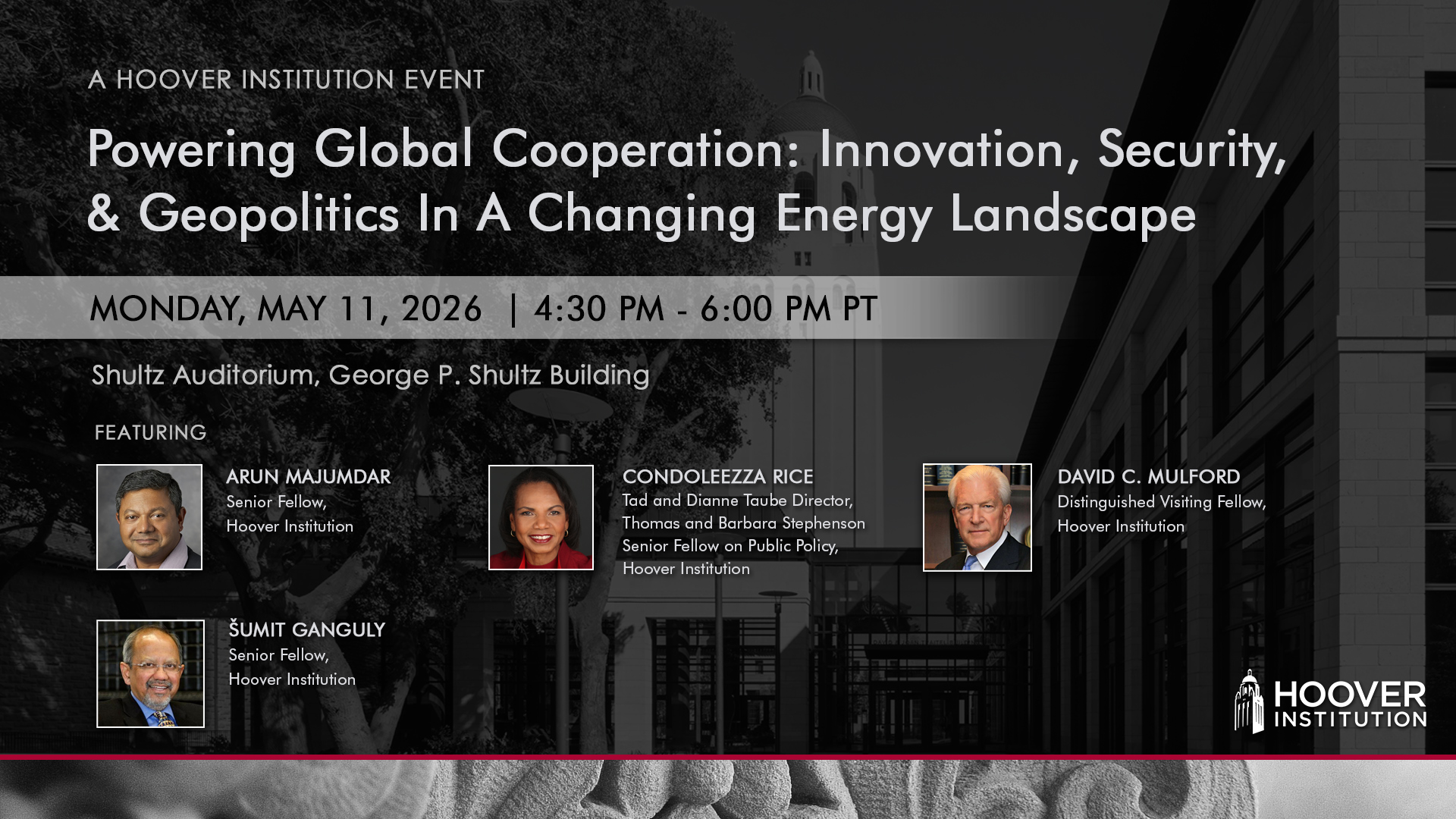
The Hoover Institution held Powering Global Cooperation: Innovation, Security, & Geopolitics in a Changing Energy Landscape on Monday, May 11, 2026 from 4:30 p.m. - 6:00 p.m. PT.
In today’s world, energy is a driver of security, prosperity, and strategic influence. As geopolitical shocks, market volatility, and technological change transform the global energy landscape, trusted partnerships are becoming essential to resilience and long-term stability.
Join Condoleezza Rice and Arun Majumdar, in conversation, moderated by Šumit Ganguly, on how energy is reshaping international cooperation. Drawing on lessons from the U.S.-India Civil Nuclear Accord and the challenges of today’s security environment, the discussion explores how the United States and its partners can strengthen energy security, advance innovation, and build a more stable global future.
This timely discussion examines the intersection of energy, trust, and geopolitics—and what it will take to power cooperation in a rapidly changing world.
About the Speakers
Arun Majumdar is the inaugural Dean of the Stanford Doerr School of Sustainability and the Jay Precourt Provostial Chair Professor at Stanford University. He holds faculty appointments across engineering and energy disciplines at Stanford and SLAC and is a Senior Fellow (courtesy) at the Hoover Institution. Dr. Majumdar was the Founding Director of ARPA-E and served as Acting Under Secretary of Energy and Senior Advisor to Secretary Steven Chu, leading key initiatives including SunShot. He later led the Department of Energy review team during the Biden-Harris transition and chaired the DOE Advisory Board. Prior to Stanford, he was Vice President for Energy at Google.
Condoleezza Rice is the Tad and Dianne Taube Director of the Hoover Institution and the Thomas and Barbara Stephenson Senior Fellow on Public Policy. She is also the Denning Professor in Global Business and the Economy at the Stanford Graduate School of Business and a founding partner of Rice, Hadley, Gates & Manuel LLC. From 2005 to 2009, she served as the 66th US Secretary of State, the second woman and first Black woman to hold the position. She previously served as National Security Advisor from 2001 to 2005, the first woman to hold that role.
David C. Mulford is a distinguished visiting fellow at the Hoover Institution at Stanford University, focusing on global economic integration, trade policy, and growth in the Indian subcontinent. He served as US ambassador to India from 2004 to 2009, where he played a key role in strengthening bilateral ties, including negotiating the US–India Civil Nuclear Initiative and founding the US-India CEO Forum. Mulford also held senior roles at Credit Suisse and served in the US Treasury as undersecretary for International Affairs, coordinating economic policy with G-7 nations and leading international financial initiatives.
Šumit Ganguly is a senior fellow at the Hoover Institution and director of its Huntington Program on Strengthening US-India Relations. He is also the Rabindranath Tagore Professor Emeritus at Indiana University, where he specialized in Indian politics and international security. He has taught at numerous institutions, including the University of Texas at Austin, Columbia University, and Sciences Po, and has contributed extensively to scholarship on South Asia and global security. He also serves on the board of the American Friends of the Alexander von Humboldt Foundation.
- All righty. Welcome to Hoover. My name is Dcia Mistri. I'm a research fellow here at Hoover. I'm glad you're all with us today. We have an exciting event ahead. Before the discussion, we've asked Ambassador David Mulford to say a few words. Ambassador David Mulford helped start our US India program. Let me give you a little bit of a background about him just so you can appreciate how incredible he's been. So he's a distinguished visiting fellow here. In 1966, he got his DFI from Oxford and answered the call to public service as a White House fellow. He then started a career in investment banking for about 10 years before he left the comforts of London and New York to work for the Saudis in processing their money at their monetary agency. So he is had frontline experience looking specifically at the relationship between energy and Geoeconomics. He spent 10 years in Saudi Arabia and in the Middle East before again coming back to public service, joining the Reagan administration at a very senior level with the Treasury Department. And he spent through the Reagan administration, through the George HW Bush administration, his time working at Treasury. In 2004, he was named as US Ambassador to India, serving directly under Condoleezza Rice, our secretary of state. And he, he worked to strengthen US India relationships of US India relations during his time there culminating in the US India civil nuclear agreement. So we've got somebody who's not just an oil man, not somebody who's just a banker, not somebody who's just even a nuclear expert, but somebody who's been looking at this, this prism for quite a while. So we'd like him to come up and say a few words about what we've got going here. So thank you. Please welcome David Mulford. Oh, good evening. Thank you very much for the reception. And if I may, I'm gonna give a few minutes of remarks before our other speakers come forward. And thank you did Jim. It's a pleasure to be with you this afternoon. I want to begin with the thought from George Schultz who served his country with distinction as Secretary of State and who returned to the Hoover Institution as a distinguished fellow for more than three decades after his time in government. He used to say that in international affairs trust is the to of the realm. That observation sits at the heart of what we are here to discuss to today. This evening's conversation is about energy and about how energy, perhaps more than any other domain, is reshaping the international cooperation. In our time in the world of geopolitical shocks, market volatility and rapid technological change, energy has become a test of which partnerships are real and which are merely transactional. I want to spend a few minutes on the United States and India because the story of how we built our energy partnership offers a useful lens on the larger questions. Secretary Rice, Dean Maar and Chuma GLI will take up these issues momentarily. In 2004, when President Bush asked Secretary Rice to begin discussions with India on a new strategic partnership, the centerpiece of which emerged was the US India Civil nuclear agreement, it is worth remembering that what that agreement was and what it was not, it was not in the first instance a commercial deal. Although commerce followed, it was a strategic decision by two governments that the time had come to set aside three decades of estrangement on the question of civil nuclear cooperation. And to do so because of mutual interests and mutual confidence, the negotiation took four years. It required cooperation with the International Atomic Energy Agency, the unanimous, unanimous agreement of the nuclear suppliers group, the ascent of the United States Congress, and a great deal of political courage from Prime Minister man Mahan Singh, who staked his government on the outcome. When the agreement was concluded in October of 2008, it did far more than open the door to civil nuclear trade. It established a baseline of trust between Washington and New Delhi that has shaped every dimension of the relationship since. That is the lesson that I would offer for this afternoon's conversation. Energy partnerships, when done well are not narrow technical arrangements. They are strategic instruments. They signal which countries are prepared to share sensitive technologies, to align supply chains, to make long-term commitments that survive changes in government. And once that signal is sent, it tends to be reciprocated across other domains. The world we face today is different, different from the one in which civil nuclear agreement was negotiated. The energy landscape is being shaped by forces no one fully anticipated even a decay ago. The dramatic rise of artificial intelligence and the staggering power demands that come with it, the global race for critical minerals, the renewed seriousness about nuclear power as part of the pathway to a lower carbon future, the recognition that energy security and national security are in many respects the same subject in this environment. The question is not whether the United States and its partners need to deepen energy cooperation. The question is how with whom and on what terms. The answer again will turn on trust and on the consistent action over time that trust requires. That is why I am particularly pleased about the conversation you are about to hear. Secretary Rice, Dean Maar and Chuma Gully bring to this discussion an extraordinary combination of state craft scientific leadership and scholarship on the very questions before us. Let me close with one observation. The US India S civil nuclear agreement was in its day considered improbable. It happened be because a small number of leaders on both sides decided that the strategic stakes were large enough and the moment important enough to take real political risks. The energy question before us today are at least as consequential. The opportunity I would suggest is at least as large Thank you and please join me in welcoming our speakers. Thank So this afternoon we've got some of the best energy diplomats one can find in this country and they happen to be locals at Stanford. So Arun Majumdar is the dean of the Stanford Door School of Sustainability. He also has the title of the J pre-court chair professor and most importantly, he's also a senior fellow at the Hoover administration. He served as the inaugural director of the Advanced Research Projects Agency for a agency for energy during the Obama administration. And he is been a trusted advisor to a number of different leaders, both in Department of Energy and and at at state as well as across the government, Condoleezza Rice, the Tad and DI Diane Taub, director at the Hoover Institution and the Thomas and Barbara Stevenson, senior Fellow on public policy at Stanford. Throughout her career, she's balanced her academic and scholarly positions with government service culminating in 2005 through 2009 where she was the 66th Secretary of State for the United States. Our moderator, sume Ganguli, is a senior fellow here at the Hoover Institution where he runs the Huntington program on strengthening US India relations. Ladies and gentlemen, please join me in welcoming our panelists to the stage. Good evening everyone, and my thanks to my colleague DIN in the Huntington program for introducing us. I'm just going to make a set of preliminary remarks and then very quickly turn to these two distinguished colleagues and the director of the of the Hoover Institution, Condoleezza Rice, Dr. Conez Rice, and Dr. Ron Moj there who is the dean of the inaugural Dean of the Doer School of Sustainability. And I'll try and keep my remarks as brief as possible. And to avoid significant nervousness, I printed out my remarks and faltering with in their absence. This year. We've been extremely fortunate in seeing the publication of our co-edited book with my colleague Din Shatri, the US India Nuclear Record History Analysis and Reflections through Stanford University Press. This is a book that is based on a conference that was held two years ago at the Hoover Institution that brought together most of the principles who were involved in negotiating this historic US India nuclear record of 2008, which Ambassador Malford alluded to in his prepared remarks. The accord it is worth highlighting was nothing short of a pivotal moment in US India relations. The Bush administration in an extraordinary leap of faith ended India's isolation in the global order owing to its pursuit of nuclear web, of a nuclear weapons program outside the ambit of the global non-proliferation regime, this gesture contributed to much needed trust in the bilateral relationship. Since then, US India relations have traveled a great distance, however it now appears to be in the doldrums or worse. Allow me to suggest to paraphrase Mark Twain, the reports of its demise have been greatly exaggerated to make this argument, let me invoke the work of a noted historian, probably known to the vast majority of people in this room, Roberta Walsteader, who while at the Rand Corporation, published a book in 1962 called Pearl Harbor Warning and Decision. In the present context, it may seem irrelevant to invoke her work on that historic intelligence failure. However, a central tenet of that classic work, the signal to noise ratio is pertinent to today's discussion at the moment. There's a great deal of noise surrounding the US India relationship, the unresolved trade dispute, Pakistan's role in offering a venue for US Iran negotiations and occasional careless remarks on the part of members of of the president's cabinet about various bilateral matters have roiled the relationship. The noise, however in my view is drowning out the signals. Secretary Rubio is on the verge of traveling to India next week to participate in the Quadrilateral security initiative. Foreign ministers meeting that however, is hardly the only item on his agenda. It which follows hard on the heels of the Indian foreign secretary's visit last month to Washington on his agenda are matters of trade defense and above all in this particular context, energy cooperation. Furthermore, especially since we are in the heart of Silicon Valley with its vast entrepreneurial Indian diaspora, it needs to be underscored that cooperation between the private sectors of the two countries is nevertheless preceding a pace. It's tempting for me to dwell on a host of other matters that lend the last to this relationship, however I shall ew that impulse and turn to our two speakers who will discuss how the two countries remain critical partners in the global arena in the 21st century on a range of crucial issues. Without any further ado, I will turn to Dr. Rice. Thank you. Well first of all, thank you very much Schmidt for your leadership of the program. I think we are very grateful that here at the Hoover Institution we've been able to, to fulfill, I would say David Milford's, let me call it a charge, not a dream. His charge to us to build a US India program that would be brought in its scope that would also involve the entire university in its work. And I'm grateful to share the stage with my, my good friend Arun, the dean of the the Door School for sustainability of sustainability because it demonstrates, I think that we can draw here at Stanford on a range of capabilities, a range of expertise to cover the waterfront of what is really a quite extraordinarily broad relationship. And that is the relationship with United with between the United States and India. I have said on a number of occasions that I actually think this is the central relationship in international politics at this moment. I know I will get arguments about the US China relationship about others, but to use your metaphor of signal to noise, there's a lot of noise and a lot of relationships. But when one looks at the fundamental building blocks of the international system, one looks at the fundamental building blocks, blocks of American foreign policy. The US India relationship is really unmatched in a number of elements. First of all, it is a relationship in which we do share values. I can remember President Bush's favorite line in some ways was that the United States was the oldest democracy and India was the largest. And I do think the fact that we have democracies at our core make it a values, shared values, it also makes it from time to time a little bit complicated because democracies are cacas one cannot, as one is can do in an authoritarian regime, simply dictate that the relationship is going to look like this. There are a lot of different interests, but I do think that our shared values service very well. It also share serves us very well that we have a parallel, if not exact interest, and those interests are across a wide variety of issues. And I'll just highlight too, we will talk more about energy, but obviously the efforts that we are making to make our energy supplies secure and to do so in a way that is sustainable for the environment becomes a major source of interest. And then finally, not against any country, but insisting that the Indo-Pacific will be open to all that trade commerce, the relationships in the region should not be under the thumb of any country, is also a shared interest. And so India and the United States have found common cause with countries like Australia and many in Southeast Asia and including in the Middle East, to make certain that that sense of an open international economy is, is maintained. And then finally, the private sector relationship, which is growing and maturing is of course a very important part of the story too. So this is a relationship that is central. It is a relationship that will always have have its ups and downs because we are complicated countries with complicated interests. But I am optimistic about the relationship and about where it will go in the future. Thank you very much for those introductory remarks and we'll obviously return to some of the themes that you've identified. But let me turn to Dean Mo there to talk about one of the pillars of cooperation, actually two, because the two are closely linked. One is the idea of technological innovation, which is closely related to energy. We are in a, in a world that's in flux and where energies, even before the onset of the Middle Eastern crisis, remained crucial. As Ambassador Malford alluded to that with the growth of artificially intelligence that demands for energy are simply going to be exponential. And India's trying to position itself to benefit from this revolution in artificially intelligence. Without any further ado on my part, please. The floor is yours. Well, thank you Shami and thank you DHA for, you know, putting together this fantastic program on on India, the Hoover. And thank you Ambassador Mulford for setting the tone for the discussion on trust and Secretary Rice. Just building on your comments, if I look back at the US Indian relationship, and I know that the US Indian nuclear deal was a really important milestone. I go further back after Independence, India had a big food crisis and at that time people, there was rationing of food. I still remember when I was a kid, there was rationing, this rationed rice and rationed sugar, et cetera. And at that time in, in the Eisenhower admin administration, P 4 81 4 84, 80 P four 80. And that was critical. At that time my, my father was here as a visiting student, just happens to, happened to be in Oklahoma and worked with the, the then senator of Oklahoma and said, what is this thing about, I don't know anyone from India? And someone said, Hey, there's this kid out here who seems to be writing in the newspapers out there about India. Why don't you talk to him? And so they actually, so my father educated this, the senator and he said, oh, if that's the case, I'm gonna sign it on. Then when my father went back, he was invited by Prime Minister Naru, he said, why don't you join the foreign service? He said, no, I'm an engineer, I'll stick to engineering. So, but the point being that there's a long history out here. The Green Revolution was born out here and with Norman Borlaug and we are products of the Green Revolution. And now India is a food exporter and, and I would say the relationship has, has strengthened but gone had some ups and downs with the India Pakistan war in 1971, et cetera. But I would say the, the last 20 years, especially the foundation that secular rice you built on the Indian nuclear deal, that trust was, I have never seen stronger in terms of US and India. I would say right now there's a, you know, given the trade posture and all, I would say there's some trust to be, to be rebuilt, to be, but I, I would say that this foundation is so strong that I think there's a lot of things that can be built if you align our interest together. Whether it's technology, whether it's AI or manufacturing, where both the United States and the India, you know, seems to have kind of be behind in terms of the progress with respect to China. I think they're both aligned in that. So I think there are many other opportunities where you need something where we aligned to rebuild a trust and take it to a different level. Thank you very much for those remarks. And yes, I vividly recall as a child seeing PL 480 sacks at my school because it was a distribution point and it literally enabled India to stave off famine. And since you mentioned the Eisenhower administration, there was a man called John Sherman Cooper who was the ambassador to India who had grown up on a hard scrabble farm in Kentucky and thereby immediately had empathy for poor sharecroppers in India. And he became one of the staunchest advocates for India saying, here is a democracy which we have to ensure survives. And one way to ensure the survival was to provide this floor of food assistance. And that's what enabled India to get through to tide over some of the worst years that it confronted. And if I may be so self-referential, it was my university, the University of Illinois Champion Urbana that had the original plot, wheat for wheat and it's still there. Wow. And that's what brought about the hybrid seeds that led to the Green Revolution. But enough on my part, we have here two people f eminently more qualified than I am to talk about any number of these issues. As we look forward to the Indo, the evolution of the Indo US relationship. I wonder if I can get Dr. Rice to skate out a bit on thin ice and talk about say, two or three challenges that you visualize. Well, I think that the challenges are nothing like they once were, right? No, a lot of the framework is in place. One of the things that should make this doable in any area that we wish to do it is that it is a bipartisan issue. In the United States, there are not very many, you know, that sometimes one wonders in Washington, if the two parties can decide that yes, well the sun did come up this morning, it's that hard. But on India there is broad agreement that this is a critical relationship. And so on that foundation I think we can really resolve almost anything. But I'll give you three challenges. The first I would suggest is that we aren't spending enough time on getting our people to know each other. Now what do I mean by that? We have the marvelous situation in, for instance, the Silicon Valley or Austin, Texas where President Bush was serving as governor of a, an Indian diaspora that is clearly at the lead of driving the American, the, the innovation in the United States across the whole range of technologies. And yet when I talk to my students about where they want to go to study, they still haven't caught up to the fact that India would be a terrific place to go and study. First of all, they wouldn't have a language problem and for the most part they'd be at great universities like Thes, where Haroun was of course an alum. And so I think we need to do more to connect particularly the next generations on this issue. We still have an awful lot of kids who would go to China. It used to be Russia, it should be India. That's one challenge that I think we should take on a second challenge is that our economies are not really compatible and we have to work on that piece of it. I know that Prime Minister Modi is working very hard against a lot of difficulties and constituencies to make the Indian economy more open. But one reason that we've had the tariff situation is that as the president thinks about restructuring the international economy, the protectionism of India is a problem. It was a problem when I was secretary, when we were trying to do under the WTO World Trade Organization work on, for instance, pandemic drugs and the like. It was very hard because of Indian protectionism. And so that I think is a challenge. These economies in some ways, they're more compatible on the high tech side than they are on the kind of natural or, or the kind of mainstream economic issues. And the openness of the economy will also make it easier for American companies to come and do what they want to do in India, which is to find an alternative to China for manufacturing, for, for assembly and the like. I, when I was in India most recently, there were a number of companies like Apple that were looking for a place outside of Foxcom and China to, so if we can, if the the economy's become more compatible, that will make a difference. And right now they're not completely compatible. And then the final is, let me put the, the issue out there, the India, the, the, the Pakistan problem. Now, one of the things that we did when we came into office is we stopped talking about end opec, which is how many in the State Department and others talked about. And we simply did not link these two fully understanding that they have a troubled history, fully understanding that there are terrible flareups from time to time. I myself dealt with two crises. One in December of 2001 when there was an attack on the Indian Parliament by terrorists who were clearly linked to Pakistan. And then justice, I was about to leave office the bombings in Mumbai again by terrorists who were linked to Pakistan. And so we understand the security issues. We also understand that every time there's been an effort to, to resolve the conflict, that it's not appreciated if there's a third party meaning the United States that tries to deal with it. So if, if you imagine the Secretary of State trying to navigate this complex relationship between India and the United States on the one hand and Pakistan and the United States on the other, this is not easy. And I will very, very frankly say sometimes there's not much empathy for what the United States has to go through in dealing with this. I hope it would be something that we can deal with it when we need to, but not let the relationship between Indian and Pakistan get in the way of the relationship between India and the United States. It just, it, it, it isn't worth it. We have our own relationship with Pakistan, variety of things that we need to do with Pakistan. And you know, if they can have people in Islam abroad, it's kind of okay, hasn't turned out so well yet. But if, if we can be allowed a little freedom in the United States to deal with these relationships on their own terms without each side thinking, well if you're dealing with Pakistan, you must not love India. And if you're dealing with India, you must not leave love Pakistan. It's, it's kind of hard being a great power. Sometimes The process of de hyphenation that you undertook was greatly appreciated in New Delhi. And it is possible to build on that legacy Yes, yes. To Remind people that there was a conscious effort on the part of the two consecutive bush administrations to disentangle Yes, This relationship and to treat them on their own terms. And particularly, we can't go into it any in any detail, especially you can't, but I as a private citizen, always have been a private citizen. I can say that the American role, even as you were on the verge of remitting office in November, 2008, is appreciated by people in the know that even while the terrorist attack was taking place and it stretched out over three days, there was direct communication from the United States and an attempt to prevent a full scale war from erupting. And that is not lost on people who matter. Let me turn to Dr. Mojo there again. Let, just to rephrase the question that I asked Dr. Rice, I was just gonna ask to ask a question. Yes, Please. Would people mind if we refer to Arun and Condi humid? I always say that Secretary Rice was a long time ago. Dr. Rice was my father and only my students call me professor. And so Conde's just fine. Thank you for that exceedingly kind gesture. Even my mother called me Arun. So I think anyone can, Arun will appreciate this. We grew up in a country where we were told that the, unless you are specifically instructed, you may not assume this familiarity That that was true when you grew up in Birmingham, Alabama too. So You you've managed to shed it. I haven't or to pick up where Condi left off. Let me also ask you about three challenges from your vantage point. Sure. So I, I think the, lemme turn the challenges into opportunities. Yeah. 'cause I think that these, all of these challenges, opportunities, when I look at, let's take the tech sector right now, India has the largest digital public infrastructure for financial payments. And, and it is, if you look at the number of transactions per year, it is the highest in the world. Which is an amazing achievement in a matter of about, let's say 10 years to come to this kind of level. Not that it, you know, it's not that it, there's no room for improvement. There is, and now with this AI revolution that is going on, you are seeing many of the tech companies kind of reach out to India to see how to leverage both the talent, the resources, and provide the AI services out there because it's a huge market, right? So if you look at the Indian tech sector, they're using all the tools that we are using over here and they are innovating and that innovation economy is, is thriving out there, right? So I think there's a huge opportunity to align and make sure that we use the AI for the good reasons and make sure that we are to ensure that we are not, you know, we being, we are being careful about using it for the right reasons and not the wrong ones. So I think there's a shared responsibility also out here as the two largest democracies that we instill the democratic values and how we use AI in terms of people's freedom, et cetera. So I think that's, that's a common thread that I think we can, in terms of building trust as, as David you talked about, this is an element where we can build. And the fact that you have the India diaspora out here involved in the tech sector with close connections is a natural kind of a foundation that we can build upon. The other one I said is about, oh, by the way, so let me just back up a little. If you look at the progress of AI today, it is limited by the access to electricity. It's not access to GPUs or access to algorithms. And there is, so this is what's going on in the United States, which is in terms of algorithmically, it is, I would say ahead of most other countries. Maybe China is close by and if energy is the issue, and since that is how we started off, we have a shared, you know, kind of need as well in terms of energy both on the electricity side and the non electricity side. So I think this is where, when I talk to the business folks in India, they're looking for technology technological solutions. If you look at where India is going, 75% is of the electricity still produced from coal. They would like to get off it, but it's not gonna happen overnight. But if you look at the deployment of renewables, I think you're gonna see a huge amount going on out there. And that raises the question of storage. And now we will not only look at lithium-ion batteries, but beyond. And so that's going to, I think that's a huge opportunity given what's going on in the Middle East right now. And the curtailment of this fuel supply chain, this is bigger than the 1973 Arab oil shock that we had. And that was a watershed moment for the United States in terms of energy policy, the speed limit of 55 miles an hour. The cafe fuel standards, the energy efficiency that we have today. At that time, I was not here, but I hear stories from my colleagues at LBL. The buildings did not have light switches. They were on 24 7 in Candace and lamps. And, and then in Art Rosenfeld who was there as a physicist said, okay, let me look into it for two years, spend his whole career. He said, can we introduce light switches? And then the CFL, the refrigerator, energy efficiency appliances all happened after that. The Department of Energy got created. If you look at this moment from the point of view of India where there's a oil shock as well as LPG shock that is going on, I think this is a watershed moment as well. I think we are likely to see more electrification of transportation because that's where the oil is used. And if you're looking at two and three wheelers, it's much easier to electrify than SUVs. And not that people don't want SUVs, somehow people want SUV despite the roads out there. But nevertheless, this is a opportunity where the United States and India can align because we, even though most of the battery manufacturing is going on in China, we have an opportunity to align with India to develop that supply chain. And that's gonna be very important. So I think that's on the energy side. And as, as Connie was talking about manufacturing, you know, Tata is partnering with, with Apple and Bosch to develop manufacturing of iPhones and others and there are others as well. And I think there's a huge opportunity when manufacturing, working with China, which has dominated manufacturing for the last couple of decades now, especially now, here's huge opportunity to, to align our supply chains and align the manufacturing knowhow and thereby what India and the United States did in it can happen in manufacturing as well. So I think those are the places where you could grab and say, okay, let's build some trust between the two countries in a strategic way. I particularly like the fact that you concluded by referring to manufacturing because that also affords India the possibility of employing vast numbers of people where China did so effectively and moved huge numbers of people engaged in subsistence agriculture to factories and giving them at least the very basics of a decent life. And that opportunity looms in India and one hopes that the Modi government will seize this and continue to work with the United States. Setting aside some transient differences. And I wonder if the two of you would agree with me that unlike during the Cold War and even thereafter, now there are foundational issues that link the two countries. And yes, a particular government might bolster a policy or retired one, but are we finally at a stage when there is a threshold below which relationships will not fall? I I think there is so much at stake in a sense that the relationship is on a, on a firm footing. And you're right, there may be ups and downs movement sideways, it's rare in international politics by the way that everything's just a straight line. It just doesn't happen. And so I'm not surprised, I will say on the manufacturing side, everyone was a bit dismissive some years ago when Prime Minister Modi said that he wanted a manufacturing economy, not just a service economy. And now you hear President Trump saying, I want a manufacturing economy, not just a service economy because it is, it's fine to have a service economy, but it, it doesn't bring in the same way jobs and, and a wage that is really appropriate to maintaining a, a level for a middle or even working class. And so that is important. But of course manufacturing won't look like it did in 1956. And so the real question is what can we do with advanced manufacturing and India because of its sophistication on the technology side, the number of engineers that are trained there, you mentioned the, the digital infrastructure, which is just amazing to me. I remember going to the, to the first demonstrations of the biometric ID and thinking, my goodness, this is gonna do this for a billion people and by God did it for a billion people. And so there is a lot to be learned from both societies about advanced manufacturing. And if we look to the future of manufacturing, I think we're going to have a lot to do there. The other area, which is sometimes more sensitive, but I do think that on defense there is just a great deal to do. And here the United States has not always been as forward leaning as it could be. And it's largely because we get ourselves into a kind of circular argument about so-called end user requirements. And so we say we can't give you that because you might have an end user be the Russians because you're still very dependent on Russian equipment for this or that the S 300 was an example of this. But then the Indians say, but how are we going to get off of dependence on the Russians if you won't give us the, so it's a, a kind of circular argument and I've, I've myself argued very strongly that we're gonna have to break this chain and that the Pentagon should really be a lot more forward leaning about what it is willing to, to sell India. And in the absence of that, I've been saying to my Indian colleagues, just buy buy blue team, right? You can buy from Australia or Great Britain or Israel, be my guest. If you can buy blue team, that's just fine too. Because I think we have a moment with the Indian military and military establishment where you've gotta wonder about the, the wisdom of being dependent on Russian military cap military equipment when one looks at the performance of the Russian military in Ukraine and in other places. And so this might be a time to revisit also the defense relationship. I was tempted to add something there, but I will restrain myself and turn to our own because he has something to say probably of much greater consequence. I'm not sure much greater consequence, but I just wanted to point out, since we started with a nuclear discussion, I think that's an opportunity. Yeah, we are seeing somewhat of a nuclear renaissance going on in the United States when Steve Kon and Steve was there, when you and I were there in the Department of Energy, we thought we had a nuclear renaissance with small modular reactor that was signed off from DOE et cetera. And then Fukushima happened and we thought it'll be a decade, it's been 15 years and now if I, I spend two days in, in I Idaho National Lab just to see what's going on. And it does feel like there's a revival coming and with the tech companies interested in electricity and willing to pay a little bit higher, frankly with some government partnership. I think there's a possibility out here, or having said that, I don't think any new nuclear plant will be built before 2030. So we are talking about slightly longer term. So that's going on in the United States, right? And it, it is U2 35 base. We have to develop our, our supply chain out here, although we get it from Kazaki Stan, we still have to do the processing. And, and so that is in the United States, I think you're seeing now revival of interest in the phase two of India's nuclear and they want to get to thorium in the fast reader reactor. So I think there's an opportunity on building on the foundation that Con u and others laid on bringing it back to the nuclear front on developing civil nuclear because given the shock that, again, the energy shock that these countries have received, you'll find not just India, I mean we are talking about Singapore going deep into nuclear, the intensely interested in that. So I think this is an opportunity for United States to build the strategic partnership that David was talking about on issues that are a common interest At this stage. While I am sorely tempted to continue this conversation amongst us, I think in interests of fairness, I would like to open this up to the audience because I'm sure given the wide range of items that both of you have covered, it's generated a probably a spate of questions or comments or both. And so if, if it's a, if both of you are so amenable, I'd like to open this up to the audience to start an exchange. Absolutely. Maybe while people are thinking, I just wanted to add one point on the nuclear though. I think we're seeing the difference for a, for instance of France where France is largely dependent on nuclear for its generating power and is probably not gonna suffer the fate actually of some of the other Europeans as the Straits of MOUs has become a problem. So just with that now, maybe that gave people a chance to get their questions together. So Secretary Rubio is going to India visit, is it next week? Yes. What can you share with us your thoughts on what would be sort of the best outcomes that could come out of this trip? Is he going, I think, is he going, he's going for Quad, right? Schmid? He's going for that. That's the public face of it. Okay. But alongside that, there is an array of issues that will be discussed including energy, including trade, including regional security. Otherwise Ambassador Vikram mystery would not have been here last month. And I'm sure the Indians have a laundry list ready for him. And, and so what, what, what are your sort of wildest guesses about what's cooking there now that given that India is in this middle of it, it's right there near the war, it's just been to Israel, Moen, Israel, Moen speaking regularly. What's cooking? What's, what's, what's happening under the surface and what, what are your guesses there? As I mentioned that there will be discussions on energy cooperation on tackling the nettle sum trade issue, which has been complicated by two major judicial judgments, which essentially said that Trump lacked the authority to impose these tariffs and but still the Indo US free trade accord is in advance. Yes. And I am certain that that is on Secretary Rubio's mind. And I wonder if the, his Indian interlocutors will bring up a bill that Secretary Rubio was going to introduce in the Senate before he was whisked away to the State Department. And thereby the bill never made progress, which would have dramatically enhanced the US India defense relationship and defense cooperation. Yeah. How would you proceed? Well, I look, I used to do these meetings and you don't, you're not always looking for a a, an outcome in a declaration of some kind. I think what's really important about this is that I happen to know this, that Josh Shankar and Rubio established relationship pretty soon after things were really going south around the tariffs. And I think they've had pretty constant contact. And the good thing is, I think even at levels below them. And so I wouldn't expect some sort of grand declaration or even maybe any outcomes per se. The relationship's been going through some rocky times. I think they just want to have these discussions they might set up and I would expect they might set up working arrangements for their subordinates to continue the progress on a number of issues. I recently was with a group of journalists, we have a media round table here, and I said to them, before you write the story, and this was in relationship to the she Trump summit, but if before you write the story that if they set up a bunch of working groups, that's just 'cause they couldn't think anything to do. Actually those working groups can be very important because it's the rhythm of constant contact with the, with the other side that sometimes produces the best results rather than waiting for everything to go to the top. So I, I suspect that this is just getting the relationship back into a steady place. They may well launch some discussions of increased on, on increased cooperation on a number of areas. Probably I, I know that that Rubio introduced it if they would probably need to have the Pentagon along if they were gonna do something on defense. But I wouldn't be surprised if you get a series of follow on actions and that would be very, very good. Thank you. Question if you could give us kind of a summary of the civil nuclear agreement and what it means. 'cause as a layperson, you know that India didn't sign the non-proliferation agreement, right, related to nuclear weapons. Yes. They have a significant stockpile of nuclear weapons. So kind of parse that issue if you would. That'd be very helpful. So somebody, I think it might have been Chuma who said that India was completely isolated because of its decision essentially in 98. But actually earlier India barely missed the window for the non-proliferation treaty. So the five who were grandfathered under the non-proliferation treaty were the United States, the Soviet Union at the time, great Britain, France, and China. Right? So their nuclear programs were, even though the non-proliferation treaty says you're not supposed to seek a nuclear weapon, those five were allowed in under the wire. And their programs were therefore legal under the non-proliferation treaty. Everybody else who seeks a nuclear weapon is outside the non-proliferation treaty. It's also a little bit bizarre that those are also the five, the permanent five members of the security council. Yes. So it's not surprising that a number of countries find this arrangement, shall we say not totally fair. But most countries have continued to live under the, the non-proliferation treaty and have not sought a nuclear weapon. Both Pakistan and India because of their relationship, of course crossed the threshold. And India was punished for having first in 74, but then actually in 98 was the big one tested. And it became a, there were, there were a series of sanctions that were undertaken as a result. And to not, to put too fine a point on it, those sanctions essentially precluded technological cooperation with India defense cooperation with India. Those sanctions were in the IN were international, they were a part of the nuclear suppliers group and they were congressionally imposed. So there was a labrinth of restrictions on what one could do with India because they had made this decision to be outside the non-proliferation treaty. So there was never any thought that India would join the non-proliferation treaty. When you think about it, since you were excluded at the beginning, you couldn't join. But through some conversations with the then head of the IAEA, the International Atomic Energy Agency, which is the guardian of the Non-proliferation treaty, a man named Muhammad Al Alberti, he really felt, and we felt that it was better to have India within the framework of the non-proliferation treaty, even if it wasn't a member of the non-proliferation treaty. And so we did a kind of, sometimes what you do in diplomacy, we excluded India's existing military infrastructure for nuclear weapons because they did not wish to give into inspections of those or the like. But every new reactor that came on was covered under an IEA agreement for inspections and the like. So that's how we kind of cut the baby in half if you, if you will. Now that then allowed us to take India off of all kinds of lists, including the entities list that countries like North Korea and Iran were on, as you might imagine. Something that the Indians didn't take kindly to. I should make one other point, India had no history of proliferation of its nuclear program. Pakistan on the other hand, had a terrible record including a man named AQ Khan who was the father of the Pakistani bomb and had gone into a little side business of selling nuclear kits to various countries, including to the North Koreans. North Koreans, That's Right. So there, but India didn't have, and people would say, well if you do it for India, you have to do it for Pakistan. And we'd say, no, no, no, the Indians don't have AQ con. So India had no history of actually proliferation. We could work out this deal with them, we could take 'em off the list. And now that opened up the possibilities of defense and technological cooperation. It also opened the possibility for the United States, France, Russia, to sell reactors to India. That was the piece that people focused on. When David said that it was not a commercial deal, many people said, oh, now you'll be able to sell these reactors. Yes. But that was never a particularly the, the purpose of this, this was a strategic decision. The deals for the reactors, particularly with the US companies got somewhat stalled because nobody could determine who the liability belonged to and so forth. But we felt we'd done what we needed to do by getting them off of all of these lists so that we could actually have the cooperation, sorry for the long explanation, but it's a rather complicated set of issues. I would mention one other thing. We had to have the agreement of what's called the Nuclear suppliers group, which included countries like Sweden. And I remember very well finding the Austrian foreign minister who I think was trying to avoid me to give me the last vote in the nuclear suppliers group. And I had the Norwegians went and hunt her down so that I could get her agreement. So it was that tactical at a certain point it then had to go through the US Congress and we had to get a vote in the US Congress to agree to this. And interestingly it was a number of, a number of people, but Jack Reed, who was Nevada at the time, was probably the most important person in getting that through because it had gotten to the Congress quite late. And we were worried that we couldn't get it passed before the president was out of office and more than you wanna know, but they figured out a way to get it before the Congress didn't get it passed. So it was, there was a lot, lot to it. If I may add one sentence, Conde is being remarkably modest. This involved negotiations with three parties, the NSG, the Nuclear Suppliers Group, and the hold doubts there. Yes, of course the US Congress and India. Yes. It was one of the most remarkable feats of diplomacy. You can't say that, but I can Thank you. Yes, please. So balanced energy distribution is really important. You brought up the point of coal and actually reducing coal. If you look at what happened in Germany about 15 years ago, I was meeting with a German energy minister and we had some discussions over at park on the issue of denuclearize Germany. Then Fukushima happened, zooming into today you have a collapse at the German economy. Mila has moved to Poland, VAG is going under, there's sabotage taking place along the the grid system. We have power outages, the Berlin blackout. China, meanwhile is building two coal-fired power plants a week. How do you balance the desire of creating a power grid that is actually effective as opposed to what's politically hip for the season? Germany's really hurting right now. Yeah. In a lot of other countries, including some states like California have made decisions that have been disastrous in terms of our economy. I would love to hear your perspective and I appreciate this discussion. Thank you. Well, I think the German case after Fukushima, they decided to go and, you know, get off nuclear, which, you know, the press, when Steve and I were in DOE at that time, this, when Fukushima happened, they asked us, so what are you gonna do? I said, well, we wanna make sure that our, at that time, 104 nuclear plants are safe. That's number one. And they said, what about Germany? He said, well, you should go and ask them why they're getting off nuclear. But that was a political decision that they had to make. And so what they also found was that because of that, when they started integrating a lot of renewables and it, they had to have some kind of a backup. And, and so now, you know, they started, they had to turn on some coal plants. We're seeing the same thing in, in Japan as well. So I think the transition to, to renewables for, you know, if the percentage of renewables on the grid is below a certain level, you can get by with lithium ion batteries or you can get by with dispatching different sources, et cetera. But if you are beyond a certain level, you need other fines and kinds of storage fuel is a storage essentially, and whether it is gas or coal. And so I think that's where you're seeing that you, you cannot just turn on renewables and go a hundred percent right away. It, it'll take some time. And I think in this transition period, that's what India's using right now is coal. It's 75% or so, 74% of coal. And while they want to reduce the coal percentage, it's not gonna be overnight. They're going heavily into renewables as well. And hydro, Well, brown coal in North r Misal just heavily lined around the area. Again, north Rhine mis they have technology that pretty much clean the Clean coal su, Highly sulfurous brown coal or lignite up. So there are technologies, and again, I think the key here is having a balanced energy grid. Yep. You have to have fossil fuel. The French have made a huge industry of selling nuclear power and nuclear plants and then refilling the plants basically with, with fresh frauds. And that's an entire industry. Yeah. So to to Conde's point, again, you have to have a balanced grid because otherwise you can't serve. Yeah. I I would also mention it's, it's a balanced grid, but it's also a balanced policy. So I've always said that there're the three E's that any country has to have and it'll be different for, there's a question of economic growth, there's environmental sustainability and there's energy mix and the way that you balance those and get to an appropriate place is gonna be different for different countries. One reason that I preferred the Paris accords to Kyoto before that, or to what we're seeing now is it recognizes that the, the problems of the United States with long haul trucking being a, a major concern looks different than it does in Denmark. And so having to, I I think if you can think of each country's having its own dynamics in this way, will, will get further and then you add it up into hopefully something international. I have two questions. One is, if you could comment on what type of nuclear technology is likely to win in in India and then the other one is, goes with the renewables that you talked about, backup. I'm curious as to what's the calculation for a backup? 'cause we kind of fooled ourselves by saying, oh, you, you only need 24 hours of backup because it sun shines during the day. I had the experience with my solar with having a, a week of no power when we had soot in the air due to a fire. And I'm imagining that the monsoons in India would curtail a lot of solar production for a while. So I'm curious as how that's being attacked by normal people that are rational. I'm an engineer, so I, I look at things as a rational way As Lockwood have it. We have the ideal person. Yes, yes. Also an engineer. I'm not sure I think about it rationally all the time, but I, I think, you know, the, just to build on what Connie was saying, when you're looking at energy policy, you gotta balance out the national security, the energy security part, the economic growth as well as the environmental side. And if you go to some of the places where coal is burned today, like UR or some in India, the steel plants and the coal fired power plants be hot area. It is pretty bad. It is very hard to breathe and people are living in those conditions. And air pollution is a major issue. Not that if you go to Delhi, air pollution is only due to coal fired power plants, but it, it is, it's many other parts of the country. There are issues with that. So you've gotta deal with that. So I think what India is, is doing right now, one of the government policies is to not shut down coal. That's gonna be devastating for the, for the economy. But, but because the grid is growing so fast, it has in the next 30 years, the amount of terawatt hours that it'll generate is about three times what it is today. So it's in growth mode and they wanna make sure that the growth mode happens in a clean way. Now how do you then balance out the fluctuations in wind and solar? Luckily India has a lot of hydro up north and that, and it's one grid, which is not true in the United States. United States we have Balkanized or grid. So because it is one grid, you could use the, you could leverage some of the storage that is there in hydro or modulate the hydro to do that, or they're not yet there yet. But modulate the coal fired pipelines that we do out here right now in India, the coal fired are 24 7. Same sort of power wattage coming out. So I think those are the opportunities that they're looking at. But they, they have to grow their economy so they need more and more electricity. And I think that's where you're seeing renewables come in. Solar. What, what technology solar is going, I think most of the solar, nuclear, I'm sorry, nuclear, I think right now your are, if you look at India's nuclear fuel supply chain long term, they wanna bank on thorium. Right? But to get to thorium, you need to go through uranium based system, which is what the nuclear deal was about, is uranium based system. So they're in the process. They just announced a fast meter reactor, which is, you know, kind of the right direction. But they have some ways to go to the thorium reactor, but they still have to go through the uranium side right now. So is there a small modular reactor in the crop in the future at all? I don't know whether it's small, the, you know, AP 1000 style, like a gigawatt scale reactor? I don't think it is small. I think Steve, you may know better. He's left. Okay. So that was a roll call for Steve, but I, I don't think it is small modular. So my question is about how India has historically sort of played different great powers of each other from like the non-aligned, a non-aligned movement to now what's called like strategic autonomy in the foreign policy establishment. To what extent is we move from a more unipolar to a bipolar multipolar world. Does that sort of India hedging its bets or trying to be a friend with everyone become like a sticking point in the US India relationship? Let me take this and I, I understand the, the long longstanding Indian tradition and norm of strategic autonomy. And when I said we have to understand each other, I understand that and I accept that. I think India, I would only suggest needs to understand, as I said, that great powers don't actually mind their own business. They try to shape the international system and we happen to be a great power. So if we can understand each other on those terms, I think we're gonna be just fine. And so from my point of view, India will make its own choices, but I will bet for the reasons that we've been talking about that those choices will over the long run favor a core relationship with the United States over some other core relationships. I don't, for instance, worry too much about a Indian tilt toward China, just as an example. And while at, you know, one might say, well, there was the quote tilt toward Russia during the Ukraine War. My view of that was this was largely about cheap energy. And I kind of understand that my own personal view is as a bad bet, as we are kind of seeing the, the Russians unable to defeat Ukraine on May 7th, which was victory, which is Victory day in Russia. It turns out that the, on that day, the war against Ukraine has now gone longer than the war against the Nazis. And as one of the Russian bloggers said, by this time our boys were in Berlin. So I guess I would ask myself if I were Indians, if that was a good strategic bet, I would say probably not, but you're welcome to make your own strategic bits. So respecting each other's geostrategic posture, each other's geostrategic requirements is part of a mature relationship. And again, I totally respect India's strategic autonomy as a tradition, as a norm, the long history, non-alignment, and so forth and so on. I won't always agree in the Ukraine situation, India's also always stood for a rules-based system. And you know, when a large country tries to eat its small neighbor, that's kind of not a good thing. But I respect that. But I think ultimately these choices will come down to interest. And I think in the long run, those interests will drive toward a stronger relationship with the United States, not with others. I thank you. I have a question on the India Middle East corridor, which was championed by both the Biden administration and the Trump administration. I'm wondering how does India and the US look at it now, especially with the light of the current crisis in the Middle East? Do you wanna start? I'm happy to. Yeah. Well, obviously it's in a advance at the moment because of the crisis in the Middle East, but this is not an issue that's going to go away because close to 80% of India's hydrocarbons come from the Middle East. Furthermore, India has developed a series of defense relationships in the Middle East with countries ranging amazingly enough from the UA all the way to Israel. These are not going to unravel. What we are faced with at the moment is a disruption. It, it is, there is going to be some discontinuity, but the underlying links will remain the hydrocarbons, the strategic relationships, and also vast numbers of Indians work in the Gulf. Those remittances are critical to maintaining the finances of particular Indian states. The infusions of money that come from there ranging from, you know, daily wage earners all the way to accountants and doctors who are dispersed through the region, provide substantial amounts of remittances. And, and that com involvement is not going to collapse even though there's an important interruption at the moment. And I, I think one of the relationships that is most likely to, to ultimately strengthen would be that the relationship with the UAE and India has been quite close. And it's been not only about energy, but also about data centers and about what role could be played in AI and the like. And I, I suspect that will come background, the, if anything, and nobody trusted the Iranians anyway, and they probably trust them even less now. So I think the UAE India relationship will, but as, as Schmidt said, it'll be interrupted for a little bit while the UAE deals with its, with its circumstances. Thank you so much for this great panel, Schmid, KDI and Arun. I'm gonna go somewhere a little further away. And you know what we're all trying to find, I believe is some creative new ways of creating cooperation, advancement, innovation in international relations, something that kdi, you did so well when you were Secretary of State and Arun you did when you were Secretary Deputy in the energy department. So I'm gonna go to a place that I love, which is Africa and say that wouldn't it be exciting if US and India developed a new plan, a new partnership and engaging Africa, a a continent of 54 countries. It's not a single place, it's 54 countries, 2 billion people, a a youth age population, a population of 18 or under across the continent. Huge critical minerals that we all need desperately energy potential, right? Arun, like geothermal and so much else. A longstanding tradition in the Indo African relations going back civilizationally and a very deep relationship, thanks to your leadership at our great friend and I where we had such strong US Africa partnerships, could we not find someplace like that where we could work together for a whole host of other reasons, which I won't even mention in terms of geopolitics. It seems like this is an easy one to do. How could we engender something Like this? I, I think this is a really very important point and I'll, I'll Arun can speak to some of the energy possibilities and like this, but look, and not only is Africa, all of the things, the continent of Africa, all of the things that you've mentioned, but it is also of course a place where, with the exception of maybe the two biggest countries which are somewhat troubled, where you're having fewer presidents for life, you actually have a burgeoning middle class, a more educated middle class. And I, my sadness is that we seem to have lost, lost a focus on Africa that I think was there in our administration largely because of our friend and Die Frazier who was assistant secretary for Africa. And President Bush is inexplicable interest in and fascination with Africa and somehow we're not doing as much. But I think it's, we should be because Africa is going to have to have a great future, or the world won't have a great future because it's such a young population. It's a burgeoning population. It's, I think there, there are many, many opportunities there. So it is a great thing India and the United States could do together, but, but somebody had better do it because it's a continent. And I'll, I'll say this about the so-called, I don't like the term global south, but let's talk about the others. There's also a sense in so many parts of the world that they're being left out of these critical important conversations around technology and AI and what's happening in, in energy technology and the like. And Arun and I've talked about it, when one talks about the effects of climate change, you're talking about places that are gonna be on the front lines even before we are. And so it really does speak to the need to broaden our horizons about who needs to be part of the conversation. And there really isn't an institution that that does that. And so I think it's a really excellent point. I think it's a fabulous point and and worth undertaking. As you know, the Indian diaspora in Africa goes back Generations. Okay, there you go. Generations and generations, you know, at least a hundred, I mean a hundred plus years, right? And, and they are Deep embedded in the business community and in the professionals. I mean, for God's sake we play cricket with Zimbabwe and so many other countries, right? So I think that given that background and the heritage out there and the people, I think right now, from what I understand, and I may be wrong since I'm not living in India right now, is that India's trying to be a bit of a bridge on one hand work with Africa because of its diaspora and broader and opportunities. And I think one should look at that as not so much. You know, there's a lot of things, oh there's in Congo, there's copper and all of that, that's more extractive, but actually a partnership to develop the nations in the capabilities, education, et cetera. And I think that is the role that Prime Minister Modi is trying to play, given the fact that, that most of the population growth from now till the end of the century is gonna be in Africa. And, and there are opportunities out there. They aspire to have the energy and the economic growth. They aspire to have all the things that we have out here. And I think if India can play a role, I think that's the posture, if I understand correctly that they're trying, on one hand there's Africa, which parts of India look like that. On the other hand, the parts of India that look like Palo Alto. And so, so it, there's a bridge out here that India's trying to play and I think, you know, it'll be a tremendous opportunity for United States and India to collaborate with Africa in a joint development and on, on medicine, on, you know, health aids research and all of the things that you all did when you and Genai and all were in the State Department. And I think that's the kind of opportunity there is. And not, I mean, just to say a little bit about issues related to water on food security, on medicine and all the issues related to climate and the ification that's going on. There could be some major migration of people that may happen and that's becomes a security issue eventually. So I think there's a huge opportunity out here. So thank you for bringing it up. And I will say one thing, I am a fierce believer in US India relations. And I, the one thing I will not do is learn anything about cricket. I don't get it. That's, that's my project Right with you. That'll be our joint project. Darren, Sorry, I'm, I'm off the train on that one. Alright, well I think in the, if you read the news, you hear about how energy is the sore spot and all of these countries are struggling with it. But I think you'll agree with me that this panel today has given some optimism that we can all take home and enjoy from thinking about energy and thinking about diplomacy. So please join me in thanking our panel.