

















- Economics
- US Labor Market
- Answering Challenges to Advanced Economies
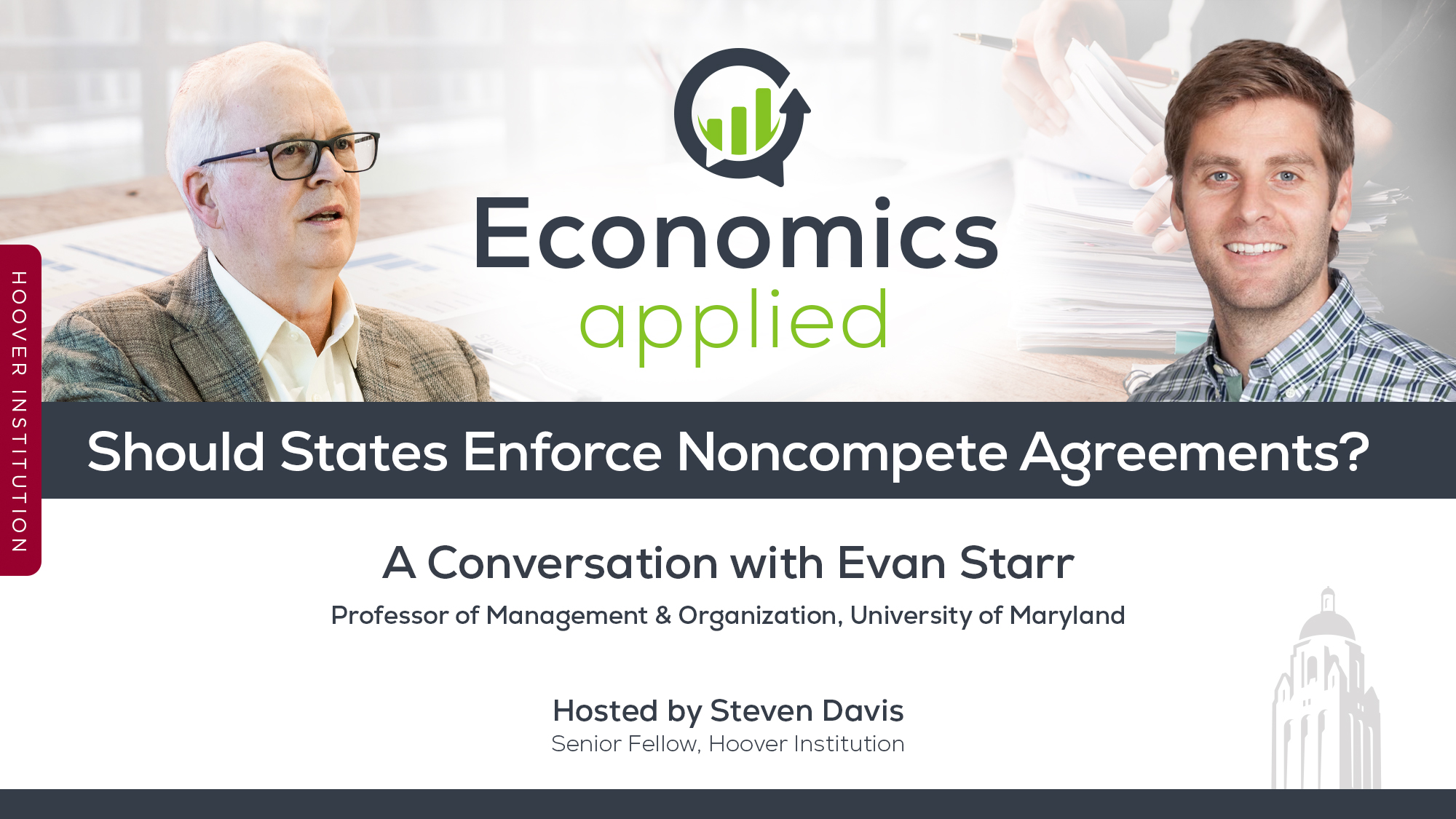
Steven Davis speaks to Evan Starr, a leading expert on the economics of noncompete clauses. They discuss the prevalence of noncompete clauses in employment agreements; the pros and cons for employers, workers, and society; where to draw the line in disallowing noncompete clauses; the role of antitrust in policing noncompete clauses; their effects on the pace of innovation; and whether the United States should adopt a national policy on noncompete clauses.
Recorded on March 24, 2026.
- Many workers consent to non-compete clauses that inhibit their ability to take another job in the same line of work, or to start a business that competes with their employer's business. Why would workers accept non-compete clauses? Why do some employers insist on them as a condition of employment and as a matter of public policy, does it make sense to ban or limit the use of non-compete clauses in the labor market? Stay tuned as we take up these questions in today's show. Welcome to Economics Applied, a podcast series sponsored by the Hoover Institution, and thanks for watching. I'm Steven Davis, senior fellow and director of research at the Hoover Institution. With me is Evan Starr. He's a professor of management and organization at the University of Maryland. He obtained his PhD at the University of Michigan and he's a leading expert on the economics of non-compete clauses. Welcome Evan.
- Thanks for having me, Steve. It's a pleasure.
- Likewise. So maybe we can start just by, you could tell us what types of restrictions do you find in these non-compete clauses and these, are you often buried in the employment agreement that someone signs when they accept a job?
- Yeah, that's right. So a non-compete clause is simply a term in an employment contract typically found among another set of terms, generally called restrictive covenants that prohibit a worker from doing certain things either while they're on the job or after they leave. So a few common restrictions you might be familiar with are non-disclosure agreements that say you can't share certain confidential information or agreements not to solicit clients you've worked with or former coworkers. And then a non-compete clause is a, is another one of these that typically says that if you're a departing worker that you can't go join or start a competitor typically within a particular timeframe. Often one or two years, but sometimes even longer. And within a, within a, a particular geographic area. And again, sometimes there is no geographic area, it's the world. Other times it could be a few miles from replace of business or the state or the United States, for example.
- Okay. But that's starting another business. What if I just have a regular job? These,
- Yeah.
- Not compete agreements sometimes prevent me from taking another job of the same type.
- It depends on the language in the non-compete, but the non-compete often defines what the scope is if in terms of what a competitor would be included as. So for example, if you worked at Jimmy John's back in 2015 or so and you made minimum, you made sandwiches, you would be asked to sign the two year non-compete clause that would prohibit you from working in, in nearly every food establishment that was three miles from any Jim Jimmy John's sandwich location.
- Okay. So the Jimmy John's example makes clear we're not just talking about high-end knowledge and sales workers, technical people who might have access to really specific knowledge and skills and know-how, I mean there, there's some know-how in making a sandwich for Jimmy John, but it's not, it's not the kind of know-how you would think normally think of a firm as we really gotta protect this because it's core to our business, like the secret Coca-Cola formula.
- Well, I imagine if we had the Jimmy John's attorneys on the call, they would probably argue that their process of making a sandwich has lots of confidential and proprietary pieces to it at the same time. Not even
- Though you can watch them make them
- Fair enough. But you, you, you're right that the, the, the tools and the a process for making a sandwich is different from the secret formula to Coca-Cola, for example, or other really detailed knowledge like the algorithm that makes your I AI company run.
- Okay. But again, the, the, the Jimmy John John's example is instructive as an example of how far these non-compete agreements can extend across different segments of the labor market. What can you tell us in a more systematic way about how prevalent non-compete agreements clauses in in employment relationships are in the United States and where you tend to find them and where you don't find them?
- Yeah, so the Jimmy John's example that came out in 2014, it came out shortly after that, that a a temporarily employed Amazon packer who was making $13 an hour, had an 18 month non-compete that prohibited them from working on anything that Amazon produced or manufactured. And so these are, these, these can be very broad. We tend to see them in, in, in high skilled jobs. That's the places where they appear most commonly. For example, if you work with trade secrets or have access to clients, there's about a one in three chance you have access to, you have a non-compete clause in your contract. If you are a higher paid worker, again, we'll see relatively high proportions. About 20% of workers overall have non-compete clauses, even on the low end of the earning spectrum, let's say the lowest earning deciles, they sign non-competes at about a rate of one in 10. When you think about the firm level, we have several firm level surveys and about half of firms in those surveys report using non-compete clauses. And about 30% of those firms use those non-competes for every worker. And so that's how you get, that's how you get the examples of the super high paid workers and the janitors and the unpaid interns also having non-competes.
- Okay, let me drill in a couple of those. So I do want to repeat one thing and make sure I understood. You're saying in the lower decile of the earnings or wage distribution, you still find quite a few of these, like in 10 workers are subject to these. Did I hear that correctly?
- That's right. If you look at the, at the bottom, the bottom deciles of the earnings distribution about one in 10 workers have not
- One in 10. So the Jimmy John's example is actually illustrative of a fairly common outcome. Maybe not the, not the, it's not the modal outcome for low wage workers, but it's by no means unheard of. Right?
- I think that's that's right. It's by no means unheard of. And there's, there's lots of examples like that that you can see out there. Bartenders, volunteers and nonprofits signing non-competes. So they're certainly used in, in low wage jobs across this country. They tend to be more common though, among sort of high wage, more technical jobs.
- And what, we'll come back to these issues. 'cause I think the, the economic case in favor of letting workers enter into non-compete agreements is often more compelling in these higher end technical jobs where workers may have access to special knowledge, pro proprietary value to the employer. And, and, you know, you can kind of understand the economic reasoning why you might wanna protect that knowledge as a matter of the employment relationship where it's a little harder to understand, I think. But, but I don't wanna, I don't wanna put words in your mouth, but I you did say one more thing that I, I wanted to underscore, which is, and this is consistent with my experience dealing with lawyers. When you write contracts in many large organizations, they just default to the most sweeping possible language in favor of their client. So I think that's, so that's one way you get an organization, which for some, for some employees, the non-compete clause might make perfect business sense, might even be desirable from society's point of view. But then they write that language and it just gets inserted to all employment into the contractual language governing all employment relationships for that enterprise. That, that, in my limited experience, that's how lawyer corporate lawyers often operate.
- My, my my sense is that economists have different views of how contracts are written than than lawyers do. And I think your, your understanding is what the lawyers tell me as well that they are anxious about risk mitigation and so they take a belt, a belt and suspenders to all their contracts. And it may be that, that yes, Janet, the janitor who sneaks in and steals a phone drive, they want to have a non-compete to protect against even that or the independent contractors that they hire and work with and have no real relationship outside of that contract.
- Okay. Let's start with the employer's perspective and just why might a business insist or ask for a non-compete clause as a condition of employment? What's the, what's the business case for that?
- Well, there's sort of two arguments depending on what your disposition is. The, the first maybe most natural argument is that non-compete clauses are restraints on competition. And so if, if you hire a worker and then they get a job offer from a competitor that pays more money, that you don't have to compete with that employer because the non-compete acts as a shield. And if the, if the worker wants to go start a competitor, again, the non-competes act as a shield, and so it can allow you to hold onto your workers longer and pay them less and reduce product market competition. And so that's sort of the anti-competitive view of why a firm might, might want a non-compete. Well, you, you
- Describe it as the anti-competitive view, but I wanted to ask you is, is there from society's perspective, sometimes a case to be made for allowing the employer to restrict competition after the fact in that way?
- Yes, absolutely. I'm, I'm getting there. So this is the, the first, this is the one justification, a second justification for why a company might want them in the most common one that you hear in courts, and the reason that they're at least enforced in, in many US states is because they provide incentives for firms to develop valuable information and to invest in their workers to share that information with their workers without fear that their workers might go take that information and share it with a competitor and go start a competitor. And so this is the, this is the most, or,
- Or take the, or take training that the employer has paid for and go apply, use it in some other enterprise
- Training is a slightly different argument because in, in, in most states, they don't actually uphold non-competes on the basis of training investments. This is a, a legal, a legal point, not an economic point. Well, okay,
- Fair enough. But I, I wanna distinguish here between the law and the economic perspective on things, and sometimes they overlap, sometimes they don't. Some economists will advance an argument which one can view positively or negatively that it's advantageous from society's point of view to sometimes place restrictions on workers taking training that they have acquired at the expense of their employer and then just leaving and using that training elsewhere. And the economic argument is, well, if you don't give the employer some stake in the training they provide by inhibiting mobility ex post, they won't provide the training in the first place. At least that's the argument.
- No, that, that's exactly right. You're worried about subsidizing your competitors. Right. And, but it's a similar argument to the information sharing and to, you know, if you invest in clients, for example, or client specific relationships that a worker might then take with them to a competitor, it is a similar flavor to those stories as well.
- Okay. So yes, that, that's right. So I wanna get the case on the table. There is a sound economic argument, at least in principle, whether it applies with much force and practice is another case, but at least in principle, there's a sound economic argument that says you wanna have some form of commitment upfront to encourage mutual investments in what might be valuable to the parties, to the contract, but also valuable to society as a whole. Now that's, that's one motivation, but you've already explained there's also just another straightforward motivation, which is we just don't wanna do anything that might let our employees go off and benefit my competitors whether I made upfront investments or not, and I want to be able to pay low wages other, you know, that's an, that's a rationale for the employer. So already you can see there's kind of this mix of good and bad art, good and bad reasons. I should be a little more clear from the, the business has clear motivations to restrict the ability of its employees to go off and work for rival firms. In some cases, the business motivations aligned with society's interests, but in many other cases they don't. Is that, is that a fair way to put it? I,
- I think, I think that's fair. And you know, I think that the language that, that people often use this sort of pro-competitive versus anti-competitive, and there are certainly pro-competitive justifications for non-compete agreements and there's also anti-competitive ones.
- Okay. Okay. So let's, let's shift to the worker's perspective for a minute. So some of this is obvious, but why would a worker knowingly, and sometimes they may do it unknowingly, but why would a worker knowingly enter into an employment relationship that restricts them in this way, in the, in, in the way of these non-compete clauses that you've already sketched out? Why would an employee do that?
- Yeah, so if, if I take the example of the, the, in the Amazon packer who's joining Amazon and sees an 18 month non-compete, that restricts them pretty broadly from working in a lot of places. Why, why would they ascend to that? So there are several possible reasons, but they, the, the most common one they receive from, so a, a classic econ model is that the worker gets something in exchange that they value more than they expect the cost to be on them later at a later point when they do leave. And so it could be that the firm has to pay them a premium to agree to the non-compete, or they, or they pay them in an amenities instead of wages. It could be that they get training, for example, that they really value that benefits them at some later point in time. And so this is the kind of the classic argument. It could also be that the worker doesn't expect the non-compete to bind. Maybe they're gonna retire in a few years, maybe they never expect to leave. And so who cares about those restrictions?
- Right. Okay. And well, you didn't say that maybe the worker doesn't really understand what they're getting into.
- Well you, you, you presume, you presume that they were knowingly getting into it, but you're right. Well, an
- Economist would presume that, but is it always the case in your, in your judgment?
- Well, so I think this is the, this is the other point that, you know, our workers aware when they assign, when they sign these things, and so this is really important, you know, we ran a field experiment with Bo Cowgill and Brandon Freberg, where we randomly gave people contracts and some of those contracts had a non-compete and we could track how many seconds they spent on the non-compete page. And the, the non-compete was on page seven of the contract. And about a third of the workers skipped that page entirely. And then the, the, the typical time spent on it, the meeting was two and a half seconds. Most workers didn't read the non-compete clause. And so this is a stylized experiment that, that we ran with real workers. But I can, I, I, from, just from personal experience, I can tell you many people don't, don't read and don't negotiate over these provisions, but firms often don't make it easy for them as well. About somewhere between 30 and 50% of non-competes are deployed after the worker has accepted the job. Often when they show up on the first day, that's the first instance in which they learn about the non-compete. So there's, you can also with a little
- Bit of holdup problem there.
- That's right. Yeah. Yeah. So that's like you, you don't know about the non-compete. You moved your family, you took your job, and then you get there on day one, you go to hr, you told the other job,
- No, you didn't want that job.
- That's right. You, you, you moved your family and hr, you know, gives you a stack of papers and says, sign these. And, and then you find yourself under a non-compete.
- I see that you, you say that happens often that yeah, that, that, that is problematic. It, it could just be because that's convenient and easy. You know, you're, the people have to come in and sign a whole bunch of stuff on day one anyway, and much of that's just to comply with law, but it's, it's also an opportunity for the employer to slip in contractual restrictions in a setting where they may, they might not receive due consideration.
- Yeah, I think that's, that, that's right. I, it's not clear if it's it's strategic or just the kind of thing that makes the most sense on, on the firm's end. Sometimes I'll say also the non-competes are in employee handbooks and not in in employment contracts. And so you may not even know about that handbook until some, some later point in time.
- I'm laughing because I have been at, in, in senior leadership roles in two academic institutions and I've, so I've seen what employment contracts look like. I've seen what handbooks look like. They're often tens and tens of pages, dense language, sometimes written in clear English, sometimes written in legalese. Nobody reads all that stuff carefully in, in advance of taking a job. Sometimes they look at, they scan it, they may peruse parts of it when something comes up after the fact, then they may go to this guidebook. These, it's, it's an, it's a complex area at the intersection of law and economics where we bind ourselves to these implicit or explicit contractual arrangements. They're so complex and dense that nobody, very few people, I don't wanna say nobody, but most people don't bother to read them thoroughly and digest them fully before they make a decision. And nor am I saying they should, you can't spend your life reading all the, all the contracts you're presented with or you wouldn't have much time to do anything else.
- But I think that's exactly right. And you know, there's all the details and the fine print that we, that we use that this is actually a, a hope of AI is that you can plug your employment contract into AI and have it summarize the key pieces for you and you can ask about a noncompete. Yeah. And maybe, maybe that that helps some of this problem. That
- Would help. Yeah, that would help. Okay. And you can also instruct your AI over time as to what particular types of provisions are most concerned to you.
- Exactly,
- Yeah. Okay. So that's, there's some hope for hope for the future there with respect to ai. Alright, so, so the worker has a number, again, it's, I wanna stress, I wanna stress the complexity of the, the terrain here. The worker has a number of reasons to consent that they might consent to one of these non-compete clauses. And some, you know, in some cases allowing for that kind of consent I think is in society's interests. In other cases it may be more problematic. So you can tell me if you disagree with this, but my, my sense of this whole terrain about non-compete clauses is it's quite complex in terms of a bunch of positive pro-social and antisocial or pro-competitive and anti-competitive motivations are in play as well as not fully understanding what you're getting into, perhaps not fully realizing the consequences of what this language might mean. So the, it's just pretty complex territory and that makes it hard to design, I think, good public policies in this area.
- Well, it is, it is complex and especially when you talk about the laws that are being created. And if I could just offer a, a, a contrast, you know, you might, you might think about the, the, the minimum wage sandwich maker who has a, a non-compete clause and, and a real concern with that worker, as you know, that worker's non-compete might bind, but they, they may not read it, they might not have access to legal representation, and if the company threatens them over a non-compete lawsuit, they may not have access to the legal system to protect themselves even if the non-compete is entirely bogus. And so I think that's, that's one vein. And then if you compare an executive who has a legal team who can read their non-compete, who can assess exactly what's in that contract and think about it's worth it, and, and maybe they, they consent to it or they negotiate the details of the non-compete or other terms of the contract, those are very different situations. And so I think that the, the way that the state laws have, have changed, have been to try to protect the Jimmy John's workers and kind of keep the executives, or maybe we're okay with the executives having non-competes, but the really tech, the hard part where states have really struggled and policy makers have struggled is exactly where you're kind of alluding to is, is there a spot in the middle or do we just go all the way? How do we, how do we slice and dice this? And I think that's been, a lot of states have been experimenting with that.
- Yeah. So I wanna get to that, but I but first you, you said one thing that I want you to elaborate on. You, you, you used the term bogus non-compete clauses. And I'm guessing there, but you can tell me if I'm wrong, you're referring to the fact that employers sometimes ask you to sign these agreements even when there's good reasons to think they're not binding in that state. Is that what you, is that what you meant and or if not, what do you mean by bogus?
- Sorry. Yeah, that, that's what I mean. I, I meant, so in several states that they don't enforce non-compete clauses and for example, so California, Oklahoma, and North Dakota all ban non-compete clauses in the late 18 hundreds. And Minnesota did so in 2023. So there's four US states in which you cannot enforce a, a non-compete clause, but that hasn't stopped companies from using non-compete clauses in, in those states. But if you're a worker
- And the employee may not know that, so you read, you read this thing, you're making a good faith effort, you say, well, wow, I'm bound by this. I don't want to get into a legal tussle with the employer who I used to work for, so I'm going to abide by it not knowing absent legal advice, that it's not even binding in your state. Is that right?
- So JJ Prescott and I we're curious about exactly this question. So we surveyed workers and asked them what they believe about the enforcement of their non-compete clauses. And you're exactly right. What we found is that workers in California generally were uninformed about the enforceability of their contract, just like workers were in, in many other states. But the default, the default presumption is that when you put your signature on a contract, people tend to think it will be upheld in court.
- Yeah. Well, and there are people who just view it as a manner of self honor. If I agreed something, I'm going to try to abide by it. Okay. That's right. So, alright, so let's, we, we've touched on this already, but I I want to go through it in a systematic way. Why not simply ban non-compete agreements?
- Well, so I'll be honest, I don't think it's a totally unreasonable policy idea to ban non-compete agreements. I think there are arguments on, on either side, but if you look at some of the historical examples we have, we, as I talked about, we have California, North Dakota and Oklahoma who haven't enforced non-compete agreements for over a hundred years. And there's arguments that Silicon Valley wouldn't have risen to become Silicon Valley if it were, if it weren't for California's ban on such such agreements. And that's a never ending policy debate that we can get into if we want to. But there's also another really interesting ban, which is that attorneys are the only occupation, the whole United States for whom they cannot have non-compete clauses. That's true in every state. And the, the justification for that ban is in part that is, is related to negative externalities. It's that if you have an attorney, if your attorney can't practice because they are being excluded from the market because of a non-compete, then the client can't access their attorney of choice. And so written into the American Bar Association rules is this ban and it's based on client externalities. And so I think that there's various arguments that get to this point about externalities and how even if an executive consents and even if it's good for the firm and the executive, it might still be bad for a society. And so
- That's, well it might be, but I look, I two things here I wanna drill into in a second, what are some alternatives to non-competes, which related to the issue of whether you want to ban them, but I'm not sold on the argument that we wanna ban them everywhere at all times. And the reason, the reason is simply we've already elaborated on a number of circumstances in which there can be pro-social benefits of letting parties willingly enter into these agreements. It's hard for me to see, imagine that the world is such that those circumstances, the pro-social, the pro-competitive ones never dominate. And even, and I also, I'm not totally persuaded by the example of any one state like California, because it may well be that if there are certain business models, types of businesses that really rest on the ability to sign non-compete agreements, they just won't operate in California. But I'm not sure I wanna prevent them from operating anywhere in the United States. So I I I I'm not, I'm not gonna go, I I'm not pushed, maybe you are, I'm not sure. I'm not pushed to the point where I think it would be good policy to ban these things outright nationally.
- Let me first say, I was gonna talk about the, the reasons why. It's not an unreasonable policy at this point, but then, but this is, you know, this is exactly the tension that, that there, there are alternatives to non-competes. We've talked about them and there's a theoretical justification, but there are other tools that protect company information like NDAs and trade secret law. There's other tools that protect clients like non-solicitation agreements. And these restrictions are more narrow. They don't prohibit a, a, a, a worker from taking another job that's a better fit for them. And so I guess the point I'm trying to make is that there is a body of research as a recent econometrica by Leon Xi, which, which studies executives into her argument is that the externalities from executive non-competes are so large that the optimal policy is a ban. And so I guess I'm saying that depending on your perspective, it's not unreasonable. Now there have been various choices that states have made that I've been a part of where it, it is difficult, it is difficult to get around the idea that an executive shouldn't have a non-compete clause. If you look at the case of Ontario, our neighbor in 2020, they passed a ban on non-competes for everybody but executives. And so this is where the rubber meets the road. And most states have taken kind of a, a middle approach trying to carve out the really high income earners, the, the kind of where the, where the pro competitive arguments may have some sway. And so that's, that's been the balance.
- I think we're on the same page here that well maybe we're on the same page. The, there's ultimately a line drawing exercise here. It's a rather challenging line drawing exercise. It does require quite careful consideration of these other more narrowly tailored tools. And some settings, these other narrow tools will work just fine if the real, if the real issue, for example is access to a customer list, then non solicit a non-solicitation restriction of those customers after the salesperson leaves the organization that does the, that does the job. But in other circumstances, you know, it's harder to pin down and specify exactly what the, what, what are the elements of a pro-competitive reason to impose some type of restriction. And you know, economists often like to think about, I don't know whether this, this particular study you referenced, but economists often like to think about a world in which it's costless to write down all the contingencies in a contract and to specify all the responses. And in that case, yeah, you can probably almost always design something that fits any particular situation but have as narrow a restriction is feasible to meet that whatever that concern is. In practice, of course, contracts aren't complete, they're not complete for a whole variety of reasons, including the con the simple cost of spelling out all of the different contingencies and issues. But also there's, there's challenges to sometimes anticipating things. So I, I I'm, I I I can understand why in some circumstances they may not be very common circumstances, non-compete agreements, non-compete clauses may still be the, the natural and most efficient from society's point of view that is to allow these non-compete clauses, not to mandate them, but to allow them,
- Yeah. Well let me, I mean, lemme just respond that I think that the, the debate gets caught up with thinking about the efficiency of a bilateral relationship. But if you think about the function of the market as a whole, then you have to, the Ronald Gilson had this idea, 1999, that non-competes are a potential prisoner's dilemma. And the argument is that the firm has effectively control only over its workers. And so if, if I don't use non-competes, everybody can poach from me. But if I use non-competes, then they, then they can't. And so every company has these private incentives to try to adopt non-competes. And so when you end up with non-competes being used en mass, then what, then who's gonna start the new company in the industry? Who, who's gonna hire? If you wanna move into an area, you end up with more acquisitions as a mode of growth, and then you have concentration and effects for consumer. So that,
- That, so this is a, that's a reasonable argument as to why you might want to inhibit or ban these non-compete agreements in some settings. But let me, let me just ask you a, a different line of question. Often like I think about antitrust law, particularly the, the portion of antitrust law that operates under a rule of reason principle as a tool of regulation that we use when the contingencies and the circumstances are so varied and, and complicate complex, that we just understand ex andante, it'll be very hard to write a piece of legislation in advance that it governs something that's reasonably optimal most of the time. So instead we operate with basic principles. And the pri the principles under which antitrust law operates is, has changed somewhat over time, but basically in much of antitrust law. And when it's operating under a rule of reason principle, an an issue that comes before the court, it could be an exercise of market power by an existing firm, the possible merger of two firms. It's evaluated under a rule of reason principle is this pro-competitive or anti-competitive on balance, you can define pro-competitive in different ways. Let's set those details aside. It's basically what's good for society economically. Well, let's leave it at that. This sounds like, this seems like a terrain where you kind of wanna lean heavily on the courts operating under some kind of rule of reason principle and build up a body of case law over time to handle what is really a very complex terrain rather than trying to legislate every little detail. Or do you, maybe, maybe you agree, I want to see what you think about that, whether you agree with it or not.
- Well, what you've just described is the last 200 years of non-compete law in the US these have typically not been taken up under antitrust laws. It's, it's very rare. I'll give you a few examples,
- But Yeah, but that's, that, that's a different question. I agree with you about that. That's in my view, a failure of the antitrust authorities. Okay. And that's different. So for what, for whatever reason, they've given a lot more attention to product markets than labor markets. I don't know that history and I think that's been a mistake. Okay. And there's some moves in recent years to rectify that mistake. I take that point nonetheless, in principle, a more aggressive application of antitrust tools to non-compete agreements is a possible alternative to a explicit rule writing approach. That's, that's the question I'm trying to ask you. Sorry. Okay, sorry for interrupting.
- No, no, it's okay. So, you know, the Eric Posner has a nice article on non-competes and the challenges it faces with, with, with antitrust laws. And, and the, the main concern is that non-compete agreements tend to be signed by individuals and, and a single non-compete clause is probably not going to generate market level harm. Where the antitrust laws, you know, the concern is if there's a merger, how is it gonna affect prices in, in the market? Is it, you know, if we're, if we're wage fixing, how does that reduce compensation in a market? And so when you have a market perspective, a single non-compete is probably not gonna move the needle. And so what we've seen is that the FTC brought a case recently with a bunch of glass container manufacturers where it was a, it was a concentrated industry where they were all using non-compete clauses and they, they alleged there was market level harm and they came to, to a, an agreement with those manufacturers. And so that's a market story though. And so you get stuck thinking here between about the market versus the individual. And I think that's where the antitrust laws have have struggled.
- Yeah, that, that's an interesting insight because it g that I hadn't appreciated before. It gives me some sense of why the antitrust laws has been, law machinery has been slow to take up non-competes relative to save, they're always on top of big mergers basically. And even in other, other instances, when you have potentially anti-competitive agreements between two firms, the transaction scale is often large. So it kind of has market level consequences at least potentially at the outset. And as you're pointing out here, and this is something I hadn't appreciated before, that's not often the case for bilateral agreements between one employer and one individual. Yeah,
- That's right. That's right. And this is why, this is why I presume the FTC went either after, well first they define non-competes as unfair methods of competition, which they had to, they redesigned what a method of unfair competition was. And that, I think that's why they ultimately probably chose a rule approach. And to my knowledge, the FTC is still considering cases of non-competes, but it's just difficult to get out of this, you know, individual non-compete versus market level harm issue.
- Yeah. Although there's still scope for class action suits. So then, then the question becomes why don't, you know, why haven't class action suits on behalf of plaintiffs who are subject, these will be employees who are subject to non-compete clauses. Why haven't they achieved more traction in the courts? I don't, and the regulatory agencies, I just, I don't know the answer to that, but I,
- Well, the, the, the FTC, the FTC as far as I'm aware, doesn't have the, the power to bring class actions like you would in a, in a typical, in a, in a typical state case. And the second reason is that many states don't have laws that enable easy collection of damages. So I'll give you an example. The state of Washington in 2020 changed their law and they developed a bright line rule where they banned non-competes for workers making below a hundred thousand dollars a year, and it was tied to inflation. So it's, it's higher now. And so they, they, you know, so any worker can check you make an under a hundred K, okay, you can't have a non-compete. But what the law did is it gave workers a private right of action to sue their employers for I think it was $5,000. And so, you know, that's, that's like easy money for the law firms, right? You just find, you find, you know, a bunch of firms who are using these for low wage workers, then you get a bunch of money and it's very easy. And that, that happened. And if you look at the filings in Washington, you'll find class action lawsuits on behalf of a whole bunch of workers. Car carpet installers is one I remember. But we had conversations with attorneys in Washington about exactly that, that behavior. So I think it's a combination of no pre right of action in many of these states and, and no clear red line about whether or non committee is enforceable or not.
- Okay. So what I'm taking from this part of our conversation is, you can tell me if you disagree. The, the scope for using antitrust tools as a way to mitigate harm from non-compete clauses is, is has potential but has been under u underdeveloped, underutilized. And you might need some changes in the law governing when you can bring these suits and not, not bring these suits. Does that a, that seem
- Reasonable
- To you? I think
- I, I think that's right. And, and I also think that there has been some, you know, sort of individual firm cases where it's been egregious behavior. So the, the FTC sued a prudential security company and Prudential security had a, a, a non-compete clause with a hundred thousand dollars liquidated damages provision if, if you violated it. And the Michigan Court previously found that non-compete to be unenforceable, but Prudential kept using it. And so the FTC went after Prudential and, and got them to remove that, that non-compete clause.
- Okay. So let me ask you about, I got two other things I wanna ask you about. One is we haven't talked explicitly about innovation, and this is a big topic in, in many respects, but you often hear competing claims about whether allowing the use of non-compete clauses in employment relationships fosters or hinders innovation, both technological innovation but commercial innovation. So what do we know on that score and what evidence would you point to?
- Yeah, it, it's, this is, this is such a great question because it gets right to the, the point of, you know, of why we might think non-competes are pro-competitive. It's because they spur firms to invest and develop new things that create value and then they share some of that with their workers. And so the innovation mode, you know, that that's, that's, that's primary. And so there've been two recent studies that I'll, that I'll point you to and they come to the same conclusion. One is by rein with and Rockall, and I think it's an AJ applied, and another one is Johnson Lipson pay. And they both look at how state policies that change their regulations on non-competes affect innovation. And they're looking at, at patents, but also other, other forms of innovation. And their broad conclusion is that if you enforce non-compete agreements, that innovation tends to fall and innovate. You know, the, the high, the high impact innovations tend to fall even more. And so the core mechanisms appear to be that non-compete clauses, slow inventor mobility and they slow knowledge sharing. And so I think this is an important part of the story, which is that innovation doesn't just happen in a vacuum. It happens 'cause you have new ideas and you recombine ideas. And so you bring in a worker from another place, they think differently and you bring those two ideas and you come up with a new thing. And so that story of recombination is just less likely to happen even though firms have stronger incentives to invest when you have, when you are willing to enforce non-compete clauses. So my understanding is that there's sort of a duality, which is that there is evidence that when you enforce non-compete clauses that investment rises on the firm's behalf. But still we see these drops in, in, in innovation overall. And so there's something, there's something washing out that positive investment effect.
- Yeah. That, that's an interesting conjunction there. It it can, I'll say what, what I heard you to say in a different language, it can simultaneously be true. Both the two statements can be true, allowing the enforcement of non-compete agreements can increase explicit monetary investments in innovation behavior. At the same time it can be deleterious to the overall innovation innovation rate because the innovation that emerges from the overall ecosystem is not just a function of how much resources you put into it, monetary resources, but how the flow of ideas gets exchanged over time. I got that right.
- I think that that sounds exactly right. And I'll just add that, you know, innovation also also comes from new firms. And so to the extent that new firms are not being created because of non-compete clauses, that that could exacerbate some of these points,
- Right. And you alluded to California and Silicon Valley earlier, but it is a pretty powerful, just easy to understand example, I'm sitting in Silicon Valley, this is an awfully innovative area both commercially and technically, and oh by the way, non-compete agreements are unenforceable in California. So that that by itself should give you pause. It's not but it should give you pause.
- Yeah. The, the, the, the, the proponents of non-competes will say where's the silicon North Dakota or where's the silicon Oklahoma? So, you know.
- Well, but I wanna get back to this point I made earlier. Should we have any place in the, in the country that allows these things? Is it, are there any su any big innovative success stories in these states that allow, that allow it enforce non-compete agreements? Because my ar the argument I gave you earlier was even if I grant in most cases, most industries, most technologies there might, the the pro-competitive benefits of banning non-competes might outweigh the anti-competitive benefits. Doesn't mean that's true everywhere. So is there any, any example you can point to me to that says, yeah, you know, it looks like these, these allowing these non-com allowing and enforcing non-competing agreements works pretty well in this domain. Is there any such example? There must be some even if it's just by accident.
- You know, IIII think that the, the, well, so this is a great, a great point for research, which is that we're often to often looking at averages. And even though we look at some forms of heterogeneity, it may be that there are some non-compete agreements, individual non-compete agreements that that, that were pro-competitive and you know, we're not looking at oh, every single one we're looking at the average. Right. And so yeah, that's,
- That's a good, that's a good way to put it. I, in other context, try, try to make that point as well, you know, a regression model, most of the statistical analysis we do, they're, they're telling you about means or conditional means. And unless you work really hard and think carefully about what's happening at the various extremes, you're not learning much about those. And what happens at the tails of the distribution of outcomes can be quite different in terms of both the outcomes obviously, but even in terms of what determines the outcomes and that, that, that point is often forgotten, I'd say more often forgotten than remembered in the context of empirical research.
- I I think you're, you're absolutely right. And actually Steve, this is why I'm, I'm, I'm excited about the Minnesota policy that banned non-competes for everybody because it's the first modern natural experiment where we now have executives and there are many of them in, in, in, in, in Minnesota who, who won't have non-competes in their contracts once they're renewed. And so that gives us a really nice laboratory to study the upper end in these, these arguments about whether, and and do we need non-competes even for executives or how do firms change their contracting if you can't use non-competes? We haven't had that example because policymakers haven't been so bold as, as they were in Minnesota a few years ago.
- Right. Well that's actually a segue to the last thing I wanted to ask you about and, and it's a bit of an open-ended question, but as I understand it, there's a, there's a lot, there remains a great deal of differences across states and the extent to which they allow non-competes or if they don't or enforce non-compete clauses. Is that, is that a correct statement? And if so, can you, can you elaborate a bit on the ways in which states differ and how we got to this really wide variation in, in treatments of non-compete agreements?
- Yeah, the, the history of non-compete agreements is fascinating. It, it goes back a long time. The, the first case of non-competes was in 1414. The kind of the seminal, the seminal case was in, in England in 1711 where the court established this reasonableness criterion for the first time. And for a non-compete to be reasonable, it effectively has to have some, a cognizable legitimate interest from the firm's perspective. It has to be protecting a trade secret or clients or something valuable and it can't unduly harm the worker or society. And that's kind of the reasonableness test that crossed the Atlantic. And that most states adopted, with the exception again, of California, North Dakota and Oklahoma and then Minnesota until recently. But what's deemed reasonable has very dif quite considerably across states. And I'll just give you a few examples. Yeah, lemme pause and let me ask you ask question. No, I
- Just was struck that that case you just cited was 315 years ago and it sounds very modern in its outlook. It's a basically a ruled reason approach.
- That's exactly what it was. The, the, the judge called it a partial restraint and it was a case of a bakery where the, where the, the judge said, Hey, this is actually sort of, you know, you agreed to this, you must be getting something in exchange and partial restraints can be okay. And so that, that is the, the reasonableness criteria and that most states have adopted, it's just what is reasonable is different across states. So for example, in Florida, well they, they changed their law recently. It's actually Florida's the most vigorous non-compete enforcing state. They just made a, they just passed a very pro non-compete law this year, last year. But prior to that they had a provision in their law that said that a non-compete agreement, when you're challenging a non-compete, you can't argue that the worker was unduly harmed by it. That's not a part of their policy. And so, but that's true in every other state. So in some states, in some states you can be fired from your job without cause and still have your non-compete enforced. In other states, that's not true. Some states require extra, what they call consideration. If you have a non-compete agreement that's thrust upon you midem employment, other states continued employment is sufficient. And so there's many dimensions on which reasonableness can differ.
- Hmm hmm. This is such a, this is such a rich and interesting territory at the intersection of economics, law and public policy. There, there, there's, it's just a fascinating area. You've, you've been, you've been on this topic for at least a decade I guess, but it still hasn't attracted that much attention from economics to, to my knowledge. It's a little understudied is my sense.
- Yeah.
- Is that
- Right? You know, there was, when I, when I came on to non-competes, I learned about them in probably 2013 or so, 20 maybe 2012. And the research on non-competes was coming primarily from management journals. And it, it didn't really reach economics until recently. I, I was on the job market in 2014 trying to convince people this was an interesting area. And in six years, I
- Remember when you were on the job market. 'cause I thought it was interesting, but
- No, thank you, thank you. And six years later though it was on the, the presidential agenda of almost every democratic president and the Obama administration found those Jimmy John's and Amazon examples and new evidence was coming out. It's still early days in many ways in terms of a research stream if you compare it to like the minimum wage. But, but, but there's a lot of variation. The
- Scales are, are kinda like this minimum wage is so up here high up here, it's off the, off my screen and cut non-compete clauses are way down here at the bottom. It's coming up. But I, I'd like to see the scales like this in terms of what would actually benefit from some economic insight.
- Well I think that, you know, there, there's a lot, there's a lot to study. I've been fascinated by this debate for a decade plus and, you know, non-compete clauses. We, we learned about them really from these examples and we didn't have systematic data. And so the insight that I had working with my advisor, Charlie Brown and JJ Prescott, norm Becher was like, how common are these? What, what can we learn about what's actually in employment contracts and about the contracting process and how that matters for firms and workers and society? And that's, that's generated the last decade of my research agenda. And, and I was fortunate to add questions to other surveys and, and now there's lots more opportunity with all the policy variation we have.
- Yeah. Okay. Great. This has been a, this has been a lot of fun, Evan and I learned a lot. I'm, I'm sure most of our audience listening probably learned a lot too. 'cause non-competes don't come up in everyday conversations or even among professional economists, they don't come up much. So thanks very much. Keep on,
- Thank you so much Steve
- And take care.
- It was a pleasure. Thank you.
- Yeah.
ABOUT THE SPEAKERS
Evan Starr is a professor of management & organization at the Robert H. Smith School of Business, University of Maryland. He’s an associate editor at the Strategic Management Journal and previously served as an associate editor at Management Science. He studies issues at the intersection of labor markets, human capital, entrepreneurship, and innovation, with a focus on employer-employee contracting practices. Originally from Claremont, California, Evan earned a BA from Denison University and a PhD in Economics at the University of Michigan.
- Visit Evan Starr's website
Steven Davis is the Thomas W. and Susan B. Ford Senior Fellow and Director of Research at the Hoover Institution, and Senior Fellow at the Stanford Institute for Economic Policy Research (SIEPR). He is a research associate of the NBER, IZA research fellow, elected fellow of the Society of Labor Economists, and a consultant to the Federal Reserve Bank of Atlanta. He co-founded the Economic Policy Uncertainty project, the U.S. Survey of Working Arrangements and Attitudes, the Global Survey of Working Arrangements, the Survey of Business Uncertainty, and the Stock Market Jumps project. He also co-organizes the Asian Monetary Policy Forum, held annually in Singapore. Before joining Hoover, Davis was on the faculty at the University of Chicago Booth School of Business, serving as both distinguished service professor and deputy dean of the faculty.
RELATED SOURCES
- “The Economics of Noncompete Clauses” by Evan Starr, Journal of Economic Perspectives, 2026.
- “Low-Wage Workers and the Enforceability of Noncompete Agreements” by Michael Lipsitz and Evan Starr, Management Science, 2022.
- “The Behavioral Effecs of (Unenforceable) Contracts” by Evan Starr, James Prescott and Normal Bishara, Journal of Law, Economics, and Organization, 2020.
ABOUT THE SERIES
Each episode of Economics, Applied, a video podcast series, features senior fellow Steven Davis in conversation with leaders and researchers about economic developments and their ramifications. The goal is to bring evidence and economic reasoning to the table, drawing lessons for individuals, organizations, and society. The podcast also aims to showcase the value of individual initiative, markets, the rule of law, and sound policy in fostering prosperity and security.
For more information, visit hoover.org/podcasts/economics-applied.

