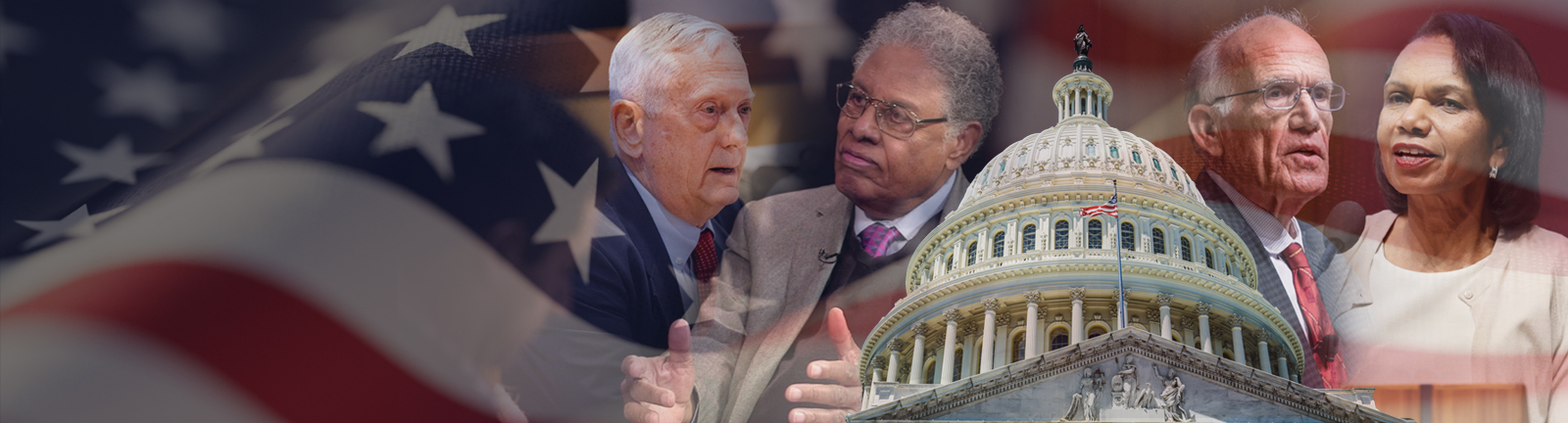
Accomplished historians David Kennedy, author of Freedom from fear; Andrew Roberts, author of Churchill: Walking with Destiny; and Stephen Kotkin, author of Stalin: Waiting for Hitler discuss why the peaceful new international order that Roosevelt, Churchill, and Stalin agreed to establish after crushing Nazi Germany turned instead into each of the Allies pursuing their own national interests amid the Cold War.
The love of liberty has nourished our nation since before its founding. Yet classical liberalism, which ought to provide common ground for left and right in the United States, is under attack today by prominent elements of both.
When figurehead Robert Mueller likely allowed Andrew Weissman to form his special counsel team to investigate so-called charges of Russian collusion involving Donald Trump’s presidential campaign and the Kremlin, Washington elites became bouncy. The high-profile legal “powerhouse” lineup immediately looked like a sure-thing—an elite slaughter of the yokels.
This week I’ll leave the Hoover Institution, my professional home for the last few years. And because I am leaving with a heart full of gratitude for the institution and my colleagues, I want to take a moment to say “thanks.” This place, which I’ve admired for so long, changed my life. I will be forever indebted.
The bodies in Gilroy, El Paso, and Dayton were still in the morgue when the progressive “carrion-picking crows” started politicizing the murders. But everything they said about gun control, “white nationalism,” and Trump’s culpability was based on lies and stale clichés recycled for political gain.
One exchange from the first debate in Detroit this week between Democratic Party presidential candidates has already received substantial airplay. Its deeper significance warrants further exploration.
Twenty of the Democrats vying to be our next President finished two nights of debates, where it became very clear that the energy of the party was behind policies that would push America to the far left—making the Democrats of the past look like conservatives.
Software Engineer Andy Matuschak talks about his essay "Why Books Don't Work" with EconTalk host Russ Roberts. Matuschak argues that most books rely on transmissionism, the idea that an author can share an idea in print and the reader will absorb it. And yet after reading a non-fiction book, most readers will struggle to remember any of the ideas in the book. Matuschak argues for a different approach to transmitting ideas via the web including different ways that authors or teachers can test for understanding that will increase the chances of retention and mastery of complex ideas.
Jason Delisle, a resident fellow at the American Enterprise Institute, joins Paul E. Peterson to discuss how the federal Pell Grant program, initially designed to help low-income students access college, has become available to more and more middle-class families.
Hoover Institution fellow Jack Goldsmith interviews Mary Ann Glendon to discuss the Commission on Unalienable Rights. They talk about why examining the root bases of human rights claims is a worthwhile endeavor for a State Department commission.
University of Chicago economics professor Casey Mulligan, fresh off his one-year stint as chief economist with President Trump’s Council of Economic Advisers, has an interesting comparison of Trump vs. Reagan on economic deregulation.
My wife and I rented the recent Clint Eastwood movie, The Mule, last night. I would give it an 8 out of 10. At various points, we paused and talk about the fact that we had no idea where the movie would go. Once it ended the way it did, it was plausible, but I wouldn’t have necessarily predicted that.
Hoover Institution fellow Niall Ferguson discusses President Trump's tough stance against China and the Sino-American trade imbalance that has alerted the American public to the second Cold War with China. Ferguson notes that China is both an economic and strategic threat.
Hoover Institution fellows Peter Robinson and John Yoo discuss Kavanaugh’s confirmation hearing and the aftermath and lasting effects with Mollie Hemingway and Rob Long.
(1:58) Hoover Institution fellow Michael McFaul criticizes Trump’s vetting process, calling Ratcliffe’s nomination a failure of the inter-agency process in the Trump administration.
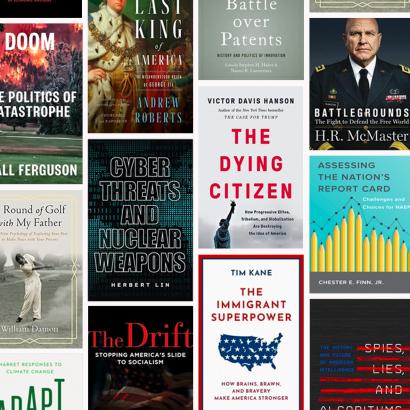
In 'The Case For Trump,' scholar Victor Davis Hanson makes the case that Donald Trump's presidency has been more effective than anyone wants to admit, and as such he will go down as a tragic hero.
Two years ago, our friend Michael Auslin published The End of the Asian Century. Michael argued that, contrary to conventional wisdom, Asia is not on its way to global domination and China is not on its way to displacing the U.S.
“One trait of the Democratic field of presidential candidates is always to sound further to the left than any of their primary rivals,” columnist Victor Davis Hanson noted.
On Friday, a nonproliferation pact that underpinned three decades of global security will collapse. In 1987, the United States and the Soviet Union agreed to the Intermediate-Range Nuclear Forces Treaty, which led to the removal of more than 2,600 U.S. and Soviet nuclear and conventional ballistic missiles - specifically, ground-based weapons systems with ranges between 500 and 5,500 kilometers (310 and 3,417 miles). That proximate distance, and the fact that they could hit their targets within 10 minutes, made such missiles the source of constant miscalculation fears during the Cold War era.
The other night, a politician criticized Bernie Sanders and Elizabeth Warren for offering voters “free everything and impossible promises.” Remarkably, the critique came, not from a Republican fiscal conservative, but from a fellow Democrat during a primary debate. John Delaney, a former congressman from Maryland, said such policies were based on “fairy-tale economics.”
California was once a thriving two party state. We replaced it with the current one party state, one party rule. Scholar and Central Valley resident Victor Davis Hanson calls California “America’s First Third-World State.”
Although the total costs of Medicare for All have been analyzed in detail in multiple studies, few have considered how these costs would affect U.S. taxpayers in specific income brackets.
Former US Secretary of State Condoleezza Rice will be a keynote speaker at Oil & Gas 4.0, the strategic conference that is part of ADIPEC in Abu Dhabi.
What will happen next with the global economy and how governments will respond is troubling Wall Street as investors and economists chase a moving target of trade wars and monetary policy shifts.
Need a good, last-minute beach read? Or a page-turner that makes your flight fly by? Finance may not seem like summer fun, but these old, breezy, bestsellers will surprise you.
California high school social science and history teachers gathered at Stanford recently to take part in a professional development course on Latin America and the Cold War.