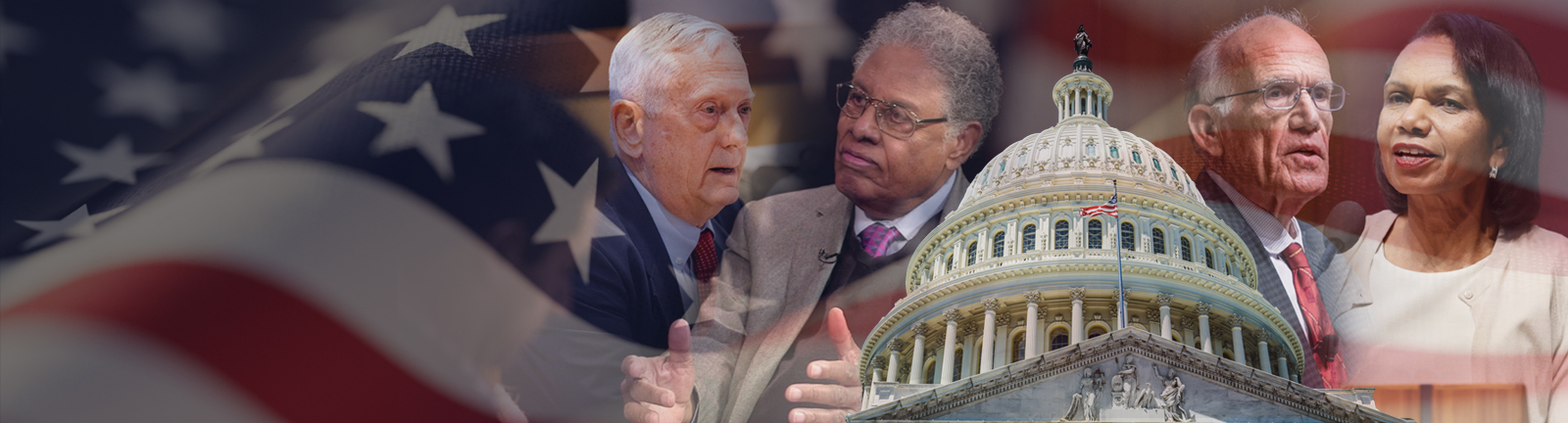
In his first televised interview in almost a year, Secretary of Defense James N. Mattis sits down with Peter Robinson to discuss a wide range of issues facing the United States Armed Forces at home and across the globe.
Scott Shane had an interesting piece over the weekend in the New York Times on a topic I wrote about last year: What should journalists do when they receive “authentic and newsworthy” information from a foreign intelligence service? The question has become salient again because of Amy Chozick’s worry that she was an “unwitting agent of Russian intelligence” due to her reporting about the Russia-hacked DNC emails in 2016.
Last month, dueling guest opinion pieces marking the 70th anniversary of Israel’s birth (according to the Hebrew calendar) appeared in the United States’ two most influential newspapers. The opposing spirits in which the articles were written reflect a recurring asymmetry in the Israeli-Palestinian conflict.
Peter Boettke of George Mason University talks with EconTalk host Russ Roberts about the proper role of the state in the economy. This is a wide-ranging conversation on political economy. Topics include Adam Smith's view of the state, the tension between the state as enabler of real vs. crony capitalism, the potential for the poor to flourish in a market economy, and the challenges of democracy.
The Trump administration may undo regulations that punish for-profit colleges if their graduates are unable to earn enough money to repay their student loans. In this episode, Paul Peterson is joined by the authors of a new study that examines the impact on student enrollment in for-profit colleges and community colleges when the federal government cracks down on for-profit colleges with high rates of students defaulting on their loans.
A funny thing about my job: every election cycle, I can count on at least one conservation with a political neophyte interested in the pursuit of elected office.
On Friday President Trump in the White House Rose Garden briefly outlined the four key aspirational strategies of his "blueprint to lower drug prices": "improved competition, better negotiation, incentives for lower list prices, and lowering out-of-pocket costs."
Greg Mankiw writes: Some sign a letter opposing tariffs. Others sign a letter supporting President Trump. You can guess which one I signed. Like Greg, I signed the first one and not the second one. However, had I been asked to sign the second--I wasn't--the only reason I would have refused is that it's billed as "Economists for Trump."
A labor economist friend who studies the minimum wage writes: I found a 103 year old BLS report on a minimum wage increase in Oregon that had a stronger grasp on credible research design than Card & Krueger. Also, one of the authors is named "Bertha von der Nienburg" and she was 24 when the report was written. If I was the sort of person who did that sort of thing, I'd blog about this.
An economic study that caused me to change my mind. I have believed for a long time that racial segregation would have been a small problem if not for laws requiring it.
Hoover Institution fellow Thomas Henriksen says US, North Korea, and South Korea can make progress toward the denuclearization of the Korean peninsula but hammering out an agreement, will be slower "than we would like," because North Korea will want things in return, like financial assistance, the end of sanctions, and pledges by the US not to invade.
Hoover Institution fellow John Taylor says he disagrees with the International Monetary Fund’s emphasis on capital controls as a policy tool, and China’s steps to regularly impose them when needed, saying they should be replaced by open markets and free movement of capital around the world.
Hoover Institution fellow Condoleezza Rice discusses the upcoming meeting between President Trump and North Korean leader Kim Jong Un and what denuclearization means to both parties.
Hoover Institution fellow Kiron Skinner discusses the three Americans who were released by North Korea, and what they can offer concerning North Korea.
interview with Michael McFaulvia Council on Foreign Relations
Friday, May 11, 2018
Hoover Institution fellow Michael McFaul provides an insider’s perspective on Russia during his time as US ambassador, including his analysis of Russia’s foreign policy from the end of the cold war to the presidency of Vladimir Putin and the future of U.S.-Russia relations.
Hoover Institution fellow Raghuram Rajan explains why he is concerned about spillover effects on emerging markets from the policies of central banks in industrialized nations, adding that it’s appropriate for the Federal Reserve to be raising interest rates now as a precautionary move against the possibility of a "magic moment" when tighter labor markets around the world starts pushing up wages and causes inflation to accelerate.
This is part II of Hoover Institution Russ Roberts's interview where Russ moves away from the abstract and the philosophical and more into the contemporary and the political.
For over a decade there has been a trade war between China and America, with America playing the role of passive victim. China has required American firms investing in its country to take on a Chinese partner and turn over their technology, which it agreed not to do when it joined the World Trade Organization. It has stolen American intellectual property, imposed heavy duties on imported vehicles, subsidized its exports, and manipulated its currency.
Even as leading Democrats try to tamp down talk of impeachment, President Trump’s legal challenges invariably invite comparisons to Richard Nixon, says Sam Tanenhaus at Bloomberg. But there’s good reason why those “hoping for a Watergate-style salvation from Trump” should “think again.” For one thing, unlike now Democrats then had large majorities in both houses of Congress; now the GOP controls Congress.
The rapper Kanye West’s slavery remarks are indeed insensitive. He suggested that the blacks in America chose to become and remain slaves for centuries. He is wrong because in a society that legitimises slavery, only slavers make choices, and their choices dictate the lives of slaves.
China’s top economic adviser Liu He lands in Washington on Tuesday for another round of trade negotiations with counterparts in the Trump administration. His mission: to find an eleventh-hour compromise that will dissuade Trump from imposing sanctions on Chinese imports, avert retaliation in kind from Beijing, and thereby save the world’s two largest economies from stumbling into a senseless and mutually destructive trade war.
Last week, I attended an event at the American Enterprise Institute. It was a podcast summit which was a joint venture between AEI and Ricochet. I watched several podcasts taped live, and while they were all informative and entertaining, the crown jewel was an interview with Defense Secretary James Mattis.
The world lost a great champion of liberty with the passing of Allan Meltzer on May 8, 2017, at the age of 89. A longtime Professor of Political Economy at Carnegie Mellon University, Allan was a prodigious worker who wrote hundreds of articles and more than ten books, including his monumental A History of the Federal Reserve and more recently Why Capitalism?
President Trump’s decision to withdraw from the nuclear deal has produced much hand-wringing from its supporters. Some of the angst is understandable. Former administration officials and many in the foreign policy establishment thought the deal was our best option for dealing with the threat of Iran developing nuclear weapons. I don’t agree, but acknowledge that the path Trump has chosen carries considerable risks (as, of course, did Obama’s).
Walmart is buying Flipkart. The bully of Bentonville is acquiring 77 percent stake in India’s e-commerce giant for $16 billion. A deal that puts the valuation of Flipkart at over $20 billion (or Rs 1,34,800 crore, at Rs 67.4 to a dollar).
Secretary of State Mike Pompeo has promised that the United States will help rebuild North Korea’s ramshackle economy if Pyongyang gives up its nuclear weapons. His comments came ahead of the President Donald Trump’s historic summit with North Korea’s leader Kim Jong-un in Singapore on June 12.
Times are discouraging for the shrinking number of budget hawks in Congress. With passage of the $1.3 trillion budget bill, the sequestration imposed by Congress on the federal budget since 2011 is officially dead. And trillion dollar budget deficits loom for the foreseeable future.
“I’d love to live in San Francisco, but I don’t want to pay $750,000 to live in a closet.” That’s what I tell my introductory economics students when I discuss housing prices. I probably need to update it to $2 million or something like that.
For decades, leakers of confidential information to the press were a genus that included many species: the government worker infuriated by wrongdoing, the ideologue pushing a particular line, the politico out to savage an opponent. In recent years, technology has helped such leakers operate on a mass scale: Chelsea Manning and the WikiLeaks diplomatic cables, Edward Snowden and the stolen National Security Agency archive, and the still-anonymous source of the Panama Papers.
Paying student athletes has been a major topic in recent years and months. While finding a solution to the problem is the hard part, it’s equally hard to swallow the fact the NCAA makes an insane amount of money each year off the hard work of student athletes.
You don’t get the nickname “Mad Dog” by being a shrinking violet in interviews — and a whole room of people at the American Enterprise Institute found that out the hard way this week.
A series of new protests could occur throughout Iran if millions of citizens feel empowered by President Donald Trump’s decision to walk out of the Iran nuclear deal, according to Mideast experts.