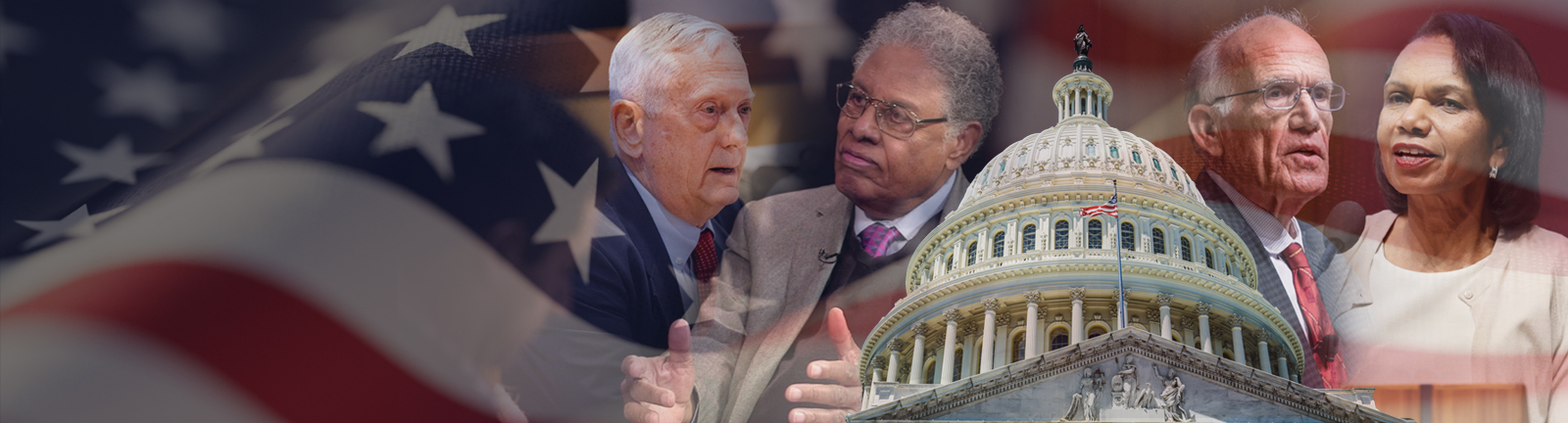
Even pre-pandemic, America was experiencing a crisis in institutional confidence (with the noted exception of the military)—a lack of public trust in government, business, education, media, and faith organizations. Yuval Levin, a social and cultural scholar at the American Enterprise Institute, joins Hoover senior fellows and GoodFellows regulars John Cochrane and H. R. McMaster to discuss where America went astray and how the nation can rebuild from the grass roots up.
On the occasion of his new book, Defender in Chief: Donald Trump’s Fight for Presidential Power, Hoover visiting fellow and Berkeley Law School professor John Yoo joins the show to make a spirited case against the criticisms of Donald Trump for his supposed disruption of constitutional rules and norms.
In the re-release of this inaugural episode of Battlegrounds, H.R. McMaster and Minister Atmar discuss this critical time for Afghanistan. They look at how the past impacts the present, the role of Afghanistan’s neighbors and what is at stake for the United States, Afghanistan, and the world as Afghanistan moves towards peace.
The known details of the so-called Steele dossier point to a peculiar ambiguity. To expert analysts, it always appeared to be low-quality political opposition research. Yet, it turned American against American, paralyzed our government — and may be the greatest Russian disinformation coup in history.
President Trump has changed his mind on many issues. Yet there is one theme of his presidency that remains strikingly constant: his peculiar deference to his Russian counterpart Vladimir Putin.
On Friday, July 24, Hagia Sophia was reopened as a mosque, after about a century as a museum. About 1,000 people attended Friday prayers there. The date, July 24, was not chosen at random, but marks a significant moment in military history.
As the November 2020 presidential election approaches, it is worth imagining how a foreign adversary might attempt to intervene in the domestic political process. We have no evidence that any of the precise things we consider in this essay are actually happening—though some may well be. They are based on a review of what we know to be possible and plausible given what has occurred in the past and the vulnerabilities we can see clearly today.
by David Altig, Jose Maria Barrero, Nick Bloom, Steven J. Davis, Brent Meyer, Emil Mihaylov, Nick Parkervia Federal Reserve Bank of Atlanta
Tuesday, August 4, 2020
In the months (and years) following 9/11, airline travel was fundamentally altered. Despite a host of new measures to increase safety, not until April 2004 did airlines see passenger loads reach pre-9/11 levels. When thinking about how that crisis compares to the current pandemic, current and former airline execs say the current pandemic is having a much more significant impact on travel than 9/11 did.
Conventional wisdom holds that Congress has abandoned its duty regarding the government’s war powers. It is not hard to understand why. Between the agelessness and flexibility of the 2001 and 2002 Authorizations for Use of Military Force (AUMFs) and periodic unilateral uses of military force in Libya, Syria, and Iraq, the executive branch appears to act largely at its own discretion when it comes to conventional military operations.
interview with Michael R. Auslinvia Center for Strategic & International Studies
Wednesday, August 5, 2020
Hoover Institution fellow Michael Auslin discusses the pervasive espionage, intimidation, intellectual property theft, and self-isolation pursued by Chinese President Xi Jinping.
Hoover Institution fellow John Yoo discusses the Supreme Court ruling concerning the DACA program and whether that decision actually gives President Trump and future presidents more executive power moving forward.
Hoover Institution fellow Casey Mulligan discusses the government's response to COVID-19 as well as extending the $600-per-week pandemic jobless benefit.
Historian Norman Naimark, the Robert and Florence McDonnell Professor in East European Studies, has been awarded a 2020 Norris and Carol Hundley Award from the Pacific Coast Branch of the American Historical Association, for his book Stalin and the Fate of Europe.
The "problem with the left" is that liberals have "preconceived notions" about how Black people should think, former Secretary of State Condoleezza Rice said Tuesday while commenting that she does not think the United States will ever be truly colorblind.
The former State Secretary Condoleezza Rice said that Georgia should build its own democracy and economy in order to cope with difficult international circumstances, while the international community can only assist in this process.
Former Secretary of State Condoleezza Rice said Tuesday that she doesn't "know why anybody wants to defend the Confederacy" and monuments erected in honor of it, but warned against the removal of other controversial statues, arguing that doing so would erase history.
Going back to school after a lazy summer can be a struggle for many children, but this year the biggest challenge may be convincing the teachers to return
The former chief of neuroradiology at Stanford University Medical Center advocates for a different approach to fighting the coronavirus by protecting the higher-risk populations and allowing the virus to burn through people to whom it poses little to no risk.
President Trump said Monday that he’s looking at unilaterally taking steps to stop tenant evictions and lower payroll taxes, adding that such moves might be necessary if a new coronavirus relief bill can’t be brokered with congressional Democrats.
Europe has the motivation, but not the means, to break up Big Tech. For the U.S., the inverse is true. That’s bad news for anyone hoping for a full regulatory reckoning with Silicon Valley’s and Seattle’s giants over their monopolistic tendencies.