Military

History

Filter By:

Type

Fellow

Research Team

Use comma-separated ID numbers for each author

Support the Hoover Institution

Join the Hoover Institution's community of supporters in advancing ideas defining a free society.

Support Hoover

Blank Section (Placeholder)Analysis and Commentary

Fredericksburg, Gettysburg, The South China Sea, And Offensive Use Of Defensive Positions

by Angelo M. Codevillavia Military History in the News
Friday, July 1, 2016

On July 3, 1863, as General George Meade’s Union troops were pouring rifle and artillery fire from behind their redoubts onto George Pickett’s Virginians charging up Cemetery Ridge on the last day of the Battle of Gettysburg, they yelled: “Fredericksburg! Fredericksburg!” That is because, on December 13, 1862, Union troops had suffered the Civil War’s most one-sided defeat when they had charged against Confederates dug in on Marye’s Heights.

In the News

Hillary Clinton And Benghazi Look Very Different Through Lens Of History

quoting Thomas H. Henriksenvia Christian Science Monitor
Friday, July 1, 2016

The fallout from Benghazi shows what hasn’t – and has – changed about the way Washington handles foreign policy crises.

Featured

Why The Battle Of The Somme Marks A Turning Point Of World War I

by Mark Harrisonvia The Conversation
Wednesday, June 29, 2016

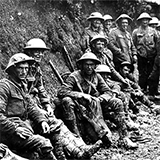
The British offensive on the Somme began on July 1, 1916. After 20 weeks, they had advanced six miles. The German line retreated, but was not broken. The horrifying casualties were shared equally between the two sides: 300,000 men died. Bloodier battles would come in 1918, but on the first day of the Somme the British Army suffered its greatest daily loss: 19,000 killed.

Blank Section (Placeholder)Analysis and Commentary

Sacrifice At The Somme‬

by Max Bootvia Military History in the News
Wednesday, June 29, 2016

One hundred years ago, on July 1, 1916, five French divisions and eleven British divisions attacked across no man’s land in an attempt to puncture the German lines in northern France. The infantry assault had been preceded by an intense bombardment lasting seven days and involving a thousand artillery pieces. 

Blank Section (Placeholder)Analysis and Commentary

The Ubiquity Of Terrorism

by Max Bootvia Military History in the News
Tuesday, June 21, 2016

Last December, Donald Trump roiled the presidential race by calling for a “a total and complete shutdown of Muslims entering the United States until our country's representatives can figure out what is going on.”

Analysis and Commentary

The Inexorable Truth

by Victor Davis Hansonvia New Criterion
Monday, June 13, 2016

[Subscription Required] A review of Elegy: The First Day on the Somme by Andrew Roberts.

Period Military History

This Kind of War: The Classic Korean War History, by T. R. Fehrenbach

by Barry Straussvia Classics of Military History
Tuesday, June 7, 2016

A journalist rather than an academic, Fehrenbach (1925-2013) wrote larger-than-life history of a heroic bent. He is remembered for the bestselling Lone Star: A History of Texas and Texans (1968), whose emphasis on gun-slinging white men now makes it politically incorrect. But he also wrote the sad and beautiful Comanches: The Destruction of a People (1974), which shows great admiration for Native Americans. This Kind of War originally appeared in 1963 with the subtitle of A Study in Unpreparedness and was republished in a new edition in 1994.

Autobiography & MemoirAnalysis and Commentary

Anabasis, by Xenophon

by Barry Straussvia Classics of Military History
Tuesday, June 7, 2016

Anabasis is a classic story of an army’s retreat from disaster, told by the man who was thrust into the role of saving it. Anabasis means “march inland from the coast,” which is a paradoxical title for a book that is mostly about a march to the coast from inland. But the author, Xenophon, an Athenian, had a taste for irony, borrowed from his teacher, the great philosopher Socrates.

Battle History

Decision at Trafalgar: The Story of the Greatest British Naval Battle of the Age of Nelson, by Dudley Pope

by Barry Straussvia Classics of Military History
Tuesday, June 7, 2016

Dudley Pope is best known as a novelist who wrote a well-loved series of books about a fictional Lord Nicholas Ramage, an officer in His Majesty’s Navy during the Napoleonic Wars. Pope was also a journalist, writing on naval defense, and he knew the sea. A survivor of a torpedoed merchant ship in World War II, he later lived for over 20 years on a yacht in the Caribbean.

Autobiography & Memoir

The Sergeant in the Snow, by Mario Rigoni Stern

by Barry Straussvia Classics of Military History
Tuesday, June 7, 2016

Rigoni Stern began writing this short, powerful memoir of the Russian front in a German prison camp, where he was interned after refusing to continue serving in Mussolini’s army after the armistice with the allies in September 1943. Earlier he served in an elite Italian mountain fighting unit that saw action on various fronts in World War II: France, Albania, Yugoslavia and, most memorably, Russia. 

Pages

Military History Working Group


The Working Group on the Role of Military History in Contemporary Conflict examines how knowledge of past military operations can influence contemporary public policy decisions concerning current conflicts.