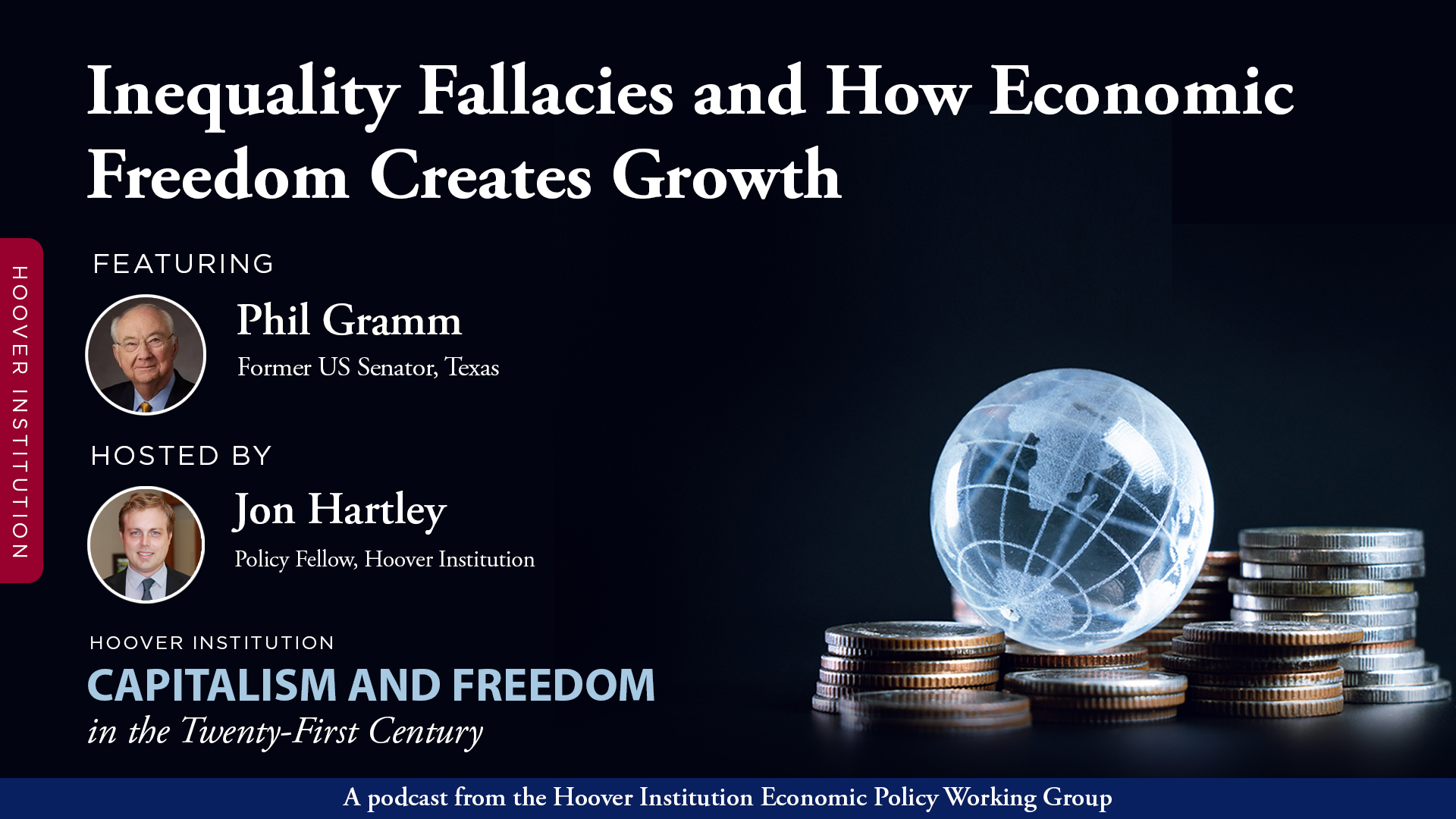
- This is The Capitalism and Freedom in the 21st Century Podcast, an official podcast of the Hoover Institution's economic policy working group where we talk about economics, markets, and public policy. I'm Jon Hartley, your host. Today, my guest is Senator Phil Gramm, who served as the US Senator from Texas from 1985 to 2002, during which time he served as chair of the Senate Banking Committee. Prior to that, he was a congressman in the US House of Representatives from 1979 to 1985. And prior to that, he taught economics as a professor at Texas a and m. From 1967 to 1978, he served as vice chair at UBS. He's a fellow at a EI. He's also the author of recent books, the Myth of American Inequality, which John Early and Robert und, and the Triumph of Economic Freedom with Don Boudreaux. Welcome, Senator Graham and honor to have you
- Oh, thank you, honor to be here. I appreciate your patience, John.
- Oh, it's a true honor to have you here, Senator Graham, and, and I think it's really so fantastic to talk to someone who not only is a PhD research economist and a very decorated one at that, but also has served in government at the highest levels of government engaged in economic policy. I think it's a very rare, increasingly rare combination. So it's a real honor to have you on and to talk to you about all your thoughts on economic policy and what, why economic freedom matters, and how we should talk about inequality. I wanna start with your early beginnings. Senator Grave, you were born in Georgia, your father was in the military, and your mother was a nurse. What got you interested in economics and what led you to get a PhD in it from the University of Georgia?
- Well, I, I was born at Fort Benning. My dad was sergeant in the army. My mother was a practical nurse, and I grew up in Columbus and I went to the University of Georgia, and I had run outta money at the end of my freshman year and had spent 18 months working, going to school at night and taking correspondence courses. So when I got back to university, I, much of the stuff I'd taken didn't add up to any kind of degree plan. So the first subject that I thought I might be interested in was physics. And so I thought, well, you know, I liked school. And so I went to my professor, Dr. Ning, and said, well, what would you recommend to somebody who was thinking about getting their PhD in physics? And in a level of honesty that I don't think you would've run into by most people who were in an active department teaching. He said, if you love economic, if you love physics more than anything else in the world, do it. But if you don't, don't, there are no jobs in physics. You'll end up spending 15 years as a post doc. You may never get tenure. And so I walked out of his office down to the National Science Foundation office, and there on the wall was a poster that showed the starting salaries of PhDs in 1963. And at the top of the list was economics. So I thought, well, you know, economics I think has something to do with the stock market. So I signed up and I was immediately taken by the fact that economics described in a formal way the world I'd grown up in. I didn't know anybody knew those things. I didn't know anybody'd ever formalize thinking about 'em. I was immediately captured. And so I became an economics major. I won a national defense fellowship, and I got my PhD at the university. And then hearing the words of Horace Greeley, go west, young man, go west. I went to Texas a and m,
- How wonderful. And, you know, love the Aggies, even though I'm sort of becoming a Longhorn, that's another story. I know, you know, John Cochran, he, you know, studied physics. Many economists, you know, first got their start in physics and, you know, found their way into economics. So I, I know you're not the only one. And I think there's, you know, a lot of shared, you know, tools, you know, from, you know, differential equations and so forth. So really, really fantastic. And you were a professor at Texas a and m for many years,
- 12 years, great years, by the way,
- Along with your wife Wendy, and, and who's also a, a PhD economist. And you're both professors, you know, you many wonderful publications. I'm curious what, you know, what made you want to go to Washington DC and serve?
- Well, I had met Wendy in 1969. A professor from Northwestern had come as a visiting professor at a and m and was showing people a dissertation he was looking at that he thought was great. And we read it and everybody thought it was fantastic. And it was by this young lady, Wendy Lee. And so we decided the, decided to interview her at the American Economics Association meeting. And I wasn't senior enough to have a vote on who we hired, but I was going to be at the meetings. And so I sat in on the interview with Wendy, and then she was very impressive. And as she walked out, I walked outta the room when she did, and she was having trouble putting on her coat. And so I went and rushed over to help her and for some reason known. But to God in the hip era of 1969, I said to Wendy, as a single member of the faculty, I'd be especially interested in you coming to Texas a and m. And that beautiful smile turned into a glare. And she said one word to me, yuck. And so I went back in the room, they voted to make her an offer, and I said, what, she's going to come to Texas a and m and I'm gonna marry. And she did, and I did, and our careers bloomed. We bought one of the nicest houses in town. We had two children. Everything we touched turned a goal, and we were very happy. But I became increasingly unhappy about what was happening in America in the 1970s. I knew we weren't running outta oil and gas. All of this talk about we gotta learn to live on less, the joy ride is over. That wasn't the America I'd signed on for. And so, make a long story short, I wrote an article for the Wall Street Journal on the energy crisis. I've since published over 150 of 'em in the Wall Street Journal. But that was the first, and I got a lot of first class mail in response to that article. And I'd written a lot in academic journals, but I don't know who read the journals or the tenure committee did, because I got a tenure and I got promoted. But I sense that people were interested in how free markets worked, how prices work. And so I started speaking out on energy, and I was asked testify before the Senate Energy Committee, and then I decided to begin to enter the sort of public policy debate. And I didn't know anybody really. And the people who knew me didn't much like me. And so it was sort of my political beginning, and I was terrible at politics to begin with. I felt uncomfortable going up and glad handing somebody I didn't know. But gradually I learned to do what I needed to do, to do what I wanted to do. And so I was finally elected to Congress by 122 votes, and that started my political career.
- Well, fantastic. And, and one amazing, you know, career that you've had in Washington dc I wanna, I guess, talk to you just about some of those accomplishments. And you served as, you know, chair of the Senate Banking Committee. What accomplishments in particular, from your time in serving in Washington, DC are you most happy about today looking back?
- Well, I'm happy about a lot of it, including many of the bad things that I killed. But I think I should begin at the beginning. I came to Washington two years before Reagan, and my first day on the Energy and Commerce Committee, I, David Stockman, who was a, a second term congressman from Michigan, and I sort of discovered each other. And we started working together on healthcare matters, energy matters. And we did a budget, we call a bipartisan recovery budget in 1980. And let me remind you, in 1980, the inflation rate was 13.5%. Prime interest rates were 21.5%. The unemployment rate was the highest of the post-war era. At 12.2%, we were in a double dip recession. And then Reagan was elected, president Stockman became OMB director. Our budget became the Reagan program. I was a democrat in Congress. There were no Republicans in my district. I didn't think party made any difference. I guess if you wanted to be technical, you say, I was sort of a, a carryover from the Civil War era when in the South there was only the Democrat party, or at least part of it I was in, in rural central Texas. In any case, I was the author of the Reagan program in the house, and we put together a bipartisan coalition at the critical point, the Reagan program passed by one vote, one vote, and the inflation rate was brought down in three years. The Soviet Union was on that headed toward the as heap of history. So it made a difference. And so I, that was the beginning of my working with Reagan. And then in 1984, suddenly it was morning in America. We were at the beginning of a 40 year period of no inflation. Everybody forgot about the deficit except me. Stockman had left. Fortunately, a guy that I had gone to college and graduate school with and whose wife had been my lab partner in physics became OMB Director, Jim Miller, another economist. And so I did Graham Rudman. I had gone to the, I'd been elected to the Senate not by 122 votes this time, but by a million votes. Votes. And so I did Graham Rudman to try to get the focus back on dealing with the size of government and with the deficit. And so from there, I went on, became chairman of the banking committee, and, and was instrumental in the passage of Graham Leach Bliley, which opened up competition in the American financial sector.
- Yeah, so I guess I, I, a, a couple questions on, on that. I, I guess on, on the Reagan era, obviously the, you know, tax cuts were, you know, fundamental to that time, you know, deregulation. And really this was, you know, if you compare this, I guess to the, you know, the Nixon admin, which, you know, is, you know, there's a lot going on in that timeframe including, you know, price controls and other things, and the economic policy. I think many successes on the foreign policy side of things. But, you know, it was a, a big, you know, the Reagan revolution was a big turn in terms of really embracing, you know, free markets and economic freedom. I, I think more fully, but yeah, you know, when I think of, you know, the, like C chair, like Marty Feldstein, he, during the Reagan years, you know, he sort of, I think famously left and, and protest over over the deficits. Obviously you, you had the 1986, you know, tax act and, and you know, bringing down marginal rates from, you know, pretty, pretty high levels when Reagan came in and, and also brought down corporate rates. Any thoughts about, I guess, debt and deficits, just in the sense that, you know, we talk a lot about public debt today. Some, you know, critics of the Reagan admin, you know, sort of say, well, you know, Reagan wasn't really a fiscal hawk either in that sort of, this period of deficits began in, in that era. I mean, there was a, you know, democratic Congress as well. But I'm curious what, what you think about public debt and you, you know, has, you know, what, what should Congress be doing in, in your sense, or, or how did sort of congress and, you know, administrations from both parties kind of drop the ball on this? I mean, it's sort of an issue where you don't really have a lot of interested parties. I mean, obviously the taxpayers and future generations are, are interested parties. I mean, many of them aren't born yet, but I'm curious, what, what do you think about that era sort of being the beginning of the deficit? Well,
- I, John, you've gotta start with the 1970s, one of the most misunderstood periods in American history in the 1970s, beginning in, in earnest in 1973, we started a period of nine years where we had 9.2% average inflation rate. We had a very large number of tax brackets over 15 on average during the period. And so with that massive inflation, we had bracket creep at a galloping rate, and the tax burden exploded. Even though Congress cut taxes five times during that decade, they never cut taxes as much as bracket creep was increasing them, the size of government exploded. And the America, in essence, in the 1970s became a welfare state. Non-defense spending grew at rates unprecedented in the post-war period. And so when Reagan came into office, defense had been cut dramatically. The Soviet Union was on the march all over the world, there had been an explosion in social welfare spending, and the tax burden was so high that the Congressional Budget Office, which was run by Democrats for two years in a row, warn Congress that we were courting a recession because the tax burden was so high that it was a constraint on growth. So that's when Reagan put his hand on the Bible, that January day, that's what the world looked like. Okay. And so we were able to reduce, first the growth and then the absolute size of non-defense spending. Defense spending went up, we cut taxes, but taxes were still higher than they were in 1973 when the inflation started and the economy responded. We had Paul Voker, who was head of the Fed, and I give Jimmy Carter great credit for appointing Volker. And we forget that the massive deregulation that defined the world we live in today in transportation and communications, that deregulation occurred under Jimmy Carter, and he doesn't get sufficient credit for it. And then Reagan came in and expanded that regulation and the energy and completed it in many of the other areas. So the economy responded. Inflation came down quicker than anybody had ever anticipated. The economy was growing at 7% by 1984. So the number of people who were still focused on the deficit had gotten very, very small. And so the idea behind Graham Rudman was, I had observed as a member of Congress that all the people that wanted something from Washington were looking over the congressman's shoulder, letting people back home know whether they cared about the old, the poor, the sick, the bicycle rider list went on and on, but nobody was looking over the right shoulder, seeing whether the congressman cared anything about the taxpayer and our children and the future of the country. So the idea behind Graham Ruman was to set a limit on the deficit and force special interest to compete against each other. It was to bring to the budget what the Constitution had done in checks and balances on the different parts of the government. And for a while at worked congress cheated on it, and then the Supreme Court struck down the triggering mechanism, which I had been forced to take, to get it passed with a Democrat controlled house. And so to get it re-triggered, we had to agree that the new president, whoever was elected at the Reagan, got to decide whether to continue it. And President Clinton was elected and killed Gem Ruman. And if I didn't sign, maybe I got, I hope I didn't get I Clinton and Carter mixed up before Carter deregulated. But in any case, it had an effect. But our problem was, even though at the end of the Reagan years, the tax burden was pretty much back to where it was at the beginning of the inflation defense was pretty well backed to where it was there social spending, which had been constrained and continued to be constrained in the Clinton administration. And we balanced the budget three times at the end of the clin of the Clinton administration because we were using the peace dividend from the end of the cold water. And because he had controlled the growth, the growth of social spending, and because the economy had gotten bigger grown up relative to the size of government, but after that point, you had to explosion in social spending, and that's the source of the deficit in the debt today.
- Absolutely. So a challenging problem to, to figure out, given the concentrated benefits and sort of the diffuse costs spread on, you know, future generations, I wanna talk a bit about Graham Leach Bliley. This is, you know, law passed in the late nineties, you know, allowing commercial banking and investment banks or commercial banks, investment banks to merge undid glass Segal. And you know, I, I think a lot of people, you know, in the sort of the post 2008 global initial crisis sort of plays blame on it. I, I think it that this blame is misplaced, you know, at some level, you know, you think about what it means to allow commercial banks and investment banks to merge. I mean, the trouble banks in 2008 were actually the non-med banks. They were the solo investment banks. Yeah. Well, and Brothers, bear Stearns, Morgan Stanley, the solo commercial banks of Wacovia wamu, the, the merge banks like JP Morgan were just fine. In fact, they were those, they were the ones providing, you know, solvency the rest of the system. So, you know, a lot of people, but for some reason, Elizabeth Warren, you know, to to this day, still wants to in Reinstitute Glass Segal. I mean, what do you say to these
- Residents? Yeah, well, first of all, the subprime crisis was caused by the federal government. President Clinton had run for office on a platform of using public money to pro abusing private wealth to promote public objectives. But once he got elected, not even the unions were willing to let him use their pension funds to do good. They wanted their pension funds to do well for them. And so he turned to HUD and hud Department of Housing and Urban Development set out a, to bring down lending standards. And so the policy involved the federal government and regulators, pressuring banks under an obscure law called the Community Reinvestment Act to make subprime loans. And then the Congress set out a quota that got as high as 56% of all loans, home loans that was securitized by Freddy and Fannie. The two government housing agencies had to be subprime so that by the time the wheels came off, when housing prices stopped growing in 19 67, 19 97, when the wheels came off, 50% of all the loans that were being made was subprime. And these were people that when prices flattened and started to decline, owed more on the house and the house was worth. And so they took the key, threw it over their left shoulder, landed on the rug in the living room, and they walked out. And so had a massive default. Banks had been encouraged by government to hold subprime loans to hold securitized sub subprime loans because banking regulators counted mortgage backed securities as being as secure as sovereign debt. So on the balance sheet of the bank, government bonds and mortgage backed securities were viewed as the same degree of risk. So since mortgage backed securities paid more interest, which, which one do you think banks held? They owe mortgage backed securities. And so when the value of those securities started to fall, it destroyed the financial base, the world's banking system. I was vice chairman of UBS investment banks, then we were the best capitalized bank in the world. We had $50 billion of mortgage backed securities. Any other bank in the world would've gone broke with our balance sheet. And we were typical. Now you had made the point before about what about Graham Leach Bliley? What had happened, by the time I had become chairman of the banking committee, there'd been a 30 year effort to do something about Graham, about glass. Our competitors around the world and banking had become an international business, were working under different rules than we were. We, we and Japan and Korea, which, and we wrote their banking laws after the war we were operating where banking and securities and insurance had to be totally separate businesses. What Graham Leach Bliley allowed very highly capitalized financial service holding companies to do, was to own a bank, own a security company, own an insurance company. But they couldn't co-mingle capital. They couldn't take capital outta the bank to subsidize securities or capitalize securities bids of subsidized banks unless they paid it out as earnings within the law. And nothing was deregulated. Each of those entities was regulated as it was regulated before Graham Leach Bliley. So what happened is, when the law passed, most of the biggest banks in the world were Japanese. Today, most of the biggest banks in the world are American banks and the banks that were Graham Leach Bliley holding companies. As you mentioned, when you started the question before I gave this long lecture, those banks held up during the financial crisis in this there. So what really happened was the Obama administration desperately wanted to expand government control of the financial sector. And so they blamed deregulation for the financial crisis. There had been no deregulation for the 30 years prior to the financial crisis. They said banks were poorly secured, but they were, the poor securitization was at Freddie and Fannie. The banks had more capital than they'd had 30 years ago when the crisis started. But in any case, that's sort of the myth that has been built up. It's one of the myths we deal with in our new book, the Triumph of Economic Freedom to debunking the Seven Great Myths of American Capitalism.
- Fantastic. And I wanna talk to you about that book in in just a minute. I, I just wanna talk about, I guess one other thing I I think is just fantastic about your story, which is, you know, that, you know, former Congressman Jeb Hesling, who was one of your students at Texas a and m, who like in in your very classroom went on, you know, became a, you became a mentor to him. And, and, and he went on to become a congressman and eventually became chair of the House Financial Services Committee in the late 2010s. And he, he passed the, you know, fin reg, you know, relief belt at the time that lowered the CFI standard level. And I'm, I'm just curious, like, you know, does that kind of lifelong mentorship really bring a lot of fulfillment to you?
- Well, first of all, I love Jeff Penley. He's as close to a son as I have that's not a member of my immediate family. But yeah, it's the only classroom in the history of America where you had two future chairman of banking, of the banking committee committees in the same classroom. Yeah, I've had three people who work for me or with students of mine have become congressmen. I'm very proud of Jeff. He's a very good and great man.
- That's, that's wonderful.
- And one of the rewards, as you know, from academics of teaching, which I miss, you know, I'm on my third life. I was a college professor, I was in government, now I'm in finance and I keep working 'cause I have a young wife who wants money and would put me in a cheap nursing home if I tried to quit to lie. But I like a good life, I, I keep working 'cause I like working. But in any case, part of the reward for teaching is your students or your student the rest of your life. And so I stay in touch with a lot of my former students.
- Oh, that's wonderful. And you know, it's fantastic that the brain trust that you built as, as a, as a professor. And it's also worth noting that Wendy, your wife, served as chair of the CFTC, you know, during the Reagan years as well. So really quite amazing just how much economic policy in Finch regulatory policy, you know, has been achieved, you know, both in, in, in your household and and amongst your students. So really my, I tip my hat to you in in in that regard. I wanna talk about your books and you know, I'm gonna go and sort of in reverse order here, and I wanna start with the triumph of economic freedom, which you just mentioned. I'm personally, I'm a, lemme
- Hold a picture of it.
- Oh, beautiful, beautiful.
- You can order it on Amazon and I've already given the, the, the royalties away, but I want people to read it. The, the thesis of the book is that we hold the views we hold because of our life's experience and because of our perception of how the world works. And in America, that perception is built around seven key periods in American history. And if you go back and look at the, the history as it is recorded of those periods from the industrial revolution through the two contemporary issues of poverty and inequality, basically the conventional view, which is presented in the bestselling high school history book, in the bestselling college textbook in history, American history. The myth is conventional wisdom. And so what we do in the book is like we, well, like Thomas St. Thomas, we set out the undisputed facts and then the myth. And we had 14 people, including some of your colleagues at the Hoover Institute who read the transcript. And nine of 'em said, you were, you did too much in making the case for the myth. I thought you were writing in support of it, but we didn't change that. We didn't wanna set up a straw man and knock him down. We wanted to make the best argument they got and then knock it down. And I think we did.
- That's, that's terrific. Had a true, truly inspired by Thomas Aquinas Su Summa. And, and that's exactly how, how that, that, you know, is written. I'm personally a big fan of the idea that economic freedom causes growth. You know, the idea that strongly legal institutions rule of law, light regulation and, you know, light taxation, you know, allow people to innovate and, and and sort of by gain out of, out of the way, by government getting outta the way, you know, that enables economic growth. I mean, what in your mind is sort of the, the best case for, for economic freedom today? I feel like there are a increasingly, you know, a lot of, I don't wanna say yeah, to varying degrees, opponents of, of the idea that, you know, economic freedom causes growth, you know, that it's really, it's, I would say it's not like even considered in ac in academia to be like a mainstream idea. I mean, obviously you have the first welfare theorem, and I think that in a way kind of says that, you know, markets, you know, lead to efficient outcomes. And, and that I think is obviously held up pretty well over time. But, you know, people like, you know, STIGs would argue that information frictions sort of render the first welfare theorem mood or inappropriate, I don't think that's totally true or accurate. But then, you know, you have these other theories of what causes economic growth. You have, you know, the sort of institution's view of the world, which maybe I think economic freedom can be embedded in. But the challenge is just, you know, you think about alu Robinson's, you know, theory or, or or definition of inclusive versus extractive institutions at some level, everything becomes an institution. And you know, it's, it's not just about
- Free
- Markets. It becomes about, you know, things like everything under the sun from trust to, you know, democracy, you know, that, that everything. And at some level people argue that government, you know, more, you know, larger government is sort of a, an institution too, or even regulation or things like that. And it sort of, it comes outta at some level, it sort of becomes a meaningless theory at some level. But if institutions in my mind mean economic freedom, I, I'm there or you know, these sorts of legal things, other, you know, culture, you know, think, you know, culture of Joel Meier's book
- Culture. Yeah. Let me, I've got geography
- Too, but I'm curious, you know, economic freedom as a theory of growth. How does that stand up and and what do you say to these?
- Well, first of all, it's the only thing that stands up. I mean, the greatest evidence for economic freedom is America. America's not a rich and powerful country because most brilliant and mentality people in the world came to live here. They came to live here because of the institutions of America. But America's the greatest and richest country in the world because it was here that ordinary people like you and me had more opportunity and more freedom than any other people who have ever breathed the breath of life on this planet. And with that opportunity and with that freedom, we've done extraordinary things. Critics of capitalism have been around a long time. Karl Marx was funded by Ingles, whose father owned two textile mills in Germany and one in Britain. And so from the very beginning, Karl Marx writes about the industrial revolution. First of all, in his genius, he was the only person who really understood it. And he said, it has done more, it has unleashed more productive forces than all previous generations combined and has done it in only a hundred years. That was the creative wave of destruction of the industrial revolution. But as Schumpeter later explained, there was a destructive wave, and he describes the destructive wave this way capitalism hideously destroyed feudalism and its bonds that bound people to their natural superiors and left between man and man, the only bond of naked self-interest and cash payments. Now we know naked self-interest and cash payments as economic freedom. Okay? What happened is it freed people from feudalism. It gave rise to the wage contract people voluntarily left rural Britain and in rural America to find a better life. And they found it and they built from it. America works. And you look at the criticisms that are made, and they're all, we're not in heaven. We're not gonna get back in the garden of Eden, certainly without dying then it's a question whether you'll get there or not, but is there any other place on earth you would rather be? Or is there any other time you would rather be living in? I don't think so. I once said to my brother, we were pulling weeds in the front yard and I'd seen the movie Ivan. So I said to my brother, older brother, Don, don't you wish we'd lived in the olden days? And he said, why would we have wanted to live in the olden days? I said, well, we'd lived in the olden days, he'd been servants out here pulling these weeds. And so he said, don't you realize that if we'd lived in the olden days, we would've been the servants. We are living in the best era that's ever existed in the best place anybody's ever lived. And I've never forgotten that lesson. And even though it came from a 12-year-old boy, it is a profound lesson that it's important for us to remember, look, if government actually could run things better than freedom, why didn't we tear down the Berlin Wall to get into Eastern Europe? Why were the Chinese starving to death until they started adopting good policies? And why did their growth rate stagnate when they started adopting bad policies? Again, it's no accident. Freedom works and the American system works. Is it perfect? No, it is better to be born brilliant and beautiful and rich. If you can do that, you should do it. But being born ugly and ordinary, and four, they're not disqualifications America, I'm living proof of that. Neither of my parents graduate from high school. My brother was the first person in my family ever to graduate from high school, first to go to college, first to graduate from college. And so if Bernie Sanders is going to try to convince me that the system's fixed it's rigged, he's going to get up money early in the morning, money early in the morning, the, because the life I've lived. And that heavily colors my view of the world. And then the evidence, when you look at the evidence, it's overwhelming. I don't, my belief in economic freedom is not faith, it's evidence, economic freedom works. And, you know, we've got this new right wing element and in the Republican party now that really believes that government should decide, you know, where investment occurs. They can figure out these chosen people, like in Plato's Republic, the the guardians. These new guardians in our government are going to figure out where growth can occur and we're going to invest in there, we're gonna beat the Chinese, and they're going to decide, and then we're all going to be better off. That's as old as, as the Greek republic, and it's never ever worked. Bad policies fail, not sometimes, and not in, in some places they fail all the time in all places. So one of the reasons I know that America, as long as people won't tolerate failure in government, that America will never really be a socialist country because socialism doesn't work. And I don't care if you are a Democrat or a Republican, if you deliver the goods, the American voter throws you out. That has been our salvation from the very beginning.
- Absolutely. I was born the, basically the day that the Berlin Wall fell. I was born November 11th, 1989. And I think that basically everyone born after in the millennial generation and in Gen Z, you know, they, they sort of, because they hadn't lived through the Soviet Union, because they sort of lived through a time where, you know, capitalism, you know, free market cap capitalism largely was sort of the only game in town that they sort of missed out on. You
- Know, the lesson, yeah.
- On the lesson of it. So, you know, at some level, you know, I feel like it's maybe the same thing with public debt too. You know, there are these cycles where people sort of have to relearn these, these difficult lessons of history that you know, these, you know, that ultimately economic freedom works and that trying to hamper it can, can lead to in, in a serious way, can lead to some disastrous results and, and, you know, think the Soviet Union starvation or China and, you know, it's, it's similarly, you know, a terrible period of the great leap forward and other things. But yeah, you know, it's, it's amazing today just seeing, you know, whether it's Mayor Menani in New York or Senator Elizabeth Warren or Senator Bernie Sanders or you know, a OC, how they sort of represent, I feel like, you know, people who haven't learned these lessons yet, and
- Well look, there are a lot of people who history is full of repeated failed experiments and socialism has been tested for at least 5,000 years of recorded history and it's never worked. But unfortunately, the birth death cycle continually requires the teaching of lessons in economics. And often they're painful lessons. It's a shame we can't avoid the cycle, but the cycle goes on. We're seeing the cycle in China today. China, China rose very rapidly by adopting market oriented systems, but the communist party could not tolerate genius, the ma. And so in attacking them, they destroyed their, their tech industry, half its equity value in a week. And as freedom dies, so does opportunity and growth. This idea that I, I guess Will Durant said it best opportunity, freedom and equality are sworn enemies when one lives the other dies. If you set people free, some people are going to work hard and be successful and some aren't. And it is part of what you gotta accept in a free society. And what the mayor of New York and a OC and Bernie Sanders, a lesson they have not learned is that when you try to promote artificial inequality, the only way to do it is to kill freedom. And it's, the trade is not worthwhile because it makes everybody poorer and talented people gain control of the government. So you don't, you don't get, you don't get to them, you just get to everybody else like me. And so, and that's a lesson, it's a shame, you know, why people have to be hit upside the head with facts to learn something is very difficult to understand. But when the facts are out there, if you really go looking for 'em, and what we try to do in this last book is put it all in simple readable English. You read this, you'll, this is really a sort of a history of American capitalism and freedom in action in these seven, in these five key historical periods and with the two issues of poverty and inequality.
- Absolutely. And that, that segues into your other book I wanna talk about titled The Myth of American Inequality. You know, it won the 2024 Hayek Prize and it was a 2022 Wall Street Journal, best book of the year in, you know, really, you know, since I'd say the 2014 publication of Thomas Pickety book Capital in the 21st century, in part named, you know, after Karl Marx's book desk Capal, since the publication of the Pickety book, there's been a real, I think, obsession about inequality, particularly on the left amongst progressives, not just in the US but really around the world. And, you know, they point to, you know, these facts that have been put out there by Pickety and, and some of his co-authors that inequality's been rising. Now I know you challenge, you know, to the extent that Inequality's been rising, but in my mind, you know, sort of inequality metrics aside, you know, we should be more focused on poverty and growth, you know, focused on absolute measures and needs rather than, you know, relative measures. Like, you know, whether someone's wealth makes someone else work worse off through some sort of sort of jealous externality or something like that. You know, we could argue that, you know, maybe inequality sometimes is maybe a byproduct of something going on that's not great. I mean, South Africa has a, you know, high level in inequality, but you know, that's maybe a, a product of, of many, you know, many decades of, you know, some, some pre you know, challenging, lack of economic freedom, lack of opportunity Yeah. On the apartheid system. But, you know, countries, as you mentioned, you know, that, that are allowed to succeed, you know, they will have inequality as well. And, and so it sort of gets back to this old Margaret Thatcher saying, some would rather the, the poor B worse off provide the rich or less rich. I'm just
- Paraphrasing that. Well, lemme lemme respond by saying that there are two facts everybody ought to know and they're irrefutable. Okay? So the first fact is that the Census Bureau in the way it measures income presents a totally inaccurate picture of income distribution in America. The Census Bureau does not count as income any payment where the government pays a bill on your behalf as part of your income. Now this didn't create much of a problem prior to 1965 when the war on poverty came, but now all of our welfare programs are payments in kind. You get a debit card and you can go to the grocery store and buy your groceries and it doesn't count as income. The government pays your rent with rent subsidies, but it doesn't count as income. The government pays your healthcare bill with Medicaid, but it doesn't count as income. 70% of what American middle class families spend their income on is given to poor people, and they don't, and the Census Bureau does not count that expenditure as part of their income. The Census Bureau says that the income of the bottom 20% of income recipients and the income of the top 20% of income recipients that the top has 16.7 times the income of the bottom. But if you count transfer payments as income to the recipients, and you count taxes paid as loss to the people who earn the income taxes, they never see is deducted from their paycheck, their ratio's not 16.7, but four to one. Okay? Now you can say four to one's too much, it's not fair, but there's a big difference between four to one and 16.7 to one. And then Pickety plays these games. First of all, he compares the top 1% of income murders or one 10th of 1% to the bottom 50%. Okay? He counts no government transfer payments as income. He doesn't take taxes into account at all. But then he does a final bait and switch. He doesn't count your income if you're high income, he counts what it would be if you sold all the assets you own every year and paid taxes on. Okay? So your income would be if you cashed outta your TIAA club, you sold your house, you sold your car, sold everything you own, paid taxes on it, every yes. What your income would be under Pickety analysis. Well, that's, nobody in the world measures income that way except socialist. You remember the ProPublica expose where they stole the tax returns, they had Bill Gates's tax return, they had Warren Buffets, and they were saying how little taxes they paid. Well, we got the data and as it turned out, they apparently took the taxes, they paid off the tax returns, but they made up an income figure. What would Warren Buffett's taxes be if he sold everything he owned this year and paid taxes on it? And then they say, well, look how little he paid relative to what he would've paid, and he sold all his assets and paid taxes on it. Well, you know, right? Sure. And then picketing never says earned income, people don't earn income. They take it, they seize it, they're given it, but they never earn it. So if you, and let me just talk about mobility a minute. Okay? The great bulk of Americans that are born and grow up in the bottom quintile of income earners work their way in their lifetime into a higher income bracket, including 8% that go all the way to the top. So again, would they have been better off had they born, been born child of Warren Buffet? Yes, it would've been better off probably, but not necessarily. There are many people richer than the children of Warren Buffett who weren't Warren Buffett's child. But the point being, look what you can do. Look at the opportunities that are available. If you can put three successful generations together in your family, you are going to be what is called in the world we live in Rich. Okay? It's within your power to do that now you have to work your fanny off. You have to do without things to accumulate wealth. You have to transfer your values to your children and they gotta transfer it to your grandchildren. It is not easy, but it is out there if you are willing to do it. And to me, and, and there's one other thing. If we call, we define the American dream as doing better than our parents, okay? Most of us do. The gal who runs my business life named Marielle, she just bought her first house. She worked for me for 19 years, but she finally bought her first house. And so she was saying, you know, I know what you're writing in these books is true, but it's so hard to make ends meet. And so I said, well, look, do this experiment. Ask your mama to describe to you the first house she ever bought and then compared to the first house you ever bought, her response, my house is nicer than any house that my mother has ever lived in, including the house she lives in today. Yeah. If that's case, it's hard to make ends meet, but the ends are way out here. I mean, people just forget, in 1960 half of all poverty housing didn't have full indoor plumbing. Today 80% of poverty housing is air conditioned. 40% of people that are defined in America as poor own their own home. Okay? The world has changed. When I wrote that first book with my co-authors, I still envisioned poverty in America as an unmarried woman with a bunch of children. That's 50 years out of date. The average poverty household now has between 1.7 and 1.9 members in it. The world, if you look a little deeper, the world looks very different. Is it perfect? No. But is it better than it has ever been? And are we in the best place that anybody is in the world Now, if you live in New York City, you chose to live there. You could live in Texas, you could live in Florida. But other than that, we live in the best place at the best time in the history of the world.
- Yeah, I, I fully agree with you from an economic standpoint. Yeah, I think that's, we definitely in, in the us Yeah. You know, it's un unrivaled in, in large part thanks to economic freedom. You, the US has all these big, you know, tech companies that other countries don't have. And I think that's in part because of, you know, decades of good, you know, economic good policies that sort of promote economic freedom. And, and I'm with you that, you know, I think and equality metrics have been, you know, way overstated. And I think really the goal should be, you know, economic, you know, poverty alle alleviation through economic, I I guess, you know, just talking about, you mentioned housing a little bit, I, I guess on some of these policy ideas that, you know, could bring about, you know, further improvements in terms of, you know, cost of living, you know, further reductions in poverty and so, so forth. You know, that really get at like these absolute measures. You know, you know how many people are living, you know, below a certain absolute income metric. You know, when we talk about, you know, the developing world, you know, how many people are living under three, you know, a dollar a day or $2 a day. We sort of, if you have a constant, you know, poverty line like some, you know, researchers put together, you know, they found that in 1960, like when the LBJ one poverty was started, 20% of people live living under that poverty line. Then if you use the same absolute standard, it's around 2% today. Massive improvements across the board. But just I guess for those today that young people in particular who feel like housing's unaffordable, what do you think about, you know, these, you know, sort of pushes for land use, re regulatory reform, you know, occupational licensing reform, these, these are some of the things, you know, particularly on, on housing, you know, it's impossible to build anything in places, particularly on the coast. San Francisco, LA, New York City, Washington DC. What do you think about these, these efforts to do this? I mean, it's, it's not easy given that people have to sort of vote and face, well, reducing their own home values. But what do you think about these sort of, I'd say 21st century pushes for economic freedom in sort of a new vein?
- Well, the look why people leaving Los Angeles and New York City, why are people packing up, getting, renting a U-Haul and driving all the way to Texas or Florida to get away from bad government? If you wanna build something in Texas and it is not doing any harm to your neighbors, you can build it. We don't have a state income tax 'cause we don't have a big government now. We don't, we have among the lowest welfare payments in the country, but if you wanna work, you don't have to pay income tax at the state or local level in Texas. So, and people vote with their feet, so if they want New York to lose, its productive people, they can go right on, on the road their own. And it appears they've made that choice, at least in the short term. But people will respond if you, if people are free and we still are free in this country, and you don't treat them what the way they think is fair, they leave, they vote with their feet, and that's going to continue until they wake up. And the problem is, of course, they're elected by people who want something from government. They want all these pension benefits they didn't pay for, they want welfare benefits so they don't have to work. And so that's driving the politics of these places. And so it's going to have to get much worse before it will get better. And it's too bad. New York is historically great city and it's done great things for America and the world, and it's very sad to me to see it destroyed. To me, the new old New York Stock Exchange building is holy ground, and I don't like to see it desecrated, but you know, democracy, you in democracy, you get to choose. And some people choose wisely, and some people don't.
- It's, it's funny because I'm, I'm actually doing a move myself from, from California to Texas, so I'm, I'm, you know, just one, one data point in this, this larger trend that's going on, you know, people who are, you know, fleeing bad government for, you know, for further freedom and, and, you know, greener pastures. And speaking of Houston, you know, Houston doesn't have a zoning code. And you know, it's, it's interesting just how, how much both, you know, Texas and many parts of Florida, the example that they provide in terms of, you know, being a, a, a low taxation, stable sort of regulatory or, or low regulatory sort, sort of less regulation sorts of locations. And they've also got much more affordable housing. So really a great example and, and thank you for, for saying it in, in representing Texas for so long. Senator Graham, it's a real honor to have you on to talk
- About, oh, this has been great, thank you. And thank you for the good work you're doing, and I'm very high on the Hoover Institute, one of the great institutions in America, and thank you for having me. And if you hadn't read my book, the new one, the sh Triumph of Economic Freedom, read it. It will, it, if you believe in freedom, it will empower you to make a stronger argument for it. If you don't believe in it and you think socialism is the way to go read it and see if it changes your mind.
- Absolutely. I, I couldn't agree with you more. I, I, I believe you know very strongly that you know, it is indeed it is, you know, economic freedom that, that cause growth and that, you know, strong legal institutions like taxation do that. Definitely recommend the book as well as your other one, you know, the, the, the myth of of, of American inequality. Real honor to have you on Senator Graham,
- Thank you, I've enjoyed it.
- This is the Capitalism and Freedom and the 21st Century podcast, an official podcast of the Hoover Institution Economic Policy Working group, where we talk about economics, markets, and public policy. I'm John Harley, your host. Thank you so much for joining us.