- Immigration
- US Labor Market
- Economics
- Answering Challenges to Advanced Economies
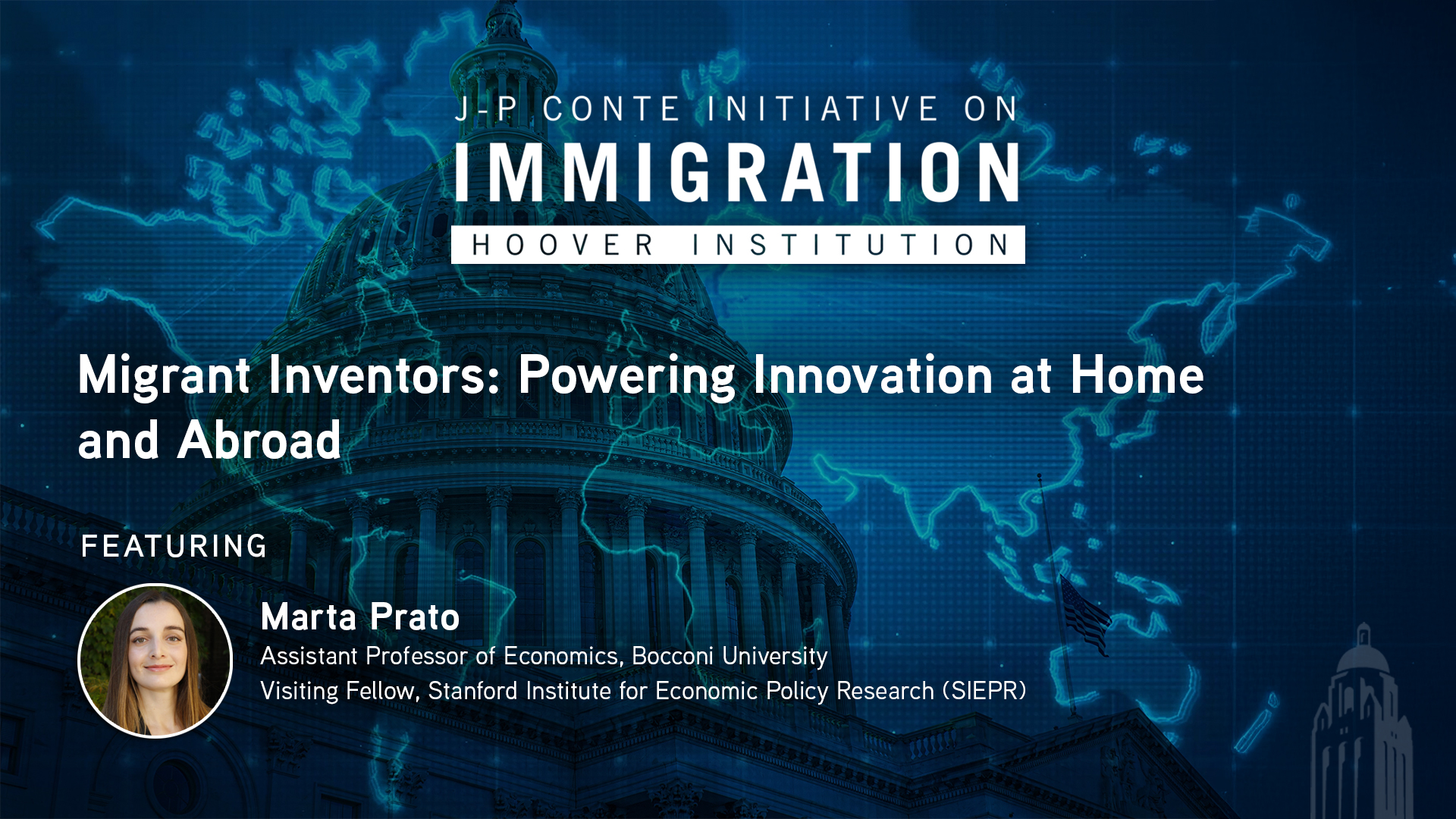
When talented inventors emigrate, does the origin or destination country benefit? Economist Marta Prato explains that inventors who come to the United States become more productive — and remarkably, so do their former co-inventors back home, through ongoing knowledge sharing. These immigrant inventors, who now account for one in five US patents, create a two-way flow of ideas that strengthens the American economy while benefiting their countries of origin.
- My name is Marta Prato. I'm an assistant professor of economics at Boon University, and I'm also currently a visitor at Stanford Super Center. And my research examines the effects of immigration on innovation and economic growth to understand the diffusion of knowledge across countries. In my study, I examine how inventors interact with their collaborators and also how their productivity changes when they move across countries. And so one finding in my research is that migrants tend to see an increase in their productivity when they move across country. But the most striking fact is that actually even their collaborators, so their former coworkers who are left behind in the home country also tend to experience an increase in their productivity when one of their co inventors moves abroad. And the reason for this is that often these migrants continue collaborating with their former coworkers in the home country, especially when they're both part of the same multinational company. And through this collaboration, the migrants share their knowledge, their new expertise that they've gained in the new innovation ecosystem in their destination country. And this knowledge sharing helps making the former coworkers in the home country more productive. When we are thinking about the effects of migration for sending countries such as the developing economies, but also many European countries that send a lot of inventors to the us, it's not just the problem of brain drain, but there are more nuances to that. In fact, in my research I document that knowledge that the migrants transfer to the home country is one force that can offset part of the negative effect of brain drain on the home country. And what I find in my research is that, for example, European countries would be worse off if they were to try to completely shut down the out-migration of their inventors if that were even possible compared to the current situation where it is true, they're facing a brain drain. So they're losing out on the direct contribution of innovation of those people that are living the country. But at the same time, there are benefit from the knowledge that is transferred back by those migrants. I also examined the effects of what would happen if the US were to expand their H one B visa program for high skilled immigrants. And the key takeaway from my findings is that the effects of this policy are not just about the number of immigrants that are coming to the US, but also about their skill levels, their expertise, and how they interact with the American workers. And immigrant inventors tend to be very highly skilled, knowledgeable, and expert individuals. And these knowledge and expertise also benefit their new American coworkers. And so as a result, as a result of these expanding the H one B Visa program can be beneficial as these immigrant inventors contribute to the innovative talent pool in the US to the n capacity of the economy and ultimately to economic growth. The key takeaway is that migration and migration policy is not just a zero sum game between sending and receiving countries and between immigrants and native workers. But in fact, when immigrant inventors come to the us, they're not just filling jobs, but they are bringing and producing valuable knowledge and expertise that benefits everyone, including to some extent their home country. And one important number to keep in mind is that currently in the US about one out of four of all inventors are immigrants. And these immigrant inventors have contributed to expanding the in capacity of the US and establishing the US as one of the technological leaders in the global economy. So policies that reduce high skill, immigration risk, slowing down US innovations in way that are hard to reverse. So the final message is that migration policy is not just about the movement of people across borders, but ultimately it's fundamentally about the movement of knowledge as well.
ABOUT THE SPEAKER
Marta Prato is an assistant professor of economics at Bocconi University. She is a research affiliate at the Center for Economic and Policy Research (CEPR), an affiliate at Bocconi's Innocenzo Gasparini Institute for Economic Research (IGIER), and a research fellow at RF Berlin. During the 2025-2026 academic year, she will be on sabbatical leave as a Stanford Institute for Economic Policy Research (SIEPR) visiting fellow. Prato also serves as a member of the editorial board of the Review of Economic Studies. Her research examines long-run macroeconomic trends in growth and inequality. Her work on economic growth investigates how the allocation of innovative human capital impacts innovation and productivity, both within and across countries, and how policy can enhance economic performance by improving talent allocation. Her research on long-run inequality connects to residential segregation and intergenerational mobility, studying policies that can tackle inequality and segregation while improving welfare. Prior to joining Bocconi, she was a Cowles Post-Doctoral Fellow at Yale University. She obtained a PhD in Economics from the University of Chicago in 2022. She holds a BS and an MSc in Economics and Social Sciences from Bocconi University.
In 2022, she participated in the Review of Economic Studies Tour. In 2021, she was a recipient of the EEA and Unicredit Job Market Best Paper Award.