The Hoover Institution hosted Defending Taiwan: A Strategy to Prevent War With China on Wednesday, April 22, 2026 from 12:00-1:30 pm PT.
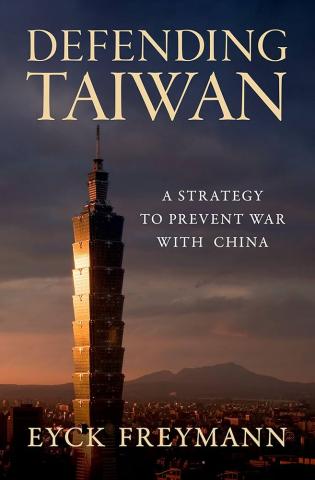
- Hello, I'm Niall Ferguson and I run the applied History working group here at the Hoover Institution and we've just had a terrific seminar from my guest, Eyck Freymann. He's a Hoover Fellow here and the director of the Allied Coordination Working Group. He's the author of several books including One Belt, one Road, and most recently Defending Taiwan, A Strategy to Prevent War with China. Ike, welcome. This is a timely book in in many ways, although eyes are on the strait of Horus. One of the points you make is that the Taiwan Strait is strategically and economically a more important, a choke point. So tell me how do we, how should we defend Taiwan?
- The first thing is to recognize that Xi Jinping is developing a battery of options that he can use against Taiwan in crisis as well as in war. Yes, there's the amphibious invasion scenario to put troops on the beaches and storm the capitol. There's also blockade scenarios where he could say, no one in or out, or I'll shoot. He can try to decapitate Taiwan's civilian leadership. He can bombard the island, he can cyber attack it, or there's a whole range of options if he's developing to move against Taiwan and what we could call the gray zone, this space short of war, but more intense than where we are now. For example, he could try to use legal tools and law enforcement like China's Coast Guard to seize the control over who and what comes and goes to Taiwan. Or he could coercively mobilize his forces on his side of the strait for what might or might not be an amphibious invasion and to see what happens. The United States needs an approach to deter all of these options because they're available to Xi Jinping in combination or in sequence.
- Now, how do you assess the current state of Taiwan's defenses and the American contribution to those defenses? Assuming that the full range of threats that you've described exists and could be executed in a relatively short timeframe, how well defended is Taiwan today and how well prepared is the United States to deter China from taking hot or gray zone action?
- Well start with the amphibious invasion scenario. The one that gets the most attention. I think Taiwan's readiness to deal with that scenario is better than most commentators assume. Even though Taiwan is only a fraction of the size of China, its military budget is around one 20th of the size. Taiwan enjoys real geographic advantages if only because the Taiwan Strait is a nasty body of water and there's very few beaches on Taiwan that are realistic to land and invading force. Taiwan knows what they've are and they spent decades fortifying those beaches. Increasingly in the last few years with covert assistance from the United States. The harder scenarios are ones where it's not just military pressure being brought to bear, but economic pressure as well. Taiwan has only around two weeks of gas reserves and yes they could. They could transform their power plants to burn coal or oil. Instead, at some point, if their energy imports are restricted, the lights would turn off and they would have to sue for peace. Beijing is building a stockpiling system precisely for this reason to show Taiwan that time wouldn't be on its side in any economic conflagration. And then the final concern where Taiwan would most need help from its allies rather from its partners is this indirect control what some call a quarantine scenario. If China says as a matter of PRC law, anyone who comes and goes from Taiwan must first clear customs at a mainland port. Well, there isn't really much Taiwan can do about that. FedEx UPS, the major shipping companies like Maersk, MSC, they don't want to pick a fight with the people's Republic of China and if they comply, what can Taiwan's government do? This is above Taiwan's pay grade. This is a question that the United States and others need to address for Taiwan.
- One of the striking things about this book, which I think is brilliant, is that you clearly delineate what a Chinese military attack would be like. There's a vivid couple of pages where you imagine the decapitation strike, but it's clear that you think the gray zone options are more likely than the military options because they're less risky for the Chinese Pxi Jinping. And I think what's really striking is that the United States seems to be very focused on the military threats and is preparing all kinds of deterrence. For example, operation Hellscape, which is something that's in the public domain, but we don't seem to have such good answers to what seem to you the more likely gray zone option. So let's, let's game this out a bit. Let's suppose the Chinese do use their coast guard to start asserting sovereignty over Taiwan's trade. They simply say from now on, since we're gonna consider you as we always have part of China, we do the customs. We decide what goes in and out of Taiwan. What's the United States reaction if that's the news one bright morning,
- Well, it's a good thing you're asked that question. China is trying to design it. So we would face three terrible options, option A, do nothing, pretend it's not that big of a deal. Why is this so different? If ships just have to make a port of call in the mainland, get some paperwork done and then continue on their way? The answer is that Taiwan in the long run would be checkmated. It would be impossible for Taiwan to modernize its military forces. Eventually, China could begin to claim control over the critical imports going into Taiwan to make the event semiconductors or even the export controlled semiconductors coming out and bound for the United States. But this wouldn't be a crisis on day one unless the United States chose to make it one. So that's option A, except that you're, that you lose in the long term that China takes the commanding hides of ai, but you avoid the short term crisis kicking the can. It's a thing that a cynical but possibly self-interested politician would do. Option two or option B is you can, you can escalate it up into a war. Theoretically the United States could just attack or we could manufacture a pretext to attack. I think it's unlikely that any American president would prefer that option, but it is on the table. China can't rule that out. And then option C, you can think of as the big red button on the resolute desk that says the economic and financial crisis that ends my presidency. Specifically the United States can disable or destroy the chip making facilities on Taiwan and it has the capability to do this that's well known. And possibly in addition, it could escalate with sanctions or other economic punishments against China. Now that would teach China a lesson. Maybe it would take this off the board, but it would, it would engender a huge economic shock, a stock market shock, possibly a bond market shock, a supply chain shock. It would throw the world into recession. It would not endear the United States to the rest of the world, and China is hoping that they can push us towards that option A. And every day that goes by that they increase the pressure on Taiwan that we don't choose is a little bit closer. We get it to option A.
- So you seem to be proposing an option D, which is preferable to surrender and blowing the world economy up or just blowing the world up. So talk a bit about your recommendation because one of the, the good things about this, but one of the reasons it's great applied history is you don't just diagnose, you also actually prescribe.
- I think we learned something valuable on liberation day in April of 2025 when the Trump administration put on tariffs of over a hundred percent essentially threatening to shut down all trade with China overnight. At first this seemed like a bold move, but it ended up backfiring badly because the stock market panicked. The bond market panicked. Captains of industry called up the White House and said, we'll have to shutter production. The country is going into recession. And just days later, president Trump found an excuse to reverse the tariffs and never actually put them back on. And that revealed to the world, including to China that the United States doesn't really have the option of a hard across the board decoupling. And if that's the case, then the only way to decouple is more gradually and a little bit at a time. So I introduced this concept that I call avalanche decoupling. The idea of an avalanche is it doesn't cost chaos and destruction on day one, but that you can trigger it at a time and in a place of your choosing and then it will gain momentum over time because it harnesses incentives and market forces and allows you to work with markets and the private sector and third countries rather than against them. The way that this would work is pretty simple rather than setting tariffs by tweet, setting them high and taking them off again, you start low and you ratchet them up in a predictable way but with no fixed end date. And ideally you would take that away from the president and Congress would legislate it to make it more credible, less likely that it would be overturned. And if you can do that, even just for one product like the critical inputs to make our medicines or legacy ships or drone parts, if you can do that and put that in legislation, you can send the signals to the private sector and to Wall Street, we're pulling this production out of China, you can find the best safe place to make that it, whether that's the United States, Vietnam or somewhere else, but this is going to happen. It's going to continue. You should start now. That's the way to decouple from China in a more reasonable way, a way that we can control and one that we could potentially do it without causing a financial crisis in the United States. That's politically unsustainable.
- You are recommending starting that process right now preemptively and it plays out over some years. Isn't the problem that the Taiwan crisis could happen really soon? I mean conceivably it could even happen this year after all. Why not now, from Xi Jinping's point of view, the United States is heavily committed to a war in the Persian Gulf, which is leading to its depletion of its most accurate precision. Missile's whole categories have been run down in the space of just seven or eight weeks. Isn't there a danger that the Taiwan crisis happens before avalanche? Decoupling has even become a policy recommendation
- As a risk. And that's the reason to start now, not to do it across the board because as we've seen, that's just not politically realistic, but as a starting point, as a proof of concept to show something that we might evolve and expand or accelerate if the situation demanded it. What I'm imagining is per Congress to say, take the 1% of US China trade, five to $7 billion a year of stuff that is really, really critical. The inputs we need to make our drones, it's crazy that we buy that from China, but the reason that we still buy it is if we stop buying it tomorrow, we couldn't make drones and say we are going to begin a crash effort as part of the next year's defense budget to start the process of bringing that back. And we hope that allied countries like the Japanese, the South Koreans and others would work with us by adopting a similar policy. If you do that, you can show China, even though that's only 1% of our trade relationship, if you create a crisis, we may expand that to 10%, to 30% to 60% or may, we may accelerate the avalanche, but we will be able to calibrate our response depending on what you do.
- One of the things that's been striking, at least to me of the past 15 months is that the United States' trade war with China has had the effect of significantly reducing China's exports to the United States and increasing China's exports to everywhere else. And it seems to me part of the challenge of your, your Plan D avalanche decoupling is getting allied countries, US allies to go along with it. You also argue quite interestingly in the book that there needs to be an Asian version of of NATO to create some kind of a military alliance framework and that that's like part two of your solution. But don't you sense that allies are looking at the United States these days through rather jaundiced eyes and it's gonna be a real challenge to get that kind of buy-in on the part of American allies, A to your economic plan and and B, to your idea of an Asian nato.
- It's a fair, we haven't done ourselves any favors in the way that we've treated our allies over the last year and things could get worse, and indeed they seem likely to get worse, especially in our relationships with our European allies. But if deterrence fails or if we are forced to the brink of a crisis or rupture with China over Taiwan, I think that will have a clarifying effect on our thinking and our allies thinking possibly it doesn't. And the whole architecture that is a sustained international order and prosperity and American power for the last 80 years comes apart and that could happen, but it's also possible that we will discover that in the heat of the crisis, we have core interests, vital interests that align with those of allies. And in fact, the only way to pursue them is by working together on the point of Asian nato. This is not an all or nothing proposition. Even if we don't get to a perfect NATO equivalent in Asia, should we do more with the Japanese or should we do more with the Japanese and the Australians on a trilateral basis? I think obviously the answer is yes, and the part of that means bringing these allies into our planning conversations, showing them that they're trusted, that their views are respected, and part of it is exercising more, building more interoperability between our forces. There's a whole bunch of stuff at the working level that we can and we should be doing. And whether or not that turns into something you call Asian NATO in the future, that's actually less important on the economic side. It's not just about allies, it's about the whole world. Because you're right, Neil, our imports from China on paper have come down since we put up tariffs, but according to the economists who've run the analysis, that's not actually true. We are importing the same amount of stuff from China as we always were, but it's coming with labels that say, made in Vietnam, made in Mexico, made in Brazil, or made in the European Union because arbitrage is a fact of life. It's a feature in every economic war between great powers in history. And if the United States stop starts to say, we won't buy from China, but we will buy more favorably from someplace else, you will create incentives for actors to lie to you about what they're actually selling. The arguments of the book is if deterrence fails with China as a matter of urgent national security necessity, we will need to work with as much of the world as possible to have eyes on what these supply chains are. Otherwise we will remain dependent and we'll be v vulnerable to sabotage or coercion or worse.
- Help me think through the timeline here because I, I remember when this topic first came into my life, which is more than 20 years ago, it all seemed quite remote habits had been formed since the 1970s of postponing a e potential change in the status of Taiwan and an elaborate complex of agreements, communicates and so forth had sort of put the the issue on the back burner. It's suddenly come right forward to the front of the stove in in recent years, and I have trouble figuring out just how soon the next Taiwan straight crisis comes. You've spent a lot of time thinking about Xi Jinping and the Chinese leadership more generally. When do you think they're most likely to take the kind of gray zone action that you think is their best strategy?
- Well, I think it's important to start with the facts that we are already in the gray zone and the gray is getting darker. That began before Xi Jinping, but he's a unique character because of his ambition, because of his personality, because of the belief that he seems to have that he's a grand historical agent of China's call it new imperial restoration. He wants to write his way into the history books. He wants China to achieve national rejuvenation, and he thinks that achieving what he calls reunification with Taiwan is the only way to achieve it. It's worth mentioning Taiwan has never been unified with the People's Republic of China, so it can't, strictly speaking be reunified, but that's the story that he tells. It's fundamental to his identity and he's building more assiduously than his predecessors. The capabilities to push personally, I think that if we can get through 2026 without a crisis, the chances of a crisis in 2027 will dip. Because as he's going into his next National Party Congress where he'll be up for a fourth term, he will have a lot of personnel work to do. Filling the People's Liberation Army with new loyalists, reshuffling the central committee, probably making sure that any potential successors are eliminated. I think he'll be consumed with domestic issues in 2027. Obviously the A crisis could flare up at any time. 2028 is the year I see as most dangerous, mainly because you have three big elections in 2028. Taiwan has an election, and then the Philippines and then the United States itself. This is a time when I think Cxi Jinping will be maximally confident and secure at home, and one in which our own politics will be the most volatile. If I were him, that's when I would push
- One of the most striking polls that I saw last year asked a representative sample of American voters, if China imposed a blockade on Taiwan, would they support the US Navy trying to break that blockade, even at the risk of war between the United States and China? And very nearly half of those asked said they would support that, and 51% of Republicans. Do you think there's a danger that we are underestimating the hawkishness of the American public on this issue and also the growing hawkishness of the Chinese public? 'cause polling that I think I saw in the economist last week pointed to an increasingly hawkish mood in China. Do we, do we kind of see these two nations sleepwalking towards conflict without their leaderships fully appreciating how high the stakes are?
- There's a risk of this, and you know, we've spoken about this for years and the lessons that history can teach about how the American public responds to these kinds of cases. As a historian, I can't think of a case in history where an American president wanted to lead the country to war, and the American people said, no. Historically speaking, the American people can be, even if they have to be misled, they are brought along for the ride. But when we ask the question of what would the American people do, what would Donald Trump do? What would Taiwan do? This is a dangerous question because it's a hypothetical question, and history doesn't present people or countries with hypothetical questions. History presents choices in context. The question that I have is, depending on how this crisis scenario comes on, will the American president, will our elected officials communicate to the American people what the stakes are, what they are willing to sacrifice, what they think we as a country should be willing to sacrifice and what the possible futures may look like on the other side? That's a difficult exercise in political communication. It's one that our leaders have basically punted on for the last 50 years. They might be call called on to make that case soon and suddenly. So thinking through these questions about why Taiwan matters to the United States, why losing control of the AI revolution, if China can take the fabs would be a disaster to our kids and their future. Why our alliance structure falling apart would mean the end of American power globally, not just in the Western Pacific, and would put our hemisphere risk. Talking about these questions, helping people to understand that will support I think, a more sensible public debate if and when China does force the question.
- Well, I congratulations on the book. Our colleague Philip Zuko, who's quite an authority on this subject, said earlier today that this was the best book on the subject and a remarkable achievement because it's not easy to write a book about a live strategic issue. Congratulations on it. It's gonna have a huge impact. I'm convinced it's going to shape the debate, not just this year, but right up into 2028 and beyond. The book is defending Taiwan, a strategy to prevent war with China, and we'd be very fortunate to have Ike fryman here with us at the applied History working group here at the Hoover Institution. Thanks very much indeed for listening to this interview and do by the book. I couldn't recommend it more enthusiastically.
- Well, good afternoon and welcome to our latest Hoover Applied History Working Group seminar. It's a great pleasure for me to introduce Ike Fryman, who's a Hoover Fellow here and director of the Allied Coordination Working Group. He's also affiliated with the US Naval War College, the China Maritime Studies Institute, the Columbia. There's so many here that it would be a waste of time to list them all. He's held, held fellowships at Harvard where he once upon a time was my undergraduate student. He saw I may survived that. He has four degrees in history and China studies from three different universities, Oxford, Cambridge, and Harvard, and he's the author of several books. One Belt One Road was the the debut book in 2021. He co-authored a couple of books on day one with Hugo Bromley and the Arsenal of Democracy, which just came out very recently with Hoover Press co-authored with Harry Haem. He's here today to talk about his most recent book, which is just out defending Taiwan, a strategy to prevent War with China. He's gonna speak for about 20 minutes. Then our colleague, Philip Zuko will offer his comment and then we'll open it up to the room. And as usual, if you want to attract my attention, you can raise your name tag like that or otherwise gesticulate. Those participants who are joining us over Zoom can attract Joseph's attention if they have questions to ask. We've got about an hour and 10 minutes the minute I shut up, so let's get to it, Ike.
- Well, thank you Neil. Thank you everyone for coming today. It's a pleasure to see so many people in the audience who supported the book as it came to be. This is a creation of Hoover in the sense that it would not have been possible without the collaborations that began with Neil. Through the applied history working group, Neil helped to support my first visits to Taiwan, gave feedback on many working drafts along the way. Philip who first put in print the quarantine scenario and helped me workshop these I these ideas with policymakers. Larry Diamond, who's not here right now, and his group as well as Glen Tifford, Francis Hissin, Admiral Ellis, and so many others. Thank you. Thank you all I I'm glad that for a book about deterrence, we've deterred all of you from sitting in the center table that anyone who's coming in you should feel
- Area access to
- Not. You should feel free to grab a seat closer to home. I just wanna speak for a few minutes so we can get into the q and a. I hope this can be an interactive conversation and I want to talk not only about the book itself, but some things that I think we've learned about the ideas in the book over the last few weeks as we've watched the crisis in Horus play out. The argument of the book is straightforward. Taiwan is the place where the uneasy piece between the United States and China will be tested and possibly broken. This is not a new issue. It goes back to the very beginning of the history of the relationship between the United States and the PRC, but it has become increasingly important, not least as Taiwan has developed a world leading semiconductor industry that is now the center of this ongoing AI revolution. And it is a place that has grown increasingly fraught over the last few years as China has used a variety of gray zone tactics to coerce you as allies and partners in the region, making clear that China believes it is in a new phase of strategic expansion that it hopes will result in the United States effectively being expelled from the region and US treaty alliances that have stood the test of time since the 1950s being weakened if not entirely dissolved. These are the stakes and Xi Jinping is building a full array of options to move against Taiwan. The easiest to grasp is the amphibious invasion scenario, but that's not the only one. He has options for bombardment with missiles and drones that can range Taiwan. He has options for blockade using ships, aircraft, submarines, drones, mines, and other tools to control the flow of people and commerce in and out of Taiwan. He has a legal apparatus that he has been developing as well as a coast guard and a maritime militia to enforce it, which could use subtler methods to constrain the flow of commerce without using using physical force. He also probably has united front agents on Taiwan that could engage in sabotage or even decapitation attacks. He has cyber options and he's developing these options so that he could use them if desired in combination or in sequence. So if the United States wants to deter a devastating crisis over Taiwan or a war, we need an idea for how we will close off each of these pathways to victory for him. We need to think deductively through all of the possible scenarios. And because Xi Jinping has a strategy that integrates every tool of China's national power to achieve these goals, we need to think through how our various tools of national power, not just military but diplomatic and political, technological, economic, industrial and beyond, could be combined to deter him across these full range of scenarios. It's hard to know that much about season Ping the man. He's a secretive type. He speaks and riddles all of his public commentary on this issue is very carefully scripted. But we do have an idea from the way that he has operated over the last 13 years in power that he is methodical. In some senses he's cautious, but he is also incredibly ambitious and possibly opportunistic and moments where he believes that he can seize major gains without encountering resistance. The most encouraging thing that Xi Jinping has revealed in the last 13 years in power is that he's deter, that he is deterring because he has been deterred so far. The task of deterrence is not to foreclose the option of seizing Taiwan so much as to persuade him that today is not the day and therefore to wait him out one day at a time. Why does seasoning care about Taiwan there in the popular understanding? I think there is a misconception that it is largely about chips, but it's not because China cared about Taiwan long before semiconductors were even a story. China, and for seasoning in particular, the question of Taiwan status matters because it is fundamentally about what China means whether there is such a thing. That is one China that includes Taiwan with the Chinese Communist Party as its undisputed leader. And in his point of view, China, the Chinese Communist Party will never be fully secure until the international community accepts that principle. And that's why he's not only approaching this as a military problem, it actually matters very much to him whether the UN general assembly and international institutions are willing to stand behind his principle. And I think we would expect that in any crisis, a crisis short of war, as well as actual kinetic conflict, there would be political and legal warfare that would be playing out in addition to other aspects of the crisis. As he tried to marshal China's friends across the developing world in particular, to take his side is fundamentally a legitimacy argument. The another reason that he cares about Taiwan is that c Bing has a political program which he calls national rejuvenation, which he's promised to achieve by 2049, the hundredth anniversary of the CCPs seizing power on the mainland. He's described Taiwan's, quote unquote reunification as an essential prerequisite to the completion of national rejuvenation. But it's important to note that while Taiwan might be the keystone in the arch, it is not the whole arch national rejuvenation is a staggeringly broad and ambitious political project. It wants to put China at the forefront of human endeavor in literally everything from technology to sports to cultural flourishing. It wants to complete the project of making China green and ethnically harmonious. Taiwan is part of that. Why is Taiwan so essential to it? It's because the way in which Taiwan's status is decided, not just the question of Taiwan itself, but the way Taiwan status is decided is in so many ways a litmus test of the United States' willingness and the US outlier structures ability to stand in the way of China as it pursues its national rejuvenation goals. And that's why from the perspective of the United States, if you look at our longstanding one China policy, the concern of the United States is not that Taiwan status will be determined any particular way. Our concern is how Taiwan status is decided. We want it to be done peacefully without coercion, including economic coercion and in a manner that's democratically acceptable to the people of Taiwan because we understand that the stakes of how Taiwan status is decided will extend across the region and ultimately shape the world in which our treaty allies live. And this incredibly important, increasingly important global economic space upon which our most critical supply chains depend. Let's talk a bit about scenarios. I argue in the book that gray zone scenarios, which we can essentially think of as being the the full spectrum from where we are to the outbreak of kinetic conflict is the locus of season ping's attention. It is where we are most likely to be tested and it is where we are relatively speaking, less prepared. The military contingencies are serious. They have gotten harder in the past couple of months as we have expended so many of these air defense interceptors and long range precision munitions in the Middle East. But fundamentally pulling off an amphibious invasion is an extremely difficult proposition. It requires many things to go right. It's intrinsically costly, highly risky. There's many reasons that Xi Jinping would prefer to take Taiwan for free, take Taiwan without a fight with its semiconductor fabs intact. In some senses, in some of these crisis scenarios, that could even be more of a humiliation to the United States if it is seen abandoning Taiwan entirely than fighting and ultimately being defeated. When we think about these gray zone scenarios, there are too many to list because there's all these tools that can be combined in different permutations. I highlight two. The first is the so-called quarantine or indirect control scenario that Philip highlighted with Bob Blackwell in what is it a 2021 CFR report. The idea of the quarantine is it's not a blockade, but China would use law fair measures. It would assert a legal right to control who and what comes and goes to Taiwan. And then it might use various law enforcement threats to coerce the private operators, FedEx and UPS and me and MSC that carry the people in goods to and from this island just to comply with PRC law. And if they do that, if they ae to the principle that Beijing gets to say who and what comes and goes, and the United States accepts that as a new normal, Taiwan is effectively checkmated because over time Beijing can turn the screws. Taiwan will not be able to modernize or adapt its armed forces. Taiwan, China will eventually be able to control the flow of chips and all of the critical inputs involved in making the chips and Taiwan will at some point be forced to accept some humiliating political agreement that neuter its effective autonomy. Another option that is available to Xi Jinping is a coercive mobilization. He can get ready for an amphibious invasion and just see what happens. Maybe taiwan's morale cracks, maybe the American morale cracks, maybe there's some kind of financial shock. And the cracks appear within the US alliance structure and then he can exploit that and he never actually has to use the force. He's building these amphibious forces as well as blockade capabilities and nuclear forces and the rest because he can get coercive value out of them without actually having to use them. And we, if we think about this situation in this way and we think through the effects on the US alliance structure, on our domestic politics, on the credibility of our alliances globally, on the possibility of a financial shock of the supply chain shock, when we realize just how ugly some of these crisis scenarios can be, the only conclusion is the object of our policies should be to deter the crisis, not just to deter the war. Because if you can't deter the crisis, you invite the crisis. How do we pull together these tools of our national power to deter the crisis? I'll just hit them very briefly. The first is political and political deterrence has three parts. How you handle Taiwan, how you handle mainland China and how you handle your allies and by extension the rest of the world. For Taiwan, my view is we should offer relentless private pressure to continue to expand their defensive capabilities to build resilience stockpiles on the rest but not public pressure. We need to respect that Taiwan's a democracy that must in the end make its own choices that will require a lot of discipline, particularly as Taiwan heads into a new presidential for China. It's just three magic words, one China policy. Now the content of those words is ambiguous, complex. Different administrations emphasize different aspects of the one China policy, but that term one China policy has a sort of totemic value in our relationship with China. Meddling with the policy itself is dangerous. It's better to say we are fully in line with our longstanding policy, which has not changed, but we will emphasize or de-emphasize certain aspects of it. The way that I would encourage modifying communication, the policy is pointing out to Beijing that just because we are strategically ambiguous as to whether we would go to war with Taiwan doesn't mean that they're pushing on an open door in the gray zone. And that if they continue to push by salami slicing their way towards something like a quarantine or something like that, or by mobilizing their forces for what may or may not be an invasion, we will not sit idly by and hopefully you as allies will not sit idly by and wait for Beijing to make a decisive first move. We will respond proportionately in a manner of our choosing, in a demand of our choosing in the gray zone to create an overall stable equilibrium situation. And hopefully that is a way of deterring season ping from pushing the current part of where we are in the gray zone, which you could call mid gray to something darker and darker and closer to black. A scenario that risks miscalculation and escalation. The second pillar of deterrence is how we get our military in shape to show that we could defeat an amphibious invasion into the 2030s. There's a whole lot of nuts and bolts in how that is done. We can get into that in the q and a if you'd like. The third is strategic deterrence, which is not just about nuclear weapons, it's about this cross-domain nexus of space and cyber and ai because increasingly it's clear that nuclear forces can be held at risk if the command control and communications apparatus can be cyber attacked or if the satellites that play such an essential role in these architectures can be threatened. This is why at some point, and I don't know exactly how, but at some point the regulation of AI or the arms control or whatever you want to call it of AI, will become central to the strategic balance. This is not an issue that is well understood or theorized, but I do think that Taiwan probably plays a role given the central role that Taiwan plays in producing the compute that drives the AI revolution in the first place. And then the fourth and final pillar of deterrence is economic. We have this way of thinking about economic deterrence, which is just sanctions. It's a playbook we've developed in the Russia case, in the Iran case, in the Venezuela and North Korea cases. We know the legal authorities, we know how it works and it's tempting to say, well, China, if you cross our lines, we'll throw the book, but you will use the same sanctions tools that we've used against others. The argument of this book, which built on work that I did with Hugo Bromley with support from Larry and Philip and others argues that is not credible. It's not credible even in some extreme cases. And it's certainly not credible in most of the gray zone cases because if there is some kind of crisis and that financial and economic reaction is already bad, the politics will not point to making that bad situation worse. And the question the United States will face is if we are confronting the possibility of a long-term attritional economic struggle with China, who is going to win that contest of endurance? The totalitarian communist state with huge stockpiles or our coalition of democracies, we need to flip on its head the way we think about economic deterrence and rather than thinking about ways that we could punish China, maximize punishment of China in a way that would also hurt ourselves, start thinking about it as what kind of world or what kind of international economic system we would need to create for our own interests if deterrence failed over Taiwan, if China revealed that it could no longer be trustworthy as a supplier of critical components, whether that be medicines or drone parts or chips or the rest. The process of thinking about these questions is no small exercise. It goes beyond the responsibility of N one agency in the US government. We're imagining how global economic order would be reconstituted. And you know, it takes a certain amount of hubris for someone of my level of seniority to even be opining about it. But what I wanna argue in the book is we have to start having those conversations now because if China reveals itself to be an unreliable player, if they cross our red lines, however we choose to define them, if we decide we need to decouple from China for the interest of our own economic security, not necessarily a hundred percent but 50% or 20% or 5%, how can we do this in the context of an integrated global economy where China sells to Indonesia, which sells to Brazil, which sells to Mexico, which sells to us, how do we know we won't be importing China's goods and parts but with made in Vietnam or made in Brazil or made in Mexico, written on the label, redesigning the international economic system in a way that recognizes that there's no world in which everyone decouples from China fully and simultaneously means imagining a web of overlapping economic security agreements that we would have to develop over a period of time and through which we would evolve the current international trading and financial system into something that worked better for our economic interests. But as we saw in liberation day, it can't be achieved by flicking a light switch or posting a tweet because we don't have the political commitment or endurance to do that. Any peace time scenario I think, or even any gray zone crisis scenario. So if you put these pieces together, what does it mean? It means we need a, an entirely new approach to gray zone's, deterrence and the anchor of our gray zone deterrence has to be economic and political rather than primarily military. It has to show China that we will match them point for point, that we will not give them the excuse that they may need to escalate to war. And if they try to push the burden of escalation onto us, that we have a set of tools that can be calibrated to push the burden of escalation back onto them while deterring escalation from the the darkest moments of crisis to a war. I wanna pause here because I want input from Philip and from others. I just wanted say thank you to everyone in this room for your attention and I'm looking, looking forward to getting into the conversation.
- Thanks very much a
- Philip. So where I wanna begin is, first thing, it is really hard to write policy books. It's hard because the, the timetable involved in producing a book means that often the policy issues move in a way that your book is superseded by the time it comes out or shortly after that. And the book or the book has no shelf life. So you're discouraged from undertaking the enterprise to begin with. Then if you try to write the book, you have to write the book at a level of professional policy analysis. Mostly people who write such books don't know how to do professional policy analysis. They do it poorly. For the handful of people who actually can do good professional policy analysis, they find that actually it's very detailed, requires a lot of analytical exposition and average general readers don't wanna read it. So it's heroic in a way to undertake a policy book of this kind. And then therefore it only deepens my appreciation of what Ike has pulled off here. This is the best policy book on Taiwan ex extent, and Taiwan is the most serious national security danger confronting the United States in the world today. So that though, that that is true in that I did this heroic undertaking, running against the headwinds I opened up with, I think deserves another round of applause.
- Yeah, yeah.
- So my comments on this are actually gonna engage Ike and then some here at in a fairly professional way. So I'm not gonna try to dumb this down a little bit 'cause the issues are very important, somewhat complex and not well understood including by many people in the area. I want to touch on the issue of risk and timing. The, the scenarios, the pillars and the strategy. Just I'll go through this, try to be fairly lucid and concise. First, risk. Risk. What is the risk? As I and some of you here know very well, they're basically the two schools on XI and China. There's a school that worries a lot and the school that says you don't need to worry so much. A number of us here are extremely familiar with both these schools and the arguments on both sides. So you can argue Xi Jinping round or flat according to your lights. Ike doesn't attempt to come down hard except to say, well, I don't know, but there's a risk and it's a big risk. That's the right conclusion. There's a risk and there's a big risk. And we don't know, I think in his introductory remarks today, so he can argue at round or flat, we don't know. So you gotta play, you gotta play as if it might be big. So then that raises the issue of timing. There is a set of schools of thought on timing. There is near term risk even to the point of this year or next near term. There is a school of thought that says, nah, 20 28, 20 29 for various, for various reasons which a number of us here know. Well then there's a school of thought is, oh there it's always gonna be a few years out because they're indefinitely kicking it down the road. But 2049 is suitably airy. And here again the answer is don't know about the timing. It could be near term. I think if I may say my impression that Ike's view say on this question a year ago was Ike was more in the 20, 28, 29 or maybe further out. We have some time. It's, I'm not sure where, where Ike is on this today. He, I, I mean it's a genuine question is I, I sense your views are constantly turning this over and you're watching what's going on in the world and you're seeing the various ways windows are opening or could be closing in certain dimensions and and what we do know from history is that dictators sometimes recalculate these matters quite rapidly for reasons that are invisible to outsiders and it actually overturn the views within their own government in very short order. And this has happened over and over again. So you have to worry about the near term problem. Second area, the second major subject that's worth calling out is scenarios. So the world is focused on invasion and blockade. 85% invasion, 55, 50% blockade. Gray zone is regarded as pressure tactics and kind of, well you know, we need to be stalwart basically and gets a little attention 'cause we'll just need to be stalwart. Very important to notice Ike's argument. It's really Ike's argument emphasizes gray zone threats over the invasion blockade threat, the gray zone threat is highly actionable even in the near term. Then more importantly, which gray zone threats exactly, he calls out two, he calls out coercive mobilization, which I don't regard as a terribly threatening scenario. I think actually could be more counterproductive than threatening but Chinese might not agree. And he calls out the, the the gray zone scenario I highlighted, which is we called quarantine in 2021. I have a abandoned that term shortly thereafter. Moved to indirect control as Ike knows the rea, the the no the terminology is important. The reason I abandoned it is 'cause people now who write about quarantine all the time, merge it and blurred in their minds with blockade and the situation is hopeless. They disregard it as a selective form of blockade, which it is not. It is not indirect Blockade is a form of coercion. I'm gonna strangle you so you'll surrender. Quarantine is basically presented as a selective blockade to coerce you to surrender. The indirect control scenario is a completely different scenario. It doesn't involve coercion to surrender. It doesn't even involve coercion at all necessarily. China's only inter taiwan's only international legal status is as a separate customs territory under the WTO. That's it. Separate customs territory of whom you might ask the Chinese have an answer to that question. And a lot of conventional international law understood by many countries would support the Chinese answer to that question. Hong Kong is a separate customs territory under the WTO in 2020. The United States government announced it would no longer recognize Hong Kong as a separate customs territory under the WTO and it would from now on treat. The PRC is having full custom sovereignty over Hong Kong. We said that was purely a US decision didn't affect the WTO status. Someone must have reminded them about Taiwan status. We did that six years ago. China could do the same to Taiwan tomorrow saying that Taiwan no longer has full autonomy over its external commercial relations. It would not be hard for China to figure out how to make that argument if Taiwan lost its status as a separate customs territory from the PRCS point of view, many things would follow from that. None of which automatically involve the use of kinetic force at all. And what this does is it doesn't blockade anything necessarily. It just means that anyone who ships to Taiwan ships to Taiwan under different rules which TA the PRC can selectively choose to enforce the way it chooses to enforce other things, diverting things to the mainland for customs clearance as needed and so on. Now it's just really important to understand this is not a quote pressure tactic to get Taiwan to surrender. This simply changes the status quo regarding Taiwan's commercial relations and then many things would flow from that over time. Ike recognizes this point and this it's important, I'm dwelling on this for a moment 'cause the whole chapter on gray zone is pressure tactics, pressure tactics, pressure tactics including the introduction of this measure. But I then points out at the end of the paragraph, a quarantine may not be a coercive diplomacy exercise designed to force Taiwan's immediate capitulation. Instead it might aim to, and here he puts it in italics incrementally establish the norm that Taiwan no longer has full practical control over its economic interactions with the outside world because you've now affirmed the PRCS economic sovereignty over Taiwan, which will have many consequences including who has sovereignty over the AI revolution. So that's great. So but again the call out, the key point for Mike's work, gray zone, most important danger and then within gray zone he believes this is one of the two leads in my view it's the number one lead and I think I'm not the only person involved in these issues who holds this view. So almost a hundred percent of the public conversation on invasion blockade, this is the most serious threat and this is the most serious form of threat and it's not in the public discourse at all. So then you go to the, the turns measures, you see the Ike does a very good job in the book of handling the military and strategic measures that are associated with the invasion blockade scenario. And I'm not gonna go into that because I think that's actually, I think they actually fundamentally the US government, a lot of the US government fundamentally agrees with his characterization of invasion blockade. He treats blockade in a way that would get it very quickly up to war. If you read the way he analyzes what we would do about it though it, it's an extremely challenging version of the war actually in some ways more challenging than the invasion 'cause it involves mainland targets and things like that as he points out. And then the US government's approach for how it handles and he has a list of what it should do. I think the US government is on track to try to do many of the things he discusses. So in that sense, from a policy point of view, we're in good shape though we may not be doing things just right or rapidly enough and so forth. So then it's worth then focusing on his political pillar where he wants to substitute strategic ambiguity with structured ambiguity, which he briefly alluded to here. And by the way, I think his argument on that is sound and inter and creative and interesting. You're left then really with focusing on the economic deterrent pillar. And here I wanna call out a key analytical contribution of the book. If Ike is right, Ike basically says your standard recourse to massive sanctions on which the Biden administration by the way tended to wave at is ill analyzed and probably will not work and you won't be able to implement it. I think his argument on that is very powerful. He makes a further argument that another stock answer is, which is the maloca straight blockade also won't work for various reasons. He could emphasize he does hit it. He could emphasize even more that basically if everybody gets blockaded that way, it hurts Japan, South Korea and Taiwan much more than it hurts China and much faster. So, and and they would figure this out. So you're then left with, okay, where's what's my economic pillar? He then hits very hard working using the work he did with Bromley, the idea of the economic security cooperation board and avalanche decoupling. I think this is a terrific set of arguments. It was creative and on day one it's still very strong. He basically, he and Bromley worked this up in a period when they didn't know that what the Trump administration would become. And now you see what the Trump administration become and boy this is now a tall hill to climb to get to back to the policy approach he has in mind. Now then where does that leave you? If your lead threat is this gray zone threat of this particular kind and your lead deterrent pillar to counter that threat is the political approach he outlines then plus an economic deterrent approach that can't rely casually on sanctioned slash malaka. That has to rely instead on something more akin to the a pre pre-crisis planning. He made this great comment by the way about deter the crisis, not just the war. Terrific point. And then that works you towards this economic security cooperation concept in the avalanche decoupling concept which is very advanced thinking about core cooperation among our key economic partners from which the Trump administration is currently steering at kind of a 175 degree angle away. So then you're saying, okay, if that's what's going on, that's the lead danger. These are our lead counters, that's the condition of the policy on the lead counters. We're in a world of hurt potentially. And then you have to hope that it's not in the near term. So then what's our answer then to world of hurt? And this is actually a big important point that is, what is the grand strategy of the United States if we actually don't have a viable strategy for the lead threat danger? I believe the view, I think the Biden administration tended to have a grand strategy towards this of appeasement and delay. They don't use words like that of course, but appeasement appease the Chinese enough so they will not want to do anything that does a big change in the status quo. And we kick the can down the road for another few years at least we won't be in office. And I believe the Trump administration has adopted funda the same generic general approach. Their notions of how to mollify China are different in detail, but the idea of mollifying China so that they'll not, they won't do anything radical to change the status quo in the near term. While meanwhile we have our military buildups and do all the things that will eventually close the window of opportunity for China if the Chinese will just hold still long enough and be mollified long enough to make all that work out. And then I don't have to worry about the hard problems. People like Ike fryman are posing to me. And that in a way is the the strategic core strategic conundrum that I think Ike's book presents.
- Thank you very much. Well I'm sure there are many, many questions and I remind you to attract my attention or Joseph's by raising your flag. I'm gonna kick it off. I agree with Philip, it's a tremendous achievement, this book. And so I'm gonna go to some of your specific recommendations that we haven't really dug into towards the end of the book you seem to be arguing for an Asian nato, which I think we should call ito, the Indo-Pacific Treaty organization. And that's, that's sort of the mechanism, institutional mechanism to make avalanche of decoupling happen. As I was reading the book, I kept thinking the historical analogies here, which are occasionally explicit are 1940s ones. It's sort of we we need a, we need an alliance, it needs to be treaty based. We also need something like a Marshall plans that their economic incentives and maybe you need Carl Vincent's two Ocean Navy act or something similar to beef up American military capabilities. But I wonder whether we are capable of these 1940s style efforts. You know, my views on American fiscal constraints, I won't go on about those. It feels to me like who joins ITO is the question. I can see Japan doing it and maybe also Australia. But who else? The incentives look totally different from the ones in the 1940s. 'cause what do the Soviets have to offer really? Well the Red Army, but China has to offer massive trade, which seems to me like a pretty strong argument against joining Ito. So that, that's really my key question. My follow up question is if a lot of what you and Harry wrote about in Arsenal is happening that the United States is getting its act together, what does Xi Jinping think Sam Paro is doing? What does he think our plans are and have we thought through how he might react to the perception of a rapid change in American attitudes towards deterrence and also compelling. So let me start off with those two questions and then we'll turn to others, including of course Larry, I'm glad to see his join us.
- Well thank you Phillips with this very generous and detailed comments and thanks to Neil for the questions. Lemme try to answer Neil's question in a way that addresses some points from Philip's comments. The argument of the book is that we need to build a core coalition and that coalition I believe should comprise essentially the Anglophone countries plus Japan, Canada because you know, abuse them though we though we like to, we are in a free trade zone with them. We are not realistically going to decouple our economies from Canada and therefore we are in the same boat on economic security. If deterrence fails over Taiwan, Japan, well it's quite obvious for Japan, right? They're for them Taiwan is existential and they now acknowledge it publicly as such. Australia, which has been with us through thick and thin in which we've learned, in which learned in the Pacific War, that the American alliance is of vital existential significance. And the UK, our best friend in the Euro Atlantic, which happens to be deeply, deeply financially intertwined with China and which would therefore suffer a devastating financial shock if there were to be US China decoupling in any form. Because what do HSBC and Standard Chartered, essentially the UK's two largest financial institutions do? Well what they do is they intermediate trade between China and the rest of the world. So any kinetic scenario in the time went straight. Any scenario in which the United States is imposing sanctions on China, decoupling from China in any meaningful way the British are involved, whether, whether they like it or not. And it's not as if the United States out of Coldheartedness could just let the British come to harm and then avoid a UK financial crisis spilling over to Wall Street. The European Union is fundamentally a different case because it's a block of 27 countries that decides things by consensus, at least in economic and sanctions and trade policy. They do things by consensus. 27 people can't figure out what to order for dinner, let alone how to decouple or weather to decouple from China. So I think you can't count on the Europeans to do any particular thing. And the Southeast Asians, which include treaty allies like the Philippines and Thailand are also in a difficult position because they are subject to such overwhelming and asymmetrical coercion by China. And South Korea, in a sense is, is part of that category as well. You would hope for partial cooperation, but you can't know any of this, what the character of that cooperation would be. But with this so-called core coalition of the US Japan, Australia, uk, Canada, we're talking about 40% of global demand and roughly half of global defense spending. That's a big enough block to work with at least to start. Now not all of those countries would necessarily take exactly the same positions, but I think the goal should be to align as much as possible on the politics, on the diplomatic communications to China and Taiwan in the gray zone. For example, if we have some gray zone crisis and the US is communicating one thing publicly and privately and Japan and Australia are communicating something very different, that is a huge credibility problem. It opens up our alliance to pressure because Beijing will then engineer situations that drive wedges into those disagreements in terms of military preparations and so forth. This is the basic coalition I think to involve in our military planning. Japan is not part of the five eyes intelligence sharing block. Japan is hustling to build the counterintelligence apparatus that would allow it to participate in a block like that. But we are moving closer towards, you know, operational integration between our armed forces, between an ability to share intelligence freely. And I think that process should basically be accelerated if we're talking about an Indo-Pacific NATO in some form in the purely defense or defense industrial space, that is essentially the block we're talking about when you're talking about defense, industrial defense technology, you need the South greens too. The South greens may not be reliable to do any particular thing in a Taiwan crisis, but for now we need their know-how to make ships. We need their industrial capacity, their high bandwidth memory to make our semiconductors. We completely rely on hanah to replenish our magazines for air defense. Interceptors, Ukraine depends on South Korea. So South Korea is in many ways part of that coalition when we're talking about avalanche decoupling and the economic domain, I think this is an entirely different thing, an entirely different thing. And thinking in terms of a, of a coalition or a rigid ingroup and outgroup is the wrong way to think about it. Because you know, I think about Elbridge Kolby, the under Secretary of Defense for policy going to South Korea and saying, will you pre-commit to doing the following things if China moves against Taiwan? And the South Korean said, are you kidding me? You won't pre-commit to doing these particular things. So why would we? You're leading, so why do you want us to be out in front in the same way, if the United States has no idea what it would do economically, if China moves against Taiwan, then none of our allies have any idea either. And in the event, depending on the nature of the situation, the politics of the situation, what China had done, what the risks were perceived to be, that the political constraints would move, and then in the moment we would know what was possible, what was not, product by product, sector by sector, technology by technology, we would figure it out and there would be a Venn diagram of what the United States was able and willing to do and would various allies were able and willing to do. And on the basis of that, you would figure out things that the US was going to do unilaterally or that other countries would do unilaterally. And then areas where cooperation was possible in groups of two or in triads or larger formats. When we're thinking about our economic response options for a crisis, I think this is the way to think about it, not not a specific package that is predesigned and preauthorized, like the British economic warfare plan against Germany was preauthorized in World War I and then they took it off the shelf and they realized it was useless because the city of London wouldn't go along. You need a flexible framework that will allow the precise character of the coalition to emerge through negotiation in the event. And more broadly, when I say an overlapping web of economic security agreements, that's really what we're talking about because I can imagine a scenario in which there's some kind of crisis. The United States says, well, for economic security we can no longer depend on China for the following 25 industries, legacy chips, medicines and their inputs, medical devices, drones go down the list and Japan says, well we agree with you on 18 of those, but we've got another set of things that we wanna decoupled in. And Australia says, well, we agree with you on this number and you at this number, but we have some other ones that for you need a basis for doing that. And then you need a basis for partnership with countries that are not treaty allies at all, but which you would hope would align with you on standards or some kinds of trade measures. For example, with Mexico or Brazil or Vietnam. These countries are never going to decouple 100% from China. That's fantasy. So if they're decoupling 10%, 30%, or if you just need them to enforce your rules of origin while you decouple by 10 or 50%, that is all gonna be subject to negotiation. And the way to think about this is an international economic order that emerges through a process of these sorts of negotiations over a period of time because that is the only way to do it. Because today, one third of global manufacturing value add lives in China. And you can't just snap your fingers and make that capacity move someplace else. The process takes years. So that is how, why we should be thinking about mechanisms that can be calibrated. Now why is this politically plausible? Because you're right in a context where the United States wants to do everything unilaterally and we're publicly dunking on our allies, it's and the, or we're politically divided and so forth. Why? Well, how is this even conceivable well be? The answer is you have to think about the alternatives which are really, really bad. First of all, what is the choice that China is trying to present us with in these gray scenarios that, or the indirect control scenario that Philip describes? They're essentially trying to present us with three options, option A, let Taiwan slip away while pretending that nothing is changing, which means in the long term we lose the compute, China sees the fabs intact, we fall far behind in ai, we are hollowed out economically. The rules of the road of the international economy don't change. We can choose to put up trade barriers and block out the world if we want, but basically China is charging ahead and the world has to continue with the status quo of openness to China's products and technology. So in other words, avoid the short term crisis but lose in the long term. Option two is escalated up into a war, which in principle we can do, but you judge for yourself about the willingness of any president to do that, let alone this one. And then the third is to essentially press the big red button on the resolute desk which says financial crisis that ends my presidency, which, and that option looks like disabling the fabs, which we can do kinetically or remotely. And then if we want to taking any number of bilateral measures against China. So China is Pres trying to present us with this choice three terrible options. And they're betting that we will keep picking option A because option A is the default option A is the do nothing option and therefore we will follow the path dependency into option A. And their strategy is to make option C, the big red button look as big as red and red as possible. And the basic idea of all of our economic security work and avalanche decoupling is to make the button look less big and less red.
- I'm gonna stop you there and 'cause you may preemptively answer everybody's question before they get to ask them. I'm going to go to two people who are leading authorities on this issue first, and then once they've posed their questions, we we will widen it out. The list at the moment, I think is seven names. Let's start with Larry Diamond and then go to Jim Ellis. Larry,
- Okay, I certainly don't claim lead le leading authority on this. I've never written a book on Taiwan, maybe on anything else that approaches this. But anyway, I'm gonna make four brief observations okay? And, and really brief and, and ask you to react at some point. The first is, I think we're approaching an analytic consensus that what, what looked like a long distance in time to crisis when Jim and I and and Ka were getting started with this Hoover project. You know, we were talking about a 10 or 15 year timeline. You know, the, the range you're presenting to us is like 20, 29 or 2030 is at the outer end of when a crisis or very significant strategic choice for the US comes. And so that's the first thing is I, I don't think this is, we might be able to kick it down the road, but the moment of truth is approaching the second is kind of an opposite perspective on this. When would be a better moment for China to play a coercive card than when most of our force was deployed halfway else around the world and we had, you know, emptied a lot of our strategic arsenal and we're in fact starting to lose a war of choice that we had in my view imp prudently launched. So I think it's rather striking that and revealing that Xi Jinping must think now is not the right time. They're not ready unless third, he's waiting to see what happens next mo month when he meets a president who I don't think has distinguished himself for his strategic vision and judgment. And maybe they are wondering what they can get in a private meeting with President Trump, in which the president may do what he did with Putin and ask that the notes of the translator be ripped up once the meeting is over. So I I'm a little bit worried about what happens next month when a weak, a strategically weakened president meets with a strategically rising self-confident Xi Jinping in China. The fourth and last point is, I think we must not lose sight of the way that what happens in Taiwan politically will, will, will shape the parameters and timing of this. And so she must be feeling very good about the visit he had from the KMT pretty pro-China chairwoman Chang Li wound, but we don't know how long we're talking about this internally, she's gonna last as chair of the KMT because there's a big division within the party. And it seems clear to me he's waiting to see what's gonna happen in the January 28th presidential election. I mean, it's now sufficiently closed, you know, barely a year and a half away. So why, why take unnecessary risks if he might get a government that is much more one he can do business with. But if Chen is elected again to his second term as a president who is not only of the party that she doesn't think he can do business with, but is on the anti-China end of the spectrum of that party well beyond what, you know, the kind of posture that twen had, I think we're on a path toward crisis not long after the re inauguration of DPP President lies. So those are my thoughts. I don't know if you have any reactions to
- Thanks. I'm going to go to, if I can cope with two.
- Well thank you. I can, thanks for allowing us to be a part of your, your journey here at, at Hoover and the number of excellent publications that you've, you've produced we're proud to, to be associated with you and in some ways even get our names mentioned in dispatches here as so I appreciate that. What I really admire about the approach that you've taken, and I used this example yesterday in a conversation. I picked up some, some insights at the National Space Symposium, the classified session last week. And the what you've done is what they said needed to be done in, in another context. You're no longer writing about what we have to do if deterrence fails, you're instead writing about what we must do in order to ensure deterrence succeeds. That's a subtle but very important distinction. And and I commend you for that. Philip lets you off the hook by saying, you wrote this some years ago before the Trump administration. I'm not gonna be so kind. I think agency is still an issue here. How do we accomplish this? How do we go through the, the things that you've, you've talked about, you talked about the, the economic security coordination board. That sounds like something outta my condo association or something. I think you need, you need to need to go to, to a better marketing strategy than that. And I'll talk about that in a moment. You know, it reminds me of the old aphorism about how you deal with the submarine threat in the second World war. And the scientist said, well, it's simple. You just boil the ocean and that would force all the submarines to come to the surface. And they said, well, how do we do that? And he said, that's not a science scientist problem. That's an engineering problem, not in my field. So I don't wanna let you off with that kind of a, kind of, we need to think about that because as has already been pointed out, and Larry has has said so eloquently, the conditions aren't ripe for that. Supernational organizations wr large are in disrepute, the, the collegiality that would be be necessary to bring the financial, the manufacturing, the edge technologies and the, and the energy sectors together in a cohesive way. This is gonna be doggone difficult. And so I'm interested in your thoughts, not in an accusatory sense, but how would you think about that? And, and I can acknowledge that as we saw in the, in the beginning of the second World Wars for, from an American perspective at least, that, you know, public opinion can change overnight and things, dramatic events can, can bring that to the fore. And you know, whether it's awaken the Sleep and dragon or, or or whatever. The America first movement, the first one went away overnight literally on on December 8th and, and so of 1941. So I think about that. The other piece that I'm interested in is I'm no longer sure that you're either, you know, that even title of the book is right because it's no longer just a Taiwan initiative. What you're talking about is dealing with the broader China threat, rich large for in, in a global context. And, and so, you know, it's almost as though if we do these things, we've got the beginnings of, or not the beginnings we're well along a path of, of defining a, a very, a very different future as we're trying to do with the, the, the commons initiative that Philip and and others are, are leading here. I mean in, in a sense that's what we're thinking about. When we began to discuss the Commons initiative, Philip was kind enough to describe it to me and said, I said, well where does national security fit? And I says, oh, it'll come along. Well what you've said is what we are doing and what we're doing addressing in the Commons initiative, the ideas of finance and manufacturing and edge technology leadership and energy supply. And, and that is the essence of national security in a sense. So we're designing a national security architecture on the fly and I think it's, it's gonna be broader than that. If we begin this with, to deal with the, the Taiwan crisis, I think we're gonna end up making Taiwan actually a lesser included case in that and I'd, I'd welcome your thoughts on that. I mean, the degree of difficulty piece, I, I don't want to overestimate it, but we all remember the, the Thomas Carlisle quote that, you know, the stumbling block and the path of the weak becomes a stepping stone in the, in the path of the strong. We need to lift our knees a bit higher, I would argue in, in all of that. And finally, to Neil's point, if we're gonna name the security architecture, I've been a proponent of a formal military architecture in the region for a long time. I would say ipso, a Indo-Pacific security organization, which in Latin means by itself and that means out without China. So thinking about that going forward, thank you.
- Excellent classical illusion there. Okay, two sets of questions. Ike timing, if not now, when, or is it just January, 2028? And then is it really just about Taiwan? Are you actually coming up here with the rudiments of Ipso
- On timing? My personal hunch is to agree with Larry that he's waiting until after the party congress, after the Taiwan election to decide how to move. This is not a man who in the past has taken risks in Party Congress years less time last time. Les, we forget, he locked everyone in their house for a year while he was reshuffling the central committee. I think given what we've seen in the pla LA, it's safe to expect that there's more purges coming. And if I were Cxi Jinping, I would much rather wait it out, get a new central committee, a new PLA leadership who I can pan pick and then get them in writing, giving me a, a mandate to push harder against Taiwan. That would, I think de-risk some of these scenarios in which he could potentially overstep his mandate and come up against internal resistance. But we will learn a lot based on what we see at the party Congress in terms of whether successors or potential successors are elevated. And we will learn more about his thinking based on the peaking knowledge of who gets, who gets elevated. 2028 is a difficult year also because there's a Filipino election and because we have a presidential election and I, I think that seems like the window where we're, our coalition will be maximally disorganized and he will be maximally comfortable taking risk. Obviously we need to be ready for something at any point, but I think that is the, the period of greatest, greatest danger. So let me get back to Neil's question 'cause I think I didn't answer it fully the first time. And it aligns with Admiral Ellis's question as well, which is how can, in the current context we even talk about an economic security cooperation board and all the rest. I would say, I would say this, I talked about these three options that China's trying to present us with. If deterrence fails in any way, the choices will be very, very, very bad. And any of those choices will involve major political costs, risk and consequences for the people making them. If you let China sees Taiwan and the fabs intact and all the rest, and you are teeing up further crises to come possibly imminently as Russia and China and other adversaries test our credibility globally, the question becomes are you prepared to deal with that? And if that then forces you to extreme economic measures, are you ready to take them? If we're actually contemplating sanctions, let's talk about some of these extreme scenarios. If you want to talk about inflation or taking away the economic futures of the American people, the fastest way to do that is a hard decoupling from China. We got a taste of it in those terrifying days after liberation day. I think it would be very difficult to imagine any political leadership taking that option seriously. So if the choice is reduced to essentially acquiesce, let China win and pay the long-term cost associated with that. If we do not have a bipartisan coalition that coalesces around another option, then that is the path that we as a nation are on and that may well be the most likely situation and we can all exercise our own judgment about how likely that is. What I'm trying to do is articulate that there is a way that we could go about resetting our economic relationship with China in a way that can be spun on a bipartisan basis as an opportunity and not just as a punishment. And the way to sell the opportunity is something like this. We made a series of mistakes over the last 40 years becoming economically interdependent with a state capitalist totalitarian regime that does not share our interests or our values and which wishes us ill and which wants to exploit our economic interdependence to blackmail and coerce us. And it has become an abusive relationship and we therefore need to get divorced or begin the process of getting divorced. And divorce is painful, divorce is difficult, divorce is expensive, but sometimes divorce is necessary and it provides an opportunity to think from a blank sheet of paper if we could actually reimagine what the global economy would look like in a world where China didn't automatically get to dump on us in every industry. If we got to bring manufacturing jobs back and revitalize communities that have been hollowed out, how would we do it? If we could bring millions of these jobs back? How would we do it? What, how would we do it in a way that would make our society whole more trusting it would repair some of the damage to our social contract? Now obviously you wouldn't do that all at once, but if you can present it in that way, that is what I mean by talking about it as a Marshall plan, a story about an investment that you make now to build confidence in the better future.
- Alright, we're gonna have to be super disciplined in the final phase of the seminar. I want each of the questioners to keep it tight, starting with Leo Bader, then going to John Ren, then Steve, David Fedor and RNA here. And then we'll get Ike to wrap it up. So lightning round Leo? Yes.
- Hi. So love it. The one question I have, the second edition is a fourth pillar in the political portion, political insurance of, you know, preparing not only the Taiwanese but ourselves. I mean we saw you didn't have the benefit of the Iran where we cannot get the majority of the American people to support a very legitimate claim. And then what that our legitimate crusade against the Iranians and what that means. So interested in your take on that. The second part is, I I I don't agree with you. I think it's still a just hypothesis that Xi Jin Pig, you know, is deter my hypothesis from watching this for seven years and being two years on the front is that, especially in the military perspective, which I like, that you're using the political and economic more, that we have been doing pushups in front of someone who doesn't want to fight and we are just tired and we are, you know, using readiness. And where I'm really worried about that is our senior military and political leaders think that we are doing the right things and that's giving bad training data to the algorithm, which then means your algorithm's not gonna be very good when you need it. And I see Neil staring at me and I would love to hear your thoughts on that.
- Try to resist the temptation to have two or bold points. One point general,
- Okay, my question is peripheral itself, because it is tied to my research. So what should be the US policy short to long term about Taiwan's formal diplomatic relations with countries like Paraguay Belize? Because yesterday, like the pulled off his trip to Africa, which was due to like a Chinese pressure on several a African countries, but I think there was a big race on being Nicolas Madu if he traveled to Africa because Chinese penetration in that regions deep, you know, thanks
- Steve Davis.
- China's capacity to exert indirect control over Hong Kong rests on the, the depth and breadth and scale of its economic relationships with other countries. And that's increased tremendously in the 21st century. Most obviously in the trade arena, but also financing infrastructure investment and to a lesser extent, payment systems. So the, when countries are, if they are, if they are faced with pressure by China to abide by China's conception of what the customs arrangements with respect to Taiwan should look like, they're going to have to make some hard choices between abiding by US wishes and China wishes. So the same economic relationships the United States has with other countries will also come into play. Now what disturbed, one thing that disturbed me so much about the trade policies in the United States in the, in the second Trump administration is that they have shown the United States to be a less trustworthy, less reliable trading partner and investment partner than, and we had thought, and that encourages other countries to pull away in its economic relationships from the United States, especially in areas where it might be vulnerable to coercion in the future. So in that sense, the US trade policy in the, in my judgment under the second Trump administration, not the first but under the second one, has, has amplified the capacity of China to exert this in indirect control strategy that you're so worried about. So I wanted to get your reaction to that. And then I, I, I know Neil said only one point, but briefly, I can't let the comment about bringing millions of manufacturing jobs back to the US is a pipe dream. It misdiagnosis why the jobs disappeared in the first places and it overlooks the highly automated capital intensive, highly skill intensive nature of manufacturing jobs that will be created in the future. So that I, I just urge you to get, find a different way to make the case. 'cause that's, that one doesn't, doesn't have solid economic foundations.
- Thanks Steve. Galloping towards the finishing line. David.
- A a riddle, a riddle for you, Ike, us Taiwan economic links are closer than ever. Our AI revolution runs through Taiwan. Our trade balance with Taiwan last month was equal to China. Okay? Taiwan is equal to China going up military preparations at the high end conflict. And during that, we've done a lot of good things in the past few years in procurement, et cetera. Different people tip ideas how far away we are, but in the right direction. The quality of think tank analysis on what to do about Taiwan is better than ever sitting in front of us. Smart people are thinking more deeply and more carefully about how to deter this outcome all in the right direction. But I weigh that against the reality where I say gray zone lawfare, everything that P rrc is doing is Taiwan. What has the US ever done in response to that as opposed to your idea of choosing our place and time to respond? What, what are we gonna do about Mauritius denying overflight rights to William live visiting Pacini Mauritius matters, we're probably gonna do nothing. We've talked about the lack of engagement on an allied economic strategy. Instead we hear about a G two from the administration despite the consensuality of Taiwan's economy and technology to our own flourishing. And then even on the military side, we've been investing in arms, but interoperability zero, you know, if we think about the hierarchy of deconfliction, the coordination, which we have Japan integration, which we have ROK joint exercises, we're barely at deconfliction in Taiwan. The most likely fight we have with our most likely fighting partner. We do the least amount of prep for that conflict. So I I I struggle with this and, and, and tell me what, what am I missing and why is the political reality so far from this nice image that we have in our heads what we should be doing?
- Last lightning round question from Rayna.
- Okay, congratulations. I look forward to reading the book. I think the timeline or the uncertainty of the timeline about Taiwan is closely related to the instability of the CCPs decisions, which dependent is dependent on the changes of domestic international situation. Even the purge of the recent one, there were two interpretations. We heard the former foreign minister of Taiwan in his talk, he interpreted that as Xi Jinping was not ready to start a war with Taiwan because he purchased major poli military chief. However, the general narratives has been, that was against the war with Taiwan and that's why he was being carried of. So even that was uncertain and and unclear to us. And I think that is important to remember. The CCPs decision about Taiwan was never really about the DPP or the km t's attitudes towards one China or to China. That was just an excuse. It seems to me Taiwan has always been a key nationalism car that the CCP need to play, especially when it's facing serious domestic crisis inside China. When they think that the economic situation is worsening, they need to play that nationalism car in order to di divert the, the, the public opinion against the CCP to rescue its legitimacy. And, and in that sense, I think that what the US policy can do domestically, I think it's important that number one, we set up a good example and second, we don't just look at military, but also all around civil society development, helping the Chinese people to build democracy and human rights. Get back to what the US used to do to support all those civil society forces. So that I cut
- You off there just 'cause we're really out of time and I meet a bit of time to respond to was more like age questions from five people. I don't suppose it's humanly possible to answer all those questions, especially since we practically are out of time. But see what you can do with let's, can we risk three minutes? It's like in a football game we're, we're into injury time.
- Alright, thank you to all of you for, for these very interesting questions. How do we prepare the American public by no longer talking about these confrontation scenarios as if it's automatic economic Armageddon, but talking about it as contingency planning and what we would do in a contingency plan's to make a bad crisis less bad. And to imagine a world after this marriage, if you like, begins to unwind. That's the way to talk about it and to try to find a bipartisan space for consensus about in the, not in the particulars, but in the generalities and the guiding principles, what that would look like. For Jen's question about Taiwan's formal diplomatic relations. It's true just in the last few years, the number of countries recognizing Taiwan has fallen from 22 to 12. That number will probably keep falling. What can we do? We can enlist the State Department and other tools of our national power to give confidence to those that remain so that they don't have to flip. And then we can be active in international institutions like the UN to push back against China's propaganda on UN resolution 27, 58 and others where they're trying to rewrite history about what the international community has actually agreed about Taiwan status. I don't know if we can reverse the situation, but we can be in the game better than this administration has been to Steve's question, I completely agree that a predictable trade policy, especially in regions where we do much less business than China does, is absolutely essential to showing that we have staying power and are reliable. That's part of the idea of avalanche decoupling. You stop doing trade policy by tweet, let Congress provide some predictability about the direction. And I do think you can talk about manufacturing jobs, maybe not, that's not to talk about millions, but in a world in which we are deciding that certain things are essential for economic security, if there won't be jobs, there will at least be investment in communities and that will have meaningful effects on the places that receive that investment. David's question, how do we actually push back in the gray zone? Well, one of the things we can do is deepen our informal only partially publicly acknowledged mill mill relationship with Taiwan. Just in the past couple of years, it's been disclosed that there's hundreds of US trainers on Taiwan, the number of trainers on the ground, what they do, how they are equipped. This is a dial of gray zone pressure of our own that we can turn. I think this is happening in plain view of the PRC, but it's not in public. So it's a way of demonstrating resolve in the gray zone. That becomes, I think, one of the key ways to impose pressure and show that you're serious. It doesn't perfectly solve any of these problems that Philip has described, but it's something. And then finally, to Ish's question, you know, I, I closed the book with the description of the last time that I was in Beijing at the National Museum in Tiananmen Square at this exhibit called Road to Rejuvenation, which seasoning is obsessed with one of the first things he did after taking power. He takes the standing committee there and he gives him a tour and he says, this exhibit records our history and our present and we're gonna write our future. And then he's added this glitzy new annex dedicated to his new era and the inexorable march towards national rejuvenation and all the things he plans to do, making China green and space sh space shuttles and submersibles and the CCTV camera in the special glass box and the aircraft carriers and the dancing ethnic minorities. And there's no mention of Taiwan in this exhibit, none. There's not some trophy case or some wall that they're keeping empty. And that's says something really important, which is that he has found glory in other achievements and all of these achievements will be put at risk if he moves against Taiwan in the at the wrong time and in the wrong way. And there's still plenty of time remaining between now and 2029 for this problem to evolve further. What we have to show him is that moving in the wrong way at the wrong time puts everything at risk and that patience is the best way to achieve his goals. He just has to wait it out. That's the only way to do it one day at a time.
- Well, on that note, I think you've managed to deal with the lightning round questions in lightning speed. Thank you for that. We are going to, at the conclusion of this event, record a little interview in here for our website. So don't linger too lofts. We turn
- This
- Into a studio quite quickly. But this has been a fantastic presentation. The size of the audience and the engagement of the audience speaks, speak for themselves. Please join me in giving Ike from the picked up.
ABOUT THE TALK
Taiwan is where the uneasy peace between the United States and China will be tested--and possibly broken. Beijing believes that "reunification" is inevitable. American military strength has preserved peace and stability for decades, but its advantages are eroding. Beijing has found critical gaps in U.S. strategy and is working to squeeze, isolate, and coerce Taiwan into submission without firing a shot. If deterrence fails, the consequences of a Taiwan crisis would be catastrophic--plunging the global economy into chaos, shattering U.S. alliances, and allowing China to dominate the region and reshape the world order.
In Defending Taiwan, Eyck Freymann presents the first integrated strategy to deter war with China and preserve an honorable peace. Drawing on untranslated Chinese sources, military and economic analysis, and deep historical research, Freymann argues that Washington's deterrence strategy must extend beyond conventional military power and familiar threats of mutually assured destruction. America must work with allies to develop a bold new vision of technological and economic statecraft--and a plan to secure its interests if deterrence fails. Freymann examines China's full range of strategic options. The United States can deter them all. But to do so, it must integrate its military strength, economic leverage, technological leadership, and diplomatic influence into a single, coherent plan to prevent war.
ABOUT THE SPEAKER
Eyck Freymann is a Hoover Fellow at Stanford University, where he directs the Allied Coordination Working Group. He is also a Non-Resident Research Fellow at Columbia University's Center on Global Energy Policy, the Institute of Geoeconomics in Tokyo, and the China Maritime Studies Institute at the U.S. Naval War College.
Dr. Freymann works on strategies to preserve peace and protect U.S. interests and values in an era of systemic competition with China. He is the author of several books, including the forthcoming Defending Taiwan: A Strategy to Prevent War with China (Oxford, 2026), The Arsenal of Democracy: Technology, Industry, and Deterrence in an Age of Hard Choices (Hoover, 2025), and One Belt One Road: Chinese Power Meets the World (Harvard, 2021). His scholarly work has appeared in The China Quarterly and is forthcoming in International Security.
ABOUT THE DISCUSSANT
Philip Zelikow is the Botha-Chan Senior Fellow at Stanford University's Hoover Institution. For twenty-five years he held a chaired professorship in history at the University of Virginia, where he also directed the nation's leading research center on the American presidency. For seven years before that, he was an associate professor at Harvard University.
ABOUT THE SERIES
The Hoover Applied History Working Group aims to conduct and disseminate historical research on issues of national and international concern, and provide concrete recommendations on the basis of research and discussion.
The mission of the Hoover Institution Library & Archives is to collect, preserve, and make available the most important materials about global political, social, and economic change in the twentieth and twenty-first centuries. We serve as a platform for a vibrant community of scholars and a broad public interested in the meaning and role of history.