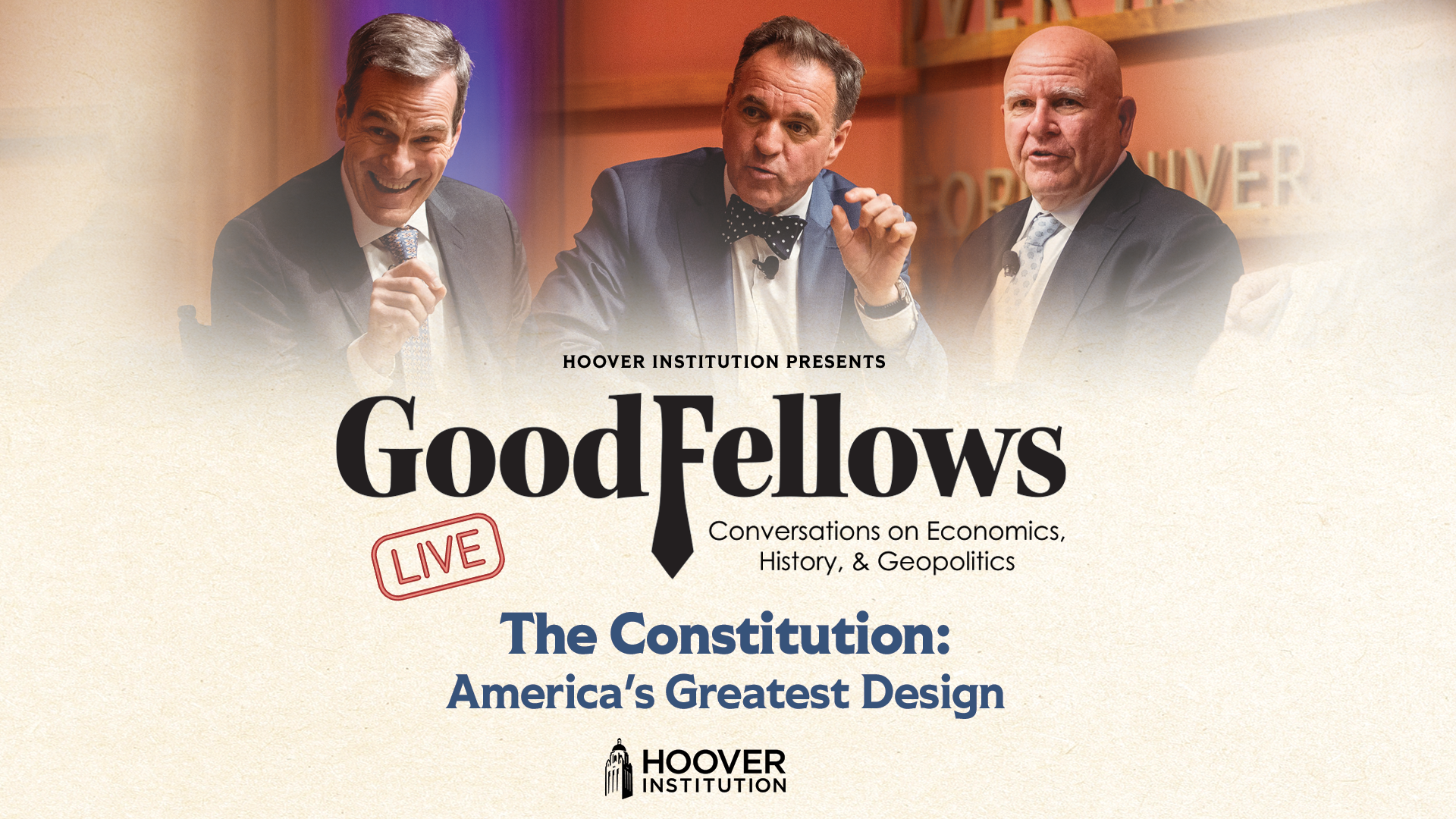

A live audience edition of GoodFellows, the Hoover Institution’s premier broadcast series examining the currents of history, economics, and geopolitics.
The GoodFellows, economist John Cochrane, historian Niall Ferguson, and geopolitical strategist and scholar Lt. Gen. H.R. McMaster, joined by moderator Bill Whalen, to explore the United States Constitution as one of the most consequential frameworks ever devised for governing a nation.
Through three perspectives—historical innovation, national power, and economic design, the conversation examined:
- Why the Constitution was a radical departure from previous systems of government
- How it was designed to preserve a strong union while limiting and dividing power, including authority over war and the military
- The economic foundations it established for long-term prosperity, including trade, property rights, and a national currency
This live taping brought the GoodFellows conversation from the studio to the stage for the first time, offering a rare opportunity to experience it in person.
- Hello. It's Tuesday, March the 31st, and welcome to the launch of Goodfellows, a Hoover Institution broadcast covering the social, economic and geostrategic concerns on a world that's fast changing due to a global pandemic. Thoughts on democracy in the United States. Hr. Hey,
- Bill. I, I think it's, it's a cause for celebration. I really do. You know, I know that there are those who were, were disappointed in how divided we are, right? Because the election been so close. Well, we really have two Americas. I don't, I don't, I don't buy that. We do have a say in, in, in how we're governed.
- It strikes me what's interesting about the Trump campaign is, is, is that it combined the traditional, I mean, the hamburger stunt was old school politics. The rallies are almost a 19th century style of campaigning.
- The best thing that could have happened was this kind of a decisive victory. Because really what Russia in particular wanted is large numbers of Americans to doubt the legitimacy of the result.
- With the current regime in place, there's still, you know, they, they will be rebuilding ballistic missiles and threatening everybody around the Gulf and the ability to reclose the straits with very cheap methods. You know, back to mowing the grass once a year seems like a, a very poor outcome for this war.
- It's a bloodbath for the Russians. I'm telling you, John and Ukranian on the map, they can't secure the country.
- I'm getting a little uneasy about where we're gonna be if Putin can get through the winter. What's your current read?
- You guys are really into this, aren't you?
- Both Putin and Xi Jinping are great manipulators of history. You know, it's consistent with, you know, the, the great Orwell quotation that he who controls the past controls the future, and he who controls the present controls the past.
- I'm gonna have to interrupt my contribution to shoot a woodpecker. Yeah, a woodpecker. Because right now, if you listen, you can hear it drilling a hole in the wall of my house. This is Montana living, and I think it's important that we share the experience with our viewers. So, so here it goes.
- And that's it For 2025. Oh, wait, wait. We have a visitor. It's Hoover, visiting fellow Chris K Cringle. Mr. K Cringle. Thank for dropping by. Ho ho ho.
- HR said, you know, if we get married, we're never gonna live in a house like this, because I'm getting out in five years. And so I'm like, okay, good. That's fair. And then he went to a right arm night and they said, you gotta stay in. So he comes home and he goes, well, you know, maybe I need to stay in. I'm like, okay, let's stay in. So I got how many more extra years than the promised?
- 5 29.
- 29. 29 extra years. Thank you.
- Did you think it would last this long?
- He's such a great partner that actually it's, it looks like it'll go on forever.
- I know you're, you're a half hour early, but
- Unprecedented.
- I'm
- Mutually never Ali. So this has never happened in our entire lives together. No, I'm actually giggling helplessly because it is true. I've never Ali
- So Neil, you're like miles standish, you know, without the, the top hat and the big belt buckle, you know? Exactly, exactly. We need to get John a gold plated, a gold plated chainsaw is what I'm thinking is what you did. We thought that China was the, the Diet Coke of communism. But actually, amen. They're the, they're, they're the real Coke of communists. You know, they're more than one calorie.
- Now here, Amy, I've got a few things to say to you, and I want you to listen carefully. The one thing that James Bond has done wonders for is recruitment to intelligence agencies. And if you want anyone to take on these frankly, crappy jobs, you're gonna need some role models up there in the silver screen. And nobody's come close to me in 50 years of espionage movies.
- And if I can quote our colleagues, Stephen Kin, he says, Hey, these authoritarian regimes, they don't have to be that strong, they just have to be stronger than any organized opposition.
- What is the best sandwich?
- Well, talking of fish, it's gotta be smoked Scottish salmon on brown bread, butter, lemon juice and, and pepper.
- A drummy on rye with a Swiss cheese sauerkraut. Pastrami Ruben. Absolutely.
- Favorite smell or favorite aroma?
- Gosh, gunpowder.
- So I, I guess kind of feel like it's too against one here, but I'll, I'll It
- Is.
- I'll
- We love you though, John. We love John.
- Today we're doing something a little different for Goodfellows. We're gonna talk a little about current events, what we're gonna talk about past events as well, specifically the founding of the Republic. And we're gonna focus on the United States Constitution. So, gentlemen, let me first throw a little constitutional trivia at you. So the Constitution, how long do we think the Constitution, not the amendments for the Constitution itself? How many words do you think it is, Neil,
- You're asking me?
- 5,000, 2000. 5,000. 10,000. 20,000. How
- Many, including the amendments or excluding the amendment?
- Excluding,
- Excluding the amendments. 2040
- 500.
- That was off
- Declaration of Independence.
- See, we don't prep for this. We don't prep for this show at all. No.
- How many, how many times has it been amended?
- Di come on. You know that.
- Come on guys.
- 27. You don't know. I'm just a simple immigrant. These guys are the ones who should know. No,
- He did to do this for a citizenship exam.
- Yeah, I know. That was a while ago. Now.
- 27.
- 27.
- 27
- Wasn't on the test,
- Including the ones repealed. You've just failed the
- Citizenship test. Yes. Yes. Including the most revealed,
- Right. HR Mcma, Nader, son of Philadelphia. You might be disturbed to know that Pennsylvania is misspelled on the Constitution. They left an N out as terrible. No, no respect for Philadelphia.
- Does that mean it's doesn't apply to Pennsylvania.
- And Pennsylvania was named after William Penn, you know, so they, it's PENN. So yeah, he's right on top of city hall right there. Thank you. And really had a big impact on, on the, the culture of Pennsylvania, which was very religiously tolerant because of the Quaker origins of the quake state origin as Maryland was because of the Catholic origins of the state. Each of the, each of the states have a different character associated with it. Based on what part of England, excuse me. Really the Brittin Britain was associated with, with the settlers who first came there. And there's a great book by David Hackett Fisher, a fantastic historian called Albion Seed. And if, if you read this book, you can still see kind of the vestiges of, of that influence from Britain. Thank you. And, and how it affected, because the s
- Each of those played a disproportionate role. I just wanna make that clear. The English played some part, but it was essentially a Scottish project.
- Alright. John Cochran, 55 members of the Constitutional Convention. 34 of them were actually lawyers or had studied the law. Maybe Shakespeare's wrong, don't always kill all the lawyers.
- Good lawyers are important to have. And we live in a society of rule of law. Let's hope it's a good one.
- Then finally, the Constitution. The United States Constitution does not grant socioeconomic rights. There's no guarantee of healthcare, there's no guarantee of income. This is in contrast to constitutions in Europe and Latin America, where governments grant what they call positive liberties. And I want to discuss this as we get further into it. But Neil, I'd like you to read the preamble of the Constitution.
- Well, I never go anywhere without that.
- Yes, exactly.
- In case I get asked difficult questions, I'm gonna read the preamble.
- Yes.
- I hope you're ready. In, in an inappropriate accent. We, the people of the United States, in order to form a more perfect union, establish justice, ensure domestic tranquility, provide for the common defense, promote the general welfare and secure the blessings of liberty to ourselves and our posterity do ordained and establish this constitution for the United States of America.
- Question for the panel. What is revolutionary about this?
- Well, I mean, think what is, what is really revolutionary about, about the revolution that's, that includes the Declaration of Independence, all the, all the way through the, the Constitution and the founding was the, the fundamental idea that sovereignty lies with the people rather than with the king or even even a parliament. And, and of course this has its roots back to, you know, to to, to classical republicanism from ancient Greece and Rome, but also the ideals of the Enlightenment ex expressed by Locke, who was reflecting in many ways that Republican ideal and the, the, the focus, the liberal focus on individual rights. And, and so of course, you know, there it wasn't a perfect founding of the constitution, of, of the country as we know. But what it did is it founded the country, I think on, on principles, on values that ultimately made, for example, the criminal institution of slavery. Untenable and I think allowed us, the Constitution did. And these ideals that were captured in the declaration and, and in the Constitution allowed us to continue this experiment toward a more perfect union. Can
- I jump in here?
- Yeah. We gotta
- Let us
- Disagree here
- Because I mean, I, it it was not novel idea to found a republic pe People had done that multiple times from the ancient period through the medieval period in the mid 17th century. They tried a republic in England. So it wasn't novel to say we're gonna have a republic. That wasn't, that wasn't new. What was new was that it survived because most republics in the ancient medieval and early modern world had failed. The one in England turned into a dictatorship extraordinarily quickly. And the founders were remarkable because they really tried to learn from history. The project was a republic. If we can keep it, that would last 250 years, not 25 years, or 2.5 years. And if you look at all the other Republican experiments before, and subsequently, the striking thing is the durability of this one. The fact that it's the same constitution amended, but the same constitution, unlike all the republics in central and South America, which would go through constitutions the way I go through shirts, changing it on a fairly regular basis. So that's the really striking thing about this. And why, why is this republic so durable? The answer is that they had a brilliant scheme called the separation of powers. And this was very much a product of enlightenment thinking. It owed a debt to Montesquieu owed a debt to the great thinkers of the Scottish Enlightenment. The project was to make sure that the republic didn't do what republics nearly always did, either tip over into anarchy because there's too democratic or tip over into tyranny because you gave too much part of the executive. So the genius of this thing, this, this extraordinary constitution is the application of the principle of the separation of powers to make sure that there is a bit of democracy that's there in the, the House of Representatives. But there, there's a bit of monarchy. The President has some of the powers, some of the attributes of a monarch. There's a bit of aristocracy. That's the Senate. But the idea is that these things will balance each other out so that it can't tip over into a tyranny or into an altogether majority democracy. That's the novel thing. And we don't talk nearly enough about that. It's quite unique when the French did a republic, not long after they did it completely differently and it failed disastrously and produced the terror and then the tyranny of Napoleon. That's what's novel.
- I just want to add, add to that. In some sense, it's not revolutionary. The same people who ran the country continue running the country just in a, you know, without the king hanging around to bother us. And it, you said will of the people. It's a very constrained will of the people. They were really afraid of democracy 'cause they saw what happened. If it's one man, one vote, one time, 51%, we shove it down your throats suddenly that that falls apart. It, it's a very limited republic. This is a, a machinery. The Constitution isn't the visionary document, it's the machinery document. And it's that machinery that has kept going so beautifully to limit government. You, you brought up rights quickly, rights as they understood them. You, they all start with Congress shall pass no law. Right? These are rights of us against the government. Now that word got completely destroyed and turned into the right to free stuff from your fellow citizens. But that's not what they meant by, by rights at all. And what I find really amazing, two things about it. First they wrote this thing in a time of crisis. The articles of Confederation were not working, the country was sort of falling apart. And you'd think we got a crisis to solve guys. And here they are thinking about this beautiful structure and all the possible ways things could go wrong and how we're gonna pick, pick a president when, when 99 parts of a hundred fall apart. And they got that right. Just a amazing that in the time of crisis, they thought to take this so seriously. The last important thing I wanna point out is we venerate the words a little too much. I think there's a tendency to take the Constitution now as sort of a Bible, you know, words written by God to be taken absolutely, literally including the commas. But what's really important is that the spirit of that constitution has remained with the American people. The, the Liberia and Argentina have almost the same constitution. They don't have the same answers because the Spirit got lost. And we saw many times in American history, I I think we'll discuss some still to this day, where the spirit of the constitution gets, gets lost and forgotten. But then in America, that is now part of our cultural fabric, which is why it, it stays, stays potent. Not just the words
- I I'll just say one of the great gifts that we had is who the founders were and what they had read and what they had had, what what they, what they had used as the basis for their education. It goes back to the, to the liberal ideals and the Enlightenment. Locke Hume. But it goes even further back to the, to, to the classical period and the influence of, of Cicero and Cincinnati and the, and the, and the, the Roman and, and Greek ideals of, of democracy. And they fused together this combination of republicanism, which is really, you know, checks on power divided government divided even further, which is to our advantage, I think, between the federal authorities and the federal system, federal authorities and state and state authorities. That was a further division than a further division even into bicameral legislatures, other checks on power, but also balanced with the i the liberal ideals, the lockean ideals of, of individual rights. And as Gordon Wood, you know, the fantastic historian of the founding has concluded that, that the, the American Revolution was radical for the reasons that John points out. It was not just because of the way they structured the constitution, but the morays as Tocqueville would write about that, that that become the elements of our culture. So it was, it was socially, it was culturally and, and, and also, and, and also radical from a political perspective as well. All altogether,
- Let's look at the constitutions from your respective academic wheelhouses in hr. I wanna start with you. The words provide for the common defense. Now, the founding fathers were suspicious of large standing armies hr. Was this a result of measures like the quartering acts, which actually put British troops into colonist households? Or was there something larger at stake here where the founding father is just afraid of entailments?
- Well, it has a lot to do with the English Civil War and, and the specter of Cromwell, the man on horseback who could extinguish liberty. And then they exported, you know, the British exported all the roundheads to the United States, you know, thanks a lot. And so he had the strange puritans. But, but, but you know, they, the, it had a lot to do with the English Civil war and, and then the, the recognition that they had to, to really that, you know, ensure that there wasn't any kind of a power, any power that that could extinguish freedom and, and liberty. So there was a deep suspicion of, of standing armor armies, you know, for example, the Constitution directs that, that, that we will sustain, build and sustain a, a navy, but we'll raise an army when we need it. It also has a lot to do with tradition associated with the American experience from the colonial times through the founding, which was the reliance on militias who could be called out. But of course when really you had the practical demand of having to fight for independence against the most powerful country on earth empire. That, that you needed a standing army, a more professional force. And we developed during the revolution and appreciation for how complimentary a standing force was when employed with the militia, look at the battle of cow pens, you know, for example. And, and the ways that they played complimentary roles even in, in battle. But that debate continued all through the founding. And Hamilton's authorship of, of, of many of the federalist papers, I think make the best argument for the need for a standing army. But what we have inherited, I think in terms of our traditions, in terms of our recognition in the military and among civilian leaders, I hope maybe not as much these days, that we need a really bold line in place between the military and partisan politics. The worst thing that could happen is if the military regarded itself as a check on executive power. 'cause guess what? Hey, nobody elects generals. Nobody elects admirals,
- Right?
- And so if sovereignty lies with the people suggesting that the military should have a role like that actually undermines the constitution, undermines the sovereignty of the people.
- Neil. - So the interesting thing to me as somebody who grew up in, in Britain, is the extent to which the American Revolution had continuities. This was in many ways the second civil war. It had many of the same issues at stake as had been at stake in the British Isles in the 1640s. There's a wonderful book by JCD Clark, the Language of Liberty that shows the extent to which there was a sort of reenactment of many of the debates that had already occurred more than a century before. There's continuity in the sense that the institutions of, of representation were established in the British colonies, in the representative assemblies, in the different colonies. The traditions of common law were also carried over. And I tried to show in, in my book Empire the paradox of the revolution because the colonists were actually the best off people in the world at the point at which they rebelled. They had far lower taxation than their counterparts back in the motherland. And so the question of, of why they revolted is actually quite a hard one. The typical way it's taught in American schools, or it used to be, is that there were terrible oppressions weighing down the colonial population. It's completely untrue. It's
- Completely, I, you know, mean completely
- F
- You. It's consider the source, consider the source on this one. I'm
- Just, they were called intolerable acts,
- You know, for a reason. I mean,
- But allow me to finish hr, contain your Philadelphia enthusiasm. So
- I'm the agitator, that's my role. I'm the agitator.
- The, the, the list of complaints against King George that follows the, the, the noble opening of the declaration is actually quite laughable because in fact the colonists got a fantastic deal. They had tax cuts duties were reduced. So what was the issue? It wasn't burdensome to be in the American colonies. It was burdensome to be paying for the British empire back in Britain. The issue was one of principle, not one of taxation. And the principle was the fact that taxes were decided, even tax cuts were decided in London, in parliament there. And what the colonists objected to was the fact that they had no say. And that I think is a really important point that gets us to something we've touched on. Liberty is the objective of the American Revolution. It's the sacred objective of the Constitution. It's not, we want lower taxes. It's not something material because their material deal was great. It's a principle. No taxation without representation. That's what the revolution was about. And final thing I'll say is remember that 20% a fifth of the colonists rejected the revolution, the loyalists, right? Were not prepared to break their oath to the king. And so it was a civil war in many ways. That's including
- Ben - Franklin's son within, within the Franklin family. Yeah. Who his son was a loyalist and he was of course one of the key governor of New Jersey founding fathers. So this is the kind of more nuanced account of the revolution that I think we need to understand. And can I just add a foot note on slavery? Slavery would have lasted less time if the colonies had remained within the British Empire because Britain moved to abolish the slave trade on slavery well before the United States. So the key point here to remember is the institutionalization of slavery in the terms of the Constitution gave it a longer lifespan than it would've had under British rule. I'm not about to sing, you'll be back from the, the, the musical. You might
- As - Well, you might as well, but I'm just saying it's not as simple as they told you in high school.
- Now John, I wanna, I wanna get you to a second job. But Neil, are you saying that there should not have been a revolution in 1776?
- Well, if you look at Canada, you can see that if you didn't have a revolution, the outcome wasn't radically different. That's an important point to bear in mind. I mean, if Canada was a totally different place when you crossed the border, it was like, whoa, if it was Haiti. But it's not, it's actually impossible to distinguish Canada from the United States. Don't tell the Canadians I said that. But it's essentially the same socioeconomic outcome more or less. But it's a different geopolitical outcome because what's interesting is an Adam Smith understood this. Can I just do a quick shout out for Adam Smith
- Scottsman, - The great author of The Wealth of Nations. It's not coincidental that the Wealth of Nations appears before the pub, the Declaration of Independence the same year, just a few months before. Smith writes about the grievances of the colonists, talks about why they are right to complain about the way they're treated by London. Smith imagined some kind of arrangement where there would be decentralization, some kind of federal outcome. He was hoping there was a way of solving the situation. But like many Scots, he was sympathetic, very sympathetic to the cause of the Patriots as they often called themselves. And I think that's one reason that there isn't such a furious effort to defeat the revolution as there was against the French Revolution. Remember, the War of Independence is an order of magnitude smaller as a conflict than the wars against Revolutionary France. Because basically, if you were Edmund Burke, the great Irish parliamentarian, the American Revolution wasn't something you were really against. You kind of got the argument for representation, taxation. You got that? Okay, the French Revolution, we gotta get to John. We
- We gotta get, we gotta get to German. We also have be the question
- More cash release per capita in the revolution than in any other American. Lemme get this one. From American perspective, it wasn't just like, we'll get to but but
- The stands of
- The French
- Revolution. It's a tiny thing. And the United King, the Great Britain does not deploy a huge force against the American Revolution. 'cause there isn't huge opposition to it in London. That's the reality. Lemme
- Just add on on this point. Perhaps the fault here was the king was so pigheaded. Yes. Because in there was substantial body of opinion in the UK that wanted to work a deal with the Americans. And most Americans started this thing wanting their rights as Englishman just a little representation, the taxes. And in fact, we do owe a a great debt. It wasn't that revolutionary. We are just the perfection of what started with the Magna Carta and then developed with the parliament and, and constitutional limitation on monarchy. And you know, we finally figured out the, the, the last best one after the king screwed it up. But this could have ended much differently with, with all of those people in Britain who wanted to make a deal rather than the the king who we still don't like.
- Well, I don't think the king is the villain of the peace by way.
- Who are those in the, in the parliament who said,
- Yeah, I mean there was parliamentary opposition to any kind of concessions to the Patriots and that was really what drove the crisis.
- But you wanted to move on to something else, bill?
- I do wanna move on.
- Can I just say
- Quickly, this was also, it was a, it was a radical revolution because it was a social revolution as well, right? The colonists, they they were second class, they were part of, they weren't part of the British
- Hierarchy. This is woke history. I don't, don't agree with this. This is
- Absolutely true. Absolutely true.
- This is not a radical revolution.
- This - French's revolution was a radical revolution to, that's why it ends in the tell
- Having the benefit of seeing the French re revolution as well. Tocqueville writes about this extensively in democracy in America, and he talks about the, the, you know, the striking differences between culture in America and culture in Europe, including the continent and, and, and Britain. So I think what, what the, what the revolution did is it unleashed this idea, right? That you can, you can be a self-made person. Now, of course, a large portion of the population was left behind the enslaved population. And what had happened is there, you know, this, this contradiction between the ideals communicated in, in the declaration and in the Constitution, you really we're, we're going to, we're going to contradict, you know, the, the, the, the institution of slavery. And, but we fought our most destructive war in our history, you know, to emancipate 6 million of our fellow, fellow Americans. So, hey, I, I just think we, we can't under undervalue how radical the revolution was. Not just from a political perspective or from independence itself, but from a social and cultural perspective as well.
- I'm, I'm not gonna let you get away with this because I think this is a, a misunderstanding that this was not a radical revolution in the way that the French Revolution was one where the ideas of Russo came to the fore. David Hume was one of the heroes of the founding fathers Hume was no radical. He was a Tory. Now, what is going on in the 1770s is an argument rather different from the one the Gordon allow me to finish Dear colleague, a rather different one from the Gordon Wood argument. The argument that's being made in Massachusetts is the pretensions of the government in London to increase the power of the monarch at the expense of our local liberties. That's the thing that's revolutionary. We want to uphold the liberties that we have, the representative assemblies that we have. So I don't think once you portray the American revolution as radical, I, you used that word earlier, and I'm skeptical. I think it a strongly conservative element to it. And it was the government in London that was seen as pushing the envelope to increase its authority at the, of the colonists. Now we would say that at Hoover, but I think we should recognize the conservative element in the so-called revolution. Secondly, religion, Tocqueville observes that one of the reasons democracy works in America and doesn't work in France is the extraordinary power of associational and religious life at the local level. And the thing that Tofield says over and over again is, wow, these Americans do things at the local level and they do it themselves and they knit together by Christian faith that those things are terribly important and they get left out of many modern accounts of the American Revolution.
- Question, do we let Neil have another scotch?
- Give him two more Nearly finish the first one.
- Finish the first
- One. But it's, but it's Hume and Montesquieu and the I idea of civic duty. I mean it really is, it, it it it is a, a radically different form of go governance and, and it's radically different in terms of what people's expert expectations are of their government. But John, and, and so yeah, there's a huge economic dimension to this. Nowhere, let's,
- I wanna talk about it.
- The centralized authority is not gonna work with the population density you've got in, in the colonies,
- Right? John Neil mentioned Adam Scott, let's talk economics.
- Adam Smith.
- Let's, let's take
- Adam Smith.
- Adam Adam Smith, I'm sorry, Adam Scott,
- Scottish Adam Smith. Adam Scott's a bad act. No, Smith, Adam, Scott.
- So let's take the grumpy economist and let's parachute 'em into the middle of the constitution. Good luck explaining Illinois to them. Good luck explaining MIT to them and so on and so forth. But John, you look at the constitution, you look at economic concepts here, interstate commerce clause, uniform currency, protection of contracts and property rights. What more could they have done?
- Oh, lots more. But I don't think we should expect them to have figured out how to counter the administrative state, for example.
- They're just laying a foundation, right?
- They're laying a foundation. You gotta remember how poor America was compared to now they set out a constitution to defend their political liberty and to stop tyranny from ha happening. And some general welfare would be nice. They had no idea that we would grow as we have to such unbelievable prosperity. Now some of that, you know, the industrial revolution did happen over in that rainy island over there because they had many of the ingredients, property rights, rule of laws, you know, the things that made for prosperity. But that this arrangement of political freedom would lead to such enormous economic prosperity is not something that really it was designed to do. It was a, a happy circumstance. That political freedom also gives you economic freedom, gives you great prosperity. There are things that well, I think we'll get to later that I, I, you know, looking back, I wish they could have done better. Yeah. But maybe they would say, well that's why we have the amendment power and why did you guys screw this up so much? And it's up to you to fix it if you don't like, if you didn't think we could foresee the administrative state up to you, to, to, to fix it. So that is kind of the miracle of it. Now, they did put the things they put in are, let, let's just say how great it is. The most basic is property rights. And they, they thought about life, liberty and property, the pursuit of happiness. And maybe it would've been nice if they had done that as, as a manager of one of the city of Palo Alto's historic homes temporarily. I sort of wish we had a more classic sense of, of property
- Doesn't have the same ring to it, does it though? No,
- It
- Doesn't. I mean, you can see why Jeff s went to the, for the pursuit of happiness. I mean, as an advertising slogan, I'll,
- I'll criticize later.
- Life, liberty and property rights.
- It's not ultimate, it's
- Not gonna work.
- A common currency, a free trade area. So one of the most important things is you are not gonna have tariffs states to other states. So we have this enormous free trade area, common currency and, and the tradition of rule of law that then got better. And that look at the amazing prosperity it led to. And that's, I'm almost whining to wish that they had done things better so we could be richer still.
- And they dealt with the problem of the state's debts. I mean, Hamilton
- Oh
- Yeah. Is a key figure in that respect because let's face it, fighting the war that wasn't a huge war did leave tremendous trail of fiscal and monetary disaster. And we forget that they had to fix wasn't both those problems. I'm sorry, it's not a big war.
- It was,
- I'll send you the, the data, I'll send you the reading that you need to do. Hr, it was a probably
- Oh,
- Oh my gosh. No, the financial aspect,
- I mean obviously you needed the French to come in to win it. That's worth adding. But you know, apart from that, that's true. That's
- Actually
- True. That is true. That's actually true. No, no French, no York time. But the French
- Would, the French would've not have come in if it wasn't for the Battle of Saratoga.
- Yeah, no, that's true too. That's
- Also true. So, so you know, and
- We, we can agree on that.
- And I, I believe that, I believe that the British military, you know, the British Navy underestimated
- They did the
- Colonials
- Quite
- A bit.
- They did quite a bit. They did. Washington was a really good general.
- He was
- Well
- He he knew how to not lose.
- Yeah,
- Well, and he, well
- He was determined. He
- Lost, he lost in New York,
- You know, but he was, he was a terrible general, just
- Determination, you
- Know, the ability, except he learned how to not lose. He, he didn't win any battles. And, and but the point
- Here for you John
- Trenton,
- You come out of this war and it is a hot mess of, of monetary and fiscal confusion and fixing that was crucial to the takeoff. The US economy does not immediately take off. No, it's actually a really lean time when the war is over. But then you get these foundations that, that Hamilton saw so clearly if you could create in this an integrated market, if you could have an a federal system of debt, he also wanted a federal bank that came much later in the end. But that's important stuff. And it's not as glamorous as the pursuit of happiness, but it does help the economy grow.
- Well, and and I'll tell you for the revolution, French financial assistance was, was just as important as, as the army and naval assistance. Yeah, yeah.
- Thing about it blew up the French, it ended up blowing up the French monarchy. So there was an unintended consequence there.
- Now six years of good fellows, we've gone through a lot of change in society. We have gone through COVID, we've gone through presidencies as the video showed, but we also have gone through cancel culture, which maybe, I dunno if it's still with us or not, but Neil, there's a question about, I
- Haven't been canceled yet. I don't dunno why. I mean, I feel left out.
- I have some more scotch. We'll work on that.
- Didn't the President cancel
- You at
- One
- Point?
- I guess so, yeah.
- But
- Neil, so did President Biden. I got canceled by
- President.
- Alright,
- Neil, the seats of the question of the First Amendment and how durable is the First Amendment these days.
- It's a tremendously important part of our constitutional legacy. And I don't think I fully appreciated how important the First Amendment was until I saw the drastic erosion of free speech in the country where I grew up, which has been one of the most shocking features of the last six years. That, that, that can be policemen turning up on people's doorsteps because of things that they put on on social media. It's just an outrageous thing to never underestimate the value of the fact that we have at the First Amendment. It's a glorious and wonderful thing because liberty is meaningless if you don't have free speech. Not to mention the other fundamental freedoms, the right of assembly. These things are crucial. That's why I say the American Revolution is about liberty and it's about the defensive liberty against a potentially or actually intrusive central government. Now there have been threats to freedom of speech and you've just touched on one cancel culture. Where did that come from? Why did we get into a world where enormous technology companies seem to be cooperating with the federal government to shut down discussion on subjects that were considered controversial? I think that's the kind of thing if, if TOC Field had a time machine and he could turn up in the 2020s and he wandered around and he saw the kinds of things that went on in modern America, he would say, well, at what point did the French conquer the United States and take control of it? 'cause this is no longer the country that I toured and was impressed by. We've lost a lot of that decentralization, that Tocqueville thought was so crucial. We've got a centrally powerful federal government just like the French did in Tocqueville's Day. But that wasn't a feature of the United States in its original design. And the very fact that we can have on campuses of all places on university campuses shutting down a free expression. To me that's just a shocking betrayal of the American tradition. I I think we've passed the peak of that odious trend, but I wouldn't underestimate its ability to make a comeback. So I'm a First Amendment fundamentalist. You can say just about anything, but not about my or my wife, but just about anything, it's fine. There are some good rules about what you can't say. You can't threaten to kill an individual, but you can, you can really say an incredibly offensive thing to me. Like some of the insane things that get said these days on the internet about Winston Churchill. I'm wearing wearing my Winston Churchill bow tie tonight. You can say those things in this country, that's okay. And it might offend me, but that is part of a free society and my offense is something I can just about handle. So these are really important foundations of our free republic, and they're one of the reasons I became an American citizen. I did that in 2018. I'm very, very glad I did it because I see a much brighter future for a constitutionally ordered republic where freedoms are explicitly guaranteed than any European country where it's essentially up to the state how much freedom you have.
- Lemme remind you, Neil, the First Amendment is a limitation on the government and only on limitation. Like Congress shall pass no law for, I may get the exact thing right, so the government may not silence your speech. Whereas much of council culture was bad behavior on the part of people and universities and other institutions. Now there, I think what's important is that this, this, this first amendment freedom of speech pervades our culture so that we feel like it's a awful thing for universities to do, to fire people for what they've said and so forth. And that's where it's, where it's vitality is, but not the actual written part of the First Amendment. And it also is a good testament for the importance of a written constitution. Britain has an unwritten constitution and we sometimes debate whether that's good enough. Well, unwritten ones get forgotten more than written ones. And it is interesting. Of course it's an amendment. It wasn't in the original Constitution. Why not? Because the framers of the Constitution said, well we don't need that because you know, all rights that we don't say are the governments. Everybody understands those retained with the people. Everyone said, well, yes, that's kind of nice, but, but why don't we write a couple of these down and just to make sure. And in fact, because the last on the Bill of Rights is my favorite, unfortunately the concept of right has has been, has been so, so devalued that it doesn't hold in for all the others. But, but writing those amendments was a, a close run thing and it's a darn good thing we did. And, and perhaps King George and Parliament then should have written down a couple of their traditions and, and tried to make them more durable.
- Well, I'll, I'll just say that you still see kind of the tensions that existed at the time of the founding between Republicanism and liberalism and how they were reconciled in the form of the Constitution. So if you think of Republicanism as kind of the separation of powers, the, the, the, the measures that are taking place in, in the design of the government and the separation of powers to prevent tyrannical rule on, on the liberalism side, the lockean liberalism, you have kinda the guarantee of the, of the, of the individual rights. Those were melded together and the First Amendment was a huge part of that. You still see, I think the radicalism of the American Revolution. It
- Never gives up
- In the, in the, in the differences between maybe the way America and Britain today, the UK today view international law, for example, Americans are more skeptical of international law as, as maybe some in the UK government today would define it because we see kind of giving up our sovereignty to some sort of international body cuts against the very radical idea of, of the revolution, for example. This also has a lot to do with America's deep skepticism of international organizations. It has a lot to do with in some parts of, of the Republican party today. And, and sort of the, the movement that, that gave rise to President Trump and, and and others within his, his movement is this deep skepticism of the European Union because they see the European Union as a folly by European citizens who gave up their, their sovereignty to a faceless body of bureaucrats who are not accountable to them. So I think, I think you can see the uniqueness of the American Revolution still playing out today in, in, in the way that we view sovereignty and the way we jealously guard it, guard it, I would say more jealously than, than those CI citizens in other Democratic countries.
- But isn't there an irony, HR, isn't there an irony that the, the United States starts out as the republic that fights against the empire and then in Perceptibly over time it becomes the empire. I mean, that seems to me to have been the trajectory certainly of the last hundred years. And it's a, it's a very uncomfortable thing for Americans to be in the position of being the empire. It's like that joke. Are we the baddies? I mean, are we the empire? Are we the red coats? No, because in truth, the way that the United States exercises par is largely seen in the rest of the world as just a new version of speaking Empire. Let's
- Examine this for a minute. First of all, I mean, I don't think the United States
- We disagree more
- On stage. I I just don't think the the United States is an empire by the definition of empire. Yeah, because because we have not created cervi relationships with countries again, against their will. And, and we have not been extractive are the relationships that we have internationally in the form of alliances and partnerships are mutually beneficial. And as President Trump would probably argue more beneficial to, to the other members of the lives than they are even to us. And if you examine kind of, you know, the, the growth of what some historians, I never thought you'd buy into the new left interpretation of history. But you know, the, the way that they'll, they'll describe their, the growth of American power is this, this new imperialism. Well, would the world be better off or worse off if the United States didn't enter World War I or World War ii? Would you know, would you rather live north or south of the 38th parallel? You know, what, if you, what if you're even fast forward to, to the 1990s, if you're a Bosnian Muslim, where would you be today without American
- Power? But British, a British imperialist could have made exactly the same arguments about British power in the 19th century. Where would you rather be in British India? I thought,
- Thought you'd rather liked the British
- Empire. But you know, I'm just saying you don't need to be a leftist to recognize an empire when you see one. No, I'm just, I'm not against empire. You, you should relax. It's fine. I'm not. It's okay. You wrote a book on it, you're not in the world. Deal with it. Everybody thinks you are an empire. You are. It's okay. We dealt with it. Get over it.
- Well, it, it, it, so, so you're
- Trying channeling, I mean, what do you think you're doing in this Straight off on news by the way. I mean, what exactly is it that's going on now, Neil? Is that, is that the Republic? I think Neil Neil's lost it. I think you've lost it.
- Okay, so
- I'm just, I'm gonna try to, let's be honest here
- And I'm gonna try to hijack
- This
- Conversation.
- You guys are, let's come clean. If the United States has morph from Republican to empire, that's not too surprising. That's what the founding fathers an anticipated Adam Smith says, this will be a great empire. I think Alexander Hamilton, someone you admire, saw that there would be an enormous empire that would emerge from the United States. It's okay. It
- Was a good Johnson.
- It's gonna get a courtesy appointment to the history department here. So you're fit right in, right? This is
- A conservative argument. You don't understand John, John
- Talking the left
- Thinks it's bad. I think it's
- Hello John.
- Hey Val, how you doing over there? So Nigel Bayer's book, you know I'm not on ate argument. That's a separate issue, but let, let's Okay. Alright. There's John Go.
- As they say, I've got take this offline
- Or or Stevie Cockle Woodson. I got an argue with George Schultz one time, which is a terrible thing to do, right? To get outta an argument because he was mad that the Trump administration got out of the INF treaty, you know, and you know, and because I was associated with President Trump, he like blamed me for everything President Trump would do. And, and so we're in this argument, I'm like, Hey, it wasn't a treaty anyway, the Russians were adhering to it. And then Secretary Schultz is getting mad and better and then Calkins in the room and he goes, Hey, why don't you guys take it outside.
- Hello John. Okay,
- John, go ahead. Go ahead.
- So I wanna avoid the trap of what would the founders think if they're alive today? Because let's face it, they'd lost walking around the Stanford campus. It's not, it's not the fur old Harvard of the 1770s nor William and Mary. It's a different world. But let's talk about one concept in the Constitution, which seems to have gone badly off the rails. That's balance of power. The Constitution has wonderful checks and balances in it. Every state gets the same number of senators. There's an electoral college and not a popular vote. But what do we have right now in our federal government? Well, we have wars that are driven by presidents. Congress doesn't vote on wars. Presidents take us into combat. We have presidents as long as they have a pen and a phone issuing executive orders. I don't know what Congress does for the life of me every day. And then we have judges legislating from the bench. What happened? John
- Congress fell apart. I mean I think the standard thing we all say is, you know, the constitutional order they imagined Congress would be supreme.
- Right? - And Congress seems to have delegated a lot of its authorities and pretty much the repair everybody sees is bring Congress back. But nobody quite knows how to bring Congress back. And maybe we don't want to get too deep into exactly why, but yes, the executive has grown into most of the things we didn't like about King George. And the courts have filled in the gaps. I'm kind of a fan of our current Supreme Court, but it is, you know, for example, we are at a stage now with immigration. The question of birthright citizenship has,
- Which we'll get to.
- Oh, can I, can I do it now? 'cause it's a great example
- As a go ahead.
- Okay.
- You, you've been patient.
- So 150 years ago there was this amendment passed with a, you know, the slaves are gonna be free citizens and you can't argue about that. We haven't really talked about it for a hundred years, but life moves on and, you know, if you change planes at O'Hare and happen to have a baby, is that baby gonna be an American citizen or not? Right? Well, interesting question. Congress cleaned a lot of this. The question up in the 1950s about who, what American citizens abroad, when did their children get to come? This is, is long law. It's very worth reading. It has nothing to do with birthright, but it has, you know, 15 cases. It's the sort of thing legislatures do. So here we are, the birthright question comes up and we are, once again, there's this one phrase subject to the jurisdiction and we're parsing that phrase written 150 years ago. This is a terrible way to make sausage because it is the sausage. This is 150 cases. And who exactly does this is what Congress is supposed to do. Now, I hope that the current court will not fall into the temptation of previous courts of coming up with, well here's our 15 part test of exactly who is and who isn't a citizenship. I hope they punt the whole thing and say, ah, yeah, whatever Trump you wanna do, fine. When Biden comes in and wants to make anybody who sneezes the word American, a citizen, I'm sorry, Biden Gavin Newsome comes in fine, you know, it's within Constitutional bounds Congress, why didn't you pass some laws and, and get this straight? So that's just an example of I think where we all wish Congress would, would wake up and, and be, take its part in our constitutional order.
- How do we rebalance things? And, and the question to rephrase, I hear as well, you need a president to win 489 electoral votes and carry 45 states. But Franklin Roosevelt did that and Franklin Roosevelt didn't necessarily balance the power on news president. So how do we rebalance things?
- I, I think recognize the, the great gift that we have, that sovereignty does still lie with the people, you know. And, and if you look at the Federalist papers and, and the discussions of really the concerns about the abuse of power, the concerns about, about the government not being responsive to the citizens, they felt that because it was a, it was a republic that represented a, a broad range of interests that within our federal system, that people could exercise that sovereignty through the vote especially. But also the demanding more from our, the elector, the, the, the leaders we do elect. I I think we do have a say in how we're governed and we can demand, you know, that congress, you know, get its act together, you know, and, and it's based on, you know, who you elected that office. But that what you ask them to do once they are elected.
- Well there's a way of thinking about this, which I think is I important. The tendency in a lot of debate in the media is to say, this is all about President Trump.
- Right?
- And his assertion of, of power. And I think that's a misreading. I think the, the project of an imperial presidency goes all the way to Franklin Roosevelt. And President Trump is by no means the first president recent times to seek, to expand the power of the executive. That was the
- Dramatic break is under R Roosevelt.
- Yes. And I, I think that is a different issue from the issue of Congress receding from its responsibilities. My old friend Kristen Muth, has a wonderful article on the rise of the administrative state in which he shows that from the 1970s onwards, Congress tended to punt difficult issues to the executive branch, which led to a proliferation of agencies, dozens upon dozens until they're almost countless of federal agencies essentially having difficult jobs passed to them by Congress that wouldn't take responsibility. That I think is a more pernicious trend than the ambitions of presidents because presidents will always want to assert, or at least regularly want to assert the power of the executive. But if Congress punts on its responsibility as the most important of the branches of government, then we do have a problem. And I come back to my point, the danger for the republic is always to degenerate into empire. It can do it in two ways and they related to one another. It gets involved more and more in wars on the periphery. And the legislature at home becomes less and less willing to take responsibility. That's the Roman story. And for, from the very outset, from the very founding, it was a worry of Americans that we would go the same way. Now as long as we're worrying about it, I think we're in good, we're in a good place and we do worry about it. But I think we worry about the wrong things. We worry all the time about the president's personality. We should worry much more about the degeneration of Congress and the failure of our elected representatives to assert their constitutional powers. That's I think what we have to fix. But
- I'm gonna, we can't just blame Congress. We have to vote blame the voters who elect Congress. And it is true that among us, among us citizens, it people, it's not just Congress, people also don't care about their state legislature and they don't care about their local, right? Everything is projected onto the president and national issues.
- John, I disagree. The voters turn out far more than they did. If you think back to the low turnout era of the seventies, they turn out far more. But they're presented with terrible choices. And that is the problem. Our system, lemme give you one illustration of this. If you are, as I was a newcomer to this country and you became a citizen, you are very surprised to discover that there are three parties That you can register to, to be, you can be Republican, a democrat, or independent. You say to yourself, lemme finish. You say to yourself, okay, I I I wanna be an independent. Hey, tell me where does the independent party hold its social events? Where, where, where can I go meet some fellow independents? The independent party doesn't exist. Doesn't exist, exist, right? And this is the way that voters are played. They're, they're given two options when they really want three. This is a genius move by the duopoly of established parties to run the system. Think how few counties, nevermind states, how few counties are actually contested in a, in a, in an election, a trivial number because everything else is sewn up by the two party machines. It's not the voters who are to blame is these political machines that run the country. That's what needs to be addressed.
- And John, will you comment on this? I mean, I, I wanna plug our colleague Mofi in his book on this topic. He just has a new edition out. He calls it like the, the, the phenomenon of sorting. And it leaves these independents outside the two tents of the, of the Republican Democrat.
- That is, that is where, so I think there's, let's call for a time of hope. The pinnacle of political philosophy seems to have been 1792. And they understood that the answer was in the gears, the rules of the game. Why do we have, for example, such polarized primaries? Well, one good theory is we have too much democracy at the primary level. The, the old white men in smoke-filled rooms would've never picked these jokers because they wanna win the general election in primaries. You all see what happens, the extremes of the parties take over. Well that is the sort of thing that's a little detail in the rules. So I think I, I hope the next generation thinks hard and as well as our ancestors did, I, there is hope in, in fixing the rules of the game. Another little one. Why do we have so little federalism? Well, we've sent all our money for Washington who sends it back as blocked grants to the states. So all the fight takes place in Washington. If states had to raise their own money to do their own spending, we might put a lot more attention on our state and local governments, which would be a healthy thing. So I, I do think there's hope in rules of the game and not just, the one thing both Adam Smith and our Constitution did not emphasize was we need to put better people in power. They understood people imperfect and venal and self-interested and need to be constrained. A good set of rules of the game. And that's why I keep pushing back on, on, on Neil's view, that it's, it's lack of responsibility of the people in power.
- And fi a final note here before we move on. You hear the word unconstitutional thrown around a lot. So simple question, what we're doing in Iran, what we're doing in the Middle East, is that, or is it not constitutional?
- Well, given we stopped doing declarations of war, when did we do, stopped doing that in the 1960s? Gulf, Gulf of Tonkin. Then every war since Vietnam has been unconstitutional, which seems like,
- Say the early, early 19th century with Jefferson's actions against the Barb Pi Pirates. So, you know, the president does have a great deal of authority on Article two of the Constitution, Congress can exercise a, a check on that executive authority through their power of the purse. And, but they've chose not to do that. Obviously in, in, in the current configuration every time there is, is the use of force under Article two authority. There's a legal review and so forth. And then ultimately, you know, the check on American, the president's power comes from the, the people themselves. So I, I mean I, you know, I dunno if you wanna talk about the current case or not, but I I think that that's well within the President's article two authorities, because unlike Neil, who is soon gonna get an appointment, I think to Smith College, you don't understand in his department, you're the left, you're the lefties
- Hr, you're the one who thinks the American Revolution was radical. I'm just trying to get David Hume into the conversation so that Tory perspective is represented. So
- We, we, we do tend toward this kind of strategic narcissism to, to find the world only relation to us. And to think and to think that the outcome depends on what we do or choose not to do. Hey, others have agency in this case. And I would say in this case, the Iranian regime, the theocratic dictatorship, there has been waging a, you know, a 47 year long war against us. So the President didn't decide to go to war. We were already at war for 47 years with the Islamic Republic of Iran. And what precipitated this decision by Israel and the US to go after Iran were a, a, a number of recent, relatively recent developments. The lighting of the, the Ring of Fire around Israel with the objective, in my view, to, to destroy Israel and kill all the Jews, which has been the objective of the Islamic Republic since its founding. They set that ring of fire around Israel and they lit it on October 7th. Then they attacked Israel directly in April and October of 2024. Big mistake for them, I think,
- Right?
- Because they had been having their way by being able to use proxies under the strategy of expending every Arab life, if necessary, to accomplish their objectives of kicking the United States outta the region as the first step in I isolating Israel and, and meeting their objectives. So, you know, the, and then the, the most approximate cause was the building up of this massive missile, drone strike complex, which they undertook since last summer after the, after the 12 day campaign by the IDF and Operation Midnight Hammer. They were increasing their missile depth by orders of magnitude building more and more she head drones and essentially, you know, creating a conventional curtain behind which they could rekindle their, their nuclear program, develop an intercontinental ballistic missile. And so where you have this argument, Hey, was it imminent? You know, and is this justified under Article two, which is not a stipulation on Article two, that it'd be imminent. But I would say, you know, what, what is imminent to you? I mean, would you rather wait for an Islam, the Islamic Republic who, who calls us the great Satan, you know, and Chance Death to America? You know, I think they really wanna do that. Do you wanna wait for them to have the capabilities that could threaten the United States directly? I, I don't think so.
- But Neil and John, but Neil and John we're in this gray area now, is this what the founders envisioned or is just a reality that 250 years after they wrote this document, this is the world we live in now, in America's not a modest republic, it's a world power.
- Well, HR mentioned the Barbery Pirate. It's actually quite a good analogy. I, I agree with everything you said there about the rationale for the war, but it is a deeply shocking thing that apparently the US Navy cannot force open the strait of hormones that apparently the new regime in Iran, which is an revolutionary guard dictatorship with a relatively small military capability, 'cause we degraded so much of it can close the strait of ous. And it appears that we are unable to do anything about that. That is a shocking thing. If that is the reality, which it appears to be, then we have a problem.
- Just say quickly on, on the mil, the military part of this, we can't open the strait here. Yeah,
- We're,
- We're
- Unwilling.
- The question is, what risk do we want to take? What do we want to invest in it? I believe we can open it and, but, but you know, we can talk more about the details about that, how you would do it. But, but I, but
- If, if we are an empire, Neil haven't tried, we've never,
- The campaign has not gone to that phase yet.
- The facts of, of Iran and Ukraine is, there's never in history been an empire, if you wish to call it such that has such overwhelming military advantage over our enemies. It is simply our choice.
- I don't think that's true anymore, John. I think you're deluding yourself because I think the technology of asymmetrical warfare, the advent of, of drones $3,000 shas has changed the nature of power. We think we are ants. The French used this phrase in the nineties, hyper power. And we still act like we are a hyper power. But here's the bad news. We keep discovering, and we discovered it in Iraq too. And we're discovering again in the strait of Horus that fer small amounts of firepower can disrupt our extraordinarily powerful military. And apparently, if not Czech made it, then at least put it into check so that the president hesitate made it Or check. Okay, wait, but wait, hold on. Wait, wait, wait, wait, wait, wait. Can I speak On man? I mean, but hr, if you were back in the white, if you were back in the White House, hr, let me just ask you a question. If you were back in the White House, would you say to the president, oh yeah, you, you should definitely go to Islam Aaba and offer the, the release of, of the frozen assets and take sanctions off. You wouldn't be advising that. You would be saying, we cannot possibly allow the Iranian regime to control the strai of hormones. It is a vital choke point in the global economy. What are we waiting for? Why has the president not deployed special forces to the rai? Why are we not escorting the carriers political escorting the, the, the tankers through as we did in the 1980s? Why are we waiting, why are we talking with these people and send me that?
- You're talking about presidential decision making.
- I
- Am his own calculation of interest. You advised the president,
- Would you advise him now to play it this way?
- I don't think so. No, I would not. But this is, you know, we're in the eye of a storm right now. Can we ask the
- Constitutional question? There is a third good fellow here,
- Right John? Just before, I'm so sorry, but here's just, just one quick point. The idea, this notion that Iran is in a position of relative strength is ridiculous in my view, based on what the, what the campaign achieved and the fact that we have not even tried really to open the trade at this point. You're right about the Asym Asym, but why not? Why? But what I'm saying is, as a historian, Conrad created, said, Hey, there are two ways to fight fundamentally asymmetrically and stupidly, what we have done over many years is we have accepted what we saw as Iran's asymmetric advantages and never applied ours. Not until the, the Israeli 12 day campaign and, and our direct strikes under Operation Midnight Hammer and the campaign you've seen now, Iran was conditioned to believe they could get away with it. That they had the ability to escalate on their own terms, asymmetrically with impunity. This campaign is ending that it's not an initiation of a war. I think it is the first phase of a campaign to end a 47 year long war. And we can talk more about that, John. I'm so
- Sorry. We're, we're doing, we're doing a show in two weeks. We'll pick up a ran John, one last thought on constitutionality, then we're gonna do a lightning round.
- Well, okay, you asked, is this a constitutional war? And I think that's the constitution was written in 1792. Yeah. And in, in a, in a world where it, it took six months to get a ship across the ocean. So are they going to foresee this situation? No, but there's a war powers act. There's all sorts of, this is how constitutions need to evolve and, and be amended. The question you didn't ask is, is, and I'm gonna answer it anyway, when you should have asked is, is the Department of Commerce constitutional 'cause That's the other big change as I look, we have tremendous social and political freedom relative to our economic freedom. And let's bring back a founding father and, and ask about Wicked v Filburn. Those of you don't know. This is the famous case in which a man grew wheat on his own farm to bake bread for his own family. And was told you can't do that because he didn't have federal marketing order to bake. Said, and, and that case survived at the Supreme Court. That's the foundation for our federal, for the administrative state that runs our economy. We have a, a federal regulation on how tips are shared between front staff and back staff at restaurants. Can you imagine any of the founding fathers here? Here's why I think they would run home and say, we gotta stop these guys from doing it. And then they would think twice and say, no, it's up to their job to write an amendment and, and, and set the ship straight again. So there are other areas where, you know, the constitution is in question, but it is up to us to keep it alive and to, you know, amend it and, and fix it and abide by it as, as we see the need to do.
- It's un amenable. It is impossible. It's, it's impossible to amend. It's perfectly amend. Politically impossible. No it's not. It's politically impossible. You can't do it because we have 50 50 political system where you simply aren't going to build to amend the constitution. That's the reality. We've lost that part.
- We have had many amendments to the Constitution. No, we
- Can't do it anymore.
- We can't do it anymore. We've had a few too many. The sign that it isn't too hard to amend is that we passed prohibition and then had to say, whoops, sorry, we didn't mean that.
- I'll raise the fast to that.
- Yes, you're running low. Alright, under lightning round gentlemen, first item on the lightning round. Article two, section one, clause five. Neil, do you know it? Do you want to read it?
- I don't have it on me, but I do know what you are alluding to.
- What am I alluding to?
- A militia
- No.
- What
- No person except a natural born citizen or a citizen in the United States at the time of the adoption of the Constitution shall be eligible to the office of president of the United States Audience poll. Should Neil Ferguson be allowed to run for president?
- Not anymore. Not after, not after that. Not after saying that the, you know, the revolution was like a little skirmish. I mean, come on. He
- Has
- Knight.
- Do
- You want job? The minor administration or Doug, he held back on that door to a citizenship exam. I guess, you know,
- He, he has an ice, he's subservient to a foreign king.
- Gee, king's, he'd be a great president in my view. He'd be, do we,
- Do we agree this is an outdated notion. This is in the Constitution. Why we feared that our American president would be a flunky of a European power.
- I mean, there are enough native born lunatics who want this job. Don't open the floodgates and allow all the foreign born lunatics to run to. I think it's a very good idea to have some kind of cutoff removes temptation.
- Alright, the aforementioned second amendment quote, A well-regulated militia being necessary to the security of free state, the right of the people to keep and bear arms shall not be infringed. HRO what the heck is a well-regulated militia?
- Well, it's, it's really what we had in the, in the colonies to defend, to defense settlements from the very beginning. It's what we relied on, you know, at, at the outset of the, of the revolution during the siege of Boston in 1775. Then it was, there was a recognition that you needed to raise, you know, regimens of, of continental for the continental army to, to bolster that militia. And what we've had since that the founding of our, our nation since 1775, even before the Declaration of Independence, was this combination of professional forces under federal control and, and militias. This is why you have the National Guard today. I think it works. I think that the, our, our small professional all volunteer force is, is unique to our era based on the demands that we have for our defense and really the, the development of technology over time that has dramatically shrunk the great moats of the Atlantic and Pacific Ocean and really has convinced us obviously that our, our security depends in large measure on four deployed capable US joint forces, professional forces that operate as part of alliances to deter conflict and then to respond to threats that emerge abroad under the recognition that once those threats reach our shores, they can only be dealt with at an exorbitant cost. So, you know, I think what we have today has our roots. It goes back to the revolution and it still works. It's been modified obviously continuously since that time. But the overall construct is, I think is beneficial to our security. Obviously the, the, the restrictions on who can regulate that militia and, and the power of the states gives governors a, a significant capability in terms of, of ability to respond to natural disasters and so forth. So I think it works.
- So now we fight about the part after the comma.
- Alright, John Cochrane,
- Wait,
- Are
- We, are we gonna, because
- Chime in if you want to
- Just half of the whole thing, which was the right to bear arms shall not be infringed, which has in today, you know, discussion, nothing to do with the mil militia. And so we go around parsing that comma, maybe they meant a semicolon, maybe they meant an M dash. Who knows? You know, and, and because Neil wants to come in on why the right to to bear arms is not a great thing. But it was very important that our, our English and Scottish forebearers did not have the right to bear arms. And that was a lot of why they were subjugated to various Lordships for thousands of years. And that's a reason why that was put in the Constitution. And if we don't like it, we can amend that. And why that is not gonna change is because most Americans say, yeah, I want the right to bear arms and I'm gonna keep it.
- Yeah, I I actually feel that way. And you saw me shooting at that woodpeckers, I'd be kind of hypocritical to be against,
- You know, you would this, right? You would call the EPA in the, in the New Republic of Palo Alto
- In Montana. That
- Doesn't happen. You, you would, you would have to call the Palo Alto Humane Society who would come and look and have a registered bird expert come and diagnose the bird. But
- This is the beauty of federalism. A permit. The beauty of federalism, and this goes right back to the origins of Goodfellas, is that obviously in a pandemic, California was gonna be a complete disaster of regulation and absurdity. So I just moved to Montana and that is the beauty of this country, that no matter how crazy state a is, let's say state blue, there is always state red. And I get to Montana and one of the first things that happened was that my neighbors discovered I didn't have any firearms. Didn't have any guns. It was like, Neil, you you need guns? And, and it was actually came to a head during the, the, the, the violence that occurred in certain cities after the, the, the murder or death of, of George Floyd. And they came to me and they said, Neil gotta get guns. I was like, I was imagining rioters sweeping through the streets of Big Sky. And it didn't seem that likely a contingency, but I got the guns 'cause it was like social. I thought I gotta, I can't say. So I got the guns and a gun is a wonderful thing outta curiosity. It's a wonderful, I'm just gonna say right now.
- But then
- Like cowboy boots, guns are part of what makes America great outta curiosity. So I'm all in on the Second Amendment and most of the bad things that happen are people who hold guns illegally. It's not the people who legally hold guns, who commit the crime. That whole federal, this whole thing is, it's a kind of liberal delusion
- That federalism is wonderful. But that is one of the things that is under attack. I mean, part of being a conservative is we, we, we think that everything is gonna fall apart. And, and the rights of states to do things differently from the massive federal government is something that's slipping slowly. And you know, if not the, the the guns, what's gonna come next is billionaires who get taxed here can't leave to somewhere else. That's, you know, that's the,
- I think they already did.
- What does
- HR
- Mean if I, if I could plug, like, we have a great program here on state and local government under Josh Roll's. Fantastic. Yeah. And we've been talking about our institutions and confidence in those and, and the Hoover program on revitalizing American institutions is really great and very, all of this discussion is in keeping with the fundamental mission of, of the Hoover institution, of, of, you know, ideas that advance freedom. So I mean, we could have it in a better place. And we're named after Herbert Hoover, who was, who was sought as part of his mission to jealously guard, liberty and individual rights.
- Five
- Minutes end of the commercial break.
- Five minutes to go. Let's end it on a light note. Name a favorite founding father or name, a favorite founding father you'd like to speak to regarding your profession or interest. So John Cochrane, who's your favorite founding father?
- Well, I have, I have many favorites for all sorts of reasons. Madison, who largely wrote the Constitution, Washington great Ben Franklin, man about town. I have to speak up for Alexander Hamilton, the great visionary of our financial system. Neil spoke about this early on. You know, when you go back, you, you think would I have had the wisdom to do what they did? And, and I doubt myself to have had the wisdom of Alexander Hamilton, who got the federal government to assume the state debts, even though some had paid and some hadn't paid. To assume them at face value even though some had been bought by speculators. And to pay them off their, and to understand that government debt properly managed could be a good and great thing for the country to borrow in, in bad times. And that our reputation for paying off that debt was, was worth a tremendous amount. And the fact that we paid off so much of that revolutionary war debt is what allowed America to borrow from English capital markets and develop so quickly later, let us hope that the spirit of Alexander Hamilton and the sanctity of repaying your debts remains in today's treasury department, federal Reserve and Congress.
- Hey, I just wanna point out too, Alexander Hamilton would never have made it in Britain because he would've been socially undesirable.
- Good. Well, he was
- Half, he
- Was
- Half Scottish.
- And so that would've given an advantage. Yeah. Hamilton is the one founding father who, if he, he came in the time Machine to America 2026, wouldn't be surprised at all. He would be the only one unsurprised to see a vast industrial superpower because that was his vision. Hamilton's vision was take what the British have done and come up with something even better. And that that's what's impressive. But he's not, he's not my hero. James Madison became my hero and he became my hero in an odd way because I had to write a constitution. I had to write a constitution for a new university, the University of Austin. My understanding was that the reason all the established universities had gone batshit crazy to use a technical term, was the governance problem. They had a chronic governance problem. So I thought this new university needs a constitution. And I modeled it on the Constitution of the United States. And when I started trying to write a constitution, then I began to understand just how huge a contribution Madison had made. 'cause it was the hardest thing I've ever done. And that's why Madison became, became my hero. No musical yet, but you never know.
- It took medicine about a hundred days to write his. How long did it take you?
- Well, it took many, many weeks indeed. Months. And it went back and forth and there must have been at least 24 different versions. And that was just for a small startup college. So once you've undertaken that exercise, you realize what an incredible achievement it was to, to mastermind writing the ultimate political operating system. I mean, here we are not far from Silicon Valley. Think of the Constitution as the operating system of the United States. And it is a work of genius. It is the single most brilliant political document ever written. And we are all the beneficiaries of Madison's genius.
- Alright, we have, we have Hamilton, we have medicine, HR Hoop. Who is your founding father? Who's your daddy?
- Okay, well first of all, let me just, let me just count on, I mean, those comment on Hamilton Love Hamilton, he was also a great military officer. You know, he was an assistant to to, to Washington, but, you know, was always bugging Washington, Hey, let me command, let me command, command, let me command. And he led, you know, one of the most important aspects of the offensive Yorktown, very courageous guy as, as well as as, as an intellect and a visionary. And Madison, I think a lot of what we're talking about is like faction cancel culture and everything. I mean, if you read Federalist 10, which Madison wrote, it is like, it is like he was talking about today, you know? Yeah. In terms of what the appropriate remedies are. My founder, my, my buddy David Kane is here. I grew up with our mo our our mothers were both great educators. And your mom is a great educator. My mom passed away, they were dear friends as well. And they, they, they imbued us with the spirit of Philadelphia where we grew up. And, and, and of course, I've gotta say, you know, Benjamin Franklin for a number of reasons based on what he did for us at the founding, from a diplomatic perspective, from an intellectual perspective, but also like his sense of civic duty. You know, when Benjamin Franklin saw like an issue at the local love, he's like, oh, let's, let's found a fire department. Let's found a library. You know, let's, I mean, and so I think that's what's great about America is that sense of civic duty and because of the liberty that we enjoy, that we can make a difference in our communities. And this is why I'm optimistic and remain optimistic about our, our country. You mentioned also like who I would identify with professionally. I mean, you can't beat George Washington, honestly, you know, I mean the, the, his, his, how he taught himself. Lake Franklin also was an AutoD actor.
- Would he, would he have been a good tank commander?
- He would've loved to have a tank around, you know, be because Knox, who was his chief of artillery, another great founder and did, did, did incredible feats in, in, in, in, in sort of growing the continental Army's artillery arm. So, yeah, I mean, you know, what you always wanna do is you don't wanna fair fight ever, right? I mean, you know, if, if you don't wanna barely win in battle, you wanna always overmatch your enemy. And, and you know, Washington, you know, he had, he had all sorts of problems from the beginning, right? I mean, we talked a lot about the tension between the, you know, continental army, standing army and militias that played out all during the revolution. That's why we only did one year enlistments. And so Washington was begging the continental Congress writing to John Hancock, Hey, we got, we have to have longer enlistments. He didn't, didn't get, never got what he wanted. He was, he was poorly supported logistically. Did he complain about it? Yeah, a little bit in his letters. But you know what, he understood what his role was. He never challenged civil authority in, in the speech that he gives at Newburgh, you know, when the Army's thinking about, you know, revolt some, some veterans are because they, they didn't receive their payments, he gives this dramatic speech, you know, and he takes off his eyeglasses and says, my eyes have grown weary in the service of my country. And, and, and, and, and tells him, Hey, this is our duty, our civic duty now is to, to go back into, into our communities and, and not engage in any kind of rebellious activity. He set the example that put this bold line again between our military and partisan politics. And I would say from a commander's perspective, what distinguishes the best military commanders in history, I think are those who can see opportunities where others only see difficulties. Put yourself in his shoes at Valley Forge. Would you have conducted an offensive operation across a partially frozen Delaware River on, on New Year's Eve? That resulted in, in an overwhelming victory at Trenton and Princeton. And, and then along with the Battle of Saratoga turned the tide to the war. So he understood the importance of seizing the initiative and gaining an advantage. And he understood that in war there is a power bigger than numbers, right? And so I think he was a fantastic commander and a fantastic founding father. And of course, a a fantastic, you know, first president of the United States as he stepped away. His farewell address, I think still remains an example of civic duty. And, you know, I, I think every president should read that farewell address and say, Hey, let me try to live up to the example of, of Washington.
- I will take Thomas Jefferson, Jefferson and Adams. By the way, you will not find them on the Constitution because they were overseas at the time of it. You'll find Washington and Madison audit. However, I choose Jefferson because I admire his writing. He writes a declaration, he's 33 years old, and as you guys can appreciate being very talented writers, he is edited to death and he likes to be edited, but he, he tolerates it, he puts up with it. But I choose Jefferson for a very selfish reason. My mother and father attended the University of Virginia, fell in love there. If he doesn't do that in 1819, I'm probably not here today, so, yay. Thomas Jefferson.
- Hey, can, can I, can I make a plug here quickly? I mean, first of all, let's, for Jefferson, yes, but hey, I mean the Museum of the American Revolution of Philadelphia Fantastic Museum. There's a display that they're, they're just getting together. Maybe it's, I think it's up now, which has all the edited versions of the, of the declaration that you can view and see those edits. These documents largely come from the American Philosophical Society, which is a fantastic organization that all of the founders kind of use to send their papers there. And they solicited their papers. They have the most fantastic kind of document collection associated with the Revolution and the founding going through the Constitution. So visit my hometown, you know, root for the Eagles, the Phillies. I hope somebody, somebody needs to tell Phillies spring training's over, man,
- While we're plugging things. Yes. Plug for our, a plug for our colleague Misha Osland's book, national Treasure on the Declaration. We spent a lot of time talking about the Constitution, but the Declaration of Independence is a truly extraordinary and important document, and it's the 250th anniversary of that that we're celebrating this year. So Misha's book is a, a, he's gonna be a guest on Goodfellas. You heard it here first. Tune in.
- Right?
- And I'm not plugging anything. I'm signing us off the witching hours here. Gentlemen, thank you for a most spirited, somewhat alcohol fueled conversation always. I thank our audience for attending to hear on behalf of the Good fellow Sir Neil Ferguson, HR McMaster, John Cochran, thanks for watching. We'll see you soon. Until next time, take care. Thank.
This talk was presented as part of the Hoover Institution’s USA@250 programming. For more information about upcoming events, click here.