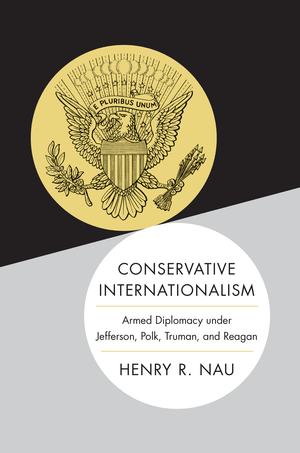
National Fellow alum Henry Nau on his recent book Conservative Internationalism


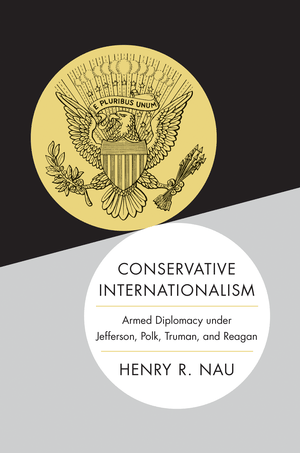
Students of international relations are familiar with the big three theories: realism, liberalism, and constructivism. But, argues former Hoover national fellow Henry Nau, those theories are insufficient to describe accurately significant foreign policy leaders, namely, US presidents Thomas Jefferson, James Polk, Harry Truman, and Ronald Reagan. In his recent book Conservative Internationalism, released earlier this year by Princeton University Press and completed during his one-year tenure as a Hoover national fellow, Nau breaks the big three theories down and identifies a fourth: conservative internationalism. That theory, falling somewhere between hawkish realism and dovelike liberalism, describes a foreign policy that encourages the use of force to spread and maintain freedom around the world.
Conservative Internationalism “has been rumbling around in my head since I entered the profession as a graduate student in the 1960s,” said Nau in a recent interview with the Hoover Institution, “because I immediately became aware how seldom I came across the word conservative and how often I came across the word liberal.” In particular, Nau noticed that, as a conservative scholar specializing in US foreign policy, he was expected to identify as a realist or, as he terms it, a nationalist, yet he identified with neither. “I was much more of an internationalist, that is, I believed that you could make the international system better by progressively advancing the cause of freedom in the world,” Nau explained. Thus he began thinking critically about how a conservative internationalist differed from a liberal internationalist and how one could fill the gap left by the foreign policy literature.
His thinking was reinforced by his service in the Reagan administration because, according to Nau, Reagan was the quintessential conservative internationalist. The current traditions portray Reagan as “either a war hawk who lost his way and Gorbachev saved him, or as a liberal internationalist, namely, someone who always believed in negotiations but was misled by his hawkish supporters to build a defense program and ultimately came to realize that negotiations with force were a last resort, like a liberal internationalist,” said Nau. “This is very unfair in respect to Ronald Reagan. He believed in negotiating and détente like liberal internationalists, but negotiating from a position of strength, which means armed diplomacy. . . . Now that kind of approach does not exist [in the traditional theories].” When Nau looked to past presidents, he found that others followed this new approach, “marrying negotiations and armed diplomacy,” which inspired him to write his ideas into a full-length book with empirical data to support his assertions. Nau drew extensively on Reagan’s personal papers from the Library & Archives during his fellowship.
Beyond his book, Nau also aims to begin a conversation about what might be lacking in the accepted international relations frameworks. He hopes that this conversation will lead professors to teaching new intervening perspectives, such as conservative internationalism. “That’s a tall order,” laughed Nau, “but I’m hoping to chip away at that a little bit.” This larger goal would not have been possible without Nau’s time a national fellow, a one-year program at the Hoover Institution during which scholars dedicate their time to research and writing, as well as being supported by Hoover through academic seminars and publications. “My Hoover contacts were invaluable,” said Nau, describing how Hoover fellows encouraged him to consider the larger academic arena in a research seminar at Hoover’s DC facility. “Hoover is the place from which to start this conversation [on other frameworks].”
So what’s next for Henry Nau? He’s already working on his next book, which expands the concepts of Conservative Internationalism to the policy realm with his views on the role of the United States in the world. In the brief preview from his interview, it includes focusing on areas of the world where democracy is ready to flourish, such as Ukraine and Russia, shifting emphasis away from the Middle East, and continuing to combat global terrorism. He is critical of George Bush’s policies in Iraq; the current fight against ISIS in Syria and Iraq is providing him with additional material. Be on the lookout for his thought-provoking work. He is already making headway in the conversation, as evidenced by a Washington Post op-ed by George Will and a recent essay in the Wall Street Journal by Bret Stephens.
For a summary of the Conservative Internationalism and its findings, an earlier version of Nau’s framework can be found in his Policy Review article, as well as a reviews of the book published by the Washington Times and National Review Online. Conservative Internationalism is available from the Princeton University Press.