






- Economics
- International Affairs
- Law & Policy
- Trade
- Answering Challenges to Advanced Economies
- Determining America's Role in the World
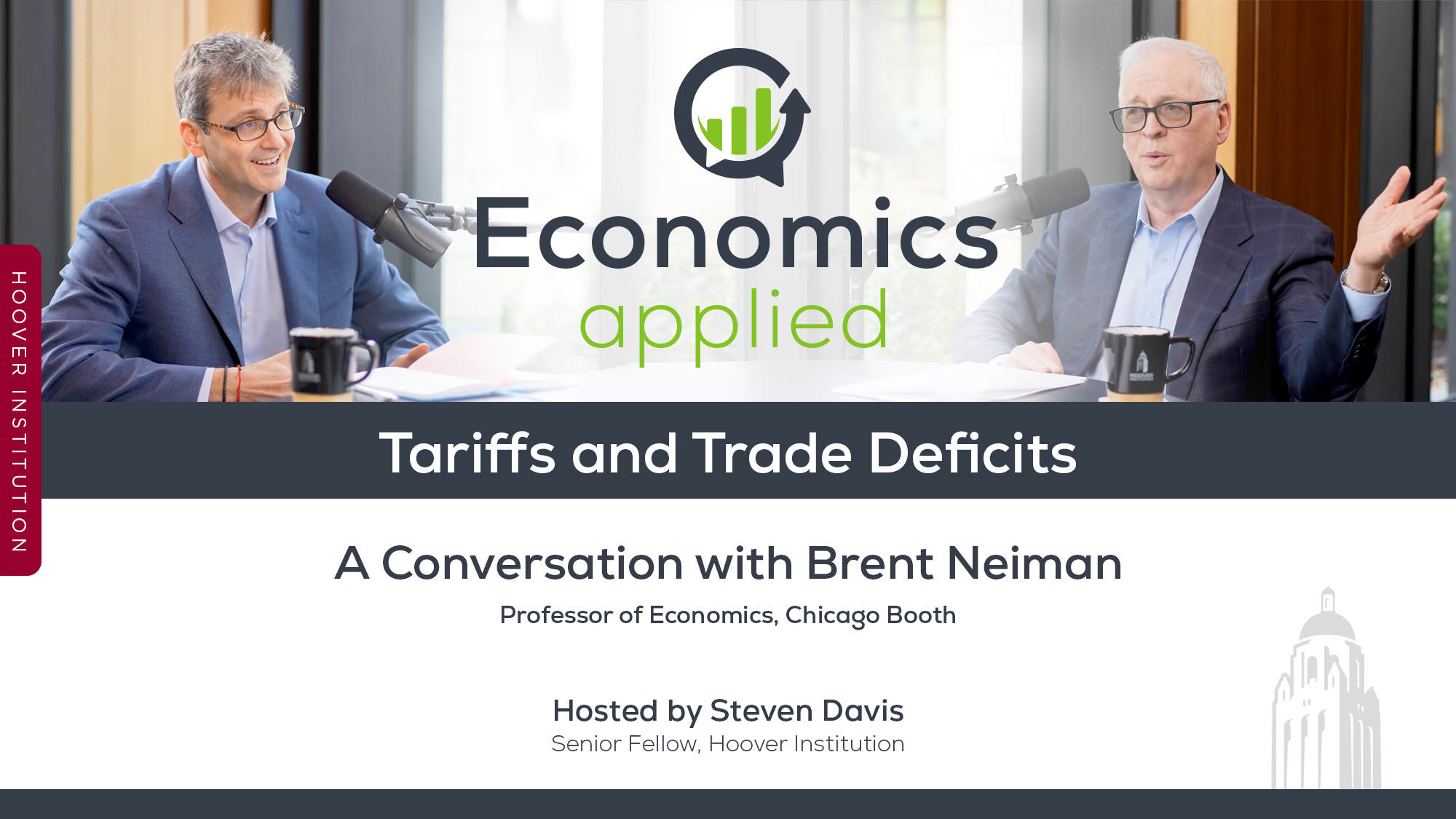
Steven Davis speaks to Brent Neiman about President Trump’s approach to tariff policy and the latest data on trade deficits. While tariffs are up in 2025, Brent’s research reveals that actual tariff rates are only half as high as headlines suggest. Steve and Brent also discuss who pays Trump’s tariffs, how we know, the damage caused by uncertainty around tariffs, and the value of commitment in the conduct of trade policy.
Recorded on February 19, 2026.
- President Trump deploys tariff hikes and threats of tariff hikes as tools of US economic and foreign policy. He sees tariffs as a useful response to persistent US trade deficits. Is that the case? And by the way, who really pays those high American tariffs? Welcome to Economics, applied at a production of the Hoover Institution. I'm Stephen Davis, host of the show. Joining me today is my former Chicago Booth colleague Brent Neiman Brent is a professor. He's the Edward Eagle Brown Professor of economics at Chicago Booth. From 2022 to early 2025, he served as the US at the US Treasury as counselor to the Secretary and Deputy Undersecretary for International Finance, where he worked on a broad set of international economic issues, including the bilateral US relationship with China. Brent, welcome. It's great to have you on the show and good to see you again.
- Thanks for having me, Steve. It's good to, good to be with you. Good to see you again too.
- The online edition of today's Wall Street Journal contains the following headline, America imported a record amount last year despite seismic trade policy changes. The article goes on to note that the US trade deficit hardly changed from 2024 to 2025. And here I'm quoting, despite steep Trump administration tariffs aimed at closing trade gaps. Are you surprised by these statistics?
- Well, I'd say a few things. First, you know, you, you quoted the Wall Street Journal. If you look across different outlets, different articles and headlines, you actually can find different signs of, you know, some people talking about the deficit going up versus down right away. I would start with what's going on is there's a differentiation between a focus on the overall goods and services deficit versus just the goods deficit. And so we can get to it a lot later, but one thing I think is kind of amazing is that now that, you know, the world is focused so much on these tariffs, on goods deficits and on overall deficits, it actually matters. I think from an economics perspective. You know, we typically would think of goods and services together as, as the much more meaningful thing to think about. Second reaction in terms of whether I'm surprised or not, I mean, I, it's, it's a boring answer, but we should be very careful about putting too much stock in this 12 months of data that happens to start at a particular spot and ended a particular spot. There was, is widely believed to have been, and the data looks to me like it exhibited significant tariff front running as soon as President Trump was elected. I think importers understandably correctly, it turns out, predicted that tariffs would come on in the future. So sort of shifted inter temporarily some purchases forward. And then, you know, there's lags and I wouldn't put too much stock in month to month changes years.
- Right. Well, that's why I focused on the 2024 to 2025 change. To your point about the front running, the Wall Street Journal article has a very nice picture of how things look from month to month, and they show exactly what you said. The imports shot up in the early months after the Trump administration took office for the reasons you say. Then they dropped off quite a bit, very sharply. And then they're kind of back up to something like 2024. So I I think the, the, the puzzle isn't so much the month to month. I agreed with you.
- I
- Just wouldn't make 24 to
- 25. Yeah.
- Essentially no change.
- Yeah, I think it's a fair qualitative assessment. Things are basically didn't change. And so I guess here's the two reactions to it. You know, first is the standard economic view of tariffs and the relationship to, to net trade. So whether imports, net of exports Right, would change very much is typically we don't think of tariffs as a, a particularly useful tool to change that net figure.
- Okay. So explain that. 'cause, 'cause to, to the layman, it seems a bit odd. You, you make tariffs, you make imports more expensive. Why don't you get fewer of them? And why doesn't that then cause the trade deficit to fall?
- Right. So zooming, you know, very far out, if you say why does a country import more than they export or vice versa, the way economists typically think about it is, it's intertemporal trade. It's taking the ability to consume today and shifting it into the future. Or if you run a deficit, vice versa, consuming more today in exchange for promises to consume less.
- And that's because we have the future to give the foreign exporters to our markets something in return for the goods and services we import. And if we can't give them other goods and services, we give them promises.
- Right? Right. To pay, pay later. Look, why would you, if you're a foreign country and you know, you produce something and you know, you, you, you took your weekends away from your family and kids. You spent the time and effort to make this thing, but you're not gonna use it. You're not gonna eat it or consume it, you're gonna ship it to me. Why would you do that? You're not being altruistic. You'd do it because in the future,
- Okay,
- I'm promising to do the same and, and ship my goods that I worked hard to create to you. And the way that works is when you ship it to me, it's in exchange for me giving you, let's say an asset, some dollars. And in the future you'll
- Okay. But then, okay, so if I take that logic, why has the US been running a trade deficit for decades?
- Yeah, so the the point I guess I was gonna get at, 'cause the question you're asking now is quite deep, and I certainly don't have a convincing answer. The profession doesn't have a ens a consensus view. But if that's the kind of thing that causes countries to run trade surpluses or deficits and that can reflect productivity trends or slowly moving demographic trends or any number of things, then it doesn't strike me as so surprising that something like an import tariff or an export subsidy equivalently would affect that net amount in a more mechanical concrete and in some sense easier to think of a way. How could it be, or what would be, what might it look like if a trade deficit doesn't change despite tariffs? Sometimes economists would say, well, because tariffs will make imports more expensive relative to, let's say domestic goods, you might expect less imports. But two things that you typically would expect to see happening in response might also bring down exports, leaving the net of imports and exports unchanged. And actually we can talk a little bit about it. 'cause those two things haven't really happened to the extent we expect.
- Yeah, let's talk about that. 'cause thats
- One would be retaliation if you put tariffs on imports from the rest of the world, that might reduce your imports relative to, to, let's say your exports all else equal. But if there's restrictions placed abroad on your exports to them, well that's a counter veiling factor.
- Okay. And so that, that can happen.
- Yeah. - Often has happened historically, hasn't happened that much this time, except perhaps in terms of China's reaction.
- Yeah. China and for instance, you know, soybeans would be like a natural example to look at. But you're right, I think it's happened to a lesser extent than than we expected. Another change, which again, has not happened this time around, but that would play into this, is typically economists, the most standard simple models would say the direct effect of tariffs. An import tariff should be an appreciation or at least upward pressure on the value of your currency. Right. And that would also push exports down that also this time around didn't happen.
- Hasn't happened, didn't happen. That's an issue we've talked about in previous episodes of this podcast.
- I see.
- So I'll put links in there for that. And, and there's some deep waters in that one. So I, I think we're gonna set that one aside for this episode and interested viewers can go to another episode.
- Yeah.
- But what, let, let me just try a different angle. Well,
- Let me actually, okay, go ahead. Real quick. The last thing I'll say in part, just because it also ties, you know, very clearly into recent work I've done is, you know, I think given the fact that most standard, I think economic theory would say the effect of tariffs on trade deficits, not necessarily on trade, but on trade deficits, shouldn't be so massive. You'd need a truly massive shock in order to really, you know, kind of expect much movement.
- So we'll get to how massive this one was.
- I think it wasn't as massive as a lot of your viewers have in mind.
- Okay. So we're gonna, we're gonna get, we're gonna drill into that. You have a recent paper on that with Geeta Goth professor at Harvard and Another former colleague of ours at Chicago Booth. So we will definitely get into that. But, but before we do, I want to just ask about one other thing on the deficit side, which is President Trump often dwells on bilateral trade deficits. Thus far we've been talking about the overall deficit right. For the United States vis-a-vis other countries. So I just, what do you think about his focus on bilateral trade deficit? And I should just say he, I think this is a fair characterization, he, the way he thinks about it, if another country sells more to us than we buy from them, we're, we're disadvantaged, perhaps even deliberately so by nefarious intentions or policies by our trading partner. So what's your view about that?
- Yeah, no, I'm, I'm glad that you, you, you brought us back to that because I think that's a, a an important and, and incredibly faulty view that the existence of a bilateral imbalance in trade is in any way on its own evidence of any sort of unfairness or even a relationship that's disadvantageous. Right? There's, there's reasonable reasons to focus on the multilateral, the overall trade deficit with the world. We could talk about those, but I think especially for the many dozens of countries that have been hit hard by these reciprocal tariffs that are explicitly aiming to close bilateral deficits, I, I think that's a terrible policy goal. And so anything you do to try to achieve that goal is likely to have negative effects. The simplest way I I explain it to students, I quote Bob Solo, so the Nobel Prize winning MIT economist that had this great quip, and he said, I don't, I have a chronic deficit with my barber who doesn't buy a darn thing from me. Because of course the barber didn't take solo's MIT economics courses and there was nothing about an bilateral imbalance. When you and I go to the grocery store or the local dry cleaners, that means the grocer or the dry cleaners ripping us off, and certainly nothing that says we should stop buying their goods until they start buying ours.
- Right. Okay. So I'm, I'm on the same page as you here as our, as our almost every professional economist. Yeah. But let me just point out, it's, it could be the case that if another country unfairly restricts the, the imports of American goods to their markets, that that would affect the bilateral trade deficit. So we, it's possible that the bilateral trade deficit could be, and probably often is affected by policy decisions made in the United States and abroad. So that, that I think we, we, it's pretty clear. Absolutely. Your point though is okay, that's true, but that doesn't mean a bilateral trade deficit or surplus for that matter in and of itself is a sign of any unfairness disadvantage. In fact, as your barbershop example illustrates, we benefit by buying things that we don't produce very well ourselves. Like haircuts in the case of solo, and probably you and me too. And we also benefit when we sell things we're pretty good at to others. And that's just as true when you're looking across countries as it is when you're looking across persons.
- Absolutely. Okay. And there's nothing, I'm not in any way suggesting that there's no unfairness in the world just suggesting that if you wanna target that unfairness Right. Looking around for it, purely by using bilateral deficits. Right. Or even at all by using bilateral deficits as the key signal, the key evidence is likely to lead you astray.
- Yes. And just to, to remind our listeners in, in case they've forgotten the Liberation Day tariffs trump's big speech with his chart and everything, those tariff rates were explicitly grounded in a formula that depended on these bilateral trade deficits.
- Exactly. - So I'm making explicit what was implicit Yeah. In your statement that the whole intellectual underpinning for those liberation day tariffs didn't make much sense in your view. And mine,
- I, if there's country A and country B on that placard, that the president held up with the reciprocal tariff rates and a's tariff rate was twice as big as B. It wasn't because there was, you know, the White House put out evidence on what A did that was more unfair or barriers or anything like that. It was purely the numerical assessment that imports less exports was twice as big in A than in B. And that to me is very much faulty logic.
- Okay. You know? Yeah. Okay. So let's get to the issue of this related issues. How big are the current tariffs in 2025 on average? Or as of now, whichever you prefer. How do they compare to tariffs historically? And also how big are they relative to like the headline numbers that we read all about, which is where your study with Geeta Gopi NI think really made some
- Progress Yes. On
- Our understanding.
- Yeah. So let me actually go in reverse order if I could. I think it'll be easier to explain. You might think it's really easy to figure out what's the sort of headline, statutory announced tariff rate. You know, certainly our, our importers need to know it. They need to know what they're paying taxes on. And in fact, in previous episodes I studied the price response of imports, import prices to the tariffs that were put on in 18 and 19 in the first Trump administration. This wasn't a very challenging thing to do. The tariffs were basically on China plus some industries like aluminum and steel or solar panels. They were announced and then they kind of stuck there. They were defined in a way that was more concordant with the definitions of products that firms knew, you know, what they fit into or not. This time around, it's been much, much more challenging.
- Okay. - The announcements are made about tariffs going up and down and things change day to day, week to week. Certainly, well, within a month, sometimes that announcements is translated or reported in the federal register in a, that still has ambiguities, sometimes custom. And border patrol later clarifies the way to implement the federal registers interpretation of the announcements. And then lastly, there are exemptions and carve outs, some of which actually are, are even sort of firm specific. And so you couldn't even really get from the aggregate data or quickly identify it. So it's a challenge to even know, you know, what are we talking about? Are these announced tariffs, big or small? What are they? And so to try to solve that problem, what we did, and it's admittedly an imperfect technique, but I think it's a helpful and informative approach. We looked across imports into the United States by country and by product. And for a given month, for given export or for given product, there are a lot of different observations of the FOB value. The essentially value of the imports
- When FOB, meaning when it arrives at the dock,
- Excluding, you know, insurance and freight and stuff like that.
- Right. Okay.
- And then we look at the actual tariff revenue that was paid or collected by the government associated with those import, you know, that import value. And there are a number of different observations of this, even within a given month, because you see it, depending on where the shipments enter the United States, maybe something comes in through the San Jose port or through Virginia, or similarly, there's different tariff programs or import programs that you might, as an importer declare the shipment to be under. So a nice example, there would be some imports might be declared to be U-S-M-C-A compliant, others not US MCA is of course the free trade agreement between Canada, Mexico, and the US that replaced nafta. You know, and finally you might even see different sort of values depending on where the shipment was unloaded. So, so there's a lot of these observations and we look across them and we say, what's the biggest, if there's two observations of 0% paid and three observations of 10% paid, and then this is within a particular product category in a certain month, within a month within a product category. A narrow
- One. Narrow one, okay.
- And from a given exporter,
- Okay,
- Let's say there's 40 such observations and they range from zero to 10%, let's say we're gonna grab 10% and say that's the statutory rate. Right. Why do we say that? Well, it's reassuring that someone is paying that, and these aren't small, it's not shipment level data. So that means that someone really paid that. So, okay, we're gonna call that the headline rate, but then we also will measure the average rate, which would aggregate the 10%, but with the 5% and the 3% and the 0% Okay. By weights. And that measures what we call,
- And I presume the average here is calculated taking into account the shares of the goods value that paid the 3%, the 0%, the 10%.
- Exactly. Okay. Exactly. So, and that's what we call the actual tariff
- Rate, the actual rate for that product category. Narrow one.
- Correct.
- In that month.
- Correct.
- And so this is kind of how you cut through all the complexity of announcements, implementations, exemptions at the product level, at the country level by, based on a whole bunch of stuff. It's just,
- It's imperfect, but it's a way to let the data speak. Right? We are not parsing any news announcements made by USTR. We're not looking at the federal
- Register. This is like, what, what's actually happening on the ground at the port, so to speak.
- And when you look at those series, I guess there's two things that really strike me. One is there's a huge gap between them. We assess the statutory rate now in November is the latest data. And our paper is frozen in time as of September. But I should note in my webpage every month it automatically updates we're through November. Okay. 'cause we didn't update today. And the statutory rate is on the order of 27 20 8%.
- Okay. - Compared to the actual rate of more like 13%. So it's even less than half. Okay. That's the first point I would make. Okay. And happy to talk about gaps in a second. What constitutes that? But the second relates to what you opened this conversation with, which is you said, you know, are, are you surprised that there's no movement? And I kind of said, well first, you know, we probably don't wanna get too worried about, you know, is it 1%, 2% one way or the other. But the other thing is we show that the actual tariff rate started 2025, very, very low and grew very, very slowly during 2025 up to the 13% rate that we see as of November for many months. In 2025, even when the statutory rate was way up there in the twenties or higher, the actual rate was five 6%. And so from that perspective, since the 2025 trade data integrates over all the months in 2025, there just haven't also been that many months where there's been very large tariffs that have actually applied to the data covering goods coming in.
- Okay. So summarizing the average effective tariff rate in 2025, maybe what, 8%?
- Yeah, it seems reasonable. So it started at Z compare and that two and went to 13,
- Compares to two. So we had maybe a six percentage point increase in the average tariff rate on imported goods in 25 to 2024. I'm just trying to do some simple here. This is a reasonable
- Back of the envelope.
- Yes. So six percentage points and a little bit more arithmetic. Imports are what, 12 15% of us, GDP,
- What's So 15 if you include services 14. Really? Okay.
- Let's, and 11 for goods. That makes the arithmetic a little easier.
- But the 11 to be clear actually. Okay. The six percentage point change that you're describing actually only applies to the
- 11. Oh, okay.
- Because there's not hitting services. Okay. It's
- Good. So now we're, we're at some overall impact we're getting, there's another important point here, which is why I'm running through the arithmetic.
- Okay.
- You know, you do the multiplication, 11% of six percentage points is around one around six tenths of a percentage point.
- Yeah. - So this would be just in a very crude way, ignoring spillover effects to the prices of other goods and services. This kind of gives you a direct impact on the inflation rate of half a percentage point, maybe a little more,
- A little more. Yeah. And
- Now all of a sudden this clears up another, I think confusion misperception, where's all the high inflation?
- Hmm.
- Well there is, there is inflation. People have done these studies, if you look very narrowly at the goods and services that were heavily affected by tariffs. But the overall impact on the US economy, the direct impact at least would be le well short of one percentage point.
- I mean, I don't know if we wanna say well short of Okay. But I like your back of the envelope very
- Much. Okay. I'm just trying to go, Steve,
- The way I do it, Steve, without anything complicated, Steve, let's pick even simpler numbers. Okay. I
- Think
- Ballpark, if, if a viewer wants to truly ballpark it, if there's 10% of consumption is hit, you know, 10% of GDP is hit because that's approximately 11 and there's full pass through, then you get pretty close to 1%.
- Okay.
- And that's, I think, pretty close. So the latest estimates that I find compelling come from Alberto CAO's work. It's, it's hard to measure this stuff properly, but
- Right.
- And I think a few months ago, I haven't looked at literally what today it says, but a few months ago he was at 0.7, you know, seven tenths of a percentage point. I'll bet it's closer to one at this point. And that seems about right.
- Okay. Okay. Now by the way, I wanna, I wanna hasten to add, just because the overall impact of tariffs on the price level is modest, as we just kind of talked about, doesn't mean the economic costs of the tariffs are modest. That's a separate question because the economic costs depend in part on these exemptions. The uncertainty that come that's been associated with Trump's trade policy, the undermining of clarity and commitment in US trade relationships will come to these things. But I just wanna make a clear marker here. Small effects on the price level doesn't mean small effects and everything else.
- So yes, I, I completely agree with that, including as I hope we get back to later even non-economic costs associated with this stuff. But the last thing is, I'm not totally sure I want to grant that one percentage point is small, including given, we don't know that it stops there. For example, there's a question, does this actual tariff rate that I said remains well below the statutory rate even today? Does it continue? It's got a whole way longer to go if it's gonna catch up. Understood. Understood. And I, I do think there's a bit of a misperception on what economists mean by, you know, kind of an important implication for inflation. I mean, if, if inflation goes up one percentage point and you price the repercussions, let's say in capital markets of a, of a fed hike aiming to undo that one percentage increase, I mean, you can, you could easily get to some big numbers. So if, if listeners in mind this is a 10 percentage point thing, fine, but, but economists never, I don't think envisioned a direct price level increase anything like that.
- Exactly. I'm just trying to take the straw man off the table. Yeah. Which I think's is sometimes put out there by advocates of the tariffs that say, well where's all the inflation? Yeah. There hasn't been that much inflation yet. And because the, the effective tariffs aren't that big now.
- And you, you also might never see it in principle, you know, the price level, the aggregate inflation rate responds to, you know, for instance, federal Reserve policy.
- Sure, sure.
- It's really the relative price that, that we think tariffs would,
- Would affect that, that that point's well taken. I've, I've made that point another time. Sure. I know you know this of course glossed over it here. Of course. So you, you hinted at the work of Alberto Cavallo and he's at Harvard and, and I wanna come back to his work for a minute because, and correct me if I'm wrong here 'cause you've updated your paper and I may miss the latest updates, but as I understand your paper with Gita Gona, you are mainly focused on measuring the size of tariffs as we just discussed, the extent to which they are passed through at the border.
- Right. - And then there's the question of, well, okay, they get passed through at the border, but how are they divided up between the importers, the people they distribute them to, the businesses that use the products and the final consumers?
- That's right.
- And, and if I put the, so again, correct me if I'm wrong, but my understanding, if I put your work with Gita together with the study by Cavallo and, and others, what we conclude is that Mo, at least as of 2025 on average, most of the tariff effects that in pass through at the border were showing up in the form of firms with smaller margins or higher input costs and, and only a fraction of it was showing up to the final consumers. Is that right? Sorry, I got basically
- Right this episode or the 20 18 20 19 episode. Are you asking
- About, I I asked about the, we can talk about both, but I was asking about 2025.
- I see. So you are right that Gita in my paper really focuses on the, at the border prices. Okay. The prices that the importers pay and Right. We really don't weigh in on how that should be broken up between, let's say wholesaler or an OEM or whoever this importer is.
- Right.
- Versus the consumers where if this is passed along. Okay. So
- To be concrete, you know, is Walmart taking smaller margins or are they passing along to consumers? That's correct.
- But my read, so, you know, Alberto is a co-author of mine, a friend of mine. I, I did not do this recent work of his
- Okay.
- But I did read it before coming to talk to you today. And I think his number is, as of today, 43% of it has been passed. Okay. Along to retail
- Prices. That's, but that's his most recent data towards the end of 2025.
- Correct. Okay. So, you know, I actually, Gita and I worked together with Al Alberto and someone named Jenny Tang in 2018 19 to, to study that episode. And I think Alberto characterizes this episode as exhibiting faster, pass through
- Faster - Given what happens at the border to retail.
- Okay. So just,
- But that's his results. I don't want to, you know,
- I understand. Yeah. But just to finish this thread of the discussion.
- Yeah.
- One seems implication of that is that even if US tariffs were frozen in stone today, it's likely that we'll probably see some continuation of the pass through to final goods consumers going forward because it's unlikely that producers are going to accept permanent reductions in their margins. Okay.
- I, I agree. The, the one caveat, so maybe I can take it in a couple steps. So the first question is, you know, what happened at the border,
- Right?
- And again, our, that's the focus of work we focus on and, and, and I should say we've got good company at this point. So researchers at the New York Fed a study out of researchers at the Kehl Institute, the CBO, in fact, when it released its annual budget report, all these analyses came up with pass through rates of tariffs to import prices inclusive of tariffs that are ostensibly, you know, close to one sort of from 90% up.
- Okay. So that, that, that's a key thing. 'cause I just wanna stop you here.
- That's the first step is there,
- That says it's, it's Americans, wholesalers, original equipment man and manufacturers final goods, consumers, they're paying it. So that, that's, I'm underscoring this just because it's contrary to the line you hear from the Trump administration so often.
- Yeah. And maybe Steve, we should just, 'cause a lot of people do, I think it's important to state the, the scenario what it would look like if the Trump administration's line or, or anyone's line that exporters or foreign countries are paying these tariffs. What would that look like? Because it is not incoherent. It is certainly, you know, theoretically possible that this could have been the case. And one of the reasons I studied this empirically in fact was just to see if there was any evidence that's happening. But you can imagine if, if a 10% tariff is, is put on by the United States and an exporter says, well look, the US is a really important customer of mine, the last thing I want is them to switch to some other country or source in a different way, maybe domestically to preserve my market share, I'm gonna reduce my export price by 10%. Well that would be a world where the US importer would say, okay, I'm paying 10% less. So it's possible.
- And so how do you know that didn't happen?
- And instead what we, what we mostly see when we look at the exporters prices in dollars to the US exclusive of TA of tariffs. So ignoring the tariffs, we by and large see that they don't change. You can think of it as if they were exporting for 20 bucks before the 10% tariff. They're more or less exporting for 20 bucks, maybe closer to $19 and 50 cents before the tariff now. And so you add that 10% tariff back on and importers are paying either $22 or a little
- Less. Okay. So you, you actually see on individual transactions or product level transactions,
- We don't.
- Well so where are you, how are you concluding with confidence?
- Yes.
- Well that most of the pa that 95% of the tariff has passed through at the border.
- Good. I think I don't wanna sort of, you know, overestimate or overstate confidence in a very, very well estimated number, like 95% per se. Okay. The way we could back in 2018 19 when we had time and access, which I don't think is as easy to get now to the micro data, like you said, shipment by shipment.
- Okay. - So inference now from us came from a variety of sources where you put 'em all together and all of the measures that we see, all the different methods that we tried and we sort of looked at three different things all give you pretty darn high numbers. And so, you know, the way at least I think of it is there's just no evidence that passed through is is low, there's no evidence,
- But give me your best evidence. Yeah. What, what are you doing? I presume somehow you are following
- Prices. I'll give you the
- Three at a very detailed level, you know, with and without the tariff.
- I'll give you the, the two things that we do that's simplest to understand. Okay. And then the third, which is more complicated, but which is the thing that gave us our baseline benchmark number of 0.94. If you told me are you super confident that it's 0.94 versus 0.97 or 0.9 No. But am I quite confident that the pass through numbers are very high?
- Yes. Okay.
- We do three things. The first is the BLS, the Bureau of Labor statistics creates an import price index. And the key challenge that they're trying to solve for is the same as for domestic CPI. It's, they wanna measure the exact same good transacted on from month to month. Because otherwise if you just look at t-shirts, it could be that the quality of the shirt goes up massively. And so the price increase is reflecting better quality as opposed to a quality adjusted price increase. Same issue with CPI. The BLS offers these data aggregated to countries and also to industries that look like two or three or four digit SIC industries loosely can think of, you know, heavy duty trucks might be kind of an example. Right. And let's start with the country case. You know, there's not that many observations that the BLS offers. They don't tell you about the prices of imports. Quality adjusted from every country in the world. They give us about a dozen countries. But these countries range in terms of the tariff that they face now from the United States from, you know, five, 6% would apply to countries like Europe all the way up to about 30%, which would be China, you know. And in here there's Japan. Somewhere in the middle, there's Canada, there's Mexico, there's lots of countries. And our, our paper basically just shows, I mean this is one of these results where you don't need anything fancy. You just look with your eyes and there's just no evidence whatsoever that any of these import prices in dollar terms are moving meaningfully. They're all going up or down by one to maybe 3%. Okay. Relative to trend
- From 2024 to 2025, so to
- Speak, over a 12 month horizon. Okay. Ending where we, and
- I I just want to emphasize, you said this before this, this, these are measurement exercises that the BLS just does routinely. Correct. This is not something new they rolled out.
- Correct.
- So they've been working on this for years, decades. And it doesn't mean it's perfect, but it's, this is a stable, reliable statistical exercise that's been ongoing for a long time.
- Absolutely. So we do that for countries, we do it for industries we see high pass through,
- Okay.
- Where I get the 0.94 and we do something fancier and probably more serious. And it's what I would call our baseline measure. But you know, I'm not claiming it's perfection, but I think it's confidence inspiring is we use, and now it is closer toran, it's not literally transaction, but micro data that is publicly offered. So we have the code out there, anyone can replicate it and check it out themselves, but offered by census. Where what you can do is look at changes in unit values. You know, what country, you know, a shipment is coming from, I should say what a unit value is, is it's a value of a shipment. Let's say we import from Thailand, a box that has, you know, it costs $30 to import the box for most goods. There's a somewhat reliable measure of the units or the quantities in that box. This doesn't always work, but let's say it's sofas, you know, that's probably an HS code, a product code where the unit is count. And that's pretty reliable. And so it's not as perfect as the BLS, you know, holding fixed goods thing. But if you see there's two sofas in that $30 container, well then we're gonna call the unit price 15 per sofa. And again, to your point, this is what economists have worked on and and done things like this forever. Using that we can regress essentially how did the prices or compare price changes in those unit values to tariffs that would be applied.
- Okay. So I think, I think we got far enough into the weeds of that was helpful. No, but I wanted to do that 'cause I, I think it's important for people to understand the analytical underpinnings of these claims so they can assess them for yourselves. But I'm, I'm gonna, I'm gonna summarize Brent as being pretty highly confident that the pair of ta ta Paris TAF tariff pass through rate at the border is pretty high, probably north of 90%.
- Yes. I'm good with
- That. And and it follows from that claim that Americans in some form businesses or consumers are paying most of the tariff hikes
- Yes.
- Under the second Trump administration.
- Yes.
- That's kind of the bottom line.
- That's the bottom line. I do think it's important some of the coverage. I mean, I think I agree entirely with your characterization. I think the statement that, you know, the price incidents of tariffs, sort of who's paying more because of this tariff. It's by and large, you know, almost entirely Americans, whether it's firms or individuals.
- Okay.
- Sometimes that's mistakenly interpreted as there's no consequence of that for the rest of the world. And to be clear, that's not the right way to think of it either. Right. Just because the prices went up only for the consumer. I mean, ask the seller they're unhappy because they're selling less,
- They're selling less. Yes. Exactly. Okay, let's, so let's kind of move a little bit back now to a few more conceptual things. And we touched on these very briefly earlier, but aside from the direct effects of the tariffs themselves, how do you think about the economic consequences of the volatility referenced earlier, the uncertainty about what tariffs will be? And let's take that and then we can, we can move into something I know you want to talk about, which is, let's just call it the lack of commitment in trade policy as it's being conducted under the second Trump administration.
- Yeah. I mean, look, you're, you're the, the expert on the effects of uncertainty. But it, it doesn't, you don't have to get so deep into academic expertise to understand that when policymaking is this volatile, when you genuinely don't know, you know, what the tariff rate that's gonna apply to some of your, your, your main supplies, let's say next month, two months, three months. It's gotta be incredibly hard to plan. In fact, it might be part of your, your, the answer to your question, why haven't we seen more changes in response to these relative price movements? I mean, part of it may be that as costly as it could be in the wake of this kind of uncertainty, a a natural and oftentimes optimal response is just to wait, do nothing and see. And so, you know, I I think that the, the form in which this trade policy was deployed, even if you had the exact same trade policy, but you deployed it in a, you know, well telegraphed, you know, kind of one time with a proper time allowed to adjust, my guess is it would've been a lot less disruptive, less costly. Right. And, and, and, and better,
- Let me, let me put it in concrete terms. So one of the things the Trump administration is, has sought to do with various economic policies, including tariffs, is encourage foreign companies to invest in US factories. Okay. So let's think about that. And there it's easy to understand why that's an appealing goal. So I'll just take it that there's some positive aspects of that take it as given. And I think it's also clear that if you are thinking about, say, building a new chip fab or automobile manufacturing plant in the United States, that looks less attractive if you think you're gonna have to pay high tariffs on certain intermediate inputs that will, you'll use to produce the chips or the cars. So that's kind of the direct effect of tariffs on intermediate inputs that is working contrary to the stated intention of encouraging more factories in the United States. But, and here's where the uncertainty kicks in. The uncertainty about what you have to pay for those intermediate inputs in the future is another deterrent to investing today and gets to your wait and see point both directly. 'cause you know, maybe I only have to pay a 5% tariff on my intermediate inputs, but depending on the president's desires, maybe I have to be 25%. And that has a huge impact on the desirability of the, of, of building that factory in the United States. And going back to something you talked about earlier, there's uncertainty about how, how other countries will react to us tariffs. So the uncertainty is biting both directly in, in my little example on my desire, my willingness to invest in a new US factory, but also indirectly because it creates a lot more uncertainty about, well what if I want to export some chips or export some automobiles from this new factory that I'm consider considering to build in the United States. So these uncertainty effects, at least in principle, especially in the short run, can be more powerful than direct effects of tariffs that we've been dwelling on in most of this conversation. Do you agree with that assessment?
- So I, you know, I, I don't know how to quantify when you say more important, but it's plausible to me. I certainly could see that and I, but the, the qualitative points you're making, I I completely agree with, I mean, the way I think of it is in the same way that it, I mean let's say you went back to the tariff regime of a year ago or two years ago, it would've been a huge mistake to try to manufacture certain things in the United States. In some cases for some products, there were moments in time during 2025 when that's flipped, when it is so prohibitive to invest, to import, for instance, some things that were produced in China, certain ships for example, that it, it would be prohibitive to produce outside the United States and you could imagine it causing a, and then within a week or two, in fact you saw an exemption for those goods. So now you're back in the case where it would've been a huge mistake, right? Had you relocated things in that context when you're producing a fab or making some investment that's long lived to the tune of years or decades, it does not surprise me that you're not gonna, you know, see much responsiveness right away. Of course, you know, business decisions, I mean household decisions are gonna, are gonna wait and see. The other element, I liked that you brought up how imports are important for producers, both for domestic goods but also for in fact US exports. One thing I think is a lot of times lost is sometimes people say these are the highest tariffs we've faced in X years and X is huge. Maybe it's a hundred years, something like that. But a hundred years ago, even at the same tariff rate, tariffs in my judgment wouldn't have been as impactful in terms of what they mean for economic activity and, and distorting economic activity. In part, I really for two things, one is trade just wasn't as big of a deal back then. The 11 14% numbers that we were playing around with on goods and services shares of GDP were much, much smaller a hundred years ago. But two trade was much more commonly, largely final goods back then. Now most trade is intermediate inputs broadly defined if you include capital goods and things like that. And one of the implications of this is I think there's also a lot more uncertainty on what exactly the implications of these tariffs might be. There are certain supply chains that run back and forth. The famous one is autos between the United States and Mexico multiple times in ways that policy makers I think would have a very hard time internalizing thinking through planning around, you know, I think because of this we don't know exactly where there's reliance on imported imports that might have been hit by really large tariffs or not. I think these kinds of issues make also the analysis of, of tariffs and the evaluation of where it's biting much more complex, much more complicated. I mean the, the final thing you can imagine thinking about would be that exercise on asking, you know, what was passed through, you know, in an intermediate input context, it's really hard to be able to condition on when is a producer and to what extent reliant on inputs that have been hit by tariffs. And I think you're likely to miss some of the pass through in those instances.
- Okay. So we have in the Mexican US Mexico border case, we've got goods being passed back and forth across the border, maybe multiple times in the production process. We have something like steel, which has high tariffs under the Trump administration that are parts of components in cars. So how do we deal with those, you know, do we deal it with it on their percentage of value? How do you calculate that for, for something that's in the process of production? So there's just a whole bunch of complications
- That's right.
- That are introduced because so much of international trade involves now these intermediate inputs rather than final goods. So that's, that's part of your point. And that that's just, that's a complication for the border authorities trying to assign tariff tariff duties. But it's a complication for businesses making plans.
- You and I study this stuff typically in a simplified economic environment, in a theoretical model or something. But in the real world, I, it is my judgment that the messiness of whatever policy you're trying to implement is a really important consideration.
- Right.
- And all the uncertainties that you're describing compounded by the fact that there's on, there's off, there's lack of commitment, there's lack of rules, it's fast, I think increases the likelihood that, that there's even more costs associated with all those.
- Well I'm, I'm glad you make that, you made that point. 'cause when I think I'm gonna make the same point a different way. When people think about something like the uncertainty about over tariffs, they tend to think, well, okay, it'd be nice to know whether the tariff rate's gonna be 10% or 20%, but how, how costly is that? But as your remarks are illustrating, the, the uncertainty around something like trade policy isn't just one dimensional, what will the tariff rate be? It's all these other things about how it will actually be applied on the ground. Figuring out what it means in practice, which is one of the reasons you went to the approach you took with Gita in the first place is 'cause you can't just read the, the tariff tables and say, ah, I know the answer. It's just too complicated. The actual implementation, the is, is critical here. And there's a whole set of complexities that arise from that. So I think that's often lost, not just in the abstract discussions that economists engage in, but even in the, even in the newspaper discussions
- And even in the, the speed of the policy process itself. So we, we haven't talked about it yet, but most of the Liberation day tariffs were justified under the, or enacted under the authority IEPA, the International Economic Power Emergency Powers Act. It was a 1977 act that had been used as the basis for things like financial sanctions but not tariffs before. Right. And, and the Supreme Courts could rule on this soon, and we can get to it in a second if, if it's of interest. But, but one repercussion of the use of this is it eliminates a number of, I think safeguards is the wrong way to phrase it, but sort of deliberate process constraints on, on speed that other sort of, that other authorities with which you'd use to, to justify sanctions or to enact sanctions require. So things like public consultations or the production of a report reflecting an investigation. These are the kinds of things that section 2 3 2 or 3 0 1 right. More classic tariffs require. I think there's greater scope for even policy errors even taking as given the objective function of the policy makers when you bypass all of this and you instead can change policy so
- Quickly. Lemme just elaborate on that 'cause I think it's a key point. So President Trump has appealed to the, in his administration, have appealed to the A EPA legislation as the basis for, I think most of its tariffs on evaluated basis. And judging from his rhetoric and his actions, president Trump thinks that authority gives him the right to set tariffs however he wishes with short notice or no notice irrespective of what US treaty obligations the United States has entered into in previous trade agreements, irrespective of any consultations with Congress or anybody else. And so much of the wild tariff gyrations we've seen flow out of that logic. And as you pointed out, that case is before the Supreme Court. Now any week now, we could get a ruling on that. It'll be tomorrow. Yeah, maybe tomorrow. We'll see and it'll be a big deal. But I think your view and my view, but I, I'll state my view, you can tell me whether you agree that in addition to all the uncertainty and the bad process that this approach leads to in tariffs, it also really undermines the ability of the United States as a whole to make any commitments to trade policy and both the actual trade policy outcomes, but any commitment to a reasoned process for setting trade policy. So in that sense, I see this a EPA legislation, this a EPA case before the Supreme Court as really critical in narrow economic terms as we try to explain, but also in terms of the relationship between the executive branch and the congress, the relationship between the United States and its trading partners and allies. So I, I just see this as an enormously inconsequential case on economic and non-economic grounds as I tried to suggest. And I, I want to, I really wanna get your perspective on this as well.
- Yeah, I I agree fully and I think it's of under appreciated or underrated importance. A a lot of people dismiss the importance of it on the basis that they say, and there's some statements from the administration supportive of the idea that other authorities would be called upon and if, if the administration wants to have high tariff rates even without a EPA, they could, they could get it. What I think that misses is exactly as you characterized these A EPA tariffs have allowed the administration to change things at very rapid clip and oftentimes for reasons that are, are not even associated with the emergency. In other words, they have a very broad set of issues that they could say are causing them to either immediately raise or immediately lower tariffs on issue X to industry Y. And I think what that does, you know, think about trade agreements that we've heard about in our lifetime. They are not quick wins. They take a long time. Right. And part of the reason it's so hard, and part of the reason it's so beneficial is that the political economy of trade negotiations everywhere, including in the United States, is difficult. There are winners and losers, you know, from reductions of impediments to trade countries have to typically give something up to get something. It's, it's hard. And why go through all that trouble if you think that, you know, hard earned agreement that involved some costs, including political costs to you could immediately be undone or, or, you know, overweighted by a pretty spontaneous, you know, imposition of an a EPA tariff. I mean, think about one of the initial waves of the IPA tariffs was on Canada hitting Canadian lumber, for example, where the associated emergency was the fentanyl crisis, which itself is a, a very real and, and, and tragic and serious thing, but it's hard to connect it to lumber if an administration is given that kind of leeway. It's pretty close to saying, look, you can just turn tariffs on and off however you want. And in that world, why would you invest in the hard work required to achieve difficult, but, but ideally mutually beneficial agreements. So the bottom line is commitment technologies are, are, are useful, they're, they're helpful. And something United States, I think has spent decades building up these commitment devices that can, can bring us and our partners and sometimes our, our even adversaries to see it as beneficial to negotiate and make hard choices that, that each, you know, the United States ultimately says is in our benefit. And I worry we're getting rid of that commitment device. Okay. Eroding that.
- So I, I'm, I agree with that, but I, I wanna take another tack and let's say, try to put myself in the shoes of an advocate of Trump's approach to trade policy. Says, well the president really needs this, this ability to move tariffs around as leverage in his negotiations with partners so we can get a better deal. So what's your response to that?
- I mean, there's always a time consistency sort of issue where if we've put structures into place that we think commit ourselves and we think commit, you know, other countries to do something there, there, there could always be short-term gains from deviating from those agreements. And you have to weigh that against the long-term losses of having eroded that, that framework in, in the first place. You know, I dunno, business relationships, you could always steal from your partner tomorrow, but you're gonna give up any ability to do business with them on into the future. And that usually is, is viewed as, as a, a winning long-term strategy in the interest of long-lived institutions or countries. I'm not saying that there's never scenarios where I could imagine walking away from agreements or trying to find ways to put significant pressure on partners to the US benefit. But if doing something like that, we better make sure that the juice is worth the squeeze. And I worry in this case that I, I don't see, you know, changes, concessions, whatever gains it is that an, a supporter of these policies might argue for. I certainly don't, don't see them in a way that I would assess to be worth the longer term erosion of commitment devices and institutions that we see. And I'll even go further in an exon sense, I can't even imagine what it would be for many, many of the dozens of, you know, small developing countries with whom we hit with, with huge tariffs. I think, you know, things are much more complicated of course in many dimensions with countries like China or major advanced economy partners. But it's hard for me to imagine that kind of logic holding up when we're, when we're talking about a lot of, you know, kind of developing emerging market economies where economically I don't, I don't it, it's hard to imagine what kind of gains anyway you would get. We're not gonna get deals with Zambia that I think are gonna move the needle.
- Yeah. Well, and two, two last points on this and then, and then we'll wrap up, which is, what does a deal mean if there isn't any commitment? So these deals are right, potentially quite ephemeral. It remains to be seen how much countries that have made concessions to the Trump administration almost at gunpoint will actually follow through. And also gotta think about, well what about the president who comes after Trump, maybe have very different policy priorities. Do we want that president to start using trade policy as a tool to pursue a very different set of policy objectives than the ones that President Trump pursues? And that presumably appeal to many of his supporters. So it's important to think through the longer term consequences of the Trumpian approach to trade policy, not just in the economic arena narrowly construed, but in the political proce in the political arena and the foreign relations arena more broadly down the road. And it's not, it's not a very pleasant picture when you think about what the world would look like when the United States cannot, will not make commitments, agreements that mean anything to other countries.
- Yeah, - And I'll just end here by quoting George Schultz who had a lot of experience in the foreign policy and the economic policy arena. One of his favorite expressions was trust is the coin of the realm. Well, there's not a lot of trust in US trade policy at the moment in my judgment
- Conversations and certainly my experience in DC bears this out, diplomatic conversations, you know, it's not as if you agree to a very narrow set, you know, extremely narrow. This element of trade policy, high level, you know, conversations between countries cover all issues of interest to the countries. And even in economic policy, not even getting more, more broadly financial policy. You know, we're asking countries and we, I think, benefit from reaching agreement or finding ways to work with countries on in the future. It's likely to include things like AI regulation in the current, it includes things like illicit financing issues, you know, monitoring, you know, efforts to counter the financing of terrorism, pandemic preparedness, et cetera. And, you know, people aren't gonna say, well, we'll work with you on that and think about trade policy completely separately. Right? There's a certain amount of diplomatic capital and we need to make sure we're, we're using it effectively. And I, I worry that we are not.
- Okay. Well put and we will end it. On that note, thank you so much, Brian. It's been great to see you again. Great to have you here at Stanford and Hoover and this was fun. Thanks for joining us.
- Thanks. It's nice to talk to you.
- Likewise, take care.
ABOUT THE SPEAKERS
Brent Neiman is the Edward Eagle Brown Professor of Economics at the University of Chicago Booth School of Business. From 2022 to early 2025, he served at the US Treasury as counselor to the secretary and deputy undersecretary for international finance. He co-directs the International Economics and Economic Geography Initiative at the Becker Friedman Institute, participates as a panelist at the US Monetary Policy Forum, and is a research associate in the International Finance and Macroeconomics Group and the International Trade and Investment Group at the National Bureau of Economic Research.
- Visit Brent Neiman’s Website
- Follow Brent Neiman on X: @brentneiman
Steven Davis is the Thomas W. and Susan B. Ford Senior Fellow and Director of Research at the Hoover Institution, and Senior Fellow at the Stanford Institute for Economic Policy Research (SIEPR). He is a research associate of the NBER, IZA research fellow, elected fellow of the Society of Labor Economists, and consultant to the Federal Reserve Bank of Atlanta. He co-founded the Economic Policy Uncertainty project, the U.S. Survey of Working Arrangements and Attitudes, the Global Survey of Working Arrangements, the Survey of Business Uncertainty, and the Stock Market Jumps project. He also co-organizes the Asian Monetary Policy Forum, held annually in Singapore. Before joining Hoover, Davis was on the faculty at the University of Chicago Booth School of Business, serving as both distinguished service professor and deputy dean of the faculty.
RELATED SOURCES
- “The Incidence of Tariffs: Rates and Reality,” Gita Gopinath and Brent Neiman, working paper, February 2026
- “America Imported a Record Amount Last Year Despite Seismic Trade Policy Changes,” Matt Grossman, Wall Street Journal, 19 February 2026.
- “You’re Paying 90% of Trump’s Tariffs,” The Editorial Board, Wall Street Journal, 13 February 2026.
- “Tracking the Short-Run Price Impact of US Tariffs,” Alberto Cavallo, Paola Llamas and Franco Vasquez, 30 January 2026.
- “The Trade Policy Rupture,” by Steven J. Davis, Freedom Frequency, The Hoover Institution, 6 October 2025.
ABOUT THE SERIES
Each episode of Economics, Applied, a video podcast series, features senior fellow Steven Davis in conversation with leaders and researchers about economic developments and their ramifications. The goal is to bring evidence and economic reasoning to the table, drawing lessons for individuals, organizations, and society. The podcast also aims to showcase the value of individual initiative, markets, the rule of law, and sound policy in fostering prosperity and security.
For more information, visit hoover.org/podcasts/economics-applied.

