


- US
- Law & Policy
- Revitalizing American Institutions
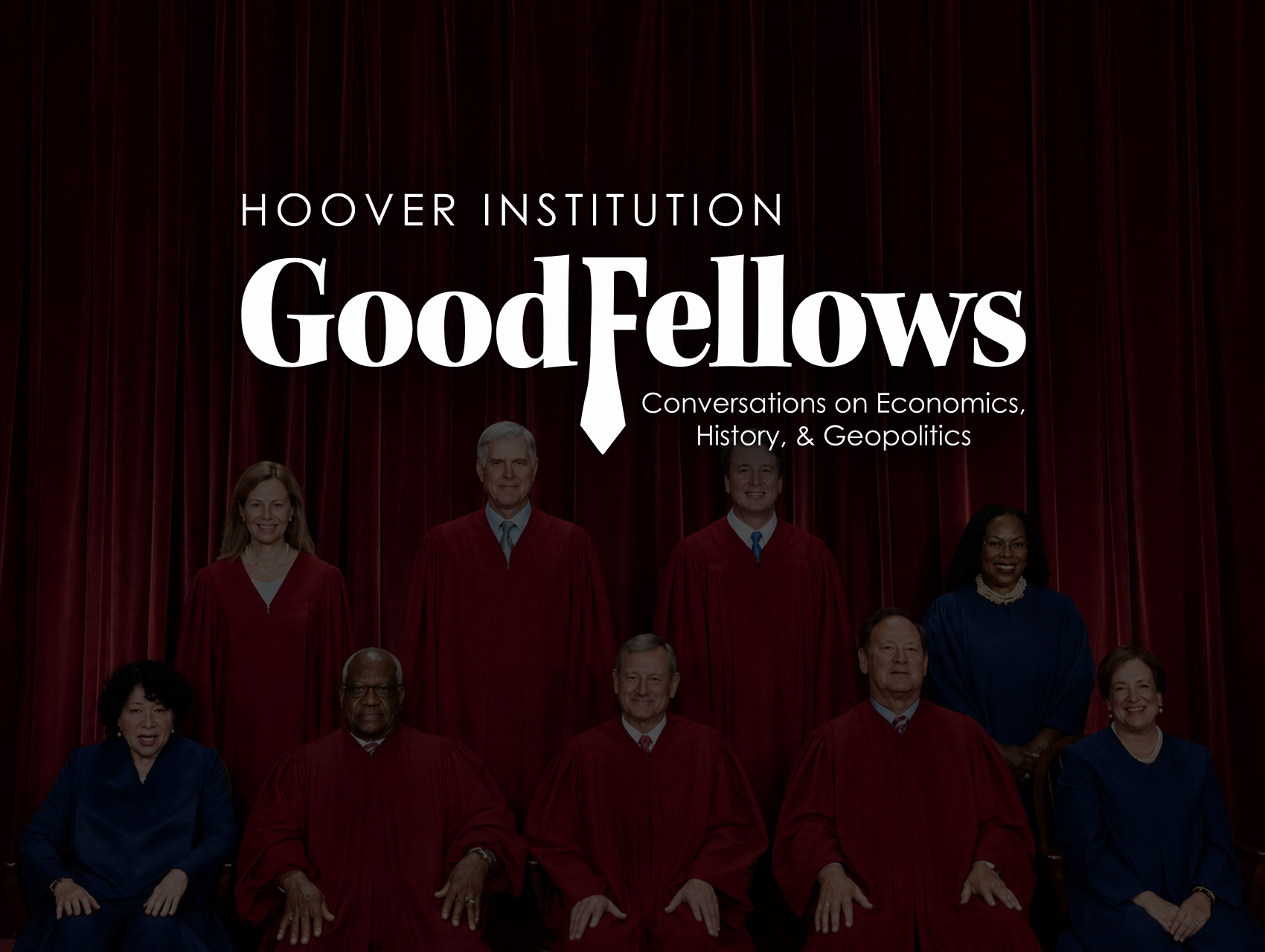
Is it time to rethink the configuration of the US Supreme Court – not nine justices divided along lockstep ideological lines, but three groups of three justices, each clique with a different approach to jurisprudence? So argues court watcher and legal analyst Sarah Isgur, who discusses her new book, Last Branch Standing: A Potentially Surprising, Occasionally Witty Journey Inside Today's Supreme Court, and explains where the justices stand on a series of contentious issues (“birthright citizenship”, the administrative state, abortion, the court’s relationship with an antagonistic president on matters like tariffs and executive authority, plus maintaining a semblance of impartiality in a polarized Washington). After that: the three fellows discuss what’s next in Iran with peace negotiations seemingly at an impasse, what to expect from this week’s US-China summit in Beijing, plus what challenges lie ahead for Hoover fellow Kevin Warsh as he takes over as the Federal Reserve’s new chair.
Recorded on May 11, 2026.
- Because man is fallen. And the desire for power was, as James Madison described, it, sewn in the nature of man government had to be limited for, as Madison also said, if men were angels, no government would be necessary. If angels were to govern men, neither external nor internal controls on government would be necessary. But alas, men are not angels.
- It's Monday, May 11th, 2026. And welcome back to Goodfellows, a Hoover Institution broadcast, examining history, economics, and geopolitics. I'm Bill Whalen. I'm an distinguished policy fellow here at the Hoover Institution. I'll be moderating our conversation today ing three of my colleagues. We jokingly refer to as the Goodfellows, referring of course to the historian SAR Ferguson, the economist, John Cochrane, and former Presidential National Security Advisor, Lieutenant General hr, McMaster Eel, John, and HR are all Hoover Senior Fellows. Gentlemen, good to see you. And today we have two segments in store. In the second part of our show, we're gonna talk about the latest situation in Iran, the diplomatic impasse, as well as the upcoming summit that Donald Trump and Xi Jinping are holding in Beijing. But the first part of our show, we're going to deal with that mysterious building next to the United States Capitol called the United States Supreme Court. We're gonna talk about some key decisions coming down this summer, as well as the power of judicial review in this current political and governing and climate. And joining us to explain this in more is Sarah Iger. Sarah's an editor at SCOTUS Blog and an A BC news analyst. And in her spare time she writes books. In fact, she just wrote one, it's called Last Branch Standing, A potentially surprising, occasionally Witty Journey inside Today's Supreme Court. Sarah, welcome to Goodfellows.
- Thanks for having me.
- So truth and advertising the book is great. It is surprising, it is witty, more than occasionally witty, I would add. And you have been busy, you've been on quite the ambitious book tour. Now I got a question for you, Sarah, Neil, John and HR also write books. They go on book tours, but you recently went on of all places the View. So what is your advice for Neil, John and HR come the time they go on The View?
- I will tell you that is the most nervous, I think I have ever been going on a TV show in like 10 years. Because there's, you know, a live audience, the host could go anywhere and they were so kind to me, it was actually a real treat and I highly recommend it. And the audience was fun and interested and curious and I, I actually had a great time.
- Okay, let's get into the book Sarah. So we are accustomed to reading about a six three Supreme Court, six justices appointed by Republican presidents, three appointed by Democratic presidents. But in your book, you take the number nine and break it down differently. You put it into camps of three, three and three. Could you briefly explain what the 3, 3, 3 camps are and could you apply it to say, the recent decision on the Voting Rights Act, which was a six to three decision, I believe.
- You bet. So basically like let's go back to, you know, high school geometry and get your graph paper out and your number two pencil. And we're gonna have an X axis at the bottom horizontal. And that's gonna be, you know, conservative to liberal. And the judges are ideological, right? Like I, I reject sort of both notions, right? The court is only political and maps onto our current partisan tribalism or this is like a math problem and you put in facts and you get out law and it's just a mechanistic thing. Both of those are incorrect. Okay? So we do have ideology, it's not partisan, it's not Republican and Democrat, but there is such a thing as a conservative and a liberal judicial philosophy, no question. But we also have this y axis, this vertical axis that I've called Institutionalism happy for someone to come up with a better term by the way. But this is the idea that Brett Kavanaugh and Neil Gorsuch are both conservative. They are federalist society, you know, Petri dish experiments with great hair. And yet last term Brett Kavanaugh was more likely to agree with Justices Kagan and Sotomayor than he was with Justice Neil Gorsuch. So how can that be? Well this is this institutionalist spectrum where Justice Kavanaugh is actually much closer to Justice Kagan as sort of a, this is a team group project. It's one court over 230 years. Whereas Justice Gorsuch, justice conservative is much more like Justice Jackson, ideologically very different. But they see themselves as like just one vote. Doesn't matter what anyone else says. This isn't a group project, this is a soloist and I will belt it out for all the world to hear. Which is why you see so many separate opinions from Justices Gorsuch and Jackson in particular. So what are these three, you know, cafeteria lunch tables that they're all sitting at? I have Justices, Kagan, Sotomayor and Jackson together call them the lonely liberals, though again, they differ on Institutionalism quite a bit. I've got my deciders, that's the Chief Justice Barrett and Justice Kavanaugh. They are the justices most likely to be in the majority. They are also the most institutionalist. And then I've got my conservative Honey Badgers, that's Justices Thomas Alito and Gorsuch. They are doing their own thing with their own projects and they're not here to make friends.
- Okay, now take the Voting Rights Act decision, Sarah, which I believe was six three. And the media is shorthand, it's the six Republican justices went one way and the three progresses went the other. But how does, how does three, three and three apply to that decision?
- For sure, I mean, right, we took two of our three clumps, all three of the deciding justices, the Chief Kagan and sorry, the Chief Barrett and Kavanaugh. And then we took our three Honey Badgers, Thomas Alito and Gorsuch. And that's our six. It happens to line up ideologically as well in that case. But you know, last term we had 15% of the cases, either six three or five four. I combined those that lined up that way with all three of the liberal justices in dissent. But we had the exact same number of cases, six three or five four with all three of the liberal justices in the majority and conservative justices in dissent. So the Voting Rights Act case absolutely lined up ideologically. And you combined like those two sets of three together. But if it looks anything like last term, we're actually gonna have a lot of the other sets of three combined together. And we've seen that happen in, when the Supreme Court also six three stopped Trump from Federalizing, the National Guard. We saw it six three when they stopped Trump from imposing worldwide tariffs through executive order. I'll be very curious how birthright citizenship comes out. Not 'cause I don't know the answer in the end, the question is how Trump loses. There are so many different options and what exactly that lineup will look like.
- All right, let's turn it over to John Cochrane, who's not a lawyer but has a lot of legal questions.
- Oh yeah, sorry. I, I, I sent Bill and Scott about three hours worth of questions this morning and they said, well you gotta pick John, lemme just take up from where you're going. First of all, the framing, I love where you started. It's not about Democrat Republican. And just a shout out, I'm really disappointed that all of the mainstream media identifies Supreme Court justices immediately by who appointed them as, as if that unit matter. It was just one of the many norms we're breaking also.
- And it didn't used to be true by the way. Right. That has increased enormously in the last 30 years. Both, like they've done a study of how many times that's mentioned in news stories. And of course it didn't use to tell you anything. There were eight justices appointed by Republicans as of 1992, but two of the most liberal justices to sit on the Supreme Court in modern history. Justice Stevens and Justice Suitor were Republican appointees. And so it wasn't actually interesting to say what the partisan lineup was.
- The other thing that I think we all take for granted, but we need to remind people, 'cause I hear it all the time on the media, the Supreme Court is there to judge if something's constitutional, not the final arbiter of our policy questions, which is, that was a quote from NPR as I was driving around yesterday, which drives me nuts. Okay, now a question for you on this axis, there's a third dimension as well, which is I'd like you to speak about, which is really the one about textualists originalist versus, let's call it living versus policy versus we have to create some policy compromise for today. It's, I I kind of joke that the Supreme Court is, is dominated by Catholics who think the constitution is the Protestant Bible, literally true in every word handed down by God and, and the make it up as you go along character. Does that, does that dimension still matter much for understanding the court?
- I actually write in my book that when Justice Scalia gets on the court and starts talking about originalism, it really is something like Martin Luther nailing the feces to the door. It's this idea that like, you guys have been making this up for decades and my God, we have actual text here, let's go with the scripture. You know, I wouldn't say it's a third axis though. I think that that is the definition of that x ideological axis. As I say, I don't think it maps onto our politics very well. It's far more about the judicial methodology that you use. We are very accustomed to thinking conservatives do originalism and textualism and liberals do living constitutionalism, sort of nine platonic guardians deciding what they think is best for American society. But look at the birthright citizenship argument and you'll see everyone reversed hats. The administration was the one arguing for something far more like living constitutionalism or practical look, the, you know, when they ratified the 14th Amendment, they didn't have the type of illegal immigration that we have today. So we just need to, you know, look at the facts as they are now and allow the president to do this. And it was actually the liberals who were arguing the text of the 14th Amendment says this, the people who ratified thought it meant this. And like, what are we even doing here? So I would also challenge people's notions that what we think of as conservative and liberal in legal world always lines up with the partisan interests of right and left. It actually doesn't, it lines up far more with who is in power and who is out of power. If you are out of power, you want process, you want to have this contract with the American people through the constitution. If you're in power, you'd like your guys to get to, you know, decide things along the way. However, willy-nilly they think that will match up with the current politics culture.
- Hey Sarah, you know, I, it, it strikes me that that the, you know, the judiciary, the Supreme Court in particular, like the military, our credibility is, rests a lot on, on the belief that we are, that we can transcend partisan politics, right? And, and of course, you know what I've, what was, what I've been upset about across multiple administrations are efforts by politicians to drag, you know, the military into partisan politics, which would be so damaging not only to our constitution, but, but I think to just our citizens' confidence. And, and you know, I I, you can see that, you can see how this plays out with, you know, the, the justices and the joint chiefs together. You know, when, whenever, whenever the president's given the State of the Union and they're all just stone faced, you know, 'cause they're jealously guarding this idea that, that they're, that they're beyond partisan politics. Hey, what's, what's your assessment of recent efforts to drag the, the, the, the Supreme Court into partisan politics? Are you concerned about it? Is it, is it, is it atypical? You know, the, the, what we're seeing or have seen this across the court's history and, and and are, how, how troubled are you by it?
- Okay, before I answer that, do you think that the joint chief should stop going to the State of the Union?
- No, I mean, I, I don't see a reason to stop going. I mean, but I think they should stay, stay stone-faced, right?
- Well, president should stop, should stop pointing at them and threatening. Yeah. Stop
- Pointing them. Start trying to drag 'em in. Yeah, they, they had to go to, they had to go to Pete Hexis, you know, convocation also,
- Right?
- During which they, they sat their stone faced as well.
- They are differently situated than justices for any number of reasons, right? The justices belong to a separate branch of government. But I would like to see a press release way in advance like today that says, from now on Supreme Court justices will not be attending the State of the Union. Thank you very much. See ya. XO XO John Roberts. But that's my own separate thing. Okay? So the answer is all of the above. You go back through history and the complaints that you read about the Supreme Court sound. So modern Jefferson is railing against John Marshall, his cousin, for how partisan the court is. They never side with him. He goes so far as to impeach Samuel Chase to try to remove him to start this practice in American politics of having a Supreme Court that mirrors the party of the President that's in 1805, like we are early on here, right after our first partisan election. His plan was to then impeach John Marshall again, his cousin. I think that's so funny. Not distant cousin, like they knew each other and just hated each other. And you're gonna see this repeat, you know, Jackson ignores the court. Lincoln runs against the court. FDR threatens to pack the court. Nixon threatens to defy the court. And so the, the threats and challenges and insults that you see from Donald Trump may feel different to us, but historically they fit into a nice normal pattern of American presidents being roll mad at an independent branch of government that says no to them. That being said, I am deeply concerned about Partisanism the Supreme Court. I could have named this book Last Branch Standing, do, do, do for now. But the threat isn't coming from Donald Trump per se, or one political party or the other. It is coming from the American people, not believing that Congress passes laws anymore. Not believing that we get to ratify amendments to the Constitution and instead believing that the Supreme Court decides everything. So we need to fight to the death over who picks these justices, how they're picked, what these confirmation hearings are about. And in the meantime, we've gotten rid of the filibuster for all of these judges and justices. So instead of having a general election where you have to have votes from both sides to win, we've moved to a primary election where you not only only need votes from your side to become a judge, you only want votes from your side. That will change who gets picked as judges. It changes the credibility of the courts over time, especially when we have rampant forum shopping. You could be the most fair judge in the world, but if everyone knows that one side keeps picking you over and over and over again for these big stop the President cases, no one's gonna believe that you're that fair. That you're not a partisan actor. These are all things that are so fixable and none of the fixes are burn it down, end the Supreme Court as we know it through packing it, you know, adding seats to it, term limits. We need Congress to do its job again. We need to bring back some version of the filibuster, maybe even more. Instead of 60 votes, let's make it 75. I don't know, something crazy. Let's, let's go out there and, and be nuts and we can end forum shopping tomorrow. Congress can do it, the courts can do it themselves,
- But in a way it's a good thing that Trump is at odds with the,
- It's great historically
- Justices he
- Picks, I mean, he's just out there on truth social in the last 24 hours. I love justice Neil Gorsuch, he's really smart and a good man, but he voted against me in our country on tariffs, a devastating move. I won't do the voice anymore. He, he goes on to, to complain that he and Amy Coney were appointed
- By me and yet have hurt our country so badly with their decision on, on tariffs overthrowing the, a EPA basis for the reciprocal tariffs. And then he,
- He comes up with this, and I want to get your reaction to it. They could have solved that situation with a tiny sentence. Any money paid by others to the United States does not have to be paid back. I mean, this fits in with your narrative that presidents have been fighting with the court and with their
- Own appointees pretty much since the beginning. This is a feature, not a bug of American governance. And so in some ways, the system's working as designed, isn't it
- When it comes to Donald Trump railing against the Supreme Court again, would I suggest that he send those truths? Do I like them? I do not. However, it is actually what has built the Supreme Court over the last 230 years. We didn't have much of a Supreme Court When George Washington was in office. John Jay was Chief justice and he said it was beneath his dignity to keep serving in that role because they weren't doing anything. You don't need a counter majoritarian branch when George Washington is your president, the most, you know, perfect beloved human being to astri the earth. You need a counter majoritarian branch when you have bear and fleeting majorities when you have a president that may overstep his bounds. And that's why you see the Supreme Court come into its own under the Jefferson presidency. Again, it builds even more credibility under the Jackson presidency. It doesn't matter. In fact, it has maybe arguably helped when these presidents have tried to defy the Supreme Court, the most famous in our modern history of the elected branches defying a Supreme Court decision is Brown versus Board of Education for 10 years. Nobody enforced that decision. And you know, who came out looking good, the Supreme Court because they said what the law and the Constitution required and it didn't matter that everyone ignored them. It is the political branches that came out smelling less than roses. And so over time, we have come to appreciate having a counter majoritarian anti, you know, by anti majority these, you know, sort of mob mentality things that the founders were so afraid of. We would not have a First Amendment, we would not have protections for criminal defendants. Those are unpopular things with the majority. And so, yes, I think presidents being mad at the Supreme Court is helpful for the Supreme Court, but that is different than the sense that the American people might have that the court not for or against one president or another, but rather that they are simply part of our partisan churn. And the way they're getting selected has become more partisan. The judges who are getting to decide are becoming more partisan. That is a different threat to the court that we have not particularly seen before. And I'll just note, by the way, so most popular decisions by the Supreme Court historically Brown V Board, West Virginia versus Barnett, a case about free speech and religious minorities, most unpopular decisions historically, Dr. Scott Plessy versus Ferguson, buck v Bell was on eugenics korematsu, on Japanese internment. Those were popular decisions and by which I mean they were with the majority at the time. So really we as Americans should appreciate that what this branch does when it's doing its best, is say no to presidents, to Congress and to us.
- And just to hand it back to John, it's clear from Trump's truth, quote unquote, that he expects to lose on birthright citizenship as well. And that, that seems to me, you know, to fit in with this pattern of presidents being frustrated even by their own appointees. But John, you had a specific question to raise about the birthright citizenship
- Question. Yeah, well, let, let me, let, let us think President Trump, because every time he sends a tweet like that, he enhances the prestige of the court and the understanding that it's, that it's independent. You know, if you read the New York Times, they think, oh, the court is just Trump's little minions doing whatever he wants. And you know, you notice, hey, he loses about half the time if not more. And the court is quite independent. So thank you President Trump. Keep at it. And, and that will enhance the prestige of the court.
- President Trump was the first president in United States history to lose more than win at the Supreme Court in his first term. And he has lost every major policy initiative that he has had this term Alien Enemies Act, immigration federalizing, the National Guard tariffs. And now you and I are gonna disagree on birthright citizenship.
- Well, I don't know if we're gonna disagree. So let, let's talk about how, how it's gonna come out. One option is the court just says, I'm sorry this was settled 150 years ago. Anybody born in the US is a citizen. We're done. And I think that that's what you're betting for. But
- No, it's not what I'm betting for, but it is an option.
- Well, you get to tell us what you're betting for. But here's what I, I noticed there is a question, you know, times have changed in 150 years. Justice Kavanaugh pointed out in his remarks, there was a 1952, I think, law that settled all the hundreds of little cases of how do US citizens who have children abroad, when do their children become citizens? And it's, you know, it it's the kind of thing you hash out in the legislative process. Now things have changed. You know, if, if your plane's delayed at O'Hare, which happens and you go into labor, does that kid get to be a US citizen? I don't know. Maybe, maybe not. And the right thing of course is Congress sets up, writes a law, it gets reviewed and, and, and here we go. But that hasn't happened bur, 'cause nobody's brought this up. I mean, like guns, we've been at it for, you know, hundreds of years. But I don't think the court would be happy if what we're gonna do is we're gonna once again go back to the text subject to the jurisdiction thereof, comma, oh, what does that mean? Well, we're gonna have a 10 part test and invent, you know, you know, this goes into like what, where it went wrong with Roe v. Wade. So I don't, I hope they're not going to do that. If they don't wanna do that, their job is to punt, to say, ah, who knows what this is? Bring us some cases. In which case I would see them allowing Trump a lot of latitude. And when President Gavin Newsom comes back and says, no, no, no, no, my executive order says anybody who sets foot in the US gets to presumed, okay, that's it. Congress, you wanna clean this up for us? So how do they pump this one having taken on? I I see is the question.
- Okay, so you're exactly right. In 1868, we ratified the 14th Amendment. All persons born in the United States and subject to the jurisdiction thereof our citizens of the US and their states respectively. So the first question is, did the Constitution answer this question when at the time subject to the jurisdiction thereof prevented Native Americans who were born on tribal lands from becoming citizens? And it obviously prevented diplomats, children from becoming citizens still does by the way, because they are not subject to our jurisdiction for so much as parking tickets, let alone anything else. So they are not subject to the jurisdiction. So the one argument goes, the Supreme Court can settle this by simply saying, we mean subject to the legal jurisdiction. If you are here unlawfully, you are still subject to our laws. You are not like a diplomat. You are not like someone born on tribal lands. And so this question is answered. There is a chance they do that. I do not think it is the most likely outcome. You present another outcome, which is, I don't know, we're not saying this is legal, but we're not gonna answer this now bring us case and facts. I think that's even less likely than outcome one. Let me give you what I think is the likely outcome that is the middle option here. You mentioned that 1952 law from Congress, so close to a hundred years after the 14th, sorry, yes, the 14th Amendment was ratified. Congress passes a law with the exact same language, but now we've had 90 years of what we call liquidation of that language, what it has meant in practice. And yet Congress didn't change the language, they didn't clarify the language. So what the court can say is, look, Congress can pass a new law if they want to. And we are happy to decide whether that fits with the language of the 14th Amendment, whether that law is constitutional, but a president acting solely through executive order without a law passed by Congress can't do nothing. That's why Joe Biden couldn't do student loan debt forgiveness. And it's why Trump couldn't do tariffs. And we sure aren't doing it for birthright citizenship. So this executive order is struck down. A president cannot change the 1952 law from Congress through executive order. Come back to us when you have a new law from Congress. We're happy to look at it. Have a nice day.
- Sarah, you mentioned birthright citizenship. There's some other interesting cases on the docket. Transgender athletes, for example, the President's authority, whether or not he can fire a Federal Reserve. Governor Peterson John's thoughts on that as well. But we're four years removed, Sarah from the Dopps decision, which came down in June of 22, 22, right in the middle of an election. And it was a political bombshell. Two questions. Number one, is there anything on the docket right now that you think qualifies as a bombshell or was Dobbs unique and that it was 50 years of the making? And then secondly, we, we forget that the Dobbs decision actually a draft decision of that the draft is right decision was leaked and the court looked into it. We never found the leak. Or is this just another Washington who done it? We're gonna have to wait 30 years like the Watergate Deep Throat to find out who did it.
- So the Dr. Scott decision was leaked to President Buchanan. He put it into his inaugural address. There was a clerk in 1919 who was indicted on leaking a decision to speculators about railroad companies. The Roe v Wade decision was actually leaked to a guy named Dave Beckwith who would go on to be my boss. And the 2002 corn campaign. And then of course we have the Dobbs decision leaking and these memos from the justices that leaked this year. But the memos themselves were back from 2016, right? I don't know that we're even seeing an increase in pace at this point, so much as we're seeing an increase in media focus on the Supreme Court for all the reasons we've talked about. Why would you focus on Congress? They're not actually doing anything or passing laws. So we've got a bunch of board reporter puppies chewing on the furniture trying to find something else to cover. The reason that Dobbs is a bombshell, there's a few factors. One, of course it is on the main culture war issue that had divided, fully divided up the two political parties. They were not particularly divided on abortion when Roe v Wade was decided. And over the following 50 years, it becomes the single issue that determines which political party you are in. So nothing is more culture war than abortion when that case is decided in 2022. The second reason is that you had something that had been taken away from the political process when the Supreme Court said that the Constitution guaranteed a right to an abortion without undue burden. And that was being returned to the political process. Well, that's always gonna have a bombshell effect because now something that you couldn't vote on, now you can. And we're seeing the result of that in all of these states who are actually having to do real legislation and then try to get reelected, you know, sort of the way the system is supposed to work, except for the most big questions that we have reserved against majority rule in the Bill of Rights for the most part. So this term, nothing like that. Almost all of the culture war questions from this term are actually about statutory construction now it's about laws passed by Congress. Again, we don't actually believe that Congress will do anything. And so it feels like the Supreme Court is having the last word, but whether Mississippi can accept ballots five days after the election, whether Donald Trump can turn people away at the southern border who want to apply for asylum. Those are simply questions of Congress's laws. Congress could pass a new law tomorrow if they don't like the outcome of the Supreme Court decision. But I will bet you guys a shiny nickel that I see a whole bunch of press releases from members' offices the day after. Those decisions from whichever side feels like they lost that rail against the Supreme Court for making a decision they don't like when they are members of Congress who are there to actually pass laws, which we used to do. The 16th Amendment by the way, was passed in response, was ratified in response to a Supreme Court decision. The Lily Ledbetter Act in, you know, the last 20 years was Rat was passed in response to a Supreme Court decision. The Voting Rights Act was amended in 1986 in response to a Supreme Court decision. We used to have this muscle memory, but now we just, we think of the Supreme Court as being the last word instead of one part of an ongoing dialogue with the American people, your articles. Hey Sarah,
- Just a quick point on this, you know, it strikes me that this is where what the, the debate in the Federalist anti-Federalists papers right there, there's this, you know, this, this belief that, you know, the court might be too strong, you know, from an anti-Federalists perspective, from the Federalist perspective. Oh no, it's gonna be the weakest branch of government, don't worry about it. But what they didn't factor in was that Article one, you know, that the Congress was going to, to abdicate a lot of its responsibilities. And it made me think of, you know, remember the six members of Congress who said it, put out that video to the military, Hey, don't follow illegal orders. But the subtext was really, Hey, you should be a check on executive power. Hell no Congressmen and women, you should be the check on executive power. It's just, it's just so crazy that congress is, is absent from checks and balances because of their profound dysfunction.
- But we've gotten a lot of great podcasts out of it. I mean like they're hosting podcasts and being Instagram influencers as if that's what we paid them to do.
- It is very important sort of in public perception of the court. The difference between statutory interpretation and constitutional ruling is so important and is missed 99% of the time. But with, with Roe v Wade and, and Dobbs is there not a little bit of hope it, it, Roe v Dobbs did exactly what you said. It did not hello New York Times. It did not outlaw abortion in the United States. Right? It sent it back to the States and back to the political process to adjudicate all that messiness of about 10 weeks, 11 weeks. Which, you know, MiFis the prone versus, you know, and then so on and so forth. You might or might not like it, but it's back to the political process. And hence for 50 years every appointment to the Supreme Court has been a show about one thing and one thing only. What's your vote on overturning Roe v Wade that's gone. I, is there not some hope that the next appointments, what are the next appointments going going to be all mad about? I mean, Chevron Humphrey's executor, I mean I sort of hope so. Our
- Culture, our culture war fights right now do seem to be about the power and the roles of our branches of government, which is maybe, okay, I wish we had a, you know, one political party that was maybe about the size and scope of government instead of two big government more spending political parties where we're just fighting over who has the power. Okay. But I think you're exactly right on Dobbs. Interestingly, there have been more abortions since Dobbs than in the years before. There have been more abortions under Donald Trump's first year in office than there were under Joe Biden. So to your point, no Dobbs certainly did not ban abortions in this country. They have increased since that time because states have been able, as you say, to actually define the contours of what the rules are going to be around a really hard question. And for 50 years we were sort of frozen like Encino man, and we were defrosted after we'd had these horrible knockdown drag out fights, which again defined both political parties, Republicans for choice, shuttered its doors in 2018, there was one pro-life Democrat left in the House of Representatives and that's where we were. And so I think we will define our political parties over different things now. And it'll be interesting to see as we get further and further from Dobbs, whether people look back and are like, well actually maybe that is something we should have been negotiating, compromising, creating stability over and voting on. And this is a problem we've had from the beginning. To your point about the fights between the Federalists and the anti-Federalists, what are these un enumerated rights? The things that we thought were so obvious we didn't need to write them down the right to raise your children. The right to travel is what about a right to privacy? Does that privacy include the right to abortion? At what level of generality do we define those un enumerated rights? So if anyone's looking for some bedtime reading tonight, may I recommend old wig number five. It should be a brand of bourbon, but it is actually my favorite anti-Federalists paper and those guys are looking pretty smart these days. Neil,
- I have no further questions, your Honor.
- Well, I have a hundred further questions if you Well, well,
- Well, are
- We about minutes?
- I've got a little gavel pencil that I can bang when we're done,
- If I get one. Go ahead. Did you want hr, did you wanna go?
- No, I just wanted to say, okay, in terms of the court though, your assessment of the court overall, are you optimistic, pessimistic, you know, there've been all these attempts, you know, to, you know, to to stack, which goes back to Ro Roosevelt, you know, but then, but even under the Biden administration, I guess they were seriously considering trying to get that done. I mean, do you, do you feel, do you feel confident that, that, you know, that the, the third branch of of government is doing its job and is in a, is in a better, is it you, you mentioned you know that you're fearful for it. Why are you afraid of, of its future? What can be done to bolster it? Besides what you already mentioned, like the, you know, article one, you know, the con the Congress stepping up the way it should.
- I'm fearful because the court is meant to be a lagging indicator of our politics. And so think of it like the light we see from a far away star. You're actually seeing that star from several years ago. That's what the Supreme Court reflects to us right now. Something more like our politics in roughly 2005, really maybe 2010. Eventually it will reflect our political moment right now. And that is a scary thing to think about. We're in this hyper tribal negative polarization, right? It's not vote for me, it's vote against that guy who's an existential threat to your, you know, wife and children. That will be bad if that gets to the Supreme Court. I think we've got time to turn the ship around. But as you say, we've got one political party that wants to pack the Supreme Court, which they acknowledge will end it as an independent branch of government. I think they should be careful what they wish for, right? Donald Trump gets in office two times. You really want him getting to pack the Supreme Court because whatever, my God, how do the two parties not get this? Whatever power you grab for yourself now you hand to your worst enemy. It's literally what our constitution was meant to guard against. And we have been ripping down those guardrails every chance we get. It's incredibly dangerous. The other party just wants to ignore Supreme Court decisions they don't like and adopt different methodologies for interpreting the law, which is basically like heads I win tails. You lose version of living constitutionalism for the right. You know? Is that an existential threat to the court in the same way? No, but if you started appointing enough justices that believe that again, it will reflect that politics that we have right now, which would be really bad for the court. So, you know, we should not let our partisanship infect this independent branch of government. My hope, by the way, is that we have seen reality TV viewership fall off a cliff recently and that politics is downstream from culture. So if people are sick and bored and now see past the reality TV nonsense for their entertainment, maybe they will feel the same way about their candidates. And we can get back to actually supporting people who wanna do the job they're getting elected for instead of 535 Instagram influencers.
- Okay? There's no clear case of tit for tat than the hyperventilating about Trump's immunity, which of course, had they not said you're immune for official actions, president Biden would be facing a grand jury right now. Let's not go down that road. So my last question does look forward to the future. I I come from that brand of hopeful libertarians who look back to Shechter and say, what the heck happened? Can you imagine the founding fathers confronted wicked v Filburn, A man may not grow wheat on his own farm to bake his own bread without a federal marketing order. Are you out of your minds quickly, we need a new amendment. That's not what the Commerce clause meant yet the court has upheld this one and there's a striking difference between our personal liberties as interpreted by the court since Schechter and our economic liberties as interpreted in entirely the other way. So I i, is there any hope for those of us who want to see record v filburn overturned and more generally? I, I think we missed the other huge philosophical issue is the administrative state Chevron Humphrey's executor. We have this fourth branch of government and just, you know, in the original setup, yes, it's part of the executive, but that didn't work out so well. 'cause if you have enormously powerful agencies that are just run as political branches, the executive it with that great power that doesn't work. We sort of built a, a restrained power of the administrative state that needs fixing in some ways. But just, you know, here, going back to the original text doesn't seem like the answer. So where is that going?
- This is the most libertarian question ever and I love it. Good. So one, they're not gonna touch wicked right now because they're trying to like, use those little paddles on Congress to get the heart starting again. So the last thing you wanna do is, you know, give medication that will sedate it further. So get the heart started, then you can sedate it down the road. I think Wicked is safe for now, in part because Justice Scalia had the chance in a way to touch on Wicked and then said, yeah, but when it comes to drug use, and it's like, eh, if you're willing to make exceptions for drugs, my friend, okay,
- For the, for the listeners, this was affirmed in a case about pot farms and Scalia, the great libertarian said, no, no, no. Well we are not gonna, if you grow pot on your own farm for your own use that we we're gonna ban
- That too, too. Any cites wicked
- And dear was our chance to get rid of wicked. Sorry, go ahead.
- And that was it on the administrative state. That's a far more interesting question to me because again, you see the court now saying, where is the constitutional crisis coming from? It used to be from a Congress passing under wicked too many laws, vis-a-vis the states taking power from the states. That is not the threat that we face anymore. Now it is a president acting unilaterally over the course of multiple, you know, Obama to Trump, to Biden, to Trump, and using the administrative state to effectuate policy without constraints, without negotiation, without legislation, without the people's representatives,
- Without the administrative procedures act. I'm kind of nostalgic for regulation.
- And you see the court again in the Biden student loan debt forgiveness case in the Trump tariff case saying, no, you must go to Congress. And so when it comes to Chevron deference, you know, whether administrative agencies get to determine the scope of their own power or removal authority, whether these guys are completely immune from any sort of political response. If you hate what the SEC commissioner did, who do you vote against? Nobody. There's nobody who can touch that guy. So I think you see six votes on the court to again, try to cut that power out of the executive and return it to Congress. But here's the problem. Congress gave away this power a hundred years ago, and it did it with two constraints that it kept, one, that removal or lack of removal power to the president and into a legislative veto. The court got rid of the legislative veto, but kept all the power. And then it's gonna remove, you know, the ability of job protection and allow presidents to fire these guys on partisan basis without removing any of the power. And so you heard Elena Kagan say, and I gotta say I am with her a thousand percent. Strike it all down, make Congress, do it again. Don't have an FDA with no constraints, enormous amounts of power that is Jen left with the president. That's the worst of all of the options. You've gotta give it back to Congress because we don't want a president further untethered from any sort of restraints. We want a political accountable president over a less powerful presidency. Our
- Solution pre Supreme Court is more Congress. Yes.
- Hey guys, let's cut it off there, Sarah, just like your book, you are witty, you are informative. Thanks for coming on the show. The book's title again is Last Branch Standing, A potentially surprising, occasionally Witty Journey inside today's Supreme Court. Sir Isker, thanks for joining us today. And hey, can you hook us up with the view
- Gentlemen? It was a pleasure. Anytime, and I'm sure the ladies of the View would be happy to have these discussions.
- Take care, Sarah. Thanks Sarah. Okay, onto the B block gentlemen. And two topics. Number one, busy week for the president. He has a, a diplomatic impasse with a rand. It appears we should talk about that. And then later this week he hops on Air Force One and he goes to Beijing to have a summit with Xi Jinping. Let's start with I Rand and Neil, I wanna begin with you. I was supposed to a podcast the other day and the podcaster lumped you into the same category as various foreign policy mavens who have opposed this war from day one. I I think it might be helpful for you to just spend a minute, explain exactly where you are on this war right now, its inception and its execution.
- Well, I certainly didn't oppose it from day one because I think there were very good reasons for taking military action against the Islamic Republic. Not least it's program of missile building, which was rapidly creating an extraordinary, dangerous imbalance of power in the region to say nothing of its ongoing ambitions to have nuclear weapons and its ongoing campaign via proxies to, to terrorize the region. Its massacring of more than 30,000 of its citizens in January was one reason that President Trump said that help was at hand to the Iranian people. And I supported the initial phase of operation Epic Fury, but it wasn't enough to take down from the air a substantial part of Iran's defense capabilities. You also had to prevent Iran gaining control of the Strai of Horus, which it swiftly did. And I think the mistake, and I've criticized this, was not to take military action to open the strait. I think the President's decision not to do that when I think it was pretty clearly proposed by the Chairman of the Joint Chiefs and Admiral Cooper, the commander of CENTCOM was a, a major strategic blunder. The decision to fall back on, on purely economic pressure on the blockade of Iranian exports of oil was insufficient given the situation. Moreover, I think the United States has not done a good job of protecting its allies in the region, particularly the United Arab Emirates, which has borne the brunt of Iranian retaliation. So what began, well, went off the rails, and now the president is in a very bad place because he's trying to exert economic pressure. It's moving too slowly. The negotiations are being strung along in a now familiar way. And as those negotiations extend and the strait of R moves remains blocked, the economic pain throughout the global economy moves closer and closer to the United States. And of course, it, it's a form of pain that the electorate is highly sensitive to because the number one issue American voters care about is affordability and everything about the straight of reforms makes that problem worse. So just to clarify my position, that's what it was. And I remain a constructive critic of the administration. I want to see regime change in Iran. At the very least, I want to see the Iranian regime unable to pursue a program of nuclear arms and a program of, of tens of thousands of ballistic missiles. Nuclear or not nuclear. All of these things were, I think, achievable war aims, but you can't achieve that kind of outcome purely with air power, as I'm sure HR McMaster, my esteemed colleague will agree,
- Takes tanks.
- Yeah. Hey, I agree with Neil. I I think what happened is the ceasefire, you know, happened too soon because that, that's when actually the military effort was gonna shift toward, toward forcing an opening of the strai, right? This gave, I think the Orion a chance to kind of assess their situation. They're still very fragmented in their leadership. You know, they, they, they're really are at each other's throats in many ways and, and really can't agree on a position in terms of these negotiations for a ceasefire. So, hey, you know what I think is gonna happen here, you know, and people always wanna focus on, Hey, what's Trump gonna do next? It has a lot to do with what the Iranians present, you know, to the Pakistanis. Hey, they are still, you know, the, the Iranians are still driven by their ideology. And, and I think it's going to be the intransigence of the Iranians that leads to another phase in this war, which will be focused on, on opening the straight by force, which will be focused on continuing attacks against their, their leadership as their missile drawn strike complex, which will put them in an even weaker position. And, and, and then, you know, I I, I think that the, this doesn't end though, until there is a change in the fundamental nature of that, of that regime. So I, I think, you know, even if there is a ceasefire and, and that leaves this regime in place, all that is is gonna be, is a pause. It's not gonna be a real piece. So, and so we've seen, you know, the latest phase in a 47-year-old long war, we're about to see the next phase, which I think is gonna probably begin with a failure of the effort to get to some kind of an agreement in Pakistan.
- So I find this curious, and I'll ask both of you. I'm, I'm completely with you on what should happen. It looks like what Trump wants and what Iran wants is to go back to where we were. Iran makes some sort of promises that it doesn't intend to keep. Trump says, great, straight of harms open for a couple months, and then Iran swiftly breaks all the promises they get to stay in power, go back to murdering their own citizenship citizens, then they start building missiles. And then, you know, six months, two a year from now, we start some airstrikes again on the missile sites and the, and the site that, that's what both sides want. It seems, you know, to, to Neil's scholarship on the first World War. We, we can't just can't bring ourselves to, to do what we, what both sides want. As smelly as that, as that is I some, some sense of a face saving. The Iranians just want some sort of face saving, I think. I mean, why? I don't know. Why don't they just agree to whatever Trump wants? No, they, they need some sort of face saving. We're not gonna promise things that we all know we're not gonna do. Why can't we get to this obviously stinking way of getting through the next six months to a year that both sides want?
- I, John, I don't think both sides do want the same thing. I think the, the obvious point is that the president wants to stop the war and get the straight reopened, 'cause the economic unintended consequences of very bad politically. But the Iranian incentive is not to strike such a deal. On the contrary, the Iranian incentive is to prolong the negotiations until the economic pain actually hits the United States, which it really hasn't yet. It's only really the price of gasoline that Americans have noticed, but they aren't yet aware of all the other bad things that are happening elsewhere and ultimately will reach the United States. For example, the impact on a great, many of the things that you buy in Walmart because of the disruption to petrochemicals in Asia, the impact on food prices, which will come because of the huge increase in fertilizer prices. None of that is being felt by American consumers yet. And so I think that the key thing for the Iranians is to string this out as long as they can. Its dangerous game in a couple of ways. Number one, it may of course lead to further military action. It's also dangerous because their economy is in a very precarious state and the president's goal is to collapse it. There's certainly incipient signs of hyperinflation. There are serious shortages. So the Iranian game is, I
- Think, different. Neil, they're about to run outta, they're about to run outta teacups into which to put, they could put their oil into. You know,
- Why
- Is
- It, and - I don't get wideness not not close enough, they're not close enough to that point, I think though, from, but why is it
- To their advantage, Neil? Why, why do they want to drag? So I thought what they want is sign some sort of deal that they're gonna, now they're gonna break, start shipping oil, the money comes back in, we get to go back to murder your citizens. Everybody leaves this loan. We,
- Why haven't they done it? They've been given an extremely attractive offer by the president's representatives, which it's lift sanctions, it would be unfreeze the assets. I mean, I, because
- They have to sign something that says, oh, we promised to do all sorts of stuff that they're not gonna do. That's the only
- Reason I, well, they did that with Obama. The J-C-P-O-A was a document they signed that said all sorts of things that they were gonna do. Exactly.
- And all they're, all they're being asked to do is sign the same thing. And then they could
- Get back to the point I'm trying to make is that there's no point signing until you've actually really made the US economy hurt. And where's the most sensitive point of the US economy? Where is the, what is the indicator that President Trump watches most closely? Yes, John? You know the answer. It's the US equity market. And the equity market is, is reaching new highs because the equity market's paying practically no attention to the straight of war moves. And all its attention is focused on artificial intelligence and the latest feats of the latest models from Anthropic and open ai. So if you are the Iranians, you don't wanna settle. Now you've got to get to the pain point. The pain point is you need the equity market to, what do they
- Get that's better? What do they get that's better out of that deal?
- Well, I think the, for example, there are specific clauses about the duration. They won't su they won't enrich uranium that they can get some give on.
- But why
- Do they
- Care about those clauses? The val rich uranium, the day after its signed
- No matter what. 'cause the key goal for the Iranian regime is a worse deal from the United States vantage point than the G-C-P-O-A because they know that if it is worse, every single former Obama and Biden administration official will say in the New York Times and at the Atlantic, how much worse it is than the J-C-P-O-A. So you, you know, you can see why they're holding out for, for a, from their vantage point, a better deal, a greater economic pain. B, the backwash for Trump will be bad.
- And,
- And they're reading the western media. And the western media is acting as if Iran is in a position of advantage, even though, you know, two thirds of their leaders at the be from the beginning of the war are dead, right? That, that their is in a shambles, that unemployment is soaring, you know, that, that inflation is o over 70% is hyperinflation and they're about to run out of, out of oil storage capacity and their wells are gonna collapse. I mean, I mean, but hey, but in the Western press, you'd think that they've got the upper hand. It's, it's the most ludicrous thing I've seen in a long time. But hey, it's, it's, that's what encourages them. And, and they've been conditioned over, you know, four plus decades to believe that we're weak because they attacked us with impunity for like 47 years. You know, and, and, and, and the idea is that we don't have the staying power, right? We left Afghanistan, right? They, you know, these are the people who would, who would extol American weakness by, you know, looking at, at the, at Mogadishu and, and, and the Black Hawk down scenario after which we withdrew. I mean, they think we're just gonna leave, but they're wrong about this, right? I mean, they're really wrong about it. I mean, so I think the, the way this ends is that they're, they're brought to their knees. I mean, they're already on their knees now, I believe.
- Well, - I don't think President Trump is not gonna sign for the reasons Neil just said that he's not gonna sign an agreement that looks like the J-C-P-O-A, he's not gonna do it. Well,
- Let's, - I, the people around him are gonna advise him, Hey, listen, Mr. President, you, what you don't wanna do is do for the Irani regime today, what Barack Obama did for them in 2015 and pull them up off the mat, which is what he did with unfreezing their assets flying play loads full of cash into them. And, and then, then, and then giving them sanctions relief, which of course just filled the coffers of the RGC. So they could put together, you know, October 7th, you know, the, the Syrian Civil War A brought to you by US sanctions relief through the IRGC, you know, the hostage Shabi militias in Iraq, the Houthis in Yemen. I mean, I, I think President Trump, despite the pressure building on him, and a lot of people think he's gonna give into that. I don't think he is, I don't think he's gonna sign anything closes. And he said it yesterday, right? He goes, Hey, you know, this is, this is unacceptable with what the riots have come back with,
- Because otherwise he takes off to Taiwan with a nice to, to, to meet President Xi with a nice little gift wrap Taiwan. Here you go. Right,
- And let's talk about, let's talk about that visit. So Neil, I see at least three t topics that could come up between Trump and G. One is Taiwan, as John mentioned. The second would be tariffs or trade, if you will. And the third would be Tehran. So tell me what you're looking for in the summit.
- It's a tough one. It's not clear just how much substance there will be in these conversations, because on trade, in many ways, the United States had to retreat last year from the near embargo that President Trump imposed after China imposed restrictions on the export of, of rare earth elements. And that was a, or that was a very major, I think, win for the Chinese. Didn't get much coverage, but that was a win. So there'll be some discussion, I think, of fentanyl tariffs. I could imagine that being on the agenda. Then I, I guess the, the key question of Taiwan, people are worried that President Trump may make a, a slip on this. I should imagine he'll be pretty well prepped, but it must be said, if he's got a script, he's the president at least capable of sticking to a script in probably all of American history. So there's that. I'm not sure just how much of a quid pro quo Xi Jinping is going to try and pull off here. I don't think he's going to say, I tell you what, I can help you out in the strai of Ous, if you'll maybe cut me some slack in the strai of Taiwan. I, I'm doubtful that that will happen. Then there, of course, is one thing you didn't mention because it doesn't begin with tea semiconductors. I think that's gonna be part of, of the conversation. My, my guess is that there'll be lots of mood music and relative little substance, both sides, certainly President Trump and I think also presidency want this to go, well, they don't want this to be one of those summits that ends with Angry Press conferences, but it's hard to know just how much substance there will be behind that. The atmospherics
- Hr, you've been there, you've done it.
- Hey, well, you know, if I was, if I was prepping the president like I did in 2017, I would have kind of a different, you know, message that in, in terms of, you know, president Trump coming in from a position I think of, of, of relative strength. You know, I mean, the conventional wisdom is that, hey, in our democracy, you know, it, it's ugly and, and his popularity's down and the Iran war is unpopular and maybe he's going in from a position of, of relative weakness. I think the opposite is the case. I mean, if you're Xi Jinping and you're looking out at the world, Hey, you know, your, your, your buddy in the Western hemisphere Maduro, he, hey, he's in a New York prison. You know, your, your your buddy's in the theocratic dictatorship in Iran that gave you entree to the Middle East because you portrayed yourself as, as, as a, as a constraint on the Islamic Republic. I mean, they, they're battered and, and on and on their knees, you know, and, and if you look at, at at Russia, you know, Russia, you know Putin, the, the guy you put your arm around in April, 2023 and said, Vladimir, Vladimir, you know, we're seeing changes like we haven't seen in a hundred years. And, and you and I are driving him, and Vladimir looks up at him and says, you know, something like, damn straight Xi Jinping, we are, and then, and where are the, where's, where's Vladimir now, man, if Vladimir's in a, in a hurt locker in terms of, you know, the casualties that he's taken, the, the economies in the shambles, then he looks around at, at his own economy for Xi Jinping. Man, he's got some problems because of, of, of all the frailties in that economy that he's incurred based on his race to surpass us. So of course, they do still have coercive power over us and control of rare earth, heavy rare earth in particular, batteries, magnets and so forth. So I, I think what President Trump goes in, he's in a position of, of strength, and I think the agenda's kind of buying some time, like a little page out of things, Jing, right? Buy some time so that we can make our supply chains more resilient, maybe, maybe lessen the course of power that China has over our economy. But I think, you know, if President Trump is, is resolute here, you know, in, in the next few months, he's gonna be in a position of even greater relative advantage. And, you know, if on top of it he could be a little bit nicer, like the allies and partners, and we could work together internationally to counter various forms of Chinese economic aggression. Hey, I, I think, you know, this is, this, this summit could be a, a pivot, you know, toward really the free world gaining strength ra you know, relative to this axis of authoritarians, which in their belief that we're so damn weak and decadent and divided, they've all overextended themselves and are positions of considerable weakness. So, hey, I, I hope he goes in with that attitude into, into the, into the meetings.
- I, I would just add, I think Xi Jinping wants one thing, and that is for Trump to utter the words, we are opposed to Taiwan independence. And I think that's his number one goal. And, and you know, I, I think that's, I hope the briefing materials are one thing only. Do not say this, but it would be nice to not be negotiating over stupid stuff. Yeah. You know, America has a drug problem, but tariffs on Chinese fentanyl is an absolutely idiotic thing to bring up in that conversation. Tariffs in general, how much you guys wanna shoot yourselves in the foot, you know, fine, we'll, we'll talk about that if that's what you want to talk about. Ideally, we would be talking about things that we really care about. The rare earths was, that was a very interesting case in some sense though, when you have one bullet, you get to shoot it once, and then the other guys learn to duck. And so in, in one sense, they, they achieved something on the tariffs, but they also woke America up to, oh wait, we gotta do something about it, which we're now doing in a big hurry, at least, you know, to develop some capacity to to, to not let that hurt us tremendously. The same sort of is true of the Straits five years from now, one way or another, the world is gonna be a whole lot less dependent on getting stuff through the straits of Ous. There's gonna be pipelines built, there's gonna be other sources of supply ready to go. You, you get to do these things once and, and then you've shot your bullet.
- Gentlemen, we have about five minutes left, so I thought we'd give a shout out to our Hoover colleague, Kevin Walsh, who this week should be confirmed as the new chairman of the Federal Reserve. In fact, by the time you're watching this, he may have been confirmed. I'd like to ask each of you to weigh in on this. John, it's sub it's May, you just did the monetary policy conference here at Hoover. Your thoughts on Jerome Powell's legacy and his staying on as a Federal Reserve Governor Neil, in the spirit of transitory inflation, we all remember that phrase. What does Kevin Morsch need to accomplish to be more than a transitory fed chair and hr, since you literally wrote the book on dealing with Donald Trump. Kevin Warsh is no stranger to dc but it's the first time he'll be working there and trying to coexist with this president. Your advice on how he should do that? So John, you go first.
- You know, we're not allowed to do one question, one answer here, bill. Yeah, we had a great conference. I'll, I'll shout out to that. Powell's legacy, he, Powell was clearly a decent man, a smart man, and a dedicated public servant. You can't take that away from him. Also did a great job of navigating the politics in Washington that said, your target was 2%, you hit 10, financial stability was supposed to be achieved. He had a big bailout. And then Silicon Valley Bank went under and just about everything else went on, came close. So the Fed has the Fed not Powell personally had some major institutional failures under his watch that are only beginning to be a addressed, however, standing up to Trump and, and for Fed's independence. I think that will be his most memorable legacy. And, and that's one on which you can retire with honor.
- Neil, your thoughts on Kevin Wesh? What kind of hand has it been dealt here?
- Well, it's a tough one. First, I should say that I think it's the right appointment and that, that Kevin Walsh will do a terrific job. He's experienced, of course, at the New York Fed during the financial crisis. He's got great in the private sector. He's respected on Wall Street. These are all major advantages, but he's coming in, in the midst of an enormous energy and commodity shock that's spreading, as we discussed earlier, through the world economy. And that will certainly push the US inflation rate up towards 4% the longer the straight of Ous remains closed. And it's conceivable that it could still be closed by July 4th, given that there's no sign of a diplomatic breakthrough. So this will be the challenge for him. The president has talked over and over again as if rate cuts were in the offing and that Jay Powell was too late, Powell. But the situation has changed because of the president's war against Iran, and it will be very hard indeed to justify rate cuts in the present and deteriorating environment. So this will be a very early test of Kevin's resolve and his commitment to Fed independence. I think he will show that he has resolve and that he is committed to Fed independence. So I don't really have any worries on that score, but yep, it's a much tougher assignment than would've been the case if it hadn't been for the closure of the RAI of Harvest.
- Can I just add quickly to that, all the talk when Warsh was appointed was about the, the discussion was, well, AI's gonna come in and dramatically raise productivity and make everything cheaper. Should we lower rates to get ahead of that? Which maybe yes, maybe no, but of course, as Neil points out between tariffs and energy, we're in exactly the opposite situation there. Kevin also has to rally a Fed to all coalesce, and he has a big reform agenda on his mind, which I think is going to be one of the most important and interesting things that, that he will try to get accomplished. So I, I call him with affection, the dog who caught the car, and he certainly caught that car and we wish him best of luck.
- Hey, John, do you worry about the media trying to turn Powell into some sort of shadow governor, some sort of resistance? Governor,
- Can I just do my Powell impression?
- Sure.
- He said he is gonna have a low profile. I think it's clear he's just, he's doing this to avoid the, the, the continued investigations and har harassment of him and that he was not going to try to be the shadow governor of the shadow boss and, and let and help, if anything, Kevin to take over. He's, he's a decent man. I cannot imagine he would do anything other, other than that.
- And finally, hr, your advice for Kevin Morsh other than maybe getting a dog and maybe not reading the President's true social feed.
- Hey, I just echo what, what, what John Neil said. He, he's a, he's a man of character, you know, who, who, who I think understands his role and the, and the role of the Fed, you know, and I think the most important thing is to, to maybe e list some support from the president's economic team. You know, we've got Kevin Hassett, who's a great guy there. You've got the Secretary of Treasury. I mean, because they're gonna be the ones who are around the president all the time. And, and, and when the president starts getting frustrated, you know, with the way the economy's going, or for the reasons Neil stated or whatever, you know, he's gonna want to hit like an easy button at the Fed or something, and then he's gonna need other people to say, Hey, well, you know, maybe that's not really the right role and it could be counterproductive. So, you know, he's a team player too. I mean, he's, he, he has a respect of, of those gentlemen and others around the president. But, you know, hey, he doesn't need advice from me. Remember, I only lasted 13 months, man. And I would just tell him, Hey, listen, you know, you know, president Trump's always loves everybody at the beginning, you know, and then it's only a a it's a rare few who he continues to love. And so just get ready for it. It's not personal, you know, it's just kind of the way it goes.
- But maybe as, as we were saying about the Supreme Court, the more that the President criticizes him, the more he can say he's independent. And his other problem will be, you know, if he skates through on a 51 49 vote with zero Democrats, he needs to have, you know, his political support on Capitol Hill. So some Trump criticism may help him on that too.
- Right? And, and, you know, and he should know that the, if the president does get dis dissatisfied with him, it's a sign that he's serving the president. Well, you know,
- Hey gentlemen, gentlemen, let's leave it there. Hey, Neil, May 31st, arsenal Victory Parade. Can I see you there?
- I have learned through bitter experience not to overestimate the chances of any team that I support and the game that you are alluding to, which is the, for, for those who do not follow the beautiful game, the game is against Paris San Joman, the, the French team, and Arsal in the Champions League final. The fact that we've made it into that final is a glorious thing. But if you've watched PSG play, if you saw what they did to Bar Munich, you'll have to say a little prayer for the Arsenal team to hold their own out there. Some of those PSG players are simply scary. We only just managed to hang on in a game against West Ham last night, a game that nearly sent me into intensive care. So I may not even be here on May the 31st the way the way Arsen are pudding, my, my cardiovascular system through the works this season.
- Well, we hope to have you here shortly after May 31st for our next good fellow show. Speaking of which viewers, we keep promising, but we're gonna do our best to do a mailbag show for the next episode, unless events overwhelm us as they sometimes do. If you have a question for Neil, John and hr, send it into us at the hoover.org/ask goodfellows. On behalf of the Good Fellows, so Neil Ferguson, John Cochrane, HR McMaster, all of us here at the Hoover Institution, hope you enjoyed today's show. We appreciate your patronage. Till next time, take care. Thanks again for watching.
- If you enjoyed this show and are interested in watching more content featuring HR McMaster, watch Battlegrounds also available@hoover.org.
ABOUT GOODFELLOWS
GoodFellows: Conversations on Economics, History, and Geopolitics is a flagship videocast from the Hoover Institution. Senior fellows John Cochrane, Niall Ferguson, and H.R. McMaster cut through the noise, challenge conventional wisdom, and explain what’s driving markets, power, and public policy. Drawing on rigorous economic analysis, deep historical perspective, and national security leadership at the highest levels, these leading thinkers deliver clear, trusted insight into the challenges facing the United States while debating the forces shaping the modern world.