

- Education
- K-12
- Reforming Education
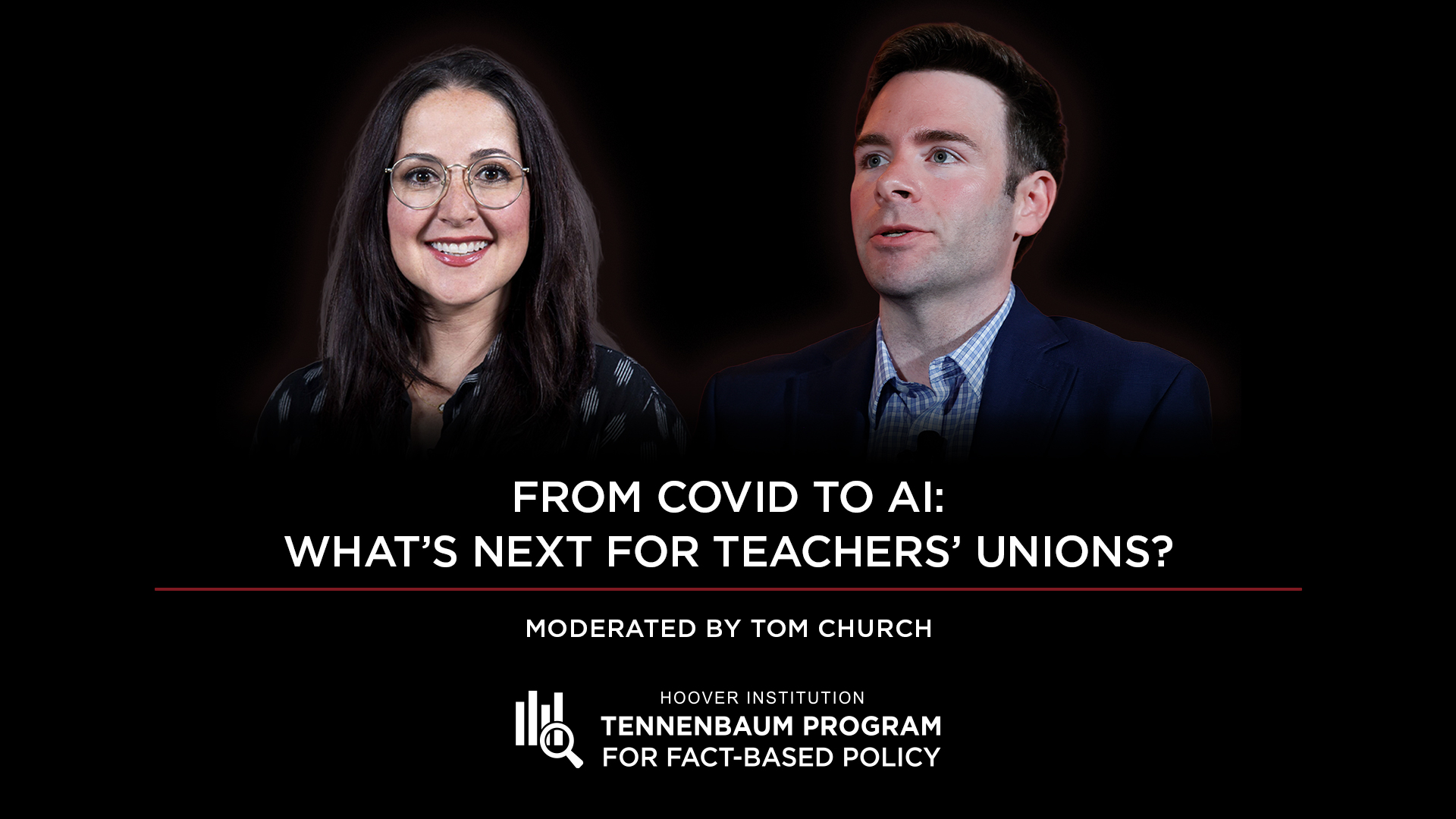
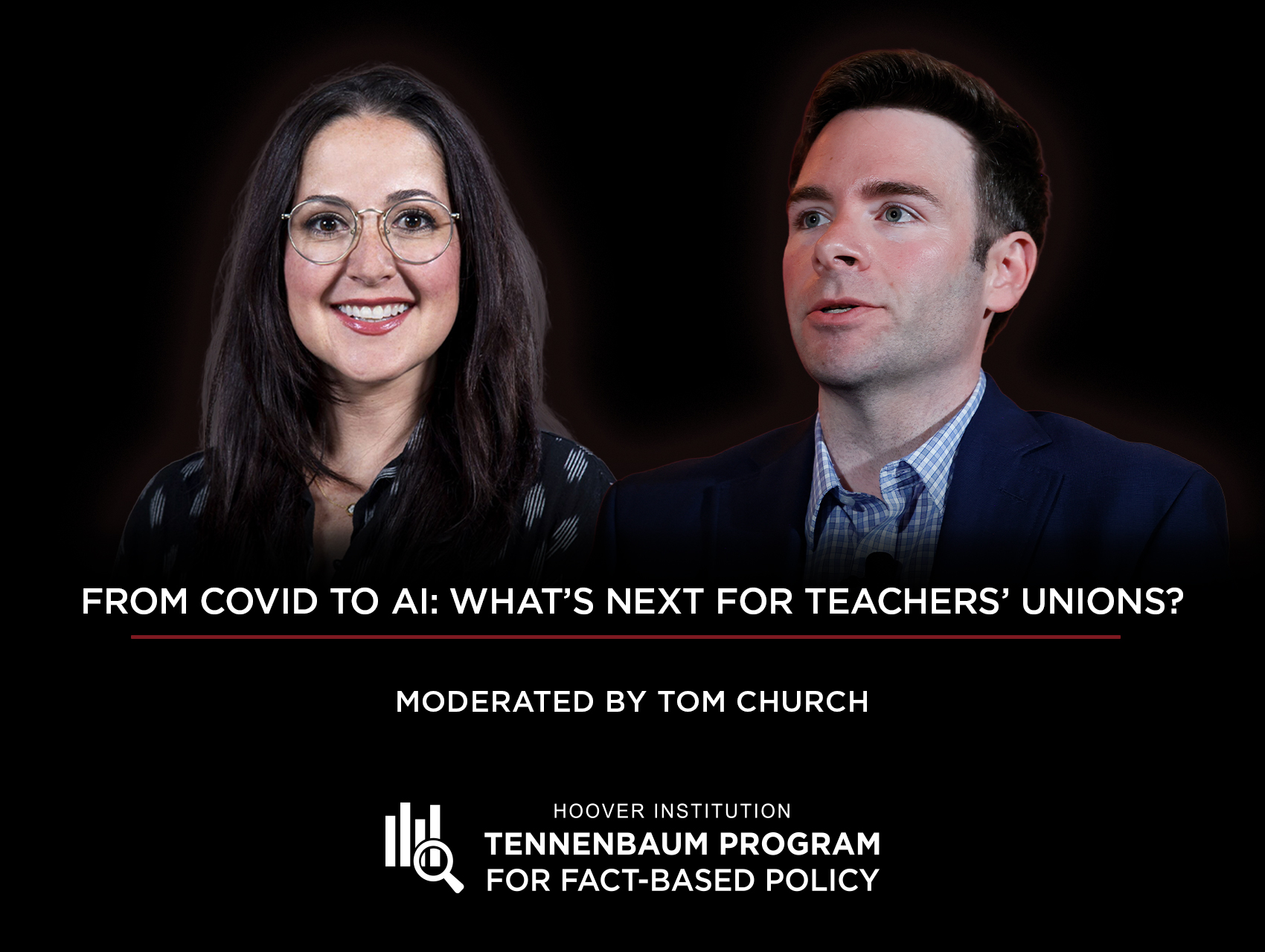
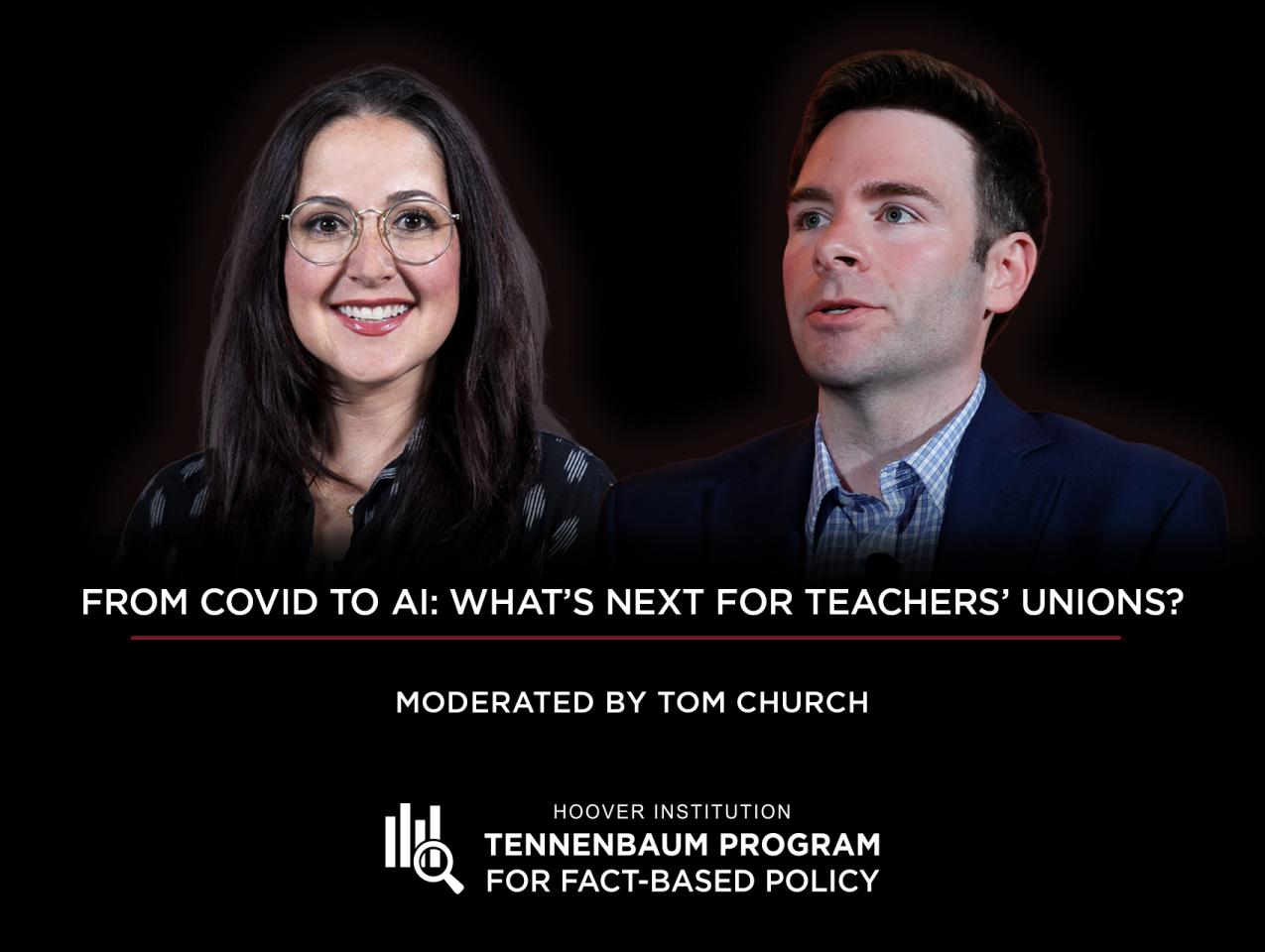
In a new episode of Factual Foundations of Policy, Michael Hartney and Melissa Lyon join host Tom Church to examine the role of teachers’ unions in American education at a time of declining student achievement, post-COVID learning loss, and rapid technological change. Drawing on research about union membership, collective bargaining, and teacher strikes, the discussion explores how unions shape both education policy and working conditions. It also reviews evidence on their effects on education spending, teacher compensation, and student outcomes.
The conversation highlights the continued political influence of teachers' unions despite declining membership in many states and explores how labor relations intersect with broader debates about public education. Hartney and Lyon also examine the role of unions during COVID-era school closures and consider how AI, school choice, and demographic changes may reshape the teaching profession in the years ahead. The episode concludes with a discussion of unions' place in civic life and potential reforms to improve transparency, accountability, and public trust in educational governance.
- Howdy everyone. Welcome to Factual Foundations of Policy, a podcast from the Hoover Institution's 10 bomb Program for fact-based policy. I'm Tom Church, and today we're gonna be talking about teachers unions in the age of ai. I'm thrilled to be joined by Michael Hartney and Melissa Mimi Lyon. Michael is the Bruney Family Fellow at the Hoover Institution and recent author of How Policies Make Interest Rules Government Unions and American Education. Melissa or Mimi, as I'm inevitably going to call her, is an associate professor of public policy at the university at Albany and co-author of an upcoming report titled A Crowded Table State By State Rankings of Teacher Union Strength in 2026 for the Fordham Institute. Michael Mimi, how are you? Thank you for joining me.
- Looking forward to it.
- Good, very good. You very kindly gave me tenure, but I am actually still an assistant professor.
- An assistant professor.
- Well, he also said my book was published recently, which in academic terms that may be true. But thank you also
- Also
- For that. Yes,
- Absolutely. Alright. Today we're talking teachers, teachers unions. I, I think it's fair to say that teachers unions are one of the most powerful interest groups in American politics, but the ground may be shifting. COVID exposed real cost to union influence over schools. Student achievement is in crisis learning loss is something hotly debated and studied right now, and AI is starting to change what teaching even looks like. Before we get to facts and research and, and, and the big questions I'd love to know from each of you, why have you spent so much of your career studying teachers unions? Michael, how about I start with you?
- Sure. So before I became a professor, I worked in policy and in government for the National Governor's Association. And this was in the late aughts at a time when you had bipartisan education reform happening across the country. And it became very clear to me that one of the major constraints on the menu of reform possibilities was not just teachers unions, of course, but a lot of established education interest groups, teachers, unions being one of the leading interest groups in this space. And one of the puzzles as I transitioned into graduate school coming out of that direct experience was that most academics who study teachers' unions were very quick to classify them as strong or weak simply on the basis of whether the state had a collective bargaining law or not. Now, I went on to write a book that made the case that collective bargaining laws are important. I do think they're important, I do think they're a component of teacher union power. But from having worked in a policy setting for governors, I knew that there were many governors from states that didn't have collective bargaining laws that also said teachers unions were big players in decision making as well. So based on that and my interest more generally in trying to improve education policy and understand the politics that underlie the process of making education policy, I thought that, you know, for the first few years of my career now it's become many more. I should probably put teachers unions at the center of my research agenda.
- Mimi, how about you? How did you get into this topic?
- So yeah, like Michael, it starts with my life. Prior to graduate school, I was a sixth grade teacher in Houston, Texas after I graduated from college. And in Texas, collective bargaining is illegal. And so we didn't, I wasn't a unionized, I wasn't in a unionized school and I was not in a union. And then I went to graduate school in New York City and I was doing some field work in schools in my first year of graduate school in New York. And I was fascinated by how different schools looked and how people talked about the union and, and not just in New York City, but also in Buffalo and other places where we were doing field work. And so pretty much immediately I became interested in studying teachers unions and that was about 11 years ago. And since then I wrote my dissertation on teachers unions and laws that were restricting collective bargaining, like right to work laws. And then I've written, I was looking back before this seven peer review papers in education, political science and econ journals about teachers unions related to how they function in cross-sector collaborations, restricted, restrictive collective bargaining laws, laws that are restricting collective bargaining, how they help teachers run for public office, and also more recently on the effects of teacher strikes. And that's a area where I'm actively studying.
- Yeah. Mimi, to follow up a little bit, could you help us get some context on size? What are we talking about here for, for interest groups? I mean as membership spread out unevenly among the states and I mean, are you seeing any changes in the post COVID world?
- Yes. So to start on size over 2 million, pre-K to 12 teachers are unionized today. That's a little over two thirds of all public school teachers in the United States. So sort of the most recent numbers we have are about 68% of public school teachers today are in teachers unions, which is down from 25 years ago when about 80% of public school teachers were in were members of their union. And it looks really different across states. So in the 10 strongest membership states, membership is above 90%. So we have some places where nine out of 10 public school teachers are members of their union and presumably not agency fee payers, though this is teacher report. So it depends on how they interpret it. Well, and no one's just doing agency fee paying now and then in 26 states. So a little over half of states, seven outta 10 teachers are union members. The states where, so in almost all states, so 45 outta 50 states, we've seen declines since 2007, 2008. So the trend overall is decline in terms of membership rates. That's really highest in Wisconsin, as you're well aware, that is almost certainly related to the 2011 Act 10, which I think Michael and I have both looked at in different ways. And, but membership also declined in other places too. And really only five states have seen membership increases since over the past whatever, 15 or so years.
- Yeah. Michael, let's talk about what teachers unions do. I mean, they have teachers that teach our students and that's terrific, but when it comes to the union activity, can you gimme a sense of like what do they use their time and money for? How much is for collective bargaining? How much is just political activity? How much is, you know, focused on students and touches classrooms?
- Classrooms? Right. So I think the first place to start is in the structure of teachers unions in the United States because if you ask some people, they would say there are two teachers unions in the United States, there's the National Education Association and the American Federation of Teachers. But other people might answer that question and say, there are thousands of teachers' unions in the United States because you have local and state affiliates of both of those organizations. And so I think that's important in answering your question because when you ask what do they do, I think what they do varies a lot depending on what level we're talking about at the, and and, and just to give a real concrete example so people can wrap their heads around this. Let's go back to the COVID-19 pandemic. We heard the president of the American Federation of Teachers, for example, Randy Weingarten would oftentimes be on Sunday shows or putting out press releases saying that she supported reopening schools, she wanted to get it done. You know, there was a lot of criticism of her. But setting all that aside, in some ways she could say that, but it really didn't have much bearing on whether schools would open, because fundamentally, the structure of labor relations in the United States and the public sector, it's all hashed out in contracts at the local level. So the local unions that are affiliated with those national unions are the ones that had to sit down and hammer out collective bargaining agreements or MOUs or in states without collective bargaining, you know, some form of consultation in some cases. So I think that's really important to point out. And, and, and, and so to sort of broaden out here a little bit, I think it's fair to say that more of the net, the partisan politics historically anyway, more of the partisan politics, more of the high level politics happens at the state and especially at the national levels of the teachers unions. But at the local level, historically really the bread and butter was focused on just then bread and butter, salary, benefits, working conditions, so on and so forth. Now, I will say that it's a little bit difficult to separate collective bargaining from politics. And you know, there's a famous quotation from Thea's long serving in-house counsel, Robert Chanin, who was sort of their lead lawyer for several decades. And in one of the Supreme Court cases where they were trying to grapple with this question of whether requiring dissenting non-members to support the union because they engage in collective bargaining on behalf of all members. And the justices were pushing him on this question and he said, look, it's impossible for me to separate NEEA's collective bargaining efforts from politics. You can't 'cause it's all politics. Now, that's not a partisan point. What Shannon was trying to get at there is that to the extent that collective bargaining supports the infrastructure of the local union, say a president, a board of of classroom reps that, you know, you would literally have to get into the business of sort of like having them keep increments of 15 minutes of how they spend their time. You know, some days they might be working on electioneering and school board elections and other days they might be working on sitting down with a lawyer to look at how are we gonna hash out, you know, salary discussions. And so it's very hard to kind of trace that. And so organizationally, I think I, I'm always sort of dissatisfied with trying to give an answer of like, do they spend more time in politics or do they spend more time in collective writing? Because even, you know, in the court, and this is why the court in many ways ruled the way that it did in the Janus decision is the court said, look, even if you're bargaining collectively over something like class sizes or the, the what should be the pay structure for teachers, fundamentally in the public sector, those decisions are political decisions because there's a lack of consensus, the voting public on how we should pay teachers on what class size should be. So in some ways I think it, it's difficult to say that they spend x amount of time on politics and y amount of time on collective bargaining. I think the, the question just doesn't break down that way.
- Fair enough. I had to ask it anyway, maybe you've got this upcoming report coming out. Where do you go for reliable data? I mean, if we're gonna start getting into, you know, what are the facts? Where do the facts come from? Where is there a federal source? Do you have to go state by state? Do you have to go locality by locality? Where are you gonna go to answer the, to to ask these questions then answer them using data?
- Yeah, so, and you've already kind of highlighted a key point that it really looks different depending on the level that you're talking about. So at the national level, CPS, the current population survey has pretty good data that they keep up to date on union membership. And there's some guys@unionstats.com that do a really nice job of putting that together. And so you can get up to date information on the national level at pretty fine grained detail. So you can like find, you know, elementary teachers and you can see how many teachers there are and what percent are unionized and covered by a union. There's also the, okay, so you know, there's also the national teacher and principal survey, which I think Michael and I have both used formerly the schools and staffing survey, which was a federal survey that was administered every couple of years that asked about union membership. And you could break that down by the state level so you could get every few years an estimate of union membership at the state level, which was very helpful. The, I have also used data from NEA handbooks to get year yearly membership data in the National Education Association at the state level. And those go way back in time. So that's been helpful for example, for looking at right to work policies going all the way back to the 1940s. Those are at the district level. I would love it if there was any way to get district level union membership data. I think that would be wonderful for my research
- For every, every academic ever says if we could just have more data, that would be great.
- There are 14,000 school districts and of course not all of them are unionized, but so going district by district is very tricky. But, so I don't know anybody that really has a lot of local union data. And then for political activity it's similarly tricky, but there's some sources. So I've looked at spending and elections from the National Institute of Money in Politics and, and I've done a lot of original data collection on teacher strikes, for example. That was a massive project that I did a couple years back and I'm still working on, on collecting a national database of teacher strikes. I've also collected data recently on teacher union endorsements. And that's something I'm working on now. And I've done a couple of original surveys and then also conducted interviews with teachers and local community members. So it's, it's not always some of the things that are most interesting, the political activity side is sometimes the harder thing to actually have data on.
- Right. Can I follow up on your research on teachers union strikes? Can you gimme a quick summary of the, the questions you've been interested in? And then just to, you know, what have you, what have you found looking into, is it, is it looking at effectiveness? Is it looking at, you know, number? Is it looking at what they get? Is it look, what, what is it looking at?
- Yes, all those things. So I have one paper that's come out from this project, which, and then I have three or four papers at various stages in progress. So the first step was collecting data on teacher strikes. So I went back to 2007 and 2008, got some administrative data where I could from a few states that have that and built out a process by which we could use local news sources to find, to like identify teacher strikes and also the reasons for why they strike. So I found evidence of almost 800 teacher strikes since 2007, 2008. And then we also kept track on why they strike a nine out of 10 are for compensation, but that's not mutually exclusive. About 10% are for sort of common good reasons. So, and there are lots of various reasons about 60% for working conditions. And then the first paper that came out was looking at how teachers strikes shape, political discourse, how teacher strike strikes shape, whether or not people are talking about education and whether or not political actors are talking about education. And we find, and this is published in the Journal of Human Resources, which is a labor economics journal, it's called Teacher Strikes as Public Signals. That's kind of, that's what we find. We find that teacher strikes cause political leads to talk a lot more about education and it's like a, a really sort of massive impact in the period leading up to elections where we see education as much more prominent in political ads as a result of teacher strikes. And, and then that also has downstream consequences for education spending where teacher strikes also increase education spending. And that's kind of like where I pick up on the next few papers where we're looking at impacts on compensation. So compensation increases, impacts on working conditions, pupil teacher ratios go down on student achievement. We find no long run effects on student achievement. Typical strike, we find no effects on student achievement. And then I've also been looking at school board election turnout as an outcome as well.
- That's really interesting. Michael, let's turn to maybe more contentious topics, if you don't mind. I mean part of the reason we're talking about this is COVID happened. We live in California, Mimi's out in in New York. I've got family in Texas and we had very different experiences when it comes to public schools and, and closing and, and through COVID and how long schools stayed closed and, and why they did. Right. And a lot of the debate right now is looking at student achievement following COVID and following school closures. So I'd like Michael, take us through right now what you know about what the data show in terms of learning loss. I mean, can we, do we have a, a clear sense right now of why certain schools stayed longer than other ones? Can you take us through that?
- Okay. But like a good academic first I'm gonna answer another question and then segue into answering your, your, your question. I I'll take it only to, to piggyback on what you had just asked Mimi, because I think I wanna sort of echo what she's saying, but, but add to it by, by noting that, you know, I think I'm gonna sort of make a, I'm gonna make, so I'm gonna try to make a bipartisan point or, or sort of nonpartisan point here, but in the spirit of, I think it's, it, it's wrong that we don't have more data and I don't say that as a selfish academic, but I, you know, and maybe, maybe others might disagree with with this characterization, but I think look, when an interest group is able to bargain collectively with government, whether you support that or you oppose it on balance, whether you think it's going to lead to good outcomes or bad outcomes, it's a clear example of something that only that interest group gets to do. Right? So, you know, you asked about COVID, it wasn't the case that school districts had a legal obligation to have the local PTA, the parent teacher association's president come in and sit down and discuss what they were going to do in regard to reopening. But in many cases they had to do that with their labor partners. And so I think what I would say is that the government, whether it's the state government or the federal government, should absolutely be collecting very basic information so that researchers like Mimi or myself don't have to guess which school districts have collective bargaining and which don't. And some states I will say have taken a lead here on this. Indiana is a state for example, where any taxpayer in Indiana can go to the state, the state's own website and see how many, how many teachers are employed in this district, how many are members of the union that has the exclusive representative that has collective bargaining rights, what did salary increases look like in the labor contract the year before, so on and so forth. It's not partisan information, it's just how you would think about sort of lobbying disclosures. Now I will sort of to, to try and be as even handed about this as I think we ought to be. I will say that while I think that some Republican governors have done good stuff in this regard in sort of forcing this information to the fore, sometimes it's not exactly done in a very equitable way. I think that the same should be true for police unions and fire unions. I think any union that's a government union is part of the policy making process and there should be transparency and I just don't think that should be particularly partisan. Sometimes it gets implemented in a partisan way. Now to your question about COVID and learning loss, you know it's been pretty well documented that the academic slide in the United States predated COVID. It tends to correlate more with the abandoning of school accountability, sort of the demise of the bipartisan era of consensus around no child left behind. Not to say that no child left behind was perfect, clearly there were many flaws in the law, whether that's causal, you know, everybody has their pet theory today. Is it cell phones? Is it abandoning accountability? You know, is it the cookie monster? I don't know. Everybody's got some theory out there, we don't know exactly. Now we do know we, we do know that there was tremendous variation in the United States in regard to schools reopening for in-person learning. We know that, we know there was also tremendous variation across sectors. Private schools including low cost private schools like Catholic parochial schools were much more likely to return to in-person learning than traditional public schools. But even within the traditional public sector, you're right in California, in Oregon and a lot of west coast states, a lot of big urban districts, they essentially kids were not in person in a regular sort of cadence for 16 to 18 months. And in other places that was simply not true. Now there is good peer reviewed research, it's particularly good, I didn't do it. So, you know, it's, it's particularly good that shows that look like learning loss was steeper in places that had longer bouts of remote learning. And I mean in some ways that's a very depressing thing to deal with. On the other hand, what's the counterfactual, the idea that if kids are not in school, they're not learning? I mean it would sort of suggest like you don't really need schools if you could just do them remotely. And I would also sort of say that I, I do find, you know, it's also worth sort of just pointing out that prior to COVID, if you sort of had to pin where where does labor versus conservative taxpayer minded Republicans stand on virtual learning? It was actually conservatives that were pro virtual learning. 'cause they thought they could save that we could go to four day a week school or something. And it was unions that were very skeptical. So it's always, you know, what, what's the prism through which this is being seen? So I, I do think it's true. And then, you know, the question of why, why was there variation? I mean, moving a little bit away from anecdote, I surveyed about 5,000 school board members in 2023 and those school board members predominantly served during COVID. And I asked them outright, I said, you know, private and Catholic schools were open, your district wasn't, you know, tell me why. And what was actually really interesting to me was even school board members who themselves, you know, presumably voted for keeping schools closed or for in virtual learning for longer, said in the survey that it wasn't an issue of resources, it wasn't an issue of class sizes, it wasn't an issue of the quality of their facilities. Those answers got 10 to 15%. But over half of the school board members either mentioned having to bargain with the teacher's union who was resistant to a quick reopening, the fact that the issue got mired in partisan politics and the fact that the public system has a lot more bureaucracy than the private system. So I think even if you turn to school board members themselves, they'll say that there was a lot of politics involved and the unions were a non-trivial, certainly not the only factor, but a non-trivial factor there because right, their job is to represent the preferences of their members. Now that's a much bigger discussion. Maybe Mimi has thoughts on that. I haven't been able to figure out exactly exactly what, and I don't think we'll ever know why it was that teachers unions were opposed to reopening. I mean I, I do think here I typically resist the idea of saying, well you can't, teachers and teachers unions are different and functionally that's true. But you know, our colleague Terry Mo showed here a long time ago that when you look at survey data, teachers who are in the union are pretty happy with what their union's doing in terms of advocating on their behalf. So I do think conservatives oftentimes are a little lazy in just saying, well, that's just the union, that's not teachers. And I do wonder sometimes on the COVID question, and you even saw this when it came to vaccines, there were some teachers who didn't wanna take the vaccine, the majority did, but then the union was in this odd position because their job is to represent all of their members. And so how do they respond? So I I do oftentimes wonder whether there was some slippage between what your everyday teacher wanted in terms of when to return to the classroom and particularly like the position that the unions took more institution.
- Mimi, can I throw this over to you? To any, any work on post COVID teachers unions, maybe involving strikes, maybe involving, looking into why they, they differed across state lines or, or you know, if, how much of it was trying to protect themselves versus what's good for students? Anything along those lines?
- Yeah, so I haven't done a lot, I haven't done research at all that's specifically related to COVID reopening with the small exception of adding a question to a survey of state elites. And, and so I, I can share a little bit about that, but I wanna back up a minute and like sort of reflect on a couple of things that Michael was saying. One that I think really importantly he emphasized that the school board members were the ones who are voting on these COVID reopening decisions. And I think that's something that sometimes gets lost with how the union negotiations or collective bargaining and negotiations are fundamentally, there are two parties involved. And so I have been doing a lot of work studying teacher contracts in Washington and in Michigan and I have some ongoing projects, coding teacher contracts. And when you really read the contracts, you see how much that there is, that this is not, this is not only restricting what districts can do, this is also restricting what teachers can do and setting sort of quite sometimes quite, you know, supportive of the district expectations about what teachers need to be doing. And so I think it's really important that we're remembering that the contract negotiations and negotiations about opening and all of these things are not teachers themselves that are making these decisions and that ultimately the district is the one who needs to decide if schools are going to open. Of course, if they believe that the teachers aren't gonna show up, that would be, you know, pretty embarrassing. But it's ultimately the district's call and that the, it may behoove some school board members to point fingers in other places, especially now sort of reflecting back on that. And so, but, but to be totally also transparent, I I asked a similar question that to state policy makers and advocates across 50 states about whether teachers unions were key decision makers in COVID reopening decisions and a quarter of respondents said that the teacher's unions were definitely key decision makers and about half said that teacher's unions were definitely or probably key decision makers. And so I think that that is quite sim like the about half is probably similar to, I don't know exactly how to interpret the probably versus definitely distinction there, but I also noticed that if we just look at teachers union representatives, so typically the leaders of state or local teachers unions, their responses, they were much more likely to say that they were key decision makers in state reopening decisions than other folks. So if we look just at teachers union leaders, they're 70% of 'em say the teacher's unions were key decision makers. And if we look at just non-teachers union leaders, then it is little bit less than 50%, 49%. So I do think that like key decision maker doesn't necessarily mean they were the ones who are, you know, to blame for not reopening schools. I think that there's a tendency sometimes for nobody wants to fully take responsibility for, for some of the like extended closures.
- Yeah. - And it's very hard to sort of trace that. Right. So I think the, the, the sort of elephant in the room a little bit is that it's very difficult to net out what's a teacher's union versus district versus the characteristics of the type of places that tend to have strong versus weak unions or districts that are aligned or not aligned with, you know, more democratic or liberal positions
- Or democratic. We have academics for and dissertations and RAs right to ask the answer those really hard questions. Alright. Right. So we've been talking and framing this a bit in terms of reactions kind of since COVID and, and what happened with school closures from there. But now we're in this age of AI and it's really, really heating up quickly. And I think it's interesting to start thinking through how teaching in the United States might change, you know, I mean unions in general are maybe slower to adopt, you know, competition to their model. And so I'd love to hear from each of you if you think that looking at development of AI in the incorporation of AI into learning, do you think teachers unions as we see them now are going to stick around? Do you think that they're going to adapt? Do you think that, you know, I mean union membership has declined, maybe you said, you know, in the last 20 years or so of, of teachers and, and public schools in the United States, would you expect that to keep falling as new ways of learning or new ways of student achievement show up?
- Well I mean it's very hard to look into the future and I don't, I haven't been doing any specific studies of teacher's union's responses to AI or like how schools are integrating ai. So I would say that my academic expertise on AI in the classroom is very, very limited. And so I'm particularly hesitant to speculate too much on that. I think that the, we are, I, I agree with your initial framing that you've sort of brought up again here, that we are at an inflection point and I think for the reasons that you've said and also because the teaching profession, I have a paper, the called the Rise and Fall of the Teaching Profession with Matthew Craft published last year, I think, and we show that across a number of different ways of conceptualizing it, that the status of the teaching profession is historically at a low place right around 20 20, 20 21. I think it looked like it might turn around, but this is also hitting at a time when we're seeing declining enrollment. And so I think that it's really an open question about what's gonna happen. I think the teachers unions are going to need to adapt. I think that especially with expansions of school choice, there are possibilities for the unions to adapt. And I think that there are really creative ways and there are maybe the like, you know, typical ways and it's an open question about whether they're gonna take one or the other. But I mean, in many states the collective bargaining rights are stronger for private sector workers than they are for public sector workers because of the National Labor Relations Act, which protects private sector workers. So to my mind there's not a sort of an obvious reason why teachers in private schools couldn't be also unionizing and organizing. But I would put that in the sort of more creative category of ways unions might be adapting
- A quick follow up. Would you think it's fair to say we, we might see, 'cause teachers unions are not monolith that that's not one teacher's union in the United States, right? It's, it's split up so much. Could you see some that adopt AI and, and you know, I guess work heavily on student achievement and use AI to do that versus others that might be slower to adopt? I mean I'm, I I think you're always looking for new research to look into and I would love to know how different teachers unions in different states or you know, just teachers who aren't even unionized adopt this and and and implement it.
- Yeah, I mean I think that it's gonna, so if we're talking about local adoption, then it's gonna look, you're gonna have tens of thou or you know, thousands at least different ways that these kinds of things get adopted locally. And so that's certainly gonna look different. I think, you know, the, the A FT has sort of pretty prominently made some public collaborations with AI companies and the teachers unions have been trying to figure out what's the place for the national union too in terms of AI advocacy. And so, you know, it's really tough to say how exactly it's gonna go. And I think it was either you or Michael made a good point earlier that sometimes these things get partisan coded. I think it was maybe Michael's point that like virtual learning was I think more partisan coded as a republican prior to COVID and then NA then during COVID shifted to be more partisan coded for on the democratic side. And so I think it's still probably too early to say exactly. I think recently AI is, seems to be trending towards partisan coded Republican, but it's still too early to say exactly where that's gonna fall.
- Michael, if you could design from scratch, I mean, you know, we're in this, I think we're in this new era sort of, of, of ai I can imagine, you know, one-on-one tutoring is, is almost zero cost at this point for, for students. I'm sure the three of us wish we had this growing up to learn because we would've been able to learn so much faster and more specialized. So Michael, I mean what's your advice to teachers unions, how they should, if they, if they started over, what would collective bargaining look like for them in this age of ai? Is there, do you expect to see much of a difference or do you think the revolution's gonna come from elsewhere in public education?
- Well I think a lot of the conversation on AI is downstream of another question which relates to what are our schools going to be for, what do people what, particularly because of something Mimi said, which is enrollment loss. We're in a period unlike others where, and this is true at higher education as well, right? I mean if you, if you don't have the same number of students and the question of what is the school for? Is the school primarily playing a custodial role, a place where two working parents can feel good that their children are spending time? Or is the school going to continue to be seen primarily as an academic institution where it's evaluated by taxpayers and parents and other community members based on our students graduating from high school or graduating from college prepared for career. And I think that question really precedes all of this because it's not a left right thing. I think we've seen in some ways a bit of a horseshoe politics here where there are a lot of folks who've been pushing school choice, sort of what I call like universal unbridled school choice, no testing requirements. When the parent has made a choice, the policy has worked, right? That's a normative view. And I'm not being critical of people who hold that normative view. I'm just saying that that means that whether the students performed well on math or ELA tests is really not the center of the conversation. Now on the left, I think that's happening as well. I think to go back to, you know, more squarely on the, the union question, it's not an accident that a lot of teachers' unions are enthusiastic about the idea of community schools, of schools where kids would go and get their fluoride treatments or you know, maybe have their checkup with their doctor or an opportunity for mental health if that's, if that's something of interest. But you know, the idea then is that the school as an institution is really not necessarily principally about academic learning. And I think the both sides here have interest in making the arguments the way they want to. But since we're talking about teacher teams today, I'll focus on that. I mean, their interest here is if if enrollment's declining and student performance on academic outcomes is not great or AI is making some of that not as central, then if you want to continue to have the same levels of staffing and employment justification for that has to come somewhere else. And I think that is why you see more emphasis on wanting to say like, say our schools are bedrock community institutions that serve all these purposes. So even if these other ones kind of go away, we, we still need to fund them and staff them commensurate with, with these other obligations. So I think that's really important. I also wanna make a point that I, that I think is important about the future of teachers unions. You know, there's large conversations going on in the United States right now about the decline of institutions. We have a center here at Hoover on revitalizing American institutions and I think people are now more comfortable seeing schools, certainly universities as part of that conversation as an institution here. But I also think institutions like teachers unions fit that fit the idea here. What I mean by that is, you know, we all know ever since Bob Putnam bowling alone, that there's been a drastic decline in civic life. People joining organizations being authentically involved in them and of course the Supreme Court's Janus decision also leading to some decrease in the percentage of union membership. You know, I think one can make a very strong case that people should be able to be a teacher, a cop, a firefighter, and not have to join the union. Fair enough. But I also wanna sort of raise maybe an unintended consequence of that, which is in some ways I'm wondering whether at least in the next 10 or 15 years, whether some of these teachers unions are gonna little look a lot more like what I would call a primary electorate in the United States rather than a general election electorate. Because if you're conservative or moderate, teachers are just leaving the union as they now have the right to do. And again, I wouldn't pose their right to do that. I think they should have the right to do it, but just what one upshot of that is, it means your median participant in the union is probably moving significantly in a different direction. And I do wonder if that's why we're seeing some of what we're saying. I mean Mimi could probably talk more to the specifics about this, but my understanding is you have a lot of like very progressive leaders being elected to be the president of local associations in big urban districts. I mean particularly like Chicago's a good example of that. Now to be fair, I think some of this predated Janice in Chicago, but in other places where progressives are really sinking their teeth into these institutional vehicles. And since, you know, like one thing that we talked, we touched on labor law at the beginning, but one thing that it's worth folks understanding is labor law is really unusual. It's not like, it's not like we're gonna have midterm congressional elections in the fall. And so the American public, if they wanna throw out all 435 members of the house, they're gonna have the opportunity to do that. Labor law is not quite like that. There is a way to decertify a union, but the threshold is a lot harder to do. And so what that means is these institutions persist, but who is in them and who's active and involved in them, that changes over time. And so it's just descriptively true that we're in a moment right now where a lot of the leadership in some of these local unions is focusing, Mimi call it common good, but like you're seeing discussions over Israel palestine, you're seeing discussions over fighting institutional racism or unaffordable housing or pick your issue. And that's like very much a far cry from when the NEA and the A FT were sort of getting their start where it was like, we need to ratchet up teacher pay and make the profession attractive. And I just think that that's like, like whatever one's politics are, that's a very different place than where we are today.
- Lemme close on this, Mimi, what's one thing you want viewers to take away from the conversation? I mean, are are unions long for this world in the age of personalized ai? Is it, are we, do you think things will look the same? Do you think things will look drastically different in 10 or 15 years?
- Well, I don't think things are gonna look drastically different in 10 to 15 years. I think if I could leave the conversation was one thing I would say that we, I think for the reasons that Michael said, and I think we should have been doing this before, that we should be paying attention to the things that teachers unions as organizations are doing that are not narrowly focused on education issues. And that I think they've actually been doing this for a while. Part, I mean for many of the same reasons that Michael just said, with the decline of civic organizations, there are very few organizations that are representing working people, especially in economic, that have an interest in economic policy or have an interest in economics. And so I think more and more it's important for us to consider how teachers unions are shaping sort of the whole ecology of education and how they might be shaping the way that that localities are it, you know, deciding on whether or not they're gonna raise the minimum wage even though teachers are not making the minimum wage that the advocacy that goes into these kinds of decisions that are not necessarily education specific. I think we should be paying much more attention to the way that teachers unions work in those kinds of spaces.
- Michael, what's one thing you want viewers to take away from this conversation?
- I'm gonna need a minute to think of it.
- Okay.
- Because I thought you might change the question. So
- What'd you think? It might change the question too, and then we could we can answer that.
- No, no, I was, well I was, I was gonna sort of engage Mimi's point maybe a little bit and sort of, but I didn't wanna leave on a point of disagreement and I wanted, and it was gonna be too, too folk too sort of like narrow. So, okay, so I think I'm ready. So I think what I'd like people to take away is that if we think that teachers unions institutionally aren't going away, and I, and I and I, you know, and I would just say, look, there's only one state that really, really fundamentally took the feed out from under teachers unions and that's Wisconsin. And even then they, they still exist operationally, right? So, so if they're going to exist, what are they going to look like? And I would sort of want people to leave the conversation understanding that it's a natural thing, especially when you work for a public sector of bureaucracy to want some form of collective voice. Now what I mean by that is just that, you know, if if you're going to work for a big school district, you want someone kind of watching out for your back. And, and I think that the problem is, this is maybe where I disagree a little bit, or not necessarily disagree, but I I'm just sort of highlighting the opposite side of what happens when you lean into non-education issues is that I think right now in the United States, a lot of interest groups that kind of came to prominence by focusing on a single issue are now becoming just part of the constellation of the left right divide. So you can think of like the NRA as a good example, they used to only rate members of congress or really care about their voting on gun issues. The A CLU used to defend speech and that was it. It didn't really care whether it was left speech or right speech. And my worry for the teachers unions are that they leaned in so far to a lot of progressive issues more generally and kind of stopping endorsing Republicans that they could work with to the point that now, you know, the minute the other side takes power, you know, there is no vehicle that like the answer on the right is just like wipe out the vehicle entirely. And the answer on the left is just like resist, resist, resist even more. And you know, I, here's the simple fact that I do think people on the right don't grapple with seriously enough, which is that, you know, Mimi's paper's excellent by the way, the one that she, she was referring to about the decline in the profession. Like one of the things going on here that was like, you gotta make the profession attractive, you need to pay teachers more. But the thing is, part of the reason you can't do that is because we're spending a lot of education money on pensions, on increasingly expensive healthcare benefits on class sizes. Like you can't do everything under the sun. And I do think that on it is unfortunate. My read of evidence a little bit is that oftentimes I'll, I'll wrap up with one quick example here. You know, I looked at the endorsement decisions for school board elections in California made by the teacher's union out here. And basically what my co-author and I found was that union endorsement decisions of incumbents, whether they wanted to give them four more years on the school board was entirely related to the pay increases that were given to the very senior teachers who were most active in the union, but with no regard for starting teacher salaries. And so I, I just like, I don't have a solution to this, but what I do think is really important here is since teachers unions aren't going away, I think we need to try as best we can to resource and balance I talked about earlier, we need transparency. Transparency not just for the public, but it's also for the benefit of the union members themselves so that they can push their union leaders and say, why are you bargaining for this and not for that in a way that they don't necessarily have to spend 12 hours a week going to meetings to learn that, but rather that information is at their fingertips for voters informing them in school board elections. What is the state of the budget and student achievement in your district rather than necessarily like right and left taking a knee jerk sort of, I'm supporting this candidate or that candidate based on their union endorsement. But I just think there are some things we could do. Maybe they're kind of like nudge, like reforms. I often write oftentimes too about the timing of school board elections. We hold these at odd times of the year, but I think we could do some small things to like marginally improve the type of democracy we have in public education, which would be both good for teachers. And
- I think that's a great note to end on. Michael Mimi, thank you so much for joining me.
- Thanks. - Thanks. Thank you everyone for tuning in. This has been Factual Foundations of Policy, a Hoover Institution podcast from the Tenenbaum program for fact-based policy. If you have any questions we you wish we'd covered, please send them in and we'll get to them in a future episode. We'll talk to you next time.
ABOUT THE SPEAKERS:
Michael Hartney is the Bruni Family Fellow at Stanford University’s Hoover Institution, an associate professor at Boston College, and a non-resident Senior Fellow at the Manhattan Institute for Policy Research. He is also a research affiliate at Harvard University’s Program on Education Policy and Governance (PEPG), and, in 2020-21, a W. Glenn Campbell and Rita Ricardo-Campbell Hoover National Fellow. Hartney’s scholarly expertise is in American politics and public policy with a focus on state and local government, interest groups, and education policy. Hartney’s first book, How Policies Make Interest Groups: Governments, Unions, and American Education, published by the University of Chicago Press, was awarded the American Political Science Association’s (APSA) prize for the best book on education politics and policy.
Melissa (Mimi) Lyon is an assistant professor of public policy at the Rockefeller College of Public Affairs and Policy at the University at Albany, SUNY. Lyon studies the political economy of education, focusing on inequality, governance, and teacher politics and policy. She is a quantitative social scientist who works at the intersection of education policy, political science, and labor economics. Her aim with this work is to contribute new knowledge that helps to inform how we can make educational systems more equitable for students and teachers. Her current projects center around three interrelated components of the political economy of education: teacher unionization, teacher labor markets, and state-level education governance.
Tom Church is a policy fellow at the Hoover Institution. He studies health care policy, entitlement reform, income inequality, poverty, and the federal budget. Church’s research interests include tax-advantaged savings accounts for health care, the fiscal effects of a federal public option, state-based regulatory reform, pro-growth federal tax policy, and the distributional effects of entitlement spending reform. He has researched the fiscal effects of major health care proposals and is a co-author of Choices for All, a set of common-sense health care reforms. He contributes to Hoover’s Healthcare Policy Working Group, the Fiscal Policy Initiative, and the Tennenbaum Program for Fact-Based Policy.
ABOUT FACTUAL FOUNDATIONS OF POLICY
An impartial investigation into the most controversial public policy issues facing Americans, answered by experts on both sides of the political aisle. Prefer the podcast version? Subscribe here.