







- State & Local
- California
- Economics
- Law & Policy
- Campaigns & Elections
- Politics, Institutions, and Public Opinion
- Answering Challenges to Advanced Economies
- California Decides
- Empowering State and Local Governance
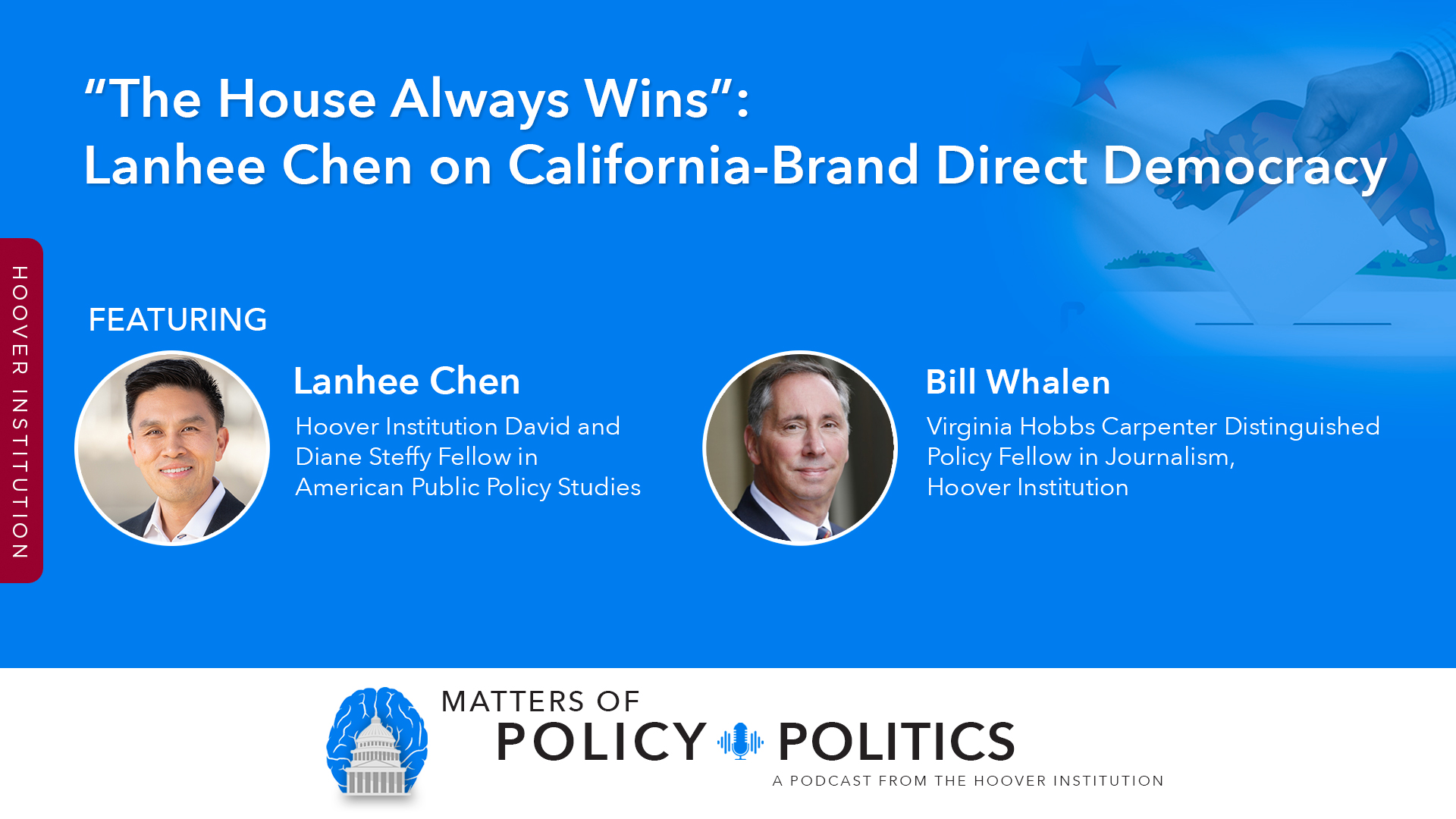
California is one of 24 states that allow voters to decide whether initiatives and referenda can become law – i.e., direct democracy. But what does California’s slate of 14 initiatives on the November ballot – including a “wealth tax” on billionaires, new voter-ID requirements, plus proposed changes to the recall of elected officials – say about the Golden State’s priorities, special interests’ influence, and California Gov. Gavin Newsom’s presidential ambitions? In the first of a series of conversations about the practice of politics and policies in America’s most populous state, Hoover fellow Lanhee Chen, a keen observer of California’s policy landscape and a past candidate for statewide office, offers a snapshot of this year’s ballot slate, how California’s wealth-tax fight factors into national politics (not to mention the near-term future of California’s tech sector), and suggests a few reforms that would re-instill the public’s confidence in the initiative process.
Recorded on June 26, 2026.
- How to make sense of California's priorities. Look no further than the dozen plus ballot initiatives that California voters will decide in the November election. But it's an issue process serving California well. Is the system meant to take influence away from special interests instead of playground for those individuals and entities with the kind of money and muscle to run a campaign In America's most populous state, we're gonna talk to a Hoover fellow who knows California better than most as a policy guru and a candidate for office, and get his thoughts on direct democracy West Coast style. It's an introduction to California policy and Politics, and it's coming up next on a new edition of Matters of Policy and Politics. Stay tuned. It's Friday, June 26th, 2026, and you're listening to Matters of Policy and Politics, the Hoover Institution podcast devoted to discussion of Hoover policy research, as well as issues of local, national and geopolitical concern. I'm Bill Wayland. I'm the Virginia Hobbs Carpenter distinguished policy fellow in journalism. And I'm not the only Hoover fellow who's loading behind a mic these days. I recommend you go to our website, which is hoover.org/podcast and see if yourself would always have to offer, by the way, that includes the audio version of the Goodfellow show that I had the great honor of moderating. Today we're gonna focus on California, actually, it's the first in a series of podcasts that we intend to do between now and election day, looking at the many political, economic and institutional challenges facing the golden State. And we thought we'd begin with the ideas on Barbara ballot and what those initiatives, those ballot initiatives say about California. Joining me for this conversation, a colleague with more than passing knowledge about all things California. Lonnie Chen is the David and Diane Steffy fellow in American Public Policy Studies at the Hoover Institution. He's also co-chair of Hoover's Healthcare Policy working group. Lonnie served as policy director for the Romney Ryan campaign back in 2012 and was a senior policy advisor to Marco Rubio's president to run in 2016. But wait, there's more. In 2022 Lon, he Chen was a candidate for California state controller. Well, he didn't win the race. He did earn the distinction of receiving the most votes of any Republican of the country that year. Lon, he, great to have you on the podcast. Thanks, bill. Great to be with you. So I did a little math, Lonnie, I went back and I looked up MIT Romney's numbers in California in 2012. I looked up your numbers in 2022, and guess what? You finished about 50,000 shys of vote shy of mit. Have you pointed out to the good senator though, when you look at the money he spent versus you that dollar for dollar pound for pound, you might be the better candidate. I don't know that I would, I, I don't know that I would say that, but it was, it was a very good experience for me. And people often ask about, you know, what that was like and whether I enjoyed it. You know, you learn a lot about yourself and it's a great state to run in and, you know, we're in the middle of another campaign now, so I'm, I'm glad I'm not one of the people that's being subjected to the fire this cycle, but I I, I do watch with some amusement at what's going on in our politics. Well, I'm glad you used lahee, but let's, let's get into it. So California's one of 24 states with the initiative process in California's case Lanhee. This goes back about 115 years to the late great higher Johnson, the great progressive reformer who came forward with his quote system of 1911, as he called it. This introduced initiatives referenda and the recall process to California. Now, how to get on the ballot in California, very simple. You clear your ID with the attorney, your ID of the attorney general. You then have to go out and collect signatures. And this is based on a formula on the previous gubernatorial vote, 5% for a ballot measure, 8% for a constitutional amendment as turnout was light. In the 2022 governor's race, it was down about 12.5% for the previous governor's race. This means you have to collect about 547,000 votes to get initiative on the ballot, 875,000 or so to get a constitutional amendment going in 2024 Lon, he campaign spent an average about $15 per signature in California. This is a ballot PD analysis. They estimated it cost about $8 million to qualify an initiative. So Lon, he Chen, California candidate, California Policy Guru. Where do you stand on initiatives? Is it VOCs populi or is it the playground of special interests? I, I, I think it's both a actually, I think if you look at the initiative process, surely it, it doesn't look exactly now the way that Hiram Johnson and, and reformers intended in, in 1911, but I, I do think that there are strong arguments for a initiative process that allows members of the public voters in California to see their will expressed on important public policy matters, particularly where there isn't responsiveness from Sacramento. And I think about it in terms of the fact that we have a largely one party establishment in Sacramento. They've got certain policy priorities, they are beholden to certain interests. What the initiative process potentially allows for, and we see this, we've seen a couple big examples of this in recent history are, are if there is a policy alternative that's not being considered by the legislature for political or other reasons, then you have an escape valve. You have something that allows people to get their ideas and their very good considered policy situations considered by the broad variety of Californians. Now, I, I think the challenge we have, of course, is that the process itself has some serious defects, and you outlined one of them, which is that predominantly initiatives get on the ballot through paid signature gathering. So it becomes a very expensive exercise. And these initiative campaigns, by and large nure a few campaign consultants who make a lot of money and a few companies that make a lot of money off of this process of running these ballot initiative campaigns. And there is a way of getting the signatures, there's things you've gotta do, it's become very formulaic. And so I I, I do think we have to figure out what the right way is to determine how this process can really be a popular process and not a consultant driven process. The other thing I would say, and we may touch on this, is that the, this process works, there are various points along the way where certain state officials can put their thumb on the scale. And one example I wanna point out is the attorney general and how the Attorney General has the responsibility for giving these initiatives, essentially a title that goes on the ballot and that people see officially when they vote on these initiatives, they see, you know, proposition 86, you know, proposition to kill all the puppies. And, and the Attorney general basically gives a, a ballot title and a summary of what every initiative does. And so the Attorney General can easily bias people one direction or another. And that's part of the problem is that if there is a policy idea that let's say a bunch of right of center folks in California want, and you have a left of center Attorney general, that person can write a ballot title and summary that makes something sound absolutely atrocious. So that's a an example of where I think the process, unfortunately, has gone arise. So I I I, I think there are advantages to this process. I think there are good things, but there's also some really pernicious things that need to get fixed. Yeah, I'm glad you mentioned the ags rule on he, one of my favorite stories about this goes back to the 2000 election. We're going back a little bit, and that's a friend of yours, somebody, I think you know, Tim Draper, very fable, Silicon Valley venture capitalist who has dabbled from time to time in California politics. He has noted a lot of people as a guy who wanted to break up California and to many pieces. But before that lon, he, he was a school choice advocate. Yeah. In 2000 came up with a ballot measure, which was going to do school vouchers statewide. So Andrew, the Attorney General at the time, bill Luckier, who was a longtime democratic legislature, obviously a very close to the California Teachers Association, which did not want this. So what title does Attorney General luckier apply to this? He calls it the quote, he calls it school vouchers, state funded private and religious education. There you go. There You go. There you go. Yeah, I, I mean, and, and it gives a disproportionate amount of power to the Attorney General to shape public opinion about initiatives. By the way, most Californians, you know, people are busy, they're not gonna spend all their time paying attention to what initiatives are on the ballot. And then you get to your, you know, election, whether it's a June election or November election, and you see 5, 10, 15, 20 ballot measures. You don't know what to make of all of this. So naturally you're gonna look at the title and say, oh, do I think that's a good idea or a bad idea? And more often than not, the attorney general has the ability to shape the opinions of how people feel about an initiative. Just through that process of being able to write the ballot title and the summary of the initiative. You're leading me. My next question, Lon, he today is the day after the deadline for those proponents of ballot measures who had qualified for the ballot to take the measure off the ballot if they wanted to. And so yesterday in Sacramento was just crazy horse trading. It was like watching the NBA draft, you, hey, pick is made and suddenly is off the board, and we have a deal going on all kinds of skullduggery. Anyway, I woke up this morning, lon, he, I checked the Secretary of State's page and what I found was now 14 ballot measures sitting there before California voters, there were 11 measures on the ballot in 2024, only seven in 2022. But you've touched on this, how do you process 14 ballot measures? I imagine some you just know and whether you're pro or con on them, but do you take the time to read all of them and, you know, how's the average California gonna process 14 measures? Well, yeah, I mean, I, I, I do try to take a look at each and, and offer, you know, a, a point of view on how I feel about e each of them. And, you know, sometimes it's hard, right, bill, because you've got some initiatives that are designed as poison pills to kill other initiatives. We actually will have that this November. We have the so-called billionaires tax, which is going to be on the ballot endorsed by certain labor unions here in California. But there are two other ballot measures that are designed explicitly to invalidate the billionaires tax in case the billionaires tax actually passes. And this is gonna be tremendously confusing. Remember when we had the dueling sports book initiatives a couple years ago in California where we had multiple ballot initiatives designed to legalize online sports gaming. That was very confusing to a lot of Californians. So it's not just that the initiatives themselves were confusing, it's that there can be actual tension even within the initiatives that are being considered on a single ballot. Well, let's look at three measures that did not make it to the ballot and what they say about power in California Sacramento these days. And let's start with the rideshare business. Uber was collecting signatures for an initiative which would've capped attorney contingency fees and limit how much California crash victims can recover medical costs. It ends up cutting a deal with trial lawyers capping medical costs, but not restricting contingency fees. Uber's been politically active the past few cycles, haven't they? Yeah, and, and look, the rideshare business is an increasingly important part of the California economy. And, and it's an increasingly part not just the economy, about how people get around, but it demonstrates the power to your point that the trial lawyers still have in California. And the, the plaintiff's bar is able to cut a deal like that because they know that they have the ability potentially to go out and not just defeat the initiative, but to make Uber and rideshare companies look bad. And, and this is not a fight necessarily that Uber wanted to, to get into down the road, and I understand why not, but it, it does show that you have these entrenched interests in Sacramento, whether it's the trial lawyers or we'll talk about the public employee labor unions, that's a big one too. They all have a tremendous amount of power and a disproportionate amount of power over the people who are sitting in positions of power in Sacramento. Right. Second item Longhi. This is the Howard Jarvis Tax Association. They had qualified a measure to cap real estate taxes, making it harder for local governments to raise taxes, enter the governor's office and legislative leaders who agreed to put a different constitutional amendment raising the vote threshold to pass certain local taxes. Democrats also agreeing, well, I need to remove it, a measure making it harder to pass certain tax limiting measures. So how do you read this one? Well, look, I I, I think we have a very strong anti-tax history and culture in California, going back to the passage of Proposition 13 in 1978, which was the original kind of tax limiting initiative that restricted increases on particularly on real property taxes. And that's become a very, very strong rallying cry for those of us here in California who believe that the problem is not that we don't tax enough, right? And, and, and I think there is a real policy debate. Do we need to collect more money or do we need to do better with the money that we've already collected? And so, to me at least, there is still a very strong level of support for, for this idea that we cannot keep increasing taxes. It is also the case though, that that runs into some of the entrenched interests I talked about earlier. So when a deal gets cut like this, what it tells you is that, you know, there is a way of getting 90% or 80% of what you want, what the anti-tax advocates want without getting into a fight that could be very costly and eventually result in a defeat. Yeah. Dan Walters wrote a really interesting column in Cal Matters in the day long. He, where he pointed out that the ju primary here in California, there were 92 local measures that either raised taxes or created bonds that would've increased local property taxes to repay them. And according to Walter's Math, only 57.5% of those passed, in other words, about four out seven. And this is down usually 70% of the, yeah. So how much do you read in that, in terms of anti-tax sentiment? Do you think there's an anti-tax seminar or, or folks just kind of tired of being nickel a dog? I, I think it's regional. Bill, I'll tell you here in the Bay area where I live, if, if you put a tax increase on the local tax increase on the ballot and say it's gonna mean a nicer school, better facilities, better library, it's gonna pass. Okay. Like, I don't, I don't think at the single time I've lived here in the Bay Area, which is 13 years now, I have never seen one of these local things fail. Local tax increases fail. Now, I think if you go down to Southern California, you go down to some parts of the state where there's a little more political diversity, maybe people are a little bit more sensitive because the economics are different. Yeah. That, that I think it's true that people are beginning to say, Hey, listen, enough is enough, particularly in Southern California and the LA area, when they look at how poorly local government has done for them over the last two years, I think there is a greater sentiment, particularly within the last couple of years, that some of these local tax increases are not doing what their proponents say that they're doing. So yeah, I I do think that that analysis certainly does point to some kind of a political change in some parts of our state. Not where I, where I am or where you are, but some parts of our state. Yeah. I think one of the challenges Juan here is when you get into a a tax initiative situation, the protex side's gonna make this emotional. And there's a very, as you know, that's a very pro in California trying out the teachers, the nurses, the firefighters, the people who run white hats in society that talk about it. And if you oppose it, you're ultimately making an intellectual argument. It's bad for the economy. And that's, that's a hard sell. Yeah, it is. And, and, and that's why increasingly, I mean, I, we'll we'll get into the discussion, I'm sure about the billionaires tax in a, in a little bit. But, but this is why, you know, for example, governor Newsom, who is opposed to the version of the billionaires tax that's on the November ballot, Right? He has made part of the argument to, to say that actually what this initiative will do is to hurt firefighters and hurt teachers because they're not gonna benefit from the billionaire's tax. It's gonna go entirely to one group of people. And while that might be a very worthy group of people, what about all these other folks who are not gonna see the benefit? So he has actually made this a version of the argument that you're talking about to avoid intellectualizing it. Because I do think that when you intellectualize the debate around some of these issues, it does become very difficult to win that kind of argument. Alright. And now, a a third measure did not make it on the ballot. Alani actually two measures. The California Federation of Labor Unions, the Ffl, CIO, the FCIU healthcare workers, we've been talking about, the California Hospital Association, all got together lon he, and they cut a deal and they agreed to remove two initiatives, one, limiting compensation for healthcare CEOs who wanted to cap their salaries at 450 K. The other would've required healthcare unions to secure direct rank and file approval before spending a million dollars of more in statewide campaigns. So this was sort of mutually assured destruction Yeah. At it as well. Yeah. Well, th this is an example of, you scratch my back, I'll scratch yours, right? Because the, the interesting thing about the initiative to limit compensation for healthcare executives is it comes up like every cycle, Right? And it comes up at the local level, at the county level. You see it all the time. And, and there's a lot of back and forth about whether that should be something that's considered. And there's arguments that both sides throw out there. But this one about restricting the kinds of political activity unions can engage in, that's an interesting one because that strikes at the heart of what these unions want, which is political power. And, and so the last thing the unions want, I mean, they are more than happy in, in my view, many union bosses are happy to sell their workers out if it means that they can continue to have political power. And I think you see that in this kind of a, an exercise where the union leadership comes in and says, well, not so fast, we're more than happy to give CEOs whatever they want as long as we get whatever we want. And that's how I read that deal, Right? For those scoring keeping score at home, SEIU has now tried six times to cap healthcare executives hours at four 50,000. There You go. Since 2012, Lon, he, SEIU has sponsored 48 state and local ballot initiatives, spent about $120 million. They're batting average isn't that great? Most of the measures were either withdrawn or voted down, but they do get wins. For example, your healthcare worker in California, your minimum wage is $25. That's a result of pressure from ballots. So this gets back to my original question, Lonnie. Is this a good way for California to be going about making its policy decisions? Well, I, I, first of all, I think it is, it's gonna be a lot easier to convince Californians to raise a minimum wage, for example, for healthcare workers. I mean that, I think a lot of Californians would say, okay, you know, that makes sense when you start to get into limiting compensation. That's actually, in my view, that's where it gets actually a little bit harder, not withstanding the populist time that we're in. I mean, look, the broader question about whether this is good or bad for California, I returned to the original focus of our conversation, which is you're gonna be able to find bad examples and you're gonna be able to find good examples. What I come back to is, do we have a process that allows a for popular opinion to be properly expressed when it's not being properly considered in Sacramento and BAA process that's truly a citizen led process and not a consultant led process. Right now, we don't seem to have the second of those, and the first is kind of mixed. So rather than scrapping the initiative process, I might suggest we ought to think about ways of improving the initiative process. Whether that's making, for example, a less political way of writing the ballot title and summary, which we've talked about, whether it might be limiting the amount that signatures can be collected for, or figuring out some way of creating a system where signatures can be more easily collected across ballot initiatives. There's all sorts of different ways that we can remove what, in my mind, has become some of the dysfunctions from the initiative system we have in California now. Right. Alright, let's look at the ballot itself. Lani, there are 14 measures, as I mentioned. I want to draw your attention to three. First, let's talk about the billionaire tax, because this is gonna get the lion's share of attention to California. It might be kind of a funny lopsided election here in this regard, lon, he, that ballot measure might get more attention than the governor's race. At the end of the day, if you consider that governor's races tend to be rather undramatic in terms of the final march to victory. And, you know, no fantastic Hilton or or Javier Becerra, but they're not the most electric guys in the, in the, in the house. So the Billionaire tax might be the attention to California. So for those not familiar, this is sponsored by S-C-I-U-U-H-W. And the idea is that you would impose a 5% tax on every Californian who has a billion dollars or more of wealth every Californian living in California as of January 20. January 1st, 2026. So if you fled the state this year, you're still stuck to it. You have five years to pay it. And about 90% the money Lonnie goes to healthcare spending in California. So lemme ask you this, Lonnie, I'm worth a billion dollars and I'm asked to give $50 million to the cause. What's wrong with giving to the cause? Well, first of all, bill, if you're worth a billion dollars, I'm, I'm doing something wrong. So that's, that's, that's the first No, look, so let's, let's, let's, let's back up for a second. Okay. I think, I think ballot measures can serve all, all sorts of different masters, as it were, right? And, and we've talked about the policy motivations, but I wanna spend a little bit of time talking about ballot measures in their relationship to politics more broadly. And what I mean by that is, sometimes you have a ballot measure that's there to drive turnout because there's a recognition by both sides, both Democrats and Republicans, that in order for your candidates to do well up and down the ballot, you gotta have your voters turning out, right? And in a year where, let's say, for example, the top of the ticket, which is the governor's race, might not generate as much attention, each party's gotta think about ways of turning out their political basis. And that's where ballot initiatives come in. So the Billionaires tax, and then we'll talk about the voter ID initiative in a minute. Yep. But those two initiatives are examples of political mechanisms to ensure that political basis, that partisan bases turn out to vote because they might care more about the billionaire's tax or about voter ID than they do about who the governor is or who even a member of Congress is. And so political parties see these initiatives as a way, not just in California, but in lots of states where this process exists to make sure that their voters are turning out to vote. So when you look at the billionaires tax, there is a lot of controversy around it. First of all, from a policy perspective, you're gonna get into this with others as, as you do these podcasts. But let me just say that the reason why this is so poorly constructed is threefold. First of all, there's no guarantee that the threshold remains where it does in terms of where the tax is imposed. So it's billionaires today, tomorrow, it's sent a millionaires the day after that it's millionaires and so on and so forth. So that's a big problem. The second issue, of course, is that there, the, the benefits of this go entirely to one issue area. So essentially we've made a policy decision that all of this revenue, rather than being distributed to the many very good causes we have in this state, is gonna go entirely to a single area. And that's why Governor Newsom opposes it, by the way, in theory, is because he says, look, I I ought to be able to have some flexibility with policy makers to determine how we use this revenue. I'm not gonna get it. So I don't like it. And the last thing I would say is that, that this tax initiative puts a tremendous burden on every California taxpayer. Why? Because you're gonna be required if this passes as a California taxpayer to attest to your net worth every single year, because that's part of the way in which this tax makes its money, is it's assessed off of your net worth. So you're gonna have to swear to the state, and by the way, under penalty of perjury as well as financial penalties if you, god forbid, make a mistake. So I think a lot of people see that as a very invasive, very problematic provision to put into law. So the, the, the billionaire's tax is, is substantively problematic, but politically it's super interesting, right? Because you do have certain unions against each other. Yes. You've Got teachers unions, for example, who oppose this because they're not gonna see any of it. They, their members aren't gonna see any of it. The governor opposes it, although this morning he says, I'm actually for a national billionaires tax, right? Which suggests that his prospects and his interest is more on that venue rather than the venue he's in right now. Right? And, and, and then you've got obviously unified opposition in the form of business, in the form of people who would be affected by this. But more importantly, a lot of people in California who are aspirational, who say, look, I, I don't wanna have to worry about attacks if I make a couple million bucks. Which doesn't seem to be the case today, but could be the case four or five years down the road. So this is gonna get a ton of attention and it's gonna put California this initiative at the center of the national discussion going into November. I think Let's talk more about the odd Ben, odd Ben Fellows who are opposing this initiative. You mentioned the unions. I think that's pretty straightforward if you're the California Teachers Association. Yeah. J Pro, you love Proposition 98, you love the 40% revenue guarantee you get out of that. You don't like a measure where 90% of the money goes to healthcare. But let's talk about two other players in this. First of all, wahi, the tech community, you've had a lot of very vocal tech leaders spanning off against this. Some tech leaders support it. I would point, I think Jess Wong Nvidia said he, he'll pay, but most tech executives don't like this. And they've acted in different ways. They voice their displeasure. Some, you know, voted with their feet and already left California. But, you know, this is interesting, Lonnie, I've been in California for a long time and I go back to 1996 for example. And Proposition two 11, this was a shareholder initiative of Iraq initiative, was called, this is kinda the first time Silicon Valley really mobilized against something because shareholder lawsuits were a big problem industry, but they were kind of, you know, back players in that regard in terms of putting in money. You see tech leaders being more vocal and more forward Now. It's, have you noticed this evolution as well? Yeah, I, I mean, look, I think there's no question that the tech community, and, and that's a very broad term, right? There are a lot of elements and sub ecosystems and all the rest, but there is no question that as these tech leaders have thought about, where they're locating their businesses in themselves, the policy and regulatory environment has become a much bigger part of the way that they think. And as they look at how dysfunctional elements of our policy and regulatory system are in California, they've gotten involved. And in some cases it's been directly involved with respect to things that affect the tech ecosystem in California, but also more broadly now with this billionaires tax as an example of them getting involved in things that they believe affect the ecosystem, not just today, but for years to come for tech companies and more importantly tech entrepreneurs, right? We're talking about the next philanthropic, the next open ai, the next Nvidia, the next Facebook. That's what we're worried about. And that's why I think they've gotten involved because there are tremendous downside effects of passing something like a billionaire's tax in terms of the flight of capital outta California. The way in which it will destabilize our revenue sources here in California. And it all goes back to the fact that so much of our tax revenue in this state, we are dependent upon the personal income tax and in particular how people realize capital gains. That is, that drives so much of whether we have a good year or bad year in California. So, putting aside for a minute what an ideal tax system would be. 'cause we should have that discussion for now. I'll tell you, I think a lot of tech entrepreneurs and tech leaders, certainly ones I've spoken to, the reason why they feel the way they do about this is because of not just their own interests. And there's clearly that, but also the question of where does California go in the next five years and 10 years if it wants to continue to be the innovation capital of the world. And I think that's part of the concern that's animating their involvement both today. But by the way, bill, it's not just today. Increasingly I talk to these leaders in the tech industry who say, look, I'm in it for the long run. I'm invested in California, I wanna stay here. So I'm gonna keep playing a role in California politics because there has to be a counterbalancing force to the predominating forces we've seen in the state's politics for the last two decades. It's a reminder, Lenny, how complicated California is. For example, I've been reading a lot about the, about ideas of to establish AI tech centers, data centers Yeah. And the Central Valley, and it sounds great jobs forward, but now you're talking about land, you're talking about water, you're talking about agriculture. Sure. It's a mess. Yeah, it was controversial, right? I mean, we had in Cal, in California, the first city or town to pass an initiative banning AI data centers from being constructed in the city limits. That was Monterey Park Roach is a southern California community not far from where I grew up. And, and they've just decided, look, we don't, we don't want 'em here. And, and this populous sentiment, you're gonna see that increasingly in this state, more and more cities, I think are going to have ballot measures for their citizens to vote on that say, we don't want that kind of infrastructure constructed here. It's gonna make it harder. I I think in a lot of ways for us to continue to lead this really significant revolution that's happening. Right. Let's spend a couple minutes now on Gavin Newsom and his role in the Billionaire Tax and moving forward. Lon Lonnie, and you're, you're already smiling. So Newsom to his credit, has opposed this from the get go. Yeah, He is, he is been very consistent on opposing wealth taxes. Although now he is changed. And by the way, he mentioned as a national billionaire tax, I think actually what he's proposed, actually it applies to everyone over a hundred million dollars in wealth. So here we are. So here we're already taking zero off the wealth. Yeah. Moving it down one slot. So Newsom opposes this, he tries to cut a deal behind the doors with S-C-I-U-S-C-I-U-I think offers a 2% alternative. He says, thanks, but no thanks. But you know, the fact that he had a column in Substack a few hours after the Battle Yeah. That Shows you that, you know, really there was no deal at all. But, you know, here he is trying to straddle, I guess it's fitting for California governor. He's trying to surf and I assume Lonnie, what he's trying to do, he's trying to show that he's pro business, pro economy on the one side. Yeah. But he's looking at what happened in New York on Tuesday. He's looking at the energy inside his party and he's saying that, you know, I gotta get me on board with this. We saw today Bill in that Substack piece, the launch of Gavin Newsom's presidential campaign. That's that that, that, that's really what I saw it as because, and, and, and for those who were watching this podcast and or, or listening to it, I would encourage you to go read the Substack. It's actually, the interesting thing about it is, it's, it's actually not just a polemic, it, it's a, it's a piece that sort of outlines a fair amount of thinking, right? About how Gavin Newsom is trying to thread the needle as you put it, between opposing a billionaire's tax, but a but a supporting his own version of, you know, what he says a effective tax reform should be. And, and the idea he proposes is actually elegant from a populous perspective, which is to say that the effective tax rate of a billionaire shouldn't be any different than the effective tax rate of an hourly wage worker. And that concept is going to be a very powerful one in a democratic primary, I think in 2028. And there's no question in my mind that he is positioning himself to run for president that this is one of the things he wants to do. And he figured out very early on, he was gonna have to take a position on this billionaires tax being for it was not gonna give him any differentiation from others who might run. So Elizabeth Warren or a OC or Ana who's in his own backyard, we're all running for president in, in some likelihood. He said, look, I've gotta distinguish myself, I had an old mentor who said to me that political primaries are about finding massive differences on very narrow pieces of land. And that's what Gavin Newsom is trying to do, is to blow out this sort of idea that he opposes the California billionaires tax, but supports something that is going to give American workers a chance, as he says. And so I'm intrigued to see how this plays out for him within the Democratic party. And you're, there are other people who can speak much more expertly to what's going on within that party now. But I will tell you that for me at least, this was a fascinating look at how Newsom is thinking about the 2028 presidential campaign. But for California, I think the takeaway is this, if he really puts his cache and his reputation and his political team into defeating this ballot measure that's worth something. And I do think that it suggests that this ballot measure is going to be headed for a very rocky road. It doesn't mean it can't pass, but I'll tell you, as you look at the survey research, now Californians seem pretty divided on whether this is a good idea or bad idea. And unless the proponents of this measure can figure out a way to dramatically improve their prospects, I think newsom's opposition could be dispositive in taking this thing down and that would give him a win, a notch on his belt. But more importantly, the enduring goodwill of some donors who might be very big supporters of a Gavin Newsom presidential campaign in 2028. Okay? On the other hand, he will have incurred the wrath of SEIU, which has followed it, the primary state in America, and is already comparative to Donald Trump. So just so it's, it's lucky, I'm fascinated to see how much he physically puts himself there. And there's a history, rich history of California governors playing this both ways. 2012, Jerry Brown supports Prop 30, which is the quote, oh yeah. Temporary tax initiative, which by the way, is on the ballot in this election lot. He now to make it permanent. But in 2016, when that first temporary tax increase was due to expire, did Jerry Brown go up before the cameras and say, you know, I, I will not support this because I said it was for only four years. No, he said nothing. He, he just let it, he just let it go by. Why? Because he did not wanna sort the money train coming into Sacramento from that measure. So, you know, again, I'll be curious to see how much uc some actually goes out that physically puts himself before the camera to badge it or if he just lets the money talk. But conversely, Lonnie is the world coming to California now because you mentioned A OC and you mentioned Liz Warren and you mentioned Bernie Sanders and Ro Kana here in California. You could have kind of a California primary coming to California, a national primary coming to California in terms of Democrats all wanting to, to pile behind this measure. Yeah, I, I mean that's what it is gonna get national attention because it's gonna become a little bit of a litmus test, I think, ahead of the 28 Democratic pri primary for the presidency. Where were you on the California billionaires tax? Right, right. Forward or against it? It's a little bit like, if you remember the, the single payer debate in healthcare in the Democratic primary going back to, to 2020 and, and, and a little bit in in 24 as well, but, but really more, more, actually it was all 20, 20 24 was an, was an incumbent, but 2020 was really the contest where they were talking a lot about single payer healthcare. And, and the reality is this is a new version of that. This is a, a, a question of where were you, who were your allies? Who were you for and against? And, and remember, you know, I I do think a lot of these Democratic presidential candidates are gonna agree on 80% of stuff, not the least of which is bashing Donald Trump where they will disagree. That's really the interesting part of this. And that's what I look forward to seeing, because ultimately that's what makes these primary fights interesting. If we could circle back to the tech community for a minute, Lanhee tech community will not lack for resources when it comes to fighting California campaigns. They can dump tens, hundreds of millions Sure. If they want to. But there's the old adage of a fool and its money soon being, you know, parted. And under that hyperlink, we'd go to Tom Steyer, I think, who spent north of $200 million in the failed run for governor this year. And lon he, he spent north of $300 million in a failed presidential remarkable 2020. That's half a billion dollars down the dra. What, what advice do you have to the tech community in terms of just don't spend but spend wisely? Well, I I, I think that there is a sense amongst tech leaders that they solve big problems and problems that were, that they were told were unsolvable, they've solved, and they look at California politics and they say they don't look that hard to solve. Right? There are some various obvious defects. We know what the defects are, we know how we can go fix 'em. Let's just, you know, apply money and, and, and figure out if we can, we can scale that wall. The the reality is politics is, is a little different from, from technology, it's a little different from business. And I do believe it can be done. And I do believe that a lot of these entrepreneurs and leaders in tech can be a big part of how we fix California. But I think they've gotta do it smartly and think about how they're applying their money and recognize that there are still some old political rules that apply regardless of whether you want them to or not. And in, in politics for example, you know, there's a lot to be said about have you built name recognition, right? And I'm thinking about the example of San Jose Mayor Matt Mayhan, who was seen during the gubernatorial primary a couple of months ago, or a couple, couple weeks ago, I guess a a as being the, the guy who was gonna be the ideal candidate, the ideal centrist democrat to come through and govern California. Well, and you had a bunch of tech leaders who, who believed in that pitch and who put a substantial amount of money. But the question was how do you take a mayor who nobody knows outside of San Jose and arguably even within San Jose, nobody knows him. How do you take that person and make him into a real credible candidate for statewide office in California as governor? And the thought was, well, we'll, we'll, we'll put a decent amount of money into doing it, but it wasn't at the scale where it was gonna make a difference. And unfortunately, he was in a contest where there was someone else, the aforementioned Tom Steyer always willing to spend more, right? And so some of these rules about how campaigns work and what you pay for, and the ROI being relatively low on a lot of these campaign investments, a lot of these lessons are lessons learned. Now I have no idea how the next campaign is gonna turn out that a lot of tech people decide to get involved in, but what I'll tell you is this, they will have learned. And one thing that I will tell you is they're not gonna keep making the same mistake over and over again. They're smart enough and they're savvy enough and successful enough to understand that you learn those lessons and you apply them. So I do think at some point if a lot of our tech leaders in the state continue to decide they wanna stay involved in California politics and they wanna make meaningful change, they'll make it eventually. But there'll be some lessons learned and there'll, there'll be some hard knocks between now and then. Well, it's about a time. Lonnie California campaigns were pretty simple operations you just spent a lot of money on. Yeah. Media, radio and tv. You spent money on mailers, you turn to your priority to get out the base, but now it's multi-dimensional because of this thing called technology and the computer. So talk a bit about how doing initiatives now is just more than just the hammer and tongs of the television ads. Yeah, I mean, look, it, it, that's exactly what it used to be. It used to be put a bunch of gross rating points on television that people are watching. You know, if you had the chance to buy the World Series where two California teams were playing or an LCS or you know, a, a playoff basketball, whatever it was, that's what you bought. And that's not really, yes, that's still important. And I'm actually convinced even after the campaign that I ran, there is still value in putting money against, you know, what we call linear television. But increasingly these campaigns are driven by the social media outreach. Are you reaching people in the pla on the platforms where they are? Are you reaching people where they're actually watching content? Are you delivering the right content to them? But even that has limits, right? I mean, I think about the Spencer Pratt campaign for LA Mayor and, and he did a great job of attracting a ton of attention with these great AI generated videos and a ton of people were talking about 'em. But as it turns out, here's the key conclusion maybe from all of that is that you can generate a lot of great content. The question is, who's consuming it? Are they actually voting? So if you've got a voter that's consuming all this great content on TikTok or whatever, but they live in Ohio or Utah, they're not a California voter, it doesn't matter, right? And so one of the things we've gotta figure out is how to deliver that message at scale in a way that is attractive to people. So I, I think we've made a lot of strides in terms of understanding how to do that. But this space is evolving so quickly and whoever stays ahead of it and is able to be on the front edge of it, I think is gonna have a huge advantage in this state. Right. Lonnie, another measure on the ballot will deal with voter id. This would require California voters to present government issued ID for in-person voting or provide the last four digits of government issued ID designated during voter registration for mail-in voting 36 states, by the way, now have ID laws question Lonnie, is this going to be a referendum on voter id? Is this gonna be referendum on Donald J? It's such a great question is gonna be both. And I think un un unfortunately, or depending on how you view it, fortunately or unfortunately, the concept of voter ID is so tied up with President Trump. It, it it is in invariably going to be a referendum in some ways on him. I mean if you look at his recent, the president's recent actions holding up the housing, the signing of the housing bill to force Congress to consider the Save America Act, which is a federal version of voter IDs. Again, it's different. All these have policy nuances, so I don't wanna them in one broad brush. But fundamentally the California measure, which includes some, what I'd argue maybe common sense ideas behind making sure that we have a secure and, and, and trustworthy voting system in California that I think people on both sides have said, listen, we gotta figure out a way to make our system work better in California. It's gonna be very difficult to have that policy conversation because it's gonna be all about President Trump. And the argument that opponents of this ballot measure are going to use is gonna be very simple. They're not gonna go to the details and the minutiae around how to get a government ID and you know, what are the issues behind providing the last four digits securely on a mail-in? They don't care about that, right? They're gonna make this about Trump. They're gonna say, do you wanna be for Trump or against Trump? And in this state of California, I will tell you, being against Trump is the majority position whether people like it or not. And I, I don't think I'm saying anything that's like revolutionary. So it, it's gonna be very easy for the opponents of this ballot measure to wage that battle. I think the question it comes down to is this bill can enough people who support President Trump? 'cause President Trump got a lot of votes in California, Right? And there are a lot of people who believe in common sense voter ID in California. Can that drive enough turnout to get this ballot measure over the finish line? That's gonna be the question. Yeah. That's a very good question. By the way, like you, I endured the California primary, which meant week after week of just relentless Trump bashing on the part of democratic candidates one KI the other saying, I will stop Donald Trump, I'll turn back the Trump. Yeah. And then lon he, the day after the primary hopped on a plane to South Carolina, which was having a primary, the following. So, you know what I got day after day of Republicans, each one, I'm the one Donald Trump wants vote for me 'cause it's a vote for Donald Trump. So yeah. Reminder, a reminder of what a interesting republic we live in. Yeah. I mean it's, we, we've become very polarized and very divided in the way that we are. Such that even a debate over electoral reform has really become a debate about whether you like the president or not. Right? And, and that, that speaks to where we are Now. I have a third measure for you, Lonnie, and then I want to get some reform thoughts for you. This has to do with recall elections. And it's one of those classic initiatives most people will not pay attention to. I'll be very curious as to where the Secretary of State puts them on the ballot, which is kind of a game in itself as to, you know, 'cause I, the part of me thinks the Secretary of State loves to bury initiatives at the bottom if she wants send to pass. Because think about it, you have to check off on 14 things. Fatigue, fatigue Probably get slap happy after a while. Yeah, yeah, yeah. Well look, it, it, it is interesting because it's yet another one of these technical ways, right? That the existing power structure in Sacramento retains its power, right? And, and this initiative, you know, for example basically says instead of having, you know, if you've got a recall election, someone gets recalled and they're gonna replace them instead of having an election to pick their replacement, you're gonna leave the position vacant Unless it's the governor, which I think Lieutenant Governors Then the Lieutenant governor steps in, right? But, but it's, it's another example of where essentially you don't allow an anti incumbent energy to sweep over and take, you know, Schwarzenegger's a bad example because you know that that situation suey generous Arnold Schwarzenegger, but also the governor, lieutenant Governor should we talked about. But any other position in California, you're gonna have essentially that position vacant and it's not gonna allow for there to be some kind of anti incumbent wash. And, and that's an example again, I mean there's just so many ways of how the existing bureaucracy, the existing, whatever you wanna call it, political class in Sacramento likes to preserve itself. And that's gonna continue. So about 15 years ago, Lon, he, the little Hoover commission in relation to the Hoover Institution, yeah. Looked at the initiative, looked at the recall process, and it came up with some reforms. One was you change the two part ballot question to a single snap election, in other words, instead of a recall. And then who do you choose to replace? You just put the candidate in, question everybody on the same ballot and pick your poison from that. It also suggested raising the threshold for a signatures required for a recall election as well. But you know, here at Point Lhi, the process has been used in various ways to kind of, you know, fortify the one party existence, if you will. So I can take you back to 2011 when Governor Brown signs a law doing what it removes ballot and issues from the primary, unless they're put on their direct of ballot legislature, why would he do this? Primaries notoriously have smaller turnout. That's a better chance of conservative ideas prevailing. I could turn your attention, Lonnie, to the ballot measure, I think it was in 2010 or 2012, which changed the rules for passing budgets in Sacramento instead of a two thirds vote required, which kept Republicans relevant, it said no simple majority that ended the Republican's role in the, in the budget process as well. And now you have a, an idea of the chance of the recall if this had existed in 2003. No, Arnold Schwarzenegger. Yeah, I, I mean again, it's, it's, it's all about the timing and the kind of turnout that you see and that's really what drives whether you have the certain initiatives passing or not. Now there are some measures that get so much attention they might transcend that. And we've seen some initiatives in California history that have done that, particularly relating to immigration, relating to preferencing in schools, relating to some social issues, for example, like we've seen how ballot measures can become a thing under themselves, but by and large most are pretty low wattage affairs. And the more you can do this reminds me of what's happening with blackjack in Las Vegas casinos. Shortly, by shortly the house has increased its edge by changing the rules a little bit here and there. You know, you gotta hit the soft 17, you know, you, you we're, we're we're gonna have very few single shoe decks. And, and by, by little by little the house in increases its edge to the point where with each hand played, they're making a lot more money. I kind of see this as being like the sacramental way of increasing the odds for their blackjack game. And, and, and so when you change the rules in these ways that seem very subtle, you're actually altering the game in a way that makes it very hard for real reform to happen. You're telling me the house always wins in second, the House always wins. Okay. Yes. Alright, Lonnie, you finally got a few minutes left here. Let's go to reform ideas for the initiative process. I've got a few, you got a few. Do you wanna, you wanna start? Well, I, I mean I've discussed a few of them already, which is to think about the signature collecting process, which I think has become largely polluted by professional signature gatherers because that seems to be the easiest way. And if you've got some money you're putting into it, we might think, for example, about how to make sure that we enhance public information about the ballot measures that are out there. How do we make sure people know what's happening? Can we figure out a way to get rid of these dueling initiatives? Maybe there's a rule where you've got an initiative that automatically cancels another one out. Both don't make the ballot so people don't get confused. It's another way of enforcing deals that are cut. So I I, I'm there, there's a lot of ways to reform the process without throwing the whole thing out, which I think that there is some value to having initiative and direct democracy in California. The question is how you fix it to make it work better. And, and those might be some things we'd look at, but you've got some thoughts too. Would you raise the signature threshold? This is my first thought. I think it is yours too. On the one hand, you raise it, that makes it harder to get more initiatives on the ballot, which maybe makes for a cleaner ballot. On the other hand, you raise the siner level law, he you're taking the little guy out of the game. Well, and also it, it, what it does is it, it increases the role of money and it increases the, the incentive of people to get in the signature gathering business, which is what I really don't want. Yeah. So I, you know, that one I would be leery of. Okay. What about online signature gathering? I mean, look, we're increasingly going to online survey research, right? It's a much more stable platform. You can even vote online in some places. Right? So that might be one we should look at. Yes. Okay. Changing the title and summary process, taking away from the Attorney General and giving it to maybe some more independent agency like the IO Or Sure. I'm, I am a hundred percent for that. I mean, I think we've seen so much hackery, particularly from the last few attorneys general, including the current democratic nominee for governor in California, the current attorney general, Mr. Bonta. We've seen a lot of bad gaming of the system, and so I would be very much in favor of making that a depolarized unpolitical process. Okay. Now, the funder, one line, he, this is what guys who sit at ivory towers do. This is being a mad monk. If we have limits for politicians, lon, he should, we have time limits for initiatives. Texas, for example, has what it call, yeah. Sunset Laws, which require state agencies to programs with build and expiration dates. What if did the same for California ballot measures Lati? Imagine the fight you would've over proposition 13 or the fight over, say prop 2 0 9, which was affirmative action in universities. Yeah, I mean, this is one of those that both sides won't like because they can each point at things Prop 13, prop 180 7, prop 2 0 9, that they like, and they could point to things Prop 98 maybe that they don't like, or, or other propositions that make it easier to raise taxes or, or do whatnot. Look here, here's the reality of it. A lot of these initiatives hamstring the ability of policy makers to make wise and current decisions about allocation of resources. So rather than a blanket restriction or a blanket time limit, I might think about is there a time limit that applies, for example, to revenue raising? Revenue collecting. Again, this starts to get polarizing because your people who like the, the increased revenue are gonna say, no, no, no, no, no. That should never be limited. But write that limit in a way that ensures that if you're talking about things that affect the allocation of resources or decisions about where money goes, that might be something we time limit, but that, that's gonna be a tough one at the end of the day. But I do think that there's some advantage to time limiting some of these things for sure. I think so. For example, if you did a sunset on Proposition 13, it would be a fascinating ballot fight. But what if you voted to end proposition 13? Could you just imagine the, the exodus of people living Palo Alto, for example, was Oh yeah, that wonder were locked in in the 1980 prices. Massive. I mean, it would be massive for, for the kind of, of disruption you would see in a lot of places. And, and, and you know, I I, I think if one wants to put things that are, that are really kind of sacred on the table, like, like Prop 13 to, to a lot of us, I think it would be, I think it'd be the biggest fight you ever saw in California initiative politics. It, it really would be. But you know, for those who observe the system, it would be very interesting. Final question for you, Lonni. You travel the country, you travel the world, and I imagine you get a lot of questions about California. Now, on the one hand, California is a very convenient whipping boy witness. For example, the emergence of the California Post, the New York Post discovered we can go to West coast version of our paper out here, and we never lack for content every Day. It surprised me that they've already got something new to tear into. Conversely, our governor talks about California derangement system. He claims that people on the rider of derangement comes to California or you come down to California, you, you bullish or bearish honor our existence. I'm, I, I'm bullish about California for a lot of reasons, but I think that there are things that I, I think we've gotta get fixed if we wanna maximize our potential. And, and I've said this all along, which is that if you look at the natural advantages we have in California, if you look at the amount of human talent that's come to California, the amount of people who, who decide and make the decision to come here, despite our our policy failures, it tells you everything you need to know about the promise the state holds. But we are never going to be able to reach, I think the levels the state has seen at points in the past and could exceed in the future if we don't get some of these policy failures, right? If we don't get energy costs affordable, if we can't figure out a way to create more housing, if we can't have a business and entrepreneurial environment that makes sense. There's all sorts of things that we as a state have to get right. So I'm, I'm bullish, but I, I put a little asterisk next to it because there are any number of these policy failures that we're seeing now that if amplified could, could, could be really tragic and problematic for this state. So I hope and pray we've got good leadership going forward, that we continue to do the things we need to do to make some of these changes. But, but I, you know, I choose to be more optimistic about the future of the state in part because I live here and, you know, I grew up here and raising a family here, so I don't wanna see it go down the drain, but I understand why there's a lot of people who take things that are happening here in California and and say, look, that's something that really b bugs me. 'cause there's a lot that bugs me too. But I think our best days are still ahead And let's put it in a 25 year context, Monty, because if you take us 25 years ahead, your kids will be coming of age by then. Your kids might be old enough to run for president by then. What does California have to fix between now and 25 years now? And kids are now the Chen, the Chen adults. Well, some of the problems I, I discussed right around, around how do we generate enough affordable energy? How do we have the right housing stock? We have a healthcare system that's, that is under strain. And, and part of that's because I think of, of policy decisions made by this governor and others that have made the system really unaffordable and inaccessible for too many Californians. I I, I do think we have a lot of institutional issues too. And we have to look, for example, with disproportionate amount of power that certain labor units have in this state, the disproportionate amount of power the trial lawyers still have in this state, and ultimately the failure of a lot of local governments throughout California to really do the right thing. So there are things we've gotta get right in that regard, but there's no like single sweeping reform that's gonna make it all better. I wish there were, but it's not gonna happen and it's gonna take a change in leadership and mindset, I think in, in a lot of places in this state. I'm glad you mentioned leadership. You know, Willie Brown, I think looked at this batch of people running for governor and he said, what a pretty uninspiring lottery. He wasn't that cruel about it, but he said, you know, you look at this group of candidates and nobody really captures your imagination. Nobody, nobody lights the world on fire. Are we just kind of in a drought right now when it comes to leadership? Are we just kind of going through a valley? Do we have peaks and valleys? And on that front, when you look at leadership in California moving forward, do you see it coming from the political class? Do you see it coming from the tech class, the business class? Do you see it coming from like Arnold, some entertainment form or something like that? Where, who's gonna lead California moving forward? I, you know, I I I don't think it's the political class because, you know, they've, they've really shown an inability to think creatively and, and it does ultimately come down to the sausage making. You know, I, first of all, I I I, I really, I have a very difficult time with folks who characterize whatever the political field looks like. 'cause it takes a lot to make the decision to run, I think. And, and having been there, I I know there, there's a lot involved in it. So the people who step up and decide to do it, I think, you know, are deserving of some level of, of credit and thanks. And, and even though it's, you know, we can characterize the field however we want, but the reality is these are the choices that we have. I I think the next generation of leaders is gonna come from all sorts of different places, right? There might be people who, who come from technology backgrounds, some who come from, you know, agricultural farming backgrounds, right? We've got a huge farming and ranching infrastructure in the state that's really important. People who come from entertainment, people come from all sorts of different parts of the state, but it's gonna require a different kind of thinking. I, I don't really care where they come from, but the thinking that we've applied now for the last several decades has managed a level of decline in our state. That, that I think is really unacceptable. If you look at, again, the natural advantages we have. So whoever ends up kind of leading us for the next several decades and beyond, I hope has a different paradigm for what California can and should be. And you know, what I, what I do fear a little bit is that the front runner for governor in this contest is a manage the decline kind of guy. And, and, and I worry a little bit about that because I think that the right solution for this state is not to say how can we continue to kind of keep things going as they are, but to really think about how we prepare ourselves for the challenges that are ahead. And I, I I, I hope that at some point we pick a leader that's willing to think like that. Why don't we just cut to the telan he and elevate somebody from the front office of the Los Angeles Dodgers and put, Listen, It's the one entity in California that spend, it's one entity that spends a lot of money and gets a lot of success. Yeah. Although I don't know how much longer the current rules will apply in Major league baseball. It seems like we might be headed for a, a, a couple of months at least, if not years of no baseball, you know, after the season is over. But you're, you're right that the Dodgers have been an incredible recipe for success. Well, it's funny when you listen to what, what management must do and Baseball Lonnie, and they're talking about free agents and limiting their options and things like that. Sounds like socialism becoming baseball's way. Who, who, whoever thought that socialism would even pervade America's pastime. That just shows you the political environment we're in now. That's good. Lonnie, we'd love to do a podcast somewhere down the line and talk about show's. I Love that. Tax tax opportunities. 'cause as people, people may or may not know, Mr. Otani has delayed a lot of his salary to down the road, which by the time I imagine he'll be in living in Japan and the state of California has one view on his taxes. And I imagine that Mr. Otani is the account will have a very different view and see you in court. Yeah, exactly. Exactly. Well let, let's call that Smart Estate planning on his part. Exactly. Hey, Lenny, enjoyed the conversation. Thanks here. Thanks for the thanks for the primary in California. Thanks, bill. You've been listening to matters of Policy and Politics, a podcast devoted to discussion of policy research from the Hoover Institution, as well as issues of local, national and geopolitical concern, state concern in this case. If you enjoy this podcast, please don't forget to rate if, review and subscribe to our show. And you in mind, please spread the word. Tell your friends about us. The Hoover Institution is Facebook, Instagram, and X feeds are at x speeded is at Hoover, inces spelled H-O-V-E-R-I-N-S-T. I also recommend you sign up for the Hoover daily report, which keeps you updated on what Lahee Chen and his Hoover colleagues were up to. And that's delivered your inbox weekdays Lanie Chen brave band that he is on. X is, X handle is at Lahee Chen. That's spelled L-A-N-H-E-E-C-H-E-N. By the way, you should look for him on Meet the Press. I don't know if you're doing Meet the Press this weekend of the summer or not lot. He, but End of July I'll be there. I'll be there again in July. Yep. Looking forward to it. For the Hoover Institution, this is Bill Whalen. Till next time, take care. Thanks for joining us today. This podcast is a production of the Hoover Institution, where we generate and promote ideas advancing freedom. For more information about our work, to hear more of our podcasts or view our video content, please visit hoover.org.
ABOUT THE SPEAKERS
Lanhee Chen is the Hoover Institution’s David and Diane Steffy Fellow in American Public Policy Studies, co-chair of Hoover’s Healthcare Policy Working Group and a noted political analyst.
In addition to serving as a presidential campaign advisor, Chen in 2022 was a candidate for California state controller, receiving the most votes of any Republican in the election cycle.
Bill Whalen is the Virginia Hobbs Carpenter Distinguished Policy Fellow in Journalism at the Hoover Institution. In addition to serving as the moderator of Goodfellows, he also hosts Hoover’s Matters of Policy & Politics podcast, which spotlights the work of Hoover fellows. Whalen writes and comments on campaigns, elections and governance, with an emphasis of California and America’s political landscapes, and contributes to Hoover’s California on Your Mind and Defining Ideas web channels.
ABOUT THE SERIES
Matters of Policy & Politics, a podcast from the Hoover Institution, examines the direction of federal, state, and local leadership and elections, with an occasional examination of national security and geopolitical concerns, all featuring insightful analysis provided by Hoover Institution scholars and guests.

