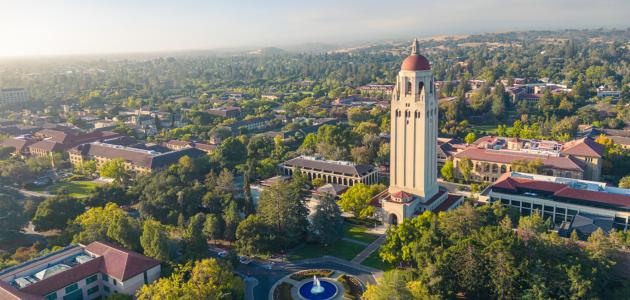




The Stanford University carillon, a musical instrument that has been located at the top of Hoover Tower for nearly 60 years, is being refurbished and enlarged so that its music will continue to be heard.
The restoration project will include adding nine large and four small bells for a total of 48 bells. This will increase the carillon's range to four octaves. The new largest bell will weigh about 2.5 tons. In addition, 23 of the current bells will be retuned, and the carillon's mechanism, frame, keyboard, and bell clappers will be replaced.
The Stanford carillon's automatic-play drum, the only one of its kind in the United States, will be restored. The drum's rotation, similar to a music box, activates hammers located on the outside of about half of the carillon's bells. The drum was damaged in the 1989 Loma Prieta earthquake.
Gifts supporting the carillon renovation project include donations from the Herbert Hoover Foundation, Herbert Hoover III and Meredith Hoover, L.W. "Bill" Lane and Jean Lane, and The Music Box Society.
A contribution from the President's Fund at Stanford will pay for the new bells and the construction of a playing cabin that will house the keyboard on the Hoover Tower observation deck. Currently, the keyboard and the automatic-play drum are located one floor below the observation deck.
The carillon's 35 bells are positioned in a frame on the observation deck. A performer sitting at the keyboard strikes wooden keys with fists to activate the clappers inside the bells and produce music. The keyboard also has foot pedals that a performer uses to play the bells.
The 23 carillon bells that need retuning will be removed from the Hoover Tower by crane and be sent to the Dutch bellfounder Royal Eijsbouts.
The Stanford carillon was built in 1938 by the Michiels Bellfoundry of Belgium and was part of the New York World's Fair of 1939-1940. At the end of the fair, the carillon was purchased by the Belgian American Educational Foundation and presented to the Hoover Institution as a gift of appreciation for Herbert Hoover's famine relief efforts during and following World War I.
From 1960 to 1991, the Stanford carillon was played and taught to students by James B. Angell, who is now a professor emeritus in the university's electrical engineering department. Two of Angell's former students have been active in the restoration project. Margo Halsted, the carillonneur and an associate professor at the University of Michigan, was the associate carillonneur at Stanford from 1967-1977 under Angell. Timothy Zerlang, the executive director of the El Camino Youth Symphony and a lecturer in piano at the Stanford music department, is currently the university's carillonneur.
Visit the Hoover Institution Web Site at www-hoover.stanford.edu.