Former US ambassador to Russia Michael McFaul returns to Uncommon Knowledge with Peter Robinson to discuss his new book, Autocrats vs. Democrats: China, Russia, America, and the New Global Disorder. McFaul explains why Vladimir Putin, Xi Jinping, and today’s autocratic leaders fundamentally do not think like we do—and why that misunderstanding has shaped some of America’s most consequential foreign-policy mistakes. Drawing on decades of scholarship and firsthand experience inside the Kremlin, McFaul traces Russia’s post–Cold War slide back into autocracy; challenges the claim that NATO expansion caused the rupture with Moscow; and argues that the true threat to authoritarian regimes is democratic example rather than Western military power. He examines the war in Ukraine, its implications for Taiwan, the limits of transactional diplomacy with ideologues like Putin, and the enduring lessons of Cold War statecraft. He also reflects on his unlikely journey from Butte, Montana, to Spaso House —the Moscow home of the U.S. ambassador to Russia— and why he remains convinced that democracy, however fragile, is still the West’s greatest strategic advantage.
Cast
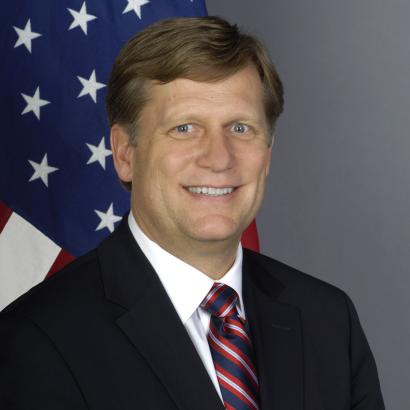
Michael McFaul
- From Butte, Montana to Spaso House, the residents of the Ambassador of the United States to Russia, ambassador Michael McFaul on Uncommon Knowledge. Now, I'm Peter Robinson, a native of Montana. Michael McFaul is a senior fellow at the Hoover Institution, a senior fellow at the Freeman Bogley Institute for International Studies, and a professor of international studies all here at Stanford. He served on the National Security Council during the first three years of the Obama administration, and then as ambassador to Russia from 2012 to 2014. Professor McFalls, most recent book, autocrats versus Democrats, China, Russia, America, and the New Global Disorder. Mike, welcome to Uncommon Knowledge. Thanks for having me from autocrats versus Democrats. While American power has declined in relative terms since its peak in 1990s, the US remains the most powerful country in the world. It is likely to maintain that position for the foreseeable future. We have four time zones. Russia has 11. We have a population of 340 million. China has a population of 1.4 billion. What do we got that they ain't got?
- Well, that's a great question and it's a hard question. I have three chapters in the book about power and how you measure power gives you different answers, right? So if you measure in terms of population and territory, those were the things that mattered most in the 18th and 19th century about power. We're not in good shape, but if you measure in terms of education, especially higher education, you measure GDP per capita. We're way ahead of both of those countries. Other proxies, I use best universities in the world. We're at one of 'em, we're ahead of them. And then I also in the book talk about not just China, Russia, and America, I talk about the free world versus the autocratic world. And as long as we're united and we have to put a question mark to that, that's a big challenge. But when you add up military power of the free world versus the autocratic world, we're way ahead. When you add up economic power of all the democracies, nine of the 10 largest economies in the world are democracies only. China makes that list as, and I could, you know, when you add up the, the, the most valuable companies in the world, the the list is dominated by companies first and foremost in our country, and first and foremost in our neighborhood here. But they're mostly in the free world. But it, but those are all variables. They're not constants. And we gotta keep working at it if we're gonna keep ahead of the Chinese, especially the Chinese, the Russians, they have one thing, they have land, of course they have nuclear weapons that deters, but they also have a guy that even though he has more limited capabilities, has proven tragically a willingness to use them for very bad ends.
- Okay, let's, let's follow along with Russia here in autocrats versus Democrats. You write about Russia after the 1991 collapse of the Soviet Union. For me, now I'm quoting you. For me, the question was whether Russia would consolidate democracy. By the way you lived in Russia during much of this post-Soviet period period in the nineties.
- Yes. Yeah, I
- Did. For me, the question was whether Russia would consolidate democracy and remain inside our tent or drift back toward its long tradition of autocratic governance. A return to dictatorship is precisely what happened. Yeah. Why,
- Why? Well, well I still believe that sentence. I'm glad you're quoting me. My sentence is to remind me what I wrote. 'cause this book took me many years and I have a very vivid memory, Peter of, of saying that to the president of the United States. George W. Bush, two weeks, three weeks before he met with Putin before, and we were having a debate about Russian power. Russia, you know, was very weak. They had the big crash in 1998. And the debate in the room, it was at his house, by the way, at the White House and not just in the West Wing. It was he, he's he, Kate, let us come to his house and give us a tour. He's a super friendly guy. And they were debating power. And I said, Mr. President, it doesn't matter how much power they have, it matters whether they're in the Democratic club or not. And if they're powerful and they're democratic, we're gonna be fine. It didn't work out that way for a big many reasons. Right? It's not just one simple thing. But the, the biggest variable, and I write about this in the book, is leaders and Putin, had there been a different president that came to power in 2000, and by the way, president of Russia meet president of Russia. Excuse me. Thanks for being clear. And there was a different era apparent. His name was Boris Soff. He was a, so
- Yeltsin takes over from Gorbachev. Gorbachev wraps up the Soviet Union.
- Yes,
- Yeltsin becomes president of the Russian Federation.
- Newly independent Russia,
- Newly independent Russia. And this is when all our hopes were soaring. Yes. And at that time there, you just named a name that I thought I knew about this stuff. I had not heard.
- Well, no, nobody has. That's what, that's the tragedy of history. Alright, so this was this guy, Boris stems himself, he was a governor in the middle of Russia, elected twice during a major economic depression in the 1990s. That's a very important part of this story. And PhD in physics, by the way, Jewish by the way, and still elected one of the most charismatic guys I've ever met in my life. He comes to Moscow in 96, 97, becomes the first deputy prime minister Yts and anoints him as his successor. But then there's what we call in political science, an exogenous shock. 1998, financial collapse all over the world starts, by the way in Asia, but reaches Russia. And it's still a quasi democracy then. So the liberals, we would call them conservatives in America, but the, the people that believe in free markets like Nims himself, they're pushed aside. The communists come in and then they have a panic. Oh my God, the communists are gonna take back over. And that's when they say, we better go with this strong guy Putin. And they annoy him. He runs and Putin, it's important to remember for a while he believed in markets for a while. He even believed in a relationship with the West, especially after September 11th. Never believed in democracy. But over time he becomes much more anti-Western anti-market. And that leads, I think, you know, one to this very ose imperial Russia that we have today. But two, Russia could have been so much richer, so much more prosperous and respected. Had my friend Boris himself been elected, by the way, Boris was my friend. He was later assassinated in 2015.
- Alright, so you've just told a story based on what happened inside Russia.
- Yes. - And of course what we get in the newspapers and the shouting is that with the United States should have done this, we missed our moment with Yeah, Yeltsin. So let's go through a little bit of that. Yeah. As indeed you do in the book. So a number of scholars argue that NATO expansion poisoned our relations with Russia. Historian Mary Sirat, quote, Washington wins its struggle with Moscow over NATO expansion in the 1990s. And we expand bringing in Czech Republic, hungry Poland and so forth. But the way the United States goes about enlargement means it loses options with regard to Russia in the longer term. The big play in Europe would've been to create a dynamic that established lasting cooperation, which sounds a lot like what you were telling George W. Bush. Instead, Washington and Moscow stat snatched stalemate from the jaws of victory. Okay? There is one version or another of that story. It's our fault and the, the proximate cause with the expansion of nato. True.
- No, I radically disagree with that. So we didn't make some mistakes. The biggest mistake we made was in the nineties when we thought the Cold War was over, we won the end of history. That's what Frank Fukiama wrote, that famous essay. And we did nothing to help rebuild Russia in our community of states. The exact opposite of what we did in World War ii. After World War ii, we won and we brought Germany and Italy and Japan in, and that's because there was this menacing threat to the East. Russia needed a autocratic China that was powerful today, back 30 years ago. For us to do that. We didn't do that. We just said, oh, it's gonna happen organically. It didn't. That was the mistake. NATO expansion is a variable in US Russia and us. So Soviet relations. So it's not always neutral, but there were many times when it was a non-issue. So Putin, when he comes to power, he says, I wanna join nato 2000. It's on the record. He said it. So hold on. This is the cause of the tension and he wants to join our our party. He said, back then Ukraine should join nato. No big deal. I don't care. This is all on the record. I went to a NATO summit when I worked at the White House in 2010 in Lisbon, mid Vieta president mid Vie was there. And he said, all of our animosity with NATO is over. And by the way, the last big bang of NATO expansion was 2004, president George W. Bush. So I think this is a very convenient retrospective thing that Putin wants to drag out. To say NATO has been threatening Russia, NATO has never threatened to invade Russia or the Soviet Union. That's important to remember. The real threat is not NATO expansion. The real threat is democratic expansion. What scares Putin the most? And I've sat at a table just like this, yes, I get to that right, is when you, Ukrainians are practicing democracy that threatens him. Because back home he tells the Russian people, we're not part of this liberal, decadent West. We're our own civilization. We don't have nothing to do with them. That he also tells us people back home Ukrainians, they're just Russians with accents. And that's part of why I need to bring together the Slavic nation. But if they're just Russians with accents, practicing democracy, practicing capitalism, that is a threat to Vladimir Putin, not NATO expansion.
- Okay. So I wanna stick with your personal history because you know, you, not only do you know a lot about Russia, but you have so much personal experience with it. President Obama at a press conference in 2009, quote, he's in Moscow when he says this early in his administration, I seek to reset relations with Russia. Reset. There's the word. I seek to reset Russian relations with Russia because I believe that Americans and Russians have many common interests. I see no reason why can, we cannot aspire together to strengthen democracy, human rights, and the rule of law. Okay, you're in his National Security Council, you become his ambassador on the ground in Russia. Yeah. Why didn't the reset work?
- Well, I'd say two things. One, it worked for a while.
- Oh,
- Did it? And yes, in my view it did. And you know where that whole, that paragraph comes from, comes from George Schultz's memoirs. I'm pretty sure it's chapter 29 or 27, 1 of the two. It's called re-Engaging the Soviets. And George, you know, I, I've seen you perform with him when he was here. He is a great mentor of mine. That chapter was the basis for what we were trying to do. And there are a lot of
- Really important principles. Wait, you need to tell me that in the Obama White House, you and the National Security Council passed around Chapter 27. IIII definitely had that book on my desk all the time. You had it. You
- Alright? Alright. Just so you know Peter, 'cause you I worked for President Reagan. I also had a magnifying glass from George Schultz, which on it said, trust but verify. And I used to change that. I said, don't trust, just verify. Just verify dealing with the Russians. Okay. But, but lemme I want to tell you the story 'cause it's really important. Yes, yes, yes. Even in, in terms of how we're dealing with Putin today. So in that chapter, and I'm just paraphrasing obviously, but I've read it many times. Remember George comes in in 1982. He's not in the Reagan administration in the beginning. And and in that period, there's not much interaction with the Soviets at all.
- Right? - And he comes in and he says, this is crazy. We have to talk to these guys. We have. And it was about nuclear weapons and regional security stuff. We have to have some dialogue with them. And he laid out a different strategy. This is before Gorbachev, by the way.
- Yes, yes. Gorbachev. Gorbachev
- Comes along. It's a lot easier,
- Right?
- He is. This is the, you know, this is way before Gorbachev 1982, BNAs still there. And then un drop off. And he says a couple of really important principles. One, not on everything, but there are certain issues where the Soviets and the United States have similar interests. And we have to work on those to achieve outcomes that are good for both of our country. So controlling nuclear weapons around the world. We both have an interest in that. But then he said some really other important things. He said, number two, when we do that, we're not gonna check our values at the door. Nobody was confused about Ronald Reagan's views about liberty and freedom, you know, well, I, I just read about it. And he said, very purposely we're gonna talk the same behind closed doors with the Soviets as we do to everybody else. And number three related to that, and I stole it right outta Ronald Reagan's v visit in 1988, when Ronald Reagan comes in 1988, very famous summit with Gorbachev. He then holds a luncheon, thank
- You all
- At Spaso house.
- Welcome to Spaso House.
- I wrote that speech. You did? Yeah. Oh my God. I knew you wrote that other one. I didn't know you are that one. I wrote that one. That's a brilliant speech. That is a brilliant speech. That's a I will give all credit to it. I want, well, I, we, I personally, I I'm not gonna speak for anybody else at all, you know, Obama administration, but I personally was focused on the same choreography that you guys did in 1988. Obama also gives a speech, wasn't as good as yours. I I, I worked on that one. But it was in the same spirit. But then in the same spirit of dual track diplomacy that Reagan and Schultz practiced. They had all their stuff with Gorbachev Kremlin and all that. And then he comes over to the ambassador's residence sponsor house that I later get to live. Yes. You, you lived. But the photos are there. I remember. And in the room are all the Jewish dissidents, the religious activists, the NGO sums people, all the, the society that the, the Soviet Union was trying to crush. And Reagan was very clear. He, he's like, you are part of this country too. I acknowledge you and we are going to engage with you. And by the way, super fancy, you know, they weren't, they didn't have like paper plates and all that. Sometimes there's like, let's do the photo op with the human rights folks. Full show best
- Dinner show.
- Oh. And that. And so that's what we are trying to do. And I don't want to dwell on that too much, but we did accomplish some things that were good for America. I'll let the Russians think if they thought it was good or not. We got a new star treaty reduced by 30% the number of nuclear weapons. That's 2010. We opened up a new pathway to supply our troops in Afghanistan through Russia because we wanted to take the war on terrorism to Pakistan. 'cause there was a certain guy there, Osama Bin Laden as you remember. And we thought we might have to invade Pakistan and violate their sovereignty. We are worried that they would cut off our supply rats. So we did that with the Russians. We had sanctions on Iran. First time that you had a multinational sanctions,
- The Russians joined our sanctions,
- Joined UN security council resolution 1929. I remember it. I could go through other things. And that was working for a time with two caveats. The dual track diplomacy thing. Obama goes, does the same thing that President President Reagan does, meets with President Vieta. We have breakfast with Putin. Then we pivot to the Reagan format. Big speech. We chose, just so you know, 'cause you know the history. Moscow State University, where Reagan's book, that's a communist state university. We deliberately chose a private university. Oh, run by my friends, by the way, great honor for me to join you at the new economic school. We wanted to signal the new Russia. That's where Obama gave his speech. And then he met with civil society leaders and opposition leaders. That worked out fine for a while. And then there was mass mobilization in Russia in response to a falsified election in 2011. And I'm gonna tell you, honestly, we didn't think much of it. Seven 8% falsification. That's a normal Russian election. Right? What's the big deal? But this time, Peter, these are what we would call the middle class. They call them the creative class. These are people that own things now. Right. And they said, you can't take, you can't steal our money that's called taxes and not give us representation. And they led these demonstrations. 5,500, eventually 200,000 people in the streets of Moscow. You know what one other slogans was, no taxation without representation. I don't know if you've heard that one before. And that scared Putin, rightfully so. He thought he was gonna lose control of the country. And so he blamed us for that. He blamed the west. And he blamed me personally, by the way, for that. He said that I was sent to foment and coordinate the revolution against him. And that's when the reset ended. Okay.
- Could I step, this is so treat me as a very slow student because I'm about to ask an extremely basic question. That's what I know. It's a very dangerous question for this guy. No, no. So here I, I'm gonna quote from autocrats versus Democrats to set this up. Vladimir, this is you. Vladimir Putin has demonstrated a willingness to deploy his government's resources to intervene in the domestic affairs of other countries. 2008, he goes into Georgia 2014 annexation of the Crimea. And then of course the 2022 invasion of Ukraine proper, so to speak. What's left of Ukraine? Yes. And here's the question. What is it about Russia? You've got a couple of periods. Alexander II freeze the serfs, and then a 20 years later he's assassinated.
- Yeah.
- Nicholas II permits the establishment of a Duma in 1905. You've got the Prime Minister still open or something if I'm not sure how Toan, thank you very much. It looks like a moment when they're actually going to have some form this fresh beginning. And then we have the first World War. Yes. And the Communist take over over just say, so when Putin says, we're not part of that civilization here we have a man who is behaving in the year 2026.
- Yeah.
- In a way that Ivan the Terrible and Catherine the Great would both have recognized and approved.
- Yes.
- What is the transmission mechanism?
- Yeah.
- How is it that this country, and then of course, during the nineties, the recent, there's a moment of hopefulness under Yeltsin. And the reset works for a time, and then it falls back into this autocratic pattern, which has lasted at least a thousand years. Correct. Why?
- Well, that's a really hard question. That's not a a a, a softball question. And I wanna be honest with you. So, you know, I teach here at Stanford and sometimes I teach about Russian politics, and I show that chart of a thousand years of, and I show the Freedom House scores. And it's all autocratic, autocratic with those two blips that you mentioned. Right? And so, other scholars argue with, and they have a lot of data to support their hypothesis, that there must be some cultural proclivity towards autocracy among the Russians. Right. And I want to be really sincere with you. I used to flatly reject those kind of arguments and those arguments we used to make about Germans and the Japanese. Yes. And by the way, I, I, there's another course, I teach a course on democracy and development. There was even a prominent professor here at Stanford 40 years ago that said, Catholic countries have a proclivity towards autocracy. 'cause we all love the pope. I was, I was raised Catholic. And then that there was a correlation, right? Latin America was all Catholic. Southern Europe was Catholic. It turned out that was a stupid argument. So I've, in this structure versus agency debate, culture is hard, isn't it? But culture is sticky. It doesn't, it doesn't fade away. And, and two things I would say about the Russia case. One, they didn't have the hard break in 1991 with their Soviet history. So the Germans through tragedy. But that necessity, they had the heartbreak. And we had Nuremberg trials and we said, Nazis are not gonna be part of the future. They didn't do that in 81. They were afraid. Yeltsin was afraid. I, I, I, I interviewed, I did a book about this. They were afraid of that. If it went too fast and too hard against the KGB, that might, that might spur a counter revolution. And as a result of that, a guy like Putin can come along from the KGB, by the way, remember that. And can use part of that history to say and blame it all on the west. And, and back to our roots. I, I still believe in the power of agency to change. I still believe in socioeconomic development, right? Countries that get rich tend to become more democratic. Even used to be 500 years ago, the whole world was autocratic. Right? Now that's not true. Richest countries where you also see freedom. But since Putin launched his full scale invasion of Ukraine in 2022 started, first one was 14, then 20, 22. I gotta tell you honestly, I am less, I'm more skeptical about my own arguments about agency and institutions because I see the atrocities that Russians are executing and implementing inside Ukraine. It's not just Putin. And he has managed to use these cultural imperial narratives of some of the people you invoked already, to say, this is who we are. And we're naturally, you know, this is naturally our territory. And I'll, I'll tell you the moment when it really hit me. I still have Russians who are small de Democrats, small L liberals, you know, Alex, a Navalny hiss wife. She's a friend of mine. I, I know the opposition. They're just as committed to democracy, I think as I am. But I was having this argument with President Zelensky, chief of staff at the time. His name's Andre Yak. And, and
- This is before or after the invasion?
- After the invasion. Alright. And we're talking, I've had a lot of connectivity with the Ukrainians. We've been doing our leadership program here at Stanford for 20 years of Ukrainians. About 250 Ukrainians have gone through this program. So I know a lot of these people. I brought President Zelensky here in 2021. In fact, nobody remembers, 'cause nobody knew who he was back then. A year later, a year later, he, we would've been much bigger crowds. But we're kind of arguing about this. And is there any hope with the democratic opposition, the Russians? And he played for me this tape of a soldier who had just committed these atrocities in a suburb of Kyiv called
- Bucha. A Russian
- Soldier. A Russian soldier. And it was a phone call to his girlfriend, I think in like Barcelona who was shopping. And we were arguing about sanctions, right? And, and the question was, should a whole society be punished for what Putin is doing? And the opposition says, that's not fair. And Andre was saying, 'cause I was involved in writing papers about this. He says, listen to this tape. And he was proud of the atrocities. And he was like, Mike should have people with girl. And the girlfriend was applauding him. I'm not gonna go into the details of his horrors. It's, it's not proper for your television show. But it was just awful. And that made me rethink, you know, maybe these cultural things are stickier than I understand. And I would add to that propaganda works. Like if you control everything, you can make people believe things that are not true. And Putin's done that. So,
- Okay, so you've, you've raised Ukraine, you write the book. The book came out in October. You worked on it for a long. So I wonder if these figures need to be revised. But you write of the casualties that the Russias suffered since the 2022 invasion and you cite 700,000. And I looked it up to see if it needed to be updated. And it turns out, of course it does. Nobody trusts that. Well, yeah, nobody knows. Exactly. Nobody knows because the Russians are gonna be telling the truth about it. Correct. But the lowest figure for casualties that I could find, the lowest figure was 200,000. So Putin has somehow or other been able to push 200,000 Russian men to their deaths.
- Yeah.
- And then you write that the Russian military machine now is more powerful than it was before. And so here's the question. I I, I mean, I don't, don't wanna get into deep history or psychology. We, but how does the command structure work? How is he capable?
- Yeah.
- Of the whole country. I know he controls the media, but you, you have 700,000 casualties. At least 200,000 of them are outright deaths.
- Yeah.
- That's a couple of hundred thousand families across the country who've lost sons in Ukraine. People in Russia know what's going on.
- Yeah.
- How does he continue to be capable of feeding human beings into the grinder, let alone of raising the money to, for the new troop carriers, for the new tanks, for the new drones. Right. How does this thing work? How can he make it work?
- Well, the first answer is it's not working very well. Right? Because on the eve of the war, Russia had the second or third, third largest army in the world. And people we all thought, you know, did that they were gonna walk to Kiev in two or three weeks. Right. That turned out not to be true. I hope Xi Jinping is studying that too with his, his army. 'cause it looks really big on paper, but you know, it has never been tested. Same with his Navy. I hope he's learning those lessons. But the second piece is how did he sustain it? Which is truly remarkable. And I would say tragic, of course. Right? One is control of independent media. So he chased everybody out or arrested them. And then he, he later killed the leader of the opposition, Alex a Navalny. And that has a sobering effect on your ability to protest when you are jailed or people are killed. Number two, he has been, you know, in terms of his domestic politics, smart about taking these soldiers primarily from rural places. The ethnic republics not masculine, St. Petersburg. Right. And by the way, we have a little history of that here in AM America. Right? So they're from more poor regions. And the, the, the pay, the payout if your son or daughter mostly sons is killed, is extraordinary. So in a culture, especially some of the Muslim republics, if your son sacrifices for the good of the family, then they're honored and reved. So that's another piece of the puzzle. And then how he finances it, that's on, that's on the world. Like, you know, we continue, not we United States
- Buying their oil,
- Buy the oil and gas, buying
- Natural
- Gas, you know, thank sanctions have made it more costly to buy that. So there's a discount rate, but the Chinese are still buying it and they're still bringing, and even some European countries are still buying it. And that's how he finances it.
- Okay? Moving, was edging toward China here.
- Okay.
- You know, everything. So it's a, i I don't know as much about China. That's why it took me so long to write the book. Oh, is that so learn about China? Yes. Elbridge kolby co-authors an article in March, 2023, Elbridge Kolby, who's now under Secretary of Defense for policy.
- Yes.
- A couple quotations from that article. Our concentration on Ukraine has undermined our ability to address the situation in Asia, especially around Taiwan. American larges is not unlimited. America must focus on China and deterring war over Taiwan. The solution for European countries, especially Germany, is to take the lead in supporting Ukraine. Close quote. Now that strikes me. I mean this is a, that strikes me as a Prudential question. And Elbridge Colby, he's become controversial among Republicans, oddly enough. To me it's odd as though there's some ideological. He's on some sort of group. He's just making a prudential point.
- Yes,
- Our resources are limited. Here's the chief threat. We should swing them in this direction. That strikes me as plausible. Yeah. I don't, I'm not in a position to evaluate whether it's correct. What do you make of it?
- So I agree with half and half. I disagree. Alright, so bridge Colby, I don't know him well, but I know his work well. He's wrote a great book about strategy of denial or something like that. And I quoted him my book, just so you know, I quote bridge several times, especially about this limited resources thing. 'cause he is right about that.
- Right?
- We can't do everything all the time. And we didn't. There's a mythology that we could in the Cold War. We actually didn't, but we most certainly can't today. So we have to make choices. And I think his focus on preventing war over Taiwan, that is a paramount American national security interest. I agree a hundred percent with that. And I have big sections in my book for how to do that. That I don't think bridge or people of his, the way of thinking would disagree with. Where I don't agree with them is that somehow he doesn't see the connectivity between the war in Ukraine and the war in Taiwan. Whereas I do, if, if Putin, God forbid, wins in Ukraine, gets to conquer Dun yets, gets to take what he wants. And we look weak there that will encourage Xi Jinping to use military force to take the island of Taiwan and
- Converse the defense of Taiwan runs through Ukraine.
- They're related. They're related. Because if the autocrats look strong and we look weak, that's the opposite of peace through strength. Right? A phrase that comes from the Reagan administration that the Trump team likes to quote, that looks like weakness. And if you look weak in Ukraine, you look weak o other places. You know, when we fell in southeast Asia, right? When we lost Vietnam, suddenly Angola and Mozambique were falling too, because we were looking weak around the world. And that, that era of the Nixon era, you know, in the late seventies, that's a decade to come out of. It took a long time to come out of. And we had to look strong to get out of that. The other thing I would say, if we win in Ukraine, then that deters Xi Jinping, it makes 'em think harder because the West looks strong. But don't believe me, go to Taiwan. I was just there three months ago. And what you'll see in the government offices are Ukrainian flags because they get this connection. They understand that these things are intertwined. So the ballots has to shift. Europeans have to do more. You know, we've been saying that for a decade and I'm, I'm with President Trump on this. They've gotta do more, they have to do more for their defense. So do our allies in Asia too, by the way. I think that is right. But they have to do it in concert with us, not with us withdrawing. Because if we look weak, we are the most powerful country in the world. And we are most certainly the most powerful country of the free world. If we look weak, if we look feckless in one domain, that could encourage autocrats to make mistakes in the other. And it doesn't mean that Xi Jinping will conquer Taiwan, that that could be a huge fight. But it might encourage him to take that risky behavior if it looks like we are
- Retreating. Alright, Taiwan next, but just a closing question on Ukraine, then. The Trump administration has sanctions on Russia's energy sector then, as best I can tell, we're continuing to supply weapons to Ukraine, but now we're selling them to the Europeans who actually supply the weapons to Ukraine. What else should the Trump administration do?
- Well, a couple of things. One, president likes to talk a lot about birding churn. And I'm with him on that. I think we should share the burden of defending the democratic sovereign country of Ukraine. Not just make it the Europeans troops on the ground. No, no, no, no, no. I just think, you know, we should not be making money off of a war unless we're trying to, I see. We have some skin in the game.
- I see. So that's one
- Thing I would,
- Number two, in other words, supply the, the arms directly. Don't sell them to the Europeans
- And do both, but, but be in the game. Be part of a coalition supporting them, not just on the sidelines.
- Yeah.
- Second, there are way more things we could do on sanctions if we wanted to. So I would encourage more sanctions. But third, the most important thing, I applaud President Trump for saying, I want to end this war. The previous administration did no negotiations to try to end the war. I even support him. And, and here I'm, I'm more lonely when he said, we have to talk to the Russians to negotiate, like, how are you gonna end the war if you're just talking to the Ukrainians? I think those were bold moves that had to be done. Where I think he has misread Putin, although I'm still optimistic he might get on the right track, is he and his special envoy. Mr. Whir thought that I'll just listen to Putin, I'll hear what he needs and then I'll tell the Ukrainians to do it and we'll end the war. And what happened instead, Putin saw that as weakness and he just pocketed their concessions. And then he asked for more. And the biggest ask was, he said, I can't conquer Donbas. That's a part of Eastern U Ukraine. He's been trying since 2014. He's failed. Think about that. So then he said, Mr. President, I need you to put pressure on Zelensky to give me donbas. And that just is a reflection of, of Putin thinking that he can maneuver the Trump administration. So I think, and then there are signs by the way that this is happening. I think if we can push back on 'em, coercive diplomacy is part of diplomacy. It's not just carrots. You gotta have sticks. And I would just like to see the balance of those things shift a little more towards sticks.
- Mike. I said I wanna turn to Taiwan and I do. But it feels to me, I'm gonna put this very crudely because I'm just a layman watching it all happen from a distance. But it feels to me as though Donald Trump and his friend from New York Whitcoff looked at Vladimir Putin and said, we've, we, we recognize this kind of guy. This is one of the big real estate guys in New York and Manhattan. Yes. We get rough with each other. Then we get into a room and decide what everybody needs. Yes. And we do a deal. Yes. Because this is a human being with interest. He's a tough guy, but he has interest. And Vladimir, now I'm asking you this because you have sat at a table with Vladimir Putin. He's not that kind of person. Exactly. What does he
- Want? So you just, that was a great metaphor by the way. 'cause when I was in the government and, and before I was in the government and after, there are so many leaders, Democrats and Republicans that said, Putin's just a deal maker. He's a transactional guy. Oh, he's a transactional guy. We can do a deal with him. Right. All he wants to
- Money the deal easy. Yeah.
- And the deal. And he, he bought him all, he wants money. He, that's what he does. And I think, and maybe even I had that reading of him 20 years ago, I, I don't, I don't want to check myself, but I know for sure that he's not just looking for a deal. He's an ideologue. He is motivated by his ideas, his ideas, his imperial ideas. And he doesn't care. We just talked about if it was just cost benefit analysis, he wouldn't let a million Russians be killed or wounded on the battlefield. That's pretty irrational for inches of territory. Yes. I mean, everybody go look at the map and see how little he's expanded for that cost. That's not a guy doing cost benefit analysis. It's a guy motivated. He wants to be Peter the great, he wants to be Catherine the great, he wants to be known as the guy that expanded the Russian empire. And he's willing to take whatever cost it, it needs to be that person.
- So this, we'll, we'll turn to China now, but to me, this is one of the basic lessons of your book. You don't put it this way. And so correct me if I'm wrong, but we are forced to do business in this great big world with people who really and truly are not like us.
- Correct. Alright. Can I tell you one story about that? Of course. You can cut it if you don't wanna use it. But when this became really apparent to me, remember I've known Putin, I met Putin in 1991. So we go way back. We are not Facebook friends, but I was, I traveled with Vice President Biden in, in 2011. We were there by the way, to get the Russians to agree with us, to use force to stop the slaughter in Benghazi and Libya. And they abstained on that. So people forget a cooperative time. Right? Right. Use of force. Un security council resolution doesn't happen much. But there're arguing at a table kinda like this. And at one point Putin leaned in, so you're gonna be Biden, I'm not sure who you voted for, and I'm not gonna ask, I'm gonna be Putin. So I'm, I'm really going out on them. And he leaned in and he said, he doesn't blink by the way. He said, you know what your problem is, you look at us and because we look like you. And then he went like this and he leaned back. He, everything he does very dramatically, we look like you, you think that we think like you, but we don't, we are different from you. He said it and it was like, whoa. And we were like, he wanted us to know. We don't think like you. And we, time and time again, hope that a guy like Putin or Xi Jinping might think like us, but they don't. They don't.
- Alright. That is fascinating. So he's aware of it himself. He's very self-conscious about it. Yes, yes. He's even using al autocrats versus Democrats Again, you have this fascinating passage in which you describe mistakes we made about the USSR during the Cold War and the risk that we make of making the same mistakes about China today. A couple of these.
- Yes. - Yeah. First and foremost, I'm quoting you first and foremost US leaders and society overestimated Soviet military power. So, and okay. So there's that. And there's a long and complicated debate. I, I mean honestly, Mike, my feeling was there were a lot of people who thought we were overestimating the Soviet Union except the CIA, It was our intel. I mean, there were, you could point to specific points that That's very fair. That's very fair. Alright. Alright. So we have China that has built a deep water Navy. Yeah. It's turned eight holes into military bases throughout the South China Sea. It has produced ship killing missiles in such numbers. I spoke to, you'd know him, but he didn't know I was gonna quote him. So I won't mention the name. A former four star admiral and I asked if it comes to a shooting war over Taiwan, what role do our aircraft carriers play? Yeah. And he immediately said, our aircraft carriers must remain 1000 miles away from the action.
- Yeah.
- Because the China now has that kind of, so they've pushed us back, we're already back at the second island chain. So how is it that we can risk overestimating Chinese military power?
- Well, that's a great question. And, and I say we overestimate Chinese power and then I break it down. Alright. Where I'm worried is that we're overestimating what they're doing with nuclear weapons. But to your point on this one, I agree completely. We are behind on this fight and we need to spend more and we gotta spend on smarter weapons and on missiles that can be launched from the theater because we are outta date and we need to be investing in sea drones. Okay. So by the way, the Ukrainians could help us on that. If we got smart about it,
- They, they now have the best drone technology in the world.
- They including sea drone. Including sea drones. Yes. And on this point, you know, I, I've, I give given a lot of book talks, mostly in red states by the way. I'm, I'm trying to go to where I think it'll be harder. But when I, I have one slide where I talk about this, the things that the Trump administration is doing. Right. And here I firmly agree. We have to say only
- One slide, Mike.
- I I, well it's a, it's a long talk. It's a long talk. But the, the, the, the piece on the lessons piece, this is where I, I I say we, we've gotta learn, we gotta learn from our mistakes, but also learn from our successes. We did a lot of smart things in the Cold War, and I have, I I go on about that. We have to spend more on military defense. I actually think we're under spending right now, even though we're getting close to a trillion dollars. So the, and mostly on the theater you're talking about, and mostly to, to defend Taiwan against that kind of attack.
- Okay? So two small countries, they're border hostile neighbors. Israel devotes almost 9% of its GDP to defense. Right? Taiwan spends only about 3% of GDP on defense. Why isn't, that's not
- Enough.
- Why isn't Taiwan
- Okay? Not enough? I they need to be closer to Israel. I write that in the book. They they are, and we need to compel them to do that. And we need to compel them to do that in a way that's cooperative. Right. If you do this, we'll do these other things. But they've gotta share the burden on this. And, and in many ways, not just in weapons, but on, on all kinds of things to help deter an attack.
- Do they know that?
- You know, that's a good question. I'm not an expert on Taiwan. I've been there a couple of times, including, we have a big group from Hoover that goes from time to time, Their neighborhood's a lot more dangerous even than Israel's second. They should also extend their military service that they're, they're, they didn't do enough on that. Third, they need to have, you know, defense of civilian defense. They need people to practice to what happens in terms of an invasion. And they need to do all that in concert with us. I'd like to see us do more with them, but we gotta do that cooperatively. They just can't rely on us for deterrence. And if you do deterrence, right, if you do all the things we just talked about, that's the best way to avoid
- War.
- Mm.
- And the Taiwanese know that. So here's what's in the back of my mind. I know the situations are different in many, in important regards. And you'll, you'll probably name two or three of those. But the Chinese reabsorb Hong Kong
- Yeah.
- In violation of promises to the British when the British handed Hong Kong over.
- Right.
- And as best I can tell, there are a lot of rich people in Hong Kong and money Yeah. Presents a certain amount of power and a lot of them left. Yeah. And a lot of 'em cut deals. Right. And as best I can tell, only Jimmy Lai, who is now in a Chinese
- Prison. Yeah.
- And one or two others of this business community of rich, powerful people stood up to the Chinese.
- Right.
- And then I look at Taiwan and say, they're just gonna wait to cut a deal. That's why they're not spending more on defense. Tell me I'm wrong about this.
- Oh no, I'm not sure you're wrong about that. Now, Taiwan political societies deeply divided. Right? They're, they have polarization issues, I would say as great as we do here in the United States. So they, they don't all think alike. And, and President LA is much more resilient in terms of building up defenses than the KMT, the opposition party. But the, the, your, I think to your point, the business community and society, the, the anxiety about that. And then capitulation is something I sense. I mean, I was just there a few months ago. There's cer certainly a view that we can get along with these folks if we have to. And that I think is deeply, deeply dangerous because things can happen. I was gonna use a different word that my mom uses in Montana when war happens and when pressure happens. Right? And, and, and that the unintended unanticipated consequences of some kind of coercive thing could be really bad for our security interests. So my argument is invest into deterrence now so that we avoid war in the future.
- Bridge Colby says, or said actually in an interview on this show, but this is before, this is a couple years ago before he, he went to the Pentagon. So I don't want to attribute this to him as this current view, but he said, the defense of Taiwan is in our interest, even if the Taiwanese don't care. Would you go that far? I mean, is
- It sound as Yeah, that's interesting. I've never heard, heard that phrase that way. I mean, obviously it's our security interest because again, the, the worst thing in the world that could happen to the American people is war with China. And so all responsible national security officials need to think, what can we do to avoid war with China? 'cause goodness knows how that ends. Right? That is not a scenario. And just think about the economy, the global economy would collapse. So we, and I, you know, I, when I teach here at Stanford about these things, I, I like to remind my students about what I call non-events. We read a lot of books about wars and revolutions and elections outcomes. Right? We don't read a lot of books about the war that almost happened, the revolution that almost happened, the election that was almost won. And the, and we forget about those non-events. I think the biggest non-event of the Cold War was the war that we didn't fight over time. And that was brilliant. And that was a mix of coercion and diplomacy. And that needs to be, as I write in my book, it's the paramount national security interest for the United States today. I hadn't thought about if, can we do it without the Taiwanese like bridge wrote, but we have to do it because we just don't know what would happen in a military conflict. It could be very dire for us.
- CIA director William Burns in 2023, US intelligence shows he's arguing at this point, Xi Jinping had quote, instructed the People's Liberation Army to be ready by 2027 to conduct a successful invasion. Close quote. Now that's next year. Yeah. On the other hand, we have in the news yesterday that Xi Jinping has just sacked his top general.
- Yes.
- And Frank Ditter, our colleague at the Hoover Institution, Frank Ditter, said that the, the military council is Xi Jinping and six other members. And Xi Jinping has now purged five of those six. Yeah. So you think to yourself, maybe his military, maybe his command structure
- Not ready for prime
- Time is not ready for prime time. Yeah. Should we, so I'm just, how worried should we be?
- Well, one, I would say to be ready for invasion does not mean to invade. Correct. So these are two different things. Number two, we should keep investing in our military and be the best in the world because that's how you keep the peace. Okay. And I think, you know, Xi Jinping was watching what we just did in Venezuela, an incredible military operation, whether it was right or wrong. And, you know, we can talk about the politics
- Of it, combine that with taking out the Iranian nuclear program
- And, and add to that, right? We are showing our capacity to do really hard military things. The exact opposite of what Putin's showing in Ukraine. And if I were Xi Jinping watching what we just did, I would be think maybe we gotta practice a little. Yeah. Maybe we, we gotta do a little bit more before we try to invade this island. Alright. And that's a good thing. We want him to think.
- Okay. So this brings us to Mike, my old friend Donald J. Trump. And you are scathing on Donald Trump. In your book, I'm just gonna quote one passage here, autocrats versus Democrats, over the next four years, trump's United States could easily emerge as a greater threat to liberal internationalism than Putin's Russia or Xi China. Now what, what, go ahead answer that. No, explain that. Explain that. Pull. Well, how can the President of the United States, oh, go ahead. Well, what's the argument?
- I wanna start with the good news. So when I go through my lessons of success from the Cold War for today, we're doing two things really, really well. One, we're spending on the military, and two, our economy is performing well. And those sort
- Surprisingly actually,
- Yes. And, and I'm not an economist. You have others that can talk about that. But I can tell you from lessons from the Cold War that those were two incredibly important things that helped us win the Cold War. We outperformed the Soviets economically, west Germany outperformed East Germany. And those were really important for us winning the Cold War. So I applaud that. Those are the, the things I applaud. Where I am nervous is two, two different pieces. One, we also had several soft power instruments. And I don't even like soft power, I just call 'em power instruments that helped us prevail in the Cold War U-S-A-I-D, voice of America Radio, Liberty National Endowment for Democracy, created by Ronald Reagan. Those, and there were hypocritical and we did certain things. You know, we're not gonna go through the whole history of the Cold War. Yeah. But those instruments of power to support ideas, ideas of freedom, ideas of liberty, ideas of democracy, also helped us win the Cold War and what we're doing now. And then, and then the last bucket Alliances. At the end of the day, our allies were way stronger than anything the Soviets had. Right. They had to coerce their allies to be on their side. That's the part what I don't like U-S-A-I-D, we just blew up. And U-S-A-I-D I've written three dozen articles about how to reform it. It was broken, but we can't disarm the Soviets. I mean the, the Chinese they've shut,
- Shut down. Hold on. It's gonna be a lot of laypeople watching this.
- Yeah, I'm going to fast. We don't even know what the U-S-A-I-D
- Lemme talk about it should do. Go
- Ahead. So U-S-A-I-D, US Agency for International Development,
- Right.
- There's a common notion that it was just us giving money away to poor countries in corrupt ways. But it was created in 1961 by John F. Kennedy. Now I, I've only read about Kennedy. Maybe he just was some woke guy that just wanted to give away money for free. But that's not my reading. 1961 was the height of the Cold War. We created U-S-A-I-D to compete with the Soviet Economic Assistance Program around what, back then we called the third world. Right.
- We create, we created U-S-A-I-D for the same reason that we went to the moon.
- Yes.
- National morale to compete with the Soviet, with the
- Soviets in my reading. That's exactly right.
- Alright.
- And it, it was broken and atrophied and all those things, but, but reform it, don't blow it up. National Endowment for Democracy, same thing. Thankfully. National Endowment for Democracy. President Reagan maybe wrote the speech too. 1982. I did. You didn't write that one. Another really brilliant speech. I don't remember. He goes to, oh, was brilliant. Maybe I did write it right Now. He goes to England, Westminster, he gives a speech about how we gotta fight in the, in the fight of ideas. He's a hundred percent right. My book is literally called Autocrats versus Democrats. Right. It's in that spirit. And we create this thing called the National Endowment for Democracy. And we begin to fund civil society, independent media, all over the world. And it produces fantastic results for freedom. Now it's on a lifeline, voice of America Radio Liberty. I met the people who used to sit in jails in the Soviet Union who when they met me, they said thank you for Radio Liberty. It kept me alive. 'cause you were the beacon of freedom. And now we're just shutting that down. So those things we just have to reinvest in. Gotta do it smarter. We can, we have to share the burden. All of that I completely agree with, but we can't disarm because the Chinese are not, they're investing in these things. Okay.
- We have to too. So, on on, on the Trump administration, he just called for an increase of 50% in the defense budget.
- Yes.
- To give us a defense budget of about one and a half trillion dollars. Now, this is only a few days old, or at least the press taking it seriously is only a few days old. I think he's used the number a couple of times a few weeks ago. And my own reading is, oh, this is Trump doing his usual anchoring.
- Right.
- That you reach for a number couldn't possibly get politically
- Right.
- But now all of a sudden, all of official Washington is saying, oh my goodness, we've been the, here he goes again, what can we do? And what can we do to increase the defense budget is a really useful question to have Washington asking, right?
- Yes.
- Without question. Okay. So we just so that Then the other one, here's what I, I kind of, and
- We need
- To go back
- To Cold War spending levels of the 1980s. And I, you know, I say this in my book talks and I get booed, just so you know, Peter around here,
- Especially, you know, for a guy who appears a lot on M-S-N-B-C, you sound like a pretty tough conservative.
- Well, I'm a Ronald Reagan conservative. I honestly, there was a time when we did have consensus about America's place in the world. And the differences between Reagan and and John F. Kennedy are very small. Very, very small. Small compared to the span. And that's another thing, we gotta be united like we can't keep fighting among ourselves. We are not the enemy. That's another piece where I, we just gotta shut this stuff down because the real enemies are, has their leadership in Beijing and Moscow, not inside the United States.
- One more. So you, you've mentioned Reagan several times. What, what role, you've talked about successes in the Cold War. What role did the so-called public diplomacy play in the victory, for example, at Moscow State University? A speech I didn't write, but I remember because I thought it was so beautiful. Reagan delivers that speech in 88 and he could be gloating about what was by then, clearly our victory in the Cold war. Yes. But he didn't, he was talking to the kids of the Soviet elite about the importance underneath Len, underneath the bus. Exactly. And he had found a way, did the same thing at the Spaso house speech, but throughout the administration, talking past the communist leadership to the people themselves.
- Yes. - Standing here before a mural of your revolution. I want to talk about a very different revolution that is taking place right now, quietly sweeping the globe without bloodshed or conflict. Its effects are peaceful, but they will fundamentally alter our world, shatter old assumptions and reshape our lives.
- No, I don't wanna make too much of it, but there was, that was going on. And, and I mean, Biden, Joe Biden, in my judgment is just that didn't have the stamina to give Yes. Big speeches. And Donald Trump is not that kind of speech giver. Was that useful? Absolutely. Should we be talking to the Russian people? Is there any point in trying to reach the ordinary Chinese do without question. Oh, you do think
- So. Without question. A hundred percent. And you know, public diplomacy, something I practiced when I was an ambassador, talking directly to the people, not just the government. It's hard to measure, right? You don't know. Do the speeches matter or not? But in retrospect, we now know, I think whole dissertations have been written about the speeches of Ronald Reagan and its impact on, on winning the Cold War. We now know that people were listening and people were inspired. And that's, that's what I meant. I'll just tell you, as an American, I travel all the time. There was a time when just being an American made you cool and people, you know, including in the Soviet Union. I lived in the Soviet Union, I lived in communist Poland. Right. And my only, the only thing that made me special was I had a blue passport. And, and we need to cultivate that because in the, in the great power competition of the 21st century, we have the balance of military power and economic power. We all already talked about. But our greatest weapon, our greatest comparative advantage, is our ideas. It turns out that Winston Churchill was right when we said, democracy's a horrible system of government. But except for all the others tried. And you know what, most people around the world agree with Churchill, that they would rather elect their leaders than have the Communist Party or a bunch of meows, or a colonel or a thug like Putin decided for them. And that is our strength. That's how we're gonna win the 21st century. On other variables and other ways to compete with Chinese. We may not be as good, But this is our competitive strength. And the other thing I would say, 'cause I have the privilege of talking to small D Democrats all over the world, right? Russians, Belarusians, Venezuelans, Iranians, they want us to be that they, they're yearning for that America again. And to, to talk directly to the people of Iran right now, or Venezuela. We're Russia's harder. But we still have to do that. I think it's not only the the right thing to do in terms of ethics and morality, it's also the strategic thing to do because we are better off if there are more democracies in the world and less autocracies in the world.
- One more question, if I may, about the Trump record or what, or, and this is the question of alliances. Two quotations. These are a little bit long-ish, but you'll see what I'm trying to get at. Okay. Irving Crystal, this is 1983 during the Reagan administration. He writes an essay in the New York Times title, what's Wrong with nato? And it concludes as follows. To the degree that Europe has been dependent on the United States, the European will has been corrupted, and European political vitality has been diminished. That's 1983. Wow. I didn't know that. Going Crystal. Great quote. Crystal's larger point is that of course, after the war when Europe was on its back, it made sense for us to handle their defense.
- Right?
- But by about the 1970s, they were about as rich as we were. Okay. You get the
- Idea. Yep.
- And then here is Sir Alex Younger, who's the former head of Britain's MI six. This is just last year in the security relationship between America and Europe. We've been infantalized we should be extraordinarily grateful to America for its provision of security guarantee. But we should recognize that we haven't had to develop a set of really important life skills, the most important of which I would describe as the creation and exercise of hard power. Okay. So Irving Crystal says, we're infantilizing the Europeans. And so Alex Younger says, yeah, actually that's exactly what has happened.
- Yeah.
- So, you know, you and I would not write Donald Trump's speeches as we have written them, but getting rough on the Europeans and saying Step up, isn't that at least plausible and possibly even quite useful? Oh, absolutely. And
- Even, even necessary. Oh, I a hundred percent. And, and I wanna go farther than that. Let's first remember that the old joke about nato, its purpose was to keep the Soviets out. The Americans in and the Germans
- Down down.
- Exactly. 'cause people forget that we didn't, there was a time when we didn't want the, the Germans to be involved in sending their soldiers abroad.
- Right. - For very good reason. We had to get over that. And now that the Germans are building a base in Lithuania, 5,000 soldiers there, that's a sign of what we need for the future. So I, I completely agree with the quotes that you just said. Many of my European friends agree to, it was too easy. They get to spend stuff on welfare, not on defense. And at, at the expense of American taxpayers. We have to have a new deal
- With our, you crack the whole argument.
- I give that.
- Alright.
- But we don't need to threaten to invade our allies. That's where I get off the boat. All
- Right. Right, right.
- And that we don't, you know, I know a lot about Greenland and it's, it's very important for our security and our missile defenses. But we have a great missile defense base in Poland, and we have another one in Romania with missiles and radars that will help our security. And we didn't need to annex those territories. That's where I get off. And I think there's a middle ground and, and maybe we're there, by the way, we, there's too, there's way too much declarations about the liberal international order is dead going on as we speak. Right. That's like become there replacement. Well, well, a, it was never liberal and international and orderly in the first place. People forget, you know, there not the first time we had fights with our NATO allies. Right. People forget, you know, the fringe left for a while. We had big fight over ping missiles in the eighties. We've had dramas before Sue as 1956. It seems like people have forgotten that. But the, the, the other piece is they're saying this proves it didn't work. I look at it and say, no, we had, we had a rough meeting and, but we're still together.
- Right? - So I'm not ready to declare the end of it because of what you just said 30 seconds ago. What will replace it when you keep saying, this is the end and we gotta go this different way. And middle powers have to cooperate together. Like, really? You wanna take on China without us? You want a good luck? Be with Russia without us. That is not a good world for anyone. Right. So I think we have to work on this, even if it's gotten a little scratchy recently.
- Okay. Mike, a couple final questions. You grew up in Butte. How in the heck do you end? I just draw the line for me from Butte, which is a mining town. Your parents were miners, but it was a working town. It's rough town. Yeah. It was a rough working town. You're one of five kids. Draw the line briefly, I guess, but you know, how do you get from Butte to living in Spaso house as the ambassador to Russia? We
- Live in a great country that way. I mean the, the story is, I, I grew up in Butte mostly. My dad was a country western musician. He was a school teacher. Then he went on the road and he was on the road for 30 years. I do not recommend that for any of your children. It's a really difficult way to make a living. He thought he had a permanent job in a town called Bozeman, which is just 90 miles away. So we moved the whole family to Bozeman, Montana State University's there. He thought I can sub help my kids go to school by giving them a place to live. So we all moved my junior year and then in December he gets fired and he never works in Bozeman ever again. But that changed my life, bless his heart. Two things changed. Totally complete freaks of history. One, I was not very interested in reading and writing back then, even though there's a really long book I wrote and my 10th book. I was not interested in these kinds of things. I was interested in other stupid things that a typical high school kid from Butte might be interested.
- I'm happy to hear it. Martin.
- And I asked my new neighbor, what's the easiest way to get an A in an English class? And she said, don't take Shakespeare, take debate class. So I took debate class to get my easy a and that topic that year was to improve US trade policy in the world. And that was the topic. And so we, my depart partner and I, we ran a case about trade with the Soviet Union. So that's how I got interested in the Soviet Union.
- I've never heard r
- By the way, I don't, I don't know if you've ever met my debate partner. His name's Steve Daines, Senator Steve Daines. And we are still friends to this day. I just saw him a few months ago. We were pretty good. We were a pretty good team. And then the other thing is, Stanford thought that we should have diversity of, you know, not everybody should come from California to be here. That's how I got in my SAT scores. Were 150 points below the average when I came to Stanford. So I I thank the admissions cowboys. Give a a break. Yeah, yeah, yeah. We definitely, there's no other way I got in. But then that year I took first year Russian and Poli Sci 35 with Steve Krasner and are you kidding? Ever since I've been kind of interested in these songs. Alright.
- Okay. Stanford and the kids, these current Stanford undergraduates were born not only after the Cold War ended. Yeah. Long after Ronald Reagan died, long after the Soviet Union went totally out of, they have no memory of it whatsoever.
- Yes.
- So can you describe the stakes if Vladimir Putin has his way in Ukraine and if China invasion blockade or just applying psychological pressure so intense that bit by bit, the Taiwanese do deals. Vladimir Putin has his way in Ukraine and Xi Jinping or whoever succeeds him has his way in Taiwan. How does life change for us? What difference would it make in the ordinary life of a college kid, of an American?
- You know, that's a great question and I don't have an easy answer for it. I'm talking a lot. You know, I'm, I'm out there, I'm going to Boise, Boise, Idaho, tomorrow to give this talk about this book. And I start the book with this euphoric period of 1991 collapse. The Soviet Union, or the only superpower, democracy's the only game in town capitalism. The only game and the liberal international order under George HW Bush seemed to be working right. We pushed Sadan Hussein out of Kuwait, and then we're here. And what I lament with my students at Stanford is they, that's all history to them. We got to live through that, Peter. Yes. They don't have that feeling of optimism about the future. That was, it was a glorious time. And so you have to remind them that it can, it, it can be better, but you have to fight for it. And, and I don't have an easy answer 'cause I think we're strong enough militarily and economically that we could go it alone for a while if they capture these territories, but not another generation or the generation after that. And there, you know, there's a lot of fatalism about America's place in the world. Most certainly is in Beijing and Moscow. And, and lots of, you know, probably around Palo Alto, the last chapter of my book is Don't Bet Against America yet. That's the way I conclude my book. Right. 'cause I think we have the power for renewal, but I also think if we don't do it, then we're gonna become a kind of post imperial, maybe nice place for some, and that's, that's a very unsafe world for us. And and it'll be economic decline, right? Travel in Europe, then you can go to some of those European capitals. You can, you know, go to Lisbon and just, they were great one time decline. Right? And we, I don't wanna be in that world and I don't think we have to be in that world. That's this, to me, as I write in the book, there are choices we can make to renew our place in the world. And we've been here before, right? 1930s was a pretty bad time for Democrats. 1960s and seventies. Not a great time for small D Democrats, right? Seemed like the communists were taking over all over the place. But we came back from both of those periods of, of difficult times. And I still believe we can both. 'cause I think the data is on our side and the ideas are on our side, but we have to work at it. We can't just be complex. Okay,
- So here's the last question. Toward the end of his life, Samuel Huntington, one of the preeminent political scientists of the 20th century, although I believe he wrote this essay just inside the 21st century, Huntington wrote an essay in which he termed the, he coined the term Davos man. And Samuel Huntington made the point in this famous essay that for the first time in its history, the United States of America had produced a class that had no use for the United States itself. And he was, he called it Davos man, because he seemed, he believed that you could see them on display at the World Economic Forum. Right. And that they had no use for national boundaries. They had very little use for national currencies.
- Right.
- That if you are, and, and this, that immigration rules, they wanted inexpensive workers. Right? Right. And I thought for a long time, he has described the world in which we live out here in Northern California. That it, I mean, you can go back and chart the moment when Facebook, as it used to be called now, meta, Google, apple, all of these, it's in the two thousands when for the first moment, more of their revenues come from abroad than from here.
- I hadn't thought of that.
- And so a strange thing, and I thought that he's just described the future, he certainly described the tech future.
- Yeah.
- And as Mark Andreessen famously said, software is eating the world Tech is more and more of Right. And now we have ai. And yet at the same time, in very recent years, you could connect it with Trump, or I think you could actually disconnect it from Trump. It's a thing that's happening independently of him. There's at least a fumbling towards some kind of new patriotism. Elon Musk needs to sell Teslas in China. But Elon Musk will say things about the indispensability of the United States. Yeah. And we have, again, you may approve or disapprove of various aspects, but we've got David Sachs, who's a big time entrepreneur, and he's volunteering time in the
- Yeah.
- Trump administration. And on and on it goes. So now there's a live debate. You are talking to some computer science genius who's 20 years old here at Stanford, who's wondering, is tech all that matters? Or does the United States of America, this anachronistic object brought into being 250 years ago still matter? How do you answer that?
- Oh, that's easy for me. Of course, America still matters. Our country still matters. Sovereignty still matters. I think that Davos man metaphor that Sam wrote about created a lot of trouble for us. And we, foreign policy elites, Democrats and Republicans alike, a lot of Republicans go to Davos, not just Democrats, they just thought it didn't matter what the American people thought. We know how to, we know what's good for America. We're gonna do it this way. And that created this huge disconnect between the way Americans, where I grew up, thought about bow outside world and the way Davos man and woman think about it. And that led to some really bad policies. And the mission of my book, honestly, is to take these debates about why engaging in the world is international interests while having allies is international interest. Why? And I dare say it, why supporting ideas of freedom, democracy, and liberty is in the long-term national interest of the United States. But we gotta win that argument in Bozeman, Montana, and Boise, Idaho. And I've been to Texas four times and Florida and Pennsylvania and Ohio. That's my last three weeks. And it's not easy, I wanna tell you. It's not easy. But the way you do it is when you appeal to American national interests, we're all Americans first. And, and I think most people want that. I think there's a, my biggest applause lines are when I talk about America and why we can do this renewal, but we gotta work on it. We can't keep calling fellow Americans enemies. That's, that's not patriotism. We gotta be united. 'cause if we're not, we lose the 21st century. We lose the 21st
- Century to China. Mike McFall, author of Autocrats versus Democrats, China, Russia, America, and the New Global Disorder. Thanks Mike. Thanks for having me. For Uncommon Knowledge, the Hoover Institution and Fox Nation. I'm Peter Robinson.