


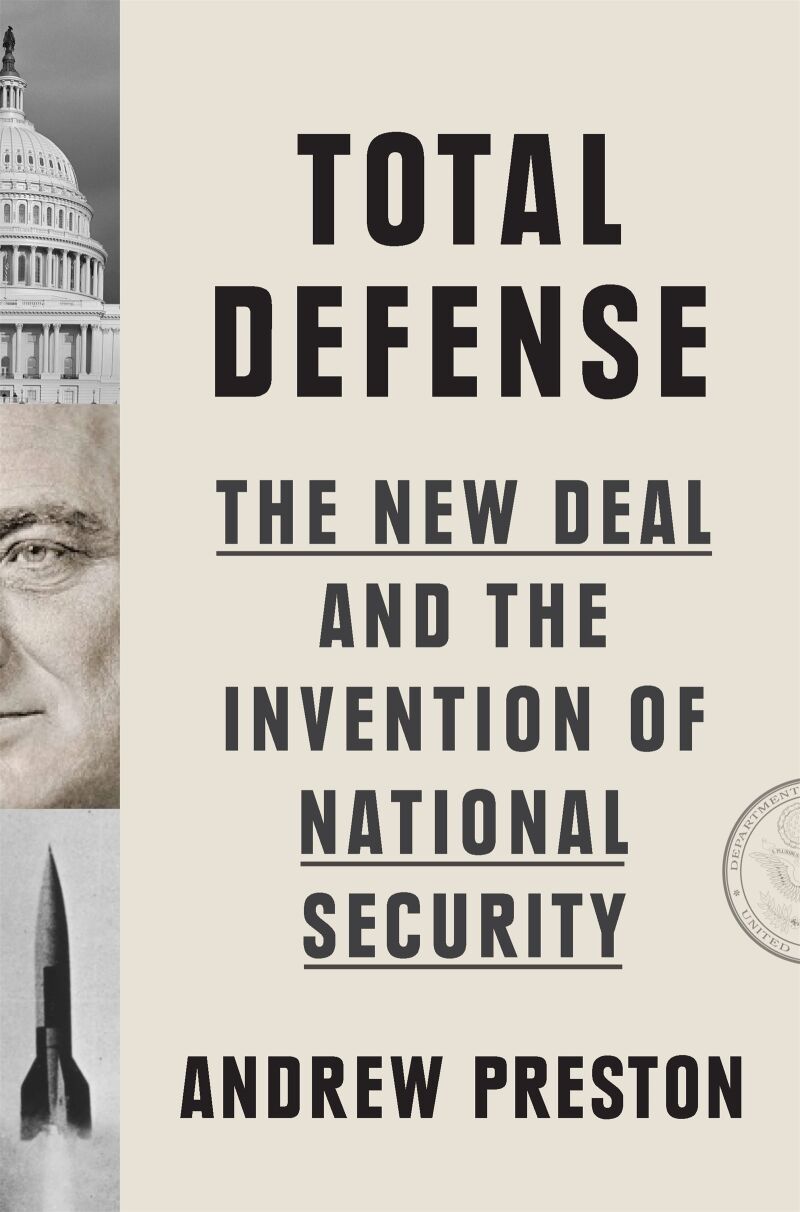
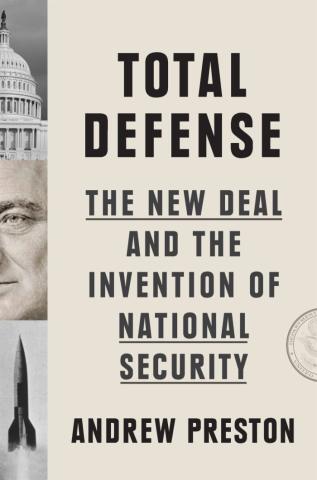
The Hoover Applied History Working Group held Total Defense: The New Deal and the Invention of National Security on Wednesday, March 11, 2026.
ABOUT THE TALK
National security may seem like a timeless notion. States have always sought to fortify themselves, and the modern state derives its legitimacy from protecting its population. Yet national security in fact has a very particular, very American, history—and a surprising one at that.
The concept of national security originates in the 1930s, as part of a White House campaign in response to the rise of fascism. Before then, national self-defense was defined in terms of protecting sovereign territory from invasion. But President Franklin D. Roosevelt and his circle worried that the US public, comforted by two vast oceans, did not take seriously the long-term risks posed by hypermilitarization abroad. New Dealers developed the doctrine of national security, Andrew Preston argues, to supplant the old idea of self-defense: now even geographically and temporally remote threats were to be understood as harms to be combated, while ideological competitors were perilous to the “American way of life.”
Total Defense shows it was no coincidence that a liberal like Roosevelt promoted this vision. National security, no less than social security, was a New Deal promise: the state was obliged to safeguard Americans as much from the guns and warships of Nazi Germany and imperial Japan as from unemployment and poverty in old age. The resulting shift in threat perception—among policymakers and ordinary citizens alike—transformed the United States, spearheading massive government expansion and placing the country on a permanent war footing.
NIALL FERGUSON TALKS WITH ANDREW PRESTON ABOUT HIS BOOK TOTAL DEFENSE
- Hello, I'm Niall Ferguson and the Milbank Family Senior Fellow here at the Hoover Institution, and I chair the Hoover Applied History Working Group. And today we've had the great pleasure of listening to my friend Andrew Preston, talk about his new book, total Defense, or maybe I should say, defense, the New Deal and the Invention of National Security. Andrew is the WA Alliance. Brian Junior, Jefferson Scholars Foundation, distinguished professor of diplomacy and statecraft at the University of Virginia. Before that, he was at Cambridge for 20 years, and this is, I think the latest of 11 books. Andrew, it's great to have you here at Hoover. Question, how do you invent national security? Isn't national security always there from the moment the Republic is
- Founded? That's a great question, Neil, but first I wanna say thanks for having me here. It's such a pleasure to be at Hoover and to be at Stanford. You, it's a great question. You might think, why would you need to invent national self-defense? Surely defense is, is just you defend your country or you don't defend your country. But national security is a very different way of thinking about self-defense. It's not just about protecting your borders or the territorial sovereignty of the United States. It's about protecting against global threats that might reach the shores of the United States through a kind of chain reaction or what later in the 20th century came to be called the Domino theory. It's about protecting an Amer, an American way of life, democracy, capitalism, what have you, anywhere in the world. And it's based on this sense that if, if, if the American way of life is imperiled, if foreign adversaries can gain strength with a declaration to one day harm the United States, even if that intent is actually not very realistic, the idea is that behind national security is that we, we have to treat those threats as if they were imminent. We have to treat those threats as if they were threats to the territorial sovereignty of the United States as like in the days of old, in the 19th century and the early 20th century. So the, this very capacious sense of American self-defense did have to be invented. And when it, when it was invented by Franklin Roosevelt in the late 1930s, he called it national security.
- Why wasn't it invented sooner after all, Woodrow Wilson had led the United States into the First World War. And prior to that, there had been American writers who'd warned that Japan or Germany might attack the United States. Why, why does it take until the 1930s for there to be a real change in American attitudes?
- I think the, the simplest answer is the most obvious one. And that's that the threats that emerged in the 1930s were far greater than what had emerged in the era of World War I or earlier threats. And so some of the writers you're referring to who warned about a Japanese threat in 1909 or in 1912, or a German threat in 1915, those threats weren't very realistic. And experts could propose them. They could argue about them, but they just didn't really catch on in the broader political culture. And politically, there wasn't really an advantage for William McKinley vis-a-vis the Spanish or even a Woodrow Wilson vis-a-vis the Germans to say, look, if we don't, if we don't fight these people, then the next thing you know, they're gonna be on the shores of Florida or the shores of New Jersey or California. In other words, we need to protect ourselves. And so previous American foreign wars, going back to, to not including the war of 1812, but going back to the end of the war of 1812, 'cause that was obviously a war of territorial self-defense. American presidents didn't really couch their foreign wars as wars of, of self-defense. And it would've been unrealistic for them to do so. There wouldn't have been a political payoff for them to do so. FDR was able to do so because they're just, it seemed to be more realistic. But even then, even then, he had a hard case to make because as, as terrible as the Germans were, as terrible as the Japanese were, they weren't going to attack the contiguous the United States. And so that's why FDR needed to invent national security. This definition of self-defense is much, much broader than just protecting your shores.
- So the oldest argument the book makes is that it's social security that begets national security. The the New Deal is the necessary precursor of what comes to be called the National Security State. Explain how that happens. It's a little counterintuitive to a, a historian of, of, of Britain where we assume that there's some kind of choice between guns and butter. You, you have a trade off between welfare and warfare in the 1930s and beyond that that isn't true in the United States. Why not?
- Well, it, it's not because that FDR turns to what he knows best and the policies for him that work best. By 1937, the New Deal had tamed the worst excesses of the depression. The depress depression isn't over yet. There's still an economic crisis going on, but, or rather there's an economic downturn, but the sense of crisis is gone. And the New Deal, at least FDR thought this. And I think he's right to think that the New Deal eased the worst excesses of that crisis. And at that very moment in 19 36, 19 37, the world crisis begins to really escalate. And if you had a different president, even if he would've been an internationalist and interventionist like Franklin Roosevelt was, he might have reached for a different toolkit to, to solve the problem of the world crisis and not invoked ideas of social security of the government's obligation to protect its citizens from remote and distant threats. Could be unemployment and old age, like under Social security or, or it could be the, the Germans and the Japanese that's putting it maybe a little glibly, but that's what FDR turns to because the New deal has worked on economic problems. Now that's because we owe you this. We as in the government, we owe you our protection. Now let's turn to these ideas and we'll apply them to foreign policy. How
- Consciously did Franklin Roosevelt see real and war as saving the New deal, which had run into an economic speed bump?
- Yeah, absolutely. It was running outta steam and it wasn't solving, it had stopped the crisis, but it wasn't getting the economy back to where it had been. And back to where Americans wanted it. I mean, that's a good question, and it's a question that I don't, well, it's what I would, what I would say is it's a terrific question in that FDR sees the two very much as linked guns and butter. It's not a choice. You have to have both, and you have to protect both. And he's very conscious at the time that it's not necessarily a trade off per se, but that the two go hand in hand. And you need both in order to save the United States first from economic crisis and then from world crisis. But I think, and I don't, this is just my conclusion in the book, I think he sees that trade off as temporary and it's something that will happen during the war. And then the national security state will fade away once the emergency of the war is over. I mean, a lot of his statecraft is based on the continued cooperation between the United States and the Soviet Union. And we all know how, how that panned out. And I think things would've played out more or less the same had FDR survived. So it's, it's this kind of structural competition between the Soviet Union and the United States was going to happen, was going to happen anyway. So Roosevelt's vision of a kind of temporary alignment of guns and butter, and then the guns would fade and you'd just have butter, I'm not sure was realistic. But I don't think there was a whole, I don't think there was really, we can blame him for that because it seemed like a realistic thing to do at the time. And it was this incredible crisis that he had to figure out a way that to, to sort of navigate through.
- I, I don't want to do a spoiler. There's lots of great material in the book, and I particularly love the way you use Frank Capra, the movie director, to get us from World War II to the post war period and the Early Cold War. And I, I get a sense as I, as I read the book that, that what Harry Truman does is to create a real institutionalization of the national security concept. I want to talk about the epilogue 'cause you do a great job in the epilogue of, of updating the concept and showing that after a long period of continuity, after nine 11, there's a new concept, Homeland Security break that concept down for, as we hear the term, there's a Department of Homeland Security. We've almost got accustomed to it, but it is a new term. And in some ways it's a distinctly different one from national security. Why?
- Well, after nine 11, the Bush administration thought, how do we think about this threat? It's a new kind of threat, at least the scale of it was new and it certainly was. So how do we respond to this? How do we think about it? Now, to me, in a very literal sense, nine 11 was the worst national security crisis in American history because it was, if you're talking about the security of the nation, it hadn't been as imperiled as that since probably the war of 1812 when the British sacked Washington and, and burned what's now the White House. But the term national security had metastasized in so many ways since World War II in the Early Cold War, that it meant everything. And it didn't just mean protecting the physical security of the United States, even though that's where it began. And that's probably where it should have stayed. To have that more limited meaning national security, by the 21st century, it could mean anything. I mean, it could mean steel tariffs on Canada as it was for previous presidents. Then the, then the current president, George W. Bush slapped tariffs on Canada in the name of national security. Other presidents have done very, very similar things like that. So when you have a, an attack like the nine 11 attack, well then, what do you call it? It can't just be how we would characterize the other things that we've called national security. And so Homeland Security emerges, and it was a very conscious product. Some people in the 1990s had started thinking about Homeland security because that's when terrorism started to become, I mean, terrorism against the United States started to become a really pressing concern. And the President Bush then directed his administration to come up with a new way of thinking about this. Homeland Security was proposed. Then he says, well, what does this exactly mean? And there's a lot of thinking to go in behind, to go behind what does, what does Homeland Security mean and how can we preserve it? And that leads to the creation of the Department of Homeland Security and so on and so forth.
- Let me drag you into the present. Oh, we're now, I think in the 12th day of Gulf War three, as we speak, the United States is at war with Iran, with Israel by its side. President Trump didn't seem like the kind of president who would start such a war. We just had a national security strategy document published late last year, which I suppose previewed the, the Venezuelan case with the Trump corollary. How do you think, in the light of your book about the new state of, of American national security, is this the same old, same old that it doesn't matter what your ideology, you end up intervening in the Middle East? How are you reading events as they unfold? They, they seem to make your book very topical, but is this something beyond Homeland Security? Does this need a new term?
- I don't think it needs a new term. I think that it would, it would've needed a new term if we weren't at war right now with Iran or the Venezuelan intervention hadn't happened. I think those fit quite nicely in, or easily into the history of national security since World War ii. There was a time when JD Vance and Donald Trump and others were calling into question that tradition of national security very deeply. And that's not to say they were right or wrong. It was just really interesting as an historian who doesn't really get into the politics of it, just to see how the ground was shifting on what constituted national security.
- But it seems as if isolationism was making a comeback that I never thought Trump was an isolationist. I agree
- With you. I agree with you. I don't think he's ever an isolationist, but I I, I think you're right in that it could be hemispheres or it could be, I think a lot of people around Trump were very clear that the United States won't be purely isolationists, but it's not going to be intervening in a lot of ways that had become common in American foreign policy. I'm a historian, I'm not a political scientist, and I'm not a journalist, so I can't comment on what is happening now. I wish I could, I wish I had those answers for you. But I do think that what's happening now is, is less of a break. In fact, it's not much of a break at all than what might've happened had, had the basics of American national security taken a direction that was foregrounded in the 2024 election campaign.
- Well, Andrew, it's been a real pleasure talking to you about this book. I've, I've learned a lot from you, and the book is just full of such fascinating material. Things that I had never heard of. Planned Dog is One Day of the Saxon is another. It's a fantastically rich study of where the national security concept comes from and, and its relationship to Social Security to the New Deal. I recommend it very highly. It's a tremendous thing to read at this moment when national security seems to be, as Andrew says, reverting to some familiar pre-Trump patterns. The book, once again, total Defense or Defense, the New Deal, and the Invention of National Security. Andrew Preston is the author. It's a, a Harvard University Press production. Andrew, thanks so much for joining us here at the Hoover Applied Through Working Group. Thanks so much.
ABOUT THE SPEAKER
Andrew Preston is the W.L. Lyons Brown Jr. Jefferson Scholars Foundation Distinguished Professor of Diplomacy and Statecraft, and Professor of History, at the University of Virginia. Before moving to UVA last summer, Preston taught for 20 years at Cambridge University in the UK. He has published 11 books, including the prizewinning Sword of the Spirit, Shield of Faith: Religion in American War and Diplomacy (Knopf, 2012). His most recent book is Total Defense: The New Deal and the Invention of National Security, which was one of The New Yorker’s Best Books of 2025. He is currently working on his next book, on the United States and the origins of World War II in Asia and the Pacific. Currently titled The Road to Infamy, it will be published by Henry Holt in the US and Penguin/Allen Lane in the UK.
ABOUT THE DISCUSSANT
Anthony Gregory is a Hoover Fellow at the Hoover Institution. His historical work examines political, legal, and ideological development of state power, in both its liberatory and coercive dimensions, and in particular the ways law enforcement and security policy interact with liberalism and constitutional federalism. He is the author of three books, most recently New Deal Law and Order: How the War on Crime Built the Modern Liberal State. His previous books are American Surveillance: Intelligence, Privacy, and the Fourth Amendment and The Power of Habeas Corpus in America: From the King’s Prerogative to the War on Terror. His writing has appeared in Law and History Review, the Journal of the Early Republic, and other popular outlets.
- Well, good afternoon. It's a great pleasure to welcome everybody back to the Hoover Applied History Working Group. And we are very thrilled to have Andrew Preston with us today. He's just recently become the WL Lyons Brown, junior Jefferson Scholars Foundation, distinguished Professor of Diplomacy and Statecraft, which is the longest academic title I've come across in a while at the University of Virginia. And we were just discussing that this is meant returning to North America, your Canadian by birth after 20 years at Cambridge. And so we've known one another for not quite 20 years, but certainly for a while you were the leading light of US History Cambridge for all that time. Your prolific writer takes one to no one. The book, I won't list all the other publications because I want to give you maximum airtime. The book you're going to tell us about is your new book, total Defense or Defense. I should really say The New Deal and the Invention of National Security. Unfortunately, it's not at all topical, but but actually as it happens, it, it really is a topical and, and we're lucky to have our colleague, Anthony Gregory Hoover fellow, to be the commentator on this book. And some of you will remember that we heard, heard from Anthony on the domestic side when he talked about his book, new Deal Law and Order. So we're all very excited to get to 1930s Experts to Work. Andrew, the floor is yours.
- Great, thank you so much Neil. Thanks for inviting me here to Hoover. I also want to thank Joseph for all the work you've done in making this visit happen to Amber. Both of you have worked harder than you probably thought just to make a, extend a simple invitation to somebody to come and speak at Stanford with the, with the rescheduling. So I appreciate everything that you've done and I I'm going to maybe take some, try and take some sting outta the comments that are to come by also thanking Anthony for reading the book and giving his comments and hopefully being gentle on me. 'cause I've commented on his work and I don't remember being vicious when I commented on your work. So I'm just setting you up now for only nice things after I, after I speak. So I'm going to sort of give an overview of the book and happy to answer any questions. I'm not really going to talk about the contemporary scene because people usually like to ask questions about it. As Neil said, it is topical. So by all means in the q and a. Ask me anything about the implications of my book for current American Foreign Policy and the Domestic Politics of foreign policy. So the subtitle of my book talks about or signals the Invention of National Security. And some of you, if you haven't read the book, you're probably thinking, why did national security need to be invented? Surely it just means self-defense and a national self-defense isn't something that's created, it just is. You either defend your nation or you don't. And so why, why is it something that has its own tradition and why did it need to be invented? And that's because one of the basic arguments that the book makes is that national security is very different from normal conceptions of self-defense usually, and this is codified in international law, national self-defense is about defending territorial sovereignty. So the only legitimate way you can use force, I mean the only legitimate way is codified by international law. And as we all know, that isn't really how the real world often works. But the way it's codified is that you can respond to an attack on your territorial sovereignty, but otherwise the use of force is more narrowly constrained. And yet, by the terms of American national security, American presidents have been able to wage war in the name of self-defense when American territorial sovereignty is not even remotely close to being threatened. So national security is, is not just traditional cons, conventional national self-defense as we've known it for centuries past, and at it's as it's been codified in international law. And I came to thinking about this, that national security has its own history and it's something that we can trace from my original topic of focus, which was the Vietnam War and the origins of the Vietnam War. That was my first book that was based on my PhD. So I, I wrote it more than 25 years ago. And as I was researching my dissertation and then turning it into a monograph, I kept coming as, as anyone who studies the escalation of the Vietnam War does. I kept coming across statements by American policymakers in 19 61, 62, 63, 64, 65, 66. That was my period. But also before, also after saying that in part American intervention in Vietnam and the decision to protect South Vietnam was Amer was a matter of American national security, not the national interest, but national security. And American officials were really clear that what that meant was protecting the United States. So it wasn't a matter of maximizing American advantage in the world system, it was about protecting the very survival of the United States, which seems like a pretty high bar to set, but I'm just, I'm just sort of reflecting what they said themselves. And if you're thinking, well, of course they said that they had to sell a very, a very difficult war to sell to the American people. You're right, that that language of survival was shot through a lot of, especially Lyndon Johnson and Robert McNamara, but also other officials. It was shot through their public statements. But what really struck me is that they talked about the survival, that the survival of the United States and the physical protection of the United States in a world system depended on the survival of self Vietnam. They were saying this to each other in highly classified memos. So it wasn't something they were just saying for public consumption to politically sell a war. Although that selling of a war is very important to my book as well. And so I started thinking, where, where does this come from? Has it always been, thus have American officials always had this extremely capacious, very expansive sense of national self-defense that just other countries didn't seem to have. And I think for the most part, until very recently didn't have. And so I started exploring it as a topic on the side, and I thought one day this could be a book. And whenever you're starting a book, you do the historiography. You see what, what other people have already written about it. And as I was wondering, has it always been, thus, has American national self-defense always been this very capacious, very expansive sense of threat perception? Has it gone, has it been that way since the founding of the Republic or the 19th century? I started looking at the secondary literature and discover that most historians assume that it has always been, thus that Americans have thought about national security more or less in the same way that policies have changed and threats have changed. But the basic matrix of what constitutes a threat, the basic sense of threat perception, has remained unchanged since the late 18th century. Now, there's a smaller, a much smaller group of historians who do historicize it, and they do argue that national security has a history and that if we were to trace the origins of American national security, this very expansive sense of self-defense, we would begin that period, begin that national, that sort of the onset of national security to the early Cold War, and that it was a product of Cold War anti-communism. And my, I wanna say my colleague, but he's retired now. But my, my friend in Charlottesville, Melvin Loeffler is one of the most important historians to historicize national security to the early Cold War. And then there's an, even if we think of about the historiography in concentric circles, there's, and you have the, the, the widest circle of it's always been that way. There has been no change. Then there's a smaller group, a smaller circle of histor historians who trace national security to the Early Cold War. Then there's a smaller circle within that, a smaller group of historians who say that actually national security does have a history, but it's not, its origin point isn't the early Cold War, but we have to date it to World War ii. And I think you could count on one hand the number of historians who have made that argument, and I fall into that last category. But the contribution that I'm making is that I argue that national security is a product of the late 1930s, early 1940s. And as you'll hear, as I described the, the book for the, the remainder of my time today, I do say that the invention of national security is very much rooted in what was happening in the world at the time and the rise of Nazi Germany and Imperial Japan. But I also say that the, the basic thinking about national security wasn't just determined or conditioned or propelled by what was going on in the rest of the world, but it was determined and conditioned and propelled by New deal liberalism, that it was a part of domestic politics and domestic political economy, at least the thinking of national security. And that how FDR and people around him reacted to the world crisis was shaped very much by their own domestic ideology about, about the welfare state at home. And so a lot of historians have looked at how the warfare state has led to the welfare state. I sort of flip that, and I'm not saying they're wrong, but I flip it around and say there are other ways we can look at it. We can look at how the welfare state actually fed into and helped create the foundations for the warfare state. And the, the basic argument of the book is that FDR created or invented the modern doctrine of national security, the modern doctrine of self-defense known as national security in the 19 37, 19 41 period. And that it wasn't just a geopolitical doctrine, it was an aspect of New deal liberalism. And we have to think about national security as a product of the New Deal. So what I do in the book is I basically give a much longer history. The 19 37 41 period is situated. It, it constitutes two chapters of the book, and there are seven chapters in total, but it's the kind of hinge point, the the most important part of the book. But basically what the book also is, is a, is a history of American threat perception, a history of American security, thinking about security going back to the late 18th century. And I have an epilogue that traces this up to what was then the present. I finished writing the epilogue in the summer of 2024. And of course, nothing has changed since then. So I'm sure it all holds true still. And the first chapter, I think it's the first real explication of this thesis, but the, the first chapter investigates the idea of free security of American free security, which has been touched upon by political scientists and historians, but not really explained. People invoke it all the time, and we know what they mean, but they don't really dig into what it exactly means. And that's, that's where I begin, that's where I begin the book. And what free security meant free the period of free security lasts from roughly the end of the war of 1812. So from 1815 until, and people differ on when free security ends, but it could be Pearl Harbor, it could be the Soviet successfully testing an atomic weapon, but it's somewhere in the 1940s, the meeting of free security is that Americans could, in this period, from 1815 to the 1940s, Americans could take for granted that they would be secure in the world. And I'm defining security here fairly narrowly to mean the defense of their territorial sovereignty, their place in the world, they could take for granted that they would not be attacked, invaded, occupied regime change, forced upon them, their way of life forcibly changed from an outside power. They could assume that they would be secure in the world. Free security also meant that the United States had unusually for great powers in the 19th century into the 20th century, a very small, small fiscal military state. It was free, it wasn't literally free, but it was as close to free as you could get in a monetary sense, where the United States spent very little on its defense through the 19th into the 20th centuries. And instead, when the United States went to war from 18, well, including the war of 1812, but from the early 19th century right up to to World War ii, it followed a pattern of what John Calhoun, when he was Secretary of War, called the Expansible Army. And if you think of it like an accordion where the United States decides it needs to go to war to fulfill an interest, although not to protect itself, which is was very rarely invoked as a reason for war. But the United States felt it needed to go to war and had a very, very small military. It would expand it extremely rapidly, mostly through, through going into debt. And then after the war, there would be an equally rapid demobilization and that debt would be paid off fairly quickly. And so you had this, essentially this accordion state of growth of sort of expansion and contraction, expansion and contraction. And over time there was a ratcheting effect where there was an incremental growth of the size of the permanent military through the 19th century into the early 20th century. So the demobilization never went back to where it had been before, but it went back to something very close to what it was before, which meant that the United States through the 19th into the early 20th century had one of the smallest standing milit permanent militaries of all great powers it had, especially when it came to the Army, it had a very, very small army. And that's because it could take for granted that it wasn't going to be attacked and invaded. And so those are the sorts of ideas I play around with other ideas in that first chapter to look at free to, to examine free security in the era of World War I, I characterize this as an era of false starts towards national security, where Woodrow Wilson started to make gestures towards what would later become known as national security. But he never sort of sealed the deal. He never fulfilled that. And partly he didn't because there was no way that that, that, that Germany was going to present a direct threat to the, the United States. Now, Americans agreed with him in 1917 that it was in America's interest to intervene in the war, but once the war is over, any sense of that need to go to war disappears. And that's why the United States doesn't extend a security guarantee to the French who are desperate for a security guarantee to maintain peace in post-war Europe. It's why the US doesn't join the League of Nations. That whole sense of urgency and necessity disappears. And even that urgency and necessity that Woodrow Wilson talked about or at, you know, called forth in April, 1917, was not based on a sense of self-defense. It wasn't based on what would later become called national security. If you read Wilson's war address in April, 1917, and all the other rhetoric around there, he definitely says that there are Americans dying on the high seas. But interestingly, that's not the case he makes for war. The case he makes for war is very universalistic. It's about world peace, it's about spreading democracy. And he doesn't then link that to the security of the United States. It later historians would have to do that, but he doesn't say we need to spread democracy or else we are in danger. He never uses that language, language of danger, which is at the heart or, and he doesn't generate a lot of fear, American fear about, about the world. As I said, he, he sort of gestures towards it, but he doesn't really bring it home. And this is why this is all to say, this is why FDR needed to invent national security in the late 1930s. So by 1937, the depression certainly isn't over. The American economy is still not in great shape. The Roosevelt recession of 1937 when he turns off this new deal spending because he thinks the economy's back on its feet, and then there's this immediate contraction of the economy shows that the depression isn't over, and it's maybe if anything too reliant on new deal spending. But despite that, things are looking much better in 37 than they were in 1929 or 1933 or 19 34, 35. And it's with the economy sort of now on a, on a more sound footing. And at the same time, with the world, with world politics entering into a serious crisis phase after 19 36, 19, in 19 36, 19 37, Roosevelt's attention shifts from the economy to geopolitics. And he very much wants to get more involved. He wants to get the US more involved in the world crisis. I'm not saying he wanted to intervene in the war in any, in either in Europe or in Asia before 19 40, 19 41. But he definitely wants to play more of a role in the world crisis. And even as we get into 38, 39 19 40, that goal that he has becomes, sorry. It, it stays increasingly difficult. And it stays difficult because most Americans do not want to get more involved in the world crisis. And so FDR had a very acute political problem
- Here,
- And they didn't want to get involved in the world crisis for a variety of reasons. But one thing that united all of the different strands of isolationist thought, and I use the quotation, the scare quotes deliberately, and I'll come back to that in a second. The one thing that united the, the diverse array of isolationists thought was that the United States was not in danger. And that in fact, getting involved in the world crisis would, would imperil the United States. But for now, the US wasn't in danger. Now, I use the scare quotes of isolation is around isolationism because the, and there's a really good literature on this now, but for a long time we just lumped everyone in, everyone who was anti-war in with the isolationist camp and isolationism absolutely is a good way of describing some people like Gerald Nye or maybe Charles Lindbergh or others who were opposed to intervention, but they were a minority of anti-war opinion in the ni late 1930s, early 1940s, a the majority of so-called isolationist opinion were people like, and this is one reason why I'm so glad to be here to give this talk is Herbert Hoover, because the last thing you could call Herbert Hoover, even if you really, really, really didn't like him, the last thing you could call him was an isolationist. He's one of the most internationally minded Americans of the 20th century, and he's deeply internationalist. He just happened to be very, very anti-war, and especially anti-war in the sense of getting involved against Germany and Japan in the late 1930s, early 1940s. Because as FDR was saying, we need to get involved in the world to protect democracy. Herbert Hoover was saying, actually getting involved in the world crisis is precisely what is going to imperil our democracy, because it's going to empower the presidency with war powers in a way that just goes beyond anything that, that had been in the American diplomatic, military or political tradition up to that point. And so FDR couldn't demonize someone like Herbert Hoover. And Hoover stands in for, I mean, a lot of Americans, and I explore them, I'm just going to keep it to him in the interest of time right now, FDR could demonize a Charles Lindbergh. He could demonize Gerald Nye or others as anti, as antisemites or as ostriches with their head in the sand or, you know, all, all of those things that people said about the hardcore isolations in the 1930s, most of which were true, some of them maybe not, but most of them were absolutely true, including the fact that most of them were antisemites. But he couldn't say that about Herbert Hoover. He couldn't say that about all the Americans who were like Hoover, who were very internationals, but just anti, just anti-war. So it's a real domestic political problem. And so this led FDR and others to then, and I'm using a, a phrase coined by the great John Thompson, who was a historian at Cambridge University for a long time and was my mentor, and then I was his successor at Cambridge. And so I've read everything John's written, and a lot of what I'm saying here about to say right now comes from John, and I also dedicate the book to him, the phrase I'm using here, the John Thompson phrase is that FDR then had to exaggerate American vulnerability. And this is, this is one aspect of where national security was born. And so unlike Woodrow Wilson in 1917, FDR says, Inre, with increasing fervor to Americans, this isn't something we just want to do. This is something we have to do because we are in danger. Our very survival is at stake here. And he expands the notions of American self-defense geographically. So it's not just the contiguous United States or even the greater United States as Daniel Limmer bar calls it, but that American self-defense could be found anywhere in the world. And this is jumping forward, this is how Amer later American officials could say that our survival depends on what happens in Korea or Vietnam or wherever you have it. So FDR expands it geographically. The frontiers of our self-defense are, and you can pick a lot of different geographical, geographical features in Asia or in Africa or in Europe where FDR says, our def, you know, the frontiers of our self-defense are now on the Rhine, or they're on the anxi or they're on various other places of the world, which was very new, a very new way of thinking at the time. It seems old hat to us now, but it was, it was quite novel when FDR used it. But Roosevelt also expands American self-defense and exaggerates American vulnerability by making the terms of self-defense ideological as well as geographical. And so he says repeatedly that using another new phrase at the time, the American way of life, he says, our way of life, the American way of life is in danger, as he says at the commencement address at the University of Virginia in June of 1940. We cannot remain a lone island of democracy in a world ruled by force, which is a military threat, but it's also an ideological threat. And just that notion, we cannot remain a lone island of democracy in a world ruled by force, completely turned on its head. American statecraft and diplomatic thought up to that point, because earlier generations of American leaders reveled in being the lone island of democracy. I mean, that's the very principle behind things like the Monroe Doctrine. We are the lone island of democracy. The rest of the world is ruled by emperors and monarchs. And and that's fine. Let them be them. They can have their part of the world just stay out of our backyard. And that's the argument that people like Charles Lindbergh were making. It's better to call them hemispheres than isolationists. And so FDR then expands these notions of, of, of American self-defense geographically as well as ideologically. It's not just about protecting against a physical attack, it's about protecting a way of life and then promoting that way of life as a solution to the problems that the rest of the world were having. And this is when FDR turned to this phrase that was new at the time, national security and used it again and again and again in the 1937 to 1941 period, Franklin Roosevelt uses the phrase national security more than all other presidents before him combined going up from George Washington to Herbert Hoover. And most of those instances, or a good chunk of those close to most, I can't remember my own math, but many if not most of those instances are in the 37 to 41 period when he is making the case for war. And he keeps saying, he, he, he uses also the phrase total defense, which I'm happy to talk about, but he just keeps coming back to national security, our national securities imperil. And that's something that pr the presidents beforehand didn't really do. Now, national security as a phrase, and this is the other part of the book, and I'll be more succinct here. It national security, the phrase as a, as a concept, it did exist before 1937, but it had a very different meaning. So before 1937, when people would say, would refer to national security, they weren't talking about geopolitics or military threat or diplomacy or foreign policy. They were talking about socioeconomic matters. They were talking about bank solvency, unemployment insurance, workplace accident insurance, pensions, I mean, a lot about pensions. They were talking about the things that Franklin Roosevelt and Congress in 1935 would call Social security. When Hoover, Herbert Hoover in his first term talked about the crisis of national security, he was clearly referring to the depression. It had nothing to do with what was going on in the rest of the world. And in Franklin Roosevelt's first term, he talked about the depression as a national security threat, but not in relation to linking it to an external threat or to some foreign enemy or some military threat. It was about the national security as in the solvency of the country and what it was going to do in order to keep its people fed and at work and, and and so on and so forth. And so the argument that I'm making is that as the New deal seems to find the floor of the, of the crisis of the depression, it stabilizes the depression. It doesn't end the depression, of course, only the war does that. But as the New deal stabilizes things, Roosevelt start and you have the passage of the Social Security Act. Roosevelt starts using this phrase that people have been talking about for over a hundred years, national security. And he starts then applying it to geopolitics. And I, I've, I've never found a document. I mean, historians, you're, you're a fool if you're looking for a smoking gun document like this where he says in a memo, yes, let's start calling it national security. It seems to work so well. I've never found that document, but I have so much, I think I have so much evidence in the book that I don't need that smoking gun document. But essentially what FDR is transferring that idea that from social security to national security, I argue in the book, I started arguing in the book, like started as in when I set out, when I, once I, I sort of fastened onto that argument. The argument was that national security and social security were two sides of the same coin. But by the time I finished writing the book, I, I argue that actually national security is a product of social security. It's an outgrowth of social security. And that's because what the new deal was based on was a new social contract, a reversion or a revision of liberalism where the state has a basic duty to its citizens to protect them against all manner of threats. And initially that's the new deal. And it seems to work very well with unemployment and old age and bank failure and all sorts of things like that. And then if you transfer it to the geopolitical realm, it becomes about protecting against other remote and distant threats that may not be about to invade, you know, the, the coast of North Carolina or Oregon or, or California. But this is a dangerous world. And that's a very limited way of thinking about our defense, that we have been, we've been thinking that way for 150 years. We have to think of a new way to think of our defense. And so Roosevelt starts turning to national security, and I don't think it's a coincidence that you can see it. If you look at his speeches, it turns on a dime. And then other people, other people follow. Now the new deal is we, we remember the New Deal for all of its alphabet agencies, all these institutions that, that a, a a, the WPA, the P-W-A-F-D-I-C-S-E-C and so on and so forth, that build an institutional framework for the welfare state. Welfare state. And what I argue in the book is that by the time we get to World War ii, and especially into the early Cold War, things like the CIA, the DOD, the NSA, the NSC, the JCS and N-A-T-O-I-M-F, that those are the last of the alphabet agencies, it's the application of this idea of state building for a welfare state that is very anal. It's, it's more than analogous. I think there's a causal link to building a warfare state. And I, I then explore other ways of how social planning feeds into war planning and grant strategy and, and excuse me, and those sorts of things that I don't have time to develop here, but I'm happy to, to discuss in the q and a, excuse me. And so 1947, then if I, if we go back to my concentric histori graphical circles, 1947, if we historicize national security and 1947 is not a beginning point, it's not the origins of national security, to me, that's the end point. That's the moment of crystallization when everything falls into place. And since 1947, that that basic matrix of threat perception of American threat perception has remained more or less the same since 1947. There have been different threats, there have been different parties in power, different ideologies, but the basic way in which Americans would perceive a foreign threat has remained the same since World War II 1947 at the latest. And that might be what's changing now, there's some bigger, I only have two minutes left, so there's some bigger questions that I answer in the book, such as, I've always found it puzzling why the progressive democratic presidents of the 20th century were also the war presidents of the 20th century, which are Wilson Franklin Roosevelt, Harry Truman, and Lyndon Johnson. And I think there's a, a causal link that I develop here. So that's also part of my argument as well. And I think in the interest of time, I will finish there. I look forward to the comments, questions.
- Thanks very much indeed, Andrew. And as you, I was through the book Confess, I have not read, but is an ex exciting thesis that, that the New deal somehow begets the national security state that you go from social security to national security. Nobody better qualify to take that on than Anthony.
- Well, thanks Neil and Andrew, this is such a thrill, commenting on this excellent book. Andrew Preston's work has inspired my own, my last project, my current project. And I, I love the way the book balances the tracing of ideas, the importance of words with institutional development. I mean, structure, agency, contingency, geography, path, dependency, cultural history, it's book really packs a punch. And it's, it forces us to think big and zoom in. I love it. And you, you hear a lot of praise. And in fact, it's a, I'm in a bit of a pickle because I don't, okay, alright, pickle, pickle, salt. Well, because there I don't have much sting and, and some of my colleagues suggested that I, you know, debate and critique, you know, and if my, if I'm charged with proving Andrew wrong, I surrender. But it's not an unconditional SI do, I do have some questions to raise because these are some, these are big, big, big, big, big questions that I'm, I'm still working out myself too. We have very, I think, complimentary bodies of work these days on this big biggest idea of national security. I like this idea that it's, it's more capacious than national survival or national defense, but narrower than national interest, right? Less discretionary than that. And you drew on Loeffler, I don't know if this you fully agree, but I think it was a useful emphasis on core values, protecting core values that, that go beyond national survival. So here's some of my historical and I guess analytical questions. One is Wilson's False Start. I love this. Right? So many ways that Wilson's the false start to what FDR achieves just broadly including on national security. I am interested in the, the Wilsonian state that that rises during the war and that become analogs that become experimental antecedents of the new deal. I mean, this is, this is a, a story that I think deserves more emphasis in policy history. How many of the new deal agencies work directly modeled, you know, on Wilsonian agencies. And I'm wondering if the false start of Wilson's revolution for the state and conception of national security, that the false start was to a degree important that it primed Americans to be ready. You know, how contingent is this is this path from World War I through the New Deal to World War ii. One policy history question in particular I have is immigration Now, immigration is one of those issues that's right at the intersection of national security and law and order. I'm humbled that this book handled that issue more thoroughly than I was able to. It, it, it come, it comes in and out. But I, to press it more on the issue, I wonder how much the immigration restriction in the twenties, which has its important, both ironic and somewhat logical outgrowth from the warfare state, how much that this closing of immigration allowed the new deal stay to merch, both the social security and the national security state now that the anxieties about who the body politic were had been settled. So by the thirties, it's almost easier to be less nativist because the Nativists had won. Now, in making the case for intervening in World War ii, this, this idea which you referenced where FDR stokes fears and exaggerates the threat, which I would say is important to national security being the idea behind the war. How much does this matter after Pearl Harbor and the German Declaration of War, how much is this kind of more nebulous or capacious flexible plastic idea of national security really animating the state building? And how much, how much can the idea be however much he, you know, foreshadows it FDR how much is the importance to the, to the state building really material, for example? And the, and here's just kind of a side point. You, you mentioned M of R one of the most intriguing things in, in his book How to Hide an Empire is about how Americans didn't really see Filipinos as nationals, but they saw Hawaii as nationals. And in a way, Hawaii being more territorially part of the United States and people's minds and American's minds. How important is that and how much does that complicate the national security story versus the national defense story? Now on the main thesis on the connection between New deal liberalism, social security, and then the national security state, there's, there is, as, as Andrew mentioned, quite a literature on the general connections between welfare and warfare or security. And it tends to fall into, into two categories if, you know, there are people who say, who really emphasize the how these forces were mutually constitutive. And then there are those who, who focus on the trade-offs between them and how, you know, at some point the United States has to choose between national security and welfare, and maybe there's a fork in the road. And depending on the politics, if we can be a upfront about it, the politics of the scholars and the commentators, usually they will, you know, they'll, they'll emphasize one side or the other. And this book doesn't oversimplify, but if we had to oversimplify, how do we look at this, this question of rupture and continuity and trade-offs. Now in the book you write that during the war, national security eclipsed social security, that by the mid forties, the irony here is astute American social security at home was becoming less status than their national security abroad. Now I'd like to examine this irony and add more irony to it because I, I agree that's a very common view that the national security state, I mean, atomic bombs, right? But on the other hand, it's World War II that consummate the New Deal state, right? It's the experience World War ii, and this is a familiar story. We focus on GI Bill, we could look at double victory and civil rights. We could say new deal liberalism doesn't even, hasn't even been tried until a until the Early Cold War. So how was, was, was there something about the exceptional moment and FDR as a leader that allowed him to suspend the trade off between these forms of state building? And is that trade off? Is his suspension of that trade off unsustainable? Eventually another irony, the national security state with this capacious non purely existential view of defense blossoms, right at the point when there's finally a true literal threat to the United States, a truly existential threat not just to territorial integrity, but to all life on earth nuclear weapons. So how do we deal with this? Is this is it that national security is now more capacious and having to do with ideology and values, but also holy smokes. Now we have an actual existential threat. And so how does, you know, duck and cover drills fit in this maybe duck and cover fulfills the spiritual emotional, you know, elements of national security without actually defending territorial integrity from existential threats at all. The existential and totalizing national security formulation that comes at the peak of the Cold War does reinforce this notion that national security overshadows social security. But here's another irony. When we think about this 19th century long 19th century of free security, you note that for about four fifths of the spent federal spending is military or security. You note that this free security comes at the cost of perpetual warfare. I mean, I don't want to take it out, right? It's not quite true, but yeah, yeah, go ahead. That well or one threat that, that that part, yes, I'm, I'm it's sorry, but no, the chapter is more than fair in, in the nuances. But I just to identify an irony that gets, I think more to the literature than to your thesis. A lot of scholars look at the 20th century, including the way that the state comes out of World War II and in the Cold War is the first time that the American state is humane as opposed to being a regressive, purely military fiscal state, which is, you know, well addressed the book, but I'm just still trying to grapple with it. I'm trying to grapple with how different scholars and others perceive this balance between social security and national security in the 20th century. And whether it has to do with just a shifting perception in what kind of state was being built. The collapse of the New Deal Coalition and the New Deal order in the sixties and seventies, of course corresponds quite nicely with a disillusionment with national security, with Vietnam, you know, with learning about Ental Pro and the, and and intelligence scandals. So could we continue to call this, could we continue to call the social security of the, of the, of the post-war era part of national security? Like does, is it really bifurcated at all? Could we, could we subsume it all in the same thematic? And this points to one question that the book doesn't have space to theorize or historicize. So this is one of those issues where I'm raising things beyond, which is this question of liberalism. And you, you did mention this, this idea that welfare liberalism gives rise to the, to national security as something that folks would consider surprising and that the origins in welfare liberalism, that, that, that originates a welfare liberalism rather than in reactionary anti-communism or conservatism. Now, again, this is just, I know you wouldn't stake everything on this one idea, but I, but just thinking about the idea, anti-communism, and I would argue post-war conservatism are however uneasily they are parts of the liberal revolution of, of new deal liberals, right? I mean, you could make a really cheeky argument that, that the Cold War begins during the New Deal as well. And, and to be pointed about it, Eisenhower, it's absolutely true. Eisenhower rather than a liberal Democrat, warns about the military industrial complex. But Eisenhower also gave bipartisan ratification to new deal liberalism at home. I would say No, you're right. So, so, so what does, what's that mean? Maybe there's something about the liberalism of the security state and the welfare state that is strengthened by this accommodation of self-criticism. And that's just kind of a, a, a side theory. Now, just a couple stray thoughts relevant to our moment. I love that one of this kind of factoids, not to diminish its importance, but one thing I really liked is how in the 19th century the United States tends to pay off, most rarely all, but most of its war deaths after these huge wars.
- Yeah.
- And there's a sense, and I'm, I'm for effect, I'm slightly exaggerated, but there's a sense in which this pattern doesn't really end until after guns and butter. There's a sense in which the, the real rupture in American fiscal, you know, strategy or fiscal, the fiscal approach of deficit spending beyond anything that could ever be paid back possibly doesn't happen until the end of the New deal order. So is there something fiscally responsible about FDRs, you know, budget conservatism, that's, that's, that's ironically important in both social security and national security. And then finally, the concept of homeland security, which you hit on at the end. Indeed, even many American conservatives have noted this. The, the idea of homeland security seems alien
- Yeah.
- To the American tradition. And I wonder how much of that is conditional on just when it was introduced? Because, because the national security was used as an idea, time, and again, as you note, it's not really consolidated until its current, meaning, until, until the late, until the forties, really. So if Homeland Security had been adopted, maybe by maybe under the influence of pressure or something in the late 19th century, would we consider that just as American as apple pie?
- Thank you. Thank you very much indeed, Anthony, for those excellent observations. Why don't you take a few minutes, Andrew, just to respond to some of the questions that, that have been raised, and then we'll open it up if you want to ask a question, do what Philip has done and raise your your name card.
- Oh, so where do I begin? I mean, not because I disagree with so much, but because those are really rich comments and I, you know, I won't, I won't touch on everything you said. I just sort of maybe highlight one or two things about Pearl Harbor. Pearl Harbor is very fundamental, and Harold Laswell, when he was working for the Congressional Research Office, talked about FDR R'S speeches in the late thirties, early forties as a ground laying operation. And then that ground laying operation is done after Pearl Harbor and Hitler's declaration of war on the United States. And national security doesn't disappear, but he doesn't rely on it as much. And I argue that that just kind of is a, shows just what a, a kind of construction it is and what a crutch it is for, for Franklin Roosevelt. A lot of the other points are fantastic. The one thing I'm gonna bring out is, and you don't ask about it exactly like this, but you sort of hinted at it once or twice, but if FDR exaggerated the tradition of American vulnerability, and he did so for domestic political purposes, this purpose would seem, and some reviewers have said that FDR is the villain of my book, whether he's a hero or a villain, that's not the point of the book. Personally, I think it was quite heroic what FDR did, and I'm glad that he did because as you said, this is a time in American history where there really is from without, not from within, not the Civil War, but where there really is from without, for the first time since the war of 1812, an existential threat. And so I think that the, the, the grounds of what constituted self-defense were long overdue for, for revision and for expansion. And so I'm, I'm personally grateful that FDR did that. What happens then, and this touches on a lot of other of your comments, is that it kind of in a way that I don't think Roosevelt's ever intended sort of runs away with him. And I call, I'd say it's like the ever the theory of the ever expanding universe. It just, once it's in place and once you have this threat perception, and once the costs of inaction becomes so high, theoretically, but though that theory then seems to be very real in large part because of the nuclear age, then the cost of inaction are far higher than the cost of action. Even if the cost of action lead the, the nation into places like Vietnam. I think I'll, I'll leave it there because I could just keep going on and on and on from these wonderful comments, but I'd like to hear some from, from the audience.
- Well, there are already several people who want to jump in. I'll restrain myself though. I have two questions. I'll keep them up my sleeve. I'm pretty sure Philip was first off the mark. And then we've got Norman Namar and Ike Ryman Philip first.
- So I two substantial comments about the book first of all. But just as a preface as I, I agree with the argument, I agree with the argument you made in your comments today. I agree with the argument in the book. I once wrote a paragraph about the origin of national, the term national security, and something I wrote years ago. I don't, I gave it a, i my paragraph dovetails with the argument of your book that's, I tried to trace actually the first uses of the term and the context, and you bring this out. And the, by the way, the book has an, i I can see has a number of real strengths in it, including the remarkable attention you give to the significance of fire. I'll just leave it at that. The two comments I wanna, the first is actually on the issue that also Anthony raised, which is this question of the tradeoffs. Anthony raises this question very g but I do, but I, I think, I think this is a much bigger issue. And because both at the time and in the literature on this subject for generation on both left and right, everyone said, you know what? There were tradeoffs. He screwed the new deal. There absolutely were tradeoffs. And he sacrificed the new deal on the altar of the war. That was the view during the war on the American left. And it was the view during the war on the American right, that he's screwing our prop prosperity. By the way, if you wanted to, you know, like who on the American left was the labor movement felt screwed. They were, they were taking down a lot of the war industries by strikes in 1941, sometimes an alliance with the communists. And it was the war that was used then to stop the strikes, which then resumed in giant waves as soon as the war ended. And if you want a kind of a typical spokesperson for this argument, it's John L. Lewis and John L. Lewis is not mentioned in the book. He's not in your index. And so you have all that, and plus there's this whole literature after the war, including from all the historians of you, you, you blew off antitrust. See, the whole paradigm is the new deals taking on big business, it's gonna beat big business and it's gonna elevate labor and the war, basically, we abandoned the war against big business, we abandoned it, our great antitrust policy, and we screwed labor and we empowered all these big businessmen. So you see this argument in books by Alan Brinkley and books by John Morton Bloom. And so in a way, by the argument you're making, by the way, and I'm, I think you're right, FDR is taking on a whole vision of American liberalism in the American left with this argument. And then the question that it's just so interesting is that why and how, I mean, why does he think that this is actually a, a re-imagining of the new deal that's more important, even though he knows he's got all these critics who are vote making these arguments. And it's worth remembering. You alluded to Hoover correctly, I thought you could mention for example, the whole term cross of iron, which Michael Hogan calls out in his book. Well, who, who came up with that term? Hang America across of Iron? That's Eisenhower and that's Eisenhower in 53, not Eisenhower in the 61 speech. So it's, and he's of course he's a little bit echoing Bob Taft and, and all of that. And in the Heinrich Gcio book about the end of the war, which that's a book I think you probably know, I don't think it has the, the huge pressure of sentiment to end the war in 1945 that is on the domestic side, which is co coming from a lot of conservatives including Hoover. It's is just extraordinary. So you've got this acute trade off that's argued by both the left and the right, and then Roosevelt is positioning himself in that argument. My first big comment, don't take, there's no way to do that.
- Don't have too many because we, we are, we only have 20 minutes left if that's your first point. I'm a little worried for Norman
- And Well, I have, I have, I have only one more. Okay. Which is that you basically make three kinds of arguments, all correct. About the geographical extension, the ideological extension, which I took as democracy tyranny. Sure, yeah. And a third argument having to do with welfare warfare and security. And in this respect, I saw you as an intellectual cousin to David Kennedy was already foreshadowing these arguments both in over here and freedom from fear. There is a fourth dimension that I thought you could, you could play up as well, and you do not play up as well, which is the whole idea of we are entering an era of total war and we need to have total societies to wage total war. There's a whole literature on the rise of this concept. It mainly dates it to the first world war, which is correct. And there are many Americans who are very conscious of this. And then the whole relationship of economic, the mobilization of economies and science to that so that you could, if you looked at the, some of the key figures that you could draw out as the new definition of national security, like who is, who is Edward Bernard Barro, who's only briefly mentioned in your book, who's also important in the Roosevelt administration. Edward Meur, who of course invents this whole business of strategic Edward Meur is an economic historian. That's how he gets his start. Ferdinand Everstat, who invents the National Security Council idea and is its lead proponent, but who's working the oil issues in the war, Forestal Bob Lovett. And then you could as a, as a 19 50 60 successor, Walt Rostow, of course gets his start as another Yale economist who's pulled into all these things. In other words, and the work of, of recent authors like Alexander Field, the, the sense, the whole reason they create a national security council is to get the economic mobilization worked in with the rest of you. You need to have an all society approach as the British had been modeling in their work cabinet system.
- Thank you Philip. I I suggest we take all the questions and then come back to you to sort of hit as many of them as, as you can find time for Norman.
- Thank you. I, I actually did not, was not familiar with this argument at all. So I hadn't read your book and I hadn't heard about this argument about national security and I, you know, my, my ideas or my thoughts about national security do go back to your colleague and friend and my colleague and friend Mel Loeffler, who talks about national security state. And so I wanted to to ask you a little bit about that part of the, you know, of your presentation, I mean, made perfect sense to me, what you said about Roosevelt and where the ideas of national security come from. But I'm curious about the period from Roosevelt's death, really, right? So that's April 45 until 47 where I think you correctly identify, you know, there being a kind of national security state in some ways created and that's created with a series of institutions, which you mentioned and which Philip was talking about as well. So we have this period, right, that I'd like to hear more about, especially about Truman and what, you know, what's Truman's role in this. I mean, my, my, again, I'm not an American historian of America, the United States or foreign policy, but I'd be, if I, how did, how does this happen with Truman? Now there's Roosevelt's phone that your story of Roosevelt makes a lot of sense. The Truman story strikes me as crucial, you know, in the continuation of this national se security state. So lemme and, and the ideas of national security, could they conceivably have been abandoned. So anyway, I I don't wanna ask anymore. Thank you.
- You've asked, you've asked my question, which was Truman's way underrepresented in the index and plays a smaller part in the book. But if you think about what had happened after 1918, that's what you would've expected to happen after 1945. And the fact that it didn't must be down to Truman and the fair deal is a big part of the story. Anyway, thank you for asking. Question Ike.
- Thank you Andrew, for this fascinating talk. In 2021, vice President Kamala Harris went to Guatemala to solve the root causes of the immigration crisis. And clearly she was completely successful. But this is an idea that has a deep, it has deep roots within the Democratic party and within American liberalism more generally, the idea that social pathologies have root causes, and if you don't address the root causes and you're only addressing the symptoms, you will never succeed. And we see a great example of this in the literature on climate security. Something that I work on where Democrats, if you look for example, if you look at the National Intelligence Council and the strategic futures reports that they put out under both Obama and Biden, they foreground climate as a root cause of all of these different pathologies, failed states, terrorist organizations, migration, all the rest. And you know, I, I interviewed Nadia Shaler who basically stripped all this stuff out of the Trump NSS and I said, why? And she said, because climate is not a national security threat. National security threats come from bad guys trying to do us harm. Climate change is not a bad guy. Climate change indirectly affects the calculations of the bad guys. The threat still comes from the bad guys. So I think when I think about how the Democratic Party has thought about root causes and the role of government, I mean taking it back to the Great Society, to Daniel Patrick Moynihan, this has certainly been part of the story since the sixties and you seem to be making a persuasive argument that this goes back further, but maybe it goes back even further than Roosevelt. Maybe it goes back to the origins of where this idea of root causes became embedded in American liberalism. Wonder if you can reflect on that
- And at the risk of overwhelming you, Andrew and I Oh, that, that we're long past that. Jacob GaN as a question.
- Okay. Thank you so much and thank you for this talk and for the book as well. So you discussed today the building of the idea of national security and the language of national security by FDR between 1937 and 1941. But I was wondering if you could discuss the, the physical national security apparatus that emerged during this period, and what steps did FDR take between 1937 and 1941 to create a national security apparatus that would eventually become the National Security Council and the national Security state that would emerge during the Cold War.
- Thank you. Thank you, Jacob. We're, we're getting a couple in from the, the Zoom audience, which I'm gonna do quickly, rather than give them the mic. Our friend Luke Ter asks, what's the link from National Security as you are discussing it to the presidency, obviously a rooseveltian concept. And then as you predicted, Charlie Lederman is on, but we haven't got his question yet, so I'll save it up for my, for the final card over to you.
- Okay. So I've just been jotting down some. No, those are fantastic questions. Thanks to everyone. I won't be able to do them justice in the interest of, of time, and I'm trying to cluster some of the ideas because there are some commonalities in the questions from Philip, from from Norman Namar, from Neil. And so I've, I've, I've lumped them into sort of three groups. So the first is this period that people have asked in different ways about the 19 45, 47 period, that immediate post-war period. And I do have a section on this in the book, the War Department. So the, the pattern of that accordion military, that accordion military state that I talked about through the 19th and through the 20th century, that pattern was set to repeat itself after 1945. It may ha may have happened under different conditions, but it ended, it didn't, it eventually didn't, and I'll come back to that in a second. But the war department as early as 19, early 1943. So the US has really been at war for about a year. And the war department starts serious planning, really detailed planning for demobilization after victory. So it's confident that it's going to win the war, even though at end of 1942, beginning of 1943, you know, it could have gone, I mean, it's still pretty contingent. It could have gone the other way for sure. In hindsight, we see it as really only moving in one direction because of the arsenal of democracy. Once the US gets involved in the war, it's, it's unlikely that Germany and Japan are going to win, but it still was highly contingent. And yet the war department is planning for demobilization. So it's, and I, I have read the Heinrich book, and I think I cited, if I didn't, I should, there's a lot of literature because the literature on national security is so vast. I haven't, I'm always running into things that I'm like, how did I not, how did I not cite that? But I think I do cite that one. And the popular pressures, the popular pressures for demobilization in 1945 are enormous. But the war department's already, they're anticipating that they're already ahead of that. Nobody is really envisioning a permanent military state, something like you. They're not envisioning a national security state in 19 42, 43. Some people are, but in general, that's not the direction of travel. In 1945, the Truman Administration led by Truman and Marshall, the two of them are, are, and through up to 1947, are adamant that that accordion can't collapse again. It has to maybe not stay at the, at the max that it was opened up during the war, but it can't go right back down to something close to zero that there to be some kind of national military establishment, which was the term used for a while at the time. And there has to be an expanded warfare state that might be on a, on, on a, on a kind of permanent war footing in 19 45, 19 46. The popular pressures are very much pushing in the opposite direction. And Truman and Marshall are really, and others, not just us, but then some of the other people who Philip mentioned like Forestall. I don't actually, and Edward me is a major figure in my book. I put him at the very, I mean, he is one of the people who does invent national security along with, along with Franklin Roosevelt. And he convenes this seminar at the Institute for Advanced Study in Princeton, where they, he gathers, I, I couldn't believe it when I found these documents in the Princeton archives at the Mud Library, Princeton, but there's a folder, mark National Security in a folder, mark Grand strategy. And Earl gathered experts, economists, historians, political scientists, others to Princeton to explicitly, as he put it, we have to think about this new ways of self-defense, what is now being called national security. What does that exactly mean? Let's fill in the blanks. It's extremely interesting and it's perfect for my, for my argument as well. In fact, a lot of the development of my argument came from those files. They're doing the same thing with grand strategy, which is a term that wasn't really used before World War II either. And I, in the book, I argue that social planning, and this is through someone like someone like Marshall, who was a new dealer. So I I, he was, you know, headed up. He was very involved in the CC and, and very close to other aspects of Roosevelt's new deal. And so, so, so anyway, Marshall, Earl other people are That's right. Are sort of moving from social planning, economic planning into grant strategy and military planning in a way, obviously the military had planned before, but not in this big large grant strategic, integrated, global way that was being done in World War ii. And the, the direction of travel between social planning, economic planning, and military planning is really, is really striking. So I do look at this. So I'm, I'm wondering from the original purpose of what I was gonna say about this Debil demobilization period of right after World War ii, German Marshall and others are very worried about it. Popular pressures are very much towards demobilization. And if there wasn't the conditions that then became the, the, the Cold War, if there wasn't something that would be called a Soviet threat and that could be realistically called a Soviet threat, then maybe there wouldn't have been a national security state. I mean, it really is a contingent moment that is pushing against a lot of recent historiography who see World War II as the beginning of a kind of unbroken warfare state of the birth of American military supremacy. I think there, it, it is that, but it's much more contingent with that, much more fluid than that. And Truman is at the very heart of that. And I think Truman the fair dealer, somebody maybe you said, yeah, Truman, the fair dealer is absolutely part of the story as well. It, it's, and if, if there had been a different vice president than Truman, even Henry Wallace or, or maybe sort of to the left, or maybe somebody to the right, there may not have been something like the national Security State State, they may have responded to the rise of the Soviet Union in, in, in different ways. Okay. Root causes the root causes question. That's right. It was from, yeah, from Ike. Absolutely. For sure. And yes, it goes back to the progressive era absolutely. And comes in through the, the New Deal. And I pay attention to that as well. And here, I, part of my argument isn't on the root causes. I mean, that's the whole essence of the New Deal. It's not just we have to, you know, it's relief recovery and reform and it's recovery and reform that are part of, we need to find the root causes and then come up with solutions to this never happens again. That's the essence of that root causes philosophy. Not just deal with the immediate crisis, provide for relief for people. How do we stop this, remember happening again? And I rely in this sense, and here I'm not, it's, it's not the most original aspect of the book. I rely a lot on Elizabeth Borg's book A New Deal for the World. That's precisely what they do. And I I do say it in a way that, that Liz doesn't and that others don't, is that the thinking that I, as I see it in the Roosevelt and Truman administrations, is that laissez fair, basically the absence of government intervention leads to chaos. So, which is kind of old hat now, but in the 1930s or early 1940s seemed to be quite revolutionary that laissez fair economics leads to depression. And in order to make sure that doesn't hap that doesn't happen again. We have to create the New deal. State isolationism, for lack of a better term, leads to the world crisis in World War. And so if you wanna prevent that from happening again, yes, you, you have the kind of al or the analog to relief, which is getting in and winning the war. How do we prevent this from happening again? We set up all of the, these institutional, this, this sort of institutional framework like with the World Bank and the IMF and GATT and all of the other alphabet agencies that I say are part of the national security state to prevent that from happening again. So yes, root causes, I actually don't use the phrase, I don't think root causes, it's so as soon as you ask your quest, ask your question, like that's, so, that's such a good way of putting it. Why didn't I think of putting it like that in the book? But absolutely. And then, oh, that's right. The question about the, the national security apparatus, I mean, that really comes with the war and re armament, especially once re armaments and then peacetime, conscription come in, things then start falling into place. But it's very difficult in that, you know, what last well called the ground laying phase as he's trying to make the case for war chapter four begins with the quarantine speech that he gives in Chicago in October, 1937. I begin the chapter that way because he gives the quarantine speech. It's a, it's the occasion which nobody mentioned, very few historians mentioned, is that the occasion is the dedication of a, of a new deal built bridge of a WPA built bridge. And it's Harold Ickes who gives FDR the idea of quarantining Japan quarantine is obviously when, as we know from COVID, is when the state's powers are at their most invasive and that they're most intrusive and at their highest. So it's this kind of thinking that then icky suggests to FDR and really strikes a chord with FDR. So he's there to dedicate a, a, a bridge in Chicago. That is a really, really big deal for the people of Chicago. I mean, the whole city turned out, 'cause it was a bridge that was linking as an expressway, the south side to the north side. And before that they were basically, it was very difficult to travel to the two sides of Chicago except over the much smaller bridges right within the city. So the whole city turns out, and they're all there to hear FDR dedicate this bridge, and he gives his quarantine the aggressor speech about Japan. He barely mentions the bridge. But the speech is all about these new I New deal ideas of, you know, what does a government do when there's a a, an outbreak of disease? It imposes a quarantine. It's that kind of linkage of this idea of a social contract of the government using its powers to protect the people. And to me, that's a very explicit link, even though the people in Chicago at the time were baffled. And so, but what happens with the quarantine speech, of course, is it falls flat and nobody is ready in October, 1937, least of all because of what's happening in Shanghai. 'cause that's the backdrop of, of, with the Battle of Shanghai, why he gives that speech. You know, Americans aren't ready to sort of, hang on a second, we're gonna really, we're gonna, what does that mean? We're gonna quarantine the aggressor. We have to then start, and I I say that qua, that's the first kind of instance or iteration of what later becomes known as containment. And I trace that history from quarantine to containment. But because nobody follows him, he says, there's nothing more after the quarantine speech. He says, there's nothing more frustrating than trying to lead the people and looking over your shoulder and nobody's behind you. So the, the state building doesn't really happen until 19 40, 41. And that's, you know, that's part of the war. And then, and there are a number of alphabet agencies then that are war agencies, including the war relocation authority, including things like that, like Japanese internment, which was a very much a liberal project. And then they're all put into place during the war. And then that foundation is there for when the Cold War comes along.
- Well, Andrew, thank you for a Vera performance. If you were updating the book to 2026 in your concluding ep, you probably point out that, that today's Republican administration wanted to roll back the federal government that failed and wouldn't lay a finger on Social security. And of course, having committed itself to No Forever Wars, what does it do? It starts Gulf War three. And to anybody's guess, when that that ends, I want to say how terrific the book is based, not just on your presentation, but on my cursory dips. If you wanna know about the Battle of Pleasant Valley, the Day of the Saxon, and most interesting of all Planned Dog, I had never heard of Planned Dog. This is the book for you. And you also get Frank Capra. So if you are a movie person, and I don't think you can understand the America of the 1930s and forties without movies, I think you write brilliantly on, on Capra's Why, why We Fight. It's a tour to force of a book. It's stimulated a terrific discussion amongst us. We could easily have gone on longer. So all it remains for us to do is to give you a big round of applause.