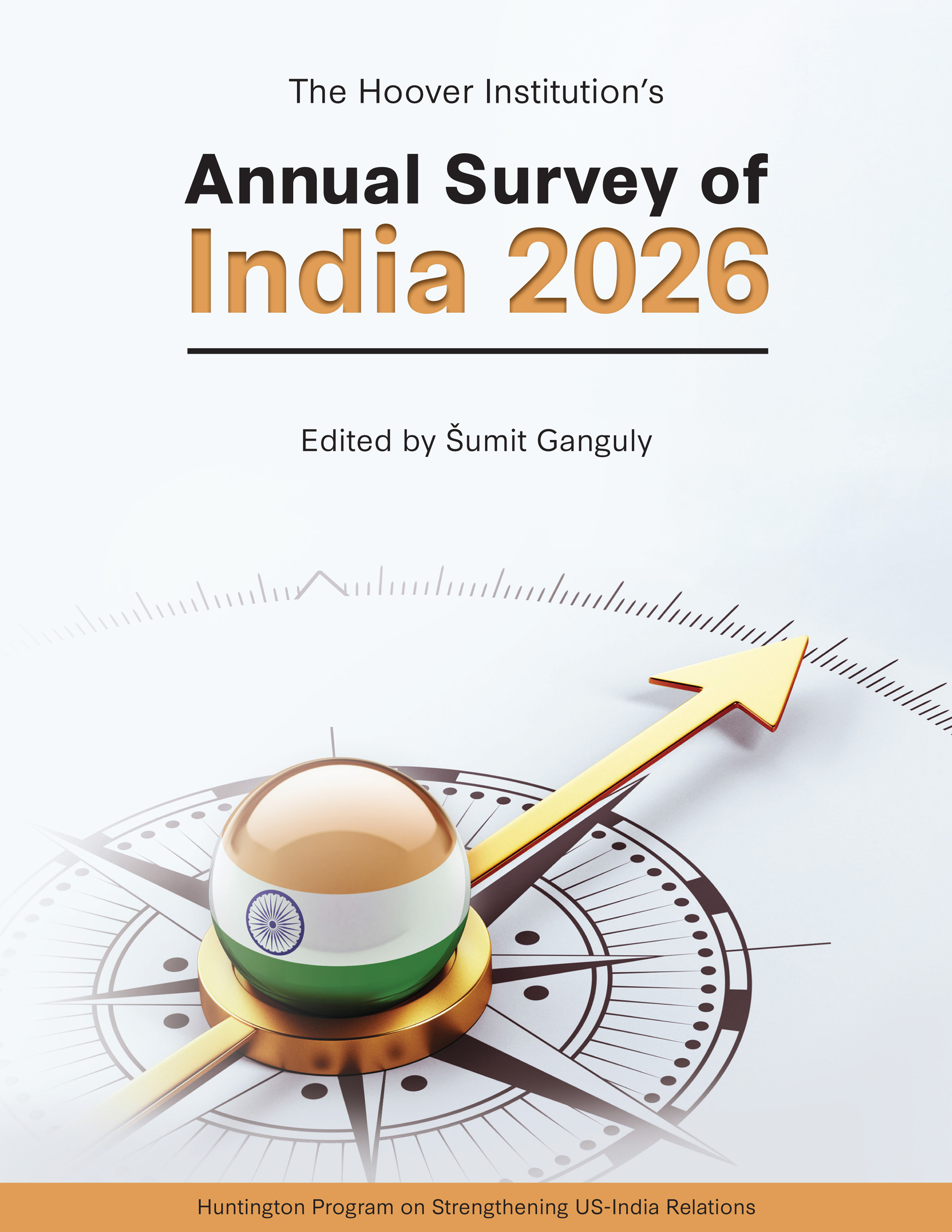



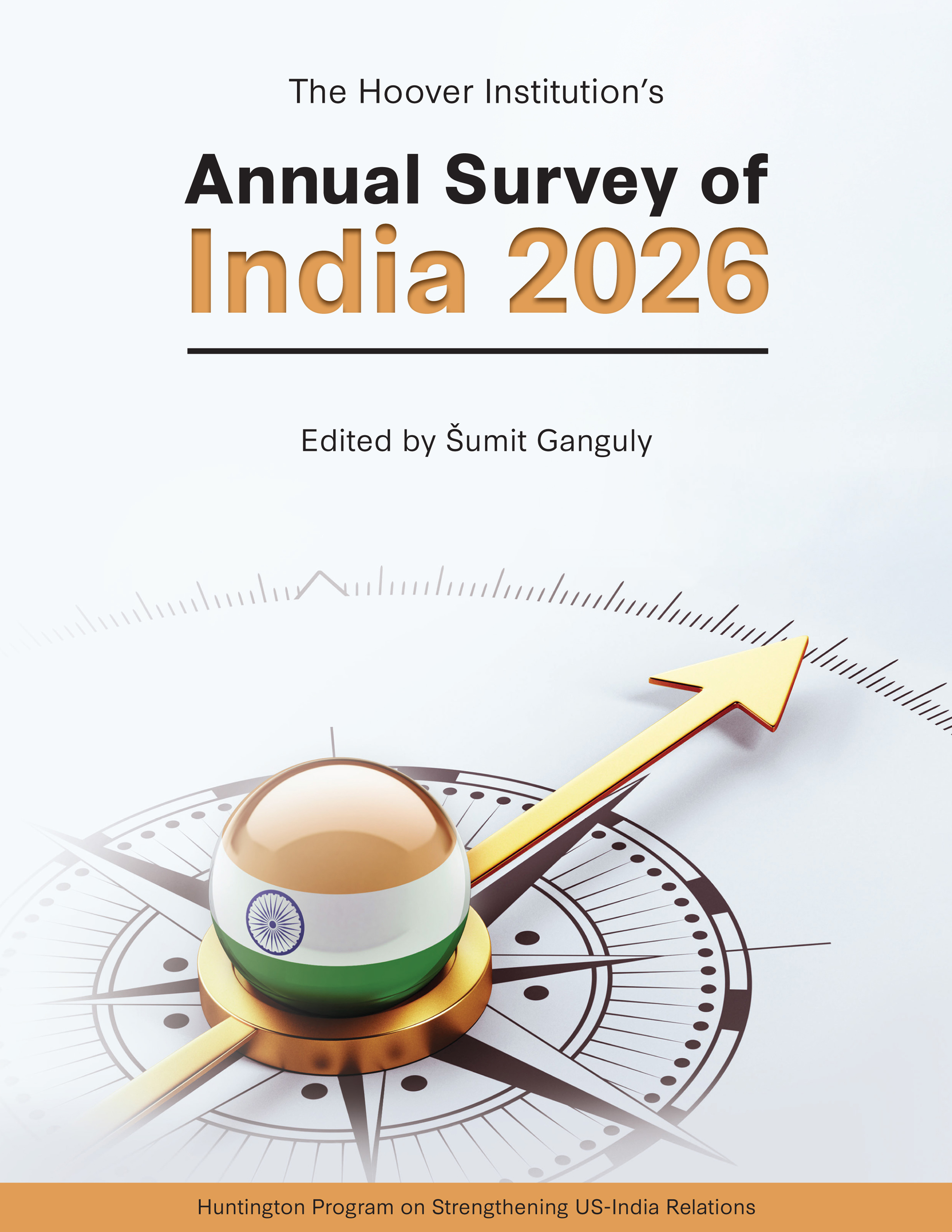
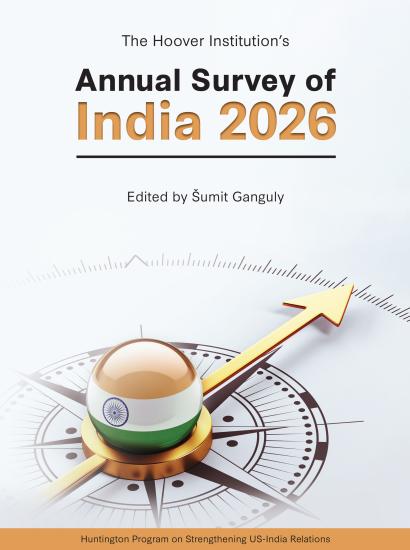
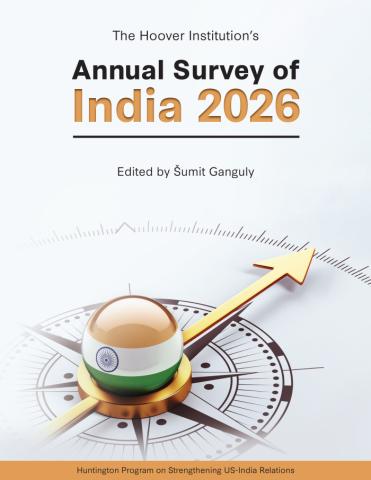
Huntington Program on Strengthening US-India Relations hosted a panel discussion on Understanding India’s Policy Landscape: Insights from the Survey of India on Friday, March 6, 2026 from 12:00-1:30 pm in Herbert Hoover Memorial Pavilion, Room 160.
In this discussion, we explore the complexities of India’s policy landscape, drawing on themes highlighted in the Hoover Annual Survey of India 2026. Our goal is to illuminate how various factors interact and shape India's policy decisions on critical issues such as defense policy, foreign policy, and economic development, among other key topics. This dialogue provides valuable insights into India’s trajectory and its implications for international collaboration.
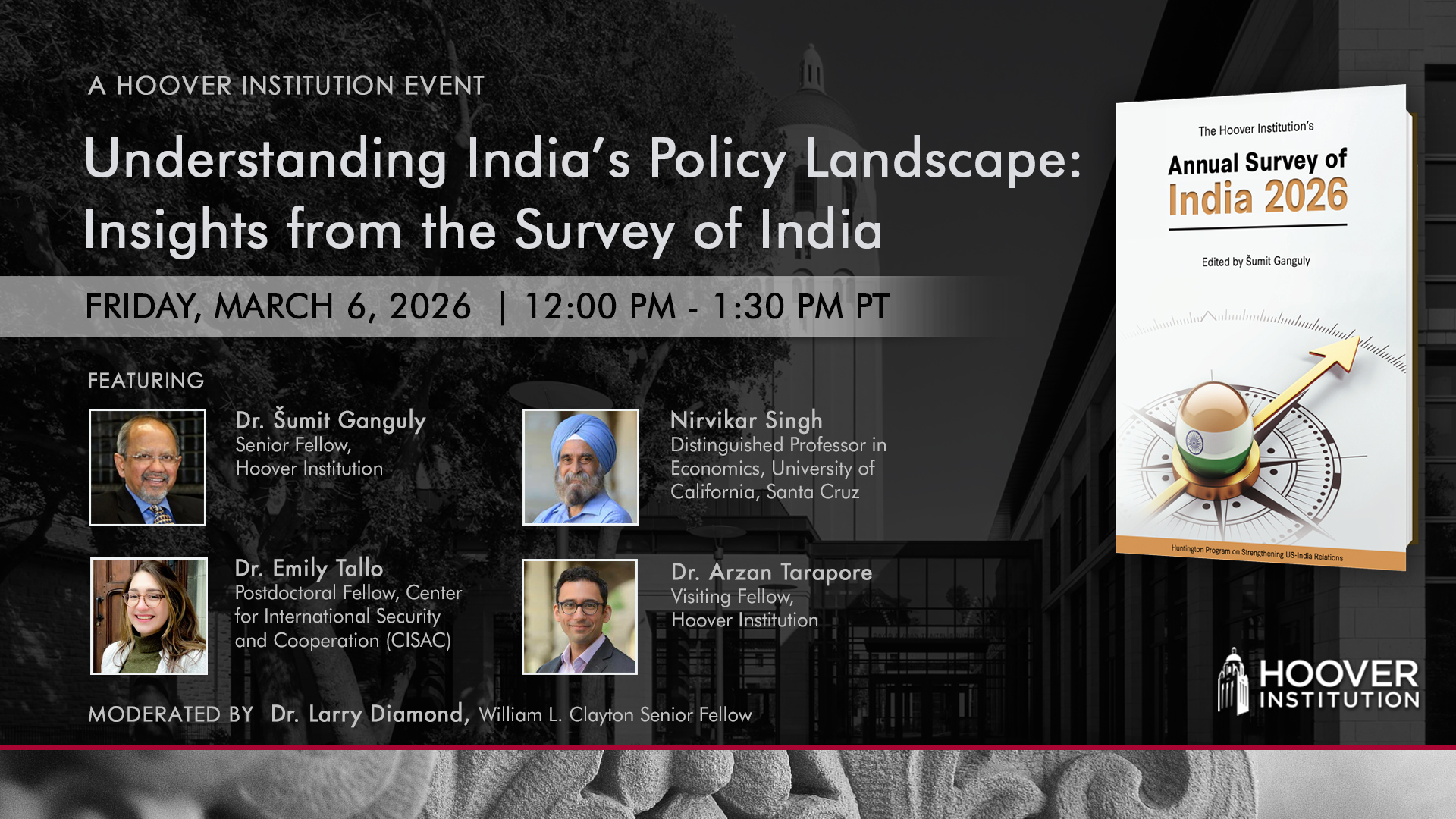
- Good afternoon everyone. I am UhHum kli. For those who do don't know me, I'm a senior fellow at Hoover and the director of the Huntington program on strengthening US India relations. And I'd like to welcome you to the release of the second iteration of the Hoover Annual Survey of India. And I'd like to underscore annual because our hope is that this will indeed be an annual event. At the outset, I'd like to thank a number of colleagues who are mentioned in the acknowledgements for their extraordinary assistance in helping put together this annual survey. Also, I'd like to thank the audience for coming today on this extraordinary spring day when it would be far preferable to be outside on this glorious campus. So particularly grateful for the turnout. This survey provides sort of a two day horizon of a range of policy arenas in contemporary India, warts and all. Each of these chapters are written by specialists ranging from healthcare to defense policy, to foreign policy, to educate education policy. It covers the entire gamut of, of subjects, which should be of interest to a number of you. We're particularly privileged to have my senior colleague, Larry Diamond, who really needs no introduction to this group. And so I will not go through a ritualistic introduction as one of the commentators. I am also particularly delighted that I have my one-time student, Emily Tallow, who is now a, the Jja Post-doctoral fellow at the Center for International Security and Cooperation, literally across the street. Finally, I want to thank all the contributors to this volume, one of whom Arpo is joining us from Italy and who where, and he is a research fellow at csac and my colleague Vic Singh from the University of California at Santa Cruz, who decided to grace us in person. Without any further ado, I'm going to turn the floor over to Larry, who will make some comments on particular features and aspects of this survey. Without any further ado, Larry,
- Well, first of all, congratulations ee i I think it's a wonderful thing that we're now doing this survey on an annual basis of what is now clearly unambiguously one of the most important and dynamic countries in the world by the mo. By the way, I don't mind speaking for 18 minutes instead of eight, but if they don't start that clock, you might wind up with 18 rather than eight. Thank you very much. That shows you what a good citizen I am. Yeah, absolutely. I'm not gonna speak on multiple elements of this study. I'm gonna speak on what you asked me to speak on, which is Sri Sri Deon's excellent opening chapter on Indian politics. Let me just say in sri's absence that I love his writing. It's so clear, it's so deeply informative, it's so full of interesting statistics and data, including I think, the results of the recent parliamentary election. And yet you can see the big picture. And so the big picture that strikes me and frankly concerns me as the scholar of democracy is a paradox in two senses. One is, is a real paradox in that he observes and you observe in your introductions shmi, that one of the striking features of India in this period that we're in is political stability. And there is political stability in two senses. First of all, there's not, you know, widespread unrest, terrorism and so on. India is a fairly objectively politically stable system now, and there's political stability in terms of the contour of partisan politics. The b JP is now in its third term. Ra Modi is about to enter his 13th year of rule in, in India only in Gandhi. And her father could, could rival that, and this is a continuous rule, I think even in Dira didn't ma match that in, in terms of uninterrupted prime ministership. And so that's stability too. And yet there's an element of, I think I would like to highlight it even more than it's apparent if you read carefully SRE chapter, instability in the quality and trajectory of democracy. India's democracy is changing from a democracy into a competitive authoritarian regime. And where we are in that trajectory and what you call India today as a political system, I think is very much in the eye of the behold beholder. And it's something we really struggled with and did not come to a clear and consensual assessment of in our edited book, EE Mystery and I, on the troubling, and I would say still troubling state of India's democracy. So I will just say that I, I would note the following that I have called from Deon's chapter bullet points to kind of highlight elements of this trajectory. The first is the promotion of a Hindu nationalist ideological agenda in the school curricula and textbooks, which per a country that's 14% Muslim and has, you know, other types of minorities and I think may have either the largest or the second largest population of Muslims of any country in the world, I'd say is pretty concerning in, in terms of a framework of liberal democracy. The second is it could feed either way the preparation of the long delayed census that for the first time we'll count the number of casts in the country since 1931 the first time. And you know, if you're counting the number of Muslims in the country and you know, that can add fuel to the fire of Hindu nationalistic anxieties, I think this is more ambiguous in its implications. The third that's less ambiguous is what's called the one nation won election, which puts all state elections on the same calendar as the National Parliament be like the, you know, the Congress saying, oh, we're not gonna have midterm elections anymore. It just happen every four years, everything everywhere, all at once. And anyone who knows anything about political science knows that if you have lower level jurisdiction elections at the same time as the national elections and you have a dominant party, it'll pull the trend over to favor the dominant party in state elections as well. And this is coinciding with something that I think is more worrisome, at least to the opposition parties, which is the special intensive revision, it's called SIR of the Electoral Register, which is purging many voters who can't show proof of citizenship. So if you think the US is the only democracy that's having this debate about who can vote and how you document your right to vote and what it means for fairness in the electoral process, we're not the only one. And this is even perhaps more consequential in India. And certainly the opposition feels that the electoral disaster it suffered in Behar in November of last year when the BJP and its allies won just a staggering, sweeping victory that part of the, the debacle that suffered may have been due to the fact that six and a half million voters were struck from the roles. Now that can't even come close to fully explaining the sweep of the BJP, but anyway, it's a factor. The fourth element, which I think is the most objectively outrageous and disturbing, is the unilateral decision of the government to change the method of appointment of the electoral commission of India, which was a consensual method of appointment, which had the prime minister, the parliamentary opposition leader, and then as a kind of neutral, presumably force the Chief justice appointing the three member commission of the Electoral Commission of India. And the BJP government and parliamentary majority, I guess, thought it would be a good idea to replace the chief justice as the moderating third vote with another minister from the government, I guess I don't know, at the appoint at the decision of the Prime Minister, which means the Prime Minister appoints the electoral commission of India now, which means it's no longer presumptively independent. That's really, I I think presumptively alarming to the opposition. Then you have the situation that the governors of the states are delaying legislation passed by the state assemblies. Now I think everyone here knows that governors in India are not like governors in the United States. They're like the queen of England. They're just appointed by the center to be, you know, magisterial presiding, you know, a, a neutral appointing figures, moderating figures. So they have no right to delay legislation, but they're doing so, and there's a concern expressed and reported in here about the conduct of the lock Saba, the lower house where, you know, speech has been cur curtailed. And to quote Sri reread on in his chapter bills were ramped through with very little freewheeling debate. And then there's delay as well and government approvals of judicial appointments to the Supreme Court, which are again done by very different process in the United States. One that is not politically driven, but determined by a panel of the five senior most judges of the Supreme Court. And that raises potential debates very similar to what's going on in Israel now in terms of restructuring the constitutional court of Israel. But if you add all this up, what I take away from it is a creeping trend again, continuing creeping trend away from not only liberal democracy, but potentially even electoral democracy towards something that looks kind of more like a gray zone or competitive authoritarian regime, even while India's booming economically rising geo strategically. So that's, that's my synthesis synthesis.
- Larry, I can't thank you enough for your insightful, entrenched comments and sadly, I, there's very little that I can disagree with in terms of your characterization of the current state of Indian politics. And based on these remarks, should you wish to pass yourself of an in as an India specialist, I'll be only too happy to endorse that proposition. And having said that, we will now turn to our colleague Garza, who's masque rating as Freddie Mercury, and I'm sure he'll bring out his guitar in a moment to accompany what he has to say. Thank you. The floor is yours, AZA.
- Thank you very much, Sumit. Good to see everyone speaking, speaking of someone passing themselves off as a, as an India specialist. Greetings everyone from Italy. It's really good to see you all. It is late in the evening here, so forgive me if, if one of my children saunters passed my left shoulder groggy, but, but we'll hopefully tolerate the disturbance. Thank you very much. And, and, and to echo what, what Larry said, congratulations Sumit on, on getting the second iteration of the annual survey out. It is, it is a, it is a very interesting project to bring all these different threads together. My piece of it is, is defense to examine what happened in the world of Indian defense policy in the year 2025. And really 2025 was meant to be a a, a big year in Indian defense policy. And it was my, my my my conclusion is that 2025 was a big year for Indian defense policy, but not for the reasons it was meant to be, right. The, it was meant to be a landmark year for defense reforms on, on the 1st of January, 2025. The rha Shari, the defense minister, said that this will be the year of reforms he declared in a, in a, in a bold sort of press release. But in fact, as, as I'll, as I'll sort of quickly outline today, my, my analysis is that instead of that bold year of reforms, what we saw was Indian defense policy being completely overshadowed by the conflict with Pakistan in May, which, which has had, I would argue, the potential for long running and, and not positive implications for Indian defense policy. So what, what do I mean by that? First of all, this was meant to be the year of reforms, but we did not see any significant reforms. The government and the military will point to certain things that did happen that they can sort of say, look, here is a press release, here is a photograph they did, for example, release a handful of joint doctrines on special operations and space and cyber, et cetera. And so they can point to some sort of incremental changes, but none of the big headline reforms that every analyst has been waiting and watching for, for the past decade. Right? Speaking of, I was, my, my eyebrows went up when, when Larry mentioned how long the Modi government has been in has been in power, we've been waiting for these defense reforms for over a decade. And again in 2025, they did not materialize. So there was no big headline reform towards jointness or theorization, which is the biggest type of reform that, that we've been waiting for. There was no open or, or publicized move towards an integrated rocket force, which is another major reform we've been waiting for. There was no announcement of a national security strategy, which everyone says may come, may have, has already been written, but not publicized, et cetera. Nothing of that sort happened. No major material acquisitions. We keep waiting for more news on a new aircraft carrier or nuclear powered submarines or new fighter jets. None of that happened decisively in 2025. Instead of all of that, instead of that year of reforms, what we saw was a four day conflict completely overshadow all of Indian defense policy. Of course, the, this, the conflict I'm referring to is, is what the Indian military called Operation ur, which began as a response to a terrorist attack in April. And in, and, and, and in response to that April terrorist attack on May the seventh, India launched punitive military strikes against Pakistan, against, against terrorist targets in Pakistan, which quickly became obviously and predictably a short conflict between India and Pakistan. Now this conflict dominates to this day Indian discussions over acquisition plans over doctrine, over the future character of war. And it's no surprise because it was a stark departure to the pattern of crises and conflict that we've seen in the subcontinent. And, and, and, and, and the Indian, let's say public discourse on this has been triumphalist. Right? Not only did India successfully launch attacks against terrorist targets on the 7th of May itself, but then in the subsequent days, India launched successful effective attacks against Pakistan Air Force bases across the country, including deep into the interior. And I think at least as notably, Indian Air defense has managed to prevent the Pakistan counteroffensive from scoring any significant hits in India. So tactically, everyone was patting themselves on the back of what a what a great job India seemed on the surface to have done. My job is to be a skeptic, to be a critic. And, and I'm doing that in this chapter by arguing that in fact not only was that tactical success more mixed than we often hear, but the more importantly at a strategic level, it was not necessarily good news. Gimme one second. Sorry. The, excuse me. The operational level discussion often got roundup over how many jets did the Indians lose? What type of jets did they use, what types of Pakistani weapons shot them down? That's not even what I'm referring to. The operational impact, the impost of this is in fact on the sort of extrapolation that we often see of what India thinks it has learned about the future character of war and what it means for a potential hypothetical future conflict, especially not only against Pakistan again, but also China. This was a cause for celebration in India because a lot of Pakistani military equipment, of course is China Chinese origin. And so the sort of simplistic conclusion drawn was that, well, if the Pakistanis lost in operations, then of course, well the Chinese must also lose when, if, if and when India fights China. But of course that sort of simplistic extrapolation is, is very, very fraught. China, the PLAs obviously not only larger and and and more has more platforms, but the variance of the equipment that even that they both countries use, the variance that China uses are more advanced, they are better integrated across the different platforms and different services. And the PLA generally operates with better training, right? So even though the Pakistani military scored a few successes against India in, in this conflict, the net effect of this at a tactical or operational level is much more mixed than the celebratory tones would suggest. But the place where this gets really important is that it's not even about the, the judgments over tactical success or or failure. The really important part is that operations endure the, the conflict in may obscure or masks the really important structural challenges that Indian defense policy faces. These are the types of structural challenges that the year of reforms was supposed to address and did not. And if anything, my argument is that operation has made the dilemmas that Indian defense policy has to face even more acute and has, has made the distortions that it operates under even more acute. Let me explain in my chapter, I, I argue that there are, for argument's sake three or potentially a fourth major dilemmas that Indian defense policy has had to contend with in all of them. There has been some moves in recent years to correct distortions that have accumulated over several years. These distortions accumulate because of the way policy is made in in India. It is in the absence of a national security strategy is made essentially by annual negotiations and annual iterations on, on previous policy, which winds up creating distortions. The first of these dilemmas or distortions is the balance that India strikes between its western border that is the Pakistan threat and the northern border. That is the China threat. Over recent years, we've seen India start to rebalance away from Pakistan and towards China, which would accord with a more rational assessment of India's security situation. But you tell me with operations in the refresh and Indian mind, is that rebalance going to continue and accelerate or is it now going to be retarded? The second dilemma is the larger dilemma between India's land borders, its continental land borders and its maritime posture, its ability to project force into the Indian Ocean region and the wider Indo-Pacific. Again, we saw in the previous decade tentative moves to correct that dilemma, but that was forestalled by the crisis in the dark in 2020. And I would suggest the conflict in 2025 will only reinforce India's priors that its primary threats come from its land borders and not from the Indian ocean. And finally, there is this move towards greater self reliance, right? Ab many abara the idea that India should be able to develop and build its own military equipment, which comes at the cost of immediate military readiness. And again, if India now believes that it is facing a continuous and pressing threat from its land borders from Pakistan, then that only creates another incentive to put off hard decisions towards at and to, to essentially make that dilemma between self-reliance and immediate readiness even more difficult overlaid on all of this, the final thing I'll say is the rupture that we saw in India. US relations in 2025 only makes all of those dilemmas even more acute. So the three dilemmas that, that I suggest, the three structural problems that went unaddressed in 2025 are only magnified when India does not have a productive relationship with the United States. I'll leave it there and, and happy to take questions later.
- Thanks very much Arza, and particularly for that last point, which I think is especially telling and it remains to be seen, water repairs can be done during 2026. There are a couple of hopeful signs and I hope that the, this they do not portend a false dawn. Without any further ado, I'll turn turn to my friend and former student, Emily Tallow, who will comment primarily on the foreign policy chapter, but you're at liberty to comment on other aspects of the report.
- Thank you Shami, and congratulations to everyone at Hoover and to you for putting out this, this excellent survey of India in 2026. I'm going to start by summarizing or providing a, an overview of what Dr. Ian Hall has written in his foreign policy chapter and suggest how I think India will approach the two topics that he says are most ripe for revision in India's foreign policy. That is India's approach to the US and its Pakistan strategy of coercive isolation. So India Hall Ian Hall's chapter on Indian foreign policy opens with a simple but important observation. India's strategy of strategic autonomy that is engaging all major powers without fully aligning with any of them has come under serious scrutiny. Since Modi Turk took office in 2014 across every major relationship, India had surprises and setbacks. It didn't, couldn't wrap. Its its hands around. And as Arja spoke about, the most dramatic was operations. Indoor India won the military exchange, but Pakistan won the peace. Trump was able to claim credit for the ceasefire. Pakistan's chief of chief of Army staff came to the White House, met with Trump, and they also suggested that India and Pakistan could negotiate over Kashmir at a neutral site. And so the, the India's policy of wanting to be treated on separate footing from Pakistan, the de hyphenation policy was undermined within just a few days. And there was also the, the issue of tariffs that were placed on Indian, on India and Trump's repeated attacks on India's trade policy, including, and they were penalized for importing cheap Russian oil, which was notably a pen, a penalty that was not applied to China, who was also importing that oil. There was also the issue with immigration, H one B visas that really affected Indians living in the United States, which is something that the, the ruling party in India really care a lot about. And there was the, the overall question of Trump Trump's focus on his own sphere of influence. And his meeting with she, which he said was a G two summit, really made India feel like it had been demoted from a strategic partner, partner in the invo Indo-Pacific to some side power that the United States couldn't, couldn't bother to treat like a, like a one-time ally. And on China. In response to that, there was cautious normalization in Indian foreign policy. They flights for the first time since the 2020 crisis. Modi visited China for the first time in seven years. But Paul says, and I agree, that it's, it's clear that this is a shallow engagement. Both militaries are heavily deployed on the border and China support for Pakistan during operations endure, which included advanced weapons. The the weapons that Pakistan used to target India and also possible real time intelligence sharing made India's fears of a two front war feel very real. And Hall's conclusion is that there are two things ripe for revision, which is this approach to the United States, which a relationship it really would like to see stabilized and its Pakistan strategy where the policy of coercive isolation has been shown to not really work anymore. And in both cases he says meaningful change might be incoming. I, I, I have a few things to say on both of these accounts. I think that India is simultaneously on the United States. That is India is simultaneously betting on stabilization with the US and on diversifying its partnerships to offset downturns in future India US relations. So it believes that US strategic competition with China is not going away and that India is going to continue to play a major role in US strategy in the long term. And I think India does have good reason for believing this. Even during the downturn in relations, they managed to sign a 10 year defense framework agreement in October and the Mbar naval exercises continued as well during that time. There's also some signs that the US is walking back its confrontational attitude towards India. Ever since the ambassador to India cer Sergio Gore, who's a close ally of Trump was appointed. There have been the US India trade deal was finally signed. And you, there's also a lot of talks currently about officials including even maybe Rubio, visiting India sometime this year. This is all kind of in the, in the, in the background of what's going on right now. They also signed deals to purchase weapon systems and liquified petroleum gas. And there was the major joint statement in February after the meeting between Trump and Modi, which covered things like semiconductors, ai, quantum computing, advanced telecom, and India is positioning itself on a lot of these new critical technologies and critical minerals. It's also decided to make a few concessions to the United States. The most notable is that it's reducing its purchases of Russian oil and it has not made any outspoken objection to the ongoing war with Iran, which I think the Modi government is increasingly feeling. It's under pressure to react to after the recent downing of the Iranian ship in the Indian Ocean region. But India's realized that it needs other partners to reduce its dependence on the US and and in order to address the China threat. And because of that it's in improving its ties with the eu including signing the EU India trade deal and finalizing the U UK free trade agreement, signing a deal to buy Rael jets from France. And it's finalizing a deal to buy to co-develop sub submarines with Germany. And I think there's only going to be more of this because there's a shared interest among India, European countries and other Indo-Pacific partners like New Zealand, Australia, and Japan to find non, to find allies of the United States and offset the dependence of the United States for on the United States for security and trade. India is also very sensitive to the nativist language that's coming out of the White House that the current administration is really perpetuating. And they see these other countries, Europe, Canada, Australia, as places for skilled in Indian immigrants who previously might have gone to the United States to go. And it's important to have good relations with those places. India will need to come to grips though with the reality that there are underlying tensions with the United States that are probably going to persist past this administration. They'll be forced to make hard choices about defending their strategic autonomy or protecting their own security interests, which Arza alluded to, since I'm running out of time, I'll just briefly talk about Pakistan. It's clear that coercive isolation has not worked. There are repeated terror, terrorist attacks and operations. Sinor demonstrated that the military escalation can be that any military escalation can be diplomatically reversed almost immediately by a third party. The war revealed the capability deficiencies that allowed Pakistan to punch above its weight conventionally and currently domestic opinion seems to be more geared towards retribution in another crisis than towards restraint. India I think wants to redeem itself at the next available opportunity, both in strategic communications and in actual war fighting. So the next time there's an potential crisis in Kashmir, I think we might see another blow up, but that remains to be seen. So in other words, I don't think that, I don't think that the Pakistan policy is going to be revised anytime soon, if anything like the Modi government will probably double down. Thank you.
- Thanks very much. I believe for that excellent commentary on Ian's chapter. And I'm going to steal a term that you used coercive isolation.
- That's his terrific.
- He did. Ian used that. Yeah, I thought you just coined it. But in any case, the thanks for a very lucid commentary and a very organized one. Without any further ado, we'll turn to our colleague Vic ing, who, who is actually written the chapter for the second time in this volume.
- Thank you eth and thank you Hoover. And indeed I had the luxury of building on what I wrote last year. Could we have my slides up please? Yes. So I'm a stereotypical economist, the only one with slides, so I consciously try to not repeat what I wrote last year. So please read both chapters. I'll, the title will become clear in a moment, but let me get into the meat of it. And as you know, India is the largest country by population and overtook China recently. It's one of the world's fastest growing economies, maybe the fastest growing large economy. It has a goal of being VIX it or advanced or developed by 2047, which is the hundredth anniversary of independence and Roth calculation. It would need to grow at 8% for the next few decades to achieve that. And I'll come back to assessing that. So this is from the economic survey of India. And again, as an economist, I look at that and I meditate on it. And the more I look at this list, actually, the more I like it, and I'm not going to read it out for you, but it's discussed, I've used it as a framework for discussing Indian economic policy. And I think it's a very useful framework that maybe there's some things that could have been added to this list, but it, it's actually quite, quite valuable and very useful. Great way of thinking about what India needs to focus on. And you'll, from this, the economic survey goes to strategic policies and you can see the echoes, right? The first, first two productive employment addressing skill gaps. You can see that bridging the education, employment gap and so on. So there's the policy framework and the idea of strategic policies is, is very well tied together. The, the, the, I think the elephant in the room is always building stake capacity and capability. And again, I'll come back to some of these as we proceed. When Sumit saw the slides, he was very skeptical, but I think I'll be there so skeptical about my ability to finish in eight minutes. So why did I use the term inside and out? Because last year I gave an overall assessment of the Indian economy. But whenever we talk about India, we really need to dig deeper. And you know, the standard story is that India's states are as big as countries with the Pradesh, Brazil and so on. My home state, original home state of Punjab is actually has a population equal to Australia and New Zealand together. Not the same area and not the same wealth. But the scale of India is important to realize India has a large and persistent inequality across the states. This is a very important aspect of Indian policy. There's actually a growing divergence in some cases in my chapter I didn't mention earlier, I do talk about non GDP measures of development because vix, it doesn't have to just mean GDP growth and one obvious one is human. The human development index, often human development indices, because they include GDP per capita GDP measure, they, they mirror what's going on with the per capita income. And you can see that to some extent in India. But that's also concern because human development is not just an outcome but also precondition for other kinds of growth. There's been a lot of work on ease of doing business business readiness indicators in India, you know, following the World Bank, which has abandoned them. But I just want to go back here and say you can see reducing regulatory burdens and financial constraints for small businesses and growing an Indian version of a Middletown. These are new ideas. These were not part of NAUV and policy for many decades and even often nru. So I think this focus on ease of doing business is, is somewhat new, but honestly the indicators are of limited value and understanding what, what is going to give India growth. And here I'm talking at the state level. So that was the inside India, we have to dig deeper. Of course we could also look at cities and villages and that would be another part of the story. I've spent a lot of my career working on federalism, so that's very natural for me. So outside India, that was another thing I didn't really touch on in last year's chapter, but I think India's international economic engagement is going to be very important for its future growth. India has been very suspicious of openness, but all the evidence suggests that openness has been good for growth. Here I'm talking about hardcore econometric analysis by my colleagues. And interestingly, all the trade turmoil over the last year has actually helped to change strategy in a positive direction. India has realized that it can't just be coasting, it has to be active in terms of building trade ties. There's obviously a different story for services versus goods. A lot of the problem has been with goods services also going to come under pressure, but India has actually got a very robust presence in the global services market. As you know, being in Silicon Valley foreign direct investment is also very important. It's still regionally concentrated, but doesn't have to be, it's not as high as it could be. And here I think China is a very useful benchmark. And we have a, a graph in our, in in, there's a graph in the chapter also lots of tables which you, you can enjoy pouring over. And I think FDI is important because it brings in know-how as well as financial capital. I think that's something that's very important. Okay, so assessment and takeaways. I'm right on time. 8% for two decades is not unrealistic, it's not easy, you know, so these Asian miracle was built on 10, 12% growth rates, but for shorter periods, India is only now, is now only growing at about 7%. You know, maybe keeping towards eight, but so we're not there yet, but it's doable. International openness has potential despite disruptions to the global trading order. I really want to emphasize this. A lot of my economics colleagues are very pessimistic about, well, you know, India missed the boat in terms of trade and labor intensive development. I, I think they're wrong because there's a whole new set of goods that are going to be produced for an aging population and for the green transition, India is falling, falling far short of creating enough higher productivity jobs. There's still no adequate strategy for improving education and training and reducing skill gaps. You saw those points being brought up in the nine, nine policy focus, focus areas and the five strategic policy areas. But if you read the text, and I critique this in the chapter, these are the weakest parts of Indian policymaking. They really are not thinking through how to actually overcome these gaps. This has been the weakest part of Indian growth is failing to produce enough jobs. State level policies are still constrained in some areas such as FDI or education skilling. And here I want to emphasize again, one of the important things that India has to do with openness is bring in knowledge, whether it's through FDI or through directly opening, opening up education and so on. And to me, this is the key to India's growth. In fact, if I look at what's happening, I was just listening to NPR on the drive over and scientists are fleeing the US and I was thinking, oh, India just needs to make a very small investment to attract a lot of scientists to India and that that can make a huge difference in India's future growth. And I know we have a chapter on innovation in the handbook in the survey. And then finally harking back to how we started out this foursome India's internal heterogeneity and the political economy that is driven by that heterogeneity. And the need for balancing acts really act as constraining factors. And it may be that, you know, authoritarianism will remove those constraints. But again, harking back to something that is discussed a little more in the chapter, that's also a cost. Being fixed doesn't just mean being materially rich, but also it means having human rights and other freedoms that we have somewhat taken for granted in India, but are not always clearly available. So I did go a minute over, I'm sorry. I'll stop. Thank you.
- Thanks very much Kar. This is a nice way to round out the conversation and I'm glad you returned to the point that Larry made in his initial remarks. But I don't think authoritarianism is, solu is a solution. And I refer you to a famous article by Francine Frankel written, I think in 1978 in world politics. Then the title of the article was, is Authoritarianism a solution to India's Economic Development Problem? And she concluded in the article, most assuredly no, it's, it's an article that's well worth going back to. And she was an authority obviously on India's political economy. The floor is now open for questions and comments and I'll try and also try and look behind me in the event. Maybe Jane can alert me if there are questions or comments from behind me. But the floor's open, I am awaiting question from anybody.
- Will let me jump in?
- Yes, please.
- Sorry. Please introduce yourself. My name is Paul Ra. I'm at, I'm mitis from the double department, but heavily involved with the India. I I work on a number of committees, the Indian Semiconductor mission, I chair the, the, the design side of the chip design side of that. And I also chairman of two labs, the CDOT and CA, these are very large labs trying to, my charters are trying and restructure them. I never talk about India publicly. And so that's, that's going to remain today. But there were two public statements made, made by me in India in the last one week there on tv, so I can talk about it. The first one was, there was a, there was a, a TV event on the Indian armed forces called the Forces First Event there one on the army. There's one on the Navy and, and Republic TV doesn't have a good vibrations with me. They asked me to speak and I said no. And the chief from the NA stop called me say, no, Paul, you have to speak. So, so in an NAS event I was given 15 minutes. And so I guess they wanted me to talk about the Abso program. Abso was iconic achievement of India. It was a world class sauna and when was it? It was F 40, 40, 40, 40, 45 years ago. And, and so I talked a little bit about that. But, but the, the, the part I made was that sauna succeeded largely because the Navy took charge. That means it wasn't as if there's an ecosystem of design and manufacturing with armed forces have no control and the wait for that system to deliver. And the system has not delivered often the LCA program, the TEJAS program come of, you heard of it, I I was supposed to lead it at one time, but I did not. I I I declined. But nevertheless, no. For example, that's an example of a program which really has not delivered. So now my point was that the armed forces cannot remain sitting this side of the fence hoping something happens, but to intervene that and shape that ecosystem so that it delivers and keso then the Chief renewal staff Admiral Pereira, he was able to shoot from the shoulders of Mrs. Gandhi, the prime minister, and he actually changed the leadership in the design side and also in the manufacturing side. So the system came out in time. So I said, you know, maybe we should look at that more carefully, that model. So that is one point I made. Another point was, I just recently wrote the report on cdot. CDOT is a iconic research lab of India in telecom set up by the, the well-known, the founder of CDOT was Sam Pitroda. All of us know the name. So they were very successful. They, they designed a switch telephone switch, which was then manufactured by ITI and by smaller companies. That was 50 years ago. And I was on the, I was on the go governing council at that time, but this time I've been asked to re restructure the lab. So the point I I, I did give a, a interview along with the minister on it so I can say that publicly, is that that model where one institution develops in a product, another institu takes it to the market. That doesn't work anymore. There's not a single example of any high tech in the kind, in, whether it's in computers or phones or anything where our, the development is divorced from the marketing side and they, and they go to market and understanding customer needs and the loop that takes place. So everything that's a very, very close loop. So, and CDOT is still stuck on that as well. They can't deliver and we really need a total fundamental change. So that much was public remarks,
- Questions, other interventions?
- I have an open question. It's, it's not necessarily directed to someone in particular for the purpose of my project. I'm interested, could you introduce yourself please? I'm sorry. My name is Abdi Diaz. I'm a research fellow in the BSL program under Drew nd and I'm interested in the approach that China taking in regards to the architecture of biotech. So for, it's important to listen, like what's the strategy that India is taking and energy is very important for us, right? So I, as an open question, I would like to know if there is more about what is the national strategy of India in regards to energy generation? 'cause there is a, a correlation between energy consumption and the growth in the economy. So
- Actually we are fortunate in having my colleague, the show mystery who's keenly interested in India's energy future. So I let him jump in.
- David Fedor and I just got back from Energy Week a couple of weeks ago. India has an acute energy need and it's just gonna grow and grow. It's an energy hungry market. So the demand is, is just gonna keep increasing. Supply is the big challenge. If you look, India doesn't have natural gas or oil deposits. They've got some coal, it's not the best stuff to breathe. They've tried to turn much more towards renewables, but of course what happens when it's nighttime or when the wind dies down? So what they were doing was they were getting a lot of energy from different places like Russia and like the Middle East. All of that is in flux right now for all kinds of reasons. Even, even just on Russia alone, they just announced the US announced today that they're gonna give India a 30 day reprieve on oil imports after having basically spent the last eight months bashing the Indian regime overtaking Russia, Russian oil. So India is really struggling with energy. When we were there a couple weeks ago, one of the things we noticed was that there was a shift away from talking about green towards talking about much more of what's practical. I think affordability is the number one concern, but they really need to think about the security of their energy access points. And it's, it's almost certainly going to have huge implications for not just quality of life, but as you're saying, future research and business opportunities. I don't think it's as forefront as it should be on policymakers minds in India. Thank
- You for that very nice quick overview of the challenges that India confronts. Yes, Sam?
- Hi, I'm, I'm Sam, I'm one of the, I'm a PhD student here at Stanford and also one of the co-presidents of the Stanford India Policy and Economics Club. My question is also just a, a general question to everyone who's taken part in this, in this project, I'm interested in understanding the balance of power between kind of national interests and state interests, because in India that's historically been a pretty contentious subject in my home state of the, we've pretty much always had a regional party that's been in power. So I'm interested to understand what, for what you all think the trend is in terms of that balance and where you think it may be headed. Thank you.
- I think Nier is best positioned to answer that question and I'll add my 2 cents after you are done. Sorry,
- What, what was the question? It was open so I was sure
- Just to understand what you think the trends are in terms of state versus national, the trade off of power between those two and where do you think it? Right,
- Right, right. So I, I think the, all the instincts of the national government are to centralize and I think the, the challenge is, is really that India is heterogeneous country. So you can see how this plays out in the sort of, you know, borderlands of the, in India artland like Cantica and West Bengal. I think if you look at the overall, I, I think one possibility is that the national government will actually allow cities to have more financial autonomy because I think they realize that urban growth is actually, and, you know, prop properly, properly designed urban growth is very important for, for being big. So I think, you know, as, as, as in some sense, you know, it, it, it's a question of where, where they will kind of give way, and actually this has been true of other, you know, it's been true of the congress party as well. You know, they will, will give some leeway to the states, so the localities, but then try to control in other ways from the perspective of fiscal federalism. The finance commission has kept things pretty stable and if the, the, it was interesting, the 16th finance commission report came, was tabled the same day as the budget. So it was fun to compare both of them. And, and you can see, you can see a lot of strategic alignment, you know, and it, and it's not kind of on the economic front, it's, it's, there's nothing kind of in in that sense too, too out, out outlandish. I think the electoral politics are a different matter.
- I'll just add 2 cents to that. One is this propensity for centralization goes back to in Gandhi when she was downright hostile towards non congress governments. And now he tried to use Article 3 56 of the Indian constitution, which allows the prime minister to dismiss a government if law and order is breaking down and the state is incapable of maintaining it on occasion it's chi who instigated the breakdown of law and order and then invoked Article 3 56 to dismiss a government. That's one. So this, it's not simply a BJP phenomenon. This has longer antecedents in Indian politics. The most important thing, and I'm surprised that someone now who knows so much about federalism didn't mention this is the growing north south divide. The, I just, not to be overly self-referential, but I just flew back from Bangalore and parts of Bangalore resemble a, a city in the developed world. And then you go to parts of northern India and you think you've landed in medieval India and they seem intent on going to that era. So, and what's happening is that the more prosperous states, including yours, are getting tired of subsidizing the lag arts. And this is becoming an electoral issue in Indian politics and will remain so if these divergent trends continue, John,
- I I wanted to say something about the prospects for us Indian relationships going forward, in particular in energy, not in everything but in energy. And I would say they are lousy. They're lousy both on the US side and I believe also more or less on the Indian side. The reason is the two big topics which get attention, one is natural gas, LNG and the other is nuclear. There have been lots of fits and starts with it, but basically if you say how are things going? They're not going well, it seems to be either place. Now I will be carrying Admiral Ellis' bags dearly s conference for a year for every year studies US energy issues. I will be sitting there, I will be talking, he will be talking much more and more wisely. But you will I think see not as much positive interest here as I believe is deserved. I draw this attention to our conversation here.
- Would you or Admiral like to add a sentence or two or more? I'd say
- John clue us into this, and this is why we've been looking at aro gas and nuclear as a potential way of collaborating with
- US India. Yeah, we've spent considerable amount of time in India having these conversations and get different views depending on which strata in India architecture you speak to. I mean, the political is one side where in some cases they seem to be wedded to longstanding policies. But if you talk to the manufacturing capabilities, the leaders in the tech field and the like, they have a very different perspective and are much more open to a, to a broader conversation. The real question is how do you reconcile those two going forward? And I think that's the, the unknown in all of this, John, I think, you know, they're incredibly intelligent about what, where they are and and what the potential is. You're
- Speaking about the Indians now, not the Americans.
- Not the Americans. No, no, no. I I would never speak positively about my colleagues, but, but the Indians get it and, and so they, they have a clear, a clear-eyed vision in the more pragmatic the, the industrial base and the like of where they can go and, and where their skillset is. And it's considerable, but there are still political and legacy barriers of, of longstanding policies that still have not yet changed. I mean, some of the liability issues around nuclear have changed and the like, but, but they're still talking about thorium instead of some of the, the, the newer and, and more readily available technologies and the like. And so there's a, a fundamental disconnect there that has not yet been bridged, I would argue. Did you, I I
- Agree and I think as you say, this is an unknown area, but we should venture into the unknown on this as we, as we plan to do in the next,
- I I should have mentioned one other thing. We had a visit here from the former head of coal. I forget his name, but I liked him a lot. The reason was he says, forget all this stuff, India's gonna have to rely on coal in a very big way. And, you know, it just made me really, first of all, I admired the fact that he could speak so clearly and knowledgeably about it, but secondly, he made the obstacles to doing anything in natural gas or in nuclear, very considerable. And the use of coal in India, which is really a, a burden on their whole society, a very big problem. And of course United States isn't gonna get into that.
- If I could,
- Can I just jump in?
- I had already had ronak in my list on my list, so please,
- But can I just respond to something he said as a, as a panelist?
- Oh, go ahead.
- I I just wanted to say certainly the nuclear cooperation angle is getting a lot of traction from the Indian side, at least right now. It was mentioned during the joint statement between Trump and Modi earlier this year. So I think there's definitely political will, whether or not the technicalities can be worked out is another question. But yeah, I just wanted to add that in because I was missing some the debate.
- Okay. I just want to add that more recently Indian policy has shifted, for example, in the last national electricity plan, they changed their plans for coal and said they're gonna invest that money in storage technology for renewables. And there is, there is that process taking place, Ron?
- Fine? Yes. No, no, no worries. Ronak Desai, I'm a visiting fellow here. Thanks for, for doing this. And again, congratulations to all of you. It's a very, it's a very profound compilation here. The question of energy. Look, I mean, us India trade has always been the historic underperformer of the bilateral energy has always been a part of that story. And to the extent that there's been energy cooperation, it's served larger bilateral strategic interests. You all just mentioned the nuclear deal. Again, the symbolic, the symbolic value of that deal, far out shadow, the lack of optimization, it wasn't, you know, it wasn't implemented even right now they fixed the liability legislation in India, you know, whole tech was supposed to come in as a white knight and, and build nuclear reactors all over India. That's just not gonna happen, right? So part of the openness of this gentleman who came here about coal, I think there's a recognition a that they're gonna a, have to rely on a number of different sources. I think what we've seen in the last six weeks within India are certain voices within the Indian government responsible for decision making feel vindicated that the United States is absolutely willing to weaponize energy security against the Indians. And I think that chorus of voices, I suspect is gonna be the dominant voice for the foreseeable future, given the fact that on the one hand the Indians have been treated and, and the beneficiaries of American exemptions on our part, going back to the Iran Chabo accord in Iran, Venezuela oil, Iran oil back in 2012, even the nuclear deals passage here in the US was conditioned upon India breaking diplomatic ties with Iran, which of course they weren't gonna do, right? So what's happened now, this waiver even in the last, you know, 24 hours that mentioned the bureaucracy in India currently saying, aha, look, we told you so what does this mean for our sources of energy going forward to ensure, you know, security and diversification of supplies in the foreseeable future? Well past the Trump administration, I think leaving when you're used to waivers, tariffs happen and this happened and they're, they're invoking the specter of energy as a reason. I think there's gonna be a, a fundamental mis you know, misalignment and realignment going forward.
- Yes, I have a question. So thank you for please introduce Yeah, I'm, and I'm a PhD student in and I'm also co-president of spe. So I have a question to the, that in the defense policy we have been discussing that India has been moving from building in India to, to buying from the other nations. And as people mentioned that we do have a place where the powers have used this kind of security of like energy or other systems can be used as to control or influence Indian decisions. How do you think that would influence in a short term loss versus long term gain the, the India has to go through and how does that, has India has to navigate through the border challenges within those situation for a short term versus long term?
- Not sure I quite understand the question.
- So my question is that India do have the border conflicts with the China, Pakistan, but building in India technology do a lot of time. But how do the n they navigate the weaponry systems which have been bought or bought from the reasons like US or France, and how does that affect the Indian defense policy?
- So, ah, aans still here since you a formal a panelist, I'll let you take a crack at that and I'll augment it with my thoughts.
- Absolutely. Again, I'm, I'm still here against my better judgment. I look, I, I think,
- I think I'm grateful.
- No, Jadin I think that, I think you're right that, that that that is the central tension between this, this dilemma that I posed between ABA and readiness, right? That there is this tension between this desire to move towards the ability to develop and produce and maintain the country's own military equipment on the one hand, but acknowledging that that is a process that will take years, if not decades for most, most weapon systems, certainly for weapon systems that are at a higher level of technological requirements. So for example, when we're talking about fighter jets, which is one of the examples where, as Paul Ro mentioned, there have been attempts since the 1980s to build an indigenous fighter jet. And, and they are so slow, these programs are so slow to come to fruition that they are a full generation behind the state of the art. That when these jets are finally developed, produced and fielded, they are a full generation behind other jets that are being developed, produced and fielded. And so this is the tension, right? There is a clear and obvious and well-founded desire to have self-reliance, obviously, as we've seen, especially after the Ukraine war. But the problem is, if that's going to take decades, what do you do in the meantime when there is an imminent threat that is causing skirmishes and causing casualties today? And if you are a military planner or if you are a security manager for a country, you have no option but to build your readiness for today. Every country faces this dilemma between modernization and readiness. And, and so far the, the way that India has tried to do this is to, is to, is to pay for readiness by getting foreign supplies and to mitigate overdependence by spreading dependence to more than one country so that you can offset, you can offset that dependence and that you are not overly reliant on only one country.
- Well, if you're old, the only thing you can remember about Indian armaments so that they get it from the Russians. Any steps away from that is a positive step. It will be recognized as such in the United States, but it's still the image you get in, in fact, your bombers are still Russian bombers.
- Well, so, so I mean, that, that, that's a, that's a, it's, it's a very, that's a very good, clear example of, of the intractably of the problem, right? If you are a country that feels 4,000 main battle tanks, then who is going to be the person that says, we are now going to change course and, and develop our own battle tank that will take decades to, to be fielded. And what is the risk that we are willing to accept for those decades? And this is, this is the prime example of why it's so, so difficult for India to move away from this reliance on Russia.
- Admir had an intervention. No, I, I think, you know, our on, I think has touched on, on a couple of issues. This says, John, that that play in the, in the space here, the, the first is the perception incorrectly in my view, but but still viable in the, in the minds of many that India wants the intellectual property and then it's gonna be made in India. And that, and that there's continuing requirements that, that be a part of a process, that be part of a purchase, that'd be part of an agreement and the like, that works up to a certain degree and, and, and then it, and then it fails as Arza knows, I, I was on the board of Lockheed for 20 years. We were pursuing an India contract when I joined the board. We were pursuing an India contract when I left the board, okay. To build the next generation of fighter aircraft. At one point, we offered to have the entire production line for the F 16 moved to India to, to facilitate the purchase of the next generation aircraft. It was never approved and never, and never supported. So some of it's, I think, I hate to use the term congenital, but you, but Aon is right. There are such a critical size that how do you shift without losing the readiness that's at such an important part of their, of their self-sufficiency. But then it even plays to the, the broader case, you know, and it, it kind of relates to the, to the weaponization of energy. If you're using F 30 fives, for example, and the source code is now not available to you or the supply line for parts that are not capable of being produced, indigenously not available to you, then somebody exercises control to some degree over your use and employment of those, of those weapons systems. So there's a, there's a need for that independence. And historically, rightly or wrongly, the, the one nation that doesn't question, but just as willing to sell and be a consistent supplier is Russia. And, and to this day, that dominates the conversation as you try and, and make that transition for, for more cooperation and collaboration with, with production in India.
- Let me add a, a, a comment. So I was the Navy and I must have been in Russia many, many times buying ships and weapons and aircraft. So what one thing that stands out was, it is far, far cheaper. I think I remember the Spro class stuff from, from here was a negligent ship, maybe not exactly the same advanced electronics, but was, was probably know 15%, 20% off the US cost. So that was second thing is we could pay in Rupe and we didn't have dollars. So there were strong economic factors also for great points. Yep. Great points.
- Just a couple of things which speak to this conversation. The LCA was started in 1985. I even recall where, I will not say with whom, but I recall meeting the DRDO scientist in New York City who came to negotiate the G 4 0 4 engine. I have a vivid recollection of this. And now India's moved to the G four 14 engine and that stalled because of production difficulties here in the United States. The LCA properly is referred to as the late coming aircraft, the Arjun battle tank. If I was in the Indian mechanized divisions, I wouldn't step inside that tank. It's a death trap and it cannot work in the, in the deserts and it cannot function in high altitudes. So what's the point of this tank?
- I was in the review committee for the tank many years ago, but it's far too heavy.
- Yeah. And oh, there, and it cannot go over certain bridges near the Pakistan border because of its weight. And finally on the F sixteens that Admiral Ellis brought up, my colleague and former Paul Kapu and I actually wrote a piece in foreign foreign affairs called f sixteens made in India. Pat. Lot of good dad did. On that cheery, uplifting note, I'm delighted that all of you could come to this event. It's been, the comments have been extremely enriching and en enlightening, not only from our panelists, but also from members of the audience. And I'm deeply grateful to all of you, and particularly to the staff at Hoover and especially at the press, who are all suitably acknowledged in the report for their extraordinary dedication to producing this report on an annual basis and in ensuring that the production is virtually flawless.
- Can I ask a question about the actual report itself please? Does it have a chapter in there?
- Yes. Each
- Year? Yes. Which discusses the current status of US Indian relationships? A
- A separate chapter? No,
- I suggest it might be of interest to do that.
- Okay. I will take that. A lot of our
- Conversations have been, but
- That status changes every day. John,
- Volunteering to do some work for you for next, I know. Just offered write chapter. Go for the lowest.
- I have to be by day. John that note. Thank you very much. One second.
About the Speakers
Šumit Ganguly is a senior fellow at the Hoover Institution and director of its Huntington Program on Strengthening US-India Relations. He is also the Rabindranath Tagore Professor in Indian Cultures and Civilizations, Emeritus, at Indiana University in Bloomington, where he served as distinguished professor and professor of political science and directed programs on India studies and on American and global security.
Nirvikar Singh is Co-Director of the Center for Analytical Finance at UCSC (of which he was the founding Director), and the Editor-in-Chief of the Journal of Economics, Management and Religion. From 2010 to 2020, he held the Sarbjit Singh Aurora Chair of Sikh and Punjabi Studies at UCSC. At UCSC, he has previously directed the South Asian Studies Initiative, and served as Director of the Santa Cruz Center for International Economics, Co-Director of the Center for Global, International and Regional Studies, and Special Advisor to the Chancellor.
Emily Tallo is an incoming postdoctoral fellow at the Center for International Security andCooperation at Stanford University. She received her Ph.D. in political science with a specialization in international relations at the University of Chicago in August 2025. Her research agenda examines the patterns of contestation and consensus between political leaders and their advisers, politicians, and bureaucrats over foreign policy. Emily’s dissertation, “Organizing Mistrust: How Leaders Navigate Bureaucratic Resistance on Foreign Policy,” explored when and why leaders strategically organize foreign policy bureaucracies. Her other projects relate to how political elites structure foreign policy debates in democratic countries, especially in South Asia.
Arzan Tarapore is a visiting fellow whose research focuses on Indian foreign and defense policy and international security issues in the Indo-Pacific region. He is completing his first book on Indian military strategy, and his policy analysis in 2025–26 will focus on how members of the Quad can deepen strategic cooperation. He previously held research and teaching positions at the US Army War College, Georgetown University, the East-West Center in Washington, the Observer Research Foundation in New Delhi, and the RAND Corporation.
Larry Diamond is the William L. Clayton Senior Fellow at the Hoover Institution, the Mosbacher Senior Fellow in Global Democracy at the Freeman Spogli Institute for International Studies (FSI), and a Bass University Fellow in Undergraduate Education at Stanford University. He is also professor by courtesy of political science and sociology at Stanford, where he lectures and teaches courses on democracy (including an online course on EdX).