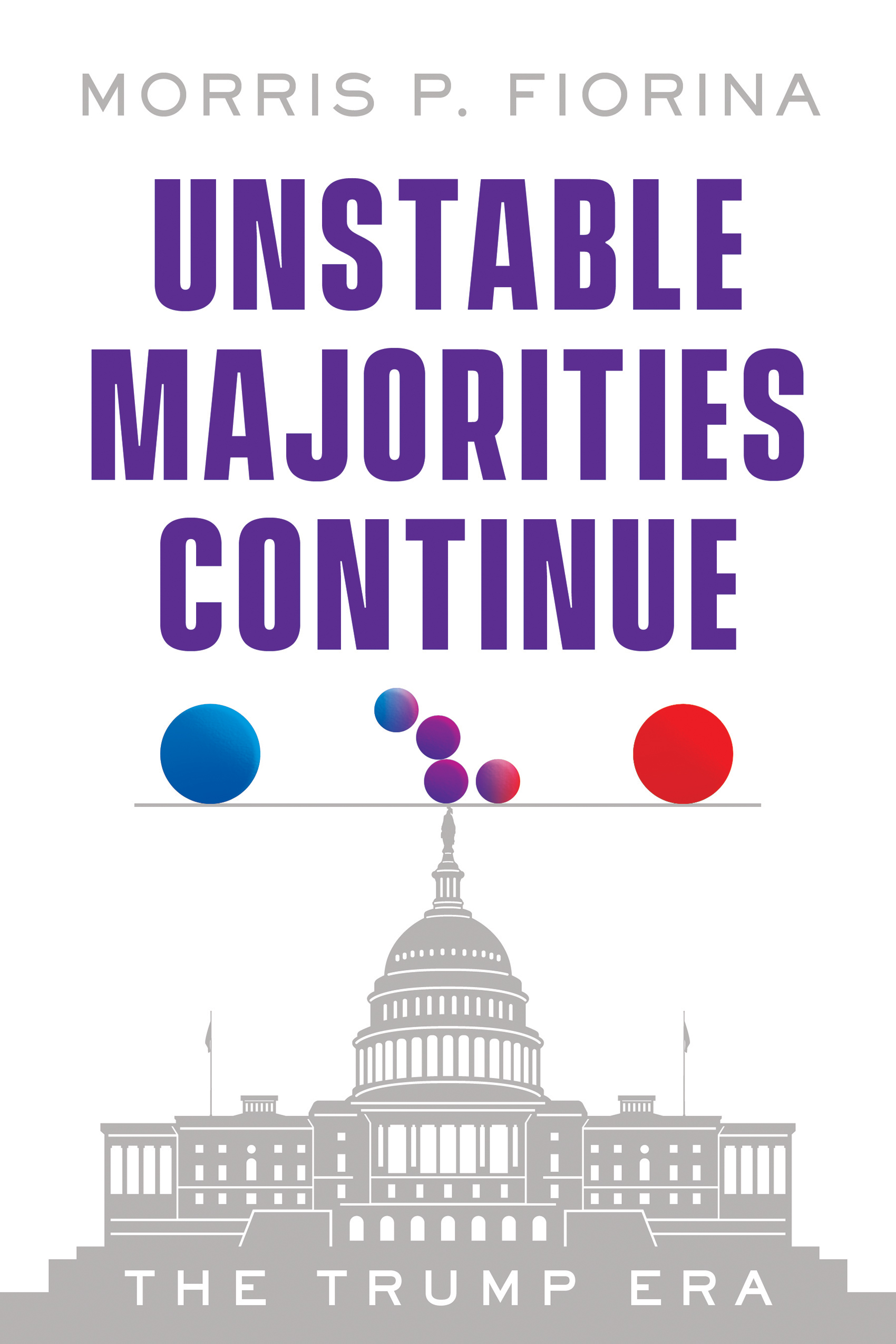
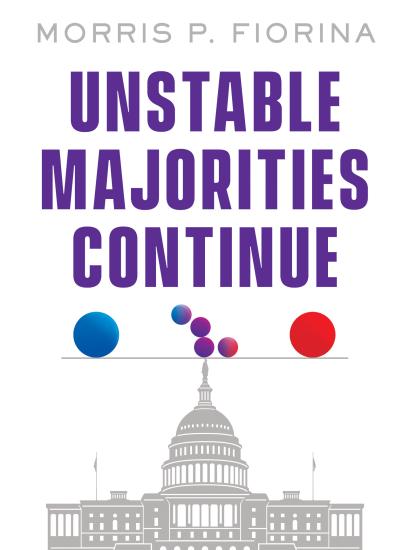

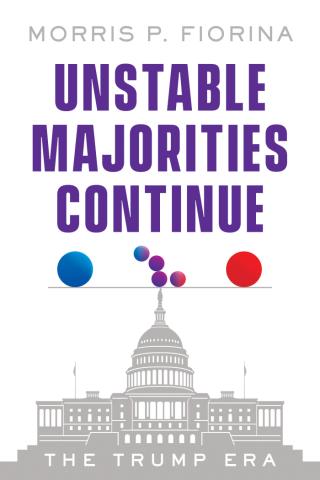

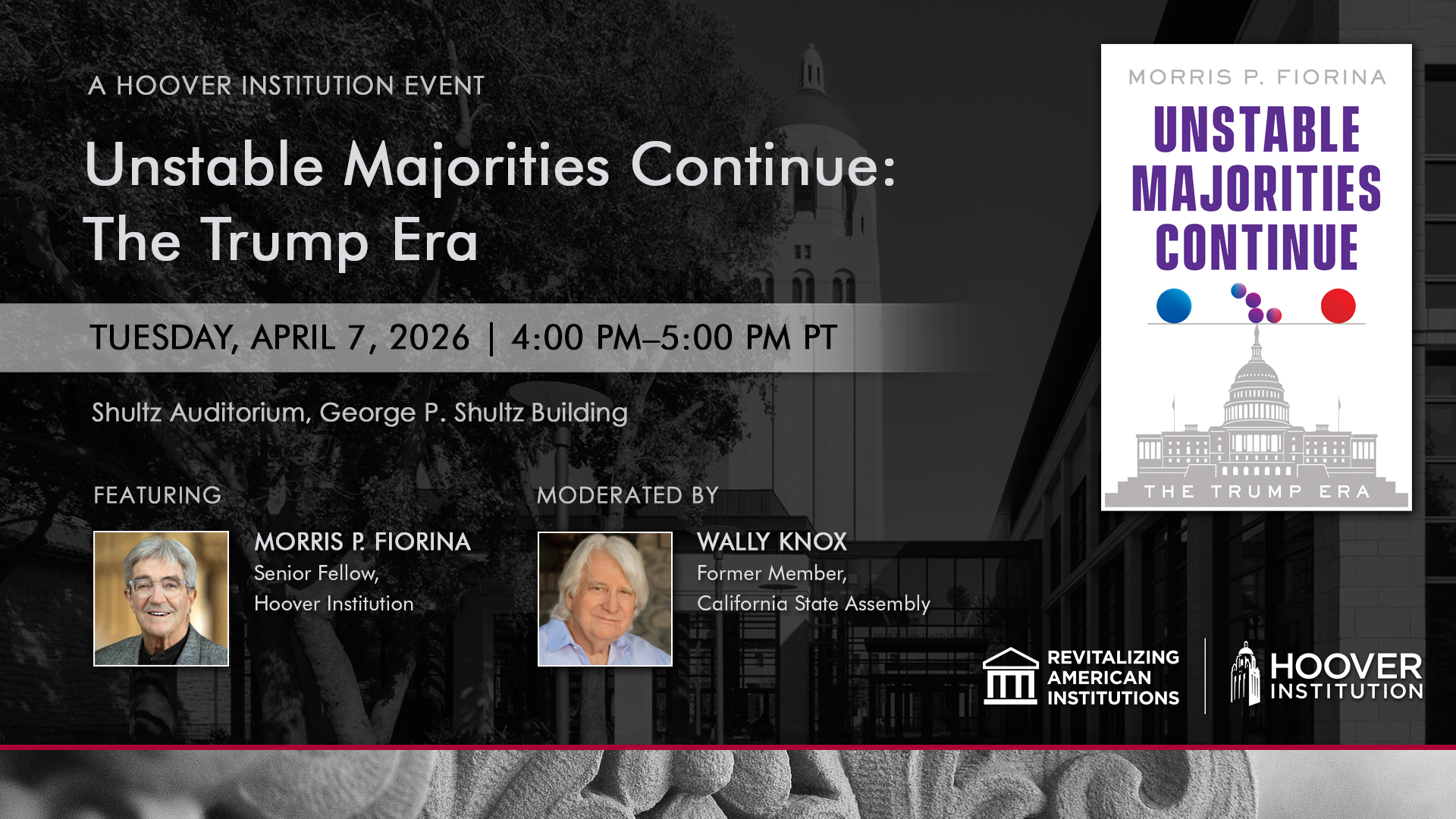

The Center for Revitalizing American Institutions hosted Unstable Majorities Continue: The Trump Era, a book talk with author Morris P. Fiorina on Tuesday, April 7, 2026, from 4:00 - 5:00 p.m. PT in the Shultz Auditorium, George P. Shultz Building, at the Hoover Institution.
About the Book:
The United States is experiencing a period of electoral instability unprecedented in our history. Neither of the two major political parties reflects the political will of the majority of Americans, who must choose between candidates holding positions more extreme than those of the typical voter. With no true centrist party, Republicans and Democrats take turns as the party in charge.
Unstable Majorities Continue: The Trump Era examines the current pattern of volatile party control that, from a historical perspective, is very unusual. It follows the author’s 2017 book Unstable Majorities, which identified this trend in analyzing the 2016 election.
In contrast to the relatively stable party majorities that characterized preceding eras, since 1992 the country has experienced a period of unstable institutional majorities, where presidential candidates have earned relatively narrow margins of victory and control of the House and Senate has fluctuated. For several decades now, the verdict from the voting electorate has often been one of no confidence in whatever institutional pattern of control prevails.
Why have American politics changed so dramatically? Fiorina states that the current nature of the country’s political conflicts is misunderstood. After reforms, societal changes, and political coalition-building, the Republican and Democratic parties of today are much different organizations from those that operated in the past, becoming more homogeneous internally and more distant from each other—and from the public—in policy and ideology. The parties have polarized; the electorate has not.
There are no indications that the 2024 elections have ended the era of unstable majorities. While the rise of populism contributes to present conflicts, it is a consequence more than a cause, with economic conditions ranking near the top of factors affecting party fortunes.
By examining data and voting behavior on abortion, gun control, environmental regulation, and other issues, Fiorina argues that voter positions have largely stayed moderate over time. He dispels the commonly held belief that American voters have become politically polarized, creating a “Divided States of America.”
- Hi, I'm Brandis Casone. I'm a colleague of Moss and as a senior fellow with him at the Hoover Institution, as well as in political science. And I am delighted to be introducing this book, talk of his new book, unstable Majorities, continue the Trump era. Most of you know Morris Pina or Mo Fiorina as the Went family professor of Political Science and a senior fellow here. His research focuses primarily on representation and elections, about which he has written or edited 15 books, A nice goal that that's for the next few decades, as well as dozens of articles. Mofi Arena has been elected to the American Academy of Arts and Sciences, the American Academy of Political and Social Sciences, as well as the National Academy of Sciences. He has received two career achievement awards from the American Political Science Association and his wife Mary, who's I saw and is here somewhere, has put up with him. And that's Mo's words for the past 57 years, which is an quite an accomplishment of its own. I'm also delighted to introduce Wally Knox. We'll be speaking with Mo today. Wally Knox graduated from Harvard University after serving four years in the United States Army and is a decorated Vietnam War veteran. While at Harvard, Wally served on the governing board of the Harvard Young Republicans Organization, but later in life he decided he'd become a democrat. As a, as an attorney, we, we welcome you to Hoover too as an attorney. While he specialized in the representation of working people in unions. During his time in the California state legislature, he restored the eight hour workday worker protection and chaired the select committee on the California middle class, which authored pathbreaking studies that were decades ahead of their time. Wally is married to Beth Garfield. They have two daughters, Aveva and Tamara, and are members of Temple Israel, of Hollywood. Well, I thanks so much for joining us today and particularly to discuss this new path breaking book.
- Thanks a lot. It's, it's a, it's a great pleasure to be here with Mo and for those of you who don't know, you insist on being called Mo. So in the q and a, watch your watch what you do. So we all know what happened in the recent election. There was a complete sweep. Trump became president and Republicans took the House and the Senate, and shortly thereafter, president Trump announced what his real objective was. It was to create a stable, reliable, perhaps permanent majority, and to hold things in that place. Mofi Arena has looked at the, the history of the majorities that have been created in the last several decades and has a few things to say on that topic. Mo, tell us about stable majorities in our politics.
- Thank you, Wally, and I'm glad you asked that question. Americans grow up with institutions that are very familiar to them and many, many don't realize to what extent they're weird by world standards. And among those are electoral institutions. For example, we are one of the minority of world countries or democracies that elect their chief executive independently. The majority of countries, it's, it's a parliamentary majority that chooses a prime minister. We also have two, we have a bicameral legislature. There are a few others like that, but we are unique in having two really equally powerful institutions, which again, are elected independently. Moreover, our House of Representatives is elected every two years, which British observer, Anthony King comments has bought the, the shortest terms of office in any established democracies where four or five years are common. And what that means is that in any presidential election, we can choose eight patterns of government from Republicans holding everything President House and Senate, and number one there to the Democrats holding everything to all the patterns in between. And in midterm, we can choose any of four. Now, ordinarily this is a, a hypothetical possibility that there's a lot of majorities don't just typically flip around. And historically, for example, the modern United States industrial country begins with a, a straight Republican majority. As you can see, there's a whole lot of bars in that table when, when Teddy Roosevelt splits the Republican party, Woodrow Wilson sneaks in with about 41% of the vote, but then it goes right back to being Republican control and that it ends in, in 2 19 30. So in the course of, I can't remember, something like 17 elections here, there's only four patterns. Then the Democrats have a turn where for 20 years it's virtually all Democrats except for one election after the war. And so we have two patterns in all these elections that comes to an end with Eisenhower's election in 1952. And that starts something new that in 1956 Eisenhower is the first President who doesn't carry the House of Representatives in his reelection of this in a two-way race. It's happened a couple times in third party races, then it looks like the Democrats have come back in. But it turns out, no, that was really a harbinger of what was to come. And we launched into this long period of divided government, which was most of my adult life, where Republicans have a clear edge in the pj in the presidential races more, the more you look back at it, the whole court of presidency looks like something of a fluke. Meanwhile, the house is straight Democratic for 40 years never changes. And the Senate almost except for a few years during the Reagan administration. And that comes to an end, I think there's something like three patterns of government, even though it's divided, there's only three patterns that show up. That comes to an end in 1992 with Clinton's victory in a three-way race. We sort of wander around for a few years and then basically in 2000 electorally speaking, all hell breaks loose. That we're in this era of just every election, everything is up for grabs. We have the presidency switching back and forth twice. The winning presidential candidate does not win a majority of the popular vote. The house is divided back and forth. The Senate twice ends at a tie for the first time since 1880. And it looks very much like we're gonna continue this in 2026. And if Democrats are, are right, or hope at least as they hope in 2028, the last, if, if Herschel Walker hadn't, if Trump hadn't endorsed Herschel Walker in the 2022 runoff would've had all eight patterns. I think it's pretty likely that we, as it is, we've had seven out of eight patterns during this period. And I think the last time we had a pattern repeat was 2012. Every election since then, we have a different pattern. So total instability. I told our my students in the last term seminar that on the one hand they're living through a really crappy p and so that's a negative. But on the other hand, it's a damned interesting political period someday historians may look at back and say, how lucky you were to go through all this. So that is the whole point about unstable majorities. What what we are now in an unprecedented year in American politics where for basically 30 years, there is simply no majority out there.
- Well, let me just just probe you one, one question on that. What's the problem with an unstable majority system? Are there any virtues to it? There are folks around here who are terrified at the idea that a single party would dominate our politics for four or eight or 12 years. And there are other folks who are afraid the other party could dominate our politics for four or eight or 12 years. Is it possible unstable majorities are kind of a cleansing tool that are unavailable in other systems?
- It's possible, yeah. I think part of the reason I'm, I'm going to step back and say one of the rea, one of the reasons people are so much afraid of the other party having total control now is a set of other developments that I want to talk about.
- Yeah.
- But the phrase this, exactly, if you have a stable majority, that means the country is likes what that party is doing. And so the answer is to beat them. The answer is to come up with public policies and govern in a way that the other party, if you could, you could win in your party. So I, I would simply say, as I'm gonna say several times that the answer to any problem we have is basically elections. But let me go back and and say a little more about why this occurred and because it's, it's not clear why do we have these unstable majorities? Well, if the average political commentator would say, it's because we're polarized, it's because we now have a 50 50 nation that we're split down the middle. It's the red and the blue. There's nobody left in the middle. And the first reaction that any political scientist has to a claim like that is what's the evidence? And when you look at the evidence, it's sort of surprising. For example, if you ask, we've been asking people questions for over 50 years, in some cases in 70, some in others, where do you stand ideologically if the prevailing views are corrected? Be everybody's now liberal or conservative? There's nobody left in the middle. Well, in fact, the ideological distribution today looks exactly the same as it did in Jimmy Carter's period, that people in the middle, middle of the road moderate. It's simply the, it's always the plurality response. Liberal conservative are two minority responses. Americans have never been a really ideological people. So you could say, well, what about issues? What about individual issues? Not general ideolog And like take something like abortion, which is a touchstone issue of the culture wars. Well, there's very few people, it's not the case that 50% of the people want abortion on demand, and 50% of the people want outlaw abortion. On the opposite, it's the opposite that very few people want to have no restrictions. Very few people want to have complete total restrictions that, did I say that right? Yeah. Everybody is sort of in between, you know, basically, and again, it really hasn't changed in 30 or 40 years that there's been a slight increase in, in people saying it should always be a matter of a woman's choice. But if you say, well, what about gender selection? They say, well, maybe not that one. You know, that sort of, people are very ambivalent on this. My my point here is just on issue after issue, you don't find the divides that people talk about. Where it gets interesting is when you say, well, what do Democrats think? And what do Republicans think? And well, it turns out in nine Jimmy Carter's era, if you ask Democrats their ideological beliefs, 25% of them said, we're liberals. 50% said moderate, and 25% said conservative. Today, 65% say they're liberals. There's no moderates, or excuse me, there are no, no conservatives left. Practically Republicans have always been more ideological. They were about 50% conservative in those days. Now there's 75, there's virtually no liberals. And sometimes, so it's, it's the question that, you know, the parties have gone in opposite directions, leaving the aggregate distribution constant. And some younger scholars sometimes say to me, what, what's the difference? Well, what, what can polarization be other than party polarization like this? And the answer is, well, a few years ago there was a book published called A History of Party Polarization in America, which doesn't talk about the Civil War, which was supposedly a somewhat polarized era. And why? Well, because the Democratic Party split apart, the Republicans replaced the wings. There were five parties that got 10% or more of the vote in the 1860 elections. And you don't have to go nearly back that far that when I was growing up, civil rights was a pretty contentious issue. And you had Northern Democrats and strongly in favor Republican Democrats, strongly opposed. And Republicans sort of caught between their historical sympathy for African Americans and their state's rights ideological positions. In, in 1964, the civil rights bill was being filibuster in the Senate. And Everett Dirksen brought 27 Republican senators to, to break the filibuster and save the civil rights bill. Now imagine in today's world, Mitch McConnell bringing 27 Republican senators to save Joe Biden. You know, it doesn't happen. That's the difference between then and now having party polarization or Vietnam. A few years later, the in, I think it was in 1968, 10,000 anti-war protestors descend on Chicago to disrupt the convention. They're presumably mostly Democrats or more extreme, they're met with 24,000 Illinois Guardsmen and police who are again, presumably Democrats and they beat them up. Yeah. And so, so these are Indonesian fights. How parties structure conflict makes a huge difference. Parties can either exacerbate conflict or they can dam dampen conflict. What we have today, which we didn't have a generation to go and through much of history, was parties that exacerbate conflict, that find it in your interest to exacerbate conflict. I could go on if you want interrupt, or
- Let me try to do a follow up on that. Sure,
- Yep.
- One of the most interesting charts in your book for me was a, a survey where folks were asked their, their preferences in pri in on, on policy. So Democrats and Republicans were asked, tell us your priorities for, oh
- Yeah,
- For, for governance. And Democrats were asked that question, Republicans were asked that question. And then they followed up on that and said, okay, you're a Democrat. What are the democratic parties priorities for governance? And the Republicans were asked, okay, you're a Republican, what are the Republican parties preferences for, for governance? And what came out of that mo
- What came out of it was what a lot of people have talked about today, which is the, the priorities of the Democratic party are to a considerable extent, not the parties that are held by a large portion of the mass space of the parties that Republicans are more in line with their, their voters than Democrats are. But could we hold that when we talk about the last two elections? Because that's, that's really important and it, it sort of gets us into a whole, a whole lot of questions about the future of the Democratic party. The, the, the, the fact that we have the two parties today that, that I'm talking about was exacerbating conflict for decades. I taught, and various other professors in this class taught, you know, who you are that the conventional wisdom, which is that in proportional representation systems, you have multi parties that you can still win seats if you have two second and second, third, fourth. I just decide, I, I once took a look at the French Parliament and it turned out they had 17 parties that had seats in the parliament.
- Yeah.
- There was something called the Hunters Party that had three seats. Its whole party platforms to defend the rights of hunters. Now, in single member district seats, we talk, excuse me, in majoritarian systems like ours where you get the most votes, you win, don't get the most votes, you win nothing. Those kinds of systems tend to generate two parties. And the argument there was you have two big tents. The parties are broad based 'cause they're fighting for the majority, the median voter and so forth. What we've done over the last generation, and it's not totally clear how this has happened, is evolved. Parties that look like the proportional representation parties, they're nearly defined and ideological, and yet there's only two of them, which gives you a real problem If you're a Democrat, you have to believe this sort of thing's on, on economics, on social issues, on foreign policy. If Republican believe this. And I think part of the consequence of that, not just the only explanation is we used to have 75% of the people in this country saying I'm a Democrat or Republican gal's, latest figures are 55. That there's a whole lot of people who they still may tend to vote Democrat or Republican, but they don't necessarily feel enough in the party to say, I am one of these, that we have increasingly parties that are being run by and for these very activist mass bases of the two parties. And this sets up really terrible incentives when you think about it because we couple this with the coast elections, the minority party, knowing that it's within this much of winning the next election has an incentive to let the majority party accomplish anything, stop them, you know, just make sure they don't have an issue. On the other hand, if the majority party, this sense is, well, we may lose the next election, so let's ram through whatever we can while we have it. Then of course it's a self-fulfilling prophecy. If you ran through too much what your base wants. Like take right now we're, we're seeing a big overreach, and this is a chapter in one of my earlier books. Okay, Trump definitely wins. People want to have clamped on the illegal immigration, but then when people see masked agents sort of arresting nannies and baristas, they say, well, we didn't mean that, you know, and so and so you have the reaction and the next affection, which is when you turned out. So we're involved in this sort of cycle. It's, it's kind of a doom cycle where each party governs in a way that's gonna help make sure it's defeated in the next election. And I don't know what to do about it. I mean, into questions if you're gonna say, what do we do? I don't know. But anyway,
- Well, Democrat these days, looking at the 2026 election, I joke to my friends, and I hope they're friends in the audience, that the worst thing that could happen for the Democrats in 26 is that we lose the election. We are unable to retake either the House or the Senate and, and again, destabilize the majority system. The second worst thing that could happen for Democrats is that we win the election. Because in that case, we are confirmed that the way you win the elections is not by addressing issues clearly and succinctly, not by distinguishing yourself from Republicans because you have three salient things to say that are vitally important. You run against Donald Trump and you win every time. I don't know about you, but I get emails from people running for obscure legislative offices in North Dakota for Democrats, and they tell me what their program and platform is. So you have North Dakota Democrats running against Donald Trump these days.
- No, I think you're absolutely right. I think, I think right. I mean, Trump is behaving in a way, it's like a Arian opera where he is pulling everything down around them. And, and it may make it easy for Republicans. I I think your scenario where they don't win is probably not gonna come to pass. They're gonna win. And the question they may take is, all we need to do is be against Trump. Right. And one of the things that's sort of interesting right now, not just sort of interesting, it is interesting is as Trump's numbers continue to go down and, and you know, the not only presidential approval, but on e on economics, on inflation, on on immigration, they continue to go down still. It's not the case that the generic vote has changed that much. That the, the generic vote is who would you vote for today for Congress or Republican Democrat? And it's, it's pretty good. I mean, it's, for the Democrats it's five or 6%. Doug, what's the latest you have on that? I
- Dunno.
- Five. Okay. And it doesn't keep dropping like in co with the other ratings. And part of the reason is when you look at the Democrats ratings Yep. They're not any matter and in some cases they're worse and Trump's ratings. So, so you basically, they're not gonna go to against Trump unless they have something better on
- What's your alternative? Yeah, yeah. We're stuck with that. Let me just on the Iran issue, which is of course the thing we're all paying great attention to, is there any other observation you have that may be escaping us as to its political significance?
- No, this isn't my area and there are lots of experts around here who have, have different views on sort of the sort of the, the overarching goal regime change or this getting rid of the nukes. There is a general sense about did anybody think this through that that or if anybody thought it through, did anybody listen to them? You know, there is a sense that we sort of somehow blundered into something that we weren't anticipating. And so I think there is a somewhat dismay in general, no matter what you think about the rightness or wrongness of sort of the original aim. Yeah,
- Your book is interesting because it goes through a series of very different arguments and very different concerns. It begins talking about unstable majorities that we paid attention to, and then you dive deep into the polarization issue and what is going on there. And then you have a concluding chapter, which didn't even exist in the first book. Yeah. And it's a very unusual chapter. I I I'll ask Moda to explain that. It really delves deep into the sort of the ultimate extension of the polarization worry about where are we headed? Are we headed to irreconcilable conflict rather than me babbling endlessly? Once you lay out what the premise what, what generated that chapter?
- Okay, well there's a definite Get Off My lawn quality to that chapter. And it was sort of frankly, an old guy sort of watching a discussion that seems to be totally bereft of any kind of historical sense. And it's, it's sort of died down now, but 'cause there are other even deeper concerns. But a couple years ago, there was a whole lot of talk about Civil War, actually it was a Greek movie on this. But anyway, but, and I have just a series of quotations about somebody saying we're on the verge of civil war, you know, and or the Civil War has already started, you know, and even people in other countries say, we're worried about an American civil war and the country hasn't been so divided since the, since the Civil War. And I think, my God, people, you think nothing happened between the Civil War and, and today, you know, that, that they, you say, what about all the, all the racial violence? Say, okay, okay, okay, that's, that's, that's the south, don't worry, that was people, white people aggressing against black people. But what about government? I say, well, for 70 years, starting in the seventies, 1870s, we had labor violence. We had over a thousand minors in their wives, children in some cases shot by the government. Yeah. Big strikes. Strikes that went on for months strikes that went on, you know, really real violence in this country. In, in 1910, late as 1910, there was a 10 day battle, 10 day of six day in West Virginia where historians estimated that a million rounds of ammunition were fired when miners had a pitch battle with law enforcement. It ended only when President Harding said, we're gonna bomb the miners and were sending in troops the US Army. Then they dispersed. And the last massacre, the Ford Massacre of 1932 was probably the last evidence of this. In 1920, on a single day, the government arrested 3000 radicals and they deported several hundred of them. And they executed two of my innocent countrymen sa van that in the thirties we had Father Kauflin, we had Lindbergh, we had America first, we had all this, and we had a couple of somewhat quiet decades, then came the sixties. And I'm convinced that a lot of people who regard today as sort of somehow un unseen in American history just were too young. Most people aren't too young to remember the sixties. But in the sixties we had riots in this country. We had, again, 300 people killed. Some of the big riots were 40 to 60 people killed in the riots. We had the army, we had tanks, we had machines, had machine guns on the steps of the capitol in the Washington riots of 1968. That the, it's it's, you know, you the the New York Times and Newsroom, they sort of retired to the, their fainting couches a few years ago when, when there was a, a suggestion farm cotton, that they sent troops into the cities. My god, they had tanks in the cities, you know, they had the national, you know, just, and these were democratic administrations, governors and so forth, sending the military into the cities. That, and, and for Joe, I had forgotten, but Kotkin reminded me that in 19 71, 72, the weatherman set off 2,500 bombs in the United States. Remember Patty Hurst in Liberation Army, a few here, here, Mike, but most of you, you won't, that then everything just sort of died, died for. But I've off, except for Rodney King rides in 1992, again, this goes on for like six days. There are 40 some people killed, you know, in, in Los Angeles. And, and it's just sort of, if you calculate, there are about, I think I count somewhere in here like, like seven out of the 11 decades since the Civil War American government shot their citizens. And I'm not making any sort of light of what's been happening today, but compared to the, the historical record, it is just, you know, a relatively peaceful era in that sense. And, you know, I I think just having a lost sight of the fact that this is a big heterogeneous country where people have different interests, beliefs, and values, it's always been conflictual. It's often been violent, and yet we've sort of come through and I don't see the light where it's coming from right now, but I sort of feel at my age still pretty comfortable if we're gonna come through it somehow.
- Well, I, I certainly hope we do too. The, the thing that strikes me is how there's an element in our politics that is, doesn't, seems like it doesn't want to come through. That there's the, the conflict is invigorating for so many people on the right and the left. Yeah. And I, I suspect part of their thought is, if only we will come to a crisis, my side could win everything and I just don't have to compromise anymore.
- I think that's right. Among the minority of people who are the public face of politics, the people who you see on your TVs, the people who post on social media, the people who give the fiery speeches and so forth. I really, from looking at the data doubt that that runs nearly as deep as people think that the average Democrat and Republican are not nearly as far apart as the people I'm talking about the, I call them the political class in, in the United States. And just to give you an example, the number of people contribute to a political campaign in the United States in the last election was about 11 or 12% to any campaign from dogcatcher up to president, number of people who work in a campaign, proportion of people who work in campaigns, less than 3% that the, the people who are really out there living and breathing politics is a relatively small fraction of the United States. Most Americans, I, I like the analogy, they, they like government to work like the utility company. You walk into the room and you flip the switch and the light goes on, or you turn up the thermostat and the heat goes on. You know, that's what they want government to work. And what go does not, government doesn't work like that. They get unhappy. Now, the only reason to feel unhappy, we've had how many decades of economic developments that have left a lot of people behind. We had 17 years of war that seemed to result in nothing but a disastrous ot. So, I mean, I think they, I think people are justified in having lost a lot of faith and wanting something new. And basically I think that is not, not just something we can get into if you want to not just Trump, but around the world where we see the same sorts of things going on.
- Perhaps we time to open up the questions from the audience.
- Thank you. This, I guess, is more of a question for Wally than Moe. By comparison to the federal government, there's probably nobody in this room who is ever old enough to vote when the California legislature was not under the control of one party. And to, to the extent that, that that's the ex the other extreme from what you're describing as an unstable majority, how does that come across in as to how democracy functions
- Poorly? I'll just tell you one war story. I, I made the mistake of creating a committee on the economic problems of the middle class while I was in the state legislature. It did not go over well with my fellow Democrats. And at one point, a prominent liberal leader screamed at me, we are Democrats, we are for the poor. The effing middle class can take care of its effing self. And that's precisely the attitude that has played itself out over the next, next years. And the Democratic party today is isolated on the left, isolated from the middle class and a hollow shell of its former self. But thank you for setting me up for that question.
- Yeah, but
- Go,
- What's the matter with the Republicans? You have okay.
- What in, in the state of California?
- Yeah. Alright.
- Damned if I know.
- Yeah,
- No, it's, it's a, it's really the, the Democratic party is just running rough shot over everything in the state of California and doing nothing about it. Also, if you look at what actually happens legislatively, it's remarkably passive, tremendous amount of aggravation, but not much going on, which I believe is one of the reasons why a prominent union is putting up a massive tax increase proposal is funding itself that's coming forward and is generating a, is generating more political controversy than California has seen in a decade or two because they were frustrated. The Democrats hadn't done anything to generate that con that controversy previously. So I think we're seeing people outside the nominal party start to try to take control of the direction of the Democratic party. Yeah. The opposition is not the Republicans, the opposition is within the Democratic party.
- Yeah. I did some work on this some years ago, and what was interesting was, remember this is the party Republicans, the party of Ronald Reagan and Ed XO and Duke Magen, you know, they, they've sort regular governments ran or Republicans ran well in California. And then one of the arguments always given, oh, Pete Wilson, okay, Pete Wilson screwed the Republicans by his support for 1 96, whatever, yeah. At the,
- The, the anti-immigration measure.
- But if you actually looked at the voting registration, democratic registration continued to go up or, or state for about 10 years, Republican registration went steadily down. And what was important was decline to state. Republicans used to clean up on the decline to state people, and they went up in number and down in Republican. And when you looked it, basically, you could argue that the Republican party of California became like the Republican Party of Texas or Mississippi. Hmm. They went, they went away from the, the Reagan Chao Wilson Wing was sort of reasonable good managers, they could keep taxes low, run the government efficiently. Now suddenly it was abortion and kill the redwoods. I got in trouble. This said Hoover once, I said, your your platform is to kill the redwoods, kill the salmon and, and sort. And that's basically the California Republican party. And as long as that's the opposition, it's like the opposite of what's happening on the, on the national side. As long as that's the opposition, people are gonna still vote for the Democrats. You have to have a credible opposition.
- And right now we don't you,
- So thank you. You said you don't quite know how we got in this mess, but I'm not sure that, I believe that you don't know. So I, I I'd like to start with California and then pose a general question. It seems that we've got maybe a similar problem a little bit on the Democratic side. Now the, the state in California, the state is not working. We're, we're losing jobs, we're shedding people, we're drowning in, in bureaucracy and political correctness. But unless the Republicans get lucky with the top two, you know, configuration of the outcome, A a Republican can't win in November against a, I mean, the most reasonable and compelling Republican who's run statewide, who ought to have been broadly attractive, I think was our own colleague, Lanny Chen. And he couldn't even win for what? Controller. Controller. Yeah. So the label is toxic and if we could get past these labels with say, rank choice voting, where you could have some other option and people wouldn't waste their vote by, you know, if they might lean Republican, they don't like the Democrats, but they don't wanna take a flyer on an independent or a new party. You know, you might see a Tom Campbell like figure win certainly for governor. In fact, I'll, I'll bet he would. So, and then when you combine it with the perverse incentives of the primaries, which didn't exist before in those earlier areas, eras, but I I think really have increasingly been dominated by the more militant types. And you have party primaries producing these polarizing options. You know, it is the, the downward spiral you suggested. So don't you think we'd all be better off with the Alaska system of nonpartisan primaries and the top four candidates from a blanket primary contesting in a general election through rank choice voting?
- I certainly think it can't hurt that I would support it. I I wouldn't be as optimistic that it'll be a major improvement. We, we know these kinds of can also be gained and the parties will, will try to game them. And the other thing you have say is, you know, we've had the same institutions for 200 years, just, they work very differently depending on the media environment and the, the social environment they operate in. And you're absolutely right about the primaries that, I mean, how can Trump keep doing what he's doing, keep congress in line. The reason is they're terrified that there are enough maggot people who show up in the primary that they're gonna lose if they cross Trump. And it's like the average house's primary has turned out under 10%. So you just don't need that many, many extremists in any primary to, to, so if as long as Trump can keep his hold on this, and I, I don't know whether that's slipping at all. Doug, what's the latest mega number? 50. Okay. As long as he can keep his hold on them, it's not gonna change too much. Yeah. But, but yeah, I think we can, I wouldn't oppose any kind of attempts to improve things, but I I think there's still some really deep, deep problems going on. And part of it's just who participates, the people who participate are abnormal.
- And that
- Is,
- That's just
- The, just the way that it is, you know, they're abnormal.
- And, and I would add the, the, the primaries have such a startlingly smaller turnout than the general election does. We hear the statistics over and over, but it's so amazingly small. I think we lose touch with that. So in the primaries these days, you're having, what is it close to a, a 10% turnout In primary elections? In the general election, we're having 50, 60% turnouts. So the primaries don't look anything like the general election whatsoever. And you can have, you know, maga dominate the primaries to an amazing extent. And on, and in my party, you can imagine what turn, what turns out and, and what could get passed at the primary level. So the primary structure is, is I would, I would be very careful about tinkering with the primary structure. We did that a while. We, Democrats did that a while back here in the state of California. And we set up a system in which we just had, we were just about to have an election in which we, democrats created a system in which two Republican candidates for governor were going to be in the runoff. And all the Democrats were going to be excluded from the runoff because that was the way the system worked. And with 30% of the elector Republican, you can elect two people there. You, you have to be really careful when you tinker with this stuff. There are really unexpected consequences that that can really come back and bite you. Can you affect systemic change without killing the DNC and the RNC? Yeah. Yeah. You wanna take that first? Alright, I can, I could, I could warm it up and then do Yeah, why don't
- You do
- That? Yeah. You can do the final, yeah. Okay.
- Yeah.
- You know, if the DNC existed, It would be a more interesting debate. It's, it's re remarkable the extent to which the, the DNC does not exist. The RNC arguably is very much alive and well, certainly as a fundraising dynamo these days, it's going whole hog. The DNC is the last example of the decline of the overall party system, which is something we have not touched on. We used to have good old fashioned, real political parties. They were dirty, they were machines, they were run very carefully by people who had very few social values of any direction whatsoever other than victory in the coming election. And we got rid of that. And now we have political parties that are run by people who are driven by a very different motivation. They're driven by ideologies, they're driven by what they truly care about. And you had to be careful when you get people who truly care about issues. So we, we did a great job of cleaning up our politics, but it has had some unexpected consequences.
- Thank you. We have seen patterns based on present and past data, and I am sure you have thought about what is next. So if so, what does the forecasting of unstable majority landscape look like? And what are the variables that are more correlated with the unstable majority? And if you have any insights in how these variables impact American societies?
- Yeah, I, I said earlier I don't, I, I don't know what to do about this. And the, the one, and, and I, I sort of shy away from the really big, big thing kinds of questions because we're not very good at it, frankly. The one thing I'd point out to people is that we're really not very good at all in predicting big turning points or societal changes. And I or Cindy Verba, former colleague, when the Soviet Union ODed, he commented that before it happened, no one predicted it an after it happened, we all could explain why it was inevitable. And, and the same thing sort of true in, I, you know, I I think back one of the previous years of unstable majorities was the short period at the end of the reconstruction period that in 1992, the Democrats won everything. And so, okay, so was this the end of the Republican Civil War body shirt thing? No one predicted in 1992 that the Republicans would run the next generation, you know, what happened was the panic of 1893.
- 1892.
- 18 90 18 18, excuse me, 1892. Yeah. And my c getting mixed up. Nowadays, the, so I mean these kind of gigantic, gigantic turning points occur when we don't see them coming and don't really after the fact fact, we can sort of look and say, oh, I understand what was going on underneath here, but we're not good at. And so I'm kind of can't answer you, give you a very good answer. It's just I'm hoping for the best, you know, but I don't have any suggestions about how it comes about in American society. The, the problems, I mean the, the one problem, you know, I have in all this is the nationalization of politics. And Wally mentioned this, why is somebody in North Dakota saying how they're gonna fight Trump, you know, and part of it is fundraising. Part of it is simply that it used to be the case that in a congressional race, you know, when I was in my twenties, they were cheap. And the, the contributions came from inside the district for the most part. Now if you're an Oregon Republican or a higher Republican, you're getting your money from the same place. If you're a Massachusetts Democrat or Mississippi Democrat, same thing. And they impose a national agenda on people. That wasn't true in the old days. The other thing is the media that the number of local newspapers, state bureaus in the, in the state capitals so forth, way down or disappeared. So even now, I, Jen Fer Law is one of our former PhD students wrote a agreed book on this about how basically the local paper takes it off the ap y and the ap y is all about Trump. The ap y is about national stuff because they don't go into in individual towns and cities and so forth. And so there's been this series of things that have made politics more national and a whole lot of politics is local. I mean, a whole lot of the, the potholes, why do we have city councils being asked to take a position on Iran? You know, when the whole point is how about your schools? How about your crime? How about your homeless? How about your potholes? And yet, yet, even
- Much harder solve potholes than taking a position on Iran. It's, it's, i I in account, I were a city council member. I would happily vote day after day on major social issues and never have to deal with actual governance.
- Yeah. I mean, there was something to be said for federalism, and we often go too far in various things and
- Well, it's the American way.
- Yeah. - Thank you for a very interesting discussion. I come from Denmark, it's an entirely different political system. We, we have that any party that gets more than 2% of the votes get represented in the parliament. So we have roughly 10 parties or something like that. And now was thinking about your, your say about the voters in the way that they don't really feel Republican, they don't really feel Democrats. And of course, coming from my viewpoint, I would say, why don't you have a system where you have more parties, where you, where it's not the winner takes all, but where you have a representation and people can, you know, choose where they are on, on the spectrum. And, and, and in my, in our view in Denmark, that would sort of park a little bit the more extreme voters on the side and make it more uniform in the middle. But I, I fully acknowledge it's very, very difficult to change the political system. But I don't know if you can comment on the idea.
- Oh, yeah, yeah. No, this is one reform I could really get behind that I think that would make a difference. But as you say, it's just not gonna happen. Constitutional amendments in this system. Not to mention every elected official in this country would say, you're gonna do what
- You're, you're tinkering with my living. So
- Yeah, yeah, yeah. So it's, it's not gonna happen. And, and again, just this whole idea about going too far, we had the two parties worked okay for a long time, you know, it just doesn't work that that way. Now I did, did you know Dan Stein? The, okay, Dan Stein's now retired UCLA lawyer, and he wrote a very, is he not retired? Okay. He, he wrote a very, well, a widely used case book where he talked about how the Supreme Court has made these decisions and to have a, an essay on pro, an essay on con and on the political parties chapter, he used something I wrote in 1980 on the pro side or the con, and then something I wrote in 2000 something on the con side. He thought it was pretty funny. I didn't think it was quite as funny as he did. But, but, but, but, but he was right. I changed my mind. And we had gone too far in one direction under corridor where the Carl said, absolutely no cohesion, no leadership, everybody. And now we've gone too far the other direction. And the sweet spot was somewhere in between. But we seem to have an inability to sort of hold these sweet spots for very long, you know.
- Well, that would be a stable majority.
- Yeah. Yeah.
- The title of chapter four is Economic Anxiety or Cultural Backlash, which is key to Trump's support. Jumping ahead to the summary, the answer is hard to say.
- Yeah, yeah, yeah.
- Could you flesh that out a little bit more? Yeah. Right.
- Yeah.
- Again, the, the question is economic or cultural and just curious what your thoughts are about that based in part on the literature and data, but also in part on your own gut instincts.
- Sure. For those of you who don't know, supervisor Ian, or I'm not sure what your proper title should be now, was audited what the seminar I taught last term. And we had wonderful discussions wide, the whole term on this subject, basically. But just to, to sort of set the stage in, in the last election, everybody agreed, okay, this was about immigration and inflation. Okay. Nobody argued that, but in 2016 it was a shock to a whole lot of people. Trump and a whole lot of people basically wanted to say this was a terrible reflection on the electorate. It was a bunch of racist, bigoted, misogynistic, et cetera, deplorables, you know, that. And so, and I think political scientists and sociologists for tended to sort of fall very easily into that camp, that there were a number of analyses done that, that by the standards they would've used, had the, had the interpreters gone the other way, were not nearly as critical. They were not nearly as, hardly thought, but I was skeptical from the beginning. I, I grew up in a, a steel town in western Pennsylvania, which voted the, the county I was in voted 71% I believe for Lyndon Johnson. They held the line for Ebert Humphrey with 55, even at 68 when the Democrats were coming apart. And they went two thirds for Trump in 2016. And was it because they had become that much more racist and that much more sexist and everything? Well, no. I mean, there you might, if you watch America's Got Talent or one of those shows, there was a little African American girl who ma almost made it to the finals. And she was from my town and they gave her a parade when she came back. And I, I go back now and I see interracial couples, you know, what I did see was different was we had five folks in steel mills when I was growing up. They're gone. And David Outer came, one of the, one of the economists in this area came through a few weeks ago, and he told me the area I grew up in was one of the very hardest hit by the China shock and this whole area, this this part of the Midwest. And so for me it was always just too easy to say these people were a bunch of racist bigots. That they had real, honest to goodness complaints about the, the Democratic Party, which had facilitated a lot of these developments. There were plenty of other things, automation and other, other things going on. But nevertheless, they had done a little to try to alleviate the pain and so forth. And eventually people abandoned them. And one of the things we talked about is how hard it is to separate these two, that you can't just say, well, is it bigotry or is it economics? That, that the, the things tie together. The example I often use is Hitler's party got 3% of the vote in the 28 election in Weimar, they got 38% in 1933. What happened in between? Hmm. Ah, there's a big depression, you know, so, so basically the economic distress is kind of the, it's the ground in which all these other pathologies flourish that I think if would've been having 4% growth all this period, everybody doing fine, you wouldn't have seen Trump.
- I agree.
- You know, that, that, that this was basically one, once, once people start suffering, they start looking around, all right, who's at fault here? Is these immigrants coming in, taking our jobs or is it, and so, so that's, you know, I I, that that's what that chapter is about. Basically saying, here are all the reasons. I think they rushed to judgment and the conclusion was premature and it didn't come to, to the conclusion that it wasn't this economics, but this is damn hard to try to separate out and in, in sort of neat categories.
- Thank you very much for joining us today.
- Oh, thank you all for coming.
About the Author: Morris P. Fiorina
Morris P. Fiorina is the Wendt Family Professor of Political Science at Stanford University and a senior fellow of the Hoover Institution. His research focuses primarily on representation and elections. He has written or edited fifteen books, including Disconnect: The Breakdown of Representation in American Politics (with Samuel Abrams, 2009) and Unstable Majorities: Polarization, Party Sorting and Political Stalemate (2017). Fiorina has been elected to the American Academy of Arts and Sciences, the American Academy of Political and Social Sciences, and the National Academy of Sciences. He has received two career achievement awards from organized sections of the American Political Science Association.
About the Moderator: Wally Knox
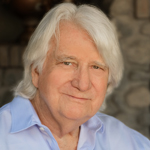
The first in his family to attend college, Wally Knox graduated from Harvard University after serving four years in the United States Army and is a decorated Vietnam War veteran. While at Harvard, Wally served on the governing board of the Harvard Young Republicans. Later in life, he decided he had become a Democrat. As an attorney, Wally specialized in the representation of working people and unions. During his time in the California State Legislature, he restored the eight-hour day worker protection and chaired the Select Committee on the California Middle Class, which authored pathbreaking studies that were decades ahead of their time. Wally is married to Beth Garfield. They have two daughters, Aviva and Tamara, and are members of Temple Israel of Hollywood.