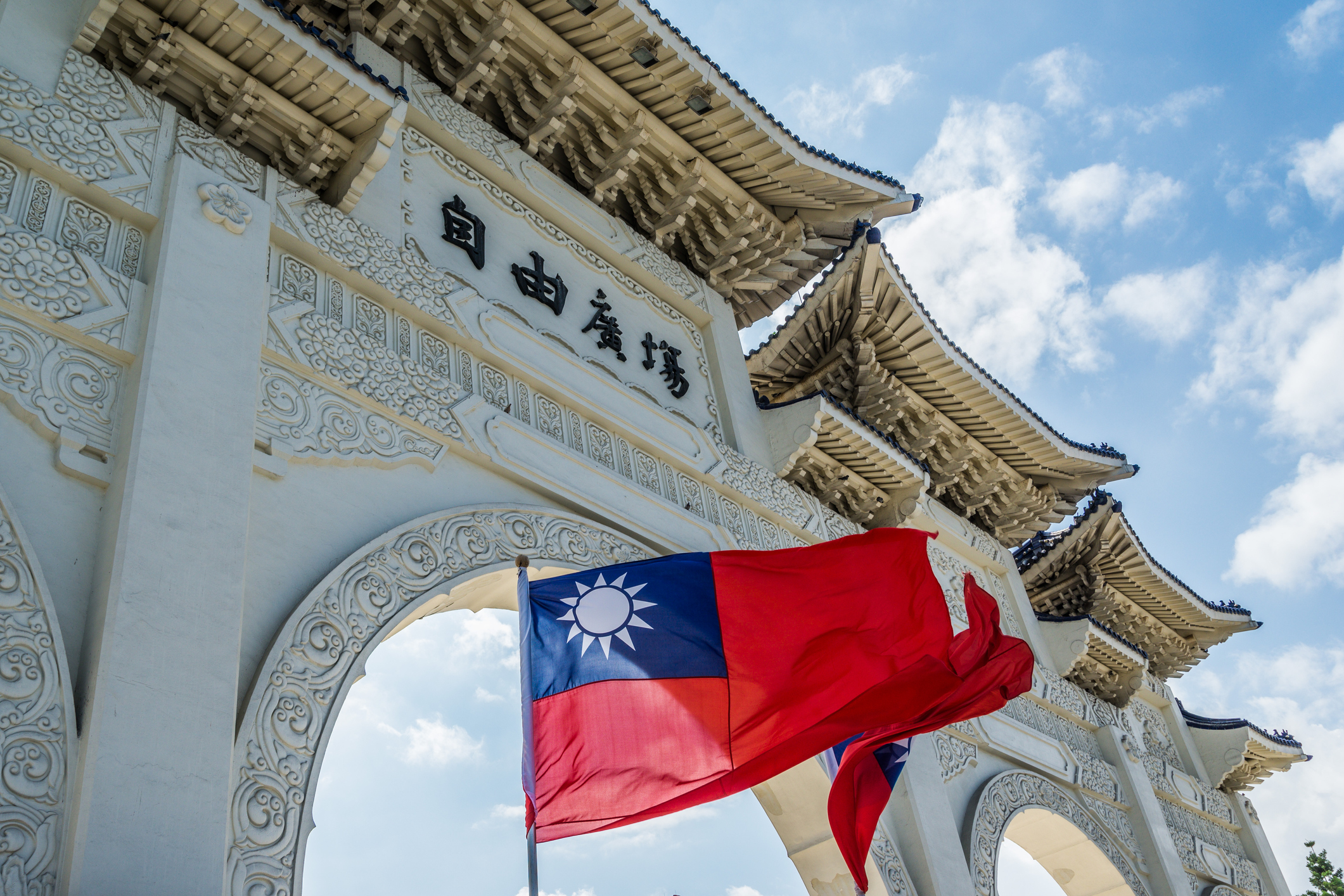
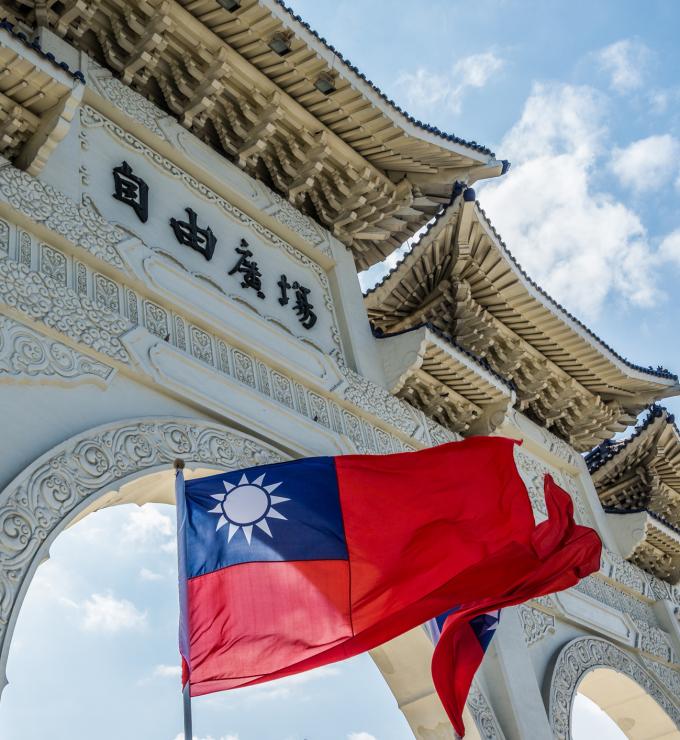
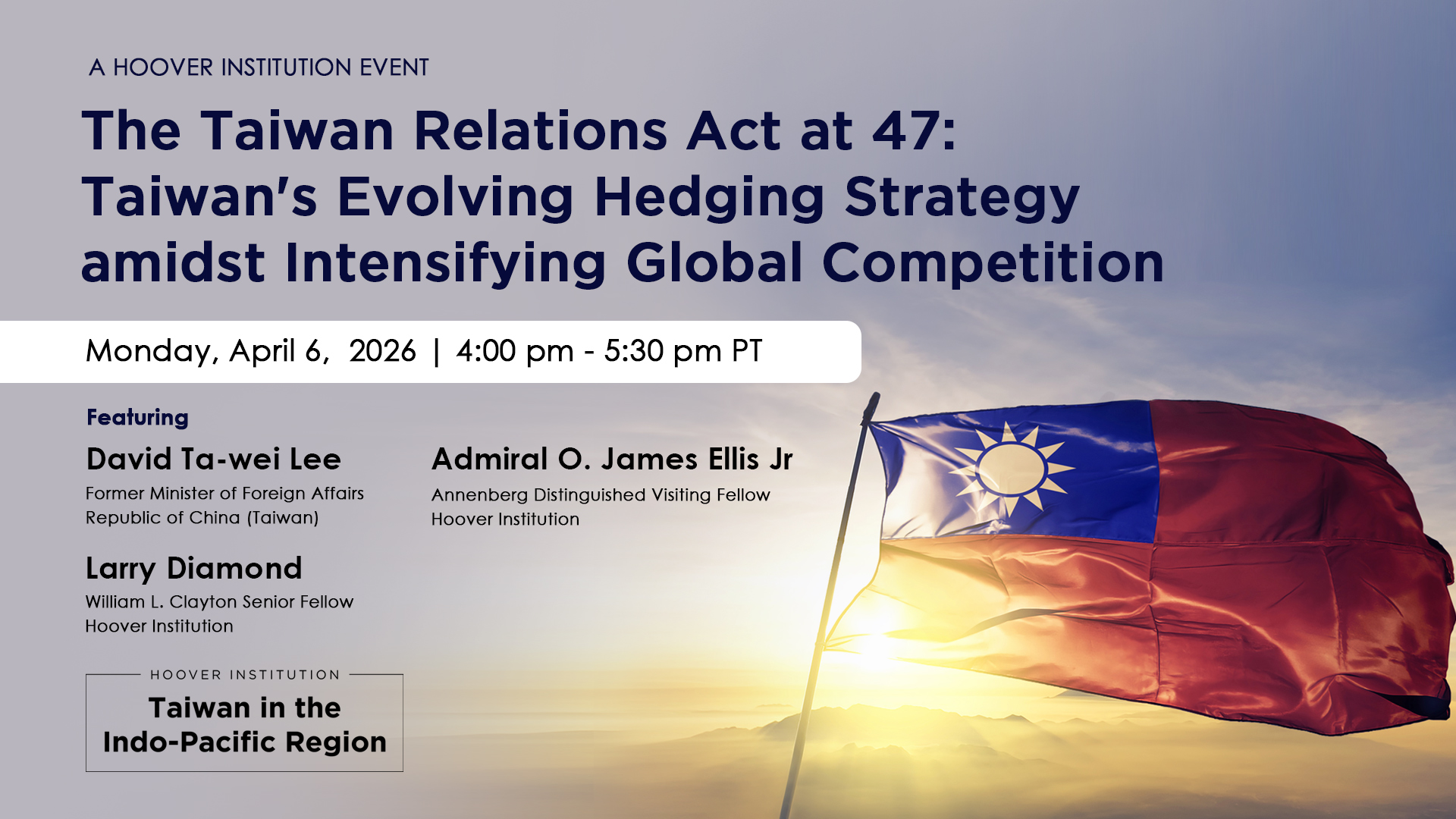
The Hoover Institution's Project on Taiwan in the Indo-Pacific Region held The Taiwan Relations Act at 47: Taiwan's Evolving Hedging Strategy amidst Intensifying Global Competition on Monday, April 6, 2026 from 4:00-5:30 pm PT in the Herbert Hoover Memorial Building, Room 160.
As we mark the 47th anniversary of the Taiwan Relations Act (TRA), the geopolitical landscape of the Indo-Pacific has reached a critical inflection point. The Hoover Institution is honored to host Dr. David Lee for an in-depth discussion on Taiwan’s evolving "Hedging Strategy" amidst intensifying global competition.
Since 1979, the TRA has served as the bedrock of unofficial relations between the United States and Taiwan, ensuring regional peace and stability. However, as the complexity of the Taipei-Washington-Beijing triangle grows, Taiwan's strategic maneuvering has shifted from traditional diplomacy to a multifaceted hedging approach.
This discussion explored the resilience of the TRA to assess how the legal framework of the Taiwan Relations Act adapts to modern security challenges 47 years later, and an analysis of Taiwan’s current policy of balancing economic integration, military deterrence, and international participation through the strategic hedging.
- Well, I want to welcome everyone here today to the Hoover Institution. I'm Ka Templeman. I'm a research fellow at the Hoover Institution, and I also manage the project on Taiwan in the Indo-Pacific region. And it's my pleasure today to introduce both our topic and our speaker. The theme for today's talk is the Taiwan Relations Act. And given who I see in the room, I imagine most of you are aware of what the Taiwan Relations Act is. And I suspect most of you also know that the Taiwan RELA Relations Act was adopted on April 10th, 1979. So we're coming up on the 47th anniversary of that momentous piece of legislation. The Taiwan Relations Act establishes the legal and diplomatic foundation for the United States robust, unofficial relationship with the people and government of Taiwan. We are also particularly privileged to have with us one of the foremost experts, perhaps the foremost expert in Taiwan on the Taiwan Relations Act. Dr. David Dawe Lee. He is a distinguished Taiwanese statesman and career diplomat whose service spans over four decades. I won't name all of the various kind of services he's done for his country, but I'll note that he was the chairman of the Straits Exchange Foundation, the semi-official body that handles cross strait relations in Taiwan. He was also the Minister of Foreign Affairs for two years, the Secretary General of the National Security Council of Taiwan, and the Secretary General to the president of Taiwan. He was also before that representative to the United States, to Canada and to the European Union and Belgium as a seasoned veteran of the Diplomatic Corps. Dr. Lee is highly respected for his professionalism and his non-partisan approach. And I, I'll just editorialize a little bit here. Dr. Lee got his start in the diplomatic Corps back before Taiwan was even a democracy under one party KMT rule. And then he later went on to advise two different DPP presidents. And so he has crossed the partisan divide in Taiwan in a way that very few kind of prominent elder statesmen have in in Taiwan. He also, and the reason we have him here today, is a leading scholar on the Taiwan Relations Act. He actually authored a book called the Making of the Taiwan Relations Act, which was published by Oxford University Press that derived from his doctoral research at the University of Virginia. This work remains a definitive analysis of the 1979 legislative struggle between the US Congress and the executive branch over at how to manage relations with the formerly recognized government of the Republic of China on Taiwan and its people after the switch in diplomatic recognition from Taipei to Beijing. At that pivotal moment, Dr. Lee was serving as the special assistant to Dr. Frederick Chen, then Director General of Taiwan's government information office. And he personally attended the congressional hearings that shaped the T-R-E-T-R-A gaining firsthand insight both into the legal framework for unofficial relations and a lot of the politics that went into this, this foundational piece of legislation. Let me just, yeah, so let me just note finally, throughout his career, particularly as as representative to the United States in the mid two thousands and as foreign minister, Dr. Lee was the primary official responsible for ensuring the United States upheld its commitments to Taiwan. Under the Taiwan Relations Act, he frequently advocated for the United States to maintain its so-called six assurances to Taiwan. And I expect we'll talk a little bit more about what those are and what they entail, and also work to ensure that the TRA remained a living document capable of supporting Taiwan's security and arm sales. So the format for today's event is Dr. Lee will speak for about 20 minutes, and then we have two of our senior fellows here at Hoover, Larry Diamond and Admiral Jim Ellis to engage in Dr. Lee in some conversation about the TRA and the other points of his presentation. And then after a a round of discussion, we'll open it up to you all. And so we welcome you to pose questions to our speaker as well. So if you have questions, please do note them down. We'll have time to get to those. Alright, without further ado, I think I'll turn the floor over to Dr. Lee.
- Welcome. Well, thank you so much Dr. Templeman for your very kind introduction. Anna Alice, professor Diamond and distinguished participants in this auditorium. I think as great honor and privilege for me to talk at this very distinguished institution and Dr. Dr. Templeman just said in a few days, we'll mark the anniversary of the Taiwan Relations Act. However, today I'm not going to talk about those historic perspective or some of the legacies of the TIA. Actually, I will take a more challenging topic to talk about the TIA 47 years after what Taiwan is facing, all the different geopolitical, geo-economic and other challenges to this audience. And I have put quite a lot of preparation for this location and because it's really great honor to, to talk to this group. And I would say that let's start from the leaders of the three major parties, which are crucial to the pretty peace and stability in the, in the region. So lemme start from Taiwan side with President la the, I think President Lai has been in office for about two years. I think over the past two years we have seen this position vis-a-vis China and vis-a-vis us have been consistent, have been realistic, and probably we can also say that there's probably no surprise, which is different from such some of his predecessors. And however, I think in Taiwan, the president now is facing some domestic headaches, especially because for the legislative minority and also the partisan rivalry and also I call that some identity divisions. I think all those put together created some political dialogues, which in my view will be extremely difficult to find a, a good compromise. And with regard to this country, I don't think you need me to elaborate. I think you should know far, far more than I do. So I just go on to talk about China and their president Xi Jinping. Actually probably I am one of the very few people who have not visited China personally because I was born in Taiwan and my career as a diplomat won't allow me
- To,
- To visit. And even after retirement, I still have a quarantine for four years. So now I've left government for two years. So I have two more years I'll be eligible to apply to visit. However, I've been the observer of China for, for decades. And my reading of the current leadership is president. She, I think he is very determined person and certainly I think I, as I I I write that he is trying to avoid direct military confrontation and highlighting his paramount authority and his historic mission. And when we read about the relationship, we have to know the factors, the reasons behind. So that's reason I, I want to talk about the, the behavior shaped by history and cultural as a I bonafide the foreign national, you know, and I've been trained as a American specialist since I was very young. So my reading is I have a lot of respect of the Marshall Spirit of America, which you demonstrated again over the Easter weekend by rescuing the pilot from the very dangerous enemy territory. That is something which I, I write that The patriotism individual responsibility and preparedness of using force, which is my reading of the culture of, of this country to face with for using force as a mean, as a political means. And my reading of the Chinese history is basically, I think Chinese history through the, the dynasty area emphasize a lot on the civil governance and try to suppress the military personnel's influence. And for the current leaders, certainly he emphasized so much on the party's command of guns and absolute loyalty to the party leadership. I think this has been the policy with the current leadership for the past 12 years. And as we have seen a lot of news about those cleansing or purchase of the leadership, both in the military and also in the government, and there are many different theories, but my personal reading is I think the main objective for the president, she is for those cleansing efforts is not for peace, but try to be better prepared for some possible armed conflicts. And, and also this is my reading of the cultural difference on, on, on war by the three parties. I always consider that even though now as a communist rule, China, I think they still respect a lot of theory, subdued the enemy without fighting. And my humble reading of the US is, I think the US can succeed in precision strikes. But as a democracy, as the president is undergoing the four years election cycle, the US Americans cannot tolerate the projected warfare. And for Taiwan, actually I think we will say that about 70 or even more of the people, they prefer to keep their stethoscope, keep their way of living as they are enjoying free and democratic way. And for the younger generation, maybe we may call them generation XR, generation ZI named that, that they are natural Taiwanese because when they were born, Taiwan has already become a very dev, economically developed and demo democracy and more pluralistic society. And I think they enjoyed the peace dividend and enjoyed the comfort hybrid. Their willingness to go to war and military service is relatively low. I think that that's a, allow me to borrow the, the Latin word copy dm, you know, very complacent with what they have. Again, I'm going to talk about the current thinking of, of using military force of the Chinese government. I still consider under President Xi, he still adopts the philosophy of trying to subdue the enemy without fighting. And I, I would say that he'll try a lot of indirect way, you know, some of the so-called traditional united front tactics to try to, to win without using military means. However, I think the recent years development in Ukraine and, and the Turmoils in Middle East has, he has learned some lesson, try to modernize the capability and effectiveness of the people celebration army by, you know, preparing some warfare for the modern times. And overall, my interpretation, even though we have read so much about the, the 2027, the possibility of a military conflict across the Taiwan Street, but my personal reading is as President Xi said himself that a peaceful unification still is his ma his optimal option. And I will say that by using force will be his last resort because he knows the cost of a military campaign, which Carrie, a high cost both I think in political, economic, social, and in international relations will be tremendous impact, which a lot of for unforeseen factors involved. And I would say that probably Xi thinks that China may not be, and this quickly as putting out, you know, when he invaded Ukraine in 2022, and I think in recent, I think in the, in the past decade, China has really prepared for those kind of a ad strategy, anti-access and aerial denial strategy by developing their rocket forest with stronger capability to reach Guam or even further. And also the supersonic missile system of VO 17 and the it, the anti-corruption and the political cleansing, as I said earlier, in my view is simply for better preparedness for a possible military conflicts. And they have worked so hard on the cyber and the electronic warfares and also joined operations. And also I have to talk about Taiwan, my own country. I think basically I would say that because during the Cold War area, era, certainly it was confrontation and, and then was the end of Cold war at the complex developed. And in 2014 there were some sunflower movement group of young people, they were suspicious of, of the government policy to be closer with the China. So that was the social movement, which in my view brought a lot of awareness of, of, of the, the threat. And now with more new emphasize on self-reliance and also the whole of society resilience and also probably thanks to the assistance from US military, under the spirit of the Taiwan Relations Act, I think over the decade there have been a lot of exchanges and assistance of training by the US to help Taiwan to be better trained toward the, I think to, to, to be more combat ready like familiarities with the terrain and exploiting asymmetrical, combat advantageous. I think this has been going on. I think as I understand we have some achieve that, but still we have a lot of room to to, to improve. And I would say that we have some patriotic resilience, but, But I would say that the, the challenges still tremendous for, for this country to face. You know, I've been a analyst at my junior years and later as a policy planners and when I get older, finally I've been close, I've been have the privilege of being close to the president's high. So I was one of her key advisors. I could have access to talk to her, to give her my honest advice and opinions as I, I I I, I read secretary shoes when he mentioned about trust is the key. I think I had a privilege of having the trust of the damn president higher. So Based on my experience serving as a, as a advisor. So I have proposed eight points of, I call that the risk hedging strategies for the current Taiwan for what we are facing for the coming years. I think the first certainly is to enhance the credible deterrence and area denial, I think by, you know, this kind of emerging asymmetric capability like drone and then both ai, electronic countermeasures, missile defense, you know, all those ISR and and C two capabilities. And as we have seen, we in the recent years since Ukraine, then Middle East now with the Iran, we find that the traditional military platforms are still essential, which is we are still trying to work with the US try to acquire some of them. The second part I would like to, to emphasize is how to strengthen the resilience of the whole people. Because this is not something we need some foreign help, it's something we have to work on ourselves, which it's not easy task, it's not very costly, but takes the joint efforts of both, both the government and also the, the whole society. The third point, I would like to say that because of current Taiwan's success in the semiconductor and ICT industry and with the development of ai, Taiwan's manufacturing and the ecosystem will be very pivotal to the forthcoming global digital economy. And which I think it will be difficult to replace the fourth suggestion, which I think will be sort of controversial to a lot of American people because I personally think the US policy vis-a-vis Taiwan, especially based on the spirit and the letters of the Taiwan Relations Act, you know, I think if the, the PO us position has been too transactional, I could, I I think it could invite some miscalculation from the other side. So that's a reason I would say that try to find some sort of dedicated balancing act on the security cost interpretation of the TRA. The fifth is, I I I'm talking about the international alliance. Actually, in my view, current situation is the best I've ever seen for my 40 plus years of, of, of a diplomatic service. I think especially after Ukraine war, I think more European nations have changed their mindset before that they thought peace will be with them. You know, it's a kind of daily life. And after the Ukraine, you know, they develop a lot of empathy or ies, which Taiwan want. And we have seen even some naval patrol from countries like uk, uk, France, Germany, Japan, Australia and Canada. You know, those were not possible before the, the, the 2000 before the Ukraine war. And I think this is really the best moments for Taiwan to work on, to strengthen the, the international alliance. The six point I would like to make is something which have not been written much in English literature certainly is sort of sensitive area of study, but based on the recent lessons from Ukraine, Israel, Venezuela, and Iran, you know, we have seen, you know, some of the most dangerous enemy are within the system, the seventh. So, so the point something we don't need any foreign assistance is something we have to work on ourself, is to find some compromise, some accommodation of the parties and politics in Taiwan, which is easy for us to say. That was extremely difficult for the players to engage those negotiations. And I had some experience, better experience. I can only confess I'm happy, I'm no longer working the government. The last a case for me was, is is the pragmatic policies. You know, I would say that the leaders should try to avoid Provo provocation, strengthen the national defense and adhere to the strategic focus and also try to have a, a prudent and moderate policy. And so as I was serving the government, I always advise my leader, you know, I think to buy time, actually it's a strategy because since 1949 it has been 77 years, we, we are able to keep the status quo, to keep the Taiwanese people free and, and pursue their happiness and, you know, to try to continue this kind of status quo to buy more time as, as we have a, a Chinese cliche which says that to wait until change to come. I think this is, I think my personal observation of the current status and my humble suggestions. Thank you.
- All right. So I'm gonna turn it over to our senior fellows, Admiral Ellis and Dr. Diamond for some initial reactions and a conversation.
- I'd be delighted. Well, first thank you again for a splendid presentation and and for your presence here today. And I know you had many things that brought you to the Bay area, including family, which is always wonderful, but we're honored to to be your first, your first stop in your, your visit. Yeah, and I, and I do appreciate the, the insights and the candor that you, you've brought to this. I guess, you know, when we look at the, the history of the, the Taiwan Relations Act, you know, 47 years and, and, and continuing as my colleagues here will, will recognize, and I saw in one of your first slides there, we often use the, the term status quo, but I think your hedging strategies indicate that in a very real sense, nothing is the same as it was 47 years ago.
- That's right.
- And everything has changed. And the idea that status quo is a euphemism for going back to where we were 47 years ago where China could not challenge and the, the US administration political dynamics was all politics ended at the water's edge. There's lots of things that have changed both in Taiwan and China and in the, in the United States. And so I try not to use the term status quo, even though I know what it means in, in one context, which is, you know, the, the, the peace and the, and the, and the access and the, and the, the evolution and, and peaceful and and pragmatic terms that are agreed to by both sides on the street. It's what's generally meant. I really don't think there is a status quo anymore in a, in a very real sense. And the real question is, I think you're wrestling with us, how do we hedge against that going forward? The the strategies are, are are all very logical and cohesive. I think the one that will leap out at most, I think is, is moving beyond strategic ambiguity. Because there are those that argue it has served us well for all of these years. We all remember that the Taiwan relations act, you were there, you lived it. I was a low level fighter pilot somewhere in the Indo-Pacific I at the time. But the, the fact was that was a, an effort, a successful effort on the part of the Congress rebalance and to, and to assert the Congress's role in oversight as one of the three pillars of our democracy. I won't go into our own domestic politics these days and, and ask the not so rhetorical question as to whether the that's still being, that role is still being filled by the, by the Congress. But, but again, that too is a, is a change that that, that we've seen over, over many, many times. But I'd like to, to ask, you know, on the domestic political scene, we, we tend to view Taiwan, I think inappropriately on occasion as a discussion through the lens of the US and China. And I don't think we give enough credence to the, to the role of Taiwan and the Taiwanese people in that consideration. And, and so I guess my, my first question is, and and some of it's laid out here, what do you think we need to do in the United States to be more aware and more understanding of the, the dynamics that are in play in the political environment in Taiwan?
- Hmm. - I mean, Larry is the expert on democracies. I'm a great admirer of them, most assuredly an admirer of the democracy that we see playing out in Taiwan. But you know, in the geopolitical space, you're a young democracy in a, in a very real, and, and, and democracies evolve over time. I mean, we didn't get it right in the United States, somewhat argue we still don't have it right today, what are there 27 amendments to the Constitution? So we didn't get it exactly right at the beginning. And so as you see these evolutionary steps taking place, what cautions would you ask of the United States? Not that there isn't a sense of urgency in dealing with the, the plate tectonics that are shifting, but, but how do you see the natural progression of Taiwan's democracy from the Taiwanese perspective, not from the, the role of the, the United States would be my first question. And then, you know, when you talked about domestic political harmony, you talked about the common denominator. I'm an engineer and unfortunately that of that term common denominator al often comes with the, the additional modifier, lowest common denominator. I don't think we want the lowest common denominator of that. And I would argue also that common denominators aren't all that common when you, when you deal with, with internal politics. So I guess, you know, rather than just say, Hey, can't we all get along the old, the old saying from America's domestic turmoil of some decades ago, what do you see really is going to be the, the pivotal forcing function that makes that happen? I would've thought that the environment in which Taiwan finds itself today, the, the economic challenges, the certainly the national security challenges, the, the political uncertainties is being injected by not just the PRC but to some degree by the United States, that there is a, an element that, hey, we've got to, to do this, to get this right is I'm fond of saying there is no such thing as local politics in Taiwan. They're all international politics. Yes. Because people are watching Yeah. And, and they draw conclusions whether they're appropriate or not. Yeah. And so my question I guess is can you be a bit more specific about that and then I guess the, the final piece piece deals with your appropriate focus on, on the resilience of the, the entire people. And I know that President Lai has a very strong initiative to talk about about that resilience going forward. Deterrence is, as the old architects of that shelling would say, require both capability and will,
- But - What's your assessment of the will of the, of the Chinese people, of the Taiwanese people in, in that context? And I'm not, you know, trying to put it in a, in an ultimatum, well, if you won't fight for yourself, why should we kind of thing the old Lyndon Johnson Yeah. Saying about Asian boys and American American boys and now men and women that, that fight so well for their nations. But I guess my, my question is what are the dependencies in all of that? What are the, the internal conversations when we go to Taiwan, as we will again in September, we now meet with the, the influencers, the younger generation and, and we get a bit of a different perspective than we do very good when we talk to the, to the cabinet members. So I guess those would be my, my three points and then I would invite Larry to, to offer his own, you know, what is it gonna take to, to deal with with those those situations as you appropriately lay out these, these hedging strategies going forward.
- Why, why don't you answer those questions? Oh,
- Okay. I know
- You have extend the agenda to,
- You are a king observer even though you are a thousand miles away and you have been trained an engineer. So I would say that your observation is sharp as a sword.
- Oh.
- And it is very difficult to answer these three questions that you proposed because my personal training as a student of political science, mainly I was highly influenced by the political realist from Hans to Reho, New York, and also my dissertation advisor, Kenne Thompson. So I mean that fashion of political thought. So we believe this mean politics is just about the struggling for power and struggling for, for personal interest. And the best way to, to manage is to find a prudent and moderate position, try to navigate a path. And I
- Like navigation as an old sailor, right? I'm in.
- Yeah. And you were a sailor and I was a diplomat. Our job was to make sure it's a safe journey. And we don't know why we going to encounter before we start the journey, but we, we'll, we'll meet with some storm difficulties and thing is how to navigate through the storm safely. And that's the objective. And I have to say this, the Taiwanese parties is not the unique one with the deep political polarization, which Larry is a top expert of this subject. One of the recent political science empirical research I read is they find the polarization of the population, especially for the age above 60 years old, with college education, is much more divided than the younger generation. And I think according to the literature, it attributes on their different positions with China, namely you can call that pro independence or pro unification and also because of the introduction of the social media. So there has been those kind of, we call echo chamber effect. And also the campaign has been mostly sort of a negative campaign style, which invites further division among the, the, the voters. I think that has been the reality, not only in Taiwan, I would say that in this country and also a lot of European countries, as we have witnessed that in uk, in France, in Germany, we all have seen this kind of a scene and that literature finds that the Japan with one nation, one country and some of the Nordic countries, that they are not as much polarized on these issues and how to man the fences, how to engage in the negotiation accommodation compromise, which is extremely massive and tedious work. Lemme tell you some of my personal experience when my, my wife is there at, when we were in Washington, it was Bush 43 years at that time the was under President Arabia's administration. The ruling party was also a legislative minority and majority party, they blocked the major weapon procurement systems, the Patriot PP three C and the submarine. Yeah. And so, you know, I I went back on, on some consultation tour, so I visited several of my old friends, they were legislators and I thought we were friends for since high high school, some of them since college days. But just I faced, IIII just had so many deaf ears, you know, they wouldn't listen to, to, to, to my my arguments at all. And a few of them later became ministers are even higher positions after 2008 and well because of the delay in during that period of time. So we are in great difficulties on the acquiring of the, the submarine. And so that's one of my personal experience also later when I serve in the foreign industry. Actually that was easier because they all legislator realized that we are facing some and, but when I was serving the National Security Council and later with the presidential office, it was also very tough, difficult negotiation. I wouldn't want to even to recall those bitter experience. That's the reason I said that I have a lot of emphasis to my friends. They are currently still working in the government.
- So I don't have questions. I have comments
- Please,
- If that's okay. And, and also quite a lot of sympathy for the basic line lines of argument you have, including quote, strategic ambiguity, end quote. Yeah. But if you'll permit permit me, I'd actually like to start by saying a few things about the Taiwan relations Act. You, you don't need to take notes on this. You could recite it all in your memory, but there might be a few people here who won't. They, they're bound to be some who weren't born 47 years ago. I, I know there were. And so I'd like to, you know, take us back to that moment in 1979 when, you know, president Carter determined, I I actually think it was inevitable.
- Okay.
- Sooner or later, let's, let's face it. I mean, a lot of people blame Carter and want to hang him in effigy. Look, we could not indefinitely maintain official diplomatic relations with a country the size of Taiwan and not have diplomatic relations with a continental or semi continental emerging power. It was just inevitable. We were gonna have to make some adjustment. And the Taiwan relations Act was a way, and I'm not sure this analogy has ever been made, but I I actually think there is a nato like element to the Taiwan relations act. I know it's a strange thing to say you should raise your eyebrows when, when I say it, but there was a security architecture dimension to this, right? Right. Because both NATO and the Taiwan Relations Act and the other pieces of the East Asian US security presence, which of of course were our, our bilateral treaty arrangements with Japan and Korea and our true presences in Japan and Korea were ways of maintaining geopolitical and security stability in V two or two of the three most important security theaters for the security of the United States. And I would say the world which are, you know, Europe extending all the way now, if I can say so to Ukraine, east Asia, and the crucial question of the future of Taiwan, which is the most open and critical question and the Middle East and preserving, you know, the existence of Israel, whatever you wanna argue about its policies, it's it's borders, et cetera, as also an embattled and independent democracy. And I think those three, and then of course you have preserving the flow of oil through the gulf. You know, I I don't think there's very much that challenges those three as security priorities of the United States. And so the Taiwan Relations Act created this structure, ingenious structure, I think to preserve, to say, okay, we have to yield to reality. We have to recognize formally the people's Republic of China as our diplomatic partner, but gosh darn it, we're, we're not abandoning Taiwan. And we will have these kind of diplomatic fictions
- Yes.
- That we will live with, with a large robust, you know, embassy in Taiwan that's not an embassy, the American Institute on Taiwan, but is, I believe, if I'm correct, one of our largest non diplomatic, diplomatic presences in the world in terms of the number of personnel there and the sophistication of our presence. All of the commitments surrounding security and arm sales with the Taiwan Relations Act, making very clear that we would provide Taiwan with defensive weapons as necessary to enable it to maintain. And then the quote, sufficient self-defense and sufficient self-defense in the context of what the people's, the People's Liberation Army has been doing to modernize and expand and prepare for, if necessary a military invasion and assault to conquer Taiwan, swallow it. I I'd say that's almost open-ended in what we should be prepared to provide. And then we come to the strategic ambiguity element of the, of the Taiwan Relations Act. And yes, we're not saying we will, we aren't saying we won't, right. But we are saying in the Taiwan Relations Act, the peace and stability in the area are the, are in the political security and economic interests of the US and are matters of international concern. Not strong enough language in my view, but then it goes on to say it is US policy. And now I'm going to quote to consider any effort to determine the future of Taiwan by other than peaceful means. And other than peaceful and means includes, it made very clear boycotts and embargoes a threat to the peace and security of the Western Pacific area and of grave concern to the United States. If something is of grave concern to the United States, like in my mind that's not optional. And so I would say built into the t Taiwan Relations Act is already the pathway for President Biden to come forward and say four times and answer to a question, will you defend Taiwan if the PRC uses force against it to violate in essence this understanding and compel reunification. And we know it's the single most significant international thing. I think Biden did Yeah. In his, for let's say uneven to be respectful years as president. Yes. Just unambiguously. Yes. Now I think probably to preserve our diplomatic obligations, we should say yes, but this, this doesn't imply with a big smile any change in our policy of strategic ambiguity. Yeah. And that says to me, and I think it reflects David, the balance you are seeking in everything you have been saying in an entire, in your entire career as a diplomat because you are the quintessential Taiwan diplomat. I think that, you know, we keep coming back to this Teddy Roosevelt's famous policy speaks, speaks softly, but carry a big stick. Right? And so you concede to the diplomatic, you know, language you need to, but you make very clear what your intentions are and you do it with deployments and so on. And now I'll conclude with a few very direct thoughts. I don't think you're gonna want to get into US politics, so you can ignore the first one if you want to. There is nothing in the world in the last couple decades, at least strategically, that has concerned me more, that keeps me up awake more than deterring the people's republic of China's, I think ambition to swallow Taiwan. I think it dwarfs anything else in terms of a plausible, not only threat to a free people, but a game changer in terms of the balance of power in the world. And I don't think we have made enough effort, not nearly enough effort in the United States and not even President Biden after saying it four times, nearly enough effort to make clear to the American people why it's a strategic imperative and what the world would look like if the PRC swallowed Taiwan's swallowed its semiconductor industry, moved its submarine fleet from Hanan Island to Taiwan and basically had a choke hold on Japan, Korea. Yeah. And all of East Asia talk about naval balances of power and, and shipping flows and so on. And you know, the longer we spend our military and financial treasure in this war on Iran, and I'll save my further comments on the war for another time. And the more we deplete our, we uneven to begin with weapon stockpiles there, the more I think we jeopardize our deterrent capacity in the region. And so my first point is, and it already implies leaving until later my comments, I think we need to shift very soon, pivot very soon back to a preeminent strategic focus on East Asia. Secondly, in terms of Taiwan's defense capability, I wanna say not only thank you for increasing your defense spending and I hope the other party will agree to it soon, but a couple other things. One is I think Taiwan must learn the lessons from Ukraine and, and the current war in, in Iran on the evolution of modern warfare and the need to self generate drones and other a asymmetric weaponry. I think this war shows both wars in Iran now and the Ukraine, Russia war, how Right. Admiral Lehi Minh was in this room when he articulated the overall defense concept right in his book in Taiwan and in everything he's been saying, and I hope that is seeping into Taiwan public and defense consciousness. Third, I very much agree with you both with respect to Taiwan and with respect to the United States, that there's an urgent need in both democracies to reduce political polarization. And we have certainly engaged moderates on, on both sides of the principal political divide in Taiwan who wanna see that happen are, you know, would like to see that happen. But was we about before the break? Part of the problem in Taiwan is intraparty conflict and not just conflict between the two parties. And I think Taiwan will definitely be not only a stronger and more vibrant democracy, it's already one of the great success stories. And we're coming up just next month on, we might add on the 30th anniversary of Taiwan's democracy, right, right. With the inauguration of Lee Donway as the first directly elected president of Taiwan. But it, it, it's a matter of national security that Taiwan achieved that. And so I hope that we and others in the, in the US community thinking about international relations and international security can do a better job of conveying to the American public why this is not only as the Taiwan Relations Act said potentially a matter of grave concern to the us but it is in fact, as I think Prime Minister Taka Ichi is now making clear to her own people in Japan a vital interest.
- Larry. Larry, I really love your comment. You know, it is, it is, it's great. And you know, I, back in the eighties, I wrote a 400 plus pages of dissertation and my wife Lynn, she's she type every page of
- Oh wow.
- And
- No word processors then,
- No word processor at that time. And Actually, you know, I used the word of master for ambiguity to describe the debate, the compromise accommodations between the member of Congress and also vis-a-vis the executive branch of Carter administration. There were let a lot of trade off, a lot of horse trading our attack of war, you know, and I personally witnessed a lot of the thing, I read a lot of the, the internal documents from the members of Congress because back in the late seventies eighties, the Congress is completely different from today's, you know, it was the era of senatorial courtesy. And, and also in a way before the nine 11, it was very permeable for graduate student to conduct an, a research interview with the key assistants or even members of Congress. They even opened the archive for me. So, so I was able to, to, to put on more than 400 pages on the legislative history of DRA and you know, a lot of, we call working horses in the, on the hill, you know, they, they are not a show horse. Right. You know, they really spend time reading and work out the language the, the the, the, the the, you know, talk with the administration to say, will you accept this and this will you accept this word? You know, those are very interesting political education for myself and it influenced my career for more than 40 years. I'm very much indebted to that democratic education.
- Yeah.
- And certainly 47 years after, it's a completely different Taiwan with a lot of transformation, not only politically to a democracy, economically, we become a powerhouse of it. ICT field. And also the polarization of the society is also tremendous. You were talking about talking with the, the younger generation, the, the, the, the social media influencer. I think that's a good idea because they, they have more influence than the traditional media. And also, you know, I think sometimes probably some advice from foreigners maybe could be more influential to some politicians because as I said, there have been a lot of bad blood of intra intraparty politics. So always some deaf ears when you talk to them and some foreign supporters or so some from friends, your advice, maybe they will listen more carefully. So I would encourage you to pay the visit and talk with people from different views and that's very good. We will appreciate. Sure.
- All right, so in a moment we'll open it up to the audience, but I wanted to pose one question myself. Yes, please. Exercise moderators prerogative here. And actually this is drawing from a question that came in online, which is your assessment of the US Taiwan relationship as it is today. Given your long history in this space, how does it compare to say, 40 years ago? Are we in a better place? I hope so. I, so, but I'm curious on, on how you evaluate that comparison and then related to that, since we're, we've kind of framed this as the 47th anniversary of the TRA, do you still think the TRA is fit for purpose? Would it help the relationship for the United States to pass new legislation that supplements what the TRA says? Yeah. For instance, there's a proposal floating on Capitol Hill now to write the six assurances into US law. Yeah. What's your take on that? Do you think that would be a positive step?
- Yeah, yeah. Thank you for your good questions. I think the first one, I would say that the bilateral relations has been quite different from 47 years ago. Because I still remember during the deliberations of the TRA, there were still some concerns, which is also included in the legislation about the human rights in Taiwan. At that time they were, they called gang of four in Congress. On the senate side there was Senator Edward, Edward Kennedy, and Alan Cranston of California, right? Those are part of two. The other two was on the, were on the house side was Congressman Lars from New York State and also Jim Leach from Iowa. So they, they call themselves gang four because they were always arguing saying that, you know, we should demand Taiwan to further democratize the political process they put into the language of human rights concern. The department needs to issue human rights assessment report on of Taiwan's political development. So, so from that angle, I would say that nowadays is we are much better off than 47 years ago to the interest of Taiwan. So I think that's one of the reasons that we have, I can call that bipartisan support on the hill to support the, the security and the welfare of the Taiwan government on the six assurance to add into legislation. I don't think, well you have a cliche in in English, which is that if it broke don't fix it. Yeah, yeah. So once you start amending process, probably like opening and Pandora's box could with some undesirable consequences. Yeah. Because the six assurances was decla. Do we have the ms do we have the two pages? Yes. Which was declassified by John Bolton right before his departure as as a national security advisor because those were the documents locked in the presidential safe because the understanding of of Reagan when by the time he signed six communique, he was very unhappy with the dance sector of state L Hay. And later he replaced with a distinguished gentleman, Mr. George shoes as the sector of
- State built this room.
- That's right. And, and that two pages of document with Ronald Reagan's hand writing, I think the best proof.
- Yes, very good.
- Yeah, those, those were top secret and now is declassified. So I put those two pages for you to take a look, which may be very clear, Ronald Reagan wants secretary shoes and defense Secretary Weinberger to know that the signing of the sixth assurances is based on the premise that the resolution of the Taiwan issue will be on peaceful means. Which I think those two documents will be, will, will be, you know, good proof of the US intention and certainly I hope the current administration, they will read us should we, but certainly now they are very busy with so many things. Yeah.
- Alright, with that, let's go ahead and open it up to our audience. We've got about 20 minutes for a q and a with our distinguished speaker. Any questions out there David?
- My name is David Fedor here at the Hoover Institution. Thank you sir for this presentation. As, as Larry mentioned, when we visit with friends in Taiwan, we aim to do so with moderates of every political party. And one thing we hear in terms of a, a risk hedging strategy that I don't think was in your eight points has to do with the dialogue and engagement with the PR C's right inside Taiwan. How do you think about the utility of that engagement? What it can get, what it can't get?
- Well that's the, in my PowerPoint I talk about identity dimensions, which signifies the different perspective on how to manage relations with the communist China. And overall, I still think that the majority, over 70% of the population, they still prefer the current, you know, status quo. Yeah. Whoever, how to define it is, is fine. Which means you keep your, your freedom, your way of choosing the system and every two years you will have opportunity to elect your representative or your national leader. I think that kind of freedom is very key to the people, but partisan politics makes things quite difficult. As I said, it's not only happen in Taiwan. Taiwan and some people even argue in this country you have a lot of poor rights are debates. So do in many of the events, the old democratic countries in Europe and, and the, the current con chairwoman of Gua, she is embarking on her trip to China in just a few hours and suddenly, you know, as I read that president, she is scheduled to meet with her. And I told Larry earlier, I said that, let's see what kind of concession president she will offer, but I wouldn't think that vice versa, vice versa. And the difference is the her party is in ness and, and, but what I can be sure is President Xi won't make any concession on the sovereignty issues, which is crucial for, for President Xi. And I don't think there was any possibility of compromise on this issue from my own reading. And you know, this kind of confrontational polarization is going on is very aesthetic, but that has been the, the, the political realities, you know, we all have to face on the island, which also stocked the, the whole government budget for 2026. And also not just that also the defense spending some of the, the procurement which has been proved by the Pentagon with the, of the Congress now is still on the table without the legislative approval. As I indicated in my PowerPoint, in my view it's quite some quite dangerous. It's not the hedging strategy. Number one was credible deterrence and credible denial. This is con completely confront against that, that strategy. That's my, my personal view.
- So Casey over here,
- Thank you very much for showing up here. One thing that strikes me is the speculation by Xi want innocent doesn't understand the willingness of the Taiwanese to
- Yeah, this
- Is the classic with regard to Ukraine and you know, everyone expected to be rolled over just a few days. So it strikes me that one of the elements of attempting to project 10 seconds, hey we, you know, this is gonna be a thorny thing is not just weapons we've got, but actual thing of this isn't gonna be easy bill rights up and this won't won't be easy Follow.
- Yeah, I think it's very important for, for President Xi to understand the, the kind of defend the homeland ethos, which is very crucial. And that's the reason I argue that I guess probably she still thinks that, you know, by using peaceful unification means will be his most optimal choice. And following the census victim, you know, by using force, by using invasion will be the last resort. That's my reading. Also, I would say that the Ukraine war and the recent Middle East Turmoils has taught him a lot of lessons as argue the clean scene, the purchase of the PLA, it's not for peace, it's, it's trying to be better prepared for, for the possible future military confrontation against the I want or against some foreign help. That's my reading.
- Can I just say that your neighbor once removed their professor Wu Chen Wu has actually been doing some public opinion research on this question. I hope Chen, that we can maybe get you to talk about your research before the quarter rounds.
- Yeah, thank you. So yeah, following up that question, I think in public 1995 yeah the, the general public is willing to fight. I think we're willing to defend the country. I think more than 60, sometimes even 75 founded indicate that they're willing to defend war. Yeah. So I think that that yeah, very confident. Yeah. But it depends on how do, how do we ask the question. So if we ask them whether they are willing to fight on a better field, then the percentage might decrease probably by yeah, two 50% or 55 in, in the general public. But that's still very high. Yeah. So I think on average the, the willing to fight is high in Taiwan, but the issue is how, how long can we stand? I think that's another, also another issue regarding the resilience. So I think in general we are willing to defend the country, but it it, it depends on how long we can resist. Yeah.
- I don't wanna interrupt too much, but I just wanna say how much does she understand?
- We don't know. I, I don't, I don't think, well I, well I was watching the, the news conference today, you know, the, the, I think obviously CIA has performed a very important role in the rescue of the pilot and I hope they could also have a good job of understanding the top leader's mind in Beijing. Yeah,
- Yeah. Don't we all they're working on it. So I have a question from online, which is about the partisan kind of debate over the special defense budget. Yeah. And the opposition parties so far refused to go along with the special budget. To the extent you understand it. Could you explain to us what their objection is to the special budget, the KMT, it may be a little more obvious, but the TPP as well, which is a new party, it's allegedly a centrist party and they have also opposed the special budget and your assessment from outside. What would it take for that budget to pass or some something that looks like what the law administration proposed?
- Well, based on my personal experience, I would say that in the end there will be a compromise.
- Okay.
- It will be a compromise. Now I would say a lot of political posture and especially before the chair woman's visit to China in the coming week, and I'm sure you know, my friend Ray Green, the a i director is working hard on them and officially they wouldn't say that they wanna listen to him, but privately his advice and important visitors like your good selves, your advice well carry weight well. So my best guess is will be passed, but probably not as much as the government expects that kind of high ceiling. There will be some compromise and definitely better, I guess will be more than what the going down proposed today. It's gonna be tedious procedure for sure. It will be very panic.
- Yeah. So let me go to another question from online. Got a sizable online audience today. Just want you to know, so this question is about the impression that the current administration, current US administration is more transactional in its foreign policy than any previous US administration. From your perspective, is that true? And if so, how should Taiwan navigate this uncertainty? What kind of, what should be the top priorities for the Taiwan leadership in this kind of environment?
- Well, that's a difficult question to answer. Fortunately, I'm a retired citizen. I have more freedom to, to to, to to, to do my own interpretation. You know, I've been as a practitioner for more than four years. So my practice told me that, you know, as a diplomat, as a policy maker, you have to face what what is in front of you. And President Trump was elected, you know, as being, he has more than two years to go. And so I remember after the 2016 election, you know, at that time I traveled to the US a lot. So I bought the art of the deal. I bought three copies, one for myself, one for the president, and one for JWW. And he is, he was a national security advisor at the time. So I told madam president, I said, this is the key book where in my view has been very honest to reflect the personality of the president elect. So we must read this, you know, she got her PhD from the of economics, but you know, she was very much preoccupied with so many things. So she turned to me, said that, David, would you make an executive summary for me? So, which I asked my colleagues to do that. And so, but honestly, I, I feel that he has followed the book very honestly. So I will say that, you know, his reelect, he, he got reelected, the book must have even more copies that being sold, which in my view, which is, so as I, as I made it clear in my PowerPoint, I said that we hope that we'll be more strategically clear in terms of the security concern of Taiwan. The too much transactional pharmacy will only invite some miscalculation. That's my my recommendation. Great.
- David, follow up.
- I'm, I'm thinking back to your, your list of eight recommendations and the last two words you used were profound and I think provocative the buy time.
- Yeah.
- Just wanna invite you to expand on that because you could, if you could buy time because you think that the trends are moving Yes. In a positive direction where that's economically or military,
- We don't know. Just like crosswords argue in the art of the world, you know, a lot of fog of war, certainly now with, with the ai, with the data analysis, you know, com company like a Palantir will make the job easier. But you know, some of the issues I would say that we still don't have enough data bank to build this kind of prediction model and what to do next for Taiwan is one of the questions I always try to ask my ai, my check GPT and, and I would say to buy time is sort of passive, but you know, we have, we have done this strategy for 77 years and who can tell us that we cannot do sometime longer because there are so many unpredictable factors in front of you and you simply cannot do those kind of long-term assessments, strategic planning as some normal countries can do so well, you know, I always envy and admire a lot of my American friends. I, I was, we, my wife and I were in Washington when I was chief of Mission there at that time. Your Stanford colleague Steven Krener, right? He was serving as Secretary Rice policy planning staff. Yeah. You know, that kind of guy with big brain is the time of kind of person I would like to see by our side. And, but our system, our bureaucratic system is very rigid. Then we won't be able to draw those kind of big brain to serve as the policy planning staff for the policy makers. So, so I think that's one of the reasons I survived for that long, long, long time in the government. Because obviously one was the junior need, your brain one was a junior analyst. My bosses seemed to like my analysis. So I got a promotion every, every few years. And later I became a policy planner and, and, and, and later I was a policymaker, but to the president, I was still her analyst. I was still doing the, the policy planner planning for her. And now I'm retired. So I just can write some of my, as I I, I read Jack Sullivan's recommendation a few weeks ago, just, you know, just to me is really resonate with myself. Right?
- Yeah. Okay. - Let me give our Hoover fellows a, a chance to respond to Admiral Morales.
- Well, thanks and, and thank you for your insights and the, and the great conversation we've enjoyed. Think I'd echo Larry's opening comments when I say that the concept of strategic ambiguity was a work of genuine diplomatic genius at its time. I mean, it really was, but I'm now involved in two track twos in China, and I sit across the table much like this from retired generals and the like. And I can tell you that tensions are now deepening in the overall US China relationship. No matter what the public rhetoric says, when I have retired four star generals across the table, say, Admiral Taiwan is coming back to China either before the war or after, and that's a quote, then you know that things are not where they need to be. Okay. The, the credibility of Washington's one China policy and Beijing support for peaceful unification are mutually eroding, and those plate tectonics continue to shift. The policy has not failed exactly, but it's under greater strain than in any point since 1979. Its future effectiveness depends less on the rhetoric of any particular president and more on the hard unglamorous work that you described, sir, of expanding missile production lines, funding, multi-year procurement contracts, and ensuring weapons actually arrive on time. Because in the end, what deters Beijing is not what Washington and Taiwan say, but what they demonstrably deliver. The core attention, I think is kind of this abandoning ambiguity for explicit clarity risks triggering the very crisis it seeks to prevent, but preserving ambiguity under a volatile transactional administration risks, allowing Beijing to gradually discount it as an empty threat. The most prudent course is likely what I call recalibrated ambiguity. One that is institutionally anchored through congressional legislation, the car's earlier point backed by credible arms deliveries and insulated from the rhetorical unpredictability, predictability of any single administration. So that's how I see it.
- Okay. Any final words, Larry?
- Well, you know, in settings like this, I constantly ask myself how candid do I want be, particularly with a, a radio audience accompanying us. Let me just say I've long felt that we need a searching candid and fulsome dialogue with the American people, as I've said before, to make the case essentially that you just articulated. Jim, maybe we should put you at, at the head of, of making the case
- If nominated, I will not run.
- But if you put this before the Congress, now, you know, particularly, I'm very worried if we don't be honest with ourselves in a setting like this, where can we be? I'm very worried about an isolationist backlash in American public opinion after this war in Iran concludes, which it will at some point. And so part of the recalibration, I, I think is, is going to have to be, you know, really a, a comprehensive kind of global strategic recalibration of what are our most important priorities, what really matters to the United States and to our strategic posture in the world. And if you're not prepared to make choices, even the United States with all our assets, then you're just not serious. You, you talk about this a lot when they sent you in 1996, you happen to be in the area, but you know, if an aircraft, a battle group is in one place, it's not in another, you know, so I think we need a, a kind of medium term plan to educate the American public and the American policymaking community. 'cause I, I agree with you Jim. I, I do worry about this. I think this, just say it again to conclude, I think the ability of Taiwan to preserve specific element of the status quo as it has emerged since 1996, this element for 30 years, which is Taiwan's ability to chart its course autonomously as a democracy and a free people is a vital interest of the United States. And if, if you declare something to be a vital interest, then you have to be prepared to defend it. And anyway, so that's where I conclude. I think we have a lot of work to do, but, you know, having people like you here, David certainly helps us and inspires us to do that work. The
- Important thing, Larry, too is we talk a lot about interests these days. I believe in my heart that America still has values as well. Yeah. And the preservation and support for democracies such as Taiwan has to be preeminent amongst them. Yeah,
- Yeah, yeah. I think personally, I feel really delighted to see the concluding remarks from the two moderators. And as from the Taiwan perspective, I still consider the self-reliance is the key word for us to work on, for all the parties to unite together, because that is, we, we, we are facing the same fate. If we don't unite together, you know, some people will drive the wedge in between. That's, that's been their specialty. And well, you know, as a formal practitioner, both UME and you know, we just have to deal with a realistic world. It's constant changing and evolving. It's kind of leaving case, just like you discussed about the term status quo. You know, it's keep on changing 47 years ago and up to today, two, the, the, the country of Republic China, Taiwan is completely transformed in several stages. So another four, seven years ago from now on, we don't have to worry about that, but at least, you know, let's try to keep the status quo, let people allow to have their democratic way of life there, and also let the economy continue to play a pivotal role in this kind of digital economy.
- We're, we're glad you're still in the, in the fight, David, my colleagues have heard me say it too many times, but I always end with a naval quote from Oliver Wendell Holmes who said, we must sail.
- Yeah.
- Sometimes with the wind, sometimes against the wind,
- Yes.
- But sail, we must and not drift. And not lie at anchor. We're glad you're at the helm.
- Yes. Thank you.
- All right. I just want to thank everyone for attending today. I'll just note to our online audience, this has been a production of the project on Taiwan in the Indo-Pacific region here at the Hoover Institution. And I just want to thank our AV team and so Marshall Robbins, Hannah mle, and especially Amy Alonso for help making this event possible. Thanks and enjoy the rest of your evening.
ABOUT THE SPEAKERS
Dr. David Ta-wei Lee is a distinguished Taiwanese statesman and career diplomat whose service spans over four decades. He has held the highest echelons of power across Taiwan’s foreign policy, national security, and cross-strait sectors. He is the chairman of Straits Exchange Foundation in 2020 and from 2023 to 2024. He formerly served as the Minister of Foreign Affairs from 2016 to 2018, Secretary-General of the National Security Council of Taiwan from 2018 to 2020, and the Secretary-General to the President since 2020 to 2023. He was also the Representative to the United States (2004–2007), Canada (2007–2012), and the European Union/Belgium (2001–2004).
As a seasoned "veteran" of the diplomatic corps, Dr. Lee is highly respected for his professionalism and non-partisan approach. Moving from the Foreign Ministry to the National Security Council and the Presidential Office, Dr. Lee transformed traditional diplomacy into a broader national security strategy.
In 2019, while serving as Secretary-General of the NSC, Dr. Lee met with then-U.S. National Security Advisor John Bolton. This marked the first meeting between top national security officials of the two countries since 1979, representing a historic milestone in U.S.-Taiwan relations.
Dr. David Lee occupies a unique place in the history of the Taiwan Relations Act (1979), serving as both a witness to its creation and a guardian of its implementation.
A leading scholar on the TRA, Dr. Lee authored The Making of the Taiwan Relations Act, published by Oxford University Press. Derived from his doctoral research at the University of Virginia, this work remains a definitive analysis of the 1979 legislative struggle between the U.S. Congress and the Executive Branch.
During the pivotal moment when the U.S. shifted recognition from Taiwan to China, Dr. Lee was a researcher at the time, and Dr. Frederick Chien was the Deputy Minister of Ministry of Foreign Affairs. He personally attended the Congressional hearings that shaped the TRA, gaining firsthand insight into the legal framework for unofficial relations.
Throughout his career, particularly as Representative to the U.S. (2004–2007) and Foreign Minister, Dr. Lee was the primary official responsible for ensuring the U.S. upheld its commitments under the TRA. He frequently advocated for the "Six Assurances" and worked to ensure that the TRA remained a living document capable of supporting Taiwan’s security and arms sales.
Larry Diamond is the William L. Clayton Senior Fellow at the Hoover Institution, the Mosbacher Senior Fellow in Global Democracy at the Freeman Spogli Institute for International Studies (FSI), and a Bass University Fellow in Undergraduate Education at Stanford University. He is also professor by courtesy of political science and sociology at Stanford, where he lectures and teaches courses on democracy (including an online course on EdX). At Hoover, he co-leads the Project on Taiwan in the Indo-Pacific Region and participates in the Program on the US, China, and the World. At FSI, he is among the core faculty of the Center on Democracy, Development, and the Rule of Law, which he directed for six and a half years. He leads FSI’s Israel Studies Program and is a member of the Program on Arab Reform and Development. He also co-leads the Global Digital Policy Incubator, based at FSI’s Cyber Policy Center. He served for thirty-two years as founding coeditor of the Journal of Democracy. Diamond’s research focuses on global trends affecting freedom and democracy and on US and international policies to defend and advance democracy. His book Ill Winds: Saving Democracy from Russian Rage, Chinese Ambition, and American Complacency (2019; paperback ed. 2020) analyzes the challenges confronting liberal democracy in the United States and around the world and offers an agenda for strengthening and defending democracy at home and abroad. His other books include In Search of Democracy (2016), The Spirit of Democracy (2008), Developing Democracy: Toward Consolidation (1999), Promoting Democracy in the 1990s (1995), and Class, Ethnicity, and Democracy in Nigeria (1989). He has edited or coedited more than fifty books, including China’s Influence and American Interests (2019, with Orville Schell), Silicon Triangle: The United States, Taiwan, China, and Global Semiconductor Security (2023, with James O. Ellis Jr. and Orville Schell), and The Troubling State of India’s Democracy (2024, with Šumit Ganguly and Dinsha Mistree).
Admiral James O. Ellis Jr. is Annenberg Distinguished Visiting Fellow at the Hoover Institution, where he oversees both the Global Policy and Strategy Initiative and the George P. Shultz Energy Policy Working Group. He retired from a 39-year career with the US Navy in 2004. He has also served in the private and nonprofit sectors in areas of energy and nuclear security. A 1969 graduate of the US Naval Academy, Ellis was designated a naval aviator in 1971. His service as a navy fighter pilot included tours with two carrier-based fighter squadrons and assignment as commanding officer of an F/A-18 strike fighter squadron. In 1991, he assumed command of the USS Abraham Lincoln, a nuclear-powered aircraft carrier. After selection to rear admiral, in 1996, he served as a carrier battle group commander, leading contingency response operations in the Taiwan Strait. His shore assignments included numerous senior military staff tours. Senior command positions included commander in chief, US Naval Forces, Europe, and commander in chief, Allied Forces, Southern Europe, during a time of historic NATO expansion. He led US and NATO forces in combat and humanitarian operations during the 1999 Kosovo crisis. Ellis’s final assignment in the navy was as commander of the US Strategic Command during a time of challenge and change. In this role, he was responsible for the global command and control of US strategic and space forces, reporting directly to the secretary of defense.