




The Hoover Institution Center for Revitalizing American Institutions webinar series features speakers who are developing innovative ideas, conducting groundbreaking research, and taking important actions to improve trust and efficacy in American institutions. Speaker expertise and topics span governmental institutions, civic organizations and practice, and the role of public opinion and culture in shaping our democracy. The webinar series builds awareness about how we can individually and collectively revitalize American institutions to ensure our country’s democracy delivers on its promise.
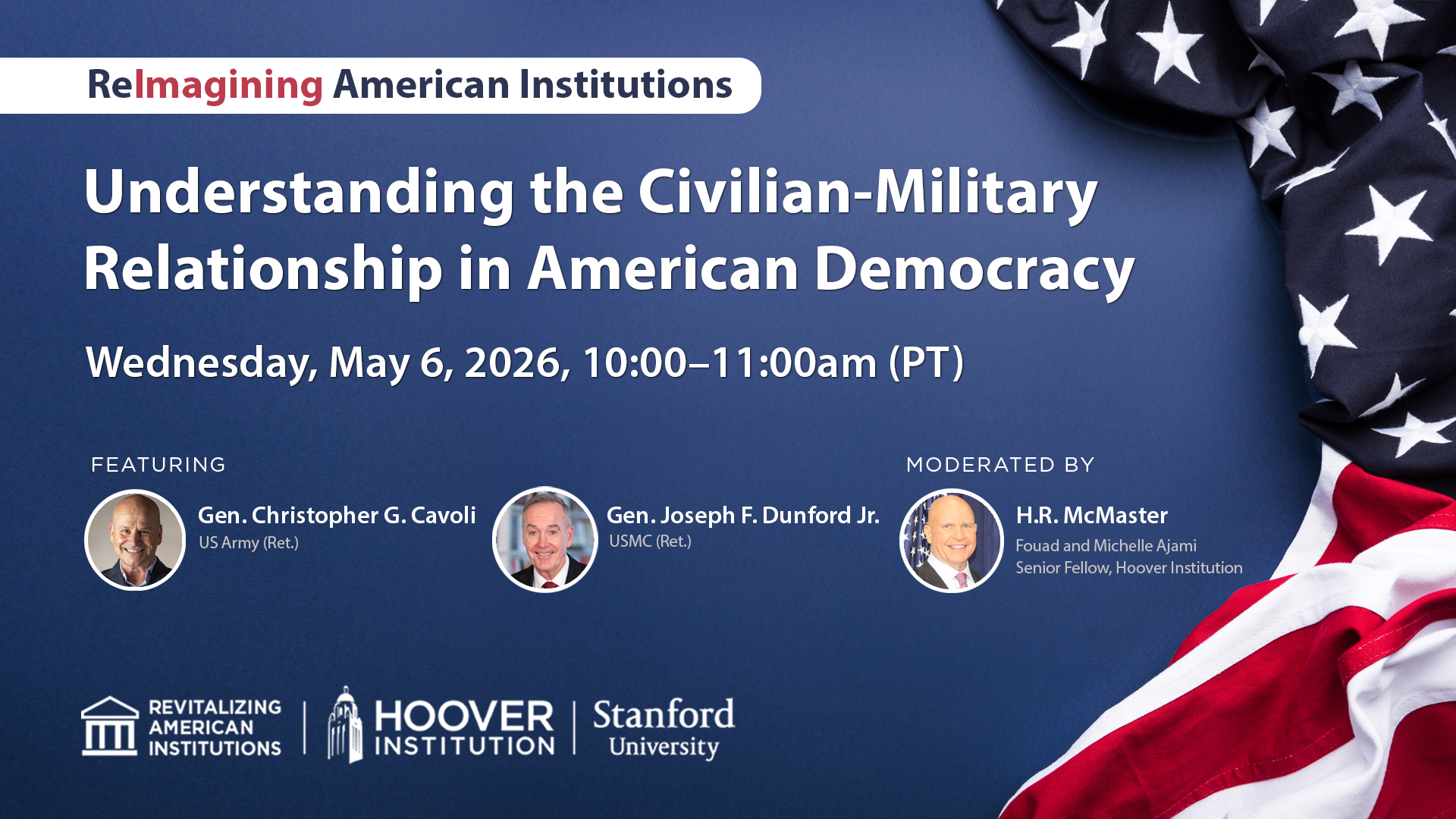
The Hoover Institution's Center for Revitalizing American Institutions held an engaging conversation on Understanding the Civilian-Military Relationship in American Democracy with General Christopher G. Cavoli, US Army (Ret.), General Joseph F. Dunford Jr., USMC (Ret.), and Lt. Gen. H.R. McMaster on May 6, 2026, from 10:00-11:00 a.m. PT.
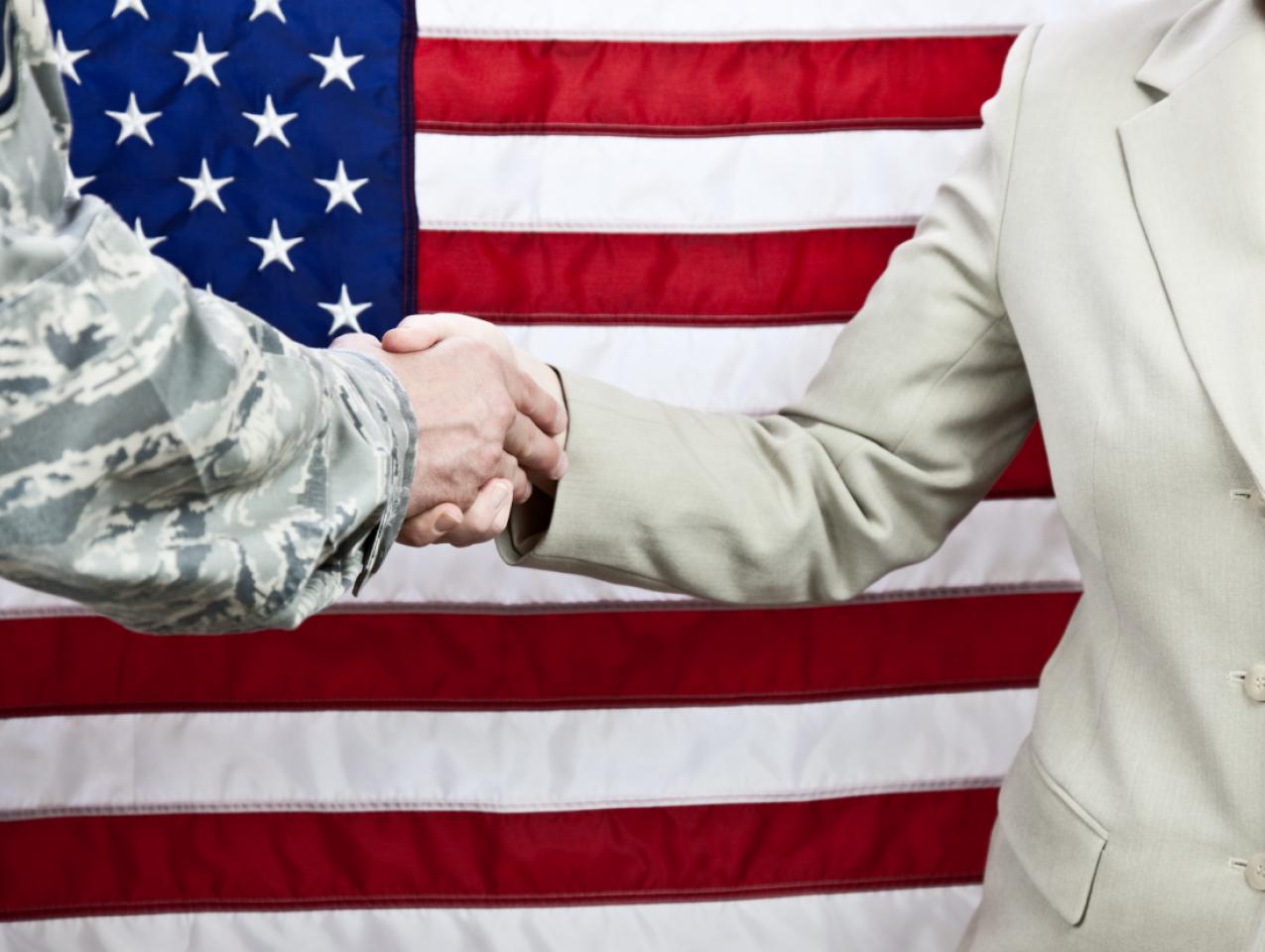
This webinar explores the evolving relationship between civilian leadership and the military in the United States—a cornerstone of democratic governance. Drawing on historical context, recent case studies, and expert analysis, the discussion examines how mutual trust, accountability, and respect for constitutional norms sustain healthy civil-military dynamics. Participants gain insight into current challenges, including political polarization, public perceptions of the armed forces, and the appropriate role of military voices in national security and domestic affairs. The session aims to deepen understanding of how civil-military balance reinforces both national security and democratic resilience.
- Welcome and thank you for joining us for today's webinar hosted by the Hoover Institutions Center for Revitalizing American Institutions. My name is Erin Tillman, and I serve as an associate Director of the Hoover Institution, and I'll be your webinar host for today's session. Before we begin, let's review a few housekeeping items. Today's session will consist of a 30 minute discussion followed by a 20 minute question and answer period. To submit a question, please use the q and a feature located at the bottom of your zoom screen. And while we may not be able to have time to address all questions, we'll do our best to respond to as many as possible. A recording of this webinar will be available on the RAI event page of the Hoover website Within the next three to four business days, the Center for Revitalizing American Institutions, also known as our RAI was established to study the reasons behind the crisis and trust based in American institutions. Analyze how they are operating in practice and consider policy recommendations to rebuild, trust and increase their effectiveness. RAI operates as the Hoover Institution's first ever center and is a testament to one of our founding principles, ideas, advancing freedom. Today's webinar takes a closer look at the evolving relationship between civilian leadership in the US military, one of the foundations of democratic governance. We'll explore how this relationship has developed over time and discuss the key ingredients that keeps civil military relations, strong mutual trust, accountability, and a shared commitment to constitutional norms. We'll also dig into some of the challenges shaping this dynamic today, including political polarization, changing public perceptions of the armed forces, and questions about the appropriate role of military voices in both national security and domestic issues. It gives me great pleasure to introduce today's moderator, Lieutenant General HR McMaster, who is the Fuad and Michelle aami, senior fellow at the Hoover Institution at Stanford University. He's also the Bernard and Susan Le Lato fellow and Freeman Spogli Institute and lecture at Stanford University's graduate School of Business. He was the 25th assistant to the President for National Security Affairs. And upon graduation from the US Mil Terry Academy in 1984, he served as a commissioned officer in the US Army for 34 years before retiring as Lieutenant General in June of 2018. We are also welcomed by our two guests to distinguished retired US military generals whose extensive command experience and strategic leadership bring invaluable perspective to today's discussion. General Christopher Cavalli and General Joe Dunford. General Koli is a partner at Valor Equity Partners joining the firm in 2025 after a distinguished 38 year career in the US Army where he retired as a four star general. His final assignment was as the Supreme Allied Commander of Europe, where he oversaw NATO military operations, a specialist in Russian affairs. He held numerous key postings in the United States and abroad throughout his career. He's the recipient of multiple US military and civilian awards, as well as the international decorations. General Koval holds an AB in biology from Princeton University and an MA in Russian studies from Yale University. General Dunford is a senior managing director at the Liberty Strategic Capital and a member of the firm's investment committee. He previously served as the 19th chairman of the Joint Chiefs of Staff from 2015 to 2019, where he was the nation's highest ranking military officer and principal advisor to the President Secretary of Defense and National Security Council Commission. In 1977. He served as an infantry officer at every level, including command of the Fifth Marine Regiment during Operation Iraqi Freedom. He also served as the 36th Commandant of the Marine Corps and as commander of the US and NATO forces in Afghanistan. General Dunford holds degrees from St. Michael's College, Georgetown University, and the Fletcher School, and is currently serves on several corporate and nonprofit boards supporting veterans and leadership initiatives. More complete bios of our speakers are available on our webinar webpage. Thank you for joining us today. And now I'll turn it to you, general McMaster.
- Hey, thanks so much, Aaron. And hey, what a, what a privilege it is to be with two officers who I've, for whom I have tremendous respect. I'm just gonna add like an, an addendum to Joe Dunford s Bio that he is soon gonna be president of, of the Center for Strategic Inter and, and, and International Studies. What, what a fortunate organization to have him leading them, but hey, great to see both of you. Thanks for your amazing service to our country. And hey, we, we are at a time where there is kind of a, a crisis in confidence in institutions. That's why we have this organization, r ai, at, at Hoover. And of course, I think for us and for all Americans, we should be most concerned if there's a, a, a decrease in, in confidence in, in, in our military. And, and so what I want to ask both of you, because you have so much experience exercising your responsibilities at the most senior level, Joe, how do you see the role of senior military officers in, in presidential decision making, decision making at the highest levels of government? And, and Chris, I mean, you were Supreme Ally, commander Europe, so you had to advise, you know, not only you know, the US president, but but also the heads of state from from multiple, multiple countries. So Joe o over to you. How do you see the role at the, at the most senior levels?
- So hr, thanks and it really is great to be with you and Chris to discuss this topic today and, and just to see you both. And at the, at the risk of sounding like the mutual admiration society, I hold you both in the, in the highest regard as well. And it was pre privilege to be around you. Hr no one knows better than you, that when something lands in the president's desk, it's a broad strategic problem with many dimensions. It'll have an economic dimension, a diplomatic dimension, and, and very often it'll have a military dimension. As I, and as I tell people in that, in that role as the chairman, I never dealt with a purely military problem. I dealt with a broader strategic problem that had a military dimension. So what, you know, what the military advisor's role in national security decision making is, is to fully understand the political objectives of the president, the context within which the president is trying to advance those political objectives and offer a military dimension, a military option, a range of military options that are gonna provide the president with an opportunity to achieve those political objectives. So, you know, some people will talk about advice versus advocacy, and I'd highlight upfront, your job is to advise not to advocate. I never in that role told the president what to do. I provided options, you know, with the appropriate risk assessment, the opportunity cost, and most importantly, as we laid out options for the president on his political objectives, the probability that he would succeed based on the military option that we were providing. And maybe just, you know, for illustrative purposes, you know, I, I'd mention a couple of cases that we can look at in more depth later. My first opportunity to brief the president in the decision making process was as the commander, US and NATO forces in Afghanistan. And obviously when I came in in 2013, we were working towards moving towards a NATO non-combat mission in 2014 for, so for a 14 or 15 month period, we spent a lot of time providing the president with options for the post 2014 presence. Not once in that process did I say we should or we shouldn't stay in Afghanistan. What I said was, I understand your job, but you, what you're trying to do, Mr. President, is you're trying to mitigate the risk of another nine 11 and you're trying to ensure that Al-Qaeda doesn't present a threat to our interests or to the interests of our allies and partners. And we would lay out for him then various levels of resourcing in Afghanistan, again, with the risk associated with each one of those options that we provided to 'em, but more importantly, the probability that the military option that we're offering would accomplish his political objective. And there's many more, but that's just an example where, you know, just gives me an opportunity to highlight this difference between advice and advocacy. Bruce?
- Yeah, hr, first of all, thanks for having me on this, on, on this webinar. And you know, obviously it's a real privilege to get to share the screen, not just with you, but with General Dunford as well, whose career was much more illustrious than, than the brief introduction allowed. So my experience was both as the commander of US European command and as the Supreme Allied Commander Europe. So it's a little bit different in, in the US arena. It was very similar to what Joe was talking about. I would describe the role of the general and his advice the same way. I would just add that typically the combatant commander goes through the chairman in order to pass information upward to the secretary and the president, or he goes simultaneously to the chairman. So the chairman's not directly in the chain of command, but he's a necessary part of the chain of information. And it's a foolish field commander who doesn't spend a lot of time talking to the chairman because the chairman's in all the meetings and the combatant commander only on the ones that he's specifically invited to. And, and he's not in the hallways afterwards, he's back in Belgium. So there's, there's an awful lot of of work to be done through the chairman for combatant commander. It, it's a little more complicated in, in the NATO position because you do, you have right now 32 heads of state and government who are your bosses and who require advice from you and expect advice from you. You additionally have a Secretary General and his secretariat in Brussels who requires the same from you. And very early in my tenure, somebody told me something that was very useful for the rest of my time. Decisions are not made in Brussels. Decisions are made in capitals. They're merely, merely reported out in Brussels. So if you wanna be influential over the decisions or make sure your advice gets all the way through, you have to spend a lot of time on the road, you have to go to capitals. And that, that occupied an awful lot of my time. For example, when we, when we prepared the regional plans that are forming sort of the basis for the re armament of nato, 'cause we went for 35 years without a general defense plan, right after the Cold War, those regional plans were of extreme political importance to the nations in which those plans will unfold. And therefore, you know, heads of state and government expected me to come brief them on them and explain them. They had a lot of opinions on 'em. So there was a lot of massaging and going back and forth. And my essential credibility in those, those episodes and those interactions was really their impression of my skill as a soldier and a general, and their impression that I was behaving in the interest of the alliance, not the United States of America or any other specific country which puts the Supreme Allied Commander Europe in a kind of delicate position, right? On the one hand, I am, I was a four star US general, and I was the commander of US European command, but at the same time, I had to be perceived as being and a disinterested arbiter of the interest of all the militaries in the alliance when I gave military advice. So the only thing you can really do is be super transparent with all parties and make sure that your position and the advice you're going to give is the same as you go from place to place, doesn't develop inconsistencies according to whom your interocular may be. And that above all, it's known by the United States before you start to render it elsewhere. So I think all of those principles, principles probably apply straightforwardly to any US general though, right? Transparency, communication, credibility, objectivity.
- Absolutely. And the trust, the trust that you build up. And it, I guess it helps if you're s you are to speak five languages too, Chris. So we're, I think we're lucky to have to have you there, you know, and Joe, I I love this point of advice versus advocacy, and I'll just comment on both of you guys just quickly here, Chris, here in you talk, it sounded like, you know, these are the kind of same kind of balancing that that General Eisenhower had to do, you know, the first, the first Supreme allic commander really, and, and Joe, this, this advice versus advocacy, you know, the Army gave me this great opportunity to study history and, and write about how and why Vietnam came an American war and what struck me about that period and the role of the joint chiefs of staff, because we didn't really have the combatant commanders with that direct line to the sec def and the president at the, at the time. So it was really on, on the chiefs and the chairman in particular, they concluded in this period of time during Lyndon Johnson's, you know, first year and a half after Kennedy's assassination, that what they should do is give the president the option that he wanted from a domestic political perspective. Because yeah, Johnson wanted to get elected in his own right in 64, passed the Great Society legislation in 1965, and he solved Vietnam principally as a danger to those goals. And he, he wanted a strategy for Vietnam that would permit him to avoid, you know, alienating any of the key constituencies on which that domestic agenda depended. So the, the, the, the, the chiefs, they, they gave, they gave Linda Justice what he wanted, you know, and, and as a result, it masked the long-term cost and consequences. So I think this, you know, given your most candid frank advice, insulating it from, from political, domestic political consideration, I think is is important because, you know, these are decisions that, that involve life and death. I, I just want to to ask you, can you share any other personal experiences about that? You know, the need to necessarily, you know, tell, tell leaders what they need to know, you know, rather than what they want to hear?
- No, absolutely. HR and, and look, if you, and there were many examples, and you and I were together when we responded to the use of chemical weapons in Syria, when the Iranian shot down a broad area, maritime surveillance aircraft, numerous conversations about presence in Iraq, presence in Afghanistan and so forth. So there's, there's many examples, but I, but I think to this issue of being candid, I, I wanna respond to something that Chris said by quoting my predecessor, general Dempsey. So in 2012, we were talking about civilian military relations, and at that time I was just getting ready to go to Afghanistan, and he, and he said something to me that actually has stuck with me, and I've quoted him almost every time I've talked about this subject. He said, you know, Joe, there's one thing you need to understand. We have an obligation to provide advice. It's actually in the law, we have an obligation to provide advice. He said, I've spent a couple years looking and I can find nowhere political leaders are obligated to listen to us. And so why would they listen to us? It goes back to what Chris was alluding to, is that if you're credible, competent, trustworthy, and in the US context nonpartisan, then you'll have that trust that you spoke about HR and, and you'll be able to do that. But, but to, to this issue of providing options that actually get the job done. I mean, the easy thing to do on just the Afghanistan issue, and you could probably make the same case for Iraq, if we had provided a, a recommendation that would've been domestically acceptable, then the military would've said, Hey, we can, we can pull out Mr. President and we assess that the risk is acceptable, but actually that was political risk and it wouldn't have been our place to say that. And so no matter how many times I was asked, should we stay in Afghanistan or should we not stay in Afghanistan, I said, if your political objectives are what they are, here is the military dimension of a strategy that gives you a probability of achieving your objectives. So the benchmark is not what the president wants to hear. The benchmark is what the president has said is his political objective in the military dimension of achieving that political objective. The other, the other point I'd make is it it'd be very easy for you to not have an agreed upon, I think this is very important when you're providing advice, you've gotta be on the same, you know, literally on the same wavelength as the senior political leadership. And I can, I'm just gonna give you one anecdote where, where this was highlighted to me, so I won't say which president, but one of the presidents I was briefing on options, and throughout the time that I was briefing him, he kept pulling a three by five card out of his pocket, looking at it, rolling his eyes. And I could tell that what was going on in his mind was, how much longer do I have to listen to this guy before I can move on to the next event on my schedule? And, and I interrupted and I said, Mr. President, I'm trying to outline for you options against the political objective that I believe that you, that you are trying to pursue. He said, I said, ha, have your objectives changed? And he said, in a moment of candor, that was actually very helpful. He said, no, but my assumption about our ability to achieve those objectives has changed. And I immediately said, well, we have to have a different conversation then, because you and I can't have a different set of assumptions and we can't ambiguity about the political objective. So I think hr, the Vietnam experience, to the extent that it informed, and I think it did inform many of us. I think we, we certainly looked at George Washington, we looked at General Marshall, but we also looked to the Vietnam experience in terms of how we think about military advice. But I think all of us have, have been trained not to provide something that the, that the leadership wants to hear, but something that actually helps the leadership think through the challenge that they're dealing with and provides, again, viable military options to help accomplish those objectives. And by the way, if there is not an acceptable option within the constraints or restraints that you've been given, you have to say that too. And, and one exa one example before I turned over to Chris was in the whole post 14 discussion about Afghanistan, at one point, you know, I said, Hey, I I think 10,000 forces at the end of 2014 is the minimum. And, and if we don't actually maintain that level, then we should get out. And the president said, well, you don't mean that. I said, no, Mr. President, we've looked at the ecosystem that is necessary to accomplish the mission. And when we balance the probability of actually achieving your political objectives with acceptable level to the force, then this ecosystem of described to you, it's, it's not a numbers game, it's a capability game. And it's an ecosystem that represents the capabilities necessary to have a sufficient probability of achieving an objective where it, where it actually is acceptable then to put young Americans in harm's way. Because if you're not in a position where we can accomplish a clearly articulated political objective, then we shouldn't have Americans in harm's way. And so that balance between risk to the mission, if you will, which is clearly owned by our political leadership and risk to the force, is also part of the conversation. So in summary, I think one, you're providing advice against those political objectives. Two, you need to make sure that you and the president share the same set of assumptions and the same understanding of the interdependent variables that bear on the problem that you're trying, that you're trying to solve. And you also need to be able to look at the force and say, yes, there is a reason for us being there. Here's the political objective that we're set out to accomplish. This is what the president said we're gonna do, and we have sufficient resources to have a sufficient probability of achieving that objective.
- Yeah. God, I mean, Joe, I would love to ask you more about that. 'cause I know, I know which president that was, and I know two presidents later that 10,000 level was, was, you know, was dictated, Hey, I'm giving you a number and a date, and we got, you know, we got August of 2021 out of that, which is that, you know, that that terrible and deadly withdrawal from, from Afghanistan and Kabul. But man, great, great points. Chris, you know, I bet you had to tell a lot of, a lot of heads of state what they didn't wanna hear because you were there time when you were trying to get them to ramp up their commitments to defense with these defense players developed. Yeah. But also, you know, with the US president and, and advice about Ukraine, I mean, i I, I don't know how much you wanted to divulge here, but, but, but you had a very clear view of what it would take to allow Ukraine to prevail and, and, and we're up against a lot of the kind of tendency to try to manage the war and Yeah. And so forth. So any, any thoughts on your experiences in this connection?
- Yeah, a co couple of comments first though, about general Dun Ford's comments. You know, for everybody listening, you know, what's obvious when Joe framed his answers is there's a high level of strategic addition that he brought to to, to his job as the chairman. That level of strategic, formal strategic preparation is not necessarily present in all of our civilian leaders or who need to be consulted. So w while he would never probably say this, I will volunteer it, there's a certain level of gentle education that, that we have to, not in a patronizing way, but, but it's our responsibility as the people who are formally trained in this, to help others frame the way the questions are looked at and understand that there are various dimensions of national power, for instance. And you've gotta know which one you're reaching for the difference between options versus courses of action and why we go, why we sometimes have missing conversations. I think all of that's really important. And, and I think it usually befalls the senior officer in the room to help frame the discussion so that it's so that it's productive and so that our civilian leaders can get to their, to the points that they need to discuss. You know, a couple of other things, the, the question of commenting on domestic political policy, that was very interesting for me as ser, when I would advise the US administration, I would never include a discussion of domestic politics, but when I was advising a non-US head of state, it was almost inevitable that I would have to acknowledge the political tensions that he or she was wrestling with at home. And, and, and, and let that person know that I understood those, I was making my recommendations in a context that was intended to provide that leader with whatever leeway he or she needed w without any sort of dispositive effect on, on, on the actual policies at home. But I, I had to mix those a little bit more I think, than I would've had I been only advising the us. Yeah. So you have to give a lot of, you have to give a lot of unpopular advice to people who don't necessarily want it. You have to do it all the time. I did it all the time as, as the commander of US European command under two administrations about Ukraine. And they, they varied in the things that they did or did not wanna do. But when I saw the, when I saw decisions unfolding that would make things militarily not work out the way it was our express desire for them to work out, it was my obligation to to, to inform them. The way you do it is super important. And I hear, I go back to the role of, of chairman, right? You, you, you know, the first step is you make sure you know what you're talking about, that it's accurate, that it's not based in emotion, that it's based in hard calculus, and that you can show that the second step is you get the chairman of the joint chiefs of staff on board and it, and if you can't get 'em on board, then it's for a reason. And you need to calculate those reasons and figure them in. You need to go refigure your advice based on that. You may come to the same conclusion and you'll go in with different advice, but nevertheless, it's an important step along the way. And then you go through the secretary and then to the White House. And it usually involves a couple more steps along the way, as, as many people on the, on the webinar know better than I do. But at each step of the way, you have to be consistent in your messages, and you have to remain objective, and you have to be able to show army math, not opinions at, at, at each step of the way, otherwise you lose that critical capability, that critical trust that we were talking about, that credibility.
- So Chris, you just mentioned the chain of command, right? Through, through the Secretary of Defense or Secretary of War to the, to the, to the, to the president. And you know, I think some Americans don't understand that, that that that chain of command and that it's civilians leadership who makes the decisions. And I'm thinking about, you know, the general officer, flag officer convocation that we saw with Secretary of War Hegseth, and, and not to be pejorative about this in any way, but one, but one of the, one of the messages he said, Hey, if, if you generals and admirals, if you're, if you're loyal to the Department of woke, you know, you know, you know you're gonna be suspect if you're, but you know, of course, any policies that he objected to under the previous administration, the Biden administration, which I think some of them were, were, were, you know, were destructive in, in some ways to, to comp to military effectiveness, you know, you know, those are no longer in place because there's a new administration in and, and the Secretary of War, hey, he's in charge. And the military, of course, right, as as we know, will do what our civilian bosses tell us to do. Because the last thing you want is the military to consider itself as a check on executive power, right? That's what our, you know, that's what our founders were most concerned about. So, in, in many ways, so I, could you maybe just talk about, you know, the, the chain of command, how it works, and maybe if you've had experiences where there is this kind of misunderstanding, you know, that that, that military officers, you know, were kind of, you know, loyal to a particular party when in fact, you know, what we do? We're we are, we are loyal to the constitution and under the constitution, we, we obey the, the orders, we implement the policies of our, of our civilian bosses,
- Right? Yeah. There's a whole lot to talk about there. Hr, I, I think the first thing, if you, if you go back to like the department of woke comment that you made it, officers as they go higher up, have bigger and wider effect on the institution, right? And you have to be really careful to distinguish between loyal obedience to lawful orders and advocacy or activism for that policy, right? Our, our job is to implement the policy, to take it at face value, to think it through, and then to implement it. It is not necessarily to advocate it or to become an activist for it. And, and, and when administrations change those, it's important that you weren't an activist because now you'll be able to change with the new lawful order that you're, that, that you're given without transmitting any semblance of hypocrisy or anything to the, or inconstancy to our subordinates in the military. So this distinction between activism and obedience that I think is, is, is a very, very important one. Yeah. The rest of it's pretty simple. So we are not obligated to follow unlawful orders. In fact, we are obligated not to follow unlawful orders, but those are pretty few and far between. Yeah. I mean, you, when you really parse it out, if you sit down with the lawyer and say, you know, whether I think it's advisable or not, is that a lawful order? The heck of a lot of orders that we don't like are perfectly lawful. So, so this idea that the military is a magic check on executive power is not only distasteful constitutionally, it's also not really effective under our constitution that that's just not our role in society.
- EHRI, I've got a, maybe a specific example that would highlight the difference between making policy in executing policy. And, and, and this is actually, I think a, a good example. When I worked for Secretary Carter, who was the Secretary of Defense, in my first year, he was gonna make a major announcement on personnel policy. And in the lead up to that personnel policy, I expressed my concerns that we were not ready for that particular personnel policy. And it wasn't my recommendation that we would do it. He took into account my advice, and he made a decision to do it. His chief of staff came to me and said, Hey, you and the secretary are gonna go down to the press room tomorrow and make this announcement. And I said, no, I'm not. I said, the day after the secretary makes this announcement, I'll be happy to go to the press room and talk about how I will enthusiastically execute what the secretary said, but I am not gonna appear next to him and make it look like this was purely a military decision based on military readiness or military effectiveness. In any event, he said, well, you're gonna have to talk to the secretary. So I went to talk to the secretary, he said, Hey, absolutely makes sense to me. I'm making a decision based on policy, you're gonna implement this policy. I said, miss secretary, no issue. We'll do that tomorrow, but you, you know, my recommendation, he said, not only that I'm gonna identify when I implement this policy, the seven issues that you raised to me, and talk about how we'll address those in implementation. And so it was a perfect example of military advice given to a political leader in deliberation. He took that into account and he made a decision that was different than what I recommended. And then the next day, just as I promised, I enthusiastically went out to the force and said, okay, team, this is, this is how we're gonna implement the policy because the policy is purely in a purview of our political leaders. And at its simplest terms, especially when we're talking about strategic issues with, you know, military dimension as opposed to military problems, or we're talking about policy issues as they affect the force, at the end of the day, political leaders determine the what, and military leaders determine the how and I, you know, well, it's not that clean. It's, it's pretty close to being that clean where we, we make recommendations about how to implement and we then talk about perhaps the, the consequences, policy decisions on the force. But at the end of the day, you know, one of the things when the, all the former secretaries of defense and chairman wrote a letter a couple years ago on kind of the, the foundations of military vice, one of the lines in there is we have to remember that our political leaders have the right to be wrong.
- AB absolutely. I
- Think that hey, hr, that's a great anecdote too, especially because of the way General Dunford solved it, right? There was a, a staffer at some level, even an important staffer, maybe an under secretary or something who, who said, this is the way we're gonna do it, but the chairman of the joint chiefs of staff said, I have direct access to the executive and I am not going to do it this way. And had the sense of personal responsibility to do the harder thing, which is to go knock on the door and say, Hey, I'm being told to do this, I'm not gonna do that. And, and got a great result, right? Got exactly what we would hope for. It's really incumbent upon military leaders to open that door to go through the door that you formally have access to, but that sometimes is very uncomfortable to walk through
- And, and Chris and do a professional, the needle that we're trying to thread is, yes, we need credibility, we've been focused on the political leader, we need credibility with the political leadership, but as military leaders, we need credibility with our men and women in uniform. We need credibility with our congressional legislative branch of government. We need credibility with the moms and dads who give us those men and women in uniform. And, and the perception has to be that our advice to our political leadership is based on military effectiveness, military efficiency as the case may be, and military readiness, all slightly different terms, but doesn't take into account as, as I think we talked about earlier, where a group of senior military leaders said, okay, let's give them some advice that actually is politically acceptable. No, the, the, the political leader's job is to determine what's politically acceptable and what the political context is. Our job is merely to provide the military dimension to that broader strategic problem. And we can, we couldn't come back to that more frequently because one thing we haven't added is the need to do this in private, like we talked about trust and credibility, but I'll quote Secretary Gates in his book when he said, too many senior leaders talk too much. And, and when you're providing advice to political leaders, in particularly when it's predecisional, you know, you have to maintain that trust and confidence with those political leaders and never get out in front of them and never give other political, political leaders perhaps from a different party the opportunity to use what you are saying against your president or your Secretary of defense. And, and so I'd emphasize one more word that we haven't talked about, which is keeping it private for all those reasons.
- And hr I would, I I I would say that that raises the question of retired officers as well, right? So retired officers who then become politically vocal or active after being in those private conversations, after being in the decision making room, if they retire and then become politically critical or active, they ensure that those remaining on active duty will be excluded from all of the opportunities to give their military advice. And that's something that has to be weighed very heavily. We certainly have First Amendment rights as retired officers, but we have to exercise them within the judicious constraints of, of, of what effect it will have on those left on active duty who are still responsible to advise.
- Yeah. A present company excluded. Absolutely. You know, one of my favorite army generals obviously is Omar Bradley, and he gave great advice and he said that what the best thing a retire general can do is retire his tongue along with his suit and mothball his opinions. And my, I, I took that spirit in my kind of north star for this chapter of my life is that I will not say or do anything in public wearing a suit coat that I wouldn't have done when I was wearing a uniform. And, and I, I believe that particularly those of us that have served at as the most senior level of the US military, to think that we can do something that doesn't reflect on the institution is not thinking enough. It's impossible. Every time we're introduced, we're introduced as General Oli, general McMaster, general Dunford, and, and what we do and what we say reflects on the institution. And, and I think to, to paraphrase the Hippocratic Oath in, in doing no harm, we ought not to make those who are currently tasked with providing advice. We should not make their job any harder by what we say in the public space.
- And I, you know, I think the real key to that too is, is to be non-partisan. You know, I think, you know, at times, I mean I kind of, our job here at Hoover, what I do here is to comment really on national security and foreign policy, but to, I, we we're great pains to, I'm great pains to do that in a non-partisan way, right? To not endorse candidates or to make any of my comments ad hominem against a particular individual or a leader or something. And, and it becomes much more complicated, right? For, for active duty officers when Congress gets involved. You alluded to this already, and this is the last kind of subject I'll tee up before we, we ask Aaron to rejoin us and we, we hear from our audience their questions, but you know, there has been a tendency in both political parties of late, I think to intensify efforts to drag the military in to partisan politics. I'm thinking of, you know, the six congressmen and senators who did that video, Hey, don't follow illegal orders. Well, we all know what the subtext of that was. It was to suggest that the military is a check on executive power on policies that of, of the administration they did, didn't agree with. And of course we also, you know, mentioned these kind of narratives. We alluded to them anyway, that ha Oh, like the military is woke. Okay. No, I mean the military's not woke. I mean, or, or the military's extremist, you know, on the other end, the military held no is not extremist, the military's intolerant of, of, of behaviors that are destructive to the cohesion of, of units, right? And, and destructive to our ethos and our professional military ethic. But could you really talk a a little bit about how it, it, it's complicated, right? Obviously in, in a, in a vitriolic partisan political environment. And now you're not just giving best advice right, to the executive, but now you have Congress, many members of which are in opposition, you know, to, to your civilian bosses within the executive branch. Any stories about that or, or guidelines on how to, how to cope with that?
- Yeah, so I, I've, I, one to start, I went into, I, we were gonna have a congressional hearing on Syria. And, and I went to see the chairman of the Senate Armed Service Committee at the time, the night before the, the, the hearing. And he asked me what I was gonna tell the president. And, and I said, well, I can tell you the framing of the problem. I can tell you the, the considerations that I'm gonna think about when I provide advice to the president, but I'm not in a position to share with you the details of the advice I'm gonna provide to the president. He hasn't made a decision yet. And then he said, okay, you've been tasked to develop a plan for isis, but are you telling me you don't think we should go after Russians? And I said, Senator, it's not my job to decide whether or not we should go after the Russians or the Iranians, as the case may be. I've been given a task to develop a military dimension of a strategic approach to the ISIS problem. And he said, well, do you think the atrocities being committed by the Russians are acceptable, or the Assad regime? And I said, well, Senator, I I, you know, as a person, I don't find that acceptable, but as a military leader, it's not my job to address that. The president hasn't asked me to do it. And what was supposed to be a 45 minute office call, I've just given you the whole, the whole office call. 'cause it lasted less than two minutes and I was dismissed. And the next day, and it's on YouTube for those that are interested, I was beaten about the head and shoulders, you know, severely for, for not providing appropriate advice. But this is where you've gotta hold
- A along. And this is a senator we probably both have a great deal of respect for Have I have tremendous, I know exactly who you're talking about,
- A tremendous amount of respect for the senator. But you know, it's an example where there's extraordinary pressure on you to say something that is inconsistent with the president's policy on an issue that he hasn't yet made a final decision on. And, and all I'm saying is sometimes you gotta take it on a chin, you know, and you can't, you can't give into, well, let me give you my personal opinion. You don't have a personal opinion when you're in that particular venue unless in testimony, as you are sworn to do, you are asked to give your personal opinion. And by the way, that never happened to me in any of the testimonies I ever, I was ever part of. I was never asked for a personal opinion. And I think in most cases, everybody understands that's not what you're there for. You're there to provide a professional opinion. And again, in that particular hearing, I just come kept coming back to this is what the president asked me to do. This is what I'm trying to do. I haven't yet given him the solution. So it, it can be, it can be uncomfortable, but in the long run, if you do that over time, everybody understands. And by the way, you earn trust even with those you may irritate when you, when you maintain that professional ethos.
- And Chris, Chris, just as you comment on this, right, but of course civilian control of the military does rest in Article one of the Constitution as well, right? And, and they have oversight responsibilities to get the power of the purse. I mean, you've, you've testified many times and, and as, as has, as has Joe, how, how, how do you, how do you think through that balance, balance, especially as I mentioned in this, you know, deeply, you know, vitriolic kind of Yeah. Political environment?
- Well, I, I think it's important for everybody to know what's actually a slightly not well-known. In fact, before being confirmed to three star rank or four star rank, an officer is obliged to write a letter to the chair of the armed services committees pledging that he or she will render their professional, personal, professional judgment when asked, even if it, and it says even if you disagrees with the presidents, what it does not say though is you must offer it. And it does not say that you must volunteer it publicly or things like that. So it's entirely on limits to say, can I share that with you privately senator? But as Joe pointed out, it's very rare for somebody to invoke that in a public hearing. Very rare that would really be picking a fight. And, and, and, and it just is rare, more use, more usual is that in the private office called beforehand, you know, an individual will tell you, well, I'm gonna ask you this tomorrow. And then I look at 'em and say, I can't possibly answer that because you're asking me to contradict, you know, presidential policy that's still in formulation. And, and you know, we have to, they, and usually the, the member of Congress will say, I know you can't answer it, but I have to ask it. And, and, and so you have to understand where the boundaries of reality and theater are a necessary part of, of, of life on Capitol Hill. You have to be able to sort of have a sense for that above. Although you have to remember that when, you know, everybody in the United States expects senior officers to be honest, and that's in private and that's in public. And so your answer can't be perceived as evasive, but you just have to lay out, listen, I am not able to answer that question to your satisfaction. It would be wrong and you would lose, you would lose respect for me if I did. And so, so I think that's a very important part of this.
- Great. Well, I had about four other questions, but we're not gonna get to 'em because we want to get to our audience and their questions. What a, what a great discussion so far. Get even better, I'm sure when Aaron tees up some of these questions for us. Thanks Aaron, for coming back and
- Yeah, we have a lot of great questions, a number of them you've already discussed, but here's a new topic. How do you see the role of the US military in maintaining the transatlantic relationship? I'm a German citizen and concerned about the recent degradation of the bonds between the US and Europe.
- Yeah, it's too bad we don't have the former Supreme ally, commander Europe here to answer that question
- Precisely. I know, I know his number. It, it's, first, thank you for the important question that, that that it, it, it's critical right now. The bonds between nations do not only exist at the political level, the ties between nations are political, they're cultural, they're, they're historical, their family ties, their commercial ties, and there are military to military ties. And, and so the, the degradation of one of those ties does not necessarily mean that they're all degrading. And frequently the other ties hold things together while the political winds blow one way or the other. Military to military relationships are very useful in this regard because military to military relationships almost always are founded in, in, in a common experience of approaching a difficult military problem and solving it together that that is really what, what makes military relationships. And so it's a relationship that's built on a foundation of objective common activity. And as such, it's a very important part of keeping things together. While commercial ties may fray or political ties may fray and, and it has been a very important part, the US military to military relationship with various countries has always been a very important part of our overall national, overall national relationship. So thank you for the question.
- There are those who argue that the US military is over lawyered. Could you comment on the role of lawyers in your experience?
- Hey, just a quick comment over to you guys. I think this is a misunderstanding as well. Commanders are not bound to follow the legal opinion of, of, of lawyers, right? You're, you're bound to do your duty as best you see it. And so there are several, a couple of occasions that in, in Iraq for example, where, you know, I used force when the, the, the, the, you know, the attorney said, well, I'm not sure if this really fits in my, in my view, it fit the rules of engagement. This is destroying, for example, about 40 trucks that were transloading weapons across the Syrian border. So, you know, I think there, this has become a, a little bit of a, you know, a red herring, I think. But I think it's, it's really in, in large measure a reaction to civilian policy makers putting restrictions on the use of force. I would say, particularly in Afghanistan. And I'll tell you, Joe, you were at the center of this. It was, it was hard to get the department to do what President Trump wanted them to do, which was to, was to, was to, to get rid of the kind of restrictive rules of engagement and go back to kind of the same, you know, juice and bellow kind of approach to war that that's codified in, in the laws of, of warfare that we adhere to. So, I mean, I, I don't know, what do you guys think about this? I mean, this, there, there's, I it's been an overreaction to some of these what had been restrictive rules of engagement. I think especially by not designating the Taliban as an enemy, for example, Joe.
- Yeah, I just say in my personal experience, I never felt encumbered by a lawyer. I welcome them as part of the team in helping me understand the full dimension of whatever issue I was dealing with. And, and as you correctly pointed out, they're providing advice. But I would say two things notwithstanding the example that you gave that's legitimate. I'd say two things. Number one, one thing I'm very proud of in my service is that when our men and women go in harm's way, they bring with them the very best of the values of the American people. And, and the law helps us get there. And when we use force, we do use force in accordance with discrimination of the targets and proportionality to the mission that we are trying to accomplish at that time, which at the simplest level is frames that just war doctrine that you alluded to and, and frankly, domestic law. So even if people don't respect international law and don't accept that that exists, domestic law does exist and, and our law of armed conflict is in accordance with domestic law. I think what the lawyers provide, and it's important to highlight this, they provide a degree of expertise on sometimes very complicated issues. And, and again, i I, I think back to my career and I had lawyers advising me probably from lieutenant colonel on up, right? So, you know, prior to that it's, it's, you typically don't have much dealing with a lawyer unless one of your marines or soldiers gets in trouble and you're talking to his defense counsel. But once you're a battalion commander and above, you are informed by operational law. And, and I would just say I found the lawyers I dealt with to be incredibly professional, to be problem solvers, to, to figure out how you could get the job done in accordance with, with the law of armed conflict. And, and I don't think we have an issue, to be honest with you. And again, sometimes in application h hr, we lean one way or another and we might lean the wrong way. But if you step back, you know, at 10,000 feet, so to speak, and you look at the strategic level, I think our track record of bringing our values with us when we deploy and we go in harm's way, and our track record of acting in accordance with the larva armed conflict is, is a pretty darn good record. And we saw, you brought the Vietnam example up earlier. We saw the Vietnam example where this can have a corrosive effect on the reputation of the force and the effectiveness of the force. And we saw that also in the early days of Iraq. I mean, the law of armed conflict is there for a reason. It's for us to be able to fight ethically and in accordance with the values of the American people and the domestic law of the American people and lawyers help us do that. They're not, in my view, a barrier to us getting the mission done.
- Chris, any any thoughts on this?
- I could not possibly add to that answer that, that, hey, I feel,
- Just an additional comment to, to amplify, there is this idea, and we've heard it expressed in a way that's troubling to me, that if you're fighting an unscrupulous enemy, that you should be less scrupulous yourself.
- No, you have to write, especially in the
- Areas of discrimination and proportionality, Hey, that's not the case, right?
- Dark,
- Dark
- Hole, dark hole,
- It's a dark hole and hey, we don't want fair fights, we're gonna overmatch the enemy. But you can overmatch the enemy in a way that is consistent with, with our laws, but especially our ethical code, which is, which is actually even even a higher standard. So
- Hr, a lot of people, until they've commanded over and over in peace time and in combat don't understand how much of military leadership is about helping people, our people not do things that they will regret for the rest of their lives. Yeah. Doing something great that causes an accident, doing something that causes committing an atrocity, being careless and allowing your buddy to get killed by all these things. The, these, these little sins of omission and commission add up in peace, time and combat in, in the military. And one of our jobs as officers is to prevent it from happening.
- And if you set the wrong tone right, I mean, you, you, so you can get outcomes that, that, you know, you, you you didn't want in terms of behavior. I'm thinking of Jonathan Shay's book, Achilles in Vietnam, combat Trauma and the Undoing I Moral Character. There's a great study in this
- Next question. In September of 2022, general Dunford, along with the other retired chairman and retired secretaries of defense wrote an open letter in which they described the norms undergird best practices of American civilian military relations. So the norms described in that open letter still a useful guide for today's military and civilian leaders. And if it is or is it a, is a, is it an appropriate grading rubric? How are we doing?
- Hey Joe, you just had a great essay in foreign affairs on civil interations, so why don't you take the first shot at that?
- Yeah, well I'll say first of all, this letter that we wrote, I looked at it as recently as this morning in preparation for this webinar. And, and so I can tell you based on a recent review, and I participated in the development of that letter obviously, and, and was one of the individuals who signed it, I think that absolutely is applicable. And in fact, we sought not to provide a contemporary review of civil military relations, but to provide the enduring principles that should inform civil military relations. And again, i I think we, we have been given a gift in the US military, the US military is trusted by the American people, is trusted by our partners and allies around the world. And that trust began as we've, we've talked about, began with George Washington and continues on to this day. And I think that what we tried to describe in that letter was a framework within which advice could be effective also within which military advisors could, could perform in an ethical way. And so I I do think those things are, are still valid. And, and again, it gets back to, as I've said many times about my last job, the day that you are seen as being nothing more than a special interest group is the day that you're no longer influential in providing advice. And the day you no longer have influence in providing military advice is the day you ought to take off your uniform and go home. It's as simple as that
- Secretary Hegseth has said and depart the Department of War is finally promoting military and civilians on a basis of merit, a change he claims from the system he inherited. Do you agree the promotions within the department were not sufficiently based on merit until now or that the civilian and military leadership today has been selected solely on the basis of merit?
- I I will say quickly, just so, so I'll take the hit on this, that I, I do think that there was a tendency in previous administrations to, to push a quality of outcome instead of a quality of opportunity. I had a couple of personal experiences with that, you know, not personal, but like view, you know, I, I saw it a couple of times on promotion boards, but what I think this now is, guys, I mean, I, and I'll just be straight up, I think this is an unequal and opposite reaction and you know, I think if it's true, you know, that, that that people are being removed because they're women or they're minorities. I mean, you know, we don't, we don't judge people in our military by identity category. We shouldn't, we should judge them by, you know, what's in their soul, what's in their heart, their sense of professionalism, their willingness to sacrifice for one another and for the mission, their courage, you know, their, their sense of honor, right? And so it, this both sides of this, right, I, I think are, are, are a threat to what, to our warrior ethos, our professional military ethic. And, and I wish it would just stop, you know, I wish it would just stop, but, but Joe and Chris over to you guys.
- Yeah, I, I let HR I'll let you and Chris comment, but what I would say is this, well, all of us can point to exceptions. The military that I grew up in, I, I can confidently say, and in candor say, was a meritocracy. And that, you know, that was what we based promotions on. And it, when, at the end of the day, in my view, the results speak for themselves. And, you know, a lot of people are talking about how, how the milit US military performed last spring or in the last 10 or 12 weeks. Well, that's, that's the result of decades. Decades of a system that developed capabilities and developed people. That system is not perfect. Humans are in the loop, by definition. It's not perfect. But by and large, I would just say in the, in the time that I served in uniform, you know, I could look the American people in the eye and say that I was part of a meritocracy.
- I agree.
- Yeah, I, I I would, I would say the same thing. Hr, the, the, I guess I probably served on 10 or a dozen general officer selection boards, and I had exactly the same reaction to those selection boards as, as general Dunford just, just, just laid out. I always saw them to be objective and they selected very tough selections. The, the, the, the best people based on their service records and their reputations and, and our knowledge of them. I never really saw anything other than that. I would also point out that our, our, our promotion system is laid out in a law called doma. And, and, and that law is followed that my experiences is with the US Army, but I'm sure it's the same across all other services. That law is followed very, very, very rigidly. And, and, and we, we try to follow it very closely.
- Absolutely. We've had a lot of great questions today. I think we're about out of time. General McMaster, any closing comments before we wrap up today's webinar?
- Hey, I'll just turn it over to, to both of you quickly for any last words, but hey, just since our founding our 250th anniversary, you know, of our, of our founding, we, we have, we have maintained and, and tried to build upon a military tradition that keeps that bold line in place between the military and partisan politics. There have been times when it's been challenged, right? We know what those case studies are, but there also have been times where, where you can see kind of the paragons of professionalism who've kept it in place. And I would say that two of those paragons are, are here right now. Chris Cavalli and Joe Dunford. We know many, we know many others, you know, who ha have held two and, and, and, and, and, and, and, and exceeded that standard, you know, from George Washington to George Marshall and beyond. So any final words for both of you?
- Joe, I'll give you the last word since since you were you no far senior to me. Look, the professionalism of the US military, of the leaders in the US military is one of the most precious things this country has. And we have to be very careful to guard it and to make sure that it's perpetuated. That is our responsibility to the American citizens. And it's also the responsibility of the American citizen to provide that to his fellow citizens. Part of that is our very careful and thoughtful adherence to civil military relations inside our country. Thanks, hr. Wonderful. Nice to see you general.
- Well, well said. Chris And, and Chris talked about the American citizens. So I'll just talk about our men and women in uniform that we, that we have talked about quite a bit over the last hour, but maybe not as specifically. And I would just say this, that this whole idea of military advice and civil military relations is, is at the end of the day to make sure that our men and women who do go in harm's way, go in harm's way, in pursuit of political objectives that are achievable and fully deliberated in all of their aspects. You know, the economic, diplomatic military piece that we, that we spoke about earlier and, and, and you can't pay too much attention to this because the functioning of the US military does affect our effectiveness around the world and our ability to secure our national interest. And, and I would just say that I think the system that we have now and the one we ought to continue to improve does produce the kinda leaders that our men and women in harm that go in harm's way deserve to have. And that's what we ought to stay focused on.
- Well, thank you. Thank you again to, to all of our distinguished speakers today for your insights and your expertise. We thank everyone who joined us for this conversation and your engagement, and we encourage you to visit the webpage and sign up for our next session, which will be June 18th, a special webinar, introducing a civic profile moderated by our vocal senior fellow checker fin. Have a wonderful rest of your day.
- Thanks Aaron. Thanks everybody. Great to be together. Take care. Thank you.
About the Speakers
General Chris Cavoli is a partner at Valor Equity Partners. He joined the firm in 2025 after a thirty-eight-year career in the US Army, from which he retired as a four-star general. His final posting was as the Supreme Allied Commander Europe. During his career, Cavoli was also a trained specialist in Russian affairs and served in numerous related postings in the United States and abroad. He holds numerous US military and civilian awards and has been decorated by many governments throughout the world. He holds an AB in biology from Princeton University and MA in Russian studies from Yale University.

General Joe Dunford is a senior managing director at Liberty Strategic Capital and a member of the firm’s investment committee. He previously served as the nineteenth chairman of the Joint Chiefs of Staff (2015–19), the nation’s highest-ranking military officer and principal military advisor to the president, secretary of defense, and National Security Council. Commissioned in 1977, Dunford served as an infantry officer at every level, including commanding the Fifth Marine Regiment during Operation Iraqi Freedom. He also served as the thirty-sixth commandant of the Marine Corps and as commander of US and NATO forces in Afghanistan. He holds degrees from Saint Michael’s College, Georgetown University, and the Fletcher School. Dunford serves on several corporate and nonprofit boards supporting veterans and national leadership initiatives.
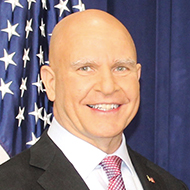
Lt. Gen. H.R. McMaster is the Fouad and Michelle Ajami Senior Fellow at the Hoover Institution, Stanford University. He is also the Bernard and Susan Liautaud Fellow at the Freeman Spogli Institute and a lecturer at Stanford University’s Graduate School of Business. He was the twenty-fifth assistant to the president for national security affairs. Upon graduation from the US Military Academy in 1984, McMaster served as a commissioned officer in the US Army for thirty-four years before retiring as a lieutenant general in June 2018.