







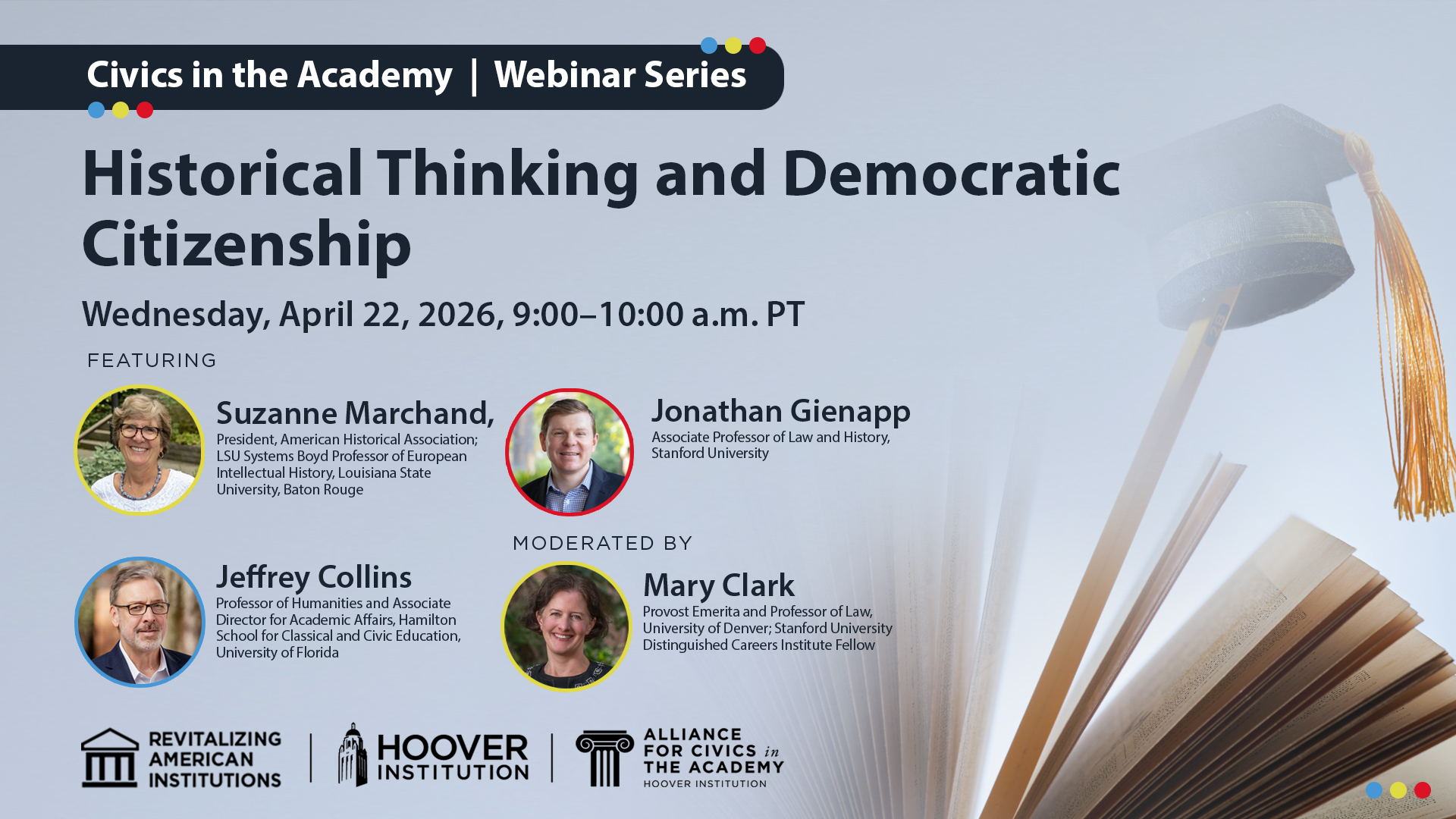
The Alliance for Civics in the Academy held "Historical Thinking and Democratic Citizenship" with Mary Clark, Suzanne Marchand, Jeffrey Collins, and Jonathan Gienapp on Wednesday, April 22, 2026, from 9:00–10:00 a.m. PT.
Where does history fit within broader efforts to renew civic education in higher education? What can the historical method contribute to the development of civic competencies? And in an era of polarized historical memory, how can colleges and universities teach history in ways that strengthen democratic culture? This session examines the distinctive contributions of historical study in cultivating informed and engaged citizens. Panelists will consider how history departments and civic initiatives can collaborate to better align curricular goals and advance a shared vision for civic learning.
- Good morning and thank you for joining us and good afternoon for those who may be on the East Coast. We're so delighted to have you join us this morning for the next, in our series of webinars, as part of the Alliance for Civics in the academy this morning or afternoon's. Webinar features, historical thinking and democratic citizenship as we think about how to engage with civics in colleges and university settings. The alliance for civics in the academy, as you may know, is a community of practice of faculty in college and university settings who are interested in sharing best practices with one another, resources and coming together to talk about how best to pursue civic education. At this time, we have a number of resources that are available to you, seed grants, sample syllabi, and again, these seminars that are offered periodically. We invite interested faculty to host their own seminars, which we're happy to support. So those of you who are interested, please reach out to us. You'll see information in the chat about how to become a member. Membership is free, so I encourage you to join and you'll also see in the chat information about how to access these resources, the seed grants and the syllabi and otherwise. So we'll look forward to having you join us right now. It is my distinct pleasure to introduce this morning's panel, and I will do so in alphabetical order. We'll begin with Jeffrey Collins, who is professor of history, humanities, excuse me, and the history of ideas at the University of Florida, where he focuses on early modern political thought. He is also the associate Director of Academic Affairs at the Hamilton School at the University of Florida, which focuses on classical and civic education. Also, joining us this morning is Jonathan Gana, who is associate professor of history and associate professor of law here at Stanford. And he is a civics faculty fellow and is quite engaged in undergraduate education related to civics, but also in his research related to the constitutional political legal history of the founding era of the United States. And last but not least is Suzanne Marchand, who is the board professor of History at Louisiana State University, where she focuses on European intellectual history, and importantly is the president of the American Historical Association, which as you may know, is a professional association for historians. And this morning's webinar signals an important partnership between the American Historical Association and the Alliance for Civics in the academy as we think through how best to integrate historical insight with civics education. I'm Mary Clark. I am a member of the executive committee of the Alliance for Civics in the Academy, professor of Law and Provost Emerita at the University of Denver. So thank you again for joining us. I'll begin by asking our panelists to address how they understand historical insights animating or benefiting our work in the area of civic education. So whoever would like to start us off, and then we will just have a conversation that flows naturally.
- Jonathan, why don't you go first since you were alphabetically first and also most closely a light, I think with American history perspectives on.
- Sure. So there's a great deal, one might say, but I think I'll, I might begin by saying, you know, every discipline or approach to knowledge has, its, its sort of distinctive features. And one of the ones that history really tries to inculcate what it means to think historically is to spend a great deal of time trying to abstract yourself from your own central assumptions. Things you take for granted, ways, you know, essential premises by which you proceed and understand how different people were altogether reasonable and rational. Or you would at least begin by assuming that they might be approach questions in a different way. And I think there are a few sort of mental habits that one cultivates that are better at creating a civic habit that is essential to living in a sort of pluralistic democracy, which is precisely predicated on people will disagree about fundamental questions and how do you go about understanding with empathy, those who might approach things slightly differently than you if you spend time engaged in serious historical inquiry, aside from the fact of trying to understand what happened in the past, which is of course the culmination of what, of what that work hopes to yield, I think you also hopefully can gain quite a bit about how do you think through difference and how do you make sense of, in a strong way, not a caricatured way, ways of approaching central questions of human life. What does it mean to be free? What is just, what is the best way to organize a society? And you can end up learning a great deal from that, but you can only learn once you're sort of engaged in the work of actually trying to understand. And history's not alone in doing this, but I think it's something that historical teaching and thinking really centrally tries to inculcate. And in that regard, I think has quite a bit to offer civics education, wr large.
- Yeah. Jeffrey and Suzanne, does this resonate with you?
- Yeah, if I could maybe just add to that, I mean, I think history, like all disciplines is a discipline set of methods and a discipline of mind. And Jonathan speaking to that dimension of history, but it's also a body of content, right? And I think often history is more bedeviled by that tension than other disciplines to some extent, because history's relevant to almost all disciplines. And so a lot of history will be done by political theorists or English professors these days and so forth. So history is everywhere, but it's, it's also, I think we often think of it strictly as a body of content. And there are aspects of western history, American history, which are, you know, obviously very relevant to civics education for a citizen of the United States. But I, but I think Jonathan's quite right. We have to think beyond that mere content. The content's important, and I think a lot of history departments have allowed the content that's relevant to civics, educations to sort of dissipate a little bit over the, over the last few decades.
- Why would that
- Be? Well, that's a, that that's, there's a large story there, and I think there are a lot of contributing factors. One is, you know, a very, you know, noble desire to diversify departments that for many generations were too western, too European, too American focused. And so we've diversified at the same time, we are shrinking a lot of departments across the United States and humanities departments in general, and history departments in particular getting smaller while they're trying to do more. And so I think this has led to a, a sort of atrophying of certain kind of core fields that are important to civics education. So there's a content side to this as well as I think what Jonathan's pointed to, which is the, the, the sort of unique disciplinary values of his, of, of his story historicism as a kind of discipline of mind, an important skill for a citizen to have. So I think we have two, two things to think about when we think about history as a contributing subject to a civics education.
- Suzanne. Yeah, we'd love to hear your thoughts and especially as it relates to your role with the American Historical Association. What appetite is there among your colleagues, for example, and engaging in this, what it appears to be a renaissance of civics education at the college and university level?
- Well, thank you, Marian. Of course, I'm speaking in my own capacity, but I will say that the, the a HA is very interested in exploring how we can do this kind of partnering. I mean, we have always been open to many other different disciplines and disciplinary backgrounds, and so that is just another step in a new direction. But this is definitely something that we want to discuss, and not just among American historians. We need to, you know, understand where we've come from and how we got here, not just as a nation, but as a world community. So world history, European history, of course, really want to be part of this conversation. We have to figure out how we can best do that. I I really wanna underscore what Jonathan said about learning empathy from history. I think that's one of our great opportunities is to walk some, you know, some distance in someone else's shoes and see how that feels. But two other things I think history is uniquely positioned to teach us. And one is about contingency that very important moment, which a decision can make a world of difference. And after which nothing will be quite the same. This is really a moment in which we can teach students about their own agency. You know, what you can do, what certain individuals have done in the past that made a difference or left a mark or didn't, but they, they attempted to make their case. And I think that students need that now. They need that sense that they can do something to help, they can make a difference. Their agency is, is something that is important to us to, to really give them that, that positive encouragement that they can, can do things. We have, I think, too much focused on the sort of glass half empty aspect to, to the world that, you know, things are dire and getting worse. And, and we need to find some ways to encourage people to think about moments of time and change when people made a positive difference or, or did something that was admirable and or, or difficult Leadership is always difficult and no one gets it right or perfect. So maybe that would be one thing we can really work on is how to teach students about contingencies that, that really do make a difference and ways in which they can, they can see themselves as past actors faced with those difficult situations.
- To your point, I was just in conversation last night about how young people today think, feel a sense of being overwhelmed by the state of the world, all of the various forces and crises and what have you. And I so appreciate your highlighting this opportunity for agency, if you will, by young people. What is it that they can feel some sense of a pathway into impacting both the present and the future? Staying with you for a moment, Suzanne, it would be helpful to explicate something you just touched on, and that is a contribution of European intellectual history to this field of civics education. Many of us are in the domain of American law or American history, but we'd love to have you highlight the role of European intellectual history in this conversation.
- Well, and Jeffrey can certainly help me on this, being a British historian, that's even more important I think for some of this conversation. But first of all, I adore teaching great books. I do that as often as I can. And I think that that is one of the ways I, there, there are two pathways, it seems to me for civics to go generally speaking. One is more like sort of experimental physics. That is how you actually become a citizen, do your part, get elected for office, and then maybe the theoretical physics side. And that's the, you know, what are the big ideas? How do we design things properly? And I think intellectual history certainly fits on that latter side, but so many of the ideas that have shaped European, have shaped American culture have come from Europe. Some bad ideas as well as good ideas, mind you. But I think that that one other thing that European intellectual history can do for you is to give you low stakes set of discussions. They're not about you directly or about America, but or about France or about ancient Greece or about the Renaissance. And you could talk through Machiavelli and, and maybe that gives you some purchase on how to deal with, with the question of, you know, being loved or being feared in current day American politics in a way that doesn't step on anyone's toes directly or personalize it too much. I also wanna say one more thing, and that is that I, I am engaged currently in a battle against cynicism for myself and for for all of my, my fellow colleagues who teach students. I think students need more wonder and more just fascination in our study of the past curiosity and less emphasis on, on, on relevance, honestly, and or on, on sort of utility or, or politics. Students do respond to that. They love it when you are really thrilled by something and we need to engage their curiosity before we can. I mean, this is a lovely line of schillers that you can only touch the, the dark valleys of, you know, of ignorance once you have lightened the peaks by poetry. So maybe, you know, you, you kind of work your way into lessons. We think students should learn by way of giving them, you know, very interesting things and ways in that we can, we can make them, make them want to know more about.
- I love your emphasis on wonder and curiosity. I do think it's infectious and I think our role as faculty is to, in fact, our students in that sense of wonder and, and awe. Jeffrey, I'd love to hear your thoughts from a British history perspective. What is the contribution? And then Jonathan, I'm coming to you 'cause you obviously bridge the British and the early American, right?
- Well, I mean the British is, is speaks for itself in a sense. And that the, the revolution of the founding was, you know, steeped in that tradition of political thoughts, political economy, political traditions, constitutional history and so forth. So I won't belabor that, but I mean, I might speak more broadly about, so at Hamilton we, we do embed the, the civic into what we call the classical, which is a, a somewhat broader kind of curriculum on Western civilization, although western civilization pretty broadly defined. So we have people here working on Islam and China and parallel civilizations too. But I mean, I think, you know, it's, it's important to understand the American experience as part of that broader experience, not to be too parochial about it. I mean, it would've been pretty nonsensical actually to Jefferson or Franklin or something to say, well, you're an American, so we'll just be reading American texts. They would've thought this was, you know, the worst kind of philistinism. They would've immediately in instructed a, a student to turn to the ancients and to turn to the early moderns to sort of understand politics or human behavior. And often when I'm trying to convince my students of this, who, who have a kind of natural interest in their own country and their own institutions and so forth, I say, you know, this is really the, the syllabus and the mind frame of the people that you're studying. You have to understand what they understood. You have to in some sense to, to coin an old calling when phrase see the, see the world through their eyes. So I think this is part of just a, you know, civics is in, in some sense, making a good citizen is a, sort of suffers from a plain problem, right? If it can go off in all directions, right? I mean, and anything that makes you more knowledgeable is, is gonna make you a better citizen in some sense. So it's sometimes hard to sort of demarcate the curriculum and, and what's really kind of vital to civics a kind of enterprise at the university level. But I certainly think the intellectual history of, of Europe, going back to antiquity really is of sort of glaring relevance. And yeah, it doesn't make a lot of sense to teach civics without some reference to that broader tradition.
- John, Jonathan would love to hear your thoughts as you sort of bridge these cultural traditions. And then my next question for folks to be thinking about is how do we instantiate civics education in the curriculum, especially at the undergrad level. Are we looking at gen ed, are we looking at requirements, electives, what have you? But over to you Jonathan.
- Sure. Well, I'll just strongly agree with what Suzanne and and Jeffrey said because I am on all dimensions. 'cause I think it's all very important. But even though I study the founding of the United States and spend a lot of time teaching that, so much of my effort building off, especially what Jeffrey was just saying, is to try to make something that can seem superficially quite familiar, less familiar, because it precisely was, and the reason why, you know, to say, well, let's look at 18th, late 18th century American political, legal and civic thinking is to recognize all of the things that they were presupposing and assuming when they constructed institutions and concepts that we think we know quite well that led them to have different understandings in important ways. And then that leads naturally, I think to if there's great concern about the current moment, which there certainly is, especially among students. Well, if you want to fix anything you need to perform a sophisticated diagnostics. And if you have learned that in fact Thomas Jefferson was drawing more heavily on a set of British or French writers that you've never heard of and thought that they held the keys to something quite significant, then that doesn't mean he's right. But now we have the foundation for the kind of critical engagement that moves past, well either they were good or bad, or either we should keep this institution or get rid of it. Now we're having a conversation about why it was created the way it was and oh, it turns out it was created for slightly different reasons with different assumptions about how politics worked than we might tend to have now. Well, what do we then do with that knowledge? Hmm. And to me that, you know, that's really where the civics conversation can take off because it's less utilitarian in a vulgar sense and it's more about, okay, now we've, we we see, you know, everything's a bit scrambled here. I don't, I don't, I don't know how to take the culture wars out there on cable news into this conversation because it now is operating along a, a sort of different set axes and is forcing me to think about some 18th century writer I've never heard of. Yes. And they're all talking about him. So what do I do with that?
- Yes. Strikes me you are using a phrase banning the binary, you're making it more complex, more complicated. And that is how it is. It also provides more opportunity for engagement if students don't simply see it as a binary.
- Precisely.
- So I'd love to hear your thoughts on, especially for our faculty who are joining us this morning, how do we instantiate historical understandings with civic education, especially at the undergrad level? Are we looking at gen ed? Are we looking merely at electives? Are we looking at required courses? And Jonathan, I wonder if I might start with you and then turn to Suzanne and Jeffrey given the Stanford experiment, if you will, in civics education at the first year level.
- Yeah, so it's a complicated question that I think yields an answer similar to one Jeffrey gave. We just sort of meet all of the above because there's no particular way, I think, to do it right. And in fact, to, to think that this is really more about gen ed than more specialized courses sort of misses the way in which it, it needs to be spread premised on a kind of more holistic culture that's revived that is that through which education leads to good citizens in a democracy, we're doing something different than those who don't live in one. Hmm. But I think you can certainly start with general education requirements, or at least nudges to use the technocratic term toward that. Yeah. Sounds and that is certainly what Stanford has tried. And I think with good success, it's never, I mean, it's, it's never simple to to know how a a kind of one size fits all course should work properly. But the premise of it that, especially here at Stanford, which can be very tech and stem heavy, let's create spaces where not simply those who might be less, take fewer classes that focus on these things, are having these conversations, but are having them with a diverse community of the student body. I mean, I think that's such a central feature of what the gen ed can provide, that someone who is interested in becoming an English major and therefore has certain habits of mind that has led them to, that is seated next to somebody who is very interested in becoming a computer programmer and they're commonly trying to make sense of WEB Du Bois or Machiavelli and, and what, what a what a thoughtful person would make of such a text, both in context and not. And I think that's also a, a crucial part of how the gen ed work, that you don't have some of the depth of knowledge that you might need to fully contextualize it the way a professional historian would, or a political theorist who understands the broader tradition. But that's true of most aspects of democracy. You are being asked to make choices with imperfect information. And the, the key there is not your information isn imperfect, it's are you doing it thoughtfully or not? And how do we cultivate that habit? So I think that the sort of gen ed requirement can do that in a very powerful way if done well and it's very hard, but then it needs to be followed up by, you know, a whole range of other courses that are providing offerings that people get a sense of how this is building on each other. Mm. But, but I think the entry level can be, can be very important
- That you're laddering a curriculum, if you will. Suzanne and Jeffrey, I'd love to hear your thoughts on this and what your experiences have been at your institutions. Suzanne, maybe starting with
- You. Shall I go first? I mean, the institution that I teach at Louisiana State University is very different of course, than Stanford. And I think that is a, that is a really important thing to acknowledge. No one size is gonna fit all because institutions are very different in what they can do and they're very big boats to turn around. So it's very hard to make a big change. I also think, you know, sort of commandments from above are just not gonna work. Not for students, not for faculty. So nudging the curriculum and having a conversation particularly about what gen ed should be, might be the best way forward. How we, how we do this, we can't, I think, add more gen ed on add a big state university. Certainly the engineers will not want us to do that. And there's a lot of push to, to keep time to degree short. So there are those pressures that make it difficult to add new courses, but we should have conversations about what gen ed is and what it should do today, what it's, what its purpose is. We have not really had those, maybe we don't know quite how to have those without fighting over resources or, or who has to do something. And this is maybe one of the problems with the resource centered management way of, of working in the world these days is it does tend to set disciplines against each other and make it a kind of zero sum game. So what, how do we deal with that? I, that I don't really know, but I think having this conversation and making more people aware of it, perhaps we need to talk to university mentors also who were often left out of the picture or advisors and ask them to talk to students, incoming students in particular about, you know, making sure that they, they take some courses that give them some direction in life and some meaning and some smaller courses and not just really, you know, really push them to get through with their education as fast as possible. But it is the, the structural issues are, are not to be sneezed at. They're, they are very much present.
- Oh, surely having been engaged in curricular reform, it can very much play out as a zero sum operation as you suggest. Jeffrey, we'd love to hear your thoughts on this and what you're doing at the Hamilton School.
- Right? Yeah, well, just speaking generally first, I mean, I think some of the challenges are increasingly vocational and utilitarian orientation of university education, which is understandable. Students are concerned about the cost of education and want to make sure this is contributing to their later career. But I think this has become a problem for sort of general broad liberal education and civic knowledge is necessarily gonna be part of that kind of a broad liberal education. It's not necessarily gonna help you be a better accountant or an engineer. Right. It's gonna make you a better citizen. And so we have to think of it beyond the vocational, the utilitarian. I think the other problem I think is the kind of purely elective model of universities, which has, it's particularly in humanities and social sciences kind of destroyed any sense of a coherent curriculum in most departments, which is I think part of the crisis of the humanities that the students think we don't take our own curriculum very seriously. So I tend to think of civics. I mean, some people think it's a discipline of its own or it should have its own departments and so forth. I don't think of it that way. I tend to think it's more helpful to think of it as a kind of question again, of, of curricular content. What are the fields that the faculty think are necessary to be on offer for students to at least have the option or maybe to be required to, to, to sort of develop civic knowledge, a kind of body of knowledge that will make them knowledgeable voters and actors in the civic space. And to me that's really more of a curricular question about fields which have either been neglected and need to be revived or need to be required in some instances. And I think we should be returning in American universities to an old mid 20th century idea, which I think what's very successful, and that's core curriculum. Mm. This used to be a very distinguished and in an, and an often elite notion right? At places like Columbia and Chicago. So I think sometimes it's, it's been tainted by that, but I don't think we have to think of it that way. I think we should be returning to sort of a sense of core curriculum. And so at Hamilton we don't necessarily, we don't offer anything called civics, I think as a subject. I think that's the branding is problematic for, for university students. I think they think of that as a high school subject. So we, we offer more legible interdisciplinary majors at the Hamilton school, which we think advance the fields, the modes of knowledge and the disciplines which are important for American civic knowledge. Mm. And so this would be things like the history of the American founding. I know a a lot of people our age probably assume this is a kind of standard subject in history departments, but, and to a surprising extent, it's kind of disintegrated in many history departments. The French revolution is to be a, every, every department have one, maybe two people standing the French Revolution, that's not necessarily the case anymore. Antiquity classics, again, it's disappearing. Mm. So I tend to want to think more about civic. I almost sometimes like to talk about civic knowledge rather than civic education. I think when people talk about civic education, it's sometimes coding it in either a left or a right way. They, they wanna produce a certain kind of citizen. You wanna produce either a patriotic citizen or a kind of citizen activist or some, we, we have to get away from that mode of thinking. That's not the, we're we're trying to empower people and civilize them in a sense with the knowledge they need to function as responsible members of a, of a, of a republic. And so that's, that's how I prefer to think about it. So it's more content driven than driven by some generalized sense of what it means to be the citizen or something, because that's always gonna be a normative question that and, and an individual one.
- Yes. When you speak of civic knowledge, one thing I think about is the role of literature. I was a literature major undergrad and what I took away from that most significantly was engagement with values, questions of, you know, what matters. And I think that plays a role in civic education, to your point and civic knowledge to your point about the core curriculum. One of my sons went to Chicago undergrad, was a physics and engineering major, but is grounded in the classics and his free time. He reads Play-Doh of all things. And so that I think is something we should aspire to in a related fashion. You referenced how the curriculum and history departments has become shaped by faculty hiring practices. In our pre-conversation we did talk about faculty hiring also the tenure review process. And how is that impacting, for example, engagement with civic education, engagement with the interdisciplinarity that may inform optimal versions of civic education.
- Yeah. - Would love to hear everyone's thoughts on that.
- Well, this offers something very quickly on that in, I mean, I think I, I think one of the problems of American higher ed we're facing in a broad sense, but it's particularly relevant to this question, is the research orientation of faculty and the emphasis, particularly the elite schools on just getting the best researchers. And often teaching is sort of follows in the wake of the research. And so the, the, the teaching can be hyper specialized, esoteric, recite and so forth. And in some sense the students are benefited from that because of course, to learn anything with a, with a, with a good teacher is to learn something and is learn to think. But I do think this is a another dimension of American higher ed, say in the last 40 to 50 years, which has made for ramshackled curriculum. And to some extent the French revolution may seem old hat to a specialist in that period, what can be said about the French Revolution anymore? I'm gonna research instead, you know, the, the, the, the cultural history of restaurants or something. But that, but the French Revolution is not old hat to students. The American Revolution is not all hat to students. They need to know something about it and they're fascinated by it. And so teaching, I think does have to be more front and center in the way we think about hiring, that we have to hire good teachers and, and also how we promote and reward our faculty. Not to say that research and publication are not important obviously, but, but I do think that a rebalancing there would help with this kind of problem of curricular content.
- Suzanne would love to hear your thoughts and especially something we spoke about in the pre-conversation is the role of professional associations in signaling what values, what matters, especially as it relates to interdisciplinarity. I'm thinking both of the faculty hiring stage and then also the tenure review process.
- So lots to lots to think about. Just one note on, you know, Jeffrey's voice comments. I, I do think that the research imperative has, has done strange things sometimes to our, to our faculties. And I think that's also just understandable because people get sick of the French revolution after, you know, in my education it was over and over again and, and the French empire hadn't been studied. So students naturally move to that. And we need to just be clear that people who research one thing can teach something else and and should teach more broadly and should be trained in those broad ways. And, and this is just a real problem for graduate programs that are trying to get students done quickly. Again, there's so much to know, there's so much literature now to study. You know, the, the French revolution is a massive undertaking on not to mention the cultural history of the restaurant, which I will speak up for because I wrote a book on the history of the porcelain industry. And I can tell you that
- Actually I meant no offense and I meant no offense. No,
- Of course you did. Not just joking, but it, there there are these wonderful, fascinating other projects that people get involved in for, for good reason or ill, but the question of, of the professional organizations, I mean, we at the a HA have for years worked on a project, started, you know, I think maybe 20 years ago on career diversity. And one of the things that we really have tried to preach is for graduate students to think in their first year already about not just plan a, but plan a one, plan a two, plan a three outside of academia or as a high school teacher, which I think is the most noble job I can recommend. And the most important they
- May and challenging
- And challenging and we can learn a lot from them and we should. But I think that there, there is a sense now amongst new graduate students and also programs that, that we need to be prepared to have other skills and do other things including, you know, write op-eds or work on digital sites or become a public historian or work in archives. This is a challenge to learn how to, you know, train people in fields you don't know yourself. That's a, that's a challenge. But I think we're, you know, we're now succeeding in, in trying to get students coming out who have a wider set of kind of ambitions and ideas about what they can be. Now that might be the sunny side, the, the less sunny side is also something that we, we have studied and tried to help with. And that is the non-tenure track lines and the enormous number of postdocs being created at universities where they don't commit to full-time tenure track hires. And this has a very skewed effect as well in many departments I know of where the non-tenure track is beginning to outweigh the tenure track. And that has all kinds of implications for, for loyalty to institution as well as for graduate student teaching and down the line. Hmm. So it's, this is a much wider and more, more difficult conversation that, you know, the, the, the aha has done. Its very best to try to address and discuss, but of course it's far, far beyond any professional society's ability to make universities create tenure track lines as much as we would like to do that.
- To your point, as a provost at two institutions, I was very mindful of the balance between tenure line faculty and non-tenure line. All benefit from academic freedom guarantees. But unsurprisingly, non-tenure line faculty don't feel that as richly as tenure line. And I think that does impact choices about teaching risks that faculty may or may not feel that they can take in both their teaching and their research. So I think it's critical that we'd be ever mindful of the balance between the contract faculty, as you say in the tenure line. I've been asked to remind folks to post questions that they'd love to see our panelists address. And before we turn to the participants questions, we'd love to turn to you, Jonathan, you may the most recent participant in the faculty hiring and tenure review process. And I don't know if you have a perspective on this question.
- Yeah, well I think one thing I'll speak to pick up on that was nicely said by my co-panelists is so I mean, first off, we are not just researchers, we are teachers. And in a lot of ways I think that teaching is the more important part of the job and needs to be taken, treated as seriously. And related to that on the research side, it is certainly true that over specialization has become a more and more dominant feature of a lot of disciplines and for understandable reasons. But we ought to spend more time reflecting broadly on how the kind of synthetic thinking that was taken to be an important part of being part of these disciplines has waned a bit. And we might even connect this full circle by returning to the founding itself. When I'm trying to get students or people today to think, think more deeply about it, I often start from the premise they didn't have disciplines as we understand them. So for instance, in the space of constitutional history that I spent a lot of time in, they didn't think there was such a thing as constitutional law. And for them, the study of law Automatically incorporated the study of politics, human nature, sociology, history, morality, philosophy. It was an integrated field of knowledge where you needed to understand the whole picture to better understand how a legal community would work well as, as just from the standpoint of history. Even if one focuses a lot of their time as a research scholar in one particular corner, how can you make broader connections either from how you run workshops or the kinds of courses you teach? Not just that, but as part of what you're trying to do. I love teaching broader survey courses precisely because it forces me to think synthetically and it is not some service item on the side. Few things have helped my research more than being forced to draw connections between parts of American or with American history in other parts of the world. I mean, I've gained some the things that I'm sort of most interested in as a researcher from really trying to think broadly and synthetically or team teaching, you know, teaching with a law professor who approaches things very differently. So I, you know, I think that needs to, when we do hiring and when we promote colleagues up, I think we, we should be encouraging and emphasizing all of the ways in which that other domain of thinking can be central to, to what we're doing and not be so siloed.
- Yes. I mean, to your point, the dynamic relationship between teaching and research, sometimes my greatest research ideas have come from the teaching and really in this synthetic fashion as you said. And then of course I can try out my research in my classes and get feedback from our students. So first question has been posted and here we go. Students need wonder and curiosity, but citizens need passion, trust, belief, and belonging. Wow. Citizenship is in some sense of faith. What is the role of history as a discipline in telling a story that can nurture and sustain a faith in democracy and civic action? That is a fabulous question and quite erudite. So who would like to take a crack at this question about faith in democracy and civic action? Something that each of you have touched upon in your remarks already?
- Well, I can, well, I I could start as a yes, German historian. So last semester I taught a course on Germany since 1871. And the teaching the Weimar period was a very interesting thing. I decided once I, I realized that the students presumed that the, the end of the war, first World war and the Nazi period were inevitably collect connected, that I needed to do some work on contingency. So I did a whole lecture called Killing Democracy, and which I talked about, there's a very famous cartoon from the magazine, SMUs, which there are all sorts of Germans holding up signs with the letters that spell Republic, but the question is, who holds up the spirit? And so we discussed in detail, you know, why did Weimar fail on? And partly it was a lack of will on the part of, of those who could have stopped it and decisions that were made in the later twenties. There were certainly other factors, but to get closer and closer to the event and to do a more and more detailed discussion about which pieces fell in place for this to happen, I think was a, a really good discussion both of contingency and then also of the loss of faith and what the loss of faith does to kind of take the, you know, take the air out of, of our institutions. So that was one case of, of being able to teach faith albeit negatively. But I'm interested in what my colleagues might might say about how they would do that.
- Thank you. And that's a fabulous example, Jeffrey. We'd love to hear your thoughts.
- Yeah, I, I mean I think it's a great question and I think it's the kind of question that would make a lot of professional historians kind of squirm in their seat, right? Because I think there's a great polarization really between the popular interest in history and in American history and, and the western history, which is kind of looking for inspiration and uplift often and, and our professional attitudes, which were often more critical, little world weary, maybe one could even say sometimes cynical. And in that divide I think is a lot of our problems in higher ed generally. But I also think it's one of the reasons professional academics tend to shy away from things like civic education, and I do not think they should. So I have a phrase I use here, I say I'm trying to teach the students kind of critical appreciation. In other words, they have to, we we, we have to be willing to uplift them to give them some sense of a shared national experience or even global experience or experiences inheritors of the kind of western tradition, no matter what our personal background might be. And I think that also requires, so that's one thing I would say that you, you, you can't shy away from this to some extent and, and be afraid of it for fear of looking naive as an academic. But the, but the other thing I would say is one of the great challenging things to do with, with modern students is to get them to think broadly and not to measure all historical experience by their own experience, not to think of everything as a projection of their own individual identity or opinions and so forth. And I don't mean to be critical of students when I say this. I think there's a lot of factors of our society that make even adults do this. But I I, I mean, I do think a sort of sense of a broad tradition that one can critique, criticize, but also benefit from and learn from no matter your own individual heritage. I think this is the important thing to kind of always keep in mind when one's instructing in and again, the field, field and content that would be relevant to civic education. And I think that's, that's another important thing to keep, keep on the table.
- Jonathan would love to turn to you and I'll just seed folks thinking about the next question that has been asked. And that is with the advent of ai, I wonder if you all would speak to how you are advocating for historical thinking skills as part of the human skills value that we need to strengthen in students. So Jonathan, dealer's choice as to whether you start with this question about AI or continue with the question about faith.
- Yeah, I mean, AI is the hardest nut to crack. So I'll, I'll start with the, the much easier one. How we instill passion and faith. So the way I think I'll approach it is because so much of my teaching is focused on the founding of the United States and the creation of the institutions and symbols that often are at the center of these, these charge disputes. And what I, what I try to get past, because it's the familiar framing and I understand why it exists, and it needs to be a starting point, is well, do you, do you honor what happened? Or are we here to indict What happened? Are we, is are we sort of focused on something more patriotic or we, or something more cynical and critical? And the seesaw can be very debilitating 'cause it, and not least because it can, it can render a more and more superficial engagement with the very thing that we're debating. And a way to get to get past this that I think is quite powerful, I have found for igniting the kind of civics conversations we need is to emphasize how the founding generation, and I always say generation, because the large diverse group of people who bitterly disagreed on, you know, performed the essential practice of Republican and democratic politics of not agreeing on, on, on the direction of the republic, that whatever else one might say about 'em, they were quite emphatic that republican institutions, Republican laws, Republican constitutions were only ever as good ultimately as the quality of citizenry that one had. So if you didn't add a Republican people and a Republican culture, nothing else really mattered, which is why they said time and again, what is the essential ingredient of a free state of a, of a republic, a well-informed citizenry. 'cause if the citizenry is not well-informed, most of the world lives under despotism because ignorance is the foundation of that. Hmm. Well, so to the question, well, the system doesn't seem to be working today. If they were here, why did you guys design it this way? They would say, well, it's only as good as the civic culture that surrounds it. So you can't set up a set of institutions or rules of the game that will self execute. If, if the broader body politic is in some ways rotten, then that's where the solution needs to lie. So here we have, you know, a different way of thinking about how, how might we be, you know, energized by the study of the early United States. And rather than say, you know, should we, what, what it would mean to honor someone like Thomas Jefferson in a lot of ways would be to take seriously his his claim that the earth belongs to the living. And that you cannot be a good democratic citizen unless you are invested in the work of making it happen. You're certainly not going to save democracy by figuring out how to best, you know, honor those past, nor are you gonna do it by not knowing anything about them. You're going to do it by recognizing that the kind of civic work that they thought was essential to all the big ideas they floated around was the predicate. And if you're not engaged in civic associations of some kind doing all those things Tocqueville described that made Americans uniquely democratic, well then it's, it's not gonna work. And that, that should be empowering because it's, this is not on autopilot, this doesn't just work. There's only works if each generation takes the essential work of being a Republican citizen and wanting to live in a republic where people know what's going on and are capable of doing what Thomas Payne radically said people could do. And others said what's wrong? They can exercise this thing they have called common sense to reach true conclusions about the world that would allow them to enjoy political power. You know, in some ways every generation of Americans are tested. Can that proposition indeed be true?
- Well, your comments in those of our fellow panelists have underscored in my mind the centrality of education, access to education including higher education, which is under threat, but also as you say, voluntary associations rise of voluntary associations in the 19th, 20th century. Civic associations, civic participation. And so what do we do about ai? How do we promote historical thinking in an age where many are sort of handing over their thinking, if you will, to ai? So how are you wrestling with that either in the classroom or curricular development? We'd love to hear, and again, possibly from the a HA perspective, and I don't mean to put you on the spot, Suzanne, but how, how have you been wrestling with these questions?
- Well, this is one of the great questions all of our colleagues are asking, both for teaching and for research purposes. We had a task force that produced a kind of a best practices. Not everyone agreed with that. We had a lot of critical feedback because it is just absolutely not something that people yet know how to deal with or, or, or an agreement about. It seems to me that one of the things to respond is to just remind people that that actually doing history, writing history is a creative enterprise. It is not just piling up facts, which of course data can do. And that could be very helpful to have someone or something help you pile that up. But look at also that massive increase of historical podcasts. People wanna hear stories, they actually do wanna know in detail what happened and why it happened and who was involved. And we can tell stories. AI is not very good at telling stories and especially not stories that have the kind of creative dynamics that make for a good, a good historical account. So, I mean, I'm not particularly afraid of it anymore than my colleagues in law or business or creative writing, but I do think that it, it necessitates us underscoring just how important our expertise is in sorting that data and evaluating it and using our, our comparative knowledge to tell good and and compelling stories. And if we need to, you know, underscore expertise a bit more, I'm all for that because I think, I think we are not machines and we should be proud of that fact.
- Yes. And there's been a decades long incursion on expertise, if you will, Jeffrey, we'd love to hear your thoughts on this question.
- Well, I'm very concerned about it and particularly for, for young people. A lot of us have a more benign attitude about it. I think because we were trained differently and this didn't displace aspects of our education, we're rather kind of adding it as a kind of value add. But for those, for those raised on it, I think it's replacing two skills in particular that are dangerous for people in terms of their civic knowledge and historical knowledge. And one is the capacity to write. And the other is, and this is becoming increasingly clear to me, the capacity to read Mm, To read the books, to follow linear arguments, to follow complex arguments, to follow narratives. And I I'm very concerned about that. I mean, I think for the historian and for the person concerned with civic education, both of these skills are essential. Students will often say, well, I don't, I'm not gonna have to write papers in my job or even as a citizen, but of course we don't make them write papers so that they can write more papers unless they're gonna go to grad school. But rather because writing papers is how you learn to think. We think verbally, we, we argue verbally, we structure good, valid, logical arguments verbally and linguistically. And so learning to write is to learn to think. And if we're outsourcing that, I'm, I'm afraid complex thinking is gonna be increasingly difficult for students. And I do think students, even the best students who are having difficulty reading long books or best thing attached to arguments. So I mean, I I'm afraid I'm a bit of a pessimist about this. I mean, how are we handling it? Well, I wish I had invested in whatever company produces the blue book because we're, we're all going back to Blue Books. But of course they can't write cursive either, so this is a problem. So they yes. Process as they can for an hour and they're, but you know, we're, we're having to reduce the number of pages we read, but at the same time try to preserve the reading of whole texts. And so that does kind of limit the curriculum to some extent. Yes. But I think the, the compromise has to be on that side more than we would like, rather than giving them a thousand small chunks of text from a thousand different sources and trying to educate all the other, sometimes you have to sort of bear the cost of the more attentive, slow patient and then try to convince them of the value of this and the enjoyment that they can get out of it. Because if you just try to convince them that it's a skill, they're not gonna believe you. Yeah, yeah. 'cause ai, ai is a, is a, is a time saver and, and, and an efficiency. So if, if you're, if you're convincing of it's a job skill for various careers that doesn't work. It has to be something more of a life enrichment process.
- Yes. It strikes me that you've brought us full circle back to where Suzanne started us with wonder, wonder and curiosity and awe and how do we infect our students. With that, Jonathan, you're going to bring us home and then I will highlight for folks our next webinar. Sure.
- Well, it's a very difficult problem and part of it is we don't quite know what it's gonna become. First thing you can do is try to place it in historical perspective, and you can take some comfort from this is hardly the first time. That is sort of disruptive technology led people to think the sky was falling. But you never quite know if it's categorically distinct or not. I mean, an example at the founding is the massive explosion of cheap print really put a lot of stress on the idea of a free press and let a lot of people say, well, we think people should be able to freely print what they want, but they can't criticize the government that way. And the people on the other side who took the more libertarian approach that said, no, I think we need to bear that cost ultimately, why not? And we can see that with a sense of distance and perspective. But what I might just add is, you know, you can try to get through 'em by say, you know, you're never gonna get strong or fit in the gym no matter how much you read about weightlifting. And this is no, this is no different. I've tried. Right, exactly. There's, I mean, at some point, if you don't flex the muscles and you're not going to do cultivate this particular kind of strength and ability, and then maybe once you've, you've kind of gotten in to see that, well why would you want this strength and ability? And I think some of it might be, well, the reason the humanities are important, it is that domain of knowledge that is not reduced to algorithmic thinking. What is the meaning of stuff ultimately is, is the kind of thing that, I mean, that that'll be the sort of final challenge for AI to conquer because whatever AI produces, it still leads the question. And what does it mean, what does it add up to? And you'd like to think that the people who have been asking that kind of question about related things will be the last one standing to say, well, we, we can now easily, someone can easily put together the book that we were writing, but now who's gonna say what it means? What did that why it's significant.
- Yeah. - Yes. And that's why we're all here. Yes, Jeffrey,
- Just very quickly, I I, I agree with this and I do think AI is a real opportunity for the humanities, actual, I think we're starting to see that on, on campuses, but only, only if we can reconnect it and make it relevant and make it broad again and, and, and sort of in, in some sense, open it up to the public and, and, and, and bring that constituency and that support back.
- Yes. And I, I thank you so much to our fabulous panelists. I think you really have highlighted what the value and really the promise of historical engagement is in civic education and indeed engagement with the liberal arts more broadly. So thank you to our panelists and just wanna highlight for our next webinar, it's on May 13th, also at 9:00 AM Pacific Time, can civic Education be Liberal? And we'll be featuring Melinda Zuck, Joseph Neuenburg and Benjamin Story, and I hope you'll join us. Also, information about joining the Alliance for Civics in the academy is in the chat. Thank you so much for joining us. I loved our conversation and look forward to it continuing. Thank you again.
- Thank you. Thank you, Mary.
ABOUT THE SPEAKERS
Mary Clark is a Professor of Law and Provost Emerita at the University of Denver. With expertise in the areas of higher education law, women’s legal history, legal ethics, judicial politics, and property, Provost Clark also holds an appointment as professor in the Sturm College of Law. Prior to being named provost at DU, Provost Clark served as interim provost, deputy provost, and dean of faculty at American University, associate dean for faculty & academic affairs at AU’s law school, director of its doctor of juridical science program, and acting director of its Law and Government Program.
Jeffrey Collins is a historian of ideas, with a focus on early modern political thought. He is the author of two books — The Allegiance of Thomas Hobbes (Oxford, 2005) and In the Shadow of Leviathan: John Locke and the Politics of Conscience (Cambridge, 2020) — as well as many articles and book chapters on subjects such as religious war, toleration, atheism, church and state. Collins is a regular contributor of reviews to both the Times Literary Supplement and the Wall Street Journal.
Suzanne Marchand is LSU Systems Boyd (University) Professor of European Intellectual History at Louisiana State University, Baton Rouge. She usually writes about the history of the humanities in Germany and Austria, but her most recent book, Porcelain: A History from the Heart of Europe (Princeton, 2020), turned to material culture and business history. Coauthoring two textbooks, one in European and one in world history, taught her a great deal about survey teaching. As president of the German Studies Association (2012–14), and as councilor for the AHA’s Professional Division (2016–19), she championed the representation of all regions and institutional types. Her commitment to cross-disciplinary conversation has led to service on numerous editorial boards and fellowships, many of them outside the US, and inspired her to cofound LSU’s Center for Collaborative Knowledge. Her fascination with the long afterlife of the ancient world has made her particularly eager to advocate for courses that treat premodern periods, as well as those that embrace the history of the sciences, arts, and religion. Recently, her work on the history of Herodotus reception has given her new affection and respect for our “father of history,” who was also known as “the father of lies.”
Jonathan Gienapp is a historian of the United States and its constitutional order. He teaches at Stanford University where he has appointments in both the History department and the Law School. He is the author of two books on American constitutional history and interpretation that have garnered wide acclaim. He is also a celebrated teacher who has been awarded numerous accolades for his teaching and dedication to students. He has lectured across the country on the history of the nation’s founding and the U.S. Constitution. He is actively involved in deepening the public’s understanding of constitutional history through public-facing writing and interviews and extensive work with institutions such as the National Constitution Center and the United States Marine Corp. As a member of the Historians Council on the Constitution at the Brennan Center for Justice, he helps advise legal experts on the historical dimensions of constitutional issues before the Supreme Court of the United States. As part of this activity, he has contributed to several amicus briefs to the Supreme Court. He is also heavily involved in various initiatives to reinvigorate civics education in America.