











Welcome to our first monthly newsletter! Each month, we’ll focus on a central theme and feature related webinar discussions, resources, and ACA members’ work connected to that theme. Our first few issues will spotlight past webinar discussions from our series.
You’ll also find updates on upcoming ACA programming and other events hosted by members of our network, along with profiles of ACA members who are doing exemplary work in the civics space. We hope you enjoy this first edition, and please feel welcome to send us resources and news to share in future issues.
“Citizenship has to do with public goods––we create together even if we disagree. If we continue to polarize, then democracy is in deep trouble. Universities and colleges have a role to play in this.”
- Josiah Ober
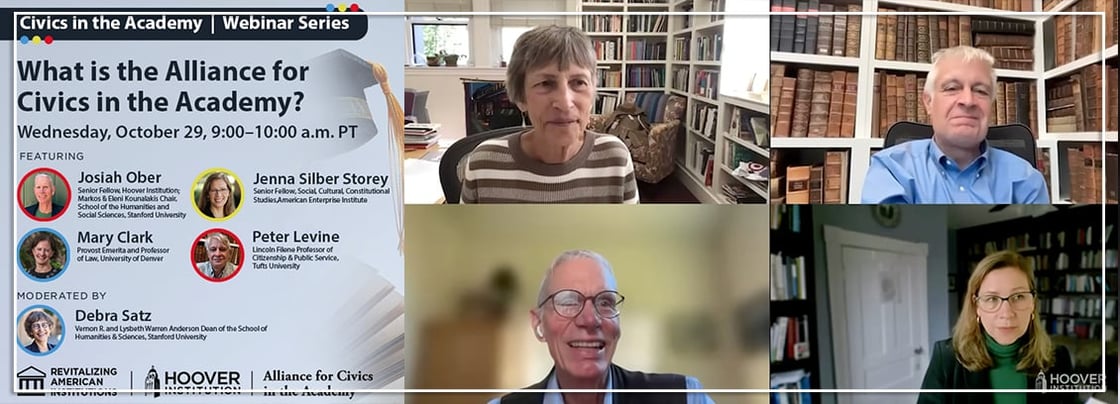
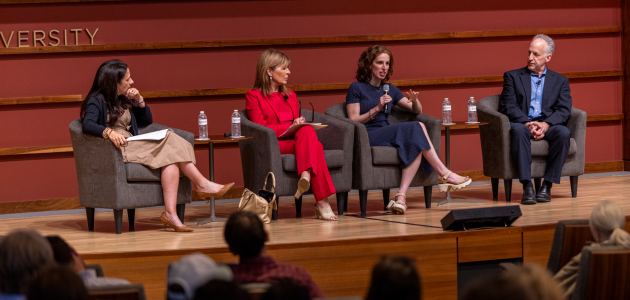
“What is the Alliance for Civics in the Academy" with Josiah Ober, Jenna Storey, Peter Levine, and Debra Satz on October 29, 2025
“If we want to improve something at scale, having a way to measure what that thing is can be a powerful idea. That is different, however, than saying metrics are all we need or that having metrics will prevent unintended consequences. What we need is a nuanced stance toward measurement.”
- Joseph Kahne
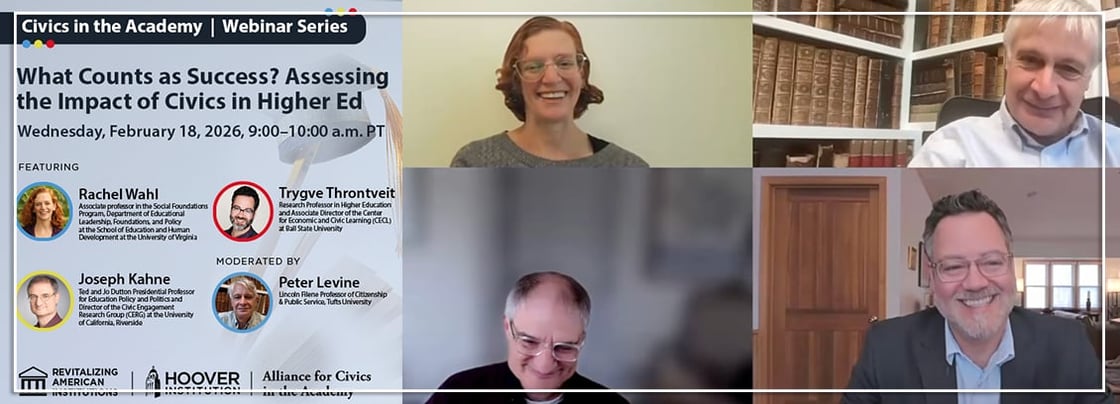
“What Counts as Success? Assessing the Impact of Civics in Higher Ed” with Trygve Throntveit, Rachel Wahl, Joseph Kahne, and Peter Levine on February 18, 2026

Syllabi
COLLEGE 102: Citizenship in the 21st Century (Stanford University)
This seminar addresses both the historical roots as well as the future of citizenship, especially as it comes under stress from populism, authoritarianism, climate change, and other challenges. Starting with Stanford’s fundamental standard, students ask how citizenship in a community needs to be constantly redefined and reinvigorated for each new era.
Introduction to Civic Studies (Tufts University)
This introductory course in civic studies explores how people can ethically and effectively organize for social change, addressing collective action, deliberation, power, conflict, and justice. Drawing on philosophy, political theory, social science, and history, students gain interdisciplinary frameworks for understanding and improving societies.

Profile Spotlight: Dan Edelstein
Dan Edelstein is the William H. Bonsall Professor of French and, by courtesy, professor of political science and history at Stanford University. He leads Stanford’s first-year COLLEGE series, which includes COLLEGE 102: Citizenship in the 21st Century. Alongside developing the COLLEGE curriculum, Edelstein focuses on developing frameworks to define and measure civic education success. COLLEGE 102 cultivates civil disagreement skills, introduces ethical frameworks for navigating political pluralism, and builds confidence for active participation. Edelstein notes that, at its core, civic education begins with civic humility: “None of us has a privileged access to the truth.”
The COLLEGE team assesses civic engagement through anonymous course evaluations and pre- and post-course surveys, with recent results showing that 72% of students report never feeling uncomfortable expressing opinions, 82% feel more open to differing perspectives after COLLEGE, and 75% report encountering ideas in class that challenge their views. Still, these approaches have limitations. Surveys can face end-of-quarter fatigue, and Edelstein also cautions against overrelying on metrics: “Assessments are useful for an initial read, but once you get into the minutiae of the assessment, you’re left not really knowing what to make of the data.” Looking ahead, the COLLEGE Steering Committee will continue refining its syllabus and goals, with hopes to collaborate with peer institutions and other campus initiatives such as Stanford Civics Initiative and ePluribus to develop more coherent approaches to measuring civic learning.

Members In The News
Civic Education for Civic Capacities by Andrew J. Perrin via American Enterprise Institute’s Center for the Future of the American University (February 10, 2026)
In Search of Good Citizens and Civic Leaders? Don’t Overlook Students Enrolled at Non-Selective Institutions by J. Cherie Strachan via American Enterprise Institute’s Center for the Future of the American University (February 10, 2026)
Course examines complex dynamics of social cooperation via Stanford Report (December 9, 2025)
Civic Education News Roundup: the Semiquincentennial, Gen Z Civic Vibe Check, and successes in civil dialogue by Joanna Kenty via Democracy 101 (December 1, 2025)
For suggestions on members to highlight in next month’s newsletter, send us an email at aca-hoover@stanford.edu.

Upcoming Events
“The University’s Role in Revitalizing K–12 Civic Education”
ACA webinar with Jennifer McNabb, Joshua Dunn, and Meira Levinson on March 4, 2026, from 9:00-10:00 a.m. PT.
Check out previous sessions in the webinar series!
“Building Civic Unity in a Religiously Diverse Democracy"
ACA Webinar with Eboo Patel, Fr. Francisco Nahoe, and Robert George on March 18, 2026, from 9:00-10:00 a.m. PT.
Three Streams of Civic Work in Higher Education
The conference will convene leaders in civic education, community engagement, and democracy-focused research for a national discussion on the future of civic life. Through interdisciplinary panels and interactive plenary discussions, the event will highlight key debates about civic learning and foster collaboration across institutions.
Hosted by Tufts University (Tisch College of Civic Life) on April 10, 2026, in person in Medford, MA
Summit speakers and panelists will include Amy Binder, Mary Clark, Michael Clune, Dayna Cunningham, Andrew Delbanco, Fonna Forman, Bryan Garsten, Leslie Garvin, Caroline Attardo Genco, Tetyana Hoggan-Kloubert, Peter Levine, Jessica Kimpell Johnson, Jennifer Brick Murtazashvili, Josiah Ober, Mindy Romero, Stefanie Sanford, Jenna Silber Storey, Amber Wichowsky, and more.
Open to ACA members at no charge. Please register here.
Centers, Institutes, and Labs of Democracy: Supporting Civic Leaning and Engagement on College Campuses and Beyond
This groundbreaking convening will bring together scholar-practitioners from democracy-focused centers, institutes, and labs nationwide for aspirational and action-oriented collaboration. Insights generated through sessions, panels, and discussions will directly inform a post-convening white paper that maps the national ecosystem; proposes a collaborative framework for research, pedagogy, programming, and field-building; and outlines next steps and structures for sustained partnership—serving as a shared guide for this emerging network
Hosted by Rutgers University on April 23–25, 2026, in person in New Brunswick, NJ.
Want to highlight your event in next month’s newsletter? Send us an email at aca-hoover@stanford.edu.

Get More Involved
Help make our community of practice as useful and impactful for educators as possible by sharing your work, ideas, and experiences!
- Visit our website to access course syllabi developed by ACA members, civics program descriptions, research and policy proposals, op-eds, book reviews, and more.
- Contribute to our community of practice by submitting your syllabi, research, commentary, and other field-building materials to aca-hoover@stanford.edu.
- Apply to host an ACA-sponsored conference.
Apply or nominate a colleague for membership in the ACA.

Who We Are
The Alliance for Civics in the Academy (ACA) is a nonpartisan network of instructors dedicated to strengthening postsecondary civic education. Drawing together faculty from across disciplines, regions, and viewpoints, the ACA fosters a community of practice devoted to improving the teaching of citizenship in a constitutional democracy—through shared resources, collaborative learning, and open inquiry.