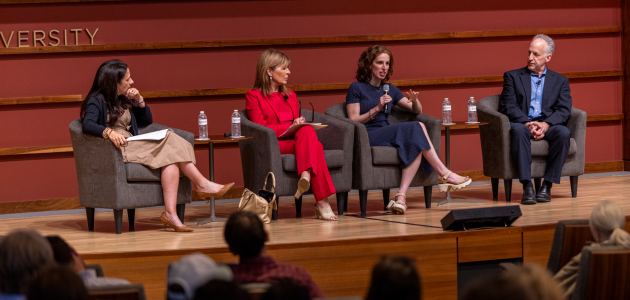













Welcome to the fourth issue of the ACA newsletter! Each month, we focus on a central theme and feature related webinar discussions, resources, and ACA members’ work. We also spotlight past webinar discussions from our series.
You’ll also find updates on upcoming ACA programming and other events hosted by members of our network, along with profiles of ACA members who are doing exemplary work in the civics space. We hope you enjoy the June issue, and please feel welcome to send us resources and news to share in future issues.
ACA Members Survey
Thank you for being a member of the ACA! Please fill out this short survey, which will help the ACA Executive Committee better understand what is working, what could be improved, and how to best support your civic education work. All responses will remain anonymous.
Call for ACA Meeting Proposals
Do you have an idea for a convening that advances civic education? Please fill out this proposal form to apply for ACA funding. Applications are reviewed quarterly, and the next deadline is July 10, 2026.
WEBINAR
“Civic education and liberal education are different. They have different aims. But civic education cannot prosper unless it is situated within the context of liberal education. Nor can liberal education, by itself and without a civic component, fully accomplish its aims. They are complementary, and they need one another.”
—Joseph Knippenberg
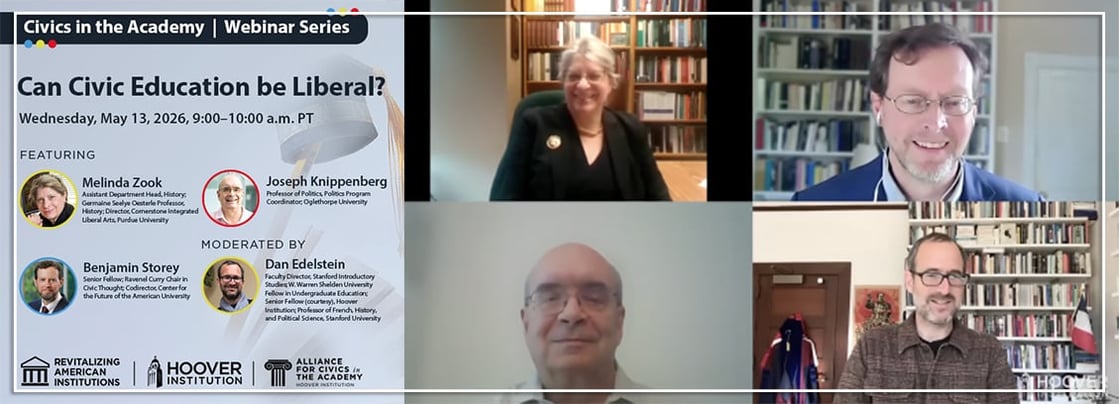
“Can Civic Education Be Liberal?” with Melinda Zook, Joseph Knippenberg, Benjamin Storey, and Dan Edelstein on May 13, 2026
“What we want from civic education is [to develop] the skills of ongoing engagement and coexistence with people with whom we disagree. It is not just about learning how to reach a conclusion but about learning how to go on disagreeing with another live person—with a neighbor, a friend, a fellow citizen.”
—Jacob Levy
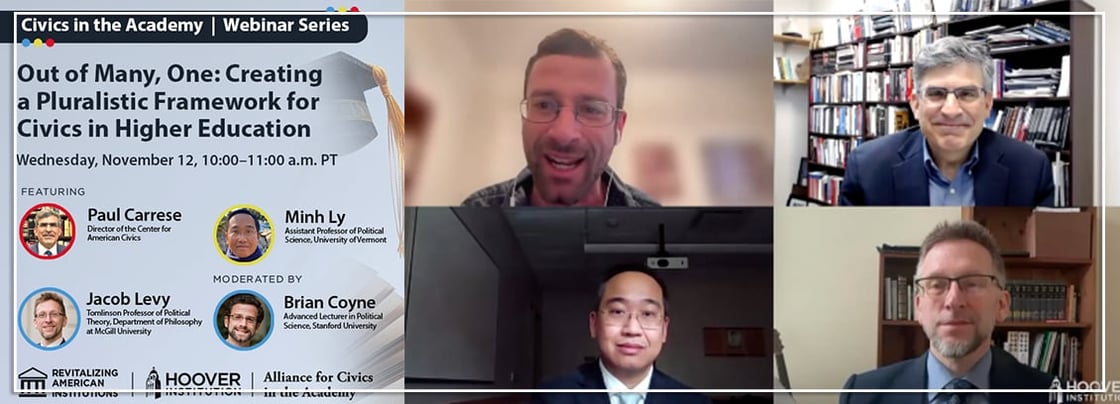
“Out of Many, One: Creating a Pluralistic Framework for Civics in Higher Education” with Paul Carrese, Jacob Levy, Minh Ly, and Brian Coyne on November 12, 2025
Please note that the ACA webinar series will be taking a summer break starting in June and will resume in September.
SYLLABI
- Interfaith Civics (University of Denver)
- This course examines religious diversity in liberal pluralist democracies, exploring how to uphold religious freedom while fostering ethical civic engagement and interfaith understanding. Through political theory, case studies, and hands-on activities—including community events and Spiritual Life projects—students develop practical skills for dialogue, bridge-building, and responsible leadership across difference.
- Civicus: Advancing Civic Education (Southern Oregon University)
- This course explores the evolution and practice of citizenship as an active, participatory commitment to the common good. Through the study of democracy’s philosophical roots, historical development, and contemporary challenges, the course equips students to think critically about the responsibilities of citizens and the conditions that sustain democratic life.
- Global Justice (University of Vermont)
- This seminar explores major ethical debates in global politics, including duties to alleviate global poverty, the principles of distributive justice, the legitimacy of global governance institutions, and the morality of war. Through philosophical inquiry and contemporary case studies, students critically examine how justice, fairness, and responsibility should guide international action in an interconnected world.
MEMBERS IN THE NEWS
- The Democratic Tradition We’ve Forgotten by Trygve Throntveit via Time (May 27, 2026)
- Nothing Beats Polarization Like Civics Education by Danielle Allen via The New York Times (May 17, 2026)
- The People's Declaration by Michael Auslin via The Patowmack Packet (May 17, 2026)
- On History and Archaeology by Suzanne Marchand via Perspectives on History (May 12, 2026)
- Is Black Studies Civic Studies? by Peter Levine (May 12, 2026), replying to Hollis Robbins, My AI Thinks Civics Is Black Studies (April 17, 2026)
UPCOMING EVENTS
- 2026 Conference on Civic Thought
- The Conference on Civic Thought is a national annual scholarly conference on civic thought in higher education. This conference brings together scholars from across the nation in multiple disciplines to present their research on citizenship. The event features keynote addresses, plenary sessions, and concurrent panels, offering a dynamic platform for dialogue and collaboration across disciplines.
- Hosted by the Ohio State University Chase Center for Civics, Culture, and Society September 23–24 at the Blackwell Inn.
- Frontiers of Democracy 2026, “The United States at 250: Meeting the Moment for Democracy, in the US and Around the World”
- At a moment of significant political change in the United States and around the world, the Frontiers of Democracy 2026 convening will explore the essential elements of democratic process, policy, and partnership. Drawing on global, historical, and youth perspectives, and using the framework of generous listening, we will examine the intersections of political pluralism, activism, and academia, and consider how to meet this pivotal moment in history.
- Consider proposing one or more sessions for the conference. Deadline June 30.
- Hosted by Tufts University’s Tisch College of Civic Life October 2–4 at Tufts University in Medford, Massachusetts.
Want to highlight your event in next month’s newsletter? Send us an email at aca-hoover@stanford.edu.
THE CIVIC PROFILE
In March, Hoover’s Center for Revitalizing American Institutions (RAI) launched the Civic Profile. Likened to a “civics Myers-Briggs,” the Civic Profile is an online educational and research tool that helps individuals explore their civic identity and those of their cohorts across three dimensions: civic values, knowledge, and engagement.
Discover your Civic Profile now!
SHEAR Launches Its Civic Exchange
The Society for Historians of the Early Republic (SHEAR) has launched the SHEAR Civics Exchange, a new online platform connecting organizations and institutions with expert historians who can speak on topics from the American Revolution through the Civil War. Visit civics.shear.org to learn more!
GET INVOLVED
Help make our community of practice as useful and impactful for educators as possible by sharing your work, ideas, and experiences.
- Visit our website to access course syllabi developed by ACA members, civics program descriptions, research and policy proposals, op-eds, book reviews, and more.
- Contribute to our community of practice by submitting your syllabi, research, commentary, and other field-building materials to aca-hoover@stanford.edu.
- Apply to host an ACA-sponsored conference.
- Apply or nominate a colleague for membership in the ACA.

WHO WE ARE
The Alliance for Civics in the Academy (ACA) is a nonpartisan network of instructors dedicated to strengthening postsecondary civic education. Drawing together faculty from across disciplines, regions, and viewpoints, the ACA fosters a community of practice devoted to improving the teaching of citizenship in a constitutional democracy—through shared resources, collaborative learning, and open inquiry.