Pioneering Monetary Policy: The Taylor Rule and the Transformation of Monetary Policy

Tuesday, June 12, 2012
Stanford
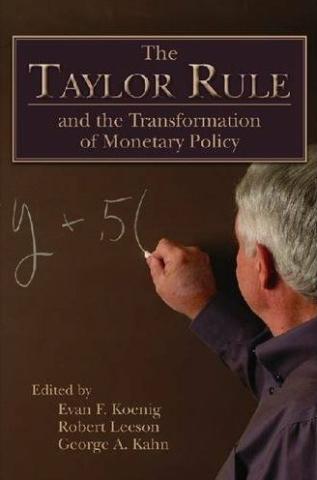
The Taylor Rule and the Transformation of Monetary Policy

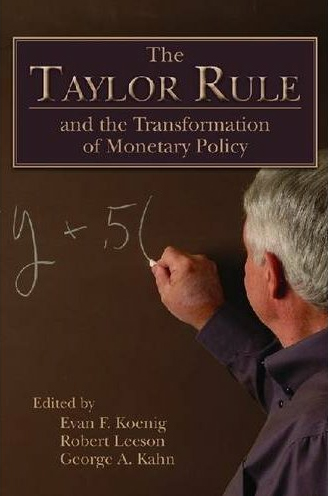
Hoover Institution Press released The Taylor Rule and the Transformation of Monetary Policy, edited by Evan F. Koenig, Robert Leeson, and George A. Kahn.  The Taylor Rule is a monetary policy strategy first proposed in 1992 by John B. Taylor, Hoover Institution senior fellow, Stanford professor, and former US Treasury undersecretary, which shows how central banks should set interest rates in response to inflation, output, and other economic conditions.  The book, which offers insight into Taylor’s revolutionary approach to monetary theory and policy, includes contributions from influential figures in the central banking community, including Ben S. Bernanke, Richard W. Fisher, Otmar Issing, Donald L. Kohn, John P. Lipsky, Edward Nelson, Guillermo Ortiz, and Janet Yellen, and academics, including Nobel laureate Robert E. Lucas, Pier Francesco Asso, Lars Svensson, and Michael Woodford, in addition to Koenig, Leeson, Kahn, and Taylor.

Notably, economists and policy makers have recently used the Taylor Rule as a basis for arguing that the Federal Reserve held interest rates too low for too long in the years leading up to the recent financial crisis.  Specifically, the rule stipulates that, for each 1 percent increase in inflation, the central bank should raise the nominal interest rate by more than one percentage point.  The Taylor Rule derives from the idea that people are forward-looking in their decision making but take time to adjust their behavior because of real-world rigidities such as staggered wages and price setting.  

“Anyone interested in monetary policy must read this collection,” said Allan Meltzer, professor of political economy at Carnegie Mellon University and author of A History of the Federal Reserve.  “John Taylor’s monetary rule is accepted as a useful guide by a wide variety of academics and practitioners.  This represents a major breakthrough in favor of rule-like policymaking.”

In this book, contributors examine how the Taylor Rule was developed and discuss its impact on global monetary policy.  They point out that, twenty years ago, John Taylor proposed a simple idea to guide monetary policy and it quickly spread through academia, to the trading floors of Wall Street, and to the Federal Reserve’s board room in Washington, DC.  Policy makers began talking about it in their debates and central bankers in other countries began applying it.  The contributors explain how, a few years after the Taylor Rule was devised, economists examined different periods of economic performance to see whether the rule held true when applied.  They found that periods of good economic performance, such as the Great Moderation of the 1980s and 1990s, could be attributed to economic policy decisions made in accordance with what would have been the Taylor Rule’s prescriptions.  Similarly, they found that periods of poor economic performance, such as the Great Inflation of the1970s, could be attributed to economic policy decisions that diverged from the rule.   The contributors point out that economists have also used the Taylor Rule to determine whether unconventional monetary policies such as quantitative easing are appropriate.  They conclude that, two decades after the rule was proposed, the existing economic environment is changing but that the Taylor Rule remains a focal point for monetary policy discussions around the world. 

“It is hard to overstate the contribution of the Taylor Rule to both theoretical and empirical work on the design of good monetary policy,” said Carl. E. Walsh, professor of economics at the University of California, Santa Cruz, and author of Monetary Theory and Policy. “The essays in the volume explore the historical development of policy rules, the theory of policy rules, and their use in policy practice.  The essays, including two chapters by John Taylor, are written by leading academic economists and policymakers (several of whom are both) and are filled with insights on debates ranging from rules versus discretion to targeting rules versus instrument rules.”

Evan F. Koenig is vice president and senior policy adviser at the Federal Reserve Bank of Dallas and an adjunct professor at Southern Methodist University.  Robert Leeson is a visiting fellow at the Hoover Institution, a professor of economics at Stanford University, and an adjunct professor at Notre Dame Australia University.  George A. Kahn is vice president and economist at the Federal Reserve Bank of Kansas City.

John Taylor is a senior fellow at the Hoover Institution, where he chairs the Working Group on Economic Policy, and a professor of economics at Stanford University.  He served as undersecretary of the Treasury for international affairs from 2001 to 2005 and was awarded the prestigious Bradley Prize in 2010.  He has authored numerous books, including the recently released First Principles (W.W. Norton, 2012).

CONTRIBUTORS: Pier Francesco Asso, Ben S. Bernanke, Richard W. Fisher, Otmar Issing, George A. Kahn, Donald L. Kohn, Robert Leeson, John P. Lipsky, Robert E. Lucas, Edward Nelson, Guillermo Ortiz, Lars Svensson, John B. Taylor, Michael Woodford, and Janet Yellen.

For more information on The Taylor Rule and the Transformation of Monetary Policy, find us on Facebook, Twitter, and Scribd (keyword: Hoover Institution) or visit HooverPress.org.  For more information on the Hoover Institution, visit Hoover.org.