

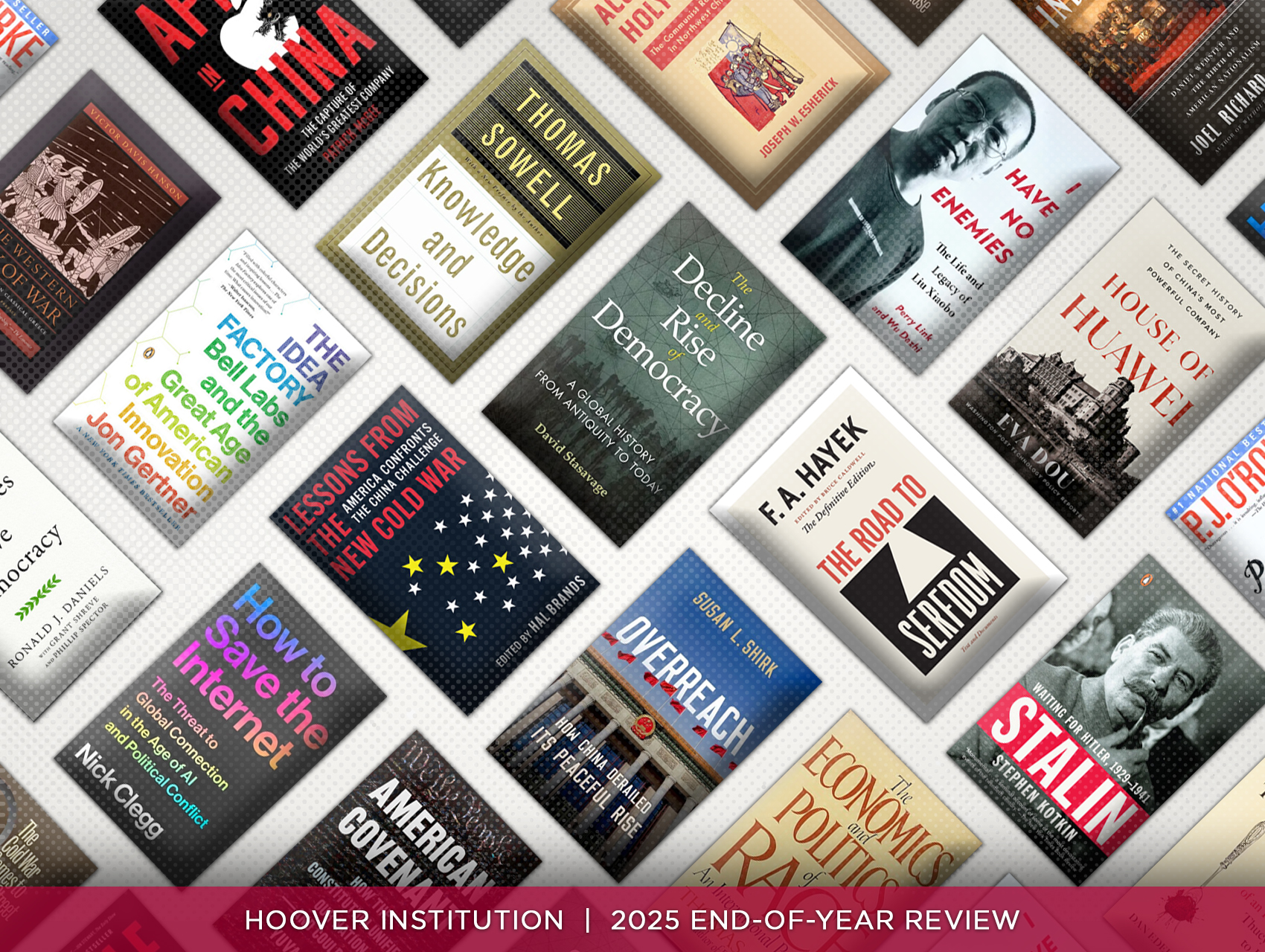
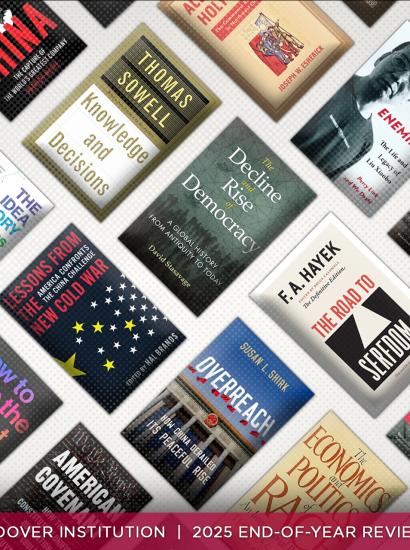
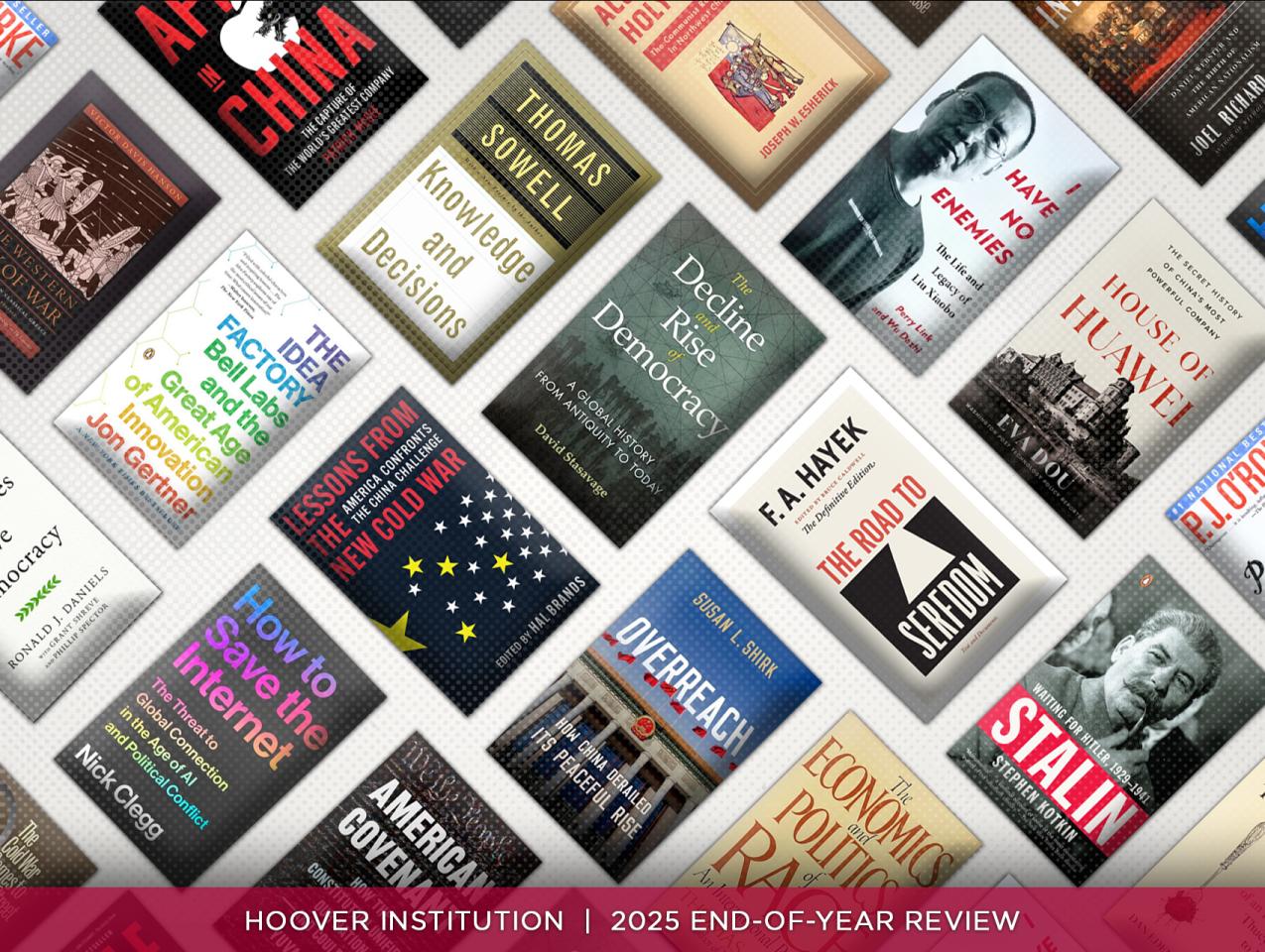
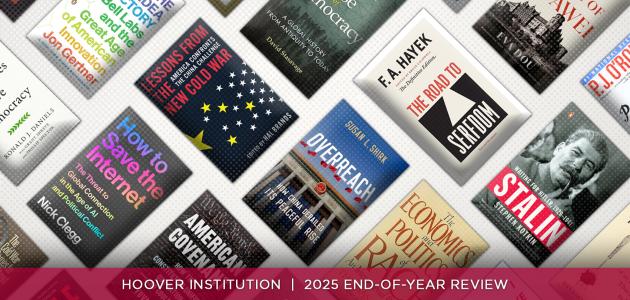
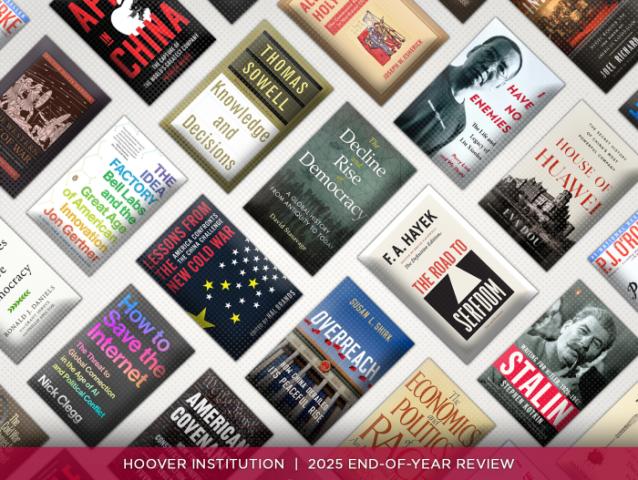
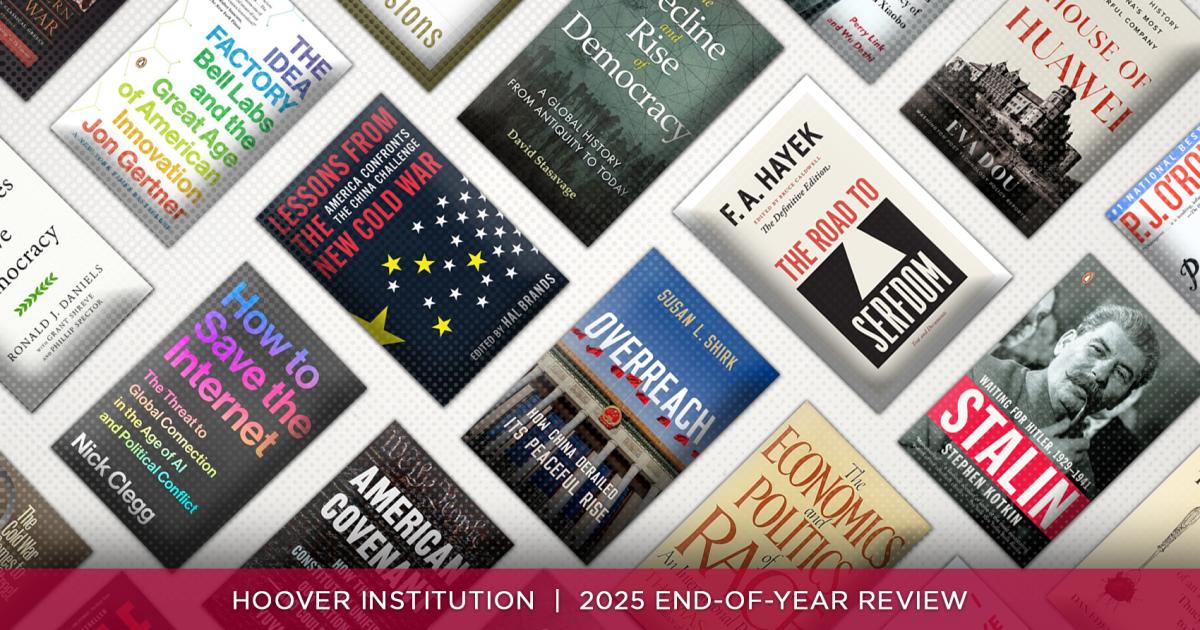
Hoover Institution (Stanford, CA) —Whether addressing national security, trade, history, civic thought, or America’s relationship with China, we asked Hoover Institution fellows to offer their picks for some of the best books they’ve read this year, as well as books in their focus area they consider the best ever written on that subject.
Whether you’re a policymaker, practitioner, educator, or curious reader, you’ll find accessible syntheses, bold arguments, and fresh narratives that illuminate urgent challenges and overlooked possibilities. These books published in 2025 showcase the breadth, rigor, and public relevance that defines our fellowship.
Every title reflects our mission, Ideas Advancing Freedom, bringing insights to subjects that matter, and connecting these ideas to people who can use them. Explore what 2025 and years past have to offer.
National Security
Philip Zelikow
Senior Fellow Philip Zelikow offers three books that evaluate US security through the challenges posed by the Cold War:
He says: “Start with Lisle Rose’s The Cold War Comes to Main Street: America in 1950 (University Press of Kansas, 1999). Then explore each angle of a major international crisis in Philip Zelikow, Ernest May, and the Harvard Suez Team’s Suez Deconstructed: An Interactive Study in Crisis, War, and Peacemaking (Brookings, 2018). Finally, learn more about how the sausage (or in this case defense innovation) is really made in Donald MacKenzie’s Inventing Accuracy: A Historical Sociology of Nuclear Missile Guidance (MIT Press, 1993).”
On all three books, Zelikow says that “together they combine four essential dimensions for understanding: These are the human side—from citizen to statesman; the detailed substance of real policy; how the foreigners saw these issues; and the organizational cultures that suffuse the workings of our government.”
History
Barry Strauss
Historian and Senior Fellow Barry Strauss offers six books to read in your winter downtime, including three written by Hoover fellows.
Strauss’s picks for all time:
- The Western Way of War: Infantry Battle in Classical Greece, (University of California Press, 2009) by Victor Davis Hanson
- 1776, (Simon & Shuster, 2006) by David McCollough
- Battle Cry of Freedom: The Civil War Era, (Oxford University Press, 1988) by James M. McPherson
Three notable books he’s read in the past 12 months:
- Dictators: The Cult of Personality in the Twentieth Century, (Bloomsbury, 2020) by Frank Dikötter
- Stalin: Waiting for Hitler, 1929–1941, (Penguin Random House, 2018) by Stephen Kotkin
- The Cleopatras: The Forgotten Queens of Egypt, (Basic Books, 2024) by Lloyd Llewellyn-Jones
On Battle Cry of Freedom, Strauss says: “Winner of the Pulitzer Prize, Battle Cry of Freedom is a succinct and eloquent history of the American Civil War by one of the subject’s great scholars.”
You can also check out Strauss’s latest work, published this year: Jews vs. Rome: Two Centuries of Rebellion Against the World's Mightiest Empire.
Stephen Kotkin at the Hoover History Lab:
Senior Fellow Stephen Kotkin wishes to draw supporters’ attention to three books written by scholars affiliated with the Hoover History Lab.
They are:
- The Revolution to Come: A History of an Idea from Thucydides to Lenin, (Princeton University Press, 2025) by Dan Edelstein
- The Party's Interests Come First: The Life of Xi Zhongxun, Father of Xi Jinping, (Stanford University Press, 2025) by Joseph Torigian
- Breakneck: China's Quest to Engineer the Future, (W.W. Norton, 2025) by Dan Wang
Politics
Brandice Canes-Wrone at RAI
Senior Fellow and Center for Revitalizing American Institutions (RAI) Director Brandice Canes-Wrone offers seven books she says are crucial reading for anyone interested in how America can reverse the declining levels of public trust in its core institutions.
Her selections from the past 12 months:
- Electoral Reform in the United States: Proposals for Combating Polarization & Extremism, (Lynne Rienner, 2025) edited by Larry Diamond, Edward B. Foley, and Richard H. Pildes
- The Rural Voter: The Politics of Place and the Disuniting of America, (Columbia University Press, 2023) by Nicolas F. Jacobs and Daniel M. Shea
- Indivisible: Daniel Webster and the Birth of American Nationalism, (Penguin Random House, 2022) by Joel Richard Paul
Canes-Wrone’s all-time picks:
- What Universities Owe Democracy, (Johns Hopkins University Press, 2021) by Ronald J. Daniels with Grant Shreve and Phillip Spector
- The American Spirit: Who We Are and What We Stand For, (Simon & Shuster, 2018) by David McCullough
- Healing the Heart of Democracy: The Courage to Create a Politics Worthy of the Human Spirit, (Wiley, 2024) by Parker J. Palmer
- American Covenant: How the Constitution Unified Our Nation—and Could Again, (Basic Books, 2024) by Yuval Levin
Canes-Wrone says, “David McCullough's The American Spirit is a collection of speeches given in different settings and contexts (commencements, naturalization ceremonies, etc.), spanning from the late 1989 to 2016. Each one tells an inspiring story about a particular place and its history, and collectively the book serves as a record of how McCullough’s ideas about who we are and what we stand for evolved over time.”
Emerging Technology
Andrew B. Hall
Senior Fellow Andrew B. Hall studies the intersection of emerging technology and democracy, specifically how using data and new systems can improve the design of democratic systems of governance in the online and offline worlds.
His picks from the past 12 months:
- Apple in China: The Capture of the World's Greatest Company, (Simon & Shuster, May 2025) by Patrick McGee
- How to Save the Internet: The Threat to Global Connection in the Age of AI and Political Conflict, (Penguin UK, 2025) by Nick Clegg
- Influence Empire: The Story of Tencent and China’s Tech Ambition, (Hodder & Stoughton, 2022) by Lulu Yilun Chen
In terms of more classic, all-time winners:
- The Idea Factory: Bell Labs and the Great Age of American Innovation, (Penguin Random House, 2013) by Jon Gertner
- The Road Ahead, (Penguin Random House, 2008) by Bill Gates
- The Dream Machine, (Stripe Press, 2018) by M. Mitchell Waldrop
On Apple in China, Hall calls it “a deeply investigated, definitive account of how the world's most important company became subjugated to the Chinese Communist Party.”
China
Elizabeth Economy
Cochair of Hoover’s US, China and the World research program, Senior Fellow Elizabeth Economy offers the top three books she’s read on her area of focus in the past year:
- Wild Swans: Three Daughters of China, (Simon & Shuster, 1991) by Jung Chang
- Red Roulette: An Insider's Story of Wealth, Power, Corruption, and Vengeance in Today's China, (Simon & Shuster 2021) by Desmond Shum
- Lessons from the New Cold War: America Confronts the China Challenge, (Johns Hopkins University Press, 2025) edited by Hal Brands
She also recommends the following books about China’s politics and the worldview of the Chinese Communist Party, including two of her own:
- Overreach: How China Derailed Its Peaceful Rise, (Oxford University Press, 2022) by Susan L. Shirk
- The World According to China, (Polity Press, 2022) by Elizabeth Economy
- The Third Revolution: Xi Jinping and the New Chinese State, (Oxford University Press, 2018) by Elizabeth Economy
You can also watch her video podcast, China Considered, about the forces shaping China and its global relationships here.
Joseph Torigian
Former Hoover Visiting Fellow Joseph Torigian’s own work this year: The Party's Interests Come First: The Life of Xi Zhongxun, Father of Xi Jinping can be found at the end of this list. But he also offered six other books he says are vital for understanding the formation and ethos of modern China:
- The End of the Maoist Era: Chinese Politics During the Twilight of the Cultural Revolution, 1972–1976, (Gale Virtual Reference Library, 2009) by Frederick C. Teiwes and Warren Sun
- To the End of Revolution: The Chinese Communist Party and Tibet, 1949–1959, (Columbia University Press, 2020) by Xiaoyuan Liu
- Accidental Holy Land: The Communist Revolution in Northwest China, (University of California Press, 2022) by Joseph W. Esherick
Books Torigian recommends from the past 12 months:
- House of Huawei: The Secret History of China's Most Powerful Company, (Penguin Random House, 2025) by Eva Dou
- I Have No Enemies: The Life and Legacy of Liu Xiaobo, (Columbia University Press, 2024) by Perry Link and Wu Dazhi
- China's Church Divided: Bishop Louis Jin and the Post-Mao Catholic Revival (Harvard University Press, 2025) by Paul P. Mariani
On The End of the Maoist Era, Torigian says “When it comes to the study of elite politics in China, Frederick Teiwes and Warren Sun built their own mountain and put a flag on it.”
Economics
Steven J. Davis
Hoover Senior Fellow and Research Director Steven J. Davis offers three books he’s read in recent months dealing with international trade.
- Our Dollar, Your Problem: An Insider’s View of Seven Turbulent Decades of Global Finance, and the Road Ahead, by Kenneth Rogoff, (Yale University Press, 2025.) Watch or hear a podcast episode Davis recorded with Rogoff about the book.
- The Great Trade Hack: How Trump’s Trade War Fails and the World Moves On, by Richard Baldwin, (CEPR Press, 2025.) Watch or hear a podcast episode Davis made with Baldwin about the book.
- Andrew Crockett Memorial Lecture, “The International Monetary and Financial System: A Fork in the Road,” by Maurice Obstfeld (Bank for International Settlements, 2025). Watch or hear two podcast episodes Davis produced with Obstfeld on his speech: Part 1 and Part 2.
Three books Davis recommends from all time:
- The Road to Serfdom, by Friedrich A. Hayek (University of Chicago Press, 1994)
This 50th anniversary edition contains an introduction by Milton Friedman. A classic analysis of why central planning fails as an economic system, and why it undermines individual liberty and rule of law.
- The Other Path: The Invisible Revolution in the Third World, by Hernando de Soto (Harper & Row Publishers, 1989)
A major work on how the formalization of property rights for the poor and dispossessed in third-world countries can promote economic growth and social stability.
- Factory Girls: From Village to City in a Changing China, by Leslie T. Chang (Spiegel & Grau, 2008)
On Factory Girls, Davis writes, “China’s economic development after 1978 was partly powered by an enormous migration of young, single women from rural to urban areas. This book delivers a journalistic account of their motivations, ambitions, and experiences, yielding much insight into the human and sociological aspects of the development process and why young women responded in such large numbers to dreams of a better life in the city.”
John H. Cochrane
Senior Fellow John H. Cochrane offers readings from a powerhouse of Hoover: Thomas Sowell, as well as one about the banality of politics.
- Knowledge and Decisions, (Basic Books, 1980) Thomas Sowell
- The Economics and Politics of Race: An International Perspective, (William Morrow and Company, 1983) Thomas Sowell
- Parliament of Whores: A Lone Humorist Attempts to Explain the Entire U.S. Government, (Grove Press, 2003) P. J. O’Rourke
Politics
Morris P. Fiorina
Senior Fellow Morris P. Fiorina offers two suggestions that speak to the state of politics in America today:
- Second Class: How the Elites Betrayed America's Working Men and Women, by Batya Ungar-Sargon (Encounter Books, 2024)
- How Elites Ate the Social Justice Movement, by Fredrik DeBoer (Simon & Shuster, 2024)
Josiah Ober
On the theoretical side of politics, Senior Fellow Josiah Ober offers books that explain the intrinsic value of democracy and suggest its best days still lie ahead.
- The Dispersion of Power: A Critical Realist Theory of Democracy, by Samuel Ely Bagg (Oxford University Press, 2024)
- Representative Democracy: A Justification, by Dimitri Landa and Ryan Pevnick (Oxford University Press, 2025).
- Election Day: How We Vote and What It Means for Democracy, by Emilee Booth Chapman (Princeton University Press, 2022)
Three books Ober recommends from who he calls all-time greats: “Each one gives hope for the future of American democracy.”
- Our Declaration: A Reading of the Declaration of Independence in Defense of Equality, by Danielle Allen, (New York: W.W. Norton, 2015).
- The Decline and Rise of Democracy: A Global History from Antiquity to Today, by David Stasavage (Princeton University Press, 2020).
- The Rise of American Democracy: Jefferson to Lincoln, by Sean Wilentz (W. W. Norton & Company, 2006).
Ober calls Our Declaration “a deep and sympathetic reading of one of the most important documents in American (and indeed world) political history, by a thoughtful political theorist.”