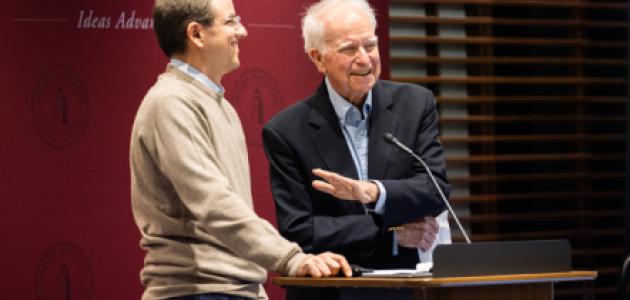









Hoover Institution (Stanford, CA) — Hoover’s Joshua D. Rauh took his research criticizing the efficacy of the proposed California billionaires’ tax straight to one of its creators in a debate at Stanford on March 6, 2026, arguing it will leave the state poorer in the long run.
In a public debate with University of California–Berkeley economist Emmanuel Saez, a key architect of the proposed wealth tax, Rauh, a senior fellow at the Hoover Institution, pointed to his own research which shows the net present value of the tax is likely negative, meaning it will drive jobs and investment away from California for years if it is passed.
Proponents of the wealth tax “would liquidate Silicon Valley for an extra $2 billion per year,” Rauh said. “This is classic, not showing or considering what the economic damage would be of liquidating Silicon Valley.”
His study shows the proposal would leave the state worse off by an estimated $25 billion once future lost income tax revenue is considered.
The study, conducted alongside Research Fellow Benjamin Jaros, Research Associate Gregory Kearney, and research analysts John Doran and Matheus Cosso, also finds that the one-time levy would collect approximately $40 billion in wealth tax revenue, less than half of the roughly $100 billion projected by proponents. This is because many billionaires have already departed California even before the initiative has qualified for the ballot.
In the debate, Saez contended that the tax is useful because federal transfers for things like Medicaid are set to decline over the next two years. He also said that the combined wealth of California’s billionaires has grown by 140 percent over the last three years to a total of $2 trillion.
Rauh’s team has found that $2 trillion wealth figure has fallen by as much as $536 billion already, as billionaires exit the state in response to the mere proposal of the new tax.
An additional $250 billion was never taxable to begin with: The proponents' estimate included three individuals who were not California residents at the time of filing, most notably Oracle founder Larry Ellison, who moved to Hawaii in 2020. After correcting for both the departures and the baseline errors, the actual taxable wealth base is approximately $1.2 trillion.
“We found that six of the billionaires, including the top two, (Sergey) Brin and (Larry) Page, left California between the time that this proposal was announced and December 31, 2025,” Rauh said.
Rauh also challenged the assertions by Saez and other proponents of the measure that it will occur one time only.
“Why would anybody believe that it's a one-time tax? The measure has to write its wealth tax authorization into the California Constitution,” Rauh said. “It's written in a way that's specific to this measure, but once that infrastructure is in place, future wealth taxes can be built on top of it, at any rate, at any threshold, and at any time.
“That’s why they’re leaving,” Rauh said of billionaires who have recently moved to other states, such as Brin and Page.
Finally, Rauh said multiple aspects of the proposal will be challenged in court and possibly could take years to litigate.
“Maybe California will ultimately prevail in court. If so, it will have litigated this for years and it will have permanently imposed real costs on employment, investment, and innovation, and there's not going to be any clawing back of that,” Rauh said.
If the proposed wealth tax secures 875,000 signatures by June, California voters will decide whether to support this measure when they go to the polls on November 3, 2026.
The debate was held as part of the Stanford Institute for Economic Policy Research’s 2026 Economic Summit.
##
Learn more about Hoover’s State and Local Governance Initiative here.