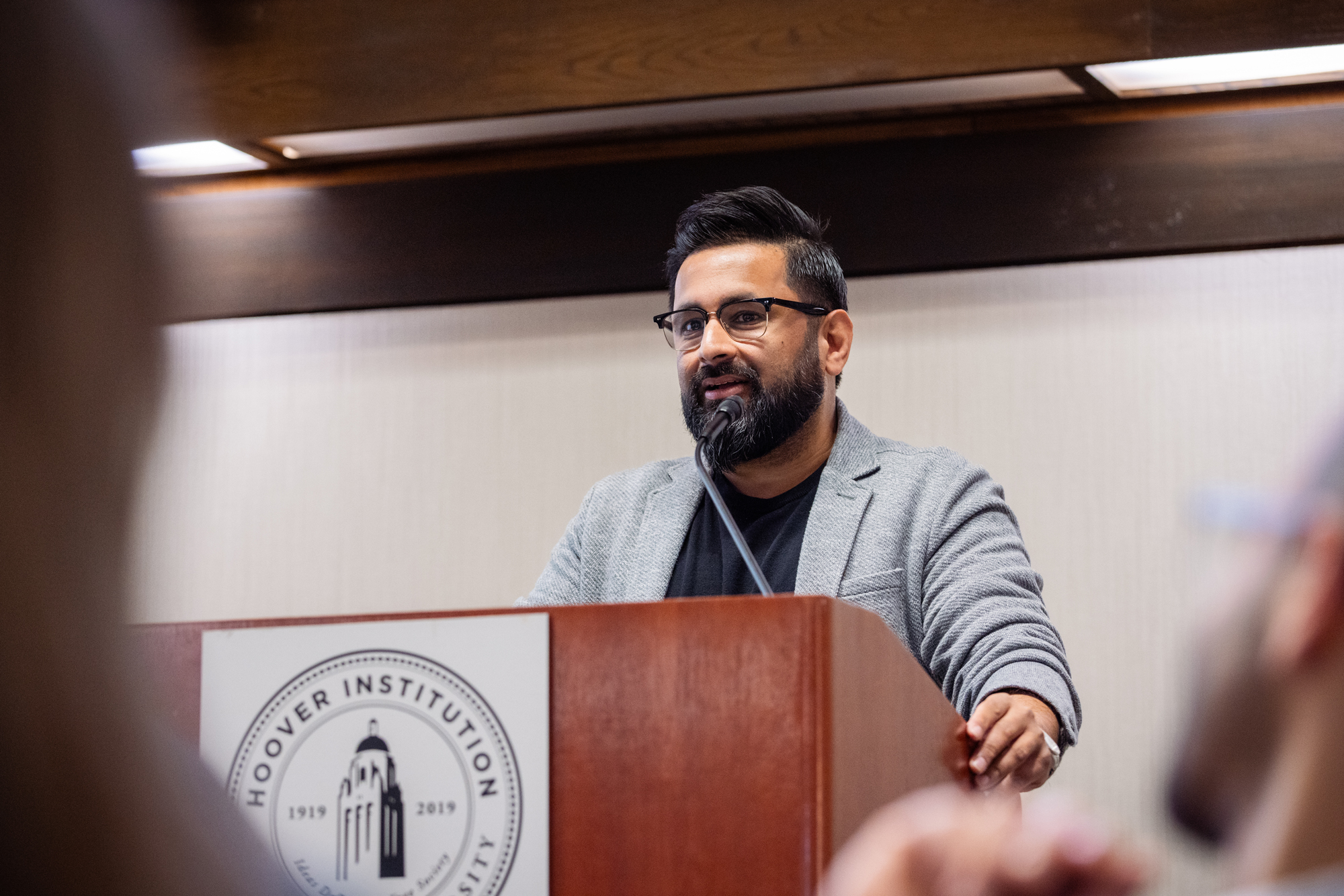









Hoover Institution (Stanford, CA) — Experts on energy and environmental policy, environmental entrepreneurs, and scholars gathered at the Hoover Institution on May 12, 2026, to consider how trade, technological improvements and entrepreneurship can augment the success of market-based approaches to promote conservation and environmental quality.
The Markets vs. Mandates research program at Hoover is directed by Senior Fellows Terry L. Anderson and Dominic Parker.
Anderson told attendees to channel an oft-cited quote from another Hoover thinker, Senior Fellow Thomas Sowell, when thinking about the role of markets and mandates in improving environmental quality.
“Every time you think of an environmental issue discussed here, think ‘there are no solutions, but there are lots of tradeoffs,’ ” Anderson said.
“And every time you think of an environmental problem, whether it’s at the top of the food chain with climate change or something as trivial as whether you fix the faucet to save water, if you lead with that, you will understand how to think about the difference between markets and mandates.”
The Value of Local Control in Environmental Protection
State and local governments can often prove more effective at environmental protection than federal mandates, according to research presented at the conference. Jonathan Adler of William and Mary College noted that major environmental problems were moving in the right direction before federal intervention, with dissolved oxygen deficits and the share of unfishable fresh water declining rapidly prior to the Clean Water Act of 1972.
Todd Myers of the Washington Policy Center highlighted how decentralized control brings accountability, citing the Quinault Nation’s forest management success rate of 50 percent, compared to 20 percent when the same area of land on Washington’s Pacific coast was the responsibility of the federal Bureau of Indian Affairs. The tribe improved tree replanting, stream protection, and cedar harvests when granted autonomy. Myers argued that decentralization allows communities to innovate differently rather than applying uniform solutions to varied local problems.
Trade Barriers Encourage Pollution
Current trade policies accelerate climate change by protecting dirty industries and discouraging clean ones, according to Joseph Shapiro, an economist at UC-Berkeley. Dirty industries face low levels of trade protection while clean industries encounter high barriers, a pattern that encourages production, consumption, and trade of polluting goods. Shapiro found that a global trade agreement could reduce emissions by 61 percent. Senior Fellow John Cochrane noted that while moving steel production, rare-earth refining, and coal overseas benefited US environmental quality, these industries would pollute less under American environmental standards. The session, which also featured economist Arik Levinson of Georgetown University, identified tariffs as counterproductive, with Cochrane dismissing them as “an answer in search of a question.”
The Data Center Question
As AI’s role in the economy widens, an ever-rising number of communities are hosting data centers, which are growing in size and capacity to keep up with the computing needs of the AI hyperscaling firms. Dominic Parker moderated a conversation featuring journalist Robert Bryce, Dado Slezak of QTS Data Centers, and Hoover policy fellow David Fedor about the reasons why data centers, which bring concerns about noise, water and power usage, and questions about durable employment impacts, are becoming a hotly contested issue.
Even with projects that largely recycle their water and contribute hundreds of long-term jobs, opposition persists. Bryce said the data center question is mobilizing ordinary Americans in a way that few other issues have in modern times. Fedor said that better coordination with state and local power utilities could alleviate many concerns about power usage. For instance, in most jurisdictions, there are only about 30 hours in an entire year where power demand reaches the limit of supply. If data centers could use cogeneration or self-generation in those few hours, they could avoid putting pressure on state grids in times of strain.
How Entrepreneurs Are Boosting Environmental Quality
Next, Visiting Fellow Holly Fretwell spoke with three participants in Hoover’s Enviropreneur Fellowship Program about how their projects and businesses support market-based efforts to improve the quality of America’s natural realm.
First, Maiky Iberkelid of Resilift spoke about how his firm is working to reduce the cost of raising structures in flood-prone areas, using sensors and other technologies to help lower barriers to entry in the building-raising business in the United States. Insurers can use data produced by Resilift to assess building raisers and see how proficient and cost-effective they are.
Next, Grant Canary spoke about Mast, which helps restore burned-out forestland by removing and storing fire-killed trees in underground clay soil deposits, so they do not decompose and emit carbon.
Finally, Manuel Pinuela spoke about Cultivo, his firm that helps restore grasslands to assist ranchers in feeding their cattle and earn carbon credits while doing so.
Data, Computing Power, and Scaling Environmental Programming
Niraj Swami leads work at the Nature Conservancy focused on translating science into actionable intelligence for decision-makers. In a talk over lunch, he emphasized the importance of capturing complete and accurate data, not just from satellite imagery but also from ground-level and underwater conditions in freshwater streams and oceans. Technology can lower transaction costs and provide new pathways to measure and monitor environmental conditions, opening opportunities for entrepreneurial environmentalists to use voluntary agreements to solve problems that mandates struggle to address. Swami discussed how AI and large language models accelerate the translation of scientific knowledge to people on the ground. His team experiments with small models that can run on chips, phones, or low-energy devices for specific environmental monitoring tasks.
Markets and Wildlife
Markets vs. Mandates codirector Dominic Parker presented his work on the legacy of America’s first environmental mandate, a 1900 ban on commercial trade in wildlife products. It led to the remarkable restoration of a wild deer population that is now generating an unforeseen and harmful effect on humans: an increase in deer collisions on roads. In the United States, Parker found that deer populations today rival their numbers prior to colonial contact. This abundance translates into 2 million accidents, 30,000 injuries, and 200 deaths per year due to collisions. The solutions? Rescinding the ban on venison sales or reintroducing wolf populations. He finds that reintroduction of wolves in areas of the United States with suitable habitat could save the economy $6.5 billion annually in lost productivity caused by human injuries and vehicle damage.
Moving to lakes and oceans, James Workman of AquaShares Inc. spoke about how effective fishery restoration practices, where market-based systems allocate quotas to commercial fishing operations to avoid fishery depletion, have collided with the needs of recreational fishers and commercial fishing tour operators who face no such restriction.
While fishery restoration efforts have been largely successful, the fact that recreational fishing can threaten sustainability requires new systems, preferably market-based ones, to stop recreational fishers from reversing progress made in recent decades.
Climate Adaptation
The final session saw Hoover fellows Steven E. Koonin and Matthew Kahn discuss the failure of the past twenty years of greenhouse gas emissions restrictions to make a dent in the changing climate, and how data and markets will propel people to adapt to the climate changing through the 21st century. Kahn spoke about how data and changes to insurance markets will help homeowners locate to safer areas or develop mitigations to stay safe in the area where they currently reside.