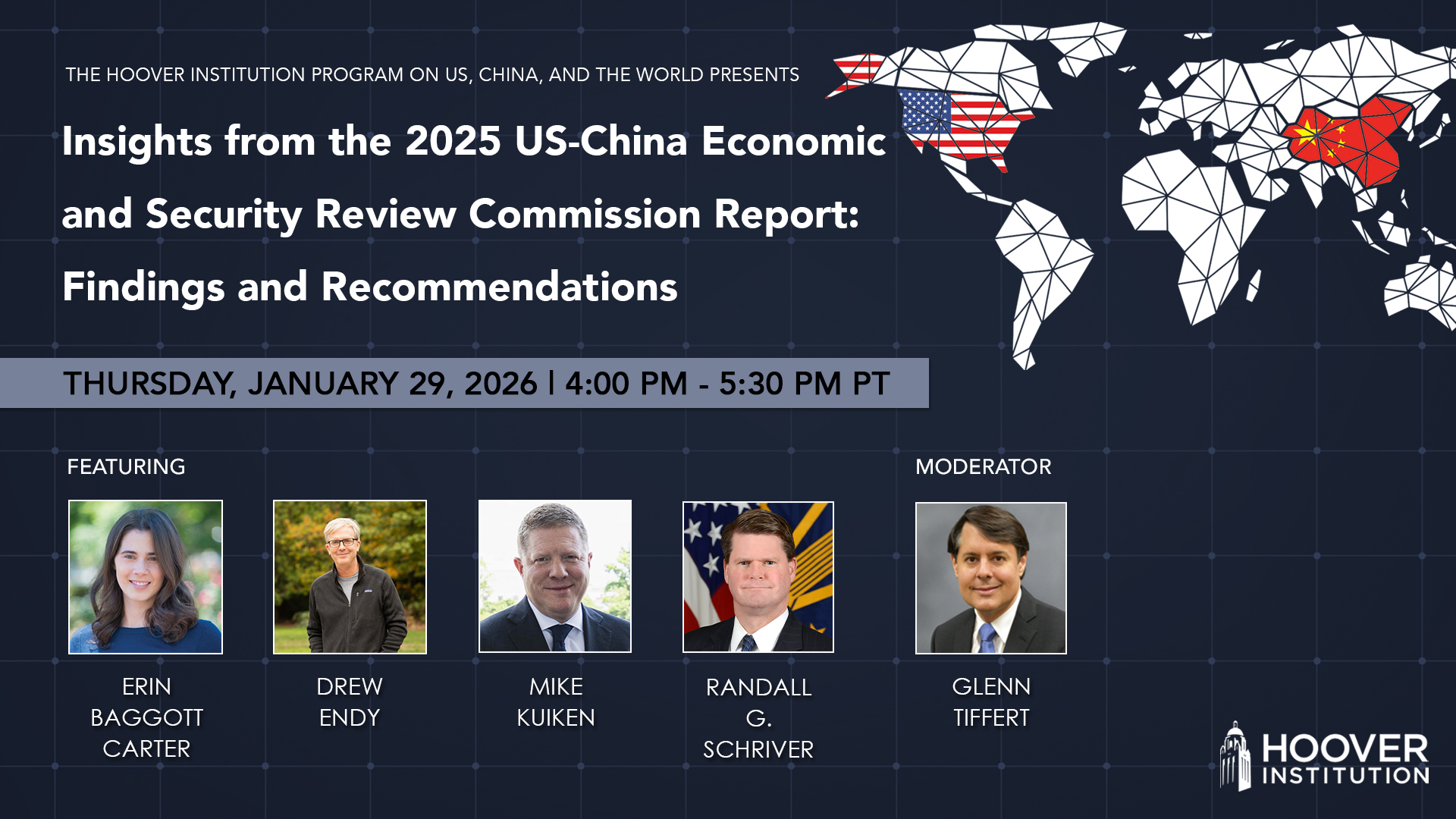
Hoover scholars joined leaders of the US-China Economic and Security Review Commission at the Hoover Institution to assess the commission’s 2025 report to Congress and to map what its findings mean for US policy.
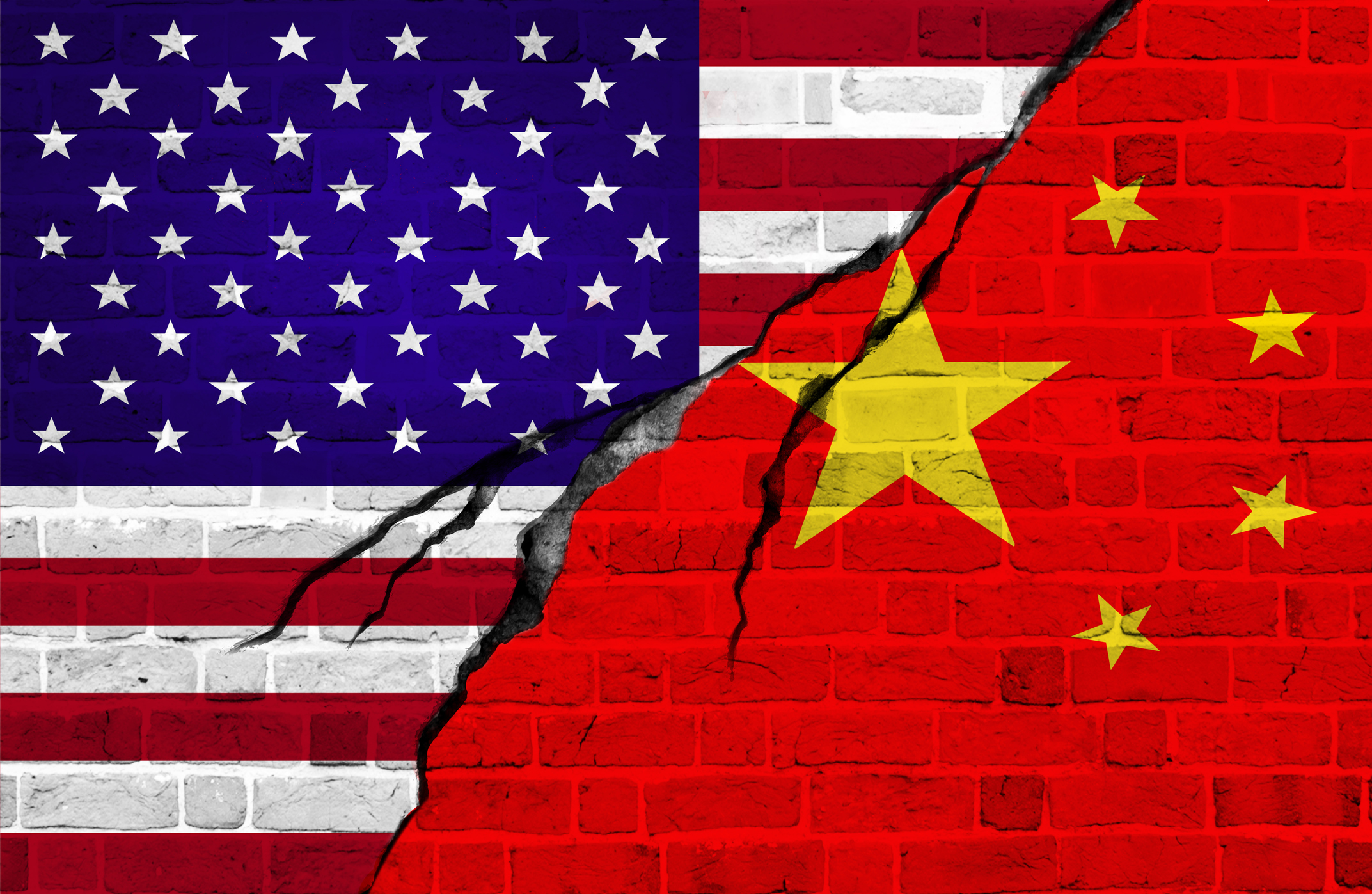
They concluded that today, China’s challenge to the United States is no longer confined to trade disputes or regional security flashpoints. It is systemic, spanning technology, certification standards, use of information, and military power, and it is accelerating faster than policymakers in Washington can keep up.
The US-China Economic and Security Review Commission, created by Congress in 2000, is tasked with monitoring, investigating, and reporting to Congress on the national security implications of the bilateral trade and economic relationship between the United States and the People’s Republic of China (PRC).
The discussion’s moderator, Distinguished Research Fellow Glenn Tiffert, framed the commission’s annual report as an unusual artifact in Washington. He described it as a rigorous, research-driven product that can put emerging issues in front of lawmakers before they arrive as crises. The commission’s value, several participants suggested, lies in early warning and agenda setting as much as in diagnosis.
Randall G. Schriver, the commission’s chair, and Distinguished Visiting Fellow Mike Kuiken, its vice chair, emphasized that the commission’s mandate forces it to connect economic decisions to security outcomes. In their account, the core conclusion of the report is that the United States must treat competition with the PRC as a whole-of-system problem, not a series of isolated, unrelated disputes. That means integrating economic security, technology policy, industrial capacity, and deterrence.
The January 29 event was organized by Hoover’s US, China, and the World research program.
China as More Than a Single-Issue Problem
The panel returned repeatedly to the idea that Beijing’s strategy links civilian and military objectives and uses economic leverage as a tool of statecraft. Schriver argued that the report urges lawmakers to see China as a competitor that can exploit frictions and slowdowns in US policy. When the United States treats technology as separate from defense, or commerce as separate from national security, he suggested, it creates openings for external influence and manipulation.
Kuiken reinforced that theme by pointing to how the commission tries to translate complex trends into actionable recommendations for Congress. The report, in this telling, is meant to help lawmakers connect dots: supply chains to readiness, research ecosystems to strategic advantage, and market access to political leverage. The implicit warning was that the United States can no longer rely on assumptions from an earlier era when economic integration was expected to moderate strategic rivalry.
Tiffert pressed both leaders to identify the “takeaways” they most wanted policymakers to absorb. In response, the conversation moved toward how the commission “horizon scans,” attempting to spot topics that will become central within two or three legislative cycles (four to six years). That forward-looking posture became part of the shared narrative. The group’s argument was not only that the challenge is comprehensive, but also that US institutions often react too late.
Technology as a Front Line
Senior Fellow Drew Endy, a Stanford bioengineering professor who works on biotechnology and public policy, pushed the discussion toward emerging technology risks and the pace of change. He underscored the panel’s broader point that the scope of competition with the PRC now includes fields that do not fit neatly into traditional national security categories.
Strategic competition will be shaped by fast-moving innovation areas where governance, standards, and research ecosystems matter as much as conventional military procurement, he said. In this framework, the commission’s report is not just about tariffs, sanctions, or force posture. It is also about whether the United States can keep its innovation base open and productive while protecting it from exploitation and coercion.
The concerns extend beyond semiconductors to biotechnology and other dual-use domains, where advances can diffuse quickly throughout the world, and where the global flow of talent, tools, and data can be hard to fence off.
Information, Influence, and Political Resilience
Hoover Fellow Erin Baggott Carter brought the conversation back to political resilience and how competition shapes the internal politics of nations. Her contribution complemented the commission leaders’ emphasis on systemic competition by highlighting how authoritarian systems can use influence and information tools to shape perceptions, constrain debate, or pressure institutions.
Carter’s participation fit the panel’s common narrative that the China challenge is not only external.; it can manifest inside open societies through influence operations, elite capture risks, or the use of market access to silence criticism. That theme aligned with the commission’s emphasis on linkages between economic and security domains. If Beijing can create dependencies, the panel suggested, it can also create incentives for self-censorship and policy hesitation by the US and its allies.
The implication for policymakers, as the discussion framed it, is that resilience is not only about ships, missiles, or export controls. It is also about ensuring institutions can absorb pressure without distorting decision making.
Congress, Lead Time, and the “Agenda-Setting” Function
A distinctive feature of the conversation was its focus on the commission’s role in the policy process. Tiffert argued that the commission’s greatest impact can come from preparing lawmakers before issues “blow up.” Schriver and Kuiken agreed, portraying the report as an instrument for building awareness and legislative readiness.
That emphasis on lead time also reflected a deeper diagnosis: The United States often moves at a slower pace than the technologies and tactics that are shaping competition. The commission’s work, the panelists suggested, can shorten the gap between emerging risks and policy action by producing a common factual foundation that members of Congress can use across committees.
A Shared Takeaway
All five discussants present stressed that what the United States needs most in this competition with the PRC is coherence and speed: coherence in how it links economic policy to security outcomes, and speed in recognizing emerging technology and influence risks before they mature into strategic disadvantages.
The panel did not claim that any single instrument can solve the problem. Instead, their shared storyline was that competition with China is comprehensive and durable, and that US success will depend on aligning domestic strengths with strategic priorities. The commission’s report, they argued, is a tool to help Congress do that work earlier and more systematically than the crisis cycle usually allows.
Learn more about the Hoover Program on US, China, and the World here.