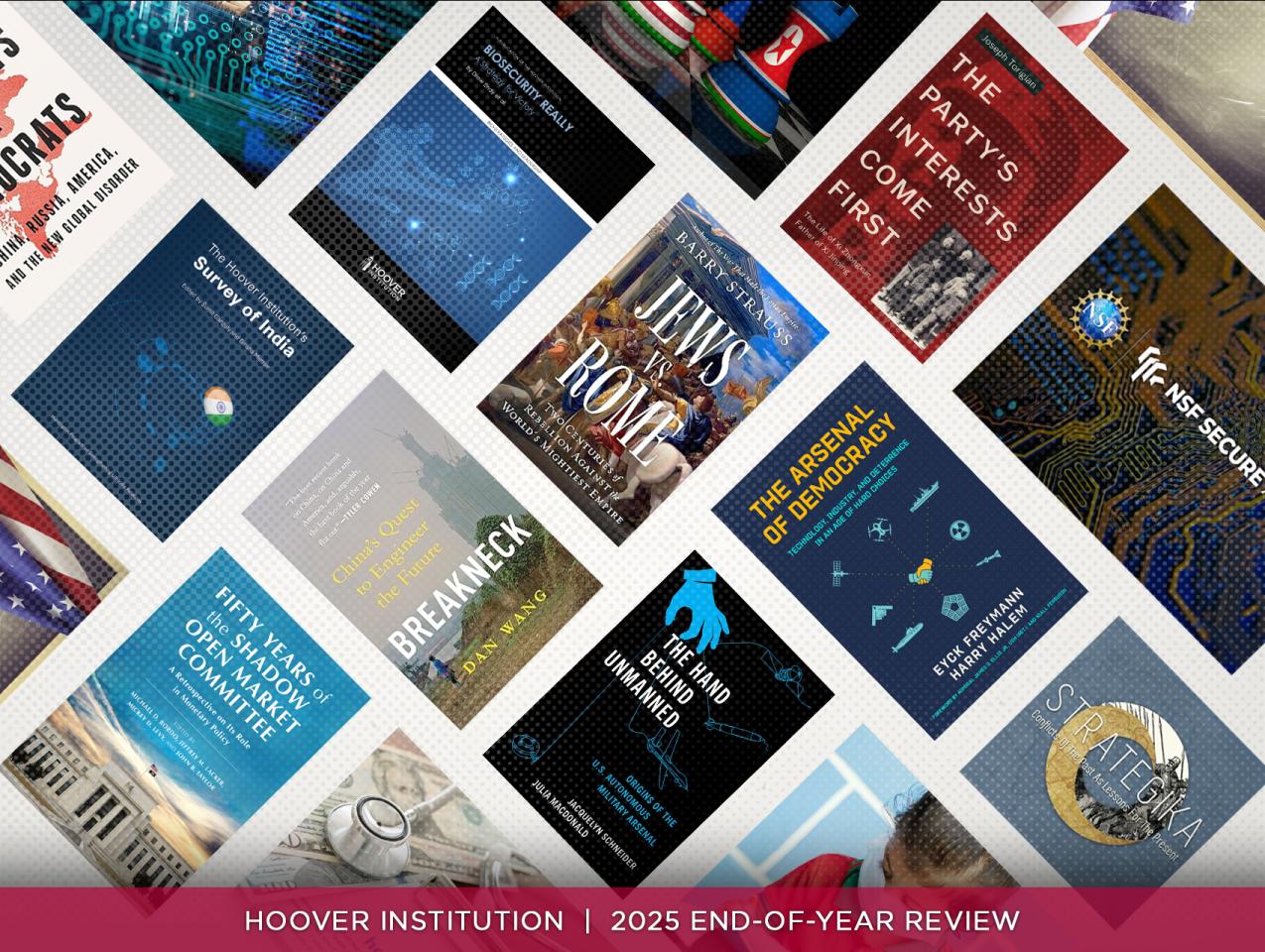
We hope you are enjoying the holidays. In this article, we look back on some of the most impactful books and research produced by Hoover Institution fellows over the last 12 months.
In 2025, Hoover scholars called for a national effort to enhance biosecurity; offered expert perspectives on US foreign policy, competition with China, and international trade; and drew from history to shed light on enduring problems of military strategy and governance.
As the publications featured below demonstrate, the Hoover fellowship is committed to conducting rigorous research across a wide range of policy areas, including geopolitics, emerging technology, government spending, and education reform. This approach enables Hoover to offer evidence-backed insights to policymakers, private-sector leaders, and the general public as each group works to understand and address urgent policy challenges.
Across its research output, Hoover points the way to peace, prosperity, and the preservation of individual freedom. These values set the Institution apart from other policy research organizations and define our unique contribution to the intellectual life of the nation. We look forward to sharing more consequential scholarship grounded in these values with you in 2026. Thank you for your readership and support of Ideas Advancing Freedom.
Featured Books and Research in 2025
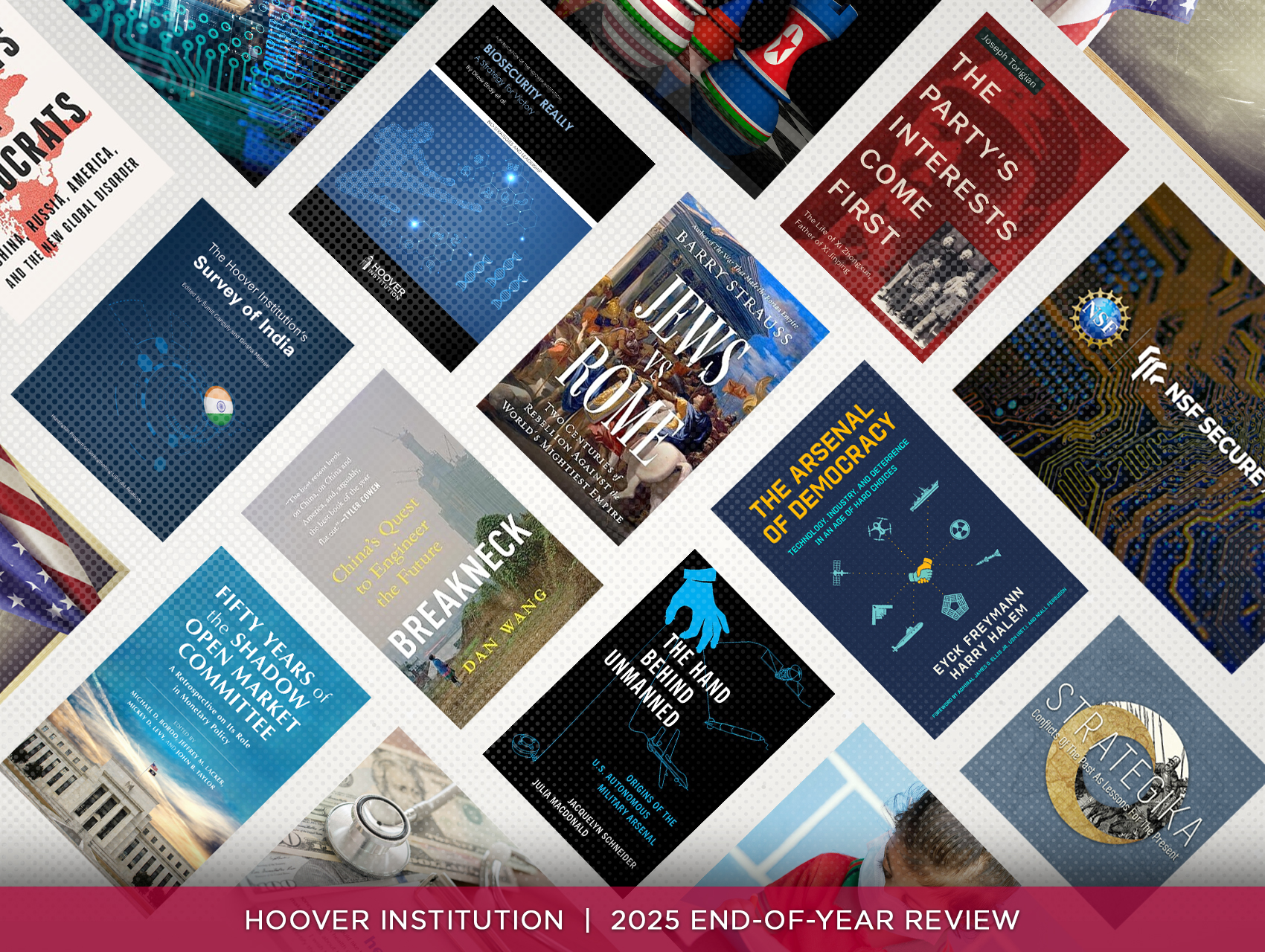
Autocrats vs. Democrats: China, Russia, America, and the New Global Disorder
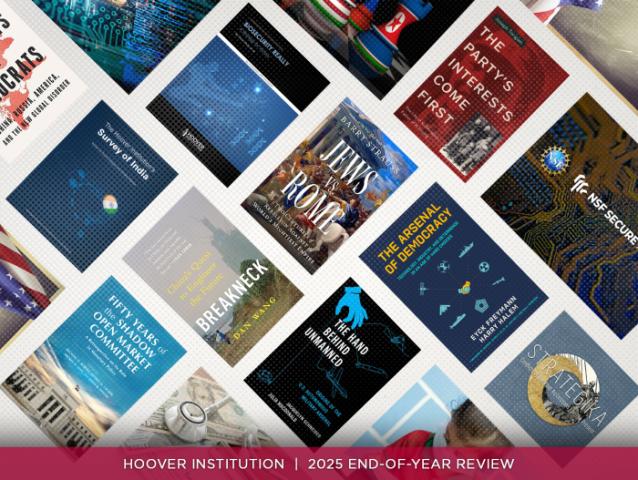
In Autocrats vs. Democrats, Senior Fellow Michael McFaul draws on his extensive foreign policy expertise to argue that the perils we face today with Russia and China are distinctly different from those during the Cold War with the Soviets. McFaul fuses history and diplomatic insights to unpack the unique military, economic, and ideological challenges presented by autocratic states today. A clarion call for American foreign policy and a forceful rebuttal of the creeping Washington consensus around China, Autocrats vs. Democrats shows that the key to prevailing in this new era isn’t simply defeating our enemies through might but using the flaws in their oppressive regimes against them.
Biosecurity Really: A Strategy for Victory
This report by Science and Senior Fellow Drew Endy and coauthors from Hoover’s Bio-Strategies and Leadership team shows how biosecurity will become much more challenging over the next several years. The report argues that the US must act strategically to secure biology, before it becomes a general-purpose technology or one with the potential to affect the entire economic system. As the report shows, failing to secure biology within the next few years will increase risks significantly. Drawing on decades of experience and the knowledge of dozens of subject matter experts, Biosecurity Really offers a forward-looking analysis of how global trends and technologies are reshaping the biosecurity landscape, and actionable steps policymakers can take to respond.
Jews vs. Rome: Two Centuries of Rebellion Against the World's Mightiest Empire
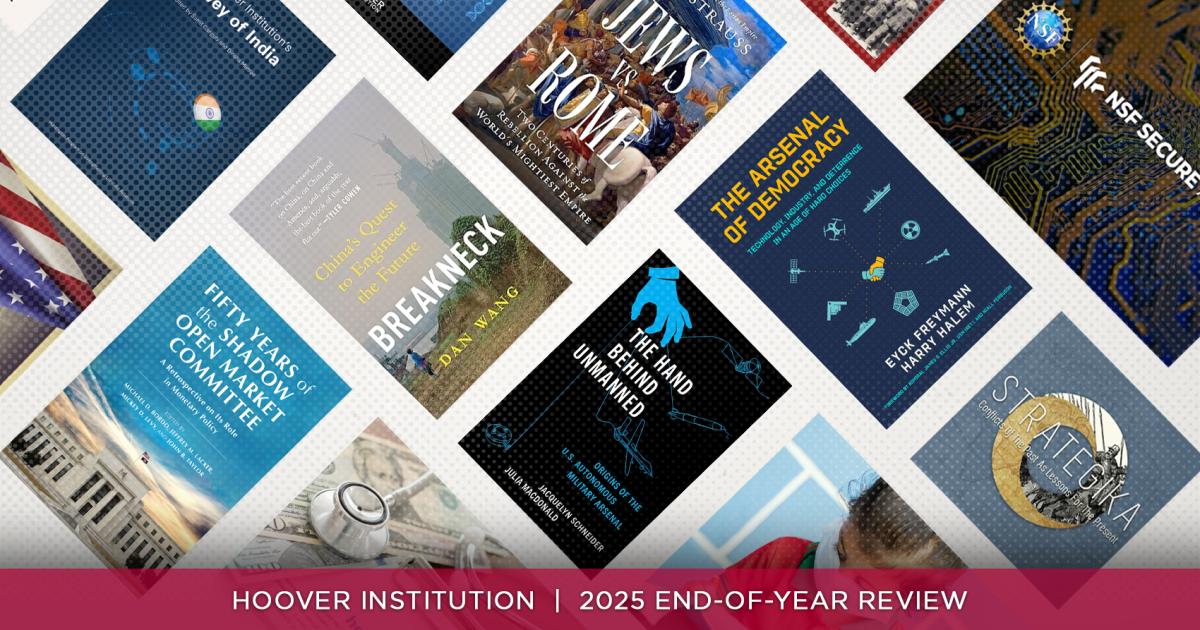
Jews vs. Rome is a gripping account of one of the most momentous eras in human history: the 200 years of ancient Israel’s battles against Rome that reshaped Judaism and gave rise to Christianity. Historian and Senior Fellow Barry Strauss vividly captures the drama of this era, highlighting courageous yet tragic uprisings, the geopolitical clash between the empires of Rome and Persia, and the internal conflicts among Jews. The book offers a captivating narrative that connects the past with the present, appealing to anyone interested in Rome, Jewish history, or compelling true tales of resilience and resistance.
A Deep Peek into DeepSeek AI’s Talent and Implications for US Innovation
DeepSeek AI’s rapid ascent in 2025 provided a wake-up call for US innovation strategy. This report from Senior Fellow Amy Zegart and coauthor Emerson Johnston shows that the Chinese startup was propelled by a deeply rooted and increasingly self-sufficient domestic talent pipeline. Over half of DeepSeek AI’s researchers were trained entirely in China, and those who passed through elite US institutions largely returned home, accelerating a reverse flow of innovation capacity that undermines long-standing American advantages. The report calls on US policymakers to employ smarter strategies for global talent competition.
Breakneck: China's Quest to Engineer the Future
In the New York Times bestseller Breakneck, Research Fellow Dan Wang blends political, economic, and philosophical analysis with original reportage from his years living in the People’s Republic of China to offer a provocative new framework for understanding China―one that helps us see America more clearly, too. While China is an engineering state, relentlessly pursuing megaprojects, Wang argues that America has transformed into a lawyerly society, reflexively blocking nearly everything. The book also exposes the downsides of social engineering, including the surveillance of ethnic minorities, political suppression, and the traumas of China’s one-child and zero-COVID policies.
The Arsenal of Democracy: Technology, Industry, and Deterrence in an Age of Hard Choices
To prevent a devastating war with China, the United States must rally its allies to build new armaments and achieve deterrence, argue Hoover Fellow Eyck Freymann and coauthor Harry Halem in The Arsenal of Democracy, published by the Hoover Institution Press. The authors integrate military strategy, studies of industrial capacity, and budget realities into a comprehensive deterrence framework. While other books explain why deterrence matters, this book provides a detailed roadmap for how America can actually sustain deterrence through the 2030s. Freymann and Halem conclude that unless policymakers recognize the scale of the challenge and take decisive steps to modernize US force structure and procurement processes, deterrence could fail—leading to potentially the most catastrophic conflict in modern history.
Additional Impactful Scholarship
Stanford Emerging Technology Review 2025 Report
The Stanford Emerging Technology Review, a joint product from Hoover and the Stanford School of Engineering, helps America’s public and private sectors better understand transformational technologies so that the United States can seize opportunities, mitigate risks, and ensure its innovation ecosystem continues to thrive. With each chapter, written by subject matter experts, the 2025 report offers an indispensable guide to the technologies and scientific developments shaping tomorrow’s world.
In this report, Senior Fellow Eric Hanushek argues that while the COVID-19 pandemic undeniably disrupted student learning, the current decline in educational outcomes began well before its onset and has persisted after the end of school closures. In fact, the achievement losses in the years before and after the pandemic match those that occurred during it. Restoring achievement to 2013 levels would raise the lifetime earnings of today’s average student by an estimated 8 percent and would produce dramatic and sustained gains for the national economy.
The Hoover Institution’s Survey of India
This survey, edited by Senior Fellow Šumit Ganguly and Research Fellow Dinsha Mistree, offers a concise, informed, and analytic overview of developments in multiple policy arenas in India over the past year while simultaneously providing appropriate historical context. The range of policy issues covered includes politics, demography, the economy, foreign policy, health, education, science, energy, and defense. For each chapter, specialists share historical background, the state of current policy choices, and likely future trends.
The American Civic Education Ecosystem: A Landscape Analysis
Led by Executive Director Thomas Schnaubelt, the Center for Revitalizing American Institutions carried out an extensive ecosystem scan and research program to develop an understanding of the American civic education landscape. This report summarizes three broad trends and 12 specific observations to foster engagement among the attentive public and educators and to encourage further dialogue and contributions that strengthen the civics ecosystem. The report found that educators, students, and leaders we interviewed overwhelmingly agree that civic learning should transcend partisanship and emphasize pluralism, dialogue across differences, and shared democratic commitments.
Expanding Access to HSAs: A Path to More Healthcare Choices for ACA Enrollees
This policy brief by Research Fellow Lanhee J. Chen and Policy Fellows Tom Church and Daniel Heil analyzes a glitch in the Affordable Care Act (ACA) that historically prevented many enrollees from accessing health savings accounts (HSAs). Unlike employer-sponsored plans, most ACA high-deductible plans didn’t qualify for HSAs due to high out-of-pocket maximums. The 2025 One Big Beautiful Bill Act included legislative changes that, beginning in 2026, will allow more ACA enrollees to contribute to HSAs. Noting that they have been researching and advocating this policy shift for years, Church and Heil wrote in a follow-up post, “This change finally pairs the highest-deductible plans with savings accounts that make sense for those who have large out-of-pocket expenses.”
Economic Statecraft: An Integrated Approach
Senior Fellow H.R. McMaster and Visiting Fellow Andrew Grotto argue in this report that President Trump has an opportunity to correct a chronic shortcoming in US grand strategy by implementing an integrated approach to economic statecraft. The competition between democracies and authoritarian regimes will shape the future of global power. China and Russia, alongside North Korea and Iran, aim to weaken US influence. To prevail, argue the authors, the United States must integrate economic power into its strategy, counter unfair trade practices, and support key industries.
China Refocuses Its Science and Technology Ecosystem on Innovation and Security
This report, edited by Distinguished Research Fellow Glenn Tiffert and Kevin Gamache, details how the government of China is overhauling its science and technology (S&T) ecosystem in ways that are sharpening geostrategic rivalry and impacting the risk portfolios managed by research security professionals. This overhaul aims to integrate basic science in priority fields with state-led mobilization of capital and S&T assets to enhance China’s global influence as an innovation hub; and advance policy goals such as self-reliance, economic and defense strength, and comprehensive national power.
Shadow Open Market Committee 50th Anniversary
Edited by Distinguished Visiting Fellow Michael D. Bordo, Visiting Fellow Mickey D. Levy, Senior Fellow John B. Taylor, and Jeffrey M. Lacker, Fifty Years of the Shadow Open Market Committee: A Retrospective on Its Role in Monetary Policy is a deep dive into the 50-year history of the Shadow Open Market Committee, a group of private academic economists that acts as the Federal Reserve’s outside watchdogs, providing candid, economically grounded critiques of the Fed’s conduct of policy. The volume, based on a two-day symposium held at the Hoover Institution October 13–14, 2024, examines the evolution of the Fed’s monetary and credit policies and critical issues it faces today.
In this book, Hoover Fellow Jacquelyn Schneider and coauthor Julia Macdonald trace the historical development of US unmanned military systems, from the Revolutionary War to contemporary conflicts. They argue that beliefs about technological determinism and military revolutions, as well as unique service identities, shape the structures and capacities chosen when the United States invests in weapon systems. In doing so, Schneider and Macdonald illustrate how ideas become influential, shape critical military choices, and ultimately manifest in budget lines and procurement decisions. The authors also hosted a limited podcast series about the people who design, direct, and deploy America’s arsenal of unmanned weapons.
The Party’s Interests Come First: The Life of Xi Zhongxun, Father of Xi Jinping
The Party's Interests Come First, by former Visiting Fellow Joseph Torigian, is the first biography of Xi Zhongxun (father of Chinese autocrat Xi Jinping) written in English. This biography is at once a sweeping story of the Chinese revolution and the first several decades of the People’s Republic of China, and a deeply personal story about making sense of one’s own identity within a larger political context. Drawing on an array of new documents, interviews, diaries, and periodicals, Torigian vividly tells the life story of Xi Zhongxun, a man who spent his entire life struggling to balance his own feelings with the demands of the Chinese Communist Party (CCP). This book reveals the extraordinary organizational, ideological, and coercive power of the CCP—and the terrible cost in human suffering that comes with it.
Strategika 100: The Current Status of Military History
For the 100th issue of Strategika, Hoover’s journal of military history, Senior Fellow Victor Davis Hanson reflects on the origins, purpose, and ongoing relevance of the Military History in Contemporary Conflict Working Group he leads, and of which Strategika is a part. “Military history is worthy of renewed academic study,” writes Hanson, “to remind an increasingly uncurious and less well-educated generation of college students about unchanging human nature, and its oldest propensity of resorting to the use of arms to settle differences, both often to prevent evil—and sometimes to perpetuate it.”
Getting Global Monetary Policy on Track
Based on the 2024 Monetary Policy Conference held at the Hoover Institution, Getting Global Monetary Policy on Track reviews recent global inflation, asking how central banks could have better responded and how they can improve their forecasting and policy strategies to avoid inflationary bursts in the future. Discussions delve into the interactions of fiscal and monetary policies, digital currency, and how the European Central Bank has become more dovish, preferring to keep interest rates low. The publication shares the presentations from economic experts around the globe, who contribute analysis of monetary policy and strategy from Asia, Europe, Latin America, and the United States, in large economies and in emerging markets. It also reproduces the lively and informative discussions at the conference.
Unyielding Resolve: Captive Nations and the Path to Freedom
This memoir documents the role of nationalism in the Cold War resistance to Moscow's domination over non-Russian peoples and details efforts to pass a US law designating Captive Nations Week. The author, Dr. Lev E. Dobriansky, provides a unique, first-person perspective on Russian imperialist behavior in the twentieth century. The book is the first to document the history of Captive Nations and the passage of PL 86-90, the Captive Nations Resolution.